Chapter 2 · Molecules of lifeLesson 2.6CS
The many roles of proteins and biotechnology: enzymes, hormones, antibodies, haemoglobin
How does haemoglobin pick up oxygen in the lungs and release it in the tissues, and how did a bacterium come to make human insulin?
- Size
- from 0.1 nm to 10 nm
- Level
- atoms and molecules
- Time
- an instant
Before you read: what do you think?
A red blood cell holds about 250 million haemoglobin molecules. How many oxygen molecules can a single red blood cell carry?
See the answer
About a billion. Each haemoglobin molecule binds four molecules of O₂, one at each iron atom: 250 million × 4 = a billion.
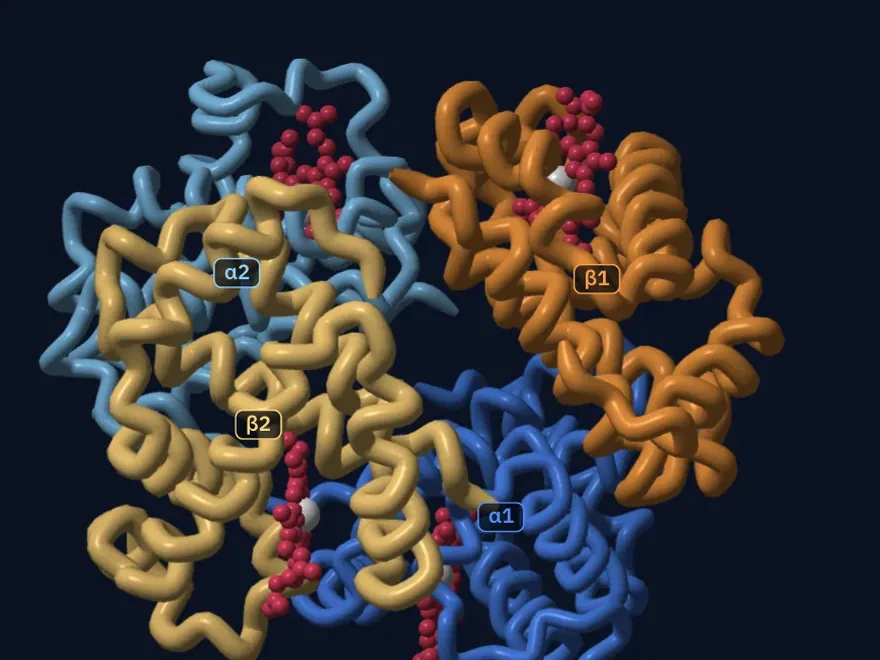
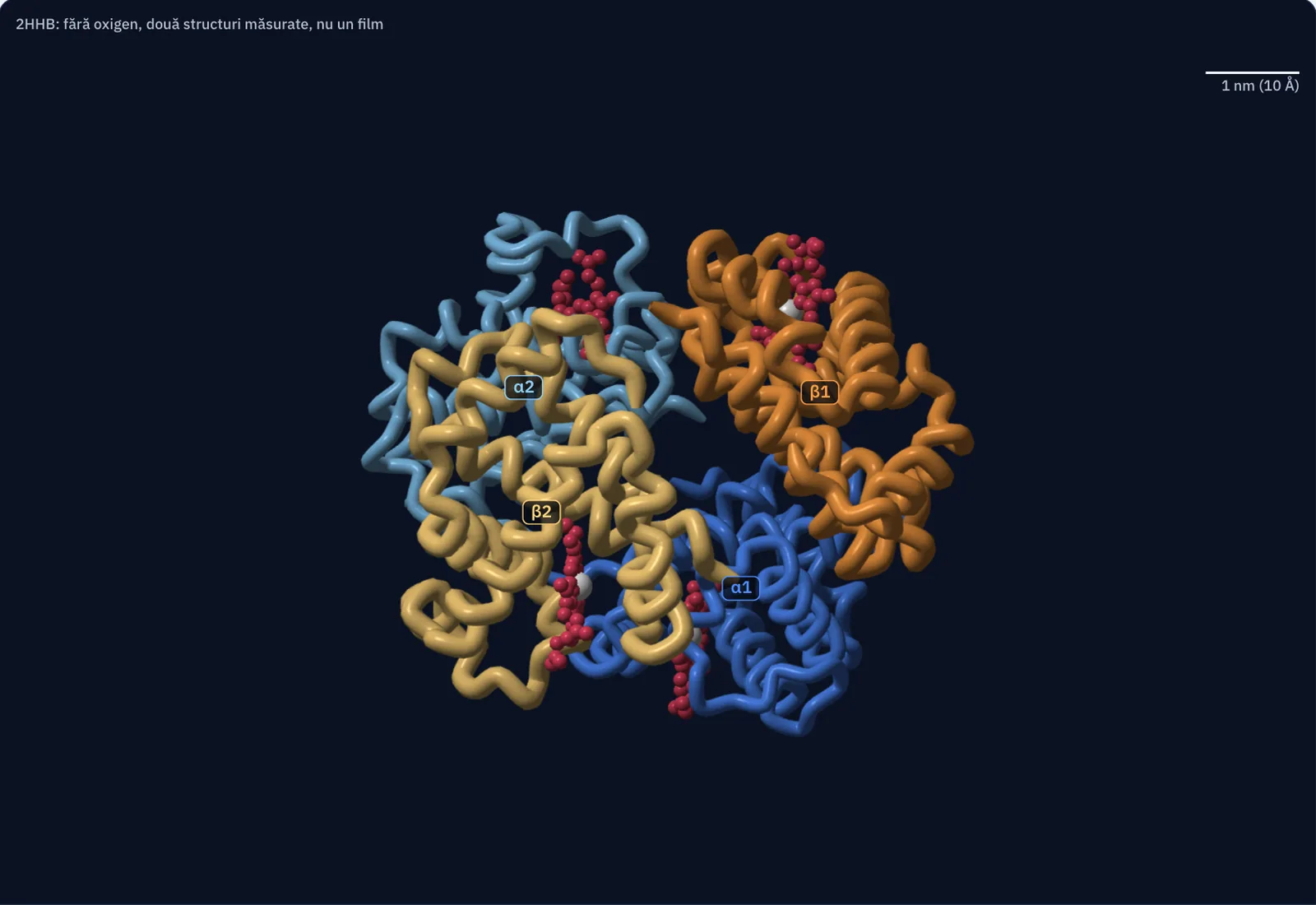
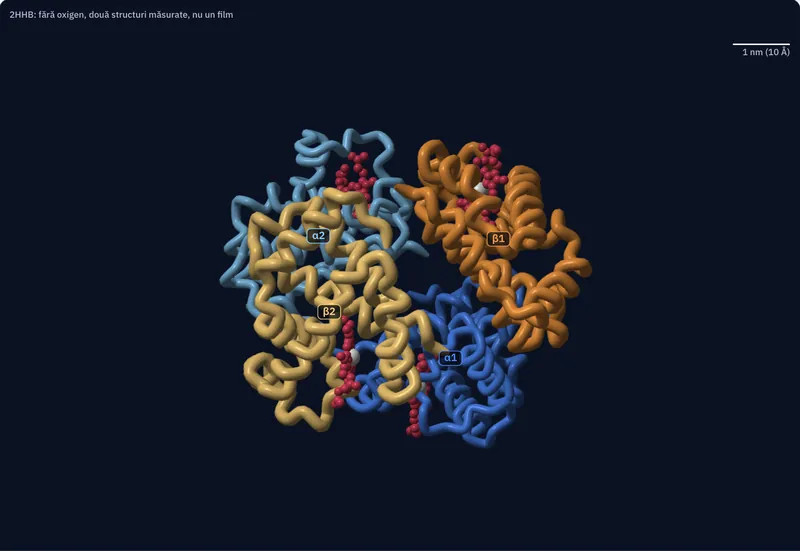
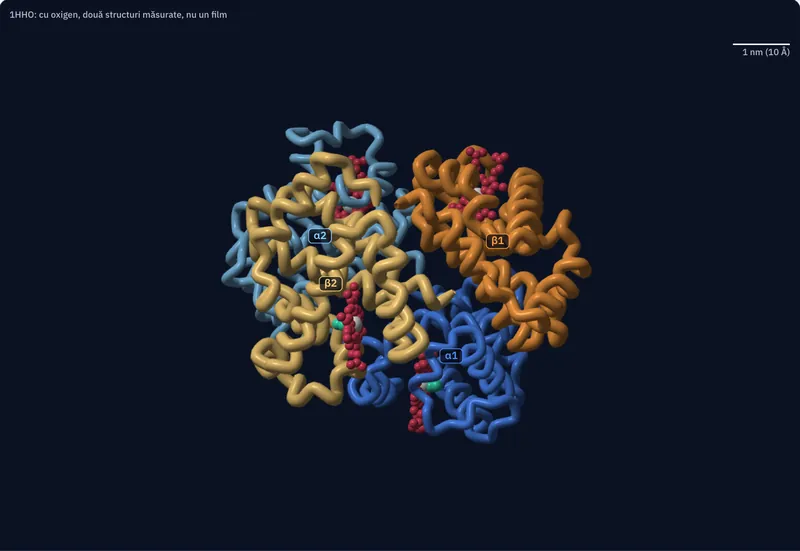
Haemoglobin has been measured atom by atom in two states: without oxygen (structure 2HHB, published in 1984) and with oxygen (structure 1HHO, published in 1983). The two structures are not identical: when oxygen binds, the chains of the molecule rotate relative to one another. Thanks to this change, haemoglobin loads up with oxygen in the lungs and releases it in the tissues.
Enzymes: specific catalysts
Enzymes are biological catalysts: they speed up chemical reactions by lowering the energy needed to start them. Almost all enzymes are proteins. The molecule an enzyme acts on is called the substrate. The substrate binds in a precise region of the enzyme, the active site, whose shape and amino acids fit only certain substrates: this is where the specificity of enzymes comes from.
The old “lock and key” model described a rigid fit. Today’s evidence supports the induced fit model: when the substrate binds, the enzyme changes shape slightly and closes around it. After the reaction, the enzyme returns to its original shape and can be used again; it is not used up.
The rate of reaction rises with temperature up to a point; too much heat breaks the bonds that hold the active site in shape, and the enzyme is denatured. Each enzyme works best within a certain pH range: pepsin in the stomach works in acid conditions, while amylase from saliva stops working when it reaches the acid in the stomach.
Hormones and antibodies: signal and defence
Insulin is a protein hormone made by the pancreas, with two chains, of 21 and 30 amino acids. It is released into the blood after a meal and tells cells how much glucose there is in the blood. Being a protein, it does not pass through the membrane: it binds to receptors on the surface of its target cells, and the binding sets off reactions inside.
Antibodies are Y-shaped proteins made by plasma cells, which develop from B lymphocytes. An antibody has four chains, two heavy and two light. At the tips of the arms of the Y are the variable regions that recognise a particular part of an antigen, for example a molecule on the surface of a bacterium. There are five classes of antibodies; the most common in blood, at about 80%, is IgG.
Haemoglobin in two measured states
Haemoglobin has four chains: two alpha chains, of 141 amino acids each, and two beta chains, of 146 each. Each chain holds a haem with an iron atom, and each iron can bind one molecule of O₂. The structures 2HHB and 1HHO were obtained by X-ray diffraction of crystals of human haemoglobin. The coloured images made from them are drawings based on the measured coordinates of the atoms; the colours are chosen by whoever draws them.
In haemoglobin without oxygen, a histidine amino acid binds to the iron from below. When oxygen binds to the iron, the iron pulls on the histidine, which pulls on the chain it belongs to. The change passes through the whole molecule, and the subunits rotate relative to one another. The rotation makes it easier for the other three haems to bind oxygen: the first O₂ molecule binds with difficulty, the second, third and fourth more and more easily. This cooperative binding lets haemoglobin load up almost completely in the lungs, where there is plenty of oxygen, and release a lot of oxygen in the tissues.
Carbon monoxide is toxic because it takes the place of oxygen on the haem and comes off only with great difficulty.
| What is measured, or calculated from the coordinates | Without oxygen (2HHB) | With oxygen (1HHO) |
|---|---|---|
| Amino acids: alpha chain, beta chain, total | 141, 146, 574 | 141, 146, 574 |
| Atoms of protein, of haem, of O₂ | 4,384, 172, 0 | 4,384, 172, 8 |
| Iron relative to the plane of the four nitrogen atoms: alpha haem, beta haem (Å) | 0.40, 0.36 | 0.12, −0.11 |
| Distance between the irons of the two beta chains (Å) | 39.5 | 34.6 |
| Distance between the irons of the two alpha chains (Å) | 34.2 | 34.7 |
| Longest extent of the molecule, between atom centres (nm) | 6.6 | 6.5 |
| Rotation of the α2β2 pair between the two structures, with α1β1 superposed | 13.0° | the same rotation |
Measurements and calculation. Measurement: the positions of the atoms, from structures 2HHB (without oxygen, 1.74 Å) and 1HHO (with oxygen, 2.1 Å), obtained by X-ray diffraction on crystals of human haemoglobin (RCSB Protein Data Bank, public domain). The two images are two structures, not a recording of a movement. In 1HHO the file contains a single alpha chain and a single beta chain; the second pair is a copy generated by crystal symmetry, as shown in the biological assembly. Calculation: the superposition of the two structures on the α1β1 pair, the distances and the angles. Drawing: the tubes, the spheres and the colours, chosen by the person who draws; the spheres have the radii of the atoms, and the iron and the O₂ are enlarged so that they can be seen.
Sources and credits. Coordinates: RCSB Protein Data Bank, entries 1HHO (B. Shaanan, 1983) and 2HHB (G. Fermi, M. F. Perutz, B. Shaanan, R. Fourme, 1984), CC0.
Proteins used in biotechnology
Biotechnology uses living organisms, or molecules they produce, to obtain useful products. In the food industry, cheese-making uses chymosin, the enzyme in rennet: it cuts a milk protein, kappa-casein, and the other caseins gather into a curd. Traditional rennet came from the stomachs of calves. In 1990, the US Food and Drug Administration (FDA) approved chymosin made by genetically modified microorganisms, the first product of genetic engineering in food. Another enzyme, lactase, splits the lactose in milk into glucose and galactose; added to milk, it gives lactose-free milk.
In the pharmaceutical industry, insulin for diabetes was obtained for decades from the pancreases of cattle and pigs. In 1978, researchers at the City of Hope centre and the company Genentech put the genes for the chains of human insulin into a bacterium, and the bacterium began to make insulin. The FDA approved the product on 28 October 1982: it was the first human insulin product made by biotechnology.
Worked example
How many animals insulin needed before 1982
In 1981, 1 pound (about 0.45 kg) of insulin required glands from 23,500 animals, and that amount was enough for 750 patients for a year. On average, how many animals did each patient need per year?
Step 1: divide the number of animals by the number of patients: 23,500 ÷ 750 ≈ 31.3.
Step 2: interpret. On average, each patient needed the pancreases of about 31 animals a year, and the number of patients was growing.
Step 3: compare with the biotechnology route. Insulin made by bacteria carrying the human insulin genes is identical to human insulin and needs no animal pancreases. The 1981 figures are quoted by the FDA; the division gives an average.
In Romania
Telemea and the enzyme in rennet
Telemea, the brined cheese common in Romania, is made by curdling milk with rennet. Traditionally it was made from sheep’s milk, and today mostly from cow’s and sheep’s milk. Once the rennet is added, the milk curdles; the curd is put into cloth, pressed overnight, cut into pieces and left to mature in brine.
Curdling is a reaction catalysed by an enzyme. The chymosin in rennet cuts kappa-casein, the protein that keeps the other caseins dispersed in the milk, and these then bind to one another and form the curd. Without the enzyme, milk does not curdle in this way.
In 2016, the European Union registered “Telemea de Ibănești” (telemea from Ibănești) as a protected designation of origin, under Implementing Regulation (EU) 2016/365. The name may be used only for telemea made according to the product specification, in the area of origin.
In short
- Enzymes are catalysts, almost all of them proteins; the substrate binds in the active site, whose shape explains specificity; after the reaction, the enzyme can be used again.
- Too high a temperature and the wrong pH denature enzymes; the current model of substrate binding is induced fit.
- Insulin is a protein hormone from the pancreas, with two chains (21 and 30 amino acids), which binds to receptors on the cell surface; antibodies are Y-shaped proteins, with two heavy and two light chains, that recognise antigens.
- Haemoglobin has two alpha and two beta chains, four haems and four iron atoms, and binds four molecules of O₂; binding oxygen changes the shape of the molecule and makes it easier for the next molecules to bind (cooperative binding).
- Biotechnology: recombinant chymosin (approved in the USA in 1990) and lactase in the food industry; human insulin made by bacteria (approved in the USA in 1982) in the pharmaceutical industry.
Common mistakes
WrongEvery protein is an enzyme.
RightEnzymes are only one category of protein. Haemoglobin carries oxygen, insulin carries a signal, antibodies defend, and keratin builds.
WrongAn enzyme is used up in the reaction, like a reactant.
RightThe enzyme returns to its original shape after the reaction and can catalyse the same reaction again.
WrongThe coloured image of haemoglobin is a photograph of the molecule.
RightIt is a drawing based on the coordinates of the atoms, obtained by X-ray diffraction; the colours are conventions.
Check yourself
Seven questions. For the first six you see the explanation at once, with the paragraph of the lesson that supports it; for the written ones you compare with a good answer.
What do you call the region of an enzyme where the substrate binds?
Answer
a) Active site. The active site has the right shape and amino acids for a particular substrate, which is where the enzyme’s specificity comes from.
Why does an enzyme stop working when it is heated strongly?
Answer
b) Because it is denatured and the active site loses its shape. Strong heat breaks the bonds that hold the protein in shape; without the right shape, the substrate can no longer bind.
What happens in a haemoglobin molecule after the first oxygen molecule binds to a haem?
Answer
d) The other haems bind oxygen more easily. Binding oxygen pulls on the iron and the histidine, and the change of shape passes to the other subunits: this is cooperative binding.
What does the chymosin in rennet do in the milk for telemea?
Answer
c) It cuts kappa-casein, and the other caseins form the curd. Chymosin is an enzyme that cuts a milk protein. Lactase is the enzyme that splits lactose.
How many amino acids does a haemoglobin molecule (two alpha chains and two beta chains) have in total?
amino acidsAnswer
574 amino acids. 2 × 141 + 2 × 146 = 282 + 292 = 574 amino acids.
Choose the role of each protein.
Answer
Catalyst: Lactase; Chymosin.
Signal: Insulin.
Defence: IgG; Antibodies that bind a bacterium.
Lactase and chymosin are enzymes, insulin is a hormone, IgG and the other antibodies recognise antigens.
Explain why human insulin made by bacteria is an example of pharmaceutical biotechnology, while the recombinant chymosin used for cheese is an example of food biotechnology. What role does each protein play in the organism it comes from?
A good answer
Both are proteins made by genetically modified microorganisms, so both are products of biotechnology. Insulin is a hormone: in the human body it carries the signal about blood glucose, and as a medicine it is used to treat diabetes, which is why it belongs to pharmaceutical biotechnology. Chymosin is an enzyme from the stomach of calves that cuts the kappa-casein in milk; in industry it curdles milk for cheese, which is why it belongs to food biotechnology.
A complete answer names the signalling role of insulin and the catalytic role of chymosin, says that both are made by genetically modified microorganisms, and links each to its field of use.
Practical work for this lesson
- One enzyme, different conditions – Case study with invented results, 35–45 minutes (CS)
Terms
- enzyme
- A biological catalyst, almost always a protein, that speeds up a reaction without being used up.
- active site
- The region of an enzyme where the substrate binds and the reaction takes place.
- induced fit
- The model in which an enzyme changes shape slightly when the substrate binds and closes around it.
- antibody
- A Y-shaped protein, made by plasma cells, that recognises and binds a particular antigen.
- cooperative binding
- The binding of one oxygen molecule to haemoglobin makes it easier for the next ones to bind, by changing the shape of the molecule.
- chymosin
- The enzyme in rennet that cuts kappa-casein and makes milk curdle.
- biotechnology
- The use of living organisms, or molecules they produce, to obtain useful products such as cheese or insulin.
Sources and link to the programme
- OpenStax – Biology 2e, 6.5 Enzymes – enzymes are catalysts, almost all proteins; they lower the activation energy; substrate, active site, specificity; induced fit versus lock and key; not used up; temperature, pH and denaturation
- OpenStax – Biology 2e, 34.3 Digestive System Processes – pepsin acts in the stomach; the acid conditions of the stomach stop salivary amylase
- OpenStax – Biology 2e, 3.4 Proteins – insulin has two chains, of 21 and 30 amino acids; the roles of proteins
- RCSB PDB-101 – Molecule of the Month: Insulin – insulin is made in the pancreas, released after a meal, and carries information about blood sugar; human insulin made by modified bacteria or yeasts
- OpenStax – Biology 2e, 37.2 How Hormones Work – polypeptide hormones do not enter the cell and bind to surface receptors
- OpenStax – Biology 2e, 42.3 Antibodies – Y-shaped antibody, two heavy and two light chains; variable domains that recognise the antigen; plasma cells from B lymphocytes; five classes; IgG about 80% in serum
- RCSB PDB-101 – Molecule of the Month: Hemoglobin – two alpha and two beta chains, each with a haem containing an iron atom; 2HHB without oxygen and 1HHO with oxygen; the histidine, the pull on the iron and the rotation of the subunits; O₂ molecules binding more and more easily; carbon monoxide
- RCSB PDB – 1HHO, human oxyhaemoglobin at 2.1 Å – the structure of haemoglobin with oxygen, X-ray diffraction, 2.10 Å, B. Shaanan, published in 1983; alpha chain 141, beta chain 146 amino acids; biological assembly of four chains
- RCSB PDB – 2HHB, human deoxyhaemoglobin at 1.74 Å – the structure of haemoglobin without oxygen, X-ray diffraction, 1.74 Å, G. Fermi and M. F. Perutz, published in 1984; four chains, four haems
- OpenStax – Biology 2e, 40.2 Components of the Blood – about 250 million haemoglobin molecules in a red blood cell, each with four oxygen molecules, about a billion per cell
- McGill University, Office for Science and Society – Say Cheese – rennet from the stomach of calves; chymosin cuts kappa-casein; recombinant chymosin approved by the FDA in 1990, the first product of genetic engineering in food; made by bacteria, yeasts or fungi
- RCSB PDB-101 – Molecule of the Month: Beta-galactosidase – the enzyme splits lactose into glucose and galactose
- Aarhus University (CiFOOD) – Enzymes to improve long-life lactose-free milk – lactose-free milk is made by adding lactase, which splits lactose
- FDA – 100 Years of Insulin – insulin from cattle and pig pancreases; the recombinant DNA method of 1978 (City of Hope, Genentech); approval of Humulin on 28 October 1982, the first biosynthetic human insulin product; in 1981: 23,500 animals for a pound of insulin, enough for 750 patients for a year
- Wikipedia – Telemea – telemea: sheep’s or cow’s milk curdled with rennet, curd pressed overnight in cloth, cut and matured in brine
- Commission Implementing Regulation (EU) 2016/365 – Telemea de Ibănești (PDO) (text on legislation.gov.uk) – registration of the name “Telemea de Ibănești” as a PDO on 11 March 2016, class 1.3 Cheeses
From the programme: “The diversity of roles of proteins: catalyst – enzymes, signal – hormones, defence – antibodies, transport – haemoglobin”; “Uses of molecules in food biotechnology – enzymes, and in pharmaceutical biotechnology – hormones” (specialism, Natural Sciences). Specific competences addressed: 2.2, 3.2, 4.2.