Chapter 8 · AnimalsLesson 8.8CS
Vertebrate diversity: how many species each class has, and why there is no ladder of progress
Which is ‘more evolved’: a carp, a frog or a bear?
- Size
- from 1 mm to 30 m
- Level
- organism
- Time
- hundreds of millions of years
Before you read: what do you think?
Brandt’s bat (Myotis brandtii), which also lives in Romania, weighs about 7 g, as much as a teaspoon of sugar. How long did the oldest known individual live?
See the answer
41 years, in the wild: a ringed bat was found again after 41 years. Going by its mass, a 7 g mammal ought to live around 6–7 years. Bats are an exception to the rule that ‘a bigger animal lives longer’.
In 2025 the IUCN Red List counted 76,289 described species of vertebrates. Almost half are fish: 37,109, about five and a half times as many as mammals. The group many people put at the top of a ‘ladder’ of animals has the fewest species.
How many species each class has
The numbers of described species, according to the IUCN Red List, version 2025-1: fish 37,109, reptiles 12,386, birds 11,195, amphibians 8,863, mammals 6,736 (excluding domestic species). The numbers grow every year as new species are described, which is why a correct figure always comes with its year.
Mammals have a four-chambered heart, a diaphragm and several kinds of teeth, so by these criteria their organisation is more complex. Yet they are the class with the fewest species. Structural complexity and taxonomic diversity, that is, the number of species, do not increase together. A group has many species when it has been able to split into many isolated populations, each adapted to a different place and a different food.
A tree, not a ladder
Evolution has no goal and does not aim for bigger, faster or more complex species. Every vertebrate alive today has an equally long history behind it, starting from the same ancestors. Today’s carp is not the fox’s ancestor; the carp and the fox are distant cousins, with a common ancestor that lived hundreds of millions of years ago.
The school classes are not all whole branches of the tree. Four-limbed animals descend from fish with fleshy fins, with bones similar to those in limbs, so ‘fish’ is just the everyday name for aquatic vertebrates with gills and fins. Birds belong to the reptile branch: crocodiles are more closely related to birds than to lizards. Saying ‘more complex’ makes sense only for a particular feature, such as the number of chambers in the heart.
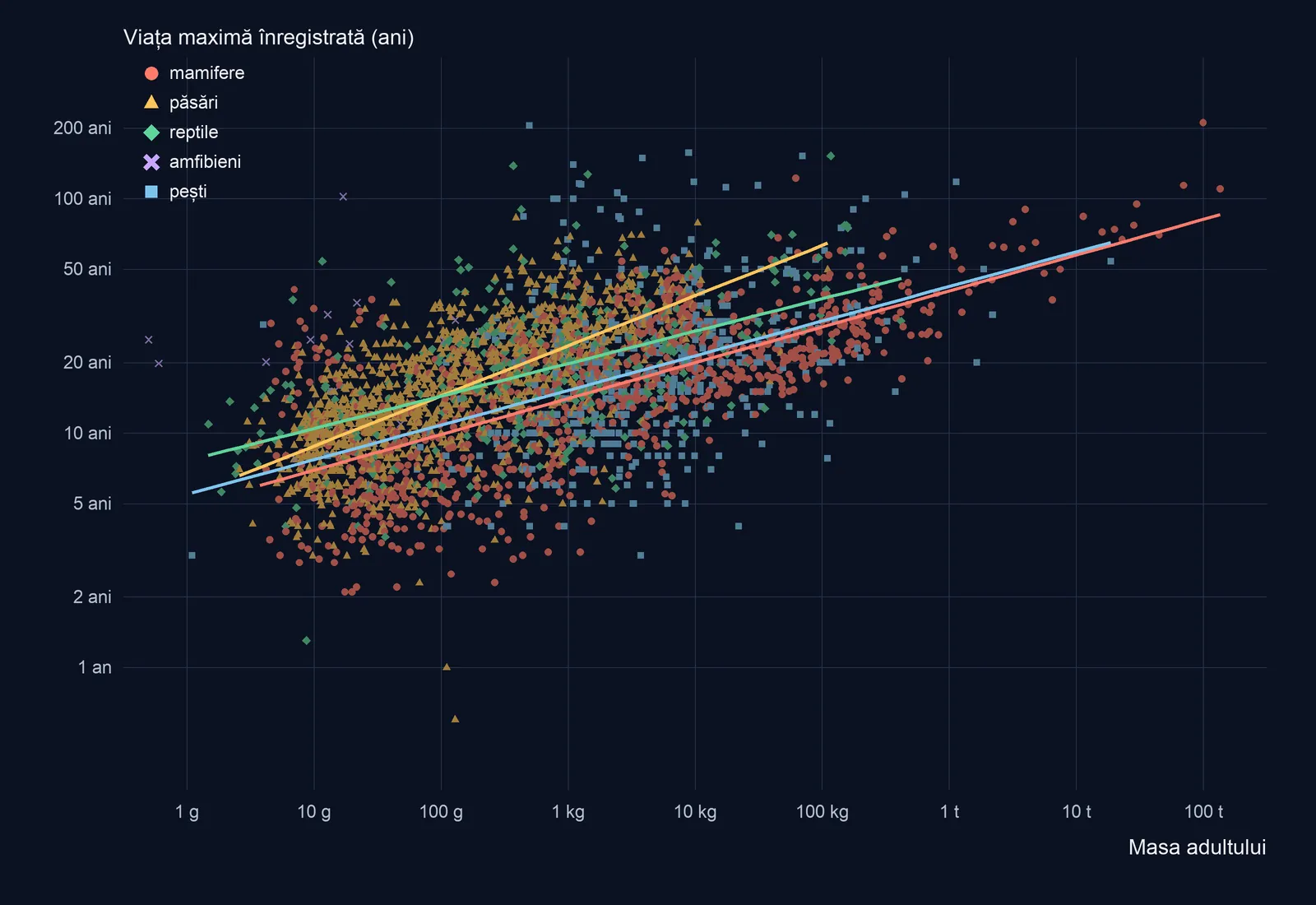
| Species | Class | Adult mass | Maximum recorded lifespan (years) | Record set | Against the class line (×) |
|---|---|---|---|---|---|
| Human Homo sapiens | mammal | 62.03 kg | 122.5 | captivity | 4.6 |
| Brown bear Ursus arctos | mammal | 277.5 kg | 40 | captivity | 1.2 |
| Grey wolf Canis lupus | mammal | 26.63 kg | 20.6 | captivity | 0.9 |
| Eurasian lynx Lynx lynx | mammal | 23 kg | 26 | captivity | 1.1 |
| Chamois Rupicapra rupicapra | mammal | 37.5 kg | 17.6 | captivity | 0.7 |
| Red deer Cervus elaphus | mammal | 200 kg | 31.5 | captivity | 1.0 |
| European bison Bison bonasus | mammal | 610 kg | 26.4 | captivity | 0.7 |
| Greater mouse-eared bat Myotis myotis | mammal | 28.55 g | 37.1 | wild | 4.6 |
| Brandt’s bat Myotis brandtii | mammal | 7 g | 41 | wild | 6.2 |
| Eurasian shrew Sorex araneus | mammal | 9 g | 3.2 | captivity | 0.5 |
| House mouse Mus musculus | mammal | 20.5 g | 4 | captivity | 0.5 |
| Yellow-necked mouse Apodemus flavicollis | mammal | 29.4 g | 4.5 | captivity | 0.5 |
| African bush elephant Loxodonta africana | mammal | 4.8 t | 65 | captivity | 1.3 |
| Blue whale Balaenoptera musculus | mammal | 136 t | 110 | wild | – |
| Bowhead whale Balaena mysticetus | mammal | 100 t | 211 | wild | – |
| European white stork Ciconia ciconia | bird | 3.35 kg | 39 | wild | 1.3 |
| Great white pelican Pelecanus onocrotalus | bird | 9.52 kg | 51 | captivity | 1.3 |
| Rock dove Columba livia | bird | 358.7 g | 35 | captivity | 1.8 |
| Common carp Cyprinus carpio | fish | 10.6 kg | 47 | captivity | 2.2 |
| Beluga sturgeon Huso huso | fish | 1.14 t | 118 | wild | 2.7 |
| Sebastes aleutianus, a deep-sea fish of the Pacific | fish | 495 g | 205 | wild | 15.0 |
| Long-nosed viper Vipera ammodytes | reptile | 220 g | 22 | captivity | 1.4 |
| Mediterranean spur-thighed tortoise Testudo graeca | reptile | 1.43 kg | 127 | captivity | 6.1 |
| Aldabra giant tortoise Aldabrachelys gigantea | reptile | 117.2 kg | 152 | captivity | 4.0 |
| European fire salamander Salamandra salamandra | amphibian | 19.1 g | 24 | captivity | – |
68 more species with a common name
| Species | Class | Adult mass | Maximum recorded lifespan (years) | Record set | Against the class line (×) |
|---|---|---|---|---|---|
| Greater horseshoe bat Rhinolophus ferrumequinum | mammal | 22.88 g | 30.5 | wild | 3.9 |
| Lesser mouse-eared bat Myotis blythii | mammal | 23 g | 33 | wild | 4.2 |
| Noctule Nyctalus noctula | mammal | 27.75 g | 12 | wild | 1.5 |
| Naked mole-rat Heterocephalus glaber | mammal | 35 g | 31 | captivity | 3.7 |
| Least weasel Mustela nivalis | mammal | 46.9 g | 9.1 | captivity | 1.0 |
| Fat dormouse Glis glis | mammal | 125 g | 8.7 | captivity | 0.9 |
| Norway rat Rattus norvegicus | mammal | 300 g | 3.8 | captivity | 0.3 |
| Black-bellied hamster Cricetus cricetus | mammal | 506.7 g | 3.6 | captivity | 0.3 |
| Eurasian red squirrel Sciurus vulgaris | mammal | 600 g | 14.8 | captivity | 1.1 |
| European pine marten Martes martes | mammal | 1.3 kg | 18.2 | captivity | 1.2 |
| Red fox Vulpes vulpes | mammal | 4.132 kg | 21.3 | captivity | 1.2 |
| European hare Lepus europaeus | mammal | 4.175 kg | 10.7 | captivity | 0.6 |
| Wild cat Felis silvestris | mammal | 5.5 kg | 19 | captivity | 1.0 |
| European otter Lutra lutra | mammal | 6.75 kg | 18.2 | captivity | 1.0 |
| European badger Meles meles | mammal | 13 kg | 18.6 | captivity | 0.9 |
| Western roe deer Capreolus capreolus | mammal | 21.67 kg | 17.5 | captivity | 0.8 |
| Domestic dog Canis familiaris | mammal | 40 kg | 27 | captivity | 1.1 |
| Chimpanzee Pan troglodytes | mammal | 44.98 kg | 68 | captivity | 2.7 |
| Harbour porpoise Phocoena phocoena | mammal | 52.5 kg | 20.4 | captivity | – |
| Wild boar Sus scrofa | mammal | 130 kg | 27 | captivity | 0.9 |
| Bottlenosed dolphin Tursiops truncatus | mammal | 200 kg | 51.6 | captivity | – |
| Horse Equus caballus | mammal | 300 kg | 57 | captivity | 1.7 |
| Giraffe Giraffa camelopardalis | mammal | 800 kg | 39.5 | captivity | 1.0 |
| Asiatic elephant Elephas maximus | mammal | 3.178 t | 79.6 | captivity | 1.7 |
| Hippopotamus Hippopotamus amphibius | mammal | 3.75 t | 61.2 | captivity | 1.2 |
| Ruby-throated hummingbird Archilochus colubris | bird | 3.1 g | 9.1 | wild | 1.3 |
| European robin Erithacus rubecula | bird | 17.3 g | 19.3 | wild | 2.0 |
| Great tit Parus major | bird | 17.9 g | 15.4 | wild | 1.5 |
| Barn swallow Hirundo rustica | bird | 18.3 g | 16 | not recorded | 1.6 |
| House sparrow Passer domesticus | bird | 25.3 g | 23 | not recorded | 2.1 |
| Budgerigar Melopsittacus undulatus | bird | 30 g | 21 | captivity | 1.9 |
| Common swift Apus apus | bird | 37.6 g | 21.1 | wild | 1.8 |
| European starling Sturnus vulgaris | bird | 74 g | 22.9 | wild | 1.7 |
| Common blackbird Turdus merula | bird | 103.2 g | 21.8 | wild | 1.5 |
| Red junglefowl (the ancestor of the chicken) Gallus gallus | bird | 779.8 g | 30 | captivity | 1.3 |
| Common raven Corvus corax | bird | 1.041 kg | 69 | captivity | 2.9 |
| Eurasian eagle-owl Bubo bubo | bird | 2.686 kg | 68 | captivity | 2.3 |
| Western capercaillie Tetrao urogallus | bird | 2.95 kg | 18 | captivity | 0.6 |
| Greylag goose Anser anser | bird | 3.308 kg | 31 | captivity | 1.0 |
| Great cormorant Phalacrocorax carbo | bird | 3.629 kg | 32.1 | wild | 1.0 |
| Golden eagle Aquila chrysaetos | bird | 4.8 kg | 48 | captivity | 1.5 |
| Common crane Grus grus | bird | 5.5 kg | 43 | wild | 1.3 |
| White-tailed sea-eagle Haliaeetus albicilla | bird | 6.697 kg | 42 | captivity | 1.2 |
| Wandering albatross Diomedea exulans | bird | 7.047 kg | 50 | wild | 1.4 |
| Mute swan Cygnus olor | bird | 8.3 kg | 40 | wild | 1.1 |
| Ostrich Struthio camelus | bird | 111 kg | 50 | captivity | 0.8 |
| Slow worm Anguis fragilis | reptile | 11.65 g | 54 | captivity | 5.1 |
| European green lizard Lacerta viridis | reptile | 21.5 g | 10 | not recorded | 0.9 |
| European grass snake Natrix natrix | reptile | 96.25 g | 20 | captivity | 1.4 |
| Northern palaearctic viper Vipera berus | reptile | 279 g | 19 | captivity | 1.1 |
| Reticulated python Python reticulatus | reptile | 32 kg | 29.4 | captivity | 0.9 |
| Nile crocodile Crocodylus niloticus | reptile | 94.2 kg | 56 | captivity | 1.5 |
| American alligator Alligator mississippiensis | reptile | 150 kg | 77 | captivity | 1.9 |
| Green sea turtle Chelonia mydas | reptile | 160 kg | 75 | not recorded | 1.9 |
| Plethodon cinereus, an eastern red-backed salamander from North America | amphibian | 0.5 g | 25 | wild | – |
| Olm, a cave-dwelling amphibian Proteus anguinus | amphibian | 17 g | 102 | wild | – |
| Eurasian perch Perca fluviatilis | fish | 2.612 kg | 22 | wild | 1.3 |
| European eel Anguilla anguilla | fish | 3.629 kg | 88 | captivity | 4.8 |
| Sterlet Acipenser ruthenus | fish | 8.8 kg | 46.1 | captivity | 2.2 |
| Zander Sander lucioperca | fish | 11 kg | 16 | wild | 0.7 |
| Northern pike Esox lucius | fish | 15.62 kg | 30 | wild | 1.3 |
| Atlantic salmon Salmo salar | fish | 25.74 kg | 13 | wild | 0.5 |
| Star sturgeon Acipenser stellatus | fish | 44 kg | 27 | wild | 1.0 |
| Russian sturgeon Acipenser gueldenstaedtii | fish | 63.25 kg | 46 | wild | 1.6 |
| Acipenser fulvescens, a lake sturgeon from North America | fish | 70 kg | 152 | wild | 5.3 |
| Sheatfish Silurus glanis | fish | 168.3 kg | 60 | captivity | 1.8 |
| Great white shark Carcharodon carcharias | fish | 1.87 t | 50 | wild | 1.1 |
| Whale shark Rhincodon typus | fish | 18.7 t | 54 | wild | 0.8 |
All 3,123 species, by class
| Class | Species | Mass | Maximum lifespan (years) | Trend line |
|---|---|---|---|---|
| Mammals | 997 | 3.77 g – 136 t | 2.1 – 211 | t = 4.88 · M0.153 (AnAge) |
| Birds | 1,330 | 2.6 g – 111 kg | 0.6 – 83 | t = 5.37 · M0.214 |
| Reptiles | 355 | 1.475 g – 420 kg | 1.3 – 152 | t = 7.61 · M0.138 |
| Amphibians | 18 | 0.5 g – 358.1 g | 7.8 – 102 | no line drawn (too few species) |
| Fish | 423 | 1.1 g – 18.7 t | 3 – 205 | t = 5.48 · M0.148 |
Species with a recorded lifespan but no mass in AnAge (not on the chart): European frog (27 years), brown trout (38 years), Greenland shark (392 years), European pond turtle (120 years), common European toad (40 years), yellow-bellied toad (29 years), northern crested newt (28 years), marsh frog (11 years).
Data: AnAge, Build 15 (Human Ageing Genomic Resources; Tacutu et al. 2013, de Magalhães et al. 2024), licence CC BY 3.0; filtered by quality and grouped into school classes.
Measurements and calculation. Each dot is a species from AnAge, Build 15, with its adult mass, its maximum recorded lifespan and data quality “acceptable” or “high” by AnAge’s criteria: 3,123 species, all vertebrates (AnAge’s invertebrate species have no adult mass). The lifespan is the species’ record, not its usual lifespan; 50% of the records come from captivity. The mammal line is the equation published by AnAge, t = 4.88 · M0.153 (without cetaceans); the lines for birds, reptiles and fish are calculated by least squares on the points on the chart; no line is drawn for amphibians. The four lampreys (cyclostomes) are counted with the fish. Data: AnAge, Human Ageing Genomic Resources, licence CC BY 3.0.
Sources and credits. Data: AnAge, The Animal Ageing and Longevity Database, Build 15, Human Ageing Genomic Resources (Tacutu et al. 2013 and de Magalhães et al. 2024, Nucleic Acids Research), dataset: source; licence CC BY 3.0, licence text: source; changes: only species with an adult mass, a maximum lifespan and data quality “acceptable” or “high” were kept, the classes were grouped into school groups, Romania markers were added, and the trend lines for birds, reptiles and fish were calculated from these data.
What gives a group many species
Climate. In almost every group, the number of species rises towards the Equator. Tropical forests have many different habitats, and each can shelter different species.
Isolation. A population cut off by a new river, a mountain or the sea evolves separately and can become a new species. In the Hawaiian Islands, a single bird species gave rise to many species of honeycreepers, each with a different beak and a different food.
Resources and time. Lake Victoria, a tropical lake, had almost 500 species of cichlid fish, all living only there. Its basin is around 400,000 years old, but its present form is only about 15,000 years old. Lake Michigan, in the temperate zone, has had its present form for only about 7,000 years and has around 79 species of fish. Latitude and the age of the lake are two of the explanations proposed for the difference. The Victoria cichlids also show how quickly many new species can arise.
Adaptations to flight, swimming, soil and cold
The same environment leads to similar shapes in different groups. Flight arose separately in birds and in bats. The spindle-shaped body appears in the shark, the dolphin and the penguin. The mole, which digs underground, has tiny eyes and front paws like shovels. The bear spends the winter in its den, living on fat reserves built up in autumn.
Large predators such as the wolf, the lynx and the bear keep the numbers of herbivores and of sick animals in check. Sturgeons were fished for caviar almost to extinction; today fishing for them is banned in Romania.
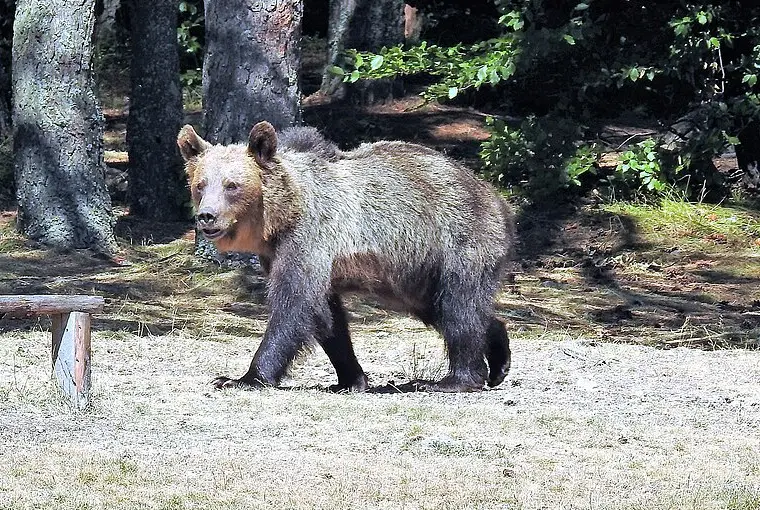

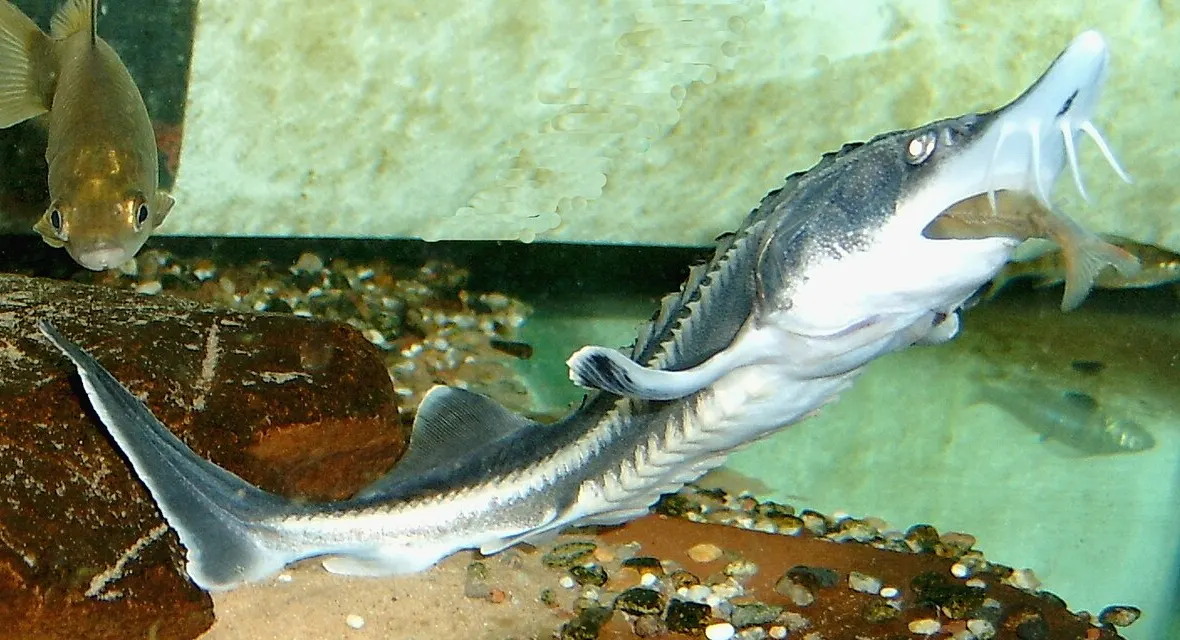
Photo: Daniel Döhne, CC BY-SA 3.0, source. Cropped and resized.

Worked example
How long should a 7-gram bat live?
Among mammals, the bigger ones usually live longer: the common shrew, at 9 g, lives at most 3.2 years, the brown bear 40 years. The AnAge database uses the formula t = 4.88 · M^0.153 for mammals, where M is the adult mass in grams and t is the expected maximum age, in years.
For Brandt’s bat, M = 7 g. You work out 7^0.153 ≈ 1.35, then t = 4.88 × 1.35 ≈ 6.6 years. The maximum age recorded in the wild, though, is 41 years: 41 ÷ 6.6 ≈ 6.2 times the predicted age.
For the brown bear, at 277,500 g, the formula gives around 33 years, and the record is 40 years, only 1.2 times higher. So for lifespan relative to mass, the bat weighing a few grams beats the bear weighing a few hundred kilograms. Lifespan, like any feature, does not put species on a ladder.
In Romania
The bears, wolves and lynx of the Carpathians
A genetic analysis of about 24,000 samples, carried out in a project of Romania’s Ministry of Environment, puts the brown bear population of Romania, in a conservative scenario, at 10,657–12,787 individuals (result announced in December 2025).
For the wolf and the lynx, the most recent official figure is Romania’s report to the European Commission for the period 2019–2024: around 2,500–3,000 wolves and 1,800–2,200 lynx, also estimates.
These top predators need large areas of connected forest. When bears reach villages, damage follows: between 2023 and 2025, 5,216 compensation claims were approved.
In short
- According to the IUCN Red List (2025-1), fish have 37,109 described species, reptiles 12,386, birds 11,195, amphibians 8,863 and mammals 6,736.
- Structural complexity does not bring taxonomic diversity: mammals, with the most complex organisation by many criteria, have the fewest species.
- Evolution is a tree whose branches are all equally old; no living species is the ancestor of another, and there are no ‘higher’ organisms.
- Diversity depends on climate (more species towards the Equator), on isolation, on resources and habitats, and on the time available.
- Different groups take on similar shapes in the same environment: flight in birds and bats, the spindle-shaped body in the shark, the dolphin and the penguin.
Common mistakes
WrongMammals are the most evolved vertebrates, which is why they have the most species.
RightAll living vertebrates have been evolving for the same length of time, and mammals are the class with the fewest species. Fish have five and a half times as many.
WrongToday’s fish are the ancestors of frogs, and frogs the ancestors of lizards.
RightToday’s fish, frogs and lizards are living branches of the same tree. They have common ancestors that died out long ago, but they do not descend from one another.
WrongSmall animals live short lives and large ones long lives: the rule has no exceptions.
RightThe trend exists, but bats break it: Brandt’s bat, at 7 g, lived 41 years, longer than the brown bear.
Check yourself
Seven questions. For the first six you see the explanation at once, with the paragraph of the lesson that supports it; for the written ones you compare with a good answer.
Which class of vertebrates has the most described species?
Answer
c) Fish. Fish have 37,109 described species, more than any other class and almost half of all vertebrates.
What does comparing the organisation of mammals with their number of species show?
Answer
b) That structural complexity and the number of species do not increase together. Mammals have a complex organisation by many criteria, but the fewest species; diversity depends on isolation, climate, resources and time.
Which statement about the carp and the fox is correct?
Answer
c) The carp and the fox have a very ancient common ancestor. Both living species are the tips of branches of the same tree; their common ancestor lived hundreds of millions of years ago.
The AnAge formula predicts a maximum age of 6.6 years for Brandt’s bat, at 7 g. The oldest known individual lived 41 years. How many times greater is the real age than the predicted one? Round to one decimal place.
timesAnswer
6.2 times. 41 ÷ 6.6 ≈ 6.2. The bat lives more than six times as long as an ordinary mammal of the same mass.
For each example, choose the diversity factor it illustrates.
Answer
Isolation: The honeycreepers of the Hawaiian Islands, with different beaks; A population cut off by a new mountain becomes a separate species.
Climate: Tropical forests have more species than temperate ones; The number of species rises towards the Equator.
Time and resources: A lake hundreds of thousands of years old has far more fish species than a lake formed a few thousand years ago.
Isolation separates populations that then evolve differently; the warm climate and varied habitats of the tropics shelter more species; the age and resources of an environment are proposed explanations: an old environment has had more time for new species to arise.
What kind of value is the figure of 10,657–12,787 brown bears in Romania?
Answer
b) An estimate made by genetic analysis of about 24,000 samples. Bears cannot be counted one by one; genetics identifies individuals from samples (hair, droppings), and the total population is estimated statistically, as a range.
A classmate says: ‘Humans are at the top of evolution, and fish have been left behind.’ Answer them using the numbers of species and the idea of a tree of life.
A good answer
Fish have 37,109 described species, five and a half times as many as mammals, so they have been hugely successful in water. Today’s fish have been evolving for as long as humans, on different branches of the same tree. Humans and fish share a common ancestor, and no living species is a step towards another.
A complete answer uses a number of species with its source and year, explains that all living species have an equally long history and replaces the image of a ladder with that of a tree.
Practical work for this lesson
- Observed behaviour, assumed intention – Observation without disturbing the animals, or an invented record, 25–35 minutes; you can repeat it on another day (CS)
Terms
- taxonomic diversity
- The number of species (or of other classification groups) in a group or in a place.
- phylogenetic tree
- A diagram that shows how species are related through common ancestors, like the branches of a tree.
- endemic species
- A species that lives in only one place on Earth.
- convergence
- The appearance of similar shapes in unrelated groups that live in the same kind of environment.
- top predator
- A predator that, as an adult, has no natural predators of its own in its ecosystem.
Sources and link to the programme
- IUCN Red List version 2025-1 – Table 1a (updated 27 March 2025) – described species: fish 37,109, reptiles 12,386, birds 11,195, amphibians 8,863, mammals 6,736 (excluding domestic species), vertebrates 76,289
- OpenStax – Biology 2e, 18.1 Understanding Evolution – evolution has no goal: it does not produce faster, bigger or more complex species
- OpenStax – Biology 2e, 18.2 Formation of New Species – geographical isolation and speciation; the adaptive radiation of the Hawaiian honeycreepers
- OpenStax – Biology 2e, 47.1 The Biodiversity Crisis – almost 500 endemic cichlid species in Lake Victoria, about 79 fish species in Lake Michigan; Victoria in its present form about 15,000 years, with a basin about 400,000 years old; Michigan in its present form about 7,000 years; diversity rises towards the Equator; latitude and the age of ecosystems as hypotheses; the rapid adaptive radiation of cichlids
- OpenStax – Biology 2e, 29.2 Fishes – fleshy-finned fish (Sarcopterygii), with bones similar to those in the limbs of the first tetrapods
- OpenStax – Biology 2e, 29.4 Reptiles – archosaurs include crocodiles and birds; birds belong to the dinosaur lineage
- AnAge – help (allometric formula for mammals) – tmax = 4.88 · M^0.153, longevity residual as a percentage of the expected value; cetaceans excluded
- AnAge – Myotis brandtii – 7 g, 41 years in the wild (one ringed individual), residual 624%
- AnAge – Ursus arctos – 277,500 g, 40 years in captivity, residual 120%
- AnAge – Sorex araneus – 9 g, 3.2 years in captivity
- CBRC – Bats of Romania – Myotis brandtii and Myotis myotis are among Romania’s 32 bat species
- Ministerul Mediului, Apelor și Pădurilor – press release on the genetic study of the brown bear population (December 2025) – about 24,000 genetic samples; between 10,657 and 12,787 bears, conservative scenario
- MMAP project “Ursul brun și noi” – Evaluarea mărimii populației de urs brun în România (28 November 2025) – 5,216 compensation claims approved in 2023–2025; population reported to the EU: 6,290 (2007–2012), 6,825 (2013–2018)
- Eionet – Habitats Directive Article 17, Canis lupus, perioada 2019–2024 – Romania’s report: wolf 1,500–1,800 (alpine) + 1,000–1,200 (continental) + 16–20 (Pannonian) individuals, estimate
- Eionet – Habitats Directive Article 17, Lynx lynx, perioada 2019–2024 – Romania’s report: lynx 1,260–1,540 (alpine) + 540–660 (continental) + 10–14 (Pannonian) individuals, estimate
- WWF România – În plasa braconierilor (report, 2026) – the permanent ban on sturgeon fishing in Romania
From the programme: “The diversity of vertebrates: examples of representative species of ecological and economic importance, interactions and adaptations, factors that influence diversity, correlations between the structural complexity of vertebrates and taxonomic diversity” (specialism, Natural Sciences). Specific competences addressed: 1.1, 1.2, 2.2, 3.2.