Chapter 2 · Molecules of lifeLesson 2.1
Water, mineral salts and vitamins: their roles in the body
Water has no calories, iron is not a food, and a vitamin is measured in milligrams. So why can’t the body do without any one of them?
- Size
- from 0.1 nm to 10 nm
- Level
- atoms and molecules
- Time
- an instant
Before you read: what do you think?
Four chemical elements make up almost all the mass of your body. What percentage of that mass do oxygen, carbon, hydrogen and nitrogen account for together?
See the answer
About 96%: oxygen 65%, carbon 18%, hydrogen 10%, nitrogen 3%. The remaining 4% includes calcium, phosphorus, potassium, sulfur, sodium and trace elements such as iron and iodine, without which the body cannot work.
If you weighed each chemical element in your body separately, oxygen would come first, with almost two-thirds of the mass. Much of it sits in water, which makes up more than half of you. At the other end is iodine: a teenager needs 150 micrograms a day, or 0.15 milligrams, and without it the thyroid gland cannot make its hormones.
What an organism is made of
The chemical elements that make up living things are called bioelements. Four of them, oxygen (O), carbon (C), hydrogen (H) and nitrogen (N), together form about 96% of the mass of the human body. With phosphorus (P), sulfur (S), calcium, potassium, sodium and magnesium, they are macroelements: they are present in large amounts. Iron (Fe), iodine (I), zinc (Zn) and copper are microelements: the body needs them in very small amounts, but a shortage of them causes disease.
Bioelements combine into two large groups of substances. Inorganic substances are water and mineral salts. Organic substances are built around carbon atoms: carbohydrates, lipids, proteins, nucleic acids, vitamins and ATP. Each group has a main role, and water, mineral salts and vitamins are the ones the body needs without getting any energy from them.
Water: solvent, transport and a steady temperature
Water makes up about 60–70% of the human body. Its molecule is polar: the oxygen end carries a partial negative electric charge and the hydrogen ends carry partial positive charges. That is why water molecules attract one another and attract ions and other polar molecules.
The roles of water follow from this property. It is a solvent for salt, sugar and many other substances, and the reactions in a cell take place in aqueous solution. Substances that mix easily with water are called hydrophilic; non-polar ones, such as oil, are called hydrophobic and do not dissolve in water. Water carries dissolved substances: nutrients and waste travel in the blood, and mineral salts rise through the vessels of plants.
Water has the highest specific heat capacity of the common liquids: it is slow to warm up and slow to cool down, so body temperature changes slowly. When sweat evaporates from the skin, it takes a large amount of heat with it. This is the role of water in thermoregulation.
Mineral salts: ions with precise roles
Dissolved in water, mineral salts split into ions, particles with an electric charge: Na⁺, K⁺, Ca²⁺, Cl⁻ and others. The body cannot make minerals, so it gets them only from food and water.
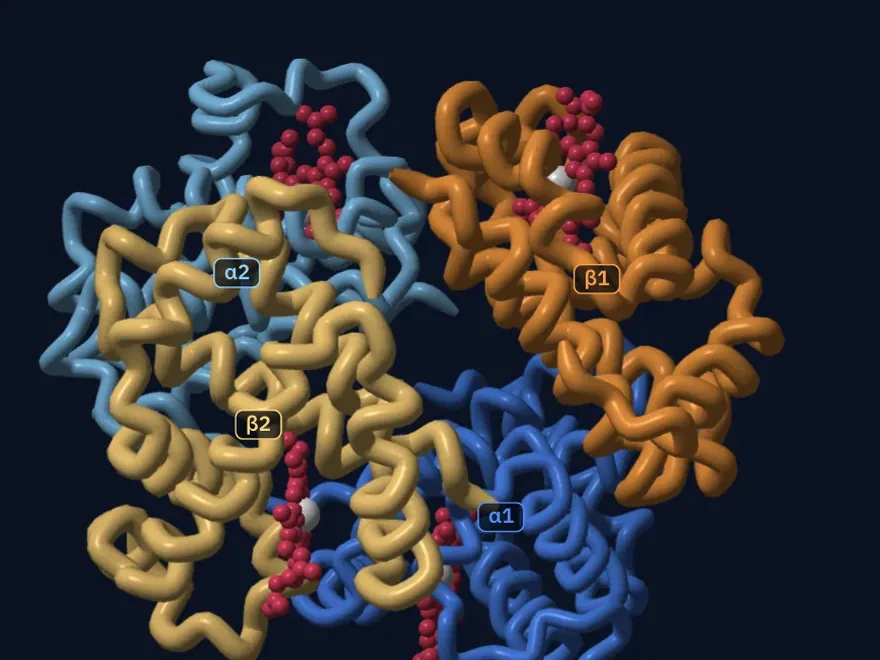
Each mineral has its own roles. Calcium is built into bones and teeth and takes part in muscle contraction and in the transmission of nerve impulses. Sodium and potassium keep the water balance and keep nerves and the heart working. Iron is part of haemoglobin, which carries oxygen in the blood; a shortage leads to anaemia. Iodine is needed for the hormones of the thyroid gland; a shortage causes goitre, an enlarged thyroid. Zinc helps several enzymes to work.
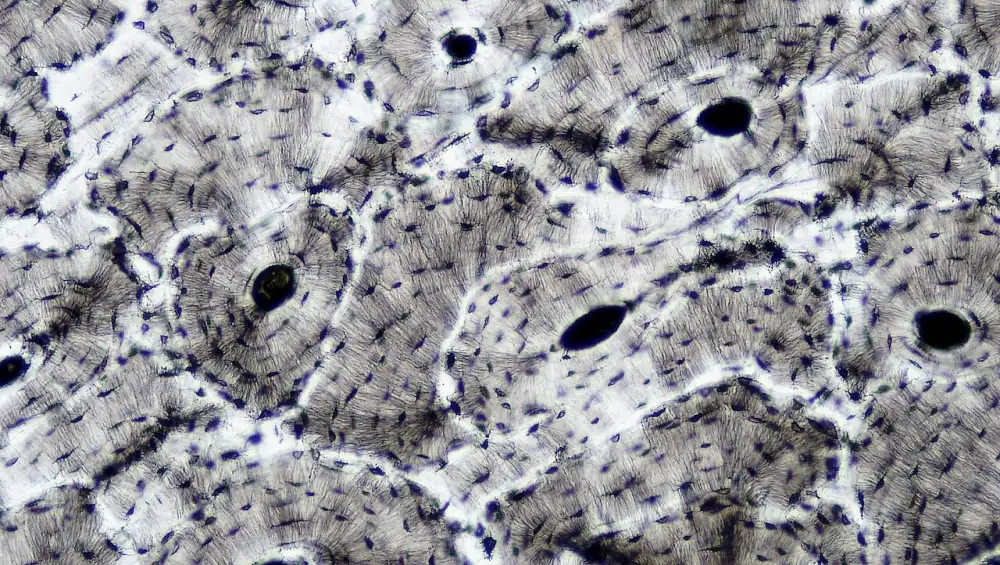
Photo: Berkshire Community College Bioscience Image Library, CC0 1.0, source. Resized.

Vitamins: tiny amounts you cannot do without
Vitamins are organic substances that the body needs in small amounts and cannot make in sufficient quantity. Vitamins do not supply energy. Many of them help enzymes to work, and a lack of one vitamin causes a deficiency disease.
Water-soluble vitamins dissolve in water: the B vitamins and vitamin C. The body does not store them and the surplus leaves in urine, so they have to come from food often. The best-known exception is vitamin B12, which the liver can keep for several years. Vitamin C is needed to make collagen; a lack of it leads to scurvy, with bleeding gums and wounds that are slow to heal. A lack of vitamin B1 causes beriberi, and a lack of vitamin B3 causes pellagra.
Fat-soluble vitamins dissolve in fats: A, D, E and K. They are absorbed together with the fats in food and can build up in the body’s fat stores. A lack of vitamin A causes night blindness, a lack of vitamin D causes rickets in children, and a lack of vitamin K leads to bleeding, because vitamin K is needed for blood clotting.
Worked example
How much iodine iodised salt provides
In Romania, salt for human consumption must contain between 25 and 40 mg of iodine per kilogram of salt. The World Health Organization recommends that an adult eat less than 5 g of salt a day.
Step 1: convert the units. A kilogram is 1,000 g, so one gram of salt contains between 25 ÷ 1,000 = 0.025 mg and 40 ÷ 1,000 = 0.040 mg of iodine, that is, between 25 and 40 micrograms (1 mg = 1,000 µg).
Step 2: multiply by the mass of salt. 5 g of iodised salt holds between 5 × 25 = 125 µg and 5 × 40 = 200 µg of iodine.
Step 3: compare. The daily iodine intake considered necessary for teenagers and adults is 150 µg, so a small amount of iodised salt covers a large part of it. Iodine also comes from fish, milk and eggs; this is a worked calculation, not a measurement of one person’s intake.
In Romania
Goitre and iodised salt
In many parts of the world, especially in mountains and in plains far from the sea, the soil and water contain little iodine, and people who eat only local food get too little. In Romania, too, iodine deficiency was recognised as a public health problem as early as the 1950s. In the 1950s and 1960s, distributing iodised salt became compulsory in 30 counties declared goitre-prone.
Since 2002, under Government Decision No. 568/2002, all salt for human consumption in Romania must be iodised, with 25–40 mg of iodine per kilogram. A study carried out in 2002–2004 among children aged 7–8 found that only 26% had an adequate iodine intake. In 2022, the national register of the National Institute of Public Health (INSP) recorded 171 new cases of thyroid disease linked to iodine deficiency, from 20 counties. The deficiency has fallen sharply compared with the years before universal iodisation, though it has not disappeared completely.
In short
- Oxygen, carbon, hydrogen and nitrogen form about 96% of the body’s mass; macroelements are present in large amounts, microelements (Fe, I, Zn) in very small amounts.
- Inorganic substances are water and mineral salts; organic substances are carbohydrates, lipids, proteins, nucleic acids, vitamins and ATP.
- Water, a polar molecule, is the solvent and the medium for the cell’s reactions, carries substances and helps thermoregulation through its high specific heat capacity and the evaporation of sweat.
- Mineral salts supply ions and are built into structures: calcium into bones, iron into haemoglobin, iodine into thyroid hormones; a lack of iron causes anaemia, a lack of iodine causes goitre.
- Vitamins are organic substances needed in small amounts, with no energy role; water-soluble: B and C; fat-soluble: A, D, E and K.
- Classic deficiencies: scurvy (C), beriberi (B1), pellagra (B3), night blindness (A), rickets (D), bleeding (K).
Common mistakes
WrongVitamins give you energy, which is why you feel stronger after taking them.
RightVitamins do not supply energy. The energy in food comes from carbohydrates, lipids and proteins; many vitamins help the enzymes that release that energy.
WrongWater dissolves every substance, which is why it is called the universal solvent.
RightWater dissolves ions and polar substances. Non-polar substances, such as oil and fats, do not dissolve in water.
WrongCalcium is a vitamin, like vitamin D.
RightCalcium is a mineral element, that is, an inorganic substance. Vitamin D is an organic substance that helps the intestine absorb calcium.
Check yourself
Seven questions. For the first six you see the explanation at once, with the paragraph of the lesson that supports it; for the written ones you compare with a good answer.
Which of the following is a microelement?
Answer
c) Iron. Iron is needed in very small amounts, but haemoglobin cannot work without it. Carbon, nitrogen and oxygen are macroelements.
Why does oil not dissolve in water?
Answer
b) Because oil is non-polar, and water dissolves polar substances and ions. Polar water molecules attract ions and other polar molecules. Oil is non-polar, that is, hydrophobic.
Which group contains only fat-soluble vitamins?
Answer
b) A, D, E, K. Vitamins A, D, E and K dissolve in fats. The B vitamins and vitamin C are water-soluble.
A person has bleeding gums and wounds that are slow to heal. In scurvy, a lack of which vitamin causes these signs?
Answer
c) Vitamin C. Vitamin C is needed to make the collagen of connective tissue. Only a doctor can diagnose a real person.
How many micrograms of iodine are there in 2 g of iodised salt containing 25 mg of iodine per kilogram?
µgAnswer
50 µg. 25 mg/kg means 25 µg per gram. For 2 g: 2 × 25 = 50 µg.
Put each substance in its group.
Answer
Inorganic substance: Water; Sodium chloride; Calcium ions.
Organic substance: Vitamin C; Glucose; Vitamin D.
Water and mineral salts, with their ions, are inorganic. Carbohydrates and vitamins are organic, built around carbon atoms.
On a scorching day, a pupil runs in a PE lesson and sweats heavily. Explain two roles of water that this situation shows, and what else the body loses with sweat.
A good answer
As sweat evaporates from the skin it takes a lot of heat with it and helps keep body temperature steady, which shows the role of water in thermoregulation. The water in blood carries heat from the muscles to the skin and carries dissolved substances. Sweat also takes mineral salts with it, that is, ions such as Na⁺ and Cl⁻, which have to be replaced from food and water.
A complete answer names thermoregulation by evaporation, the transport or solvent role, and the loss of mineral-salt ions.
Terms
- bioelements
- The chemical elements that make up living things; they are divided into macroelements and microelements.
- microelements
- Bioelements needed in very small amounts, such as iron, iodine and zinc; also called trace elements.
- polar molecule
- A molecule with an uneven distribution of electric charge, such as water, which attracts ions and other polar molecules.
- solvent
- The substance in which other substances dissolve; in living things, the solvent is water.
- ion
- An atom or group of atoms with an electric charge, for example Na⁺ or Cl⁻.
- water-soluble vitamins
- Vitamins that dissolve in water and, apart from a few such as vitamin B12, are not stored in the body: the B vitamins and vitamin C.
- fat-soluble vitamins
- Vitamins that dissolve in fats and are absorbed together with them: A, D, E and K.
- goitre
- Enlargement of the thyroid gland, most often caused by a lack of iodine in the diet.
Sources and link to the programme
- OpenStax – Biology 2e, 2.1 Atoms, Isotopes, Ions, and Molecules – percentages of the elements in the human body: O 65%, C 18%, H 10%, N 3% (together 96%)
- OpenStax – Biology 2e, 2.2 Water – water makes up 60–70% of the human body; polarity; hydrophilic and hydrophobic; highest specific heat capacity of the common liquids; cooling by evaporation of sweat
- OpenStax – Biology 2e, 34.2 Nutrition and Energy Production – roles and deficiencies of minerals (Ca, Fe – anaemia, I – goitre, Na, K, Zn) and of vitamins A, D, K, B1 (beriberi), B3 (pellagra)
- OpenStax – Anatomy and Physiology 2e, 24.7 Nutrition and Diet – water-soluble vitamins are not stored and leave in urine; fat-soluble ones are absorbed with lipids and can build up; vitamin C, collagen and scurvy; the body cannot make minerals
- INSP – press release “Importanța consumului de sare iodată”, 24 May 2024 (copy on the DSP Gorj site) – compulsory iodisation since 2002, 25–40 mg iodine/kg of salt; 150 µg/day for teenagers and adults; iodine-poor areas (mountains, plains far from the ocean); 171 new cases from 20 counties in 2022
- Journal of Medicine Brașov (2017) – Evaluarea statusului de iod prin determinarea iodurilor la copilul școlar – iodine deficiency a public health problem since 1950; iodised salt compulsory in 30 goitre-prone counties in the 1950s and 1960s; Government Decision 568/2002; the 2002–2004 study: 26% of children with adequate intake
- WHO – Healthy diet (fact sheet, 2026) – less than 5 g of salt a day for adults; recommendation of iodised salt
- MedlinePlus – Vitamins – water-soluble vitamins are not stored, the surplus leaves in urine; the exception is vitamin B12, kept in the liver
- MedlinePlus – Vitamin B12 – the liver can keep vitamin B12 for several years
- Institute of Medicine (1998), Dietary Reference Intakes, chapter 7 – Vitamin B6 (National Academies Press) – the body has stores of vitamin B6, most of them in muscle (about 80%), so B12 is not the only water-soluble vitamin that is stored
From the programme: “Water, mineral salts, proteins, carbohydrates, lipids, vitamins, nucleic acids, ATP – main role of each type of substance” (common core). Specific competences addressed: 2.1, 2.2, 5.2.