Chemistry 9 RO
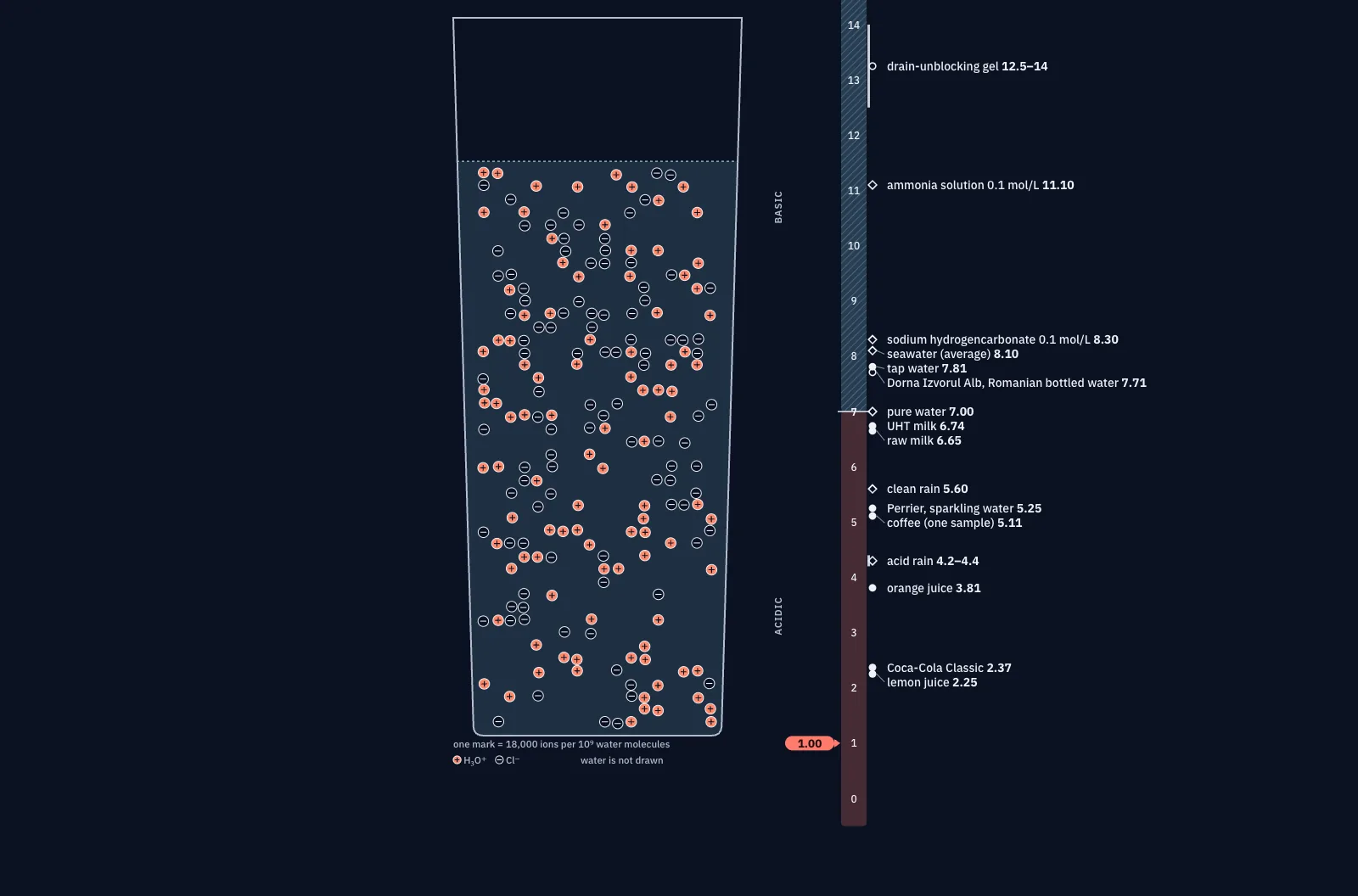
A glass of hydrochloric acid, 0.1 mol/L: a hundred + signs (H₃O⁺ ions) and a hundred − signs (Cl⁻ ions), each sign standing for 18,000 ions per billion water molecules. Beside it, a vertical pH scale from 0 at the bottom to 14 at the top, with a mark at pH 1 and, at their heights, real liquids: lemon juice 2.25; Coca-Cola Classic 2.37; orange juice 3.81; acid rain 4.2–4.4; coffee (one sample) 5.11; Perrier, sparkling water 5.25; clean rain 5.60; raw milk 6.65; pure water 7.00; Dorna Izvorul Alb, Romanian bottled water 7.71; tap water 7.81; seawater (average) 8.10; sodium hydrogencarbonate 0.1 mol/L 8.30; ammonia solution 0.1 mol/L 11.10; drain-unblocking gel 12.5–14.

Solutions

Chapter 10

Acids, bases and pH – what a number from 0 to 14 measures

What does a number from 0 to 14 measure?

A glass of hydrochloric acid at 0.1 mol/L, pH 1, and a scale from 0 to 14. Each tenfold dilution is a calculation: one part of the solution to nine parts of water. Start with a prediction, then dilute and follow the mark on the scale.

An acid of pH 1, diluted again and again

The glass holds hydrochloric acid, HCl, at 0.1 mol/L: pH 1. In the calculation the solution is diluted tenfold, then tenfold once more, and so on, up to a dilution of a billion times.

After a tenfold, a millionfold and a billionfold dilution, what pH does the solution reach?

Each tenfold dilution raises the pH by one unit

What you see. A glass and a mark on the scale, which shows the pH of the solution.

What the particles do. Each mark in the glass stands for 18,000 ions per billion water molecules. At pH 1 there are 100 + marks (H₃O⁺) and as many − marks (Cl⁻); at pH 2 10 of each are left, at pH 3 just one. The counter in the corner shows H₃O⁺ ions per billion water molecules: 1,800,000 at pH 1, 180,000 at pH 2.

How it is written. pH = −lg[H₃O⁺], with [H₃O⁺] = c = 0.1 mol/L, then 10⁻², 10⁻³ mol/L.

Lemon juice has 18 times fewer H₃O⁺ ions than the acid in the glass

Real liquids have appeared on the scale. A filled dot is a value measured with a pH meter, an empty circle one declared by the maker, a diamond a typical or reference value from a source. Lemon juice has pH 2.25, cola 2.37, a sample of coffee 5.11.

Between pH 2.25 and pH 1 there are 1.25 units, which means 18 times fewer H₃O⁺ ions. Between lemon juice and the drain-unblocking gel (12.5 at the lower end of the range on its safety data sheet) the concentration [H₃O⁺] differs by more than ten billion times.

The value belongs to the product measured; another brand gives another number. Dilute again and see which liquids the mark passes.

The mark rises to nearly 7 and does not pass 7.00

The dilutions follow one another and the counter falls: after the fifth dilution the pH is 6, then 6.79, 6.98 and 7.00. The simple formula, [H₃O⁺] = c, would give pH 8 at 10⁻⁸ mol/L, a base made from an acid.

The calculation that takes water into account gives 6.98. The bar under the glass shows where the H₃O⁺ ions come from: at 10⁻⁶ mol/L nearly all come from the acid, at 10⁻⁸ mol/L 90% come from water.

Under the glass, the key to the marks changes when they would become too few: from 18,000 ions to 180 ions (from pH 4), then to 1.8 ions (from pH 6). At 10⁻⁹ and 10⁻¹⁰ mol/L the pH is displayed as 7.00, but it stays just below 7.

Water has ions of its own, so the wall is at 7

What you see. The acid diluted a billionfold; the mark is at 7.00. What the particles do. Water molecules swap protons with one another: in every billion molecules there are 1.80 H₃O⁺ ions and as many HO⁻.

How it is written. 2H₂O ⇌ H₃O⁺ + HO⁻, with Kw, the ionic product of water, Kw = [H₃O⁺]·[HO⁻] = 10⁻¹⁴. Pure water has 10⁻⁷ mol/L of H₃O⁺ ions, so in an acid of 10⁻⁷ mol/L the ions come from two sources, and the calculated pH is 6.79. At 10⁻⁸ mol/L the pH is 6.98, at 10⁻⁹ mol/L 7.00: the acid adds less and less, and the pH stops near 7.

For the curious. The charges balance, [H₃O⁺] = c + [HO⁻], and with Kw this gives [H₃O⁺] = (c + √(c² + 4Kw)) ÷ 2. For c = 10⁻⁸ mol/L: 1.05·10⁻⁷ mol/L, so pH 6.98.

A diluted base also stops at 7, coming from above

What you see. The solution in the glass is now sodium hydroxide, NaOH, 0.1 mol/L: pH 13. What the particles do. The HO⁻ ions were already in the crystal; in the glass there are 100 − marks (HO⁻) and as many + marks (Na⁺).

How it is written. pOH = −lg[HO⁻] = 1, pH = 14 − 1 = 13. With each tenfold dilution the pH falls towards 7 from the other side: 8 after the fifth dilution, then 7.02 at 10⁻⁸ mol/L and 7.00 at 10⁻¹⁰ mol/L, again because of water.

The drain-unblocking gel contains sodium hydroxide and, according to its safety data sheet, is corrosive: it causes severe skin burns. Here it is only a calculation on paper.

Between 19.95 and 20.05 mL, the pH jumps by more than six units

What you see. A calculation for a demonstration done by the teacher: 20.0 mL of HCl 0.100 mol/L, to which sodium hydroxide 0.100 mol/L is added, 0.05 mL at a time (almost one drop). What the particles do. The H₃O⁺ and HO⁻ pairs form water and their marks disappear; the Na⁺ and Cl⁻ ions stay unchanged, as spectator ions.

How it is written. H₃O⁺ + HO⁻ → 2H₂O. At the equivalence point ca · Va = cb · Vb, so Vb = 20.0 mL and pH 7.00. At 19.95 mL the pH is 3.90, at 20.05 mL it is 10.10: more than six units in two drops. At 30.0 mL the base is in excess: [HO⁻] = 0.0200 mol/L, pH 12.30.

Now you explain

A solution of sodium hydroxide has a concentration of 10⁻³ mol/L. What is its pH at 25 °C?

Write the steps in a few sentences: which ions are in the solution, why the simple formula works here, and what you would do if the solution were 10⁻⁸ mol/L.

Compare with an answer

NaOH dissociates completely, so [HO⁻] = 10⁻³ mol/L, pOH = 3 and pH = 14 − 3 = 11. The simple formula works, because 10⁻³ mol/L is far above the 10⁻⁷ mol/L that water gives. At 10⁻⁸ mol/L you must also count the ions of water: pH 7.02. The simple formula would give pH 6, an acidic value for a base.

The lesson on calculating pH · The lesson on neutralisation

Calculation and measurements. An idealised calculation, in concentrations, for a strong acid and a strong base at 25 °C, with the ionic product of water Kw = 1.0·10⁻¹⁴: the charge balance [H₃O⁺] + [Na⁺] = [HO⁻] + [Cl⁻] gives the pH even close to 7, where the simple formula [H₃O⁺] = c fails. A filled dot on the scale is a value measured with a pH meter, an empty circle one declared by the maker or in the safety data sheet, a diamond a typical value from a source or from a reference table; another brand gives another number. The ions are drawn, not photographed: they have no colour, they are drawn enormously enlarged and far fewer than in reality (one mark stands for 18,000 ions per billion water molecules, then for 180 and for 1.8 as the solution is diluted; the key is written under the glass), and the water molecules are missing. Hydrochloric acid and sodium hydroxide are used only by the teacher; here they are a calculation.

Sources and credits. Measured values of the liquids: Reddy A. et al., “The pH of beverages in the United States”, Journal of the American Dental Association, 2016 (PubMed Central, PMC4808596); Metrohm, application notes AN-I-032 (milk) and AN-T-074 (tap water). Declared values: Coca-Cola România, the Dorna page; MELLERUD, safety data sheet for the drain-unblocking gel (10 August 2023). Values quoted from: EPA, “What is acid rain?” and “Understanding the science of ocean and coastal acidification”; PubChem (Merck Index, through HSDB), sodium hydrogencarbonate 0.1 mol/L and ammonia solution 0.1 mol/L; OpenStax, Chemistry 2e, section 14.2 (pure water). Kw at 25 °C: OpenStax, Chemistry 2e, 14.1. Molar mass of water: the school atomic masses of the book.

The same data, as a table
LiquidpHHow it is known
drain-unblocking gel12.5–14declared (MELLERUD, safety data sheet)
ammonia solution 0.1 mol/L11.10typical or reference value (PubChem, Merck Index)
sodium hydrogencarbonate 0.1 mol/L8.30typical or reference value (PubChem, Merck Index)
seawater (average)8.10typical or reference value (EPA)
tap water7.81measured (Metrohm AN-T-074)
Dorna Izvorul Alb, Romanian bottled water7.71declared (Coca-Cola România (Dorna))
pure water7.00typical or reference value (OpenStax, Chemistry 2e, 14.2)
UHT milk6.74measured (Metrohm AN-I-032)
raw milk6.65measured (Metrohm AN-I-032)
clean rain5.60typical or reference value (EPA)
Perrier, sparkling water5.25measured (Reddy et al., JADA 2016)
coffee (one sample)5.11measured (Reddy et al., JADA 2016)
acid rain4.2–4.4typical or reference value (EPA)
orange juice3.81measured (Reddy et al., JADA 2016)
Coca-Cola Classic2.37measured (Reddy et al., JADA 2016)
lemon juice2.25measured (Reddy et al., JADA 2016)
Tenfold dilutionsHCl concentrationpH, calculated, HClpH, calculated, NaOH at the same concentrationH₃O⁺ per billion water molecules, HClPercentage of the H₃O⁺ ions that come from water, HCl
00.1 mol/L1.0013.001,800,000under 1%
110⁻² mol/L2.0012.00180,000under 1%
210⁻³ mol/L3.0011.0018,000under 1%
310⁻⁴ mol/L4.0010.001,800under 1%
410⁻⁵ mol/L5.009.00180under 1%
510⁻⁶ mol/L6.008.0018.2under 1%
610⁻⁷ mol/L6.797.212.9138%
710⁻⁸ mol/L6.987.021.8990%
810⁻⁹ mol/L7.007.001.8199%
910⁻¹⁰ mol/L7.007.001.80100%
NaOH 0.100 mol/L added to 20.0 mL of HCl 0.100 mol/LpH, calculated
0.0 mL1.00
10.0 mL1.48
19.95 mL3.90
20.0 mL7.00
20.05 mL10.10
30.0 mL12.30
40.0 mL12.52

Lessons of the chapter

Lessons: 3 lessons TC, 1 lesson SN. The badge of each lesson says which profile it belongs to.

Which profile are you on?

  1. 10.1What water does to a strong acid and a strong base TC · beyond your profileIonisation of strong monoprotic acids and strong monoprotic bases in aqueous solution; the ionic product of waterThe stomach produces hydrochloric acid, and shops sell drain-unblocking gel containing sodium hydroxide. What happens to them in water?
  2. 10.2Why three pH units mean a thousand times more ions TC · beyond your profileCalculating the pH of aqueous solutions of strong monoprotic acids and strong monoprotic basesLemon juice has a pH of 2.25 and sparkling mineral water 5.25. How much more acidic is the lemon juice?
  3. 10.3What remains in the glass when a strong acid meets a strong base SN · beyond your profileThe neutralisation reaction between a strong monoprotic acid and a strong monoprotic baseIf you mix a strong acid with a strong base, is the resulting solution always neutral?
  4. 10.4What label pictograms mean and what never to mix TC · beyond your profileEvaluating the risks associated with the improper use of some chemical productsWhat does the red-bordered diamond on a bottle of bleach or drain cleaner mean, and why must cleaning products never be mixed?

Test tomorrowten questions from chapter 10For the class: projector, sheets, shared test