Chapter 10 · Acids, bases, pHLesson 10.3SN Natural sciences (3 hours) · beyond your profile
The neutralisation reaction between a strong monoprotic acid and a strong monoprotic base
What remains in the glass when a strong acid meets a strong base
If you mix a strong acid with a strong base, is the resulting solution always neutral?
Before you read: what do you think?
A glass contains a mixture of 20 mL of 0.10 mol/L HCl and 30 mL of 0.10 mol/L NaOH. What is the pH of the mixture at 25 °C?
See the answer
The base is in excess: 0.0030 moles of NaOH compared with 0.0020 moles of HCl. An excess of 0.0010 moles of HO⁻ ions remains in 50 mL of solution, giving [HO⁻] = 0.020 mol/L and a pH of approximately 12.30.
An antacid counteracts, or neutralises, stomach acid, according to the UK National Health Service (NHS). In the laboratory, solutions of hydrochloric acid and sodium hydroxide mixed in the right proportions give salt water. The proportions decide what remains in the glass: a neutral, acidic or basic solution.
H₃O⁺ and HO⁻ ions form water
A solution of HCl contains H₃O⁺ and Cl⁻ ions, while a solution of NaOH contains Na⁺ and HO⁻ ions. When mixed, H₃O⁺ and HO⁻ ions react to form water. The reaction of an acid with a base to form a salt and water is called neutralisation.
HCl + NaOH → NaCl + H₂O
The ionic equation shows what happens to the particles:
H₃O⁺ + Cl⁻ + Na⁺ + HO⁻ → Na⁺ + Cl⁻ + 2H₂O
The Na⁺ and Cl⁻ ions are the same before and after the reaction; they are called spectator ions. Removing them leaves the ionic equation for any neutralisation between a strong acid and a strong base:
H₃O⁺ + HO⁻ → 2H₂O
Neutralisation is an exothermic reaction: the mixture warms up. The teacher demonstrates it in the laboratory with dilute solutions, measuring the temperature.
The equivalence point: na = nb for a monoprotic acid and a base with one HO⁻
In the equation HCl + NaOH → NaCl + H₂O, one mole of acid reacts with one mole of base. The equivalence point is the point at which the acid and base have reacted in the proportions in the equation. For a monoprotic acid and a strong base with one HO⁻, na = nb. Using n = c · V, the relationship becomes ca · Va = cb · Vb.
At equivalence, the solution contains only dissolved NaCl and water. Na⁺ and Cl⁻ ions do not react with water, and the pH is 7 at 25 °C. The volumes of the two solutions do not have to be equal at equivalence: they depend on their concentrations.
Titration is a method of finding the concentration of a solution: a solution of known concentration is added gradually from a burette until the equivalence point is reached. A change in the colour of an indicator, such as phenolphthalein, which turns from colourless to carmine red, marks the end point, very close to the equivalence point. Example: 25.0 mL of HCl of unknown concentration requires 20.0 mL of 0.100 mol/L NaOH. Then ca = 0.100 · 20.0 ÷ 25.0 = 0.0800 mol/L.
For the curious
Near equivalence, the pH rises sharply: a few drops of base change the pH by several units. That is why phenolphthalein, which changes colour at pH 8.3, gives an end point very close to equivalence: at 0.1 mol/L, the difference is much less than one drop.
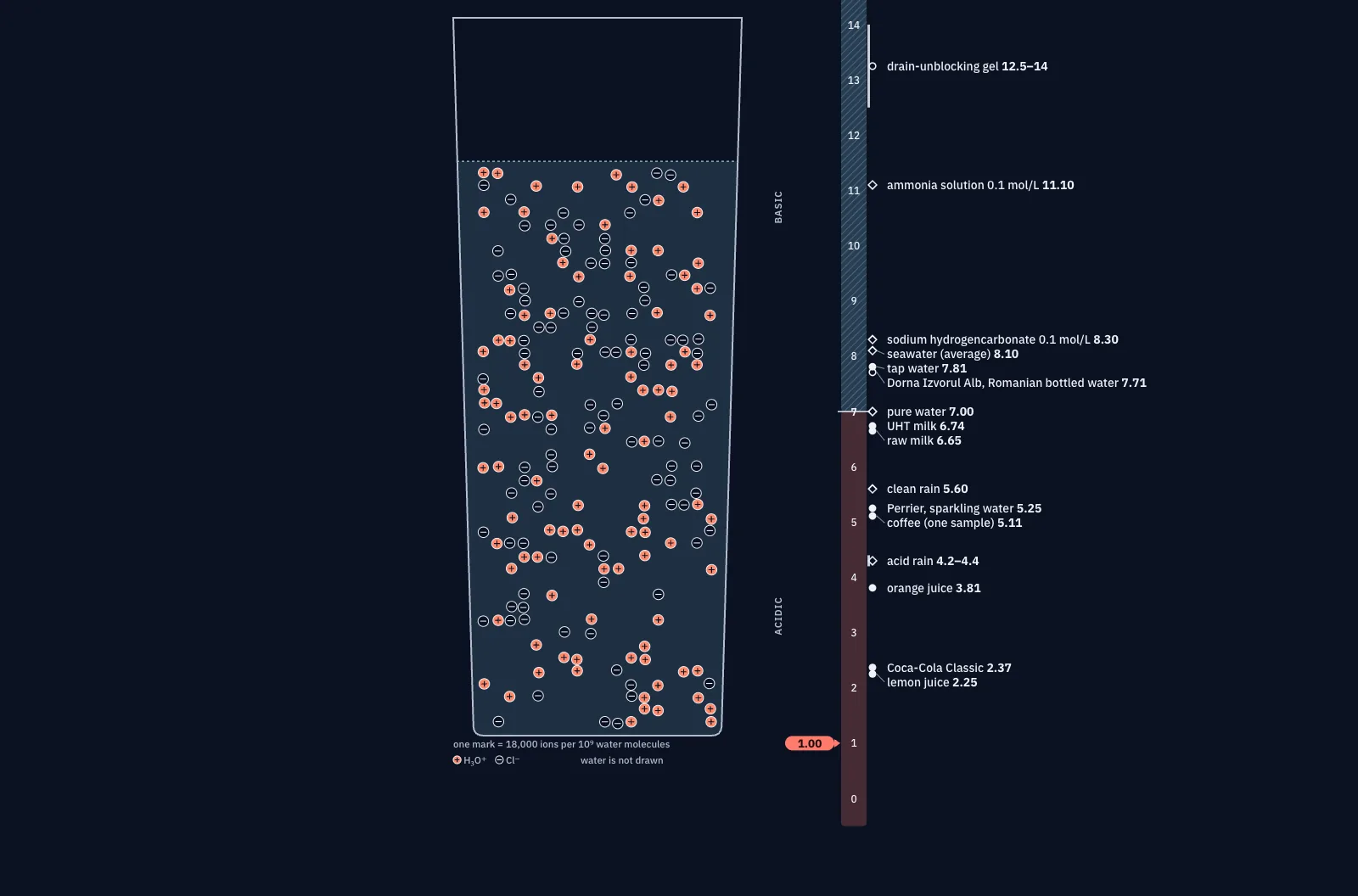
| Liquid | pH | How it is known |
|---|---|---|
| drain-unblocking gel | 12.5–14 | declared (MELLERUD, safety data sheet) |
| ammonia solution 0.1 mol/L | 11.10 | typical or reference value (PubChem, Merck Index) |
| sodium hydrogencarbonate 0.1 mol/L | 8.30 | typical or reference value (PubChem, Merck Index) |
| seawater (average) | 8.10 | typical or reference value (EPA) |
| tap water | 7.81 | measured (Metrohm AN-T-074) |
| Dorna Izvorul Alb, Romanian bottled water | 7.71 | declared (Coca-Cola România (Dorna)) |
| pure water | 7.00 | typical or reference value (OpenStax, Chemistry 2e, 14.2) |
| UHT milk | 6.74 | measured (Metrohm AN-I-032) |
| raw milk | 6.65 | measured (Metrohm AN-I-032) |
| clean rain | 5.60 | typical or reference value (EPA) |
| Perrier, sparkling water | 5.25 | measured (Reddy et al., JADA 2016) |
| coffee (one sample) | 5.11 | measured (Reddy et al., JADA 2016) |
| acid rain | 4.2–4.4 | typical or reference value (EPA) |
| orange juice | 3.81 | measured (Reddy et al., JADA 2016) |
| Coca-Cola Classic | 2.37 | measured (Reddy et al., JADA 2016) |
| lemon juice | 2.25 | measured (Reddy et al., JADA 2016) |
| Tenfold dilutions | HCl concentration | pH, calculated, HCl | pH, calculated, NaOH at the same concentration | H₃O⁺ per billion water molecules, HCl | Percentage of the H₃O⁺ ions that come from water, HCl |
|---|---|---|---|---|---|
| 0 | 0.1 mol/L | 1.00 | 13.00 | 1,800,000 | under 1% |
| 1 | 10⁻² mol/L | 2.00 | 12.00 | 180,000 | under 1% |
| 2 | 10⁻³ mol/L | 3.00 | 11.00 | 18,000 | under 1% |
| 3 | 10⁻⁴ mol/L | 4.00 | 10.00 | 1,800 | under 1% |
| 4 | 10⁻⁵ mol/L | 5.00 | 9.00 | 180 | under 1% |
| 5 | 10⁻⁶ mol/L | 6.00 | 8.00 | 18.2 | under 1% |
| 6 | 10⁻⁷ mol/L | 6.79 | 7.21 | 2.91 | 38% |
| 7 | 10⁻⁸ mol/L | 6.98 | 7.02 | 1.89 | 90% |
| 8 | 10⁻⁹ mol/L | 7.00 | 7.00 | 1.81 | 99% |
| 9 | 10⁻¹⁰ mol/L | 7.00 | 7.00 | 1.80 | 100% |
| NaOH 0.100 mol/L added to 20.0 mL of HCl 0.100 mol/L | pH, calculated |
|---|---|
| 0.0 mL | 1.00 |
| 10.0 mL | 1.48 |
| 19.95 mL | 3.90 |
| 20.0 mL | 7.00 |
| 20.05 mL | 10.10 |
| 30.0 mL | 12.30 |
| 40.0 mL | 12.52 |
Calculation and measurements. An idealised calculation, in concentrations, for a strong acid and a strong base at 25 °C, with the ionic product of water Kw = 1.0·10⁻¹⁴: the charge balance [H₃O⁺] + [Na⁺] = [HO⁻] + [Cl⁻] gives the pH even close to 7, where the simple formula [H₃O⁺] = c fails. A filled dot on the scale is a value measured with a pH meter, an empty circle one declared by the maker or in the safety data sheet, a diamond a typical value from a source or from a reference table; another brand gives another number. The ions are drawn, not photographed: they have no colour, they are drawn enormously enlarged and far fewer than in reality (one mark stands for 18,000 ions per billion water molecules, then for 180 and for 1.8 as the solution is diluted; the key is written under the glass), and the water molecules are missing. Hydrochloric acid and sodium hydroxide are used only by the teacher; here they are a calculation.
Sources and credits. Measured values of the liquids: Reddy A. et al., “The pH of beverages in the United States”, Journal of the American Dental Association, 2016 (PubMed Central, PMC4808596); Metrohm, application notes AN-I-032 (milk) and AN-T-074 (tap water). Declared values: Coca-Cola România, the Dorna page; MELLERUD, safety data sheet for the drain-unblocking gel (10 August 2023). Values quoted from: EPA, “What is acid rain?” and “Understanding the science of ocean and coastal acidification”; PubChem (Merck Index, through HSDB), sodium hydrogencarbonate 0.1 mol/L and ammonia solution 0.1 mol/L; OpenStax, Chemistry 2e, section 14.2 (pure water). Kw at 25 °C: OpenStax, Chemistry 2e, 14.1. Molar mass of water: the school atomic masses of the book.
When one reactant is in excess
If na ≠ nb, the reactant in excess remains in solution and determines the pH. First account for the moles, then divide by the total volume. The steps are: calculate na = ca · Va and nb = cb · Vb; subtract the smaller amount from the larger; divide the excess by the total volume of the mixture, in litres; calculate the pH.
Here nexcess is the amount in excess. If the acid is in excess, [H₃O⁺] = nexcess ÷ Vtotal and pH < 7. If the base is in excess, [HO⁻] = nexcess ÷ Vtotal, then calculate pOH and pH = 14 − pOH, giving pH > 7. In exercises, add the volumes of the dilute solutions; do not average their pH values. Equivalence does not mean an absence of H₃O⁺ and HO⁻ ions: water always produces them, at 10⁻⁷ mol/L each at 25 °C.
Antacids: neutralisation with magnesium hydroxide and other basic substances
An antacid counteracts, or neutralises, stomach acid. Its ingredients may include aluminium hydroxide, magnesium hydroxide, calcium carbonate or sodium bicarbonate. Milk of magnesia, a suspension of Mg(OH)₂, reacts with hydrochloric acid in the stomach.
Mg(OH)₂(s) + 2HCl(aq) → MgCl₂(aq) + 2H₂O(l)
Mg(OH)₂ is sparingly soluble in water. Sodium hydroxide in drain cleaners is a strong base classified as corrosive to skin, so it is not used in medicines.
Worked example
pH after mixing 20 mL of HCl with 30 mL of NaOH
In a calculation example, 20.0 mL of 0.100 mol/L HCl is mixed with 30.0 mL of 0.100 mol/L NaOH at 25 °C. What is the pH?
Mole balance: na = 0.100 · 0.0200 = 0.00200 mol; nb = 0.100 · 0.0300 = 0.00300 mol. The base is in excess: nexcess = 0.00300 − 0.00200 = 0.00100 mol.
The total volume is 20.0 + 30.0 = 50.0 mL = 0.0500 L. Then [HO⁻] = 0.00100 ÷ 0.0500 = 0.0200 mol/L.
pOH = −lg(2.00·10⁻²) ≈ 1.70, so pH = 14 − 1.70 = 12.30.
Check: equivalence would have required 20.0 mL of base, and 30.0 mL is more than that; the basic solution, with a pH above 7, fits the conditions.
In Romania
Acidic water at Roșia Montană in the 2004 project report
The November 2004 project report by Roșia Montană Gold Corporation described drainage from the old mine workings at Roșia Montană as acidic water with a low pH and heavy metals. It attributed the drainage to the oxidation of sulfide minerals in the ore bodies.
For such water, the project planned a treatment plant based on neutralisation with lime: milk of lime raised the pH to 7.2, and a second addition, of slaked lime, raised it to approximately 11, causing heavy metals to precipitate as hydroxides.
In short
- The ionic equation for neutralisation between a strong acid and a strong base is H₃O⁺ + HO⁻ → 2H₂O; example: HCl + NaOH → NaCl + H₂O. Na⁺ and Cl⁻ are spectator ions.
- Neutralisation is exothermic.
- At the equivalence point, the acid and base have reacted in the proportions in the equation; for a monoprotic acid and a base with one HO⁻, na = nb, so ca · Va = cb · Vb. A strong acid and a strong base give pH 7 at equivalence, at 25 °C.
- If one reactant is in excess, account for the moles, then divide the excess by the total volume and calculate the pH.
- Titration finds the concentration of a solution using a solution of known concentration and an indicator whose colour change marks the end point.
- Antacids neutralise stomach acid; Mg(OH)₂, in milk of magnesia, is sparingly soluble in water, while the strong base NaOH is not used in medicines.
Common mistakes
WrongAny mixture of an acid and a base gives a neutral solution with pH 7.
RightA pH of 7 occurs only at equivalence, when na = nb. If one is in excess, the pH is below 7 or above 7.
WrongThe pH of the mixture is the average of the pH values of the solutions.
RightpH is logarithmic, and the reaction depends on moles. Account for the moles and divide the excess by the total volume.
WrongDuring neutralisation, Na⁺ and Cl⁻ ions react and disappear.
RightThey remain unchanged in solution as spectator ions; the only ions that react are H₃O⁺ and HO⁻.
Test yourself
7 questions. For the first 6 you see the explanation at once, with the paragraph of the lesson that supports it; for the written ones you compare with a good answer.
What is the net ionic equation for neutralisation between a strong acid and a strong base?
Answer
c) H₃O⁺ + HO⁻ → 2H₂O. The only ions that react are H₃O⁺ and HO⁻; the others are spectators.
You mix 10 mL of 0.10 mol/L HCl with 20 mL of 0.10 mol/L NaOH. Is the mixture acidic, neutral or basic?
Answer
d) Basic, pH above 7. na = 0.0010 mol, nb = 0.0020 mol; the base is in excess, so pH > 7.
Why is NaOH not used as an antacid?
Answer
b) Because it is a strong base classified as corrosive to skin. NaOH is a strong, corrosive base; antacids contain, for example, Mg(OH)₂, which is sparingly soluble in water.
What volume of 0.200 mol/L NaOH is needed for equivalence with 25.0 mL of 0.100 mol/L HCl? Answer in mL.
mLAnswer
12.5 mL. ca · Va = cb · Vb, so Vb = 0.100 · 25.0 ÷ 0.200 = 12.5 mL.
You mix 30.0 mL of 0.100 mol/L HCl with 20.0 mL of 0.100 mol/L NaOH. What is the pH of the mixture at 25 °C? Round to two decimal places.
Answer
1.70. na = 0.00300 mol, nb = 0.00200 mol; the excess acid is 0.00100 mol in 0.0500 L, so [H₃O⁺] = 0.0200 mol/L and pH ≈ 1.70.
Put the steps for finding the pH of a mixture of a strong monoprotic acid and a strong base with one HO⁻ (such as HCl and NaOH) in order.
Answer
The correct order:
- Calculate na and nb from the concentrations and volumes
- Compare na with nb to see which is in excess
- Subtract the smaller amount from the larger
- Divide the excess by the total volume, in litres
- Calculate the pH
Account for the moles before dividing by the total volume. If na = nb (equivalence), no excess remains and pH = 7 at 25 °C.
A classmate mixes equal volumes of HCl at pH 1 and NaOH at pH 12 and says the result has pH 7 because the average of 1 and 12 is close to 7. Who is right?
A good answer
The classmate is wrong. HCl at pH 1 has c = 0.10 mol/L, and NaOH at pH 12 has pOH 2, so c = 0.010 mol/L. For equal volumes V, na = 0.10 V and nb = 0.010 V, so the acid is in excess by 0.090 V. The total volume is 2V, and [H₃O⁺] = 0.045 mol/L, giving pH ≈ 1.35, not 7. At equivalence, when na = nb, no excess remains and pH = 7 at 25 °C.
A complete answer converts the pH values to concentrations, accounts for the moles, divides the excess by the total volume and calculates the pH.
Terms
- neutralisation
- The reaction of an acid with a base to form a salt and water.
- spectator ion
- An ion present in solution that remains unchanged during the reaction.
- equivalence point
- The point at which the acid and base have reacted in the proportions in the equation; for a monoprotic acid and a base with one HO⁻, na = nb.
- titration
- A method of finding the concentration of a solution by gradually adding a solution of known concentration until equivalence.
- indicator
- A substance whose colour changes at a particular pH; it marks the end point of a titration.
- antacid
- A medicine that neutralises some of the hydrochloric acid in the stomach.
Sources and link to the programme
- OpenStax – Chemistry 2e, 14.7 Acid-Base Titrations – equivalence point, titration, pH 7.00 at equivalence of a strong acid and a strong base; calculating pH with excess base using a mole balance and total volume
- OpenStax – Chemistry 2e, 4.2 Classifying Chemical Reactions – definition of neutralisation (acid + base → salt + water); milk of magnesia, Mg(OH)₂, as an antacid that reacts with HCl in the stomach
- OpenStax – Chemistry 2e, 15.1 Precipitation and Dissolution – magnesium hydroxide, Mg(OH)₂, is a sparingly soluble ionic compound and the active ingredient in milk of magnesia
- NHS – Antacids – antacids neutralise stomach acid; ingredients: aluminium hydroxide, magnesium hydroxide, calcium carbonate, sodium bicarbonate
- LibreTexts – Enthalpy Change of Neutralization – neutralisation of strong acids with strong bases is exothermic
- Roșia Montană Gold Corporation – Memoriu de prezentare a proiectului Roșia Montană, noiembrie 2004 (găzduit de Ministerul Mediului) – acidic drainage from old mine workings, with low pH and heavy metals, from oxidation of sulfides; the planned treatment plant, with neutralisation and precipitation using lime, at pH 7.2 and then approximately 11
- MELLERUD – Fișă cu date de securitate: gel pentru desfundat țevi și chiuvete (10 august 2023) – sodium hydroxide in the product: Skin Corr. 1A, H314, “Causes severe skin burns and eye damage”
From the programme: “The neutralisation reaction between a strong monoprotic acid and a strong monoprotic base” (SN: Natural sciences (3 hours)). Specific competences followed: 5.5, 6.5.