The gaseous state
Chapter 11
Gases – what presses on the walls of a balloon
What presses on the walls of a balloon?
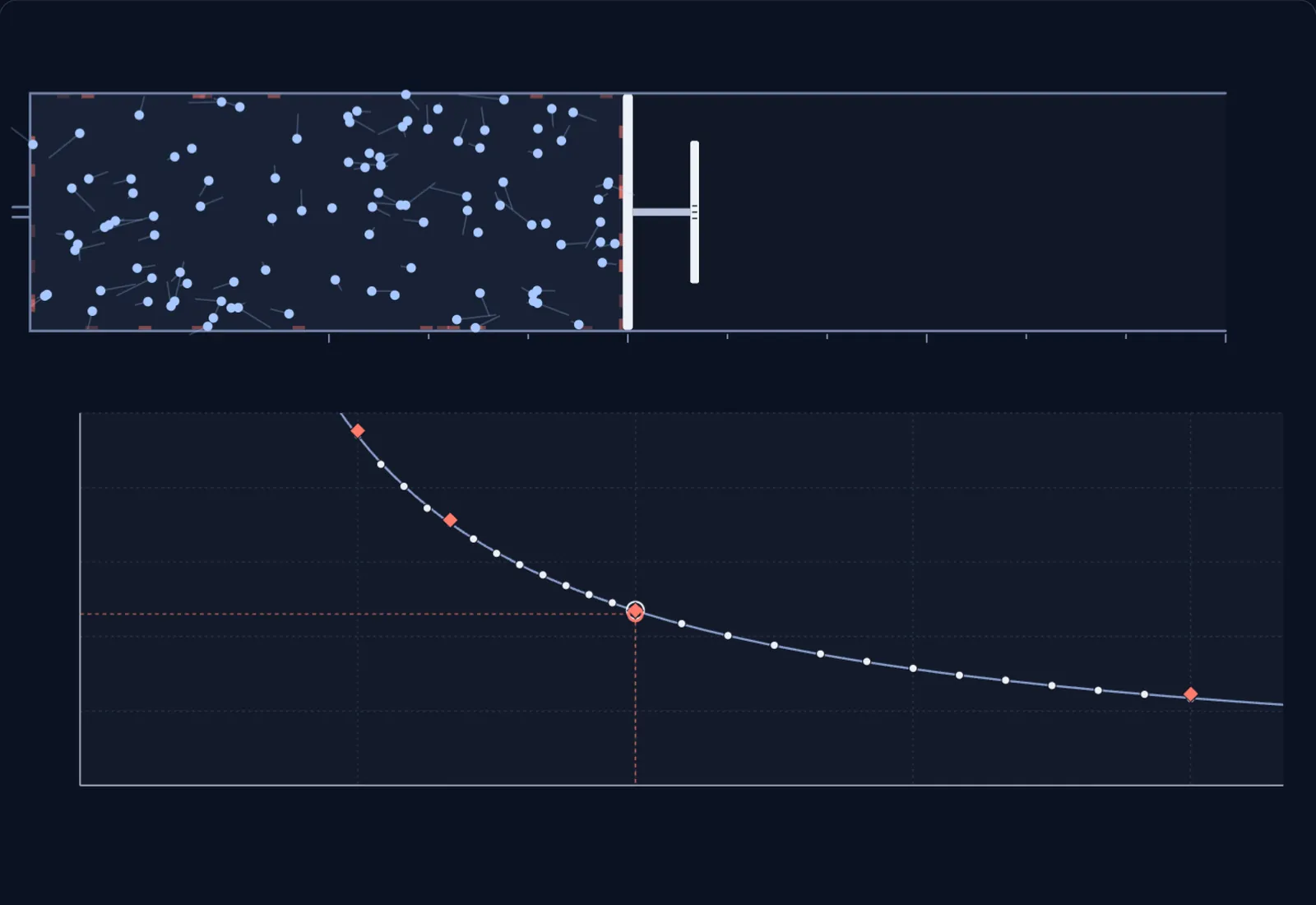
The air in a closed syringe lets itself be pressed, but pushes back harder and harder. The picture beside shows why: a hundred particles in a cylinder with a piston, and a graph with Boyle’s measurements from 1662. Start with a prediction, then press the piston.
The air in a syringe, pressed to half
You close the tip of a syringe, with no needle, with your finger. The piston stands at 48 units of volume, and the air inside is at the pressure of the room. You press the piston to 24 units, half the volume, and wait for the air to return to room temperature.
What happens to the pressure of the air in the syringe?
Pressure comes from particles hitting the walls: at half the volume, it doubles
What the particles do. The hundred particles move in every direction and hit the walls. Every hit is counted, with its strength. The pressure in the corner is the sum of the hits, divided by the length of the wall and by the number of steps of the model; beside it stands the value given by the formula.
Drag the piston to the left or use the buttons. At 24 units the same particles have half the room and hit twice as often: the formula gives twice as much, at 16 units three times, at 12 units four times. Until the count settles, the corner says “counting…”.
What you see. Each red diamond on the graph is the value counted at a volume where you left the piston.
Boyle’s 25 measurements from 1662 lie next to the curve
What you see. The white points are Boyle’s measurements: air trapped in a J-shaped tube, squeezed by mercury. At 48 units of volume he measured 29 1/8 inches of mercury (1 inch = 25.4 mm), at 24 units 58 13/16, at 12 units 117 9/16.
How it is written. The products p · V are 48 · 29.125 = 1,398, 24 · 58.8125 ≈ 1,412 and 12 · 117.5625 ≈ 1,411; over all 25 rows they lie between 1,396 and 1,415. The curve is calculated: p · V = 1,408, the mean of the 25 products.
Boyle did not keep the temperature under control; here 20 °C is taken, as an assumption. The red diamonds come from the cylinder, whose pressure scale is fixed once.
At constant volume, pressure rises with the absolute temperature
What the particles do. Heat the air, with the piston held in place. The particles have a higher mean kinetic energy, so they move faster and hit the walls more often and harder. Heating is here only a calculation.
How it is written. The temperature is counted in kelvin: T(K) = t(°C) + 273. From 20 °C to 40 °C, that is from 293 K to 313 K, the pressure rises by about 7%, it does not double. At 100 °C (373 K) the pressure is 1.27 times higher, at 200 °C (473 K) 1.61 times; the mean speed of the particles rises 1.13 and 1.27 times.
The dotted curve shows the formula at the temperature chosen.
One equation holds all the values together: pV = nRT
How it is written. At constant temperature p · V stays constant; at constant volume p ÷ T stays constant. Put together, they lead to the same ratio for the same amount of gas, p · V ÷ T, and the equation is pV = nRT. In the corner, the ratio p · V ÷ T calculated from the pressure counted comes close to the same value at every volume and temperature, with small deviations.
For one mole at 0 °C (273 K) and 1 atm, with R = 0.082 L·atm/(mol·K): V = nRT ÷ p = 1 · 0.082 · 273 ÷ 1 = 22.39 L, about 22.4 L. With the second button, the hundred drawn particles stand for one mole, that is 6.022·10²³ particles, and the full cylinder holds 22.4 L.
The model explains the curve, but leaves something out
The ideal gas is a model: particles with no volume, which do not attract one another. In the cylinder the particles are discs of a very small diameter compared with the cylinder, with no attraction between them. That is why the count gives p · V nearly constant.
On the graph, p · V is now on the vertical axis. Boyle’s 25 products deviate from the mean 1,408 by at most 0.9%, at pressures up to almost four atmospheres. Beyond these values, real gases deviate from the model: at high pressure the particles can no longer be treated as points, and at low temperature the attractions between them matter.
In air, each kind of particle presses with its own share SN
What the particles do. Of a hundred particles of dry air, 78 are nitrogen molecules (N₂, rings), 21 oxygen (O₂, filled discs) and one argon (Ar, diamond). Each kind hits the walls on its own account.
How it is written. The cylinder holds one mole of air at 0 °C: 22.4 L and 1 atm. The three values in the corner of the picture are the partial pressures, counted from the hits of each kind; the formula pi = xi · ptotal gives 0.78, 0.21 and 0.01 atm. The mean molar mass: 0.78 · 28 + 0.21 · 32 + 0.01 · 40 = 28.96 g/mol, about 29.
Argon is a single particle, so its count settles more slowly and less exactly.
Now you explain
A tyre is inflated in the morning, at 20 °C. In the afternoon it stands in the sun, and the air in it reaches 50 °C. The volume of the tyre changes very little.
Explain, in a few sentences, why the pressure in the tyre rises and by how much, using the hits of the particles and the temperature in kelvin.
Compare with an answer
At 50 °C the particles have a higher mean kinetic energy, move faster and hit the wall more often and harder. At constant volume p₂ ÷ p₁ = T₂ ÷ T₁ = 323 ÷ 293 ≈ 1.10, so the pressure rises by about 10%. The temperature goes in as kelvin, not as degrees Celsius. The pressure gauge shows the difference from the pressure of the atmosphere, while the equation takes the total pressure in the tyre.
The lesson on the ideal gas equation · The lesson on partial pressures