Chapter 11 · GasesLesson 11.2TC Core curriculum (1 hour a week) · beyond your profile
The ideal gas equation of state; calculations
From Boyle’s tube to pV = nRT
You squeeze the air in a syringe to half its volume. What happens to its pressure?
Before you read: what do you think?
In 1662, Boyle trapped air in a tube and compressed it with mercury. At 48 units of volume, the total pressure was 29 1/8 inches of mercury. What did he measure when the volume reached 24 units, half its original value?
See the answer
He measured 58 13/16 inches, almost twice as much. Boyle’s records all show that, at constant temperature, gas pressure rises by the same factor as volume falls.
In 1662, Robert Boyle trapped air in the short end of a J-shaped glass tube and poured mercury into the long end. With each addition of mercury, the air in the short end was squeezed tighter. Boyle recorded the volume and pressure of the air in 25 rows, and their product came out nearly the same. His table is the starting point for the equation used to solve gas problems today.
What Boyle found: volume falls, pressure rises
Boyle worked with an assistant: one watched the mercury level low down in the short end, while the other poured mercury into the long end from above, a little at a time. The total pressure on the trapped air is atmospheric pressure plus the pressure of the mercury column, measured in inches of mercury. The air volume is given in equal units marked on the tube.
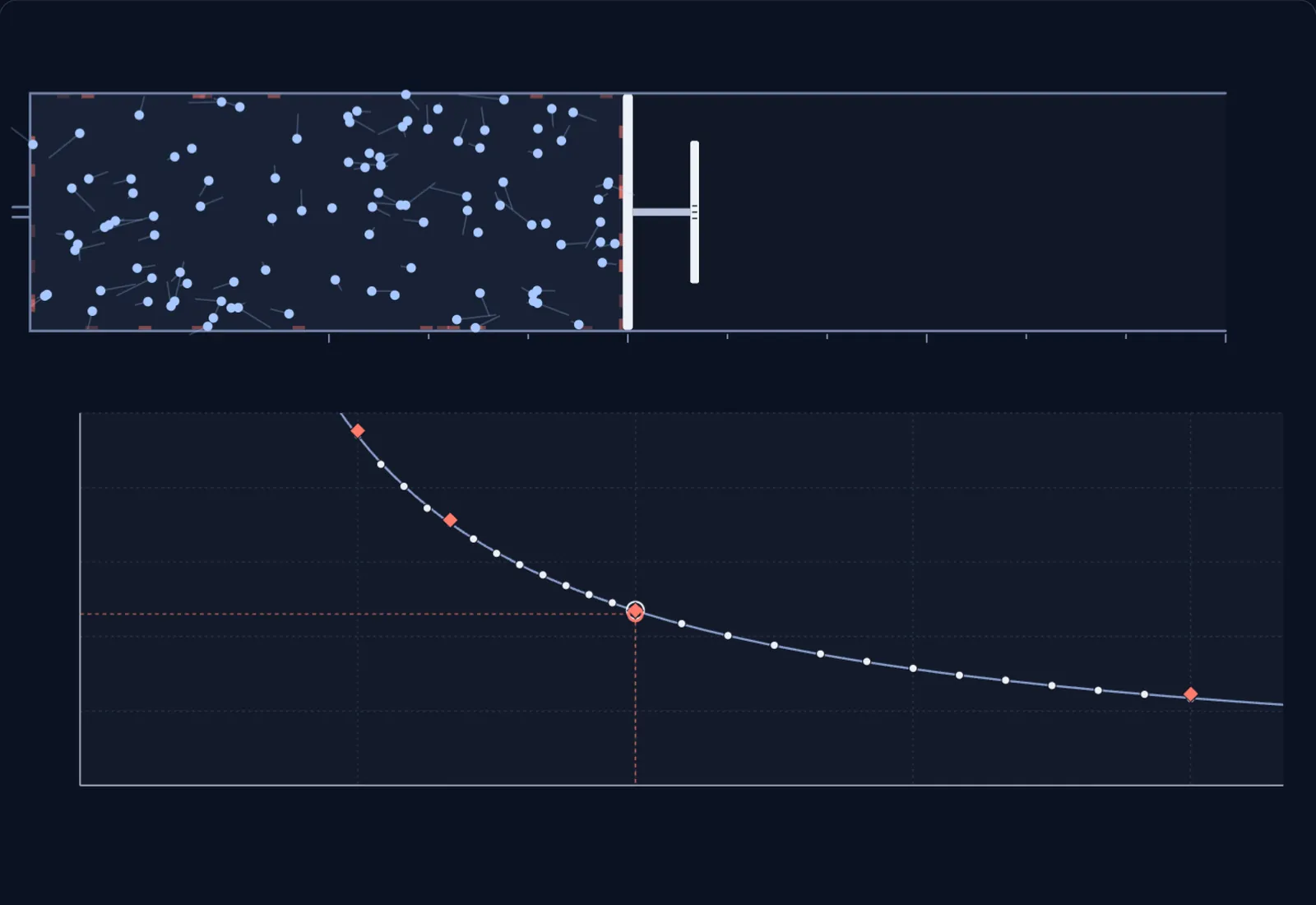
At 48 units of volume, the total pressure was 29 1/8 inches of mercury (1 inch = 25.4 mm, so about 740 mmHg). At 24 units, half the volume, it was 58 13/16. At 12 units, a quarter of the original volume, it was 117 9/16. The pressure doubled when the volume halved and quadrupled when the volume fell to a quarter. The product of the two quantities stays nearly constant: 48 · 29.125 = 1,398, 24 · 58.8125 ≈ 1,412, 12 · 117.5625 ≈ 1,411.
The Boyle–Mariotte law says that, at constant temperature, for a given amount of gas, the product p · V is constant: p₁ · V₁ = p₂ · V₂. A change at constant temperature is isothermal.
| Quantity | Value | How it is obtained |
|---|---|---|
| Volume and pressure at 48 units | 29 1/8 inches of mercury | measured by Boyle, 1662 |
| Volume and pressure at 24 units | 58 13/16 inches of mercury | measured by Boyle, 1662 |
| Volume and pressure at 12 units | 117 9/16 inches of mercury | measured by Boyle, 1662 |
| The product p · V over the 25 rows | between 1,396 and 1,415, mean 1,408 | calculated from the measurements |
| Pressure given by the formula at 24 units, 20 °C | 58.7 inches of mercury | calculated: 1,408 ÷ 24 |
| Pressure given by the formula at 24 units, 40 °C | 62.7 inches of mercury | calculated: p ÷ T constant |
| Pressure counted in the cylinder | shown in the picture, next to the value of the formula | counted from the hits of the particles |
| Pressure at constant volume, compared with 20 °C | at 40 °C 1.07 times, at 50 °C 1.10 times, at 100 °C 1.27 times, at 200 °C 1.61 times | calculated: T ÷ 293, with T in kelvin |
| Volume of one mole at 0 °C and 1 atm | 22.4 L | calculated: V = nRT ÷ p = 1 · 0.082 · 273 ÷ 1 |
| Mean molar mass of dry air | 28.96 g/mol | calculated: 0.78 · 28 + 0.21 · 32 + 0.01 · 40 |
| Partial pressures of dry air at 1 atm | N₂ 0.78 atm, O₂ 0.21 atm, Ar 0.01 atm | calculated: pi = xi · ptotal |
| Volume of the air (units) | Pressure measured by Boyle (inches of mercury) | In decimals | p · V |
|---|---|---|---|
| 48 | 29 1/8 | 29.125 | 1,398 |
| 46 | 30 9/16 | 30.5625 | 1,406 |
| 44 | 31 15/16 | 31.9375 | 1,405 |
| 42 | 33 1/2 | 33.5 | 1,407 |
| 40 | 35 5/16 | 35.3125 | 1,413 |
| 38 | 37 | 37 | 1,406 |
| 36 | 39 5/16 | 39.3125 | 1,415 |
| 34 | 41 5/8 | 41.625 | 1,415 |
| 32 | 44 3/16 | 44.1875 | 1,414 |
| 30 | 47 1/16 | 47.0625 | 1,412 |
| 28 | 50 5/16 | 50.3125 | 1,409 |
| 26 | 54 5/16 | 54.3125 | 1,412 |
| 24 | 58 13/16 | 58.8125 | 1,412 |
| 23 | 61 5/16 | 61.3125 | 1,410 |
| 22 | 64 1/16 | 64.0625 | 1,409 |
| 21 | 67 1/16 | 67.0625 | 1,408 |
| 20 | 70 11/16 | 70.6875 | 1,414 |
| 19 | 74 1/8 | 74.125 | 1,408 |
| 18 | 77 7/8 | 77.875 | 1,402 |
| 17 | 82 3/4 | 82.75 | 1,407 |
| 16 | 87 7/8 | 87.875 | 1,406 |
| 15 | 93 1/16 | 93.0625 | 1,396 |
| 14 | 100 7/16 | 100.4375 | 1,406 |
| 13 | 107 13/16 | 107.8125 | 1,402 |
| 12 | 117 9/16 | 117.5625 | 1,411 |
Measurements and model. The white points are the 25 measurements Boyle published in 1662: the volume of air trapped in a tube, in equal units marked on the tube, and the total pressure, in inches of mercury. The cylinder is a model: 100 particles, hard discs of a very small diameter compared with the cylinder, with no attraction between them, and elastic walls; they are drawn much larger and far fewer than in reality, and atoms and molecules have no colour. The pressure counted is the sum of the impulses of the hits on the walls, divided by the length of the walls and by the number of steps of the model. A single constant, fixed at the start, turns it into inches of mercury or into atmospheres; the red diamonds are the values counted at the volumes where the piston stayed. The curve is calculated: p · V = 1,408 at 20 °C, the mean of Boyle’s 25 products; Boyle did not keep the temperature under control, and the 20 °C is the choice of this picture. The temperature of the model is held constant by the walls, as in a tube in a room; heating is here only a calculation.
Sources and credits. Robert Boyle’s values from A Defence of the Doctrine Touching the Spring and Weight of the Air (1662), public domain, read from two transcriptions compared row by row: Carmen Giunta, Le Moyne College source and ChemTeam source. Composition of dry air: NASA, Earth Fact Sheet source. The constant R = 0.082 L·atm/(mol·K) and the molar masses are those of the book.
Four quantities in one equation
Experiment shows three more things. At constant pressure, the volume of a gas rises in proportion to its absolute temperature: V : T is constant (an isobaric change). At constant volume, pressure rises in proportion to absolute temperature: p : T is constant (an isochoric change). At the same pressure and temperature, volume rises in proportion to the amount of gas n: this is Avogadro’s law.
Together, these lead to the same ratio: p · V : (n · T) has the same value for any ideal gas. This constant is written R, and the relationship is the ideal gas equation:
pV = nRT
R can be found from the molar volume. Under normal conditions, 1 mol of gas has p = 1 atm, V = 22.4 L and T = 273 K, so R = 1 · 22.4 ÷ 273 ≈ 0.082 L·atm/(mol·K).
R is called the molar gas constant. Its value depends on the units: with p in atm, V in L, n in mol and T in K, R = 0.082 L·atm/(mol·K). In SI units, with p in Pa and V in m³, R = 8.314 J/(mol·K). The two values describe the same constant, because 1 L·atm = 101.3 J, and 0.082 · 101.3 ≈ 8.31.
How to solve a gas problem
Write the temperature in kelvin: T(K) = t(°C) + 273. From 20 °C to 40 °C, the absolute temperature rises from 293 K to 313 K, an increase of about 7%; it does not double.
The steps in a problem: write down the data; convert temperature to kelvin, pressure to atm and volume to L; write pV = nRT and rearrange for the required quantity; substitute with R = 0.082; calculate and check the unit and order of magnitude.
Each quantity can be found from the equation: n = pV ÷ (RT), V = nRT ÷ p, p = nRT ÷ V, T = pV ÷ (nR). For the same amount of gas, from state 1 to state 2, the equation gives p₁V₁ ÷ T₁ = p₂V₂ ÷ T₂. Its special cases follow: at constant T, p₁V₁ = p₂V₂; at constant V, p₁ ÷ T₁ = p₂ ÷ T₂; at constant p, V₁ ÷ T₁ = V₂ ÷ T₂.
The mass of the gas is found using n = m ÷ M, so pV = (m ÷ M) · RT.
For the curious
Books give different names to the two laws with T in their ratios. The grade 11 physics textbook from the Republic of Moldova (Marinciuc and Rusu, 2014, in Romanian) calls the law for an isobaric change Gay-Lussac’s law (V : T constant) and the law for an isochoric change Charles’s law (p : T constant). A laboratory sheet from the Politehnica University of Bucharest, however, links Charles’s law to isobaric conditions. The quantity held constant tells you which law is meant.
The current IUPAC standard for pressure is 1 bar (100 kPa), since 1982, rather than 1 atm. At 0 °C and 1 bar, the molar volume of an ideal gas is 22.71 L/mol. In class, calculations use 1 atm and 22.4 L/mol. The value of R has been exact since 2019: 8.314462618… J/(mol·K), while 0.082 L·atm/(mol·K) is the rounded school value.
The ideal gas is a model
The equation pV = nRT describes an ideal gas: particles with no volume of their own and no attraction between them. Real gases approach this model at low pressures and well away from the temperature at which they liquefy.
At high pressures, the particles’ own volume can no longer be ignored, and gas volume is no longer exactly inversely proportional to pressure. At low temperatures, attractions between molecules reduce the pressure below the calculated value. The equation’s result is then an estimate.
Worked example
The amount and mass of gas in a flask
A rigid 12.3 L flask contains oxygen at 2 atm and 27 °C. What amount and mass of oxygen does it contain? What is the pressure if the flask is heated to 127 °C?
Data: p = 2 atm, V = 12.3 L, T = 27 + 273 = 300 K.
From pV = nRT, n = pV ÷ (RT). The product RT = 0.082 · 300 = 24.6 L·atm/mol.
Amount: n = 2 · 12.3 ÷ 24.6 = 1 mol.
Mass: M(O₂) = 2 · 16 = 32 g/mol, so m = 1 · 32 = 32 g.
Heating takes place at constant volume, with the same amount of gas: T₂ = 127 + 273 = 400 K, and p₂ = p₁ · T₂ ÷ T₁ = 2 · 400 ÷ 300 ≈ 2.67 atm.
Check: one mole of gas at 273 K and 1 atm occupies 22.4 L. At 300 K it would occupy a little more, about 24.6 L, and at 2 atm, half that volume, or 12.3 L. The result is correct.
In Romania
A medical oxygen cylinder
Compressed medicinal oxygen is supplied in steel or aluminium cylinders. In the marketing authorisation documents of Romania’s National Agency for Medicines, a 10 L cylinder of Oxigen Linde 100% filled to 150 bar nominally contains 1.5 m³ of oxygen at 1 bar and 15 °C.
Check with the Boyle–Mariotte law, at constant temperature: p₁V₁ = p₂V₂, so V₂ = 150 · 10 ÷ 1 = 1,500 L = 1.5 m³. For 10 L at 200 bar, the table gives 2 m³, and the calculation 200 · 10 ÷ 1 = 2,000 L gives the same result. At such high pressures, real gases depart from the model, so exact values can differ a little from calculated ones.
In short
- The Boyle–Mariotte law: at constant temperature, p · V is constant (an isothermal change); in 1662 Boyle measured that air pressure doubles when volume halves.
- The ideal gas equation is pV = nRT, with R = 0.082 L·atm/(mol·K) = 8.314 J/(mol·K).
- In the equation, p is in atm, V in L, n in mol and T in K; T(K) = t(°C) + 273.
- For the same amount of gas, p₁V₁ ÷ T₁ = p₂V₂ ÷ T₂; the isothermal, isobaric (constant p) and isochoric (constant V) changes follow from it.
- An ideal gas is a model: particles with no volume and no attractions; at high pressures or low temperatures real gases depart from it.
Common mistakes
WrongIf the temperature rises from 20 °C to 40 °C, the pressure in a closed container doubles.
RightCompare the temperatures in kelvin: 293 K and 313 K. The pressure rises by a factor of 313 ÷ 293 ≈ 1.07, or about 7%.
WrongR is always 8.314.
RightThe value of R depends on the units: 0.082 when p is in atm and V in L, 8.314 when p is in Pa and V in m³.
WrongIf I double the pressure, the volume halves, whatever happens to the temperature.
RightThe Boyle–Mariotte law holds only at constant temperature and for a constant amount of gas.
Test yourself
7 questions. For the first 6 you see the explanation at once, with the paragraph of the lesson that supports it; for the written ones you compare with a good answer.
A trapped gas is compressed to half its original volume at constant temperature. How does its pressure change?
Answer
b) It doubles. At constant T, p · V is constant: if V halves, p doubles.
What temperature goes into the equation pV = nRT for a gas at 27 °C?
Answer
c) 300 K. T(K) = t(°C) + 273, so 27 + 273 = 300 K.
For p in Pa and V in m³, what is the value of the molar gas constant?
Answer
d) 8.314 J/(mol·K). In SI units, R = 8.314 J/(mol·K); 0.082 is the value for atm and L.
What amount of gas, in moles, is in 4.1 L at 3 atm and 27 °C? Use R = 0.082 L·atm/(mol·K).
molAnswer
0.50 mol. n = pV ÷ (RT) = 3 · 4.1 ÷ (0.082 · 300) = 12.3 ÷ 24.6 = 0.5 mol.
A rigid container holds gas at 1.5 atm and 27 °C. What is the pressure, in atm, after it is heated to 127 °C?
atmAnswer
2.0 atm. Volume is constant, so p₂ = p₁ · T₂ ÷ T₁ = 1.5 · 400 ÷ 300 = 2 atm.
Put the steps for solving a pV = nRT problem in order.
Answer
The correct order:
- Write down the data
- Convert temperature to kelvin, pressure to atm and volume to L
- Write pV = nRT and rearrange for the required quantity
- Substitute with R = 0.082
- Calculate and check the unit and order of magnitude
Convert the units to match those of R before substituting, then check the result at the end.
A 20 L cylinder is filled with gas at 100 atm. The gas is released at 1 atm and the same temperature. What volume does it occupy? Why is the result only an estimate?
A good answer
From p₁V₁ = p₂V₂, V₂ = 100 · 20 ÷ 1 = 2,000 L. The result is an estimate because at high pressures real gases depart from the ideal gas model: the particles’ own volume and the attractions between them can no longer be ignored.
A complete answer uses p₁V₁ = p₂V₂ at constant T and says that the ideal gas is a model, less exact at high pressures.
Terms
- ideal gas equation
- The relationship pV = nRT between pressure, volume, amount of substance and absolute temperature of an ideal gas.
- molar gas constant
- The constant R in the equation of state: 0.082 L·atm/(mol·K) or 8.314 J/(mol·K).
- isothermal change
- A change in a given amount of gas at constant temperature; p · V is constant.
- isobaric change
- A change at constant pressure; V : T is constant.
- isochoric change
- A change at constant volume; p : T is constant.
- ideal gas
- A model of a gas made of particles with no volume and no attractions between them.
- kelvin
- The unit of absolute temperature; T(K) = t(°C) + 273.
Sources and link to the programme
- Giunta, Le Moyne College – Boyle's Law: Verification – Boyle’s data table published in 1662: 48 units at 29.125, 24 at 58.8125, 12 at 117.5625
- ChemTeam – Robert Boyle and His Data – the J-tube apparatus, the meaning of the table columns (volume, mercury in the long end, atmospheric pressure, total pressure) and the two-person method
- OpenStax – Chemistry 2e, 9.2 Relating Pressure, Volume, Amount, and Temperature: The Ideal Gas Law – Boyle’s, Charles’s and Avogadro’s laws as the basis of pV = nRT; the IUPAC standard of 1 bar from 1982 compared with 1 atm
- OpenStax – Chemistry 2e, 9.6 Non-Ideal Gas Behavior – departure of real gases from the ideal gas law at high pressures and low temperatures
- NIST – CODATA, molar gas constant – R = 8.314462618… J/(mol·K), exact value
- NIST – CODATA, molar volume of ideal gas (273.15 K, 100 kPa) – molar volume of an ideal gas at 0 °C and 100 kPa: 22.711 L/mol
- Agenția Națională a Medicamentului – Rezumatul caracteristicilor produsului, Oxigen Linde 100% (autorizația 14798/2022) – the 10 L cylinder at 150 bar: 1.5 m³ of oxygen at 1 bar and 15 °C; at 200 bar: 2 m³
- Wikipedia în română – Legea Boyle-Mariotte – the Romanian name of the law and its connection with an isothermal change
- Universitatea Politehnica din București – Legea lui Charles (lucrare de laborator) – laboratory sheet linking Charles’s law to isobaric conditions (constant p)
- Ministerul Educației al Republicii Moldova – Fizică, manual pentru clasa a XI-a (Marinciuc, Rusu; Știința, 2014), capitolul 1.8 – Gay-Lussac’s law for an isobaric change and Charles’s law for an isochoric change, in Romanian
From the programme: “The ideal gas equation of state; calculations” (TC: Core curriculum (1 hour a week)). Specific competences followed: 1.6, 2.6, 3.6, 4.6, 5.6, 6.6.