Chapter 3 · Redox and cellsLesson 3.10MI Mathematics–informatics (2 hours) · beyond your profile
Electrolysis of molten sodium chloride
Molten salt and electric current: how sodium is made
Solid salt does not conduct electricity, but molten salt does. What happens to it when current passes through it?
Before you read: what do you think?
Direct current passes through molten sodium chloride between two electrodes. What forms at the negative electrode, the cathode?
See the answer
Sodium forms at the cathode. The negative electrode attracts positive Na⁺ ions, which gain electrons and become sodium atoms. Hydrogen appears at the cathode only when the salt is dissolved in water, because water takes part in the reaction. A melt contains no water.
Solid sodium chloride does not conduct electricity. Molten, it does. If direct current passes through the melt, common salt breaks down into the elements it is made from: a metal, sodium, appears at one electrode and a toxic gas, chlorine, at the other. The process takes place industrially in a Downs cell and is not attempted by pupils in the laboratory.
Why the salt must be meltedWhat you see
A sodium chloride crystal is a lattice of Na⁺ and Cl⁻ ions. In the solid, the ions stay in place and cannot carry electric charge, so the salt does not conduct electricity. Melting breaks up the lattice, and the ions can move freely. Molten salt becomes an electrical conductor.
Sodium chloride melts at 801 °C. The temperature is high and the chlorine formed is toxic. That is why electrolysis of the melt takes place only in special industrial facilities.
The melt contains no water. This matters because in an aqueous solution of NaCl, water takes part in the electrode reactions and the products are different.
What the ions do between the electrodesWhat the particles do
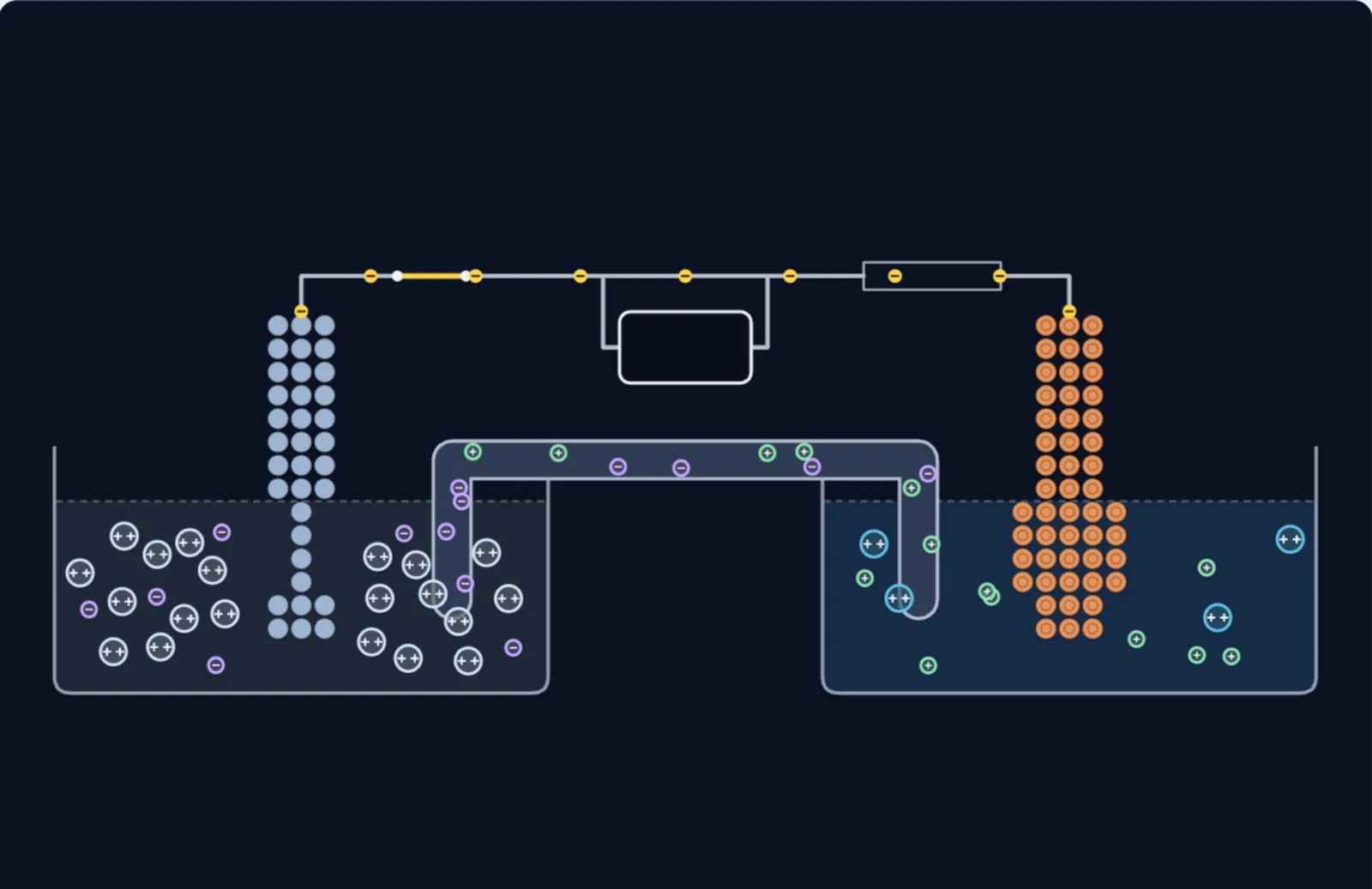
The two electrodes are connected to a direct current supply. The supply keeps one electrode positive, the anode, and the other negative, the cathode. Ions move through the melt: Na⁺ ions towards the cathode, Cl⁻ ions towards the anode. Electrons flow through the connecting wires, and ions through the melt. Electrons do not pass through the liquid: at each electrode surface, charge passes from ions to electrons or the other way round.
At the cathode, Na⁺ ions gain electrons and become sodium atoms: the oxidation number falls from +1 to 0, so this is reduction. At the anode, Cl⁻ ions lose electrons and join in pairs to form chlorine molecules: the oxidation number rises from −1 to 0, so this is oxidation. The power supply forces the reaction in this direction, in which it does not happen on its own, so it consumes electrical energy.
Writing the half-equations and the overall equationHow it is written
Reduction takes place at the cathode (−), oxidation at the anode (+):
Na⁺ + e⁻ → Na
2Cl⁻ → Cl₂ + 2e⁻
The electrons lost at the anode must equal those gained at the cathode. Two Cl⁻ ions lose 2 electrons, so the first half-equation is multiplied by 2 and the two are then added:
2Na⁺ + 2e⁻ → 2Na
2NaCl(l) → 2Na(l) + Cl₂(g)
Electrons no longer appear in the overall equation, because those lost by Cl⁻ ions are gained by Na⁺ ions. Every two moles of NaCl produce two moles of sodium and one mole of chlorine. The sodium produced is liquid at the temperature of the melt, and the chlorine is a gas. The two products are kept separate so they do not react again.
The cell and electrolysis: same site of oxidation, reversed signs
Oxidation always takes place at the anode and reduction at the cathode, in both a cell and electrolysis. The signs of the electrodes depend on the type of device: in a cell, the anode is negative and the cathode positive; in electrolysis, the anode is positive and the cathode negative.
A cell converts chemical energy into electrical energy, and the reaction takes place on its own. Electrolysis converts electrical energy into chemical energy: the reaction does not take place on its own, and the supply must provide energy. In both, electrons flow through the external circuit from anode to cathode, and ions through the electrolyte. To write this correctly, first establish the process at each electrode (oxidation or reduction), then assign the sign according to the device: cell or electrolysis.
For the curious
One mole of electrons has a charge of approximately 96,485 coulombs: this is the Faraday constant, F. In sodium formation, each Na⁺ ion gains a single electron, so for 0.20 mol of Na, 0.20 mol of electrons passes, giving Q = 0.20 · 96,485 ≈ 19,300 C in the ideal case.
In real facilities, calcium chloride is added to sodium chloride so the mixture stays liquid at approximately 600 °C, below the melting point of pure salt. A steel mesh separator keeps the products apart, and the cathode is made of iron, the anode of carbon.
Worked example
How much sodium and chlorine
11.7 g of molten sodium chloride is electrolysed until completely transformed. What mass of sodium and what volume of chlorine, at normal conditions, are produced?
Step 1, the equation: 2NaCl → 2Na + Cl₂. Ratio of amounts: n(NaCl) : n(Na) : n(Cl₂) = 2 : 2 : 1.
Step 2, amount of salt: M(NaCl) = 23 + 35.5 = 58.5 g/mol, so n(NaCl) = 11.7 ÷ 58.5 = 0.2 mol.
Step 3, sodium: n(Na) = 0.2 mol, so m(Na) = 0.2 · 23 = 4.6 g.
Step 4, chlorine: n(Cl₂) = 0.2 ÷ 2 = 0.1 mol, so V(Cl₂) = 0.1 · 22.4 = 2.24 L, and m(Cl₂) = 0.1 · 71 = 7.1 g.
Check: mass is conserved, 4.6 + 7.1 = 11.7 g, the same as the starting mass of salt.
In Romania
Aluminium from Slatina, the same idea with a different compound
ALRO Slatina also produces aluminium by electrolysis. It uses aluminium oxide, Al₂O₃, instead of sodium chloride, dissolved in molten cryolite, Na₃AlF₆, at 940–980 °C; at the cathode Al³⁺ ions are reduced, Al³⁺ + 3e⁻ → Al. The idea is the same: mobile ions in a melt, direct current, metal at the cathode.
Electrical energy consumption is high. In 2022, the world average was approximately 13.2 kWh for each kilogram of primary aluminium. A 100 W light bulb would burn for 13.2 ÷ 0.1 = 132 hours, more than five days. ALRO is the largest consumer of electricity in Romania: the group consumed 3.22 TWh in 2020, or 3.22 · 10⁹ kWh.
Electrolysis of a solution of NaCl in water, brine, is a different process: hydrogen forms at the cathode, chlorine at the anode and sodium hydroxide in solution; no sodium forms.
In short
- Solid sodium chloride does not conduct electricity; when molten, Na⁺ and Cl⁻ ions can move and the salt conducts.
- Electrolysis is the decomposition of a substance by electric current: at the cathode (−), reduction takes place, Na⁺ + e⁻ → Na; at the anode (+), oxidation takes place, 2Cl⁻ → Cl₂ + 2e⁻.
- The overall equation is 2NaCl(l) → 2Na(l) + Cl₂(g); the process consumes electrical energy and takes place industrially in a Downs cell.
- Oxidation always takes place at the anode, reduction at the cathode; in a cell the anode is negative, in electrolysis it is positive.
- The melt contains no water; in an aqueous solution of NaCl, hydrogen forms at the cathode, rather than sodium.
Common mistakes
WrongThe anode is always the negative electrode.
RightOxidation takes place at the anode. In a cell the anode is negative; in electrolysis it is positive because the power supply makes it positive.
WrongMolten salt contains NaCl molecules.
RightThe melt contains Na⁺ and Cl⁻ ions, which move freely. That is why it conducts electricity.
WrongElectrolysis of salt water produces sodium metal.
RightIn an aqueous solution, water takes part in the reaction and hydrogen forms at the cathode. Sodium is obtained from the water-free melt.
Test yourself
7 questions. For the first 6 you see the explanation at once, with the paragraph of the lesson that supports it; for the written ones you compare with a good answer.
What forms at the cathode during electrolysis of molten sodium chloride?
Answer
d) Sodium metal. The cathode is the site of reduction: Na⁺ ions gain an electron and become sodium atoms.
Which statement about the signs of the electrodes is correct?
Answer
c) In a cell the anode is negative, in electrolysis positive. Oxidation still takes place at the anode, but the sign changes: in electrolysis the power supply makes the anode positive.
Why is sodium not obtained by electrolysis of an aqueous solution of NaCl?
Answer
b) Because water takes part in the cathode reaction and hydrogen forms. In solution, water is present at the electrodes. Hydrogen forms at the cathode, and sodium remains as ions in solution.
What mass of sodium, in grams, is obtained by electrolysis of 29.25 g of molten NaCl? Take M(NaCl) = 58.5 g/mol and M(Na) = 23 g/mol.
gAnswer
11.5 g. n(NaCl) = 29.25 ÷ 58.5 = 0.5 mol; n(Na) = n(NaCl) = 0.5 mol; m(Na) = 0.5 · 23 = 11.5 g.
What volume of chlorine, in litres, at normal conditions, is released from 29.25 g of molten NaCl? Take M(NaCl) = 58.5 g/mol and VM = 22.4 L/mol.
LAnswer
5.6 L. n(NaCl) = 0.5 mol; 2 mol of NaCl produce 1 mol of Cl₂, so n(Cl₂) = 0.25 mol; V = 0.25 · 22.4 = 5.6 L.
Does each statement describe an electrochemical cell (a source of current) or electrolysis? Place each statement with the matching device.
Answer
Cell: The reaction takes place on its own; The anode is negative; Chemical energy becomes electrical energy.
Electrolysis: The power supply provides energy; The anode is positive; Electrical energy becomes chemical energy.
A cell produces current from a spontaneous reaction, while electrolysis uses current to force a reaction that does not happen on its own.
A classmate wants to obtain sodium by passing current through salt water. Explain why this will not work and what differs between salt water and molten salt.
A good answer
Salt water contains water molecules, which take part in the electrode reactions. Hydrogen forms at the cathode, while sodium remains as Na⁺ ions in solution. The melt contains no water, so Na⁺ ions are the only ones that can gain electrons at the cathode, producing sodium.
A complete answer names water as a participant in the reaction and the product at the cathode (hydrogen), and says that the melt contains no water.
Terms
- electrolysis
- Decomposition of a substance by direct electric current in a molten or dissolved electrolyte.
- anode
- The electrode where oxidation takes place; positive in electrolysis, negative in a cell.
- cathode
- The electrode where reduction takes place; negative in electrolysis, positive in a cell.
- melt
- A substance made liquid by heating; an ionic substance in this state contains mobile ions.
- Downs cell
- The industrial cell in which sodium is obtained by electrolysis of molten sodium chloride.
- electrolyte
- A substance that, when molten or dissolved, contains mobile ions and conducts electricity.
Sources and link to the programme
- Wikipedia – Downs cell – Molten NaCl electrolysed in the Downs cell; NaCl melts at 801 °C, the mixture with CaCl₂ stays liquid at 600 °C; carbon anode, iron cathode; electrode reactions
- PubChem – Sodium chloride (punct de topire) – melting point of sodium chloride: 800.7 °C (CRC Handbook of Chemistry and Physics, ed. 94)
- Wikipedia – Chloralkali process – electrolysis of brine yields sodium hydroxide, hydrogen and chlorine; molten NaCl processes yield chlorine and sodium
- Wikipedia – Hall–Héroult process – alumina dissolved in molten cryolite, 940–980 °C, reduction of Al³⁺ at the cathode
- Comisia Europeană, Centrul Comun de Cercetare – Zore, L., Decarbonisation options for the aluminium industry (EUR 31925 EN, 2024) – approximately 13.2 MWh per tonne of primary aluminium used worldwide in 2022, according to International Aluminium Institute data
- Economica – Alro, cel mai mare consumator de energie din România – ALRO is the largest consumer of electricity in Romania; aluminium is made by electrolysis; the group consumed 3.22 TWh in 2020
- AL Circle – Alro Slatina continues its strategy to reduce the production costs – ALRO Slatina produces electrolytic aluminium and tests new technologies in the electrolysis sector
- NIST – CODATA, constanta Faraday – F = 96,485.332 C/mol
- PubChem – Chlorine (clasificare GHS) – chlorine is toxic or fatal if inhaled (H330, H331)
From the programme: “Electrolysis of molten sodium chloride” (MI: Mathematics–informatics (2 hours)). Specific competences followed: 2.2, 3.2, 4.2, 5.2, 6.2.