Chapter 7 · The covalent bondLesson 7.2TC Core curriculum (1 hour a week) · beyond your profile
Molecules of hydrochloric acid, water, ammonia, methane and carbon dioxide
Why water is bent and carbon dioxide is straight
H₂O and CO₂ each have three atoms. Why is one bent and the other straight?
Before you read: what do you think?
The three atoms in a water molecule, H–O–H, form an angle. How large is it?
See the answer
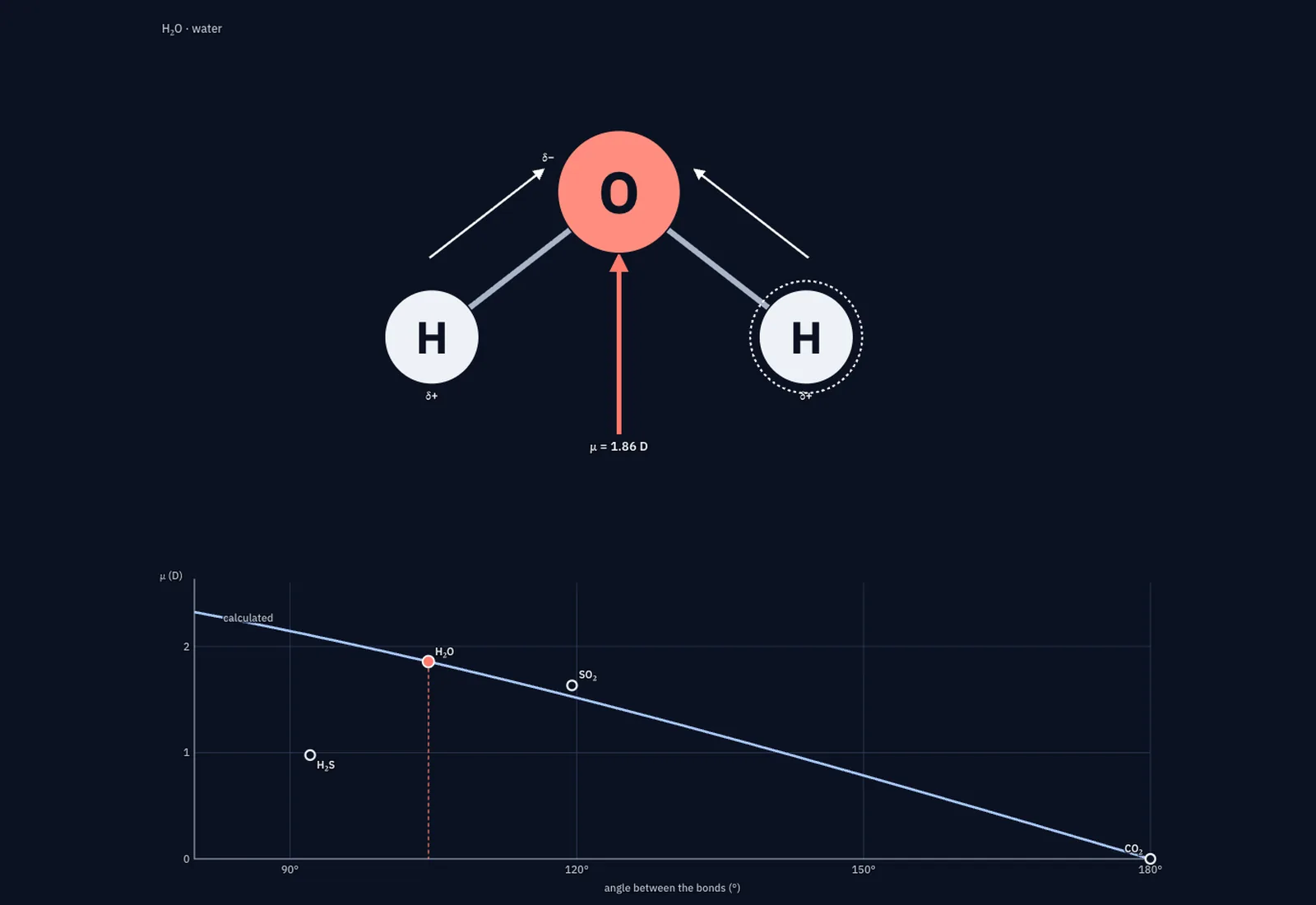
The H–O–H angle is about 104.5°. Oxygen has two lone pairs of electrons, which change the shape compared with carbon dioxide, where carbon has no lone pairs.
Methane, CH₄, burns on your gas cooker. Burning produces water, H₂O, and carbon dioxide, CO₂, which you know as steam and the bubbles in sparkling water. All three have a central atom joined to others by the same covalent bonds, yet one is straight, one bent and one shaped like a four-sided pyramid. Their shapes come from the number of bonds and the lone pairs of electrons.
Four steps to draw a molecule
Draw a molecule in four steps. First add up the valence electrons of all the atoms. Then join the atoms with lines, putting the atom that forms the most bonds in the middle and hydrogen only at the edge. Next add lone pairs until hydrogen has 2 electrons around it and each other atom has 8. Finally check the total: the number of electrons drawn must match the number added up at the start.
The total catches mistakes: if you have drawn 7 or 9 electrons for HCl, the drawing is wrong, however balanced it looks.
HCl: 1 + 7 = 8 valence electrons. One bonding pair joins H to Cl, and chlorine keeps three lone pairs: 2 + 6 = 8 electrons. The covalency of hydrogen and chlorine is 1. The molecule has two atoms, so it is linear.
Water and ammonia: two and three bonds
H₂O: 2 · 1 + 6 = 8 valence electrons. Oxygen forms two bonds, H–O–H, and has two lone pairs: 4 + 4 = 8 electrons. The covalency of oxygen is 2.
NH₃: 3 · 1 + 5 = 8 valence electrons. Nitrogen forms three bonds containing 6 electrons and has one lone pair: 6 + 2 = 8 electrons. The covalency of nitrogen is 3.
Methane and carbon dioxide: four bonds
CH₄: 4 + 4 · 1 = 8 valence electrons. Carbon forms four single bonds with the four hydrogen atoms and has no lone pairs. The covalency of carbon is 4.
CO₂: 4 + 2 · 6 = 16 valence electrons. With two single bonds, O–C–O, carbon would have only 4 electrons around it. So one lone pair from each oxygen is moved into a bond, giving two double bonds: O=C=O. Each oxygen keeps two lone pairs, and carbon has none: 8 + 8 = 16 electrons.
You can read covalency from the drawing: it is the number of lines leading from an atom. In CO₂, carbon has two double bonds, or four lines, so its covalency is 4; each oxygen has two lines, so its covalency is 2.
Shape: what the formula does not show
The formula shows which atoms make up a molecule, but not how they are arranged in space. Shape is measured and explained by repulsion between the electron pairs around the central atom: they arrange themselves as far apart as possible.
Water is bent: the H–O–H angle measured in the gas phase is 104.48°, nearly 104.5°. Ammonia is a trigonal pyramid, with nitrogen at the apex and the three hydrogens at the base; the H–N–H angle is 106.67°, nearly 107°. Methane is a tetrahedron, with carbon at the centre and hydrogens at the four corners, and all H–C–H angles are 109.5°. Carbon dioxide is linear: the O–C–O angle is 180°.
Lone pairs matter: water and ammonia have four pairs around the central atom, like methane, but two in water and one in ammonia do not form bonds, so their angles are smaller than 109.5°.
For the curious
The angle of 104.5° is measured in isolated water molecules in the gas phase. In liquid water, the molecules affect one another, and the angle can be slightly different.
Worked example
The Lewis structure of carbon dioxide
Draw the Lewis structure of CO₂ and check it.
Step 1. Valence electrons: carbon has 4, each oxygen has 6. Total: 4 + 2 · 6 = 16 electrons.
Step 2. Carbon forms more bonds and goes in the middle: O–C–O. Two single bonds use 4 electrons.
Step 3. Complete the oxygens to 8 electrons: each gets three lone pairs, or 6 · 2 = 12 electrons. Total drawn: 4 + 12 = 16 electrons, but carbon has only 4 around it.
Step 4. Move one pair from each oxygen into a bond. The result is O=C=O: four bonding pairs, or 8 electrons, and four lone pairs, or 8 electrons. 8 + 8 = 16, and each atom has 8 electrons around it.
Check: the covalency of carbon is 2 · 2 = 4, that of oxygen is 2, and the total number of electrons matches step 1.
In Romania
Methane from Sărmășel
In 1909, at Sărmășel in Mureș county, a borehole drilled to more than 300 m in search of potassium salts struck natural gas instead. The gas flowed freely to the surface. The first production, in 1913, was 113,000 m³ of gas, which was burned under the well’s boilers. Natural gas is mostly methane, CH₄, the same tetrahedral molecule described above.
Methane in your gas cooker burns with oxygen from the air to produce water and carbon dioxide:
CH₄ + 2O₂ → CO₂ + 2H₂O
One methane molecule produces one CO₂ molecule and two H₂O molecules: four hydrogen atoms go into two water molecules, and the carbon goes into carbon dioxide.
In short
- Build a Lewis structure in four steps: add up the valence electrons, join the atoms, add the lone pairs, check the total.
- HCl: one bond, three lone pairs on chlorine, linear. H₂O: two bonds, two lone pairs on oxygen, bent (104.5°).
- NH₃: three bonds, one lone pair on nitrogen, trigonal pyramid (107°). CH₄: four bonds, tetrahedron (109.5°).
- CO₂: two double bonds, O=C=O, two lone pairs on each oxygen, linear (180°).
- Covalencies: H 1, Cl 1, O 2, N 3, C 4.
- A molecule’s shape does not follow from its formula: it is measured and explained by the electron pairs around the central atom.
Common mistakes
WrongThe water molecule is straight: H–O–H in a line.
RightWater is bent, with an H–O–H angle of about 104.5°. Oxygen has two lone pairs that bend the molecule.
WrongCO₂ is written O–C–O, with single bonds.
RightWith single bonds, carbon would have only 4 electrons around it. The correct structure is O=C=O, with two double bonds.
WrongMethane is flat, with the hydrogens in a square around the carbon.
RightThe hydrogens sit at the corners of a tetrahedron, with angles of 109.5°. The square is just a projection on paper, where the molecule is drawn flat.
Test yourself
7 questions. For the first 6 you see the explanation at once, with the paragraph of the lesson that supports it; for the written ones you compare with a good answer.
What shape is a water molecule?
Answer
b) Bent, with an angle of about 104.5°. Oxygen has two lone pairs, and the molecule is bent.
How many lone pairs does the nitrogen atom in NH₃ have?
Answer
c) 1. Of the 8 electrons in the molecule, 6 are in the three N–H bonds, and the other 2 form a lone pair.
Why is CO₂ written O=C=O rather than O–C–O?
Answer
d) Because with single bonds carbon would have only 4 electrons around it. Moving one lone pair from each oxygen into a bond gives carbon 8 electrons.
How many valence electrons does a CO₂ molecule have in total?
electronsAnswer
16.0 electrons. Carbon has 4 valence electrons and each oxygen has 6; in total, 4 + 2 · 6 = 16.
How many lone pairs does a CO₂ molecule have in total in the structure O=C=O?
pairsAnswer
4.0 pairs. Each oxygen has two lone pairs and carbon has none: 2 · 2 = 4 pairs.
Sort each molecule by whether its central atom (the chlorine atom in HCl) has lone pairs.
Answer
Has lone pairs: Oxygen in H₂O; Nitrogen in NH₃; Chlorine in HCl.
Has no lone pairs: Carbon in CH₄; Carbon in CO₂.
Oxygen in water has two pairs, nitrogen in ammonia has one, chlorine in HCl has three. Carbon in CH₄ and CO₂ uses all its electrons in bonds.
Methane, ammonia and water each have four electron pairs around the central atom, but different shapes. What distinguishes the three molecules?
A good answer
Methane has four bonding pairs and is a tetrahedron with angles of 109.5°. Ammonia has three bonding pairs and one lone pair, so it is a trigonal pyramid with an angle of about 107°. Water has two bonding pairs and two lone pairs, so it is bent, with an angle of about 104.5°.
A complete answer counts the bonding pairs and lone pairs in each molecule and links their numbers to the shape.
Terms
- Lewis structure
- A representation of a molecule in which valence electrons appear as dots or lines.
- lone pair
- A pair of valence electrons that remains on one atom and is not part of a bond.
- covalency
- The number of covalent bonds formed by an atom.
- double bond
- A bond formed by two bonding pairs of electrons, as in CO₂.
- bent molecule
- A molecule with three atoms that do not lie in a straight line, such as water.
- trigonal pyramid
- A shape with the central atom at the apex and three atoms at the triangular base, as in ammonia.
- tetrahedron
- A shape with the central atom at the centre and four atoms at the corners, as in methane.
Sources and link to the programme
- OpenStax – Chemistry 2e, 7.3 Lewis Symbols and Structures – Steps for building a Lewis structure; water and ammonia; CO₂ with two double bonds; hydrogen with a duet
- OpenStax – Chemistry 2e, 7.6 Molecular Structure and Polarity – Molecular shapes, the tetrahedral angle of 109.5° and the linear angle of 180°; repulsion between electron pairs
- NIST CCCBDB – Experimental bond angles of type aHOH – The H–O–H angle of water, 104.48° (equilibrium geometry, gas-phase molecule)
- NIST CCCBDB – Experimental bond angles of type aHNH – The H–N–H angle of ammonia, 106.67°
- Romgaz – History – 1909, Sărmășel: a borehole more than 300 m deep in search of potassium salts released natural gas
- Romgaz – Natural gas production – Sărmășel in Mureș county; first gas production, 1913, 113,000 m³, used in the well’s boilers
- U.S. Energy Information Administration – Natural gas explained – Methane, CH₄, is the largest component of natural gas
From the programme: “Molecules of hydrochloric acid, water, ammonia, methane and carbon dioxide”; “Polar covalent bonding; molecules of hydrochloric acid, water, ammonia, methane, carbon dioxide, chloromethane, methylamine and methanol” (TC: Core curriculum (1 hour a week)). Specific competences followed: 3.4.