Chapter 10 · Acids, bases, pHLesson 10.4TC Core curriculum (1 hour a week) · beyond your profile
Competence: Evaluating the risks associated with the improper use of some chemical products
What label pictograms mean and what never to mix
What does the red-bordered diamond on a bottle of bleach or drain cleaner mean, and why must cleaning products never be mixed?
Before you read: what do you think?
Someone accidentally pours an acidic product onto traces of a hypochlorite bleach. What is released?
See the answer
Bleach mixed with an acid forms chlorine gas, which irritates the eyes, nose and throat and can cause coughing and lung damage. That is why cleaning products must never be mixed.
Bottles of drain cleaner and bleach and many bathroom sprays carry diamond-shaped pictograms with red borders. Each tells you something specific about the product’s hazard. One rule matters more than any pictogram: never mix cleaning products, because some combinations release toxic gases.
What the pictogram on the label means
The European CLP regulation specifies nine hazard pictograms. Each is a diamond with a red border and a white background. A label can carry one or more.
Three pictograms warn of fire and explosion: explosive (an exploding bomb), flammable (a flame) and oxidising (a flame over a circle; the substance sustains or intensifies combustion). A fourth, gas under pressure (a cylinder), marks compressed, liquefied or dissolved gases.
Corrosive means that the product attacks metals or causes skin burns and serious eye damage. Acute toxicity (a skull and crossbones) signals a serious hazard even from a single exposure. The exclamation mark signals lesser hazards: harmful products or products that irritate the skin, eyes and respiratory tract, and can also cause skin allergies; the same mark also signals a hazard to the ozone layer. Serious health hazard marks, among other things, cancer, changes to genetic material, harm to reproduction or organs, respiratory allergies and the hazard from aspiration. Hazardous to the environment marks a hazard to aquatic life.
The label also has a signal word, such as “Danger”, hazard statements (with an H code) and precautionary statements (with a P code). Full details are in the product’s safety data sheet.
For the curious
The same product can carry several pictograms and can move from one hazard category to another depending on its active substance content. The safety data sheet for a drain-cleaning gel lists sodium hydroxide at 5 to less than 10%, and states that the Skin Corr. 1A category applies at concentrations of 5% or more.
How a substance enters the body
The toxicology information register of Romania’s National Institute of Public Health (INSP) states that using a hazardous product according to its label does not rule out accidents caused by deliberate or accidental exposure through swallowing, inhalation or skin contact.
A corrosive substance acts where it lands: on the skin, in the eyes, mouth and throat. A gas irritates the respiratory tract.
What never to mix
Bleach, a solution of sodium hypochlorite, forms chlorine gas when mixed with an acid. Some toilet products contain acid. Chlorine causes burns and irritation in the eyes, nose and throat and can cause coughing and lung damage.
Bleach mixed with ammonia, found in some window-cleaning products, forms chloramines. These are poisonous gases that irritate the respiratory tract and cause throat irritation, a burning sensation in the nose and coughing.
The cited sources give the same rule: never mix bleach with other cleaning products. Keep products in their original, labelled packaging, away from children.
What to do after an accident
The INSP ReTox page, under “What should be done in case of poisoning?”, gives these rules: “Call your doctor.” “Do not wait for symptoms of poisoning to appear before calling your doctor.” “Do not give milk; milk is not an antidote.” “Do not induce vomiting. It is rarely indicated. Ask a poison information centre or a doctor for advice.”
For contact and gases: “If a hazardous product comes into contact with the eyes or skin, wash thoroughly with clean water.” “If irritating or toxic gases are released, evacuate the people present and ventilate the premises thoroughly.” Open windows and doors on the way out only if you can do so without remaining in the gas; nobody goes back in until the gas has cleared. Then: “Keep the packaging of the product that caused the poisoning at hand.”
The numbers: “IN A LIFE-THREATENING EMERGENCY DIAL THE SINGLE EMERGENCY NUMBER 112”. For children there is TOXAPEL, a poison-information telephone service run by the Grigore Alexandrescu Children’s Emergency Clinical Hospital, open 24 hours a day on (021) 210.61.83 and (021) 210.62.82.
Each product’s safety data sheet adds its own instructions for different types of contact. For a drain-cleaning gel containing sodium hydroxide, the sheet warns of “Risk of blindness” from eye contact and says “Do not attempt neutralisation” under swallowing.
Leftovers and the environment
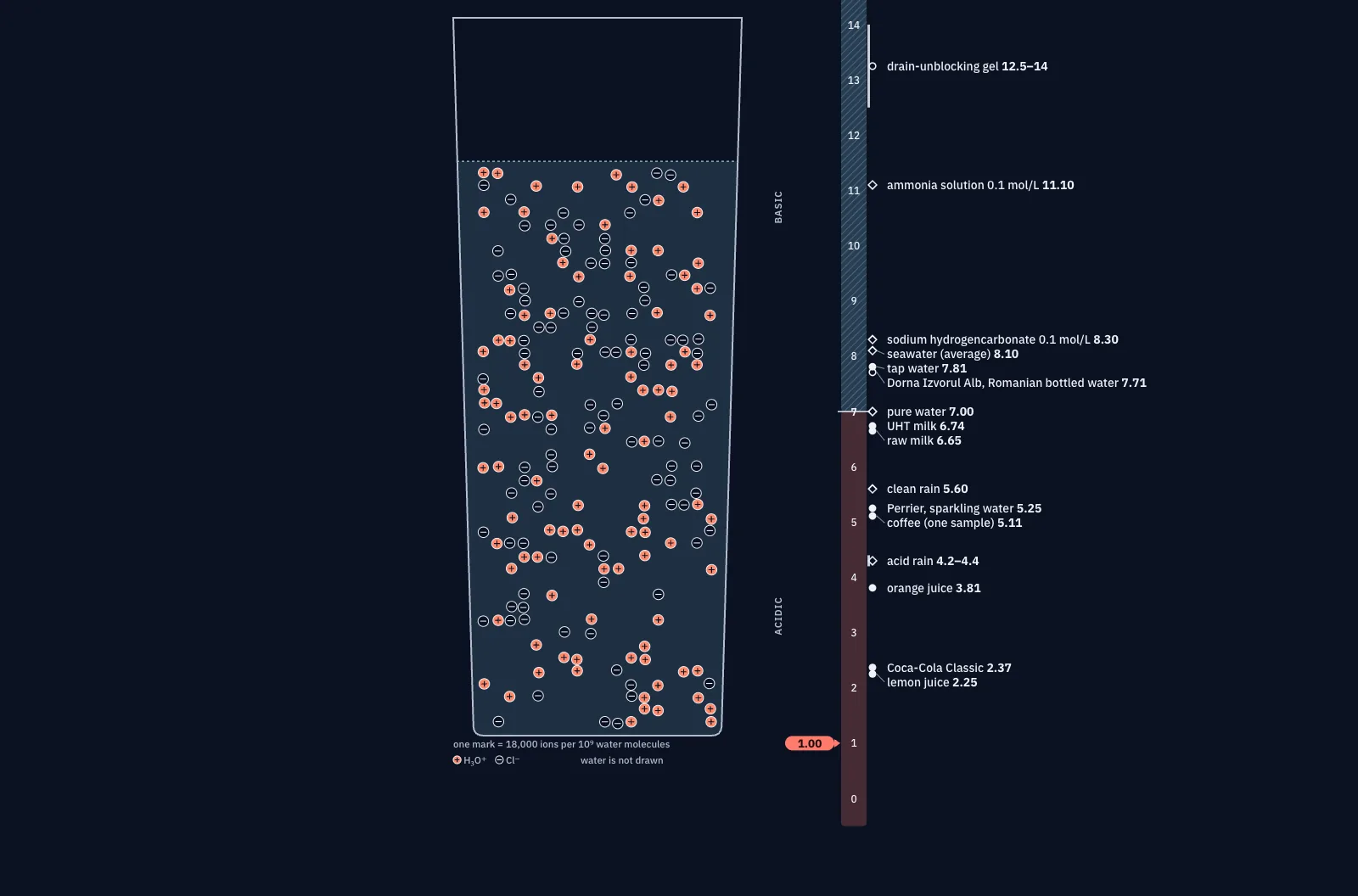
The same sheet says: “The product must not be disposed of with household waste. Avoid release into drains.” Take leftovers to a special waste collection point. A basic product discharged into water harms aquatic organisms because it raises the pH. Acidity also reaches the environment through acid rain, with a pH between 4.2 and 4.4.
Worked example
Reading a drain-cleaning gel label
You read the safety data sheet for a drain-cleaning gel containing sodium hydroxide in four steps.
The pictogram is GHS05, corrosive, and the signal word is “Danger”. The hazardous ingredient that determines the labelling is sodium hydroxide, at 5 to less than 10%.
The hazard statements: H290, “May be corrosive to metals”, and H314, “Causes severe skin burns and eye damage”.
The precautionary statements: “Keep out of reach of children”, “Wear protective gloves”, “Immediately call a POISON CENTRE / doctor”, “Store locked up”.
The conclusion: the product must be kept locked up, away from children, used with gloves and goggles, and never mixed with other products.
In Romania
Child poisonings recorded by INSP
In 2019–2021, the INSP National Toxicology Information Register recorded 604 cases of acute poisoning involving chemical products, namely biocides, detergents and plant protection products, in children aged 0–18. Of these, 562 cases, or 93.04%, were accidental. The total covers several product categories, so it does not refer to detergents alone.
The TOXAPEL service has operated since 1999 and can be called from any landline or mobile phone in the country. Grigore Alexandrescu Hospital hosts the only paediatric toxicology service in Bucharest and the largest such service in Romania.
In short
- There are nine CLP pictograms, each a diamond with a red border: explosive, flammable, oxidising, gas under pressure, corrosive, acute toxicity, exclamation mark, serious health hazard and hazardous to the environment.
- The label also carries a signal word, hazard statements (H) and precautionary statements (P); details are in the safety data sheet.
- A substance enters the body through swallowing, inhalation or skin contact.
- Bleach mixed with an acid forms chlorine; mixed with ammonia, it forms chloramines, gases that irritate the respiratory tract. Never mix bleach with other products.
- After an accident: do not wait for symptoms, do not give milk and do not induce vomiting; wash skin and eyes with clean water; get into fresh air; ventilate only if you can do so without remaining in the gas, and do not go back in until the gas has cleared; keep the packaging. In a life-threatening emergency, call 112.
- Do not put leftover hazardous products in household waste or down the drain.
Common mistakes
WrongIf a product does not clean well enough, I mix it with another to make it stronger.
RightBleach mixed with an acid produces chlorine; mixed with ammonia, it produces chloramines, toxic gases. Never mix cleaning products.
WrongAfter someone swallows a product, give them milk and make them vomit.
RightThe official source says: “Do not give milk; milk is not an antidote” and “Do not induce vomiting”. Ask a doctor or poison information centre for advice.
WrongA product sold in a shop is safe, even if it carries a pictogram.
RightThe pictogram is there because the product has a hazard; for example, a drain-cleaning gel containing sodium hydroxide causes severe skin burns.
Test yourself
6 questions. For the first 5 you see the explanation at once, with the paragraph of the lesson that supports it; for the written ones you compare with a good answer.
A label shows a flame over a circle. What hazard does the pictogram indicate?
Answer
b) The substance is oxidising: it sustains or intensifies combustion. The flame over a circle is the oxidising pictogram. A flame alone means flammable.
What is released when hypochlorite bleach is mixed with an acid?
Answer
c) Chlorine, a toxic gas. Bleach mixed with an acid forms chlorine gas, which irritates the eyes, nose and throat.
According to the INSP ReTox page, what should be done if irritating or toxic gases are released?
Answer
a) Evacuate the people present and ventilate the premises thoroughly. The official page calls for evacuation and ventilation. Open windows only if you can do so without remaining in the gas, and nobody goes back in until the gas has cleared.
What do the 604 cases in the National Toxicology Information Register in 2019–2021 represent?
Answer
b) Cases in children aged 0–18 involving chemical products, biocides, detergents and plant protection products. The total covers several product categories and refers to the 0–18 age group.
Place each pictogram under the type of hazard it marks.
Answer
Fire or explosion: Explosive; Flammable; Oxidising.
Health or environment: Acute toxicity; Serious health hazard; Hazardous to the environment.
The first three mark fire and explosion; the last three mark effects on the body or aquatic life.
A classmate says, “If a cleaning product does not work, I mix it with another.” Explain why this is dangerous and what the classmate should do.
A good answer
Some combinations release toxic gases: bleach with an acid produces chlorine, and bleach with ammonia produces chloramines, which irritate the eyes, nose, throat and lungs. The classmate should use one product, following its label, and keep products in their original packaging. If irritating gases appear, evacuate people to fresh air, ventilate the room only if that can be done without staying in the gas, and let nobody back in until the gas has cleared. Call a doctor or poison information centre; in a life-threatening emergency, dial 112.
A complete answer names at least one dangerous mixture and the gas it produces, explains why it is dangerous, and says what to do instead: use one product, get fresh air, call 112.
Terms
- hazard pictogram
- A red-bordered diamond symbol on CLP labels that shows the type of hazard a product presents.
- safety data sheet
- A document describing a product’s hazards, first aid and disposal.
- hazard statement
- A statement with an H code that describes a hazard, for example H314.
- precautionary statement
- A statement with a P code that says what to do for prevention and response.
- poison information centre
- A specialist service that gives advice in cases of poisoning.
- bleach
- A product containing sodium hypochlorite, used for whitening and disinfecting.
Sources and link to the programme
- HSE (Marea Britanie) – Hazard pictograms (symbols) – the nine pictograms, with the name and symbol of each; the hazards marked by GHS08 (including aspiration and respiratory allergies) and GHS07
- Regulamentul (CE) nr. 1272/2008 (CLP) – anexa V, pictograme de pericol, și anexa I, secțiunea 1.2.1 – the nine pictograms and their hazard classes: GHS01 exploding bomb, GHS02 flame, GHS03 flame over a circle, GHS04 gas cylinder, GHS05 corrosion, GHS06 skull and crossbones, GHS07 exclamation mark, GHS08 health hazard, GHS09 environment; black symbol on a white background, with a red border, in the shape of a square set on a corner
- INRS (Franța) – Pictogramele de pericol ale regulamentului CLP și clasele de pericol asociate – hazard classes grouped under each pictogram: explosives, flammables, oxidisers, gases under pressure, corrosives, acute toxicity, irritants, serious health hazards, hazards to the aquatic environment
- INSP – Registrul de informare toxicologică (ReTox) – routes of exposure (swallowing, inhalation, skin contact) and rules for dealing with poisoning, including 112 and TOXAPEL for children
- Spitalul Clinic de Urgență pentru Copii „Grigore Alexandrescu” – Serviciul TOXAPEL – the TOXAPEL emergency telephone service, established in 1999, open 24 hours a day on (021) 210.61.83 and (021) 210.62.82
- DSP Hunedoara – Informare privind riscurile asociate utilizării produselor de protecție a plantelor – INSP ReTox data for 2019–2021: 604 cases in children aged 0–18, including 562 accidental cases
- MELLERUD – Fișă cu date de securitate: gel pentru desfundat țevi și chiuvete (10 august 2023) – the GHS05 pictogram, the word “Danger”, H290 and H314 statements, precautionary statements, “Risk of blindness”, “Do not attempt neutralisation”, disposal of leftovers, effects on aquatic organisms
- National Capital Poison Center (SUA) – Chlorine gas – bleach mixed with an acid forms chlorine gas, which irritates the eyes, nose and throat
- National Capital Poison Center (SUA) – What is bleach? – bleach mixed with ammonia forms chloramines, gases that irritate the respiratory tract
- ATSDR / CDC – Chlorine: How can families reduce the risk of exposure? – never mix bleach with other cleaning products; chlorine from mixing with acids (for example, some toilet products), chloramines from mixing with ammonia; keep products in their original packaging, away from children
- CDC – Chlorine: chemical fact sheet – after a chlorine release from cleaning products at home: leave the building for fresh air, open windows and doors, stay away until the gas clears and seek help
- EPA – What is acid rain? – acid rain usually has a pH between 4.2 and 4.4
From the programme: “Evaluating the risks associated with the improper use of some chemical products”; “Evaluating the impact and effects of using acidic/ basic solutions on the environment and on health” (TC: Core curriculum (1 hour a week)). Specific competences followed: 6.3, 6.5.