Chapter 8 · Between moleculesLesson 8.2MI Mathematics–informatics (2 hours) · beyond your profile
Dipole–dipole attraction, hydrogen bond, London (dispersion) forces
Why a snowflake has six points
A snowflake has six points, and liquid water boils at 100 °C, even though its molecules are small. What special attraction exists between water molecules?
Before you read: what do you think?
Methane (CH₄, 16 g/mol) boils at −161.5 °C. Water (H₂O, 18 g/mol), with almost the same mass and the same number of electrons, boils at 100 °C. What happens when water boils?
See the answer
On boiling, attractions between molecules break; the vapour still consists of H₂O molecules. Hydrogen bonds between water molecules are much stronger than the London forces between methane molecules.
On a freezing morning, a snowflake on a dark sleeve has six points under a magnifying glass, never five or seven. Its shape comes from how water molecules arrange themselves as they freeze, held together by an attraction stronger than those in noble gases or chlorine.
What conditions must be metWhat the particles do
A hydrogen bond is the attraction between a hydrogen atom covalently bonded to fluorine, oxygen or nitrogen and a lone pair on a fluorine, oxygen or nitrogen atom in another molecule. There are two conditions: hydrogen is bonded to F, O or N, and the neighbouring molecule has a lone pair on an F, O or N atom.
All three elements are highly electronegative, so O–H, N–H and F–H bonds are strongly polar, leaving hydrogen with a large partial positive charge. The hydrogen atom is very small and comes close to the neighbouring electron pair, so the attraction is stronger than an ordinary dipole–dipole attraction.
Hydrogen bonded to carbon, as in CH₄, or to chlorine, as in HCl, does not form hydrogen bonds. The word “bond” can mislead: a hydrogen bond is between molecules, while an O–H bond is inside a molecule.
How to draw it: a line for a covalent bond, dots for a hydrogen bondHow it is written
A covalent bond is drawn as a solid line, and a hydrogen bond as dots. For two water molecules, two HF molecules and two ammonia molecules:
HO–H ··· OH₂
F–H ··· F–H
H₂N–H ··· NH₃
HF, H₂O, NH₃ and alcohols, such as methanol CH₃–O–H, can form hydrogen bonds between their own molecules. CH₄ and HCl cannot, because hydrogen is bonded to C or Cl. Dimethyl ether, CH₃–O–CH₃, has oxygen with lone pairs, but no hydrogen bonded to oxygen, so it cannot form hydrogen bonds between its own molecules.
How strong it is and how water molecules arrange themselvesWhat the particles do
A hydrogen bond has an energy of about 20 kJ/mol. The average energy of an O–H bond in a water molecule is 464 kJ/mol, so the O–H bond is about 464 ÷ 20 ≈ 23 times stronger. The attraction between molecules is weak compared with the covalent bond, but much stronger than London forces between small molecules.
A water molecule can form up to four hydrogen bonds: two through its two hydrogen atoms and two through the two lone pairs on oxygen. Each bond belongs to two molecules, so there are two bonds per molecule on average. Evaporating one mole of water takes 40.7 kJ. If all the bonds are assumed to break on evaporation, 40.7 ÷ 2 ≈ 20 kJ/mol for one bond: an order-of-magnitude estimate.
In ice, water molecules form a permanent network of hydrogen bonds, with rings of six molecules and empty spaces in the middle. This hexagonal arrangement shows in the shape of snowflakes. In liquid water, hydrogen bonds continually break and form again.
| Substance | Group | Electrons | Boils at, °C | How it was obtained |
|---|---|---|---|---|
| H₂O | 16 | 10 | 100 | NIST fluid properties |
| H₂S | 16 | 18 | −60.3 | given by NIST |
| H₂Se | 16 | 36 | −41.6 | calculated from the NIST equation |
| H₂Te | 16 | 54 | −1.7 | calculated from the NIST equation (0.46 K outside its range) |
| NH₃ | 15 | 10 | −33.3 | NIST fluid properties |
| PH₃ | 15 | 18 | −87.3 | calculated from the NIST equation (0.15 K outside its range) |
| AsH₃ | 15 | 36 | −61.9 | calculated from the NIST equation (0.15 K outside its range) |
| HF | 17 | 10 | 19.5 | given by NIST |
| HCl | 17 | 18 | −84.8 | calculated from the NIST equation |
| HBr | 17 | 36 | −66.5 | calculated from the NIST equation |
| HI | 17 | 54 | −34.6 | calculated from the NIST equation (0.42 K outside its range) |
| CH₄ | 14 | 10 | −161.5 | NIST fluid properties |
| SiH₄ | 14 | 18 | −111.5 | calculated from the NIST equation |
| GeH₄ | 14 | 36 | −88.8 | calculated from the NIST equation (0.04 K outside its range) |
| Group | The line passes through | Value of the line at 10 electrons, °C | Measured, °C | Difference, °C |
|---|---|---|---|---|
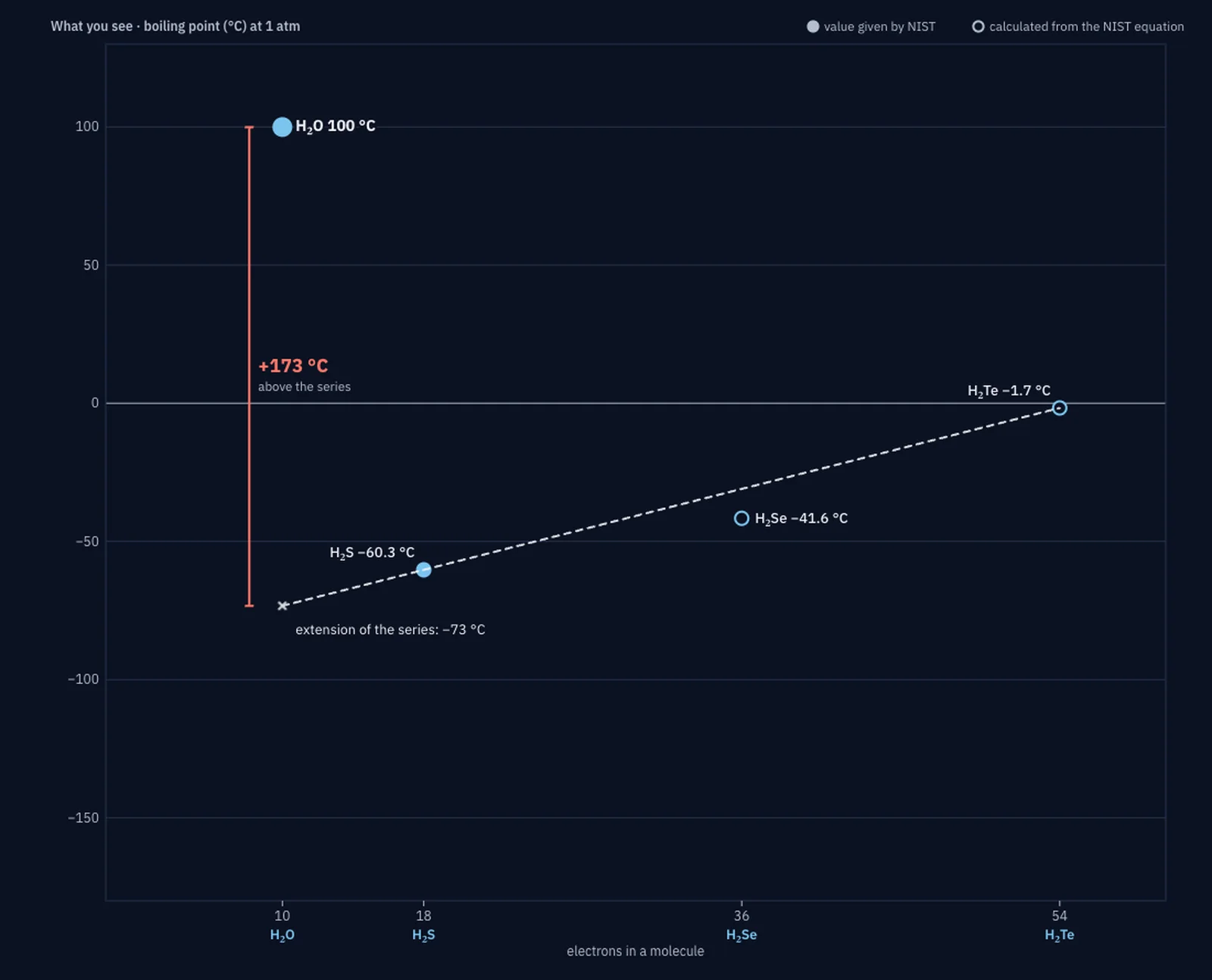
| 16 | H₂S and H₂Te | −73 | 100 | +173 |
| 15 | PH₃ and AsH₃ | −99 | −33.3 | +65 |
| 17 | HCl and HI | −96 | 19.5 | +116 |
| 14 | SiH₄ and GeH₄ | −122 | −161.5 | −40 |
| Substance | Boils at / density |
|---|---|
| ethanol, CH₃CH₂–OH | 78.2 °C |
| dimethyl ether, CH₃–O–CH₃ | −24.8 °C |
| ice at 0 °C, density | 0.917 g/cm³ |
| liquid water at 0 °C, density | 0.9998 g/cm³ |
With 10 electrons, water boils at 100 °C, which is 173 °C above −73 °C, the value of the line through H₂S and H₂Te. Average O–H bond energy: 464 kJ/mol; one hydrogen bond: about 20 kJ/mol.
Measurements, calculation and diagram. The filled points are boiling points given by NIST at normal pressure. The points with an empty ring are calculated from the vapour-pressure equation that NIST fitted to old measurements (Stull, 1947); for H₂Te, PH₃, AsH₃, GeH₄ and HI the temperature falls at most half a kelvin outside the range of the equation. The dashed line and the difference are a calculation: the line passes through the lightest and the heaviest hydride of the group with period three or higher, and is extended down to ten electrons. The molecules are a diagram without a scale: atoms have no colour, and they are drawn greatly enlarged and far fewer than in reality. For SnH₄ and SbH₃ NIST gives no boiling point, so they are missing.
Sources and credits. Values quoted from: NIST Chemistry WebBook, SRD 69 (National Institute of Standards and Technology), pages consulted in 2026 and listed under Sources (the boiling points; the density of liquid water, from the fluid properties). Ethanol and dimethyl ether: PubChem (NIH), compounds 702 and 8254. Density of ice: PubChem, compound 962. Average O–H bond energy: OpenStax, Chemistry 2e, section 7.5.
Hydrogen bonds in DNA and proteins
In DNA, the two strands are held together by hydrogen bonds between bases: adenine and thymine form two hydrogen bonds, while cytosine and guanine form three. In proteins, hydrogen bonds between the C=O group of one amino acid and the N–H group of another hold the chain in an α helix or β sheet.
For the curious
OpenStax gives hydrogen bonds a strength of about 5–10% of a covalent bond. The estimate from water evaporation gives 20 ÷ 464 ≈ 0.043, or nearly 4%. Both are order-of-magnitude values; the actual energy depends on the molecules involved.
Worked example
Ethanol and dimethyl ether, two substances with the same formula
Ethanol, CH₃CH₂–OH, and dimethyl ether, CH₃–O–CH₃, have the same molecular formula, C₂H₆O. Which boils at a higher temperature?
Step 1, molar mass and electrons: M(C₂H₆O) = 2 · 12 + 6 · 1 + 16 = 46 g/mol, the same for both. The same formula means the same number of electrons, 2 · 6 + 6 · 1 + 8 = 26, so the London forces are comparable.
Step 2, hydrogen bonded to oxygen: ethanol has an O–H group, so it forms hydrogen bonds between its own molecules. Dimethyl ether has no H bonded to O.
Step 3, conclusion: ethanol also has hydrogen bonds, so it boils at a higher temperature. The measured values are 78 °C for ethanol and −25 °C for ether. The difference is 78 − (−25) = 103 °C, caused by hydrogen bonds.
In Romania
Snowflakes on your coat
In winter, in any town in the country, you can watch snow falling without wind on a dark coat. A snow crystal is a single ice crystal, in which water molecules have a hexagonal arrangement, so the crystals have sixfold symmetry. A crystal starts as a small hexagonal plate, and branches grow from its six corners.
The exact shape of the branches differs from one crystal to another, because each passes through different temperatures and humidities in the clouds. Sixfold symmetry remains, because it comes from the network of hydrogen bonds between water molecules.
In short
- A hydrogen bond forms between an H bonded to F, O or N and a lone pair on F, O or N in another molecule.
- It is written with dots: O–H···O. It is an interaction between molecules; the O–H bond is inside the molecule.
- A hydrogen bond has an energy of about 20 kJ/mol, compared with 464 kJ/mol, the average energy of an O–H bond.
- Water can form up to four hydrogen bonds per molecule; HF, NH₃ and alcohols also form these bonds.
- In DNA, A–T has two hydrogen bonds and C–G three; hydrogen bonds also hold proteins in shape.
Common mistakes
WrongA hydrogen bond is the bond between H and O in a water molecule.
RightThe H–O bond inside the molecule is covalent, and its average bond energy is 464 kJ/mol. A hydrogen bond is between molecules, with an energy of about 20 kJ/mol.
WrongAny molecule with hydrogen forms hydrogen bonds.
RightHydrogen must be bonded to F, O or N. CH₄ and HCl have no such bonds.
WrongWhen water boils, O–H bonds break and hydrogen and oxygen form.
RightHydrogen bonds between molecules break. The vapour still consists of H₂O molecules.
Test yourself
7 questions. For the first 6 you see the explanation at once, with the paragraph of the lesson that supports it; for the written ones you compare with a good answer.
What conditions are needed for a hydrogen bond between two molecules?
Answer
b) Hydrogen bonded to F, O or N and a lone pair on a neighbouring F, O or N. Hydrogen must be bonded to a highly electronegative atom (F, O, N), and the neighbouring molecule must provide a lone pair on F, O or N.
In the notation O–H···O, what do the dots represent?
Answer
b) The hydrogen bond between molecules. The solid line is the covalent bond inside the molecule; the dots mark the hydrogen bond between molecules.
Which of these molecules does NOT form hydrogen bonds between its own molecules?
Answer
c) CH₃–O–CH₃. In dimethyl ether, hydrogen is bonded to carbon; there is no H bonded to O.
What is the maximum number of hydrogen bonds a water molecule can form?
Answer
c) Four. Two through its two hydrogen atoms and two through the two lone pairs on oxygen.
Evaporating one mole of water takes 40.7 kJ. How many kJ does it take to evaporate 36 g of water? Given M(H₂O) = 18 g/mol. Round to one decimal place.
kJAnswer
81.4 kJ. n = 36 ÷ 18 = 2 mol; Q = 2 · 40.7 = 81.4 kJ.
Sort each substance by whether it forms hydrogen bonds between its own molecules.
Answer
Yes: H₂O; NH₃; CH₃–OH.
No: CH₄; HCl; CH₃–O–CH₃.
The hydrogen bonded to F, O or N is what matters: it is present in H₂O, NH₃ and CH₃–OH. In CH₄ it is bonded to C, in HCl to Cl, and in CH₃–O–CH₃ there is no H bonded to O.
Ethanol boils at 78 °C, and dimethyl ether, with the same formula, at −25 °C. Explain the difference.
A good answer
Both molecules have 26 electrons (2 · 6 + 6 · 1 + 8), so their London forces are comparable. Ethanol has a hydrogen bonded to oxygen and forms hydrogen bonds between its own molecules, whereas dimethyl ether has no such hydrogen. On boiling, attractions between molecules must break. These are stronger in ethanol, so it boils nearly 103 °C higher.
A complete answer compares London forces, identifies whether hydrogen is bonded to oxygen, and links hydrogen bonding to boiling temperature.
Terms
- hydrogen bond
- Attraction between a hydrogen atom bonded to F, O or N and a lone pair on F, O or N in another molecule.
- lone pair
- Pair of valence electrons that is not part of a covalent bond.
- intermolecular interaction
- Weak attraction between molecules, much weaker than the covalent bond inside them.
- alcohol
- Organic compound with an –OH group bonded to a saturated carbon atom.
- electronegativity
- Measure of the ability of an atom in a bond to attract electrons towards itself.
Sources and link to the programme
- OpenStax – Chemistry 2e, 10.1 Intermolecular Forces – hydrogen bonding as an interaction between molecules, between H bonded to F, O or N and a neighbouring F, O or N atom; much weaker than a covalent bond
- OpenStax – Chemistry 2e, 7.5 Strengths of Ionic and Covalent Bonds – average O–H bond energy, 464 kJ/mol
- PubChem – Water – enthalpy of vaporisation of water, 9.717 kcal/mol (40.7 kJ/mol)
- PubChem – Ethanol – boiling point of ethanol, 78 °C
- PubChem – Dimethyl ether – boiling point of dimethyl ether, −24.8 °C
- OpenStax – Biology 2e, 14.2 DNA Structure and Sequencing – adenine and thymine form two hydrogen bonds, cytosine and guanine three
- OpenStax – Biology 2e, 3.4 Proteins – hydrogen bonds maintain the α helix and β sheet
- LibreTexts – Structure of Ice (CK-12) – ice: a network of hydrogen bonds with a hexagonal structure and open spaces; liquid water has short-lived hydrogen bonds
- Snow Crystals (K. Libbrecht, Caltech) – Snowflake science – a snow crystal is an ice crystal with water molecules in a hexagonal arrangement, with sixfold symmetry
From the programme: “Dipole–dipole attraction, hydrogen bond, London (dispersion) forces” (MI: Mathematics–informatics (2 hours)). Specific competences followed: 1.4, 2.4, 4.4, 5.4, 6.4.