Chapter 6 · Ionic and metallic bondsLesson 6.2TC Core curriculum (1 hour a week) · beyond your profile
Ionic compounds – formation of compounds: sodium fluoride, calcium fluoride, sodium chloride, sodium oxide, calcium oxide
Why the formulas are NaF, CaF₂ and Na₂O
A toothpaste label says sodium fluoride, NaF. Calcium fluoride is written CaF₂. Where does the subscript 2 come from?
Before you read: what do you think?
A Ca²⁺ ion and an O²⁻ ion have equal and opposite charges. What is the formula of calcium oxide?
See the answer
CaO. One Ca²⁺ ion cancels the charge of one O²⁻ ion, so the ratio is 1 : 1. Ca₂O₂ would be the same ratio written with larger subscripts; an ionic formula uses the smallest whole-number subscripts.
A tube of toothpaste from a shop says “Sodium Fluoride”, NaF. Calcium fluoride, another fluorine salt, is written CaF₂, and calcium oxide, or quicklime, is written CaO. Why do some formulas have a subscript 2 and others none?
How many electrons each atom gains or losesWhat the particles do
A group 1 metal atom gives up one electron, and a group 2 metal atom gives up two. A group 17 non-metal atom gains one electron, and a group 16 non-metal atom gains two. The number of electrons transferred gives the ions the electron configuration of a noble gas.
Sodium (3s¹) loses its 3s electron and becomes Na⁺, with the electron configuration of neon. Calcium (4s²) loses its two 4s electrons and becomes Ca²⁺, with the electron configuration 1s² 2s² 2p⁶ 3s² 3p⁶, that of argon. Fluorine (2s² 2p⁵) gains one electron and becomes F⁻, with the electron configuration of neon. Chlorine (3s² 3p⁵) becomes Cl⁻, with the electron configuration of argon. An oxygen atom, with 2s² 2p⁴, gains two electrons and becomes O²⁻, with the electron configuration of neon.
Calcium gives up the electrons in shell 4, sodium the electron in shell 3: when ions form, electrons leave the outermost shell, furthest from the nucleus.
The charge of an ion equals the number of electrons given up, with a plus sign, or gained, with a minus sign.
For the curious
Calcium oxide, known in households as quicklime, is made industrially by heating limestone: CaCO₃ → CaO + CO₂. In the PubChem database, most notifications classify it as a substance that causes skin irritation and serious eye damage: it is handled only with protective equipment.
The five compounds, one by oneHow it is written
For each compound, the number of electrons given up by the metal must equal the number gained by the non-metal.
Sodium fluoride, NaF: one electron given up, one electron gained.
Na + F → Na⁺ + F⁻
In the dot diagram, each dot is a valence electron: sodium has one dot, fluorine has seven (three pairs and one single dot). The single dot moves from sodium to fluorine; the F⁻ ion is written in square brackets, with eight dots around the symbol and the charge outside the brackets.
Na• + •F → Na⁺ + [F]⁻
Sodium chloride, NaCl: the same diagram, with chlorine in place of fluorine.
Na + Cl → Na⁺ + Cl⁻
Calcium fluoride, CaF₂: calcium gives up two electrons, and each fluorine atom gains one, so two fluorine atoms are needed.
Ca + 2F → Ca²⁺ + 2F⁻
In the dot diagram, each fluorine atom receives one of the two calcium dots:
•Ca• + 2 •F → Ca²⁺ + 2 [F]⁻
Sodium oxide, Na₂O: oxygen gains two electrons, and each sodium atom gives up one, so two sodium atoms are needed.
2Na + O → 2Na⁺ + O²⁻
Calcium oxide, CaO: two electrons given up, two electrons gained.
Ca + O → Ca²⁺ + O²⁻
For the curious
Starting from the elements in their usual states, the balanced equations are:
2Na + F₂ → 2NaF
2Na + Cl₂ → 2NaCl
Ca + F₂ → CaF₂
4Na + O₂ → 2Na₂O
2Ca + O₂ → 2CaO
Sodium burns in oxygen to give a mixture of sodium oxide and sodium peroxide, Na₂O₂; the equation above is for the oxide, the compound that matters here.
Fluorine and chlorine are dangerous gases, and sodium and calcium are reactive metals: these are equations to read, not experiments to perform.
How to find the formula from the ion chargesHow it is written
An ionic compound is electrically neutral: the total positive charge equals the total negative charge. The formula can be found in three steps. Write the ions and their charges. Find the smallest whole-number ratio at which the charges add up to zero. The numbers in this ratio are the subscripts in the formula; a subscript of 1 is not written.
For Ca²⁺ and F⁻, the ratio 1 : 2 gives 2 − 2 = 0, so the formula is CaF₂. For Na⁺ and O²⁻, the ratio 2 : 1 gives 2 − 2 = 0, so the formula is Na₂O. For Ca²⁺ and O²⁻, the ratio 1 : 1 gives 2 − 2 = 0, so the formula is CaO. Crossing over the charges would give Ca₂O₂, but the ratio 2 : 2 simplifies to 1 : 1.
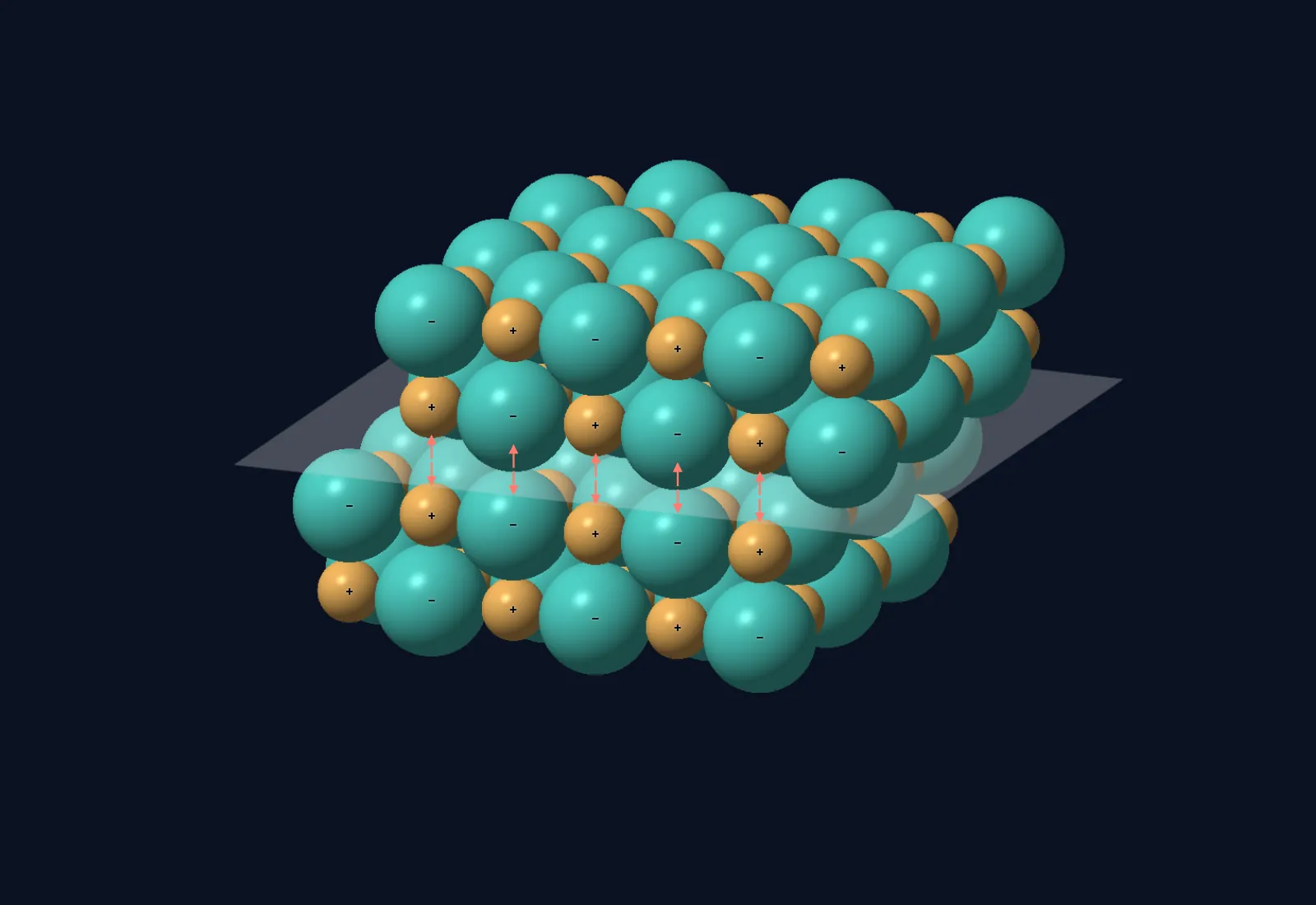
The formula also works in reverse: the subscript 2 in Na₂O shows that there are two Na⁺ ions for each O²⁻ ion, while the one in CaF₂ shows that there are two F⁻ ions for each Ca²⁺ ion. A CaF₂ crystal with a thousand Ca²⁺ ions contains two thousand F⁻ ions. The subscript does not show two atoms bonded in a molecule.
The name is formed from the metal and the anion: calcium fluoride, sodium oxide. The anion of a single element ends in –ide: fluoride, chloride and oxide, O²⁻.
Worked example
Forming calcium fluoride
Write the formation of calcium fluoride from atoms and work out its formula.
Step 1, electron configurations: Ca (Z = 20) has 1s² 2s² 2p⁶ 3s² 3p⁶ 4s²; F (Z = 9) has 1s² 2s² 2p⁵.
Step 2, ions: calcium gives up its two 4s electrons, Ca → Ca²⁺ + 2e⁻, and is left with 1s² 2s² 2p⁶ 3s² 3p⁶. Fluorine gains one electron, F + e⁻ → F⁻, and reaches 1s² 2s² 2p⁶.
Step 3, balancing electrons: the two electrons given up by one calcium atom are gained by two fluorine atoms.
Ca + 2F → Ca²⁺ + 2F⁻
Step 4, formula: one Ca²⁺ ion for two F⁻ ions. Check: 2 − 2 = 0, so the formula is CaF₂.
Numerical check: one mole of CaF₂ contains 1 mol of Ca²⁺ and 2 mol of F⁻, a total of 3 mol of ions, and M(CaF₂) = 40 + 2 · 19 = 78 g/mol.
In Romania
How much sodium fluoride is in toothpaste
The label of a toothpaste sold in Romania says: sodium fluoride 0.315% w/w (1,450 ppm fluorine). For 100 g of toothpaste: m(NaF) = 100 · 0.315 ÷ 100 = 0.315 g.
M(NaF) = 23 + 19 = 42 g/mol, so fluorine makes up 19 of every 42 parts of the mass of the fluoride: m(F) = 0.315 · 19 ÷ 42 = 0.1425 g. In 100 g of toothpaste that is 0.1425%, or 0.1425 · 10,000 = 1,425 ppm (1% is 10,000 ppm). The label also gives 1,450 ppm fluorine, 25 ppm (1.7%) above the calculated value: the two values on the label do not match exactly. A value of 1,450 ppm would require 0.32% sodium fluoride, or 0.32 · 19 ÷ 42 ≈ 0.1448 g of fluorine per 100 g of toothpaste, giving 1,448 ppm.
The European cosmetics regulation permits at most 0.15% fluorine, or 1,500 ppm, in toothpastes containing sodium fluoride.
In short
- A group 1 metal gives up one electron, a group 2 metal two; a group 17 non-metal gains one electron, a group 16 non-metal two.
- The charge of an ion equals the number of electrons given up (+) or gained (−): Na⁺, Ca²⁺, F⁻, Cl⁻, O²⁻.
- The electrons given up by the metal equal those gained by the non-metal: Ca + 2F → Ca²⁺ + 2F⁻; 2Na + O → 2Na⁺ + O²⁻.
- The formula of an ionic compound is the smallest whole-number ratio of ions at which the charges add up to zero: NaF, NaCl, CaF₂, Na₂O, CaO.
- Check and simplify crossed-over charges: Ca₂O₂ becomes CaO.
Common mistakes
WrongCalcium oxide is written Ca₂O₂ because each ion has a charge of 2.
RightThe ratio 2 : 2 simplifies to 1 : 1. One Ca²⁺ ion cancels the charge of one O²⁻ ion, so the formula is CaO.
WrongCaF₂ contains a molecule made of one calcium atom and two fluorine atoms.
RightCaF₂ is a crystal of Ca²⁺ and F⁻ ions. The formula shows the 1 : 2 ratio of ions, not a molecule.
WrongThe negative charge of the F⁻ ion shows that the fluorine atom has lost an electron.
RightThe negative charge shows one extra electron compared with the neutral atom: F + e⁻ → F⁻.
Test yourself
7 questions. For the first 6 you see the explanation at once, with the paragraph of the lesson that supports it; for the written ones you compare with a good answer.
Why is the formula of calcium fluoride CaF₂?
Answer
b) Because one Ca²⁺ ion needs two F⁻ ions for the charges to add up to zero. Ca²⁺ has two positive charges, and each F⁻ has one negative charge: 2 − 2 = 0.
How many electrons does an oxygen atom gain to become an O²⁻ ion?
Answer
b) Two. The 2− charge shows that two electrons have been gained, taking the 2s² 2p⁴ shell to 2s² 2p⁶, as in neon.
What is the ratio of ions in sodium oxide, Na₂O?
Answer
d) Two Na⁺ ions to one O²⁻ ion. Two Na⁺ ions contribute two positive charges, which one O²⁻ ion cancels.
How many moles of ions in total are in 0.5 mol of CaF₂?
molAnswer
1.5 mol. One mole of CaF₂ contains 3 mol of ions (1 mol of Ca²⁺ and 2 mol of F⁻), so 0.5 mol contains 0.5 · 3 = 1.5 mol.
What mass of fluorine, in grams, is in one gram of sodium fluoride? Given M(NaF) = 42 g/mol and A(F) = 19. Round to two decimal places.
gAnswer
0.45 g. Fluorine makes up 19 of every 42 parts of the mass of sodium fluoride: 1 · 19 ÷ 42 ≈ 0.45 g.
Put the steps for finding the formula of an ionic compound in order.
Answer
The correct order:
- Write the ions and their charges
- Find the smallest whole-number ratio at which the charges add up to zero
- Take the subscripts from this ratio, leaving out a subscript of 1
- Check the sum of the charges in the formula
First identify the ions, then their ratio, then the formula, and finally check that it is neutral.
Magnesium is in group 2 and fluorine in group 17. Write the formation of magnesium fluoride from atoms and its formula, then explain briefly why it has two fluorine atoms.
A good answer
Magnesium gives up two electrons: Mg → Mg²⁺ + 2e⁻. Each fluorine atom gains one electron: F + e⁻ → F⁻. Two fluorine atoms are needed for the two electrons given up: Mg + 2F → Mg²⁺ + 2F⁻. The formula is MgF₂, because one Mg²⁺ ion (charge 2+) is balanced by two F⁻ ions (2 · 1−).
A complete answer says how many electrons magnesium gives up and how many each fluorine atom gains, writes the equation for ion formation and links the subscript 2 to the balance of charges.
Terms
- cation
- A positively charged ion, formed by giving up electrons.
- anion
- A negatively charged ion, formed by gaining electrons.
- ionic compound
- A substance made of cations and anions in a ratio at which the positive and negative charges cancel.
- fluoride
- An ionic compound containing the F⁻ anion.
- oxide
- A compound of oxygen with another element; with a metal, as in Na₂O and CaO, it is an ionic compound containing the O²⁻ anion.
- formula unit
- The smallest whole-number ratio of ions in an ionic compound.
Sources and link to the programme
- OpenStax – Chemistry 2e, 7.1 Ionic Bonding – formation of cations and anions by loss or gain of electrons; formation of ionic compounds and ion charges
- Regulamentul (CE) nr. 1223/2009 privind produsele cosmetice, anexa III (text consolidat, 2016) – sodium fluoride in oral hygiene products: at most 0.15% calculated as F; mandatory warning for toothpastes with 0.1–0.15% fluorine
- Selgros – Sensodyne Fluoride pastă de dinți 100 ml – label of a toothpaste sold in Romania: sodium fluoride 0.315% w/w, 1,450 ppm fluorine
- PubChem – Calcium oxide – calcium oxide is obtained by heating limestone; hazard classification: skin irritation, serious eye damage
- PubChem – Sodium fluoride – formula and identity of sodium fluoride
From the programme: “Ionic compounds – formation of compounds: sodium fluoride, calcium fluoride, sodium chloride, sodium oxide, calcium oxide” (TC: Core curriculum (1 hour a week)). Specific competences followed: 1.4, 2.3, 3.4.