Chapter 12 · Chemistry problemsLesson 12.2MI Mathematics–informatics (2 hours) · beyond your profile
Stoichiometric calculations will be carried out using the chemical formula and the equation of a chemical reaction, with purity, yield, excess of a reactant, percentage concentration by mass and molar concentration of solutions
Which runs out first when the mixture does not match the equation
You mix 6 g of hydrogen with 32 g of oxygen. Hydrogen has the smaller mass. Does it run out first?
Before you read: what do you think?
The equation 2H₂ + O₂ → 2H₂O applies to 6 g of H₂ and 32 g of O₂ (complete reaction). Which reactant runs out first?
See the answer
Oxygen runs out. 6 g of H₂ is 3 mol, and 32 g of O₂ is 1 mol. The equation calls for 2 moles of H₂ for every mole of O₂, so 2 moles of H₂ are enough for 1 mol of O₂, and 1 mol of hydrogen remains.
An equation says what ratio substances react in. But you do not always put that exact ratio in a vessel: you put in what you have. At some point one reactant runs out, the reaction stops, and some of the other is left. A test question asks you to find which runs out, how much product forms and how much remains.
One reactant runs out, the other remains
The limiting reactant is the one used up first and determines how much product forms. The reactant in excess is the one of which some remains unreacted at the end. The same mixture can have one limiting reactant in one equation and another when the ratio changes. Every problem of this kind has two hidden questions: which runs out and how much remains.
An example from the kitchen: a recipe calls for two eggs per cup of flour. With four eggs and three cups of flour, you make two portions: the eggs run out first, and one cup of flour remains. The comparison shows the idea, but reactants are compared in moles and with coefficients, not in pieces of the same kind.
How to find the limiting reactant
For the equation aA + bB → products, convert the masses to moles, then divide each amount by its coefficient in the equation:
n(A) ÷ a and n(B) ÷ b
The reactant with the smaller value is limiting. Calculate the amounts of product from it alone. Subtract what was used up from the other reactant; the difference is the excess: nremaining = ninitial − nconsumed.
The smaller mass in the question decides nothing. For 2H₂ + O₂ → 2H₂O, 6 g of H₂ is 6 ÷ 2 = 3 mol, and 32 g of O₂ is 32 ÷ 32 = 1 mol. Compare 3 ÷ 2 = 1.5 with 1 ÷ 1 = 1. Oxygen has the smaller value, so oxygen is limiting, even though it has the larger mass. The reaction forms 2 moles of water, or 36 g, and leaves 1 mol of H₂, or 2 g. Mass is conserved: 6 + 32 = 36 + 2 = 38 g.
For the curious
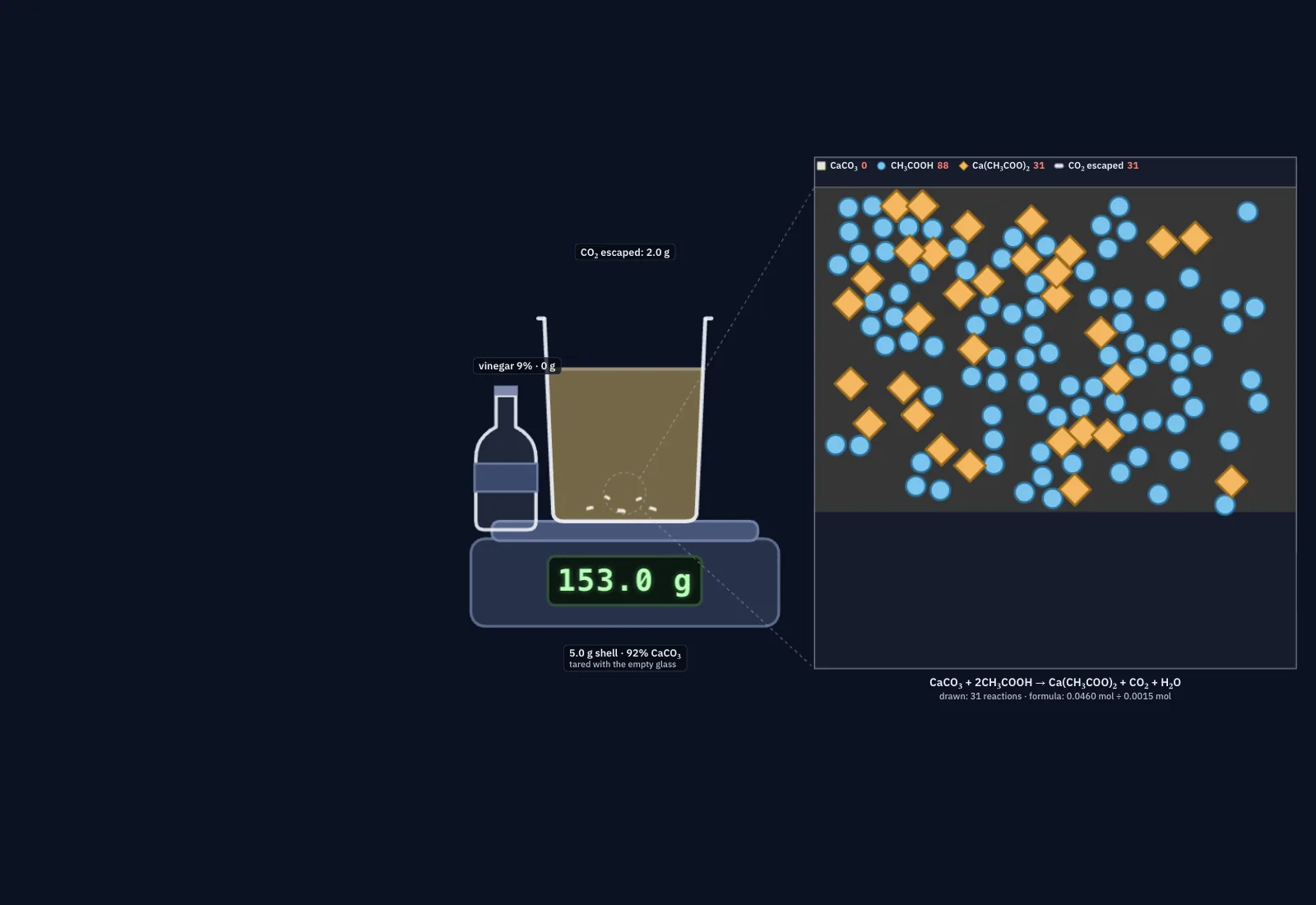
The amount of product can also be read from a graph: if you keep one reactant fixed and gradually increase the amount of the other, the product increases in proportion until the varied reactant is in excess, then stays constant. The plateau shows that the fixed reactant is limiting.
| Vinegar poured (g) | Balance (g) | CO₂ escaped (g) | Limiting reactant | Acetic acid left (mol) | Reactions drawn |
|---|---|---|---|---|---|
| 0 | 5.0 | 0.0 | — | 0.000 | 0 |
| 10 | 14.7 | 0.3 | the acid | 0.000 | 5 |
| 20 | 24.3 | 0.7 | the acid | 0.000 | 10 |
| 30 | 34.0 | 1.0 | the acid | 0.000 | 15 |
| 40 | 43.7 | 1.3 | the acid | 0.000 | 20 |
| 50 | 53.4 | 1.6 | the acid | 0.000 | 25 |
| 60 | 63.0 | 2.0 | the acid | 0.000 | 30 |
| 70 | 73.0 | 2.0 | the shell | 0.013 | 31 |
| 100 | 103.0 | 2.0 | the shell | 0.058 | 31 |
| 150 | 153.0 | 2.0 | the shell | 0.133 | 31 |
| Shell (g) | CaCO₃ in the shell | CO₂ escaped with 150 g of vinegar (g) | Balance (g) |
|---|---|---|---|
| 2 | 92% | 0.8 | 151.2 |
| 5 | 92% | 2.0 | 153.0 |
| 10 | 92% | 4.0 | 156.0 |
| 5 | 95% | 2.1 | 152.9 |
| 5 | 100% | 2.2 | 152.8 |
Shell of 5.0 g with 92% CaCO₃ (4.6 g, 0.046 mol) and vinegar with 9% acetic acid by mass (the assumption of the exercise). Calculated; the balance is tared with the empty glass. The equation: CaCO₃ + 2CH₃COOH → Ca(CH₃COO)₂ + CO₂ + H₂O. One drawn particle stands for 0.0015 mol.
Calculation. An exact calculation from the atomic masses of the book, for 5 g of shell with 92% CaCO₃ (the white shells analysed in the cited study had 91%, the brown ones 95%; the literature cited by the study gives 92–97%) and vinegar with 9% acetic acid by mass, the assumption of the exercise: labels in Romania say “9%” or “9 degrees”. The rest of the shell does not react in the calculation. The balance is tared with the empty glass. The drop on a real balance can be smaller than the calculated one, because some of the CO₂ stays dissolved in the liquid. Atoms and molecules have no colour: they are drawn enormously enlarged and far fewer than in reality, one particle for every 0.0015 mol; the water in the vinegar is not drawn.
Sources and credits. Strength of the vinegar: the Carrefour România product title, “Oțet 9% 1 L Vinalcool”, and the Auchan România page, “Oțet de Bistrița, 9 grade, 1 L” (read on 2026-11-16); the mass basis of the 9% is the assumption of the exercise. CaCO₃ content of the shell: values quoted from C. O. Ogah, K. U. Nwaeze, O. O. Adetifa, Journal of Basic and Social Pharmacy Research 2(2), 27–34 (2021): 91% for the white shells and 95% for the brown ones they analysed, 92–97% in the literature they cite. Atomic masses: CIAAW, the rounded values of the book.
For gases, compare volumes directly
At the same temperature and pressure, gas volumes are proportional to their amounts in moles. So you can compare litres of gases without converting through mass. For H₂ + Cl₂ → 2HCl, 4 L of H₂ and 6 L of Cl₂ give: H₂ is limiting (4 ÷ 1 versus 6 ÷ 1), 2 · 4 = 8 L of HCl forms and 6 − 4 = 2 L of Cl₂ remains.
The rule applies only to gases and only under the same conditions. Masses always add up; volumes do not in general; calculate them from moles.
Excess by design, excess by mistake
Excess is sometimes deliberate: more of the cheap reactant is used so the expensive reactant is completely consumed. In the laboratory, during neutralisation, an extra drop of base changes the colour of an indicator and shows that the acid has run out.
At other times excess causes trouble: if gas burns with too little air, the flame changes and unwanted substances form. This happens at a cooker, as described below.
Steps for any problem: (1) the balanced equation; (2) moles of each reactant; (3) n ÷ coefficient for each; (4) the smaller value identifies the limiting reactant; (5) calculate the product from it; (6) find the excess by subtraction; (7) check the mass: initial reactants = products + excess.
Worked example
Iron and sulfur
A mixture of 14 g of iron and 12 g of sulfur reacts completely according to Fe + S → FeS (in the laboratory, the reaction is a demonstration done by the teacher). Which reactant is in excess, what mass of FeS forms and what mass of the reactant in excess remains?
Moles: n(Fe) = 14 ÷ 56 = 0.25 mol; n(S) = 12 ÷ 32 = 0.375 mol. The coefficients are 1 and 1, so the comparison is direct.
Iron has the smaller value, 0.25 versus 0.375, so it is limiting. Sulfur is in excess.
From 0.25 moles of Fe, 0.25 moles of FeS form. M(FeS) = 56 + 32 = 88 g/mol, so m(FeS) = 0.25 · 88 = 22 g.
The reaction consumes 0.25 moles of S, leaving 0.375 − 0.25 = 0.125 mol, or 0.125 · 32 = 4 g of sulfur.
Check: 14 + 12 = 26 g at the start and 22 + 4 = 26 g at the end. Answer: sulfur is in excess, 22 g of FeS forms and 4 g of sulfur remains.
In Romania
In the kitchen: the blue and yellow flames of a gas cooker
Natural gas is mostly methane. Complete combustion: CH₄ + 2O₂ → CO₂ + 2H₂O. One litre of methane needs 2 L of oxygen. Air contains approximately 21% oxygen, so 1 L of methane needs 2 ÷ 0.21 ≈ 9.5 L of air, and the burner mixes the gas with air before combustion.
With enough air, oxygen is in excess and the flame is blue. With too little air, methane is in excess: some burns incompletely, according to CH₄ + O₂ → C + 2H₂O and 2CH₄ + 3O₂ → 2CO + 4H₂O. Glowing soot particles make the flame yellow, and carbon monoxide has no smell. A dirty burner also produces a yellow flame: colour alone does not prove an excess of gas. Carbon monoxide has no smell and, at certain concentrations, can cause death. A yellow burner flame calls for the appliance to be checked by a specialist. ISU, the emergency services inspectorate: do not use the cooker for heating, and air rooms often.
In short
- The limiting reactant is used up first and determines how much product forms; some of the reactant in excess remains unreacted.
- Convert the masses to moles and compare n ÷ coefficient; the smaller value identifies the limiting reactant.
- The smaller mass in the question does not identify the limiting reactant: with 6 g of H₂ and 32 g of O₂, oxygen is limiting.
- Calculate the product from the limiting reactant; the excess remaining is ninitial − nconsumed.
- For gases under the same conditions, compare volumes directly, like moles; masses add up, volumes do not in general.
- Check: the mass of the initial reactants equals the mass of the products plus the mass of the excess.
Common mistakes
WrongThe reactant with the smaller mass is limiting.
RightThe limiting reactant has the smallest n ÷ coefficient value. With 6 g of H₂ and 32 g of O₂, hydrogen has the smaller mass, but oxygen is the one that runs out.
WrongWhen one reactant runs out, calculate the product from the sum of both.
RightCalculate the product from the limiting reactant alone. The excess has nothing left to react with.
WrongThe reactant in excess disappears from the mixture.
RightIt remains unreacted in the vessel and counts in the mass balance: the initial reactants equal the products plus the excess.
Test yourself
7 questions. For the first 6 you see the explanation at once, with the paragraph of the lesson that supports it; for the written ones you compare with a good answer.
What is the limiting reactant?
Answer
b) The reactant used up first that determines the amount of product. The limiting reactant runs out first; the one left is in excess.
With 6 g of H₂ and 32 g of O₂ (2H₂ + O₂ → 2H₂O; M(H₂) = 2 g/mol, M(O₂) = 32 g/mol), which reactant is in excess?
Answer
c) Hydrogen. n(H₂) ÷ 2 = 1.5, and n(O₂) ÷ 1 = 1. Oxygen is limiting, and 1 mol of hydrogen remains.
A pupil says that 10 g of A reacts completely with 10 g of B because they have the same mass. What is missing from the reasoning?
Answer
d) A comparison of the amounts in moles, using the coefficients in the equation. Reactants combine in mole ratios given by the coefficients, not in equal masses.
10 g of NaOH is mixed with 7.3 g of HCl: NaOH + HCl → NaCl + H₂O. What mass of NaOH remains unreacted, in grams? M(NaOH) = 40 g/mol, M(HCl) = 36.5 g/mol.
gAnswer
2.0 g. n(NaOH) = 10 ÷ 40 = 0.25 mol; n(HCl) = 7.3 ÷ 36.5 = 0.2 mol. HCl is limiting, 0.2 moles of NaOH is consumed, leaving 0.05 mol = 2 g.
Under the same conditions, 5 L of H₂ is mixed with 8 L of Cl₂ (H₂ + Cl₂ → 2HCl). What volume of HCl forms, in litres?
LAnswer
10.0 L. H₂ is limiting, with 5 L. From 5 L of H₂, 2 · 5 = 10 L of HCl forms, and 3 L of Cl₂ remains.
Put the steps of a problem with a reactant in excess in order.
Answer
The correct order:
- Write the balanced equation
- Convert the masses to moles
- Calculate n ÷ coefficient for each reactant
- The smaller value identifies the limiting reactant
- Calculate the product from the limiting reactant
- Find the excess by subtraction
The order follows the stated steps: find the limiting reactant before the product, and the excess after you know how much was consumed.
A gas cooker flame is yellow and leaves soot on the bottom of a pan. Explain which reactant is in excess and what forms in addition to CO₂ and H₂O.
A good answer
Usually methane is in excess because too little air reaches the burner (a dirty burner has the same effect). Some methane burns incompletely, producing soot (carbon, C), which glows yellow, and carbon monoxide, CO, an odourless, toxic gas.
A complete answer names methane as the reactant in excess, air or oxygen as the insufficient reactant, and the two products of incomplete combustion.
Terms
- limiting reactant
- The reactant used up first, which determines the amount of product.
- reactant in excess
- The reactant of which some remains unreacted at the end of the reaction.
- stoichiometric ratio
- The ratio of the amounts of reactants in moles, given by the coefficients in the equation.
- incomplete combustion
- Combustion with too little oxygen, in which carbon (soot) or carbon monoxide also forms.
Sources and link to the programme
- OpenStax – Chemistry 2e, 4.4 Reaction Yields – limiting reactant and reactant in excess, theoretical yield
- Wikipedia – Natural gas – natural gas is mainly methane (approximately 95%)
- Wikipedia – Atmosphere of Earth – dry air contains approximately 20.95% oxygen by volume
- ELGAS – Blue flame: gas flame colour as a safety indicator – a blue flame indicates complete combustion; a yellow or red flame comes from fine soot particles, indicates incomplete combustion and can produce carbon monoxide, an odourless gas
- ISU Harghita (IGSU) – Aragazul NU este o sursă de căldură! – burning gas in a cooker consumes oxygen in the room and releases carbon monoxide, which can cause death; do not use the cooker for heating, air rooms often and check installations
- Agerpres – Delgaz Grid: 13 cazuri de intoxicație cu monoxid de carbon, 9 decese – carbon monoxide is colourless and odourless; CO detectors in rooms with gas appliances
From the programme: “Stoichiometric calculations will be carried out using the chemical formula and the equation of a chemical reaction, with purity, yield, excess of a reactant, percentage concentration by mass and molar concentration of solutions” (MI: Mathematics–informatics (2 hours)). Specific competences followed: 5.1, 5.2.