Chapter 6 · Ionic and metallic bondsLesson 6.5MI Mathematics–informatics (2 hours) · beyond your profile
Metallic bonding
Why copper conducts electricity and bends, while salt breaks
A copper wire bends and conducts electricity when solid. A salt crystal breaks and does not conduct. What is different inside?
Before you read: what do you think?
An electric current from a battery passes through a copper wire. What moves along the wire?
See the answer
Positive ions sit at lattice points. Delocalised electrons belong to the whole crystal; they move and carry the charge.
The National Museum of Romanian History displays spiral Dacian gold bracelets found in the Orăștie Mountains. Uncoiled, one would form a bar nearly three metres long, apparently hammered from a single ingot. The gold stretched without breaking; a salt crystal would have shattered at the first blow.
What a copper wire, aluminium foil and a gold bracelet have in commonWhat you see
Metals share several properties: they are shiny, conduct electricity and heat well, and most can be beaten into sheets (they are malleable) and drawn into wires (they are ductile). A paper clip bends without breaking, while a piece of chalk breaks. A metal spoon in a cup of warm water warms at the handle faster than a wooden one.
Silver, copper, gold and aluminium are the best electrical conductors. At 20 °C their resistivities, in nΩ·m, are: silver 15.87, copper 16.78, gold 22.14, aluminium 26.50. The lower the resistivity, the better the metal conducts. Aluminium has 1.58 times the resistivity of copper, so it conducts less well.
For the curious
Aluminium conducts less well than copper, but its density is much lower. For the same resistance, an aluminium wire has just 0.48 times the mass of a copper wire (1.58 · 2.70 ÷ 8.96 ≈ 0.48, with densities of 2.70 and 8.96 g/cm³); that is why it is used for overhead power lines. Gold can be beaten into leaf about 100 nm thick, or 1,000,000 ÷ 100 = 10,000 times thinner than a millimetre.
Not all metals are malleable: bismuth is brittle and breaks when struck, so it is used in mixtures with other metals.
Positive ions in a cloud of shared electronsWhat the particles do
Metal atoms have few electrons in their outer shell, and these are held weakly. In a crystal, the valence electrons belong to the whole crystal rather than to a particular atom: they are delocalised electrons. Positive ions, made up of the nucleus and inner electrons, remain at the lattice points. A metallic bond is the attraction between the positive ions in the lattice and the delocalised electrons.
Textbooks call this model the “sea of electrons”. It is a model: the electrons form a distribution of negative charge that holds the positive ions together, rather than a liquid between balls. The crystal remains neutral because the total positive charge equals the total negative charge.
In a wire connected to a battery, delocalised electrons move towards the positive terminal, while the ions remain in the lattice. That is why metal conducts electricity even when solid. Solid salt does not, because its ions cannot move. Mobile electrons also carry energy, which is why metals conduct heat well. Mobile electrons also give metals their shine.
Compare salt: its positive and negative ions alternate and are fixed in place, while the electrons stay with their ions. In a metal, the positive ions are all of the same kind and the electrons move among them. The first structure conducts only when the ions become mobile; the second conducts even when solid.
When one layer of ions slides past its neighbour, the delocalised electrons rearrange and the attraction between ions and electrons holds the crystal together. Delocalised electrons remain between the positive ions and weaken the repulsion between them; in a salt crystal, ions with the same charge come face to face. This is why metal bends, can be beaten into sheets and can be drawn into wires.
| Quantity | Value | How it is obtained |
|---|---|---|
| NaCl unit cell edge | 564.02 pm | measured |
| Edge from the sum of the ionic radii | 566 pm | calculated: 2 · (102 + 181) |
| Distance between a Na⁺ and a neighbouring Cl⁻ | 282 pm | half the measured edge |
| Radius of Na⁺, radius of Cl⁻ | 102 pm, 181 pm | Shannon, coordination number 6 |
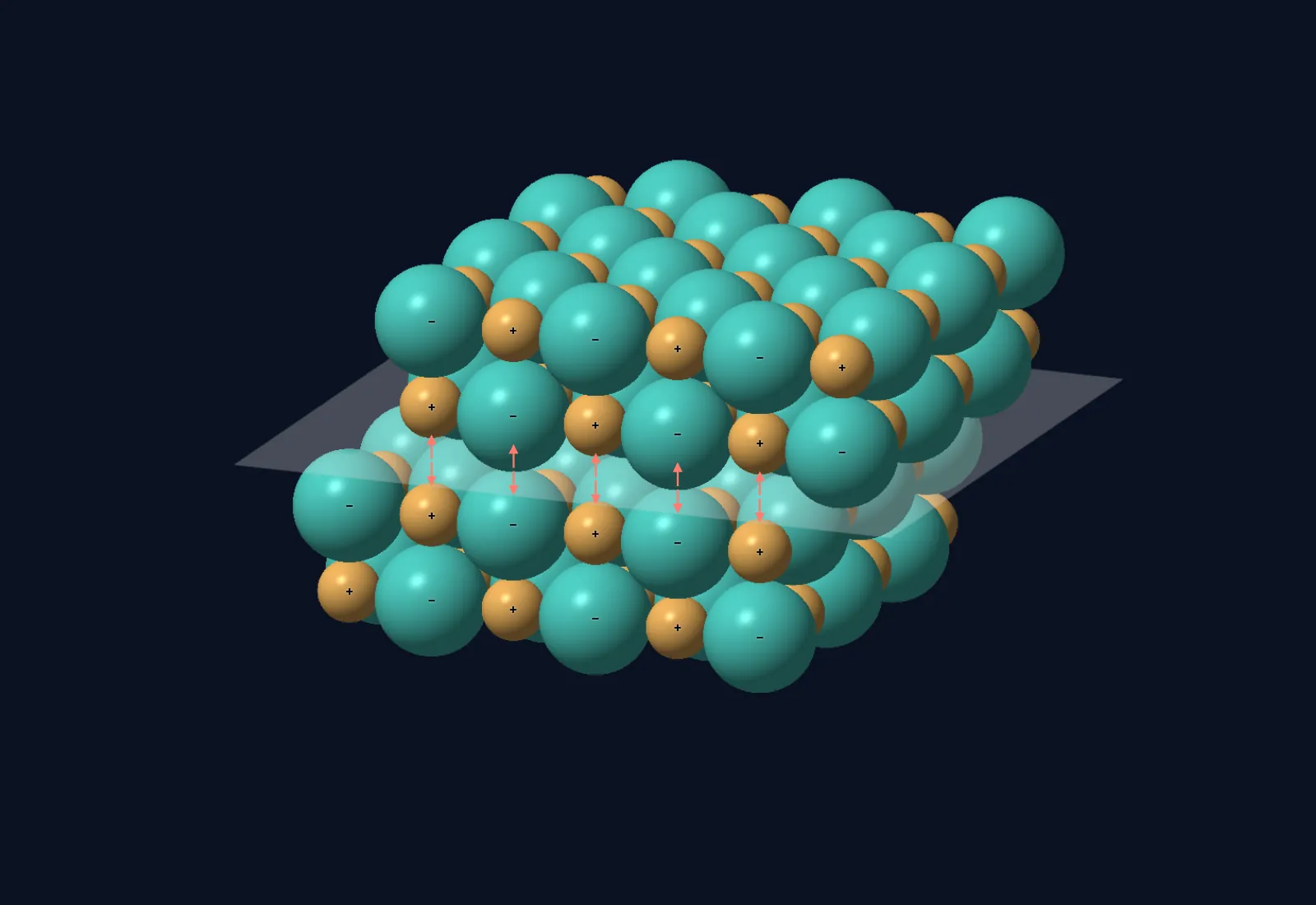
| The block drawn | 144 ions: 72 Na⁺, 72 Cl⁻ | four layers of 6 × 6 |
| Electrostatic energy between the halves of the block, before the push | −15.3 eV | calculated: negative, the halves are bound |
| Push at which the energy passes through zero | 166 pm | calculated |
| Energy after a push of 282 pm | +3.3 eV | calculated: positive, ions of the same sign face to face |
| Cu unit cell edge | 361.5 pm | measured |
| Distance between two neighbouring copper ions | 255.6 pm | the edge divided by √2 |
| Nearest neighbours of a copper ion | 12, before and after a push of 255.6 pm | counted in the block drawn |
| Neighbours of a copper ion in the pushed layer, at half a step | 10 | counted in the block drawn |
| Free particles: solid salt, molten salt, copper | 0 of 144 ions; 144 of 144 ions; 216 electrons of 216 copper ions | drawing of the motion, numbers from the block |
| Melting point of NaCl | 801 °C | measured |
Diagram and calculation. Diagram to scale: the positions of the ions come from the measured cell edges (NaCl 564 pm, Cu 361.5 pm), and the radii of Na⁺ and Cl⁻ are the Shannon ionic radii (102 and 181 pm). The electrostatic energy between the halves is calculated for the 144 ions drawn, as point charges in a vacuum, with no other forces, and the halves are rigid; so that the spheres do not overlap, the top half is lifted as far as it needs to be, a choice of the drawing. The cleavage of salt is an observed property; the calculation illustrates it, it does not prove it. The copper cores are drawn smaller than in reality, so that the electrons show, and the molten salt is a drawing, not a calculation. In a real metal, defects slide, not whole layers. Atoms and ions have no colour: they are drawn enormously enlarged and far fewer than in reality. Salt is melted only as a demonstration done by the teacher.
Sources and credits. NaCl unit cell edge: 564.02 pm, value quoted from Wikipedia, "Sodium chloride", and checked in the Crystallography Open Database (entries 9003308 and 7132177, public domain). Cu unit cell edge: 361.5 pm (Swanson and Tatge, National Bureau of Standards, in the Crystallography Open Database, entry 5000216, public domain). Ionic radii: R. D. Shannon, Acta Crystallographica A32, 751 (1976), Imperial College London database. Vacuum permittivity: CODATA, NIST. Melting point of NaCl: PubChem.
How to write a metal and an alloyHow it is written
A metal is written using only the element symbol: Cu, Fe, Na, Au. The formula has no subscript because the metal is a crystal with a very large number of atoms, rather than a molecule.
An alloy is a material made of two or more elements, at least one of which is a metal. It is described by its composition, given as percentages, and has no chemical formula. Brass is copper with zinc, bronze is copper with tin and sometimes zinc, and steel is iron with carbon and other elements.
Worked example
How thick is the bar in the Dacian bracelet
Bracelet no. 12 has a mass m = 885.02 g, and the uncoiled bar has a length l = 2.69 m = 269 cm. Assume a pure gold bar with a circular cross-section and ρ = 19.3 g/cm³. What is its diameter?
Volume: V = m ÷ ρ = 885.02 ÷ 19.3 ≈ 45.9 cm³.
Find the cross-sectional area by dividing the volume by the length: 45.9 ÷ 269 ≈ 0.171 cm², or 17.1 mm².
Radius: the area of a circle is π · r², so r² = 17.1 ÷ 3.14 ≈ 5.45 mm², and r ≈ 2.33 mm.
Diameter: d = 2 · 2.33 ≈ 4.7 mm.
Check: nearly five millimetres is a reasonable result for a bar nearly three metres long and weighing less than a kilogram. The alloy is less dense than pure gold, so for the same mass the real bar has a slightly greater volume and cross-sectional area.
In Romania
The gold bracelets from Sarmizegetusa Regia
The National Museum of Romanian History displays spiral Dacian gold bracelets, dated to the last decades of the 1st century BC, found near Sarmizegetusa Regia in the Orăștie Mountains. Uncoiled, the bar of bracelet no. 12 would be 2.69 m long and was apparently hammered from a single ingot.
The bracelets do not all have the same composition: gold content ranges from 78% to 92.9%, with silver and copper making up the rest. They are therefore alloys, and the variation is attributed to the use of unrefined native gold rich in silver.
In short
- A metallic bond is the attraction between positive ions in the lattice and delocalised valence electrons shared by the whole crystal.
- Metal conducts electricity even when solid: delocalised electrons move while ions remain in the lattice; electrons also carry energy, so metals conduct heat too.
- Malleability and ductility come from layers sliding: delocalised electrons remain between ions and rearrange, preserving cohesion. In salt, ions with the same charge come face to face.
- Silver, copper, gold and aluminium are the best electrical conductors.
- A metal is written using its symbol; an alloy is a mixture of elements, at least one of which is a metal, and is described by its composition.
Common mistakes
WrongCopper ions travel through the copper wire.
RightCopper ions remain at the lattice points. Delocalised electrons move through the wire.
WrongMetals bend because the metallic bond is weak.
RightMetallic bonds can be strong. Metal bends because, as layers slide, delocalised electrons remain between the ions and maintain cohesion; in salt, ions with the same charge come face to face.
WrongA metal is made of molecules, for example Cu₂.
RightA metal is a crystal of ions and delocalised electrons. It is written with its symbol, Cu, without a subscript.
Test yourself
7 questions. For the first 6 you see the explanation at once, with the paragraph of the lesson that supports it; for the written ones you compare with a good answer.
Which particles move through a copper wire when an electric current passes?
Answer
c) Delocalised electrons. Positive ions sit at lattice points; delocalised electrons are mobile.
Why can gold be beaten into thin sheets while salt breaks?
Answer
a) In metal, delocalised electrons remain between ions as layers slide and maintain cohesion; in salt, ions with the same charge come face to face. In salt, a sliding layer brings ions with the same charge face to face. In metal, delocalised electrons remain between the ions.
How is metallic copper written?
Answer
d) Cu, using only the symbol. Metal is a crystal with a great many atoms rather than a molecule, so its formula has no subscript.
How many times greater is the resistivity of aluminium than that of copper? Use 26.50 nΩ·m and 16.78 nΩ·m and round to two decimal places.
timesAnswer
1.58 times. 26.50 ÷ 16.78 ≈ 1.58. Aluminium conducts less well than copper.
What is the volume, in cm³, of a pure gold bar with a mass of 885.02 g? Take ρ = 19.3 g/cm³; round to one decimal place.
cm³Answer
45.9 cm³. V = m ÷ ρ = 885.02 ÷ 19.3 ≈ 45.9 cm³.
Place each property under the type of substance it belongs to.
Answer
Metal, such as copper (metallic bonding): Conducts electricity even when solid; Can be beaten into sheets; Contains delocalised electrons.
Ionic compound, such as salt: Conducts electricity only when molten or dissolved; Breaks when struck; Is a lattice of positive and negative ions.
Metal has mobile electrons and layers that slide; an ionic compound has fixed ions that repel one another if the layers slide.
A copper wire conducts electricity when solid, but solid salt does not. Explain the difference in three sentences, naming the particles that carry charge.
A good answer
In copper, valence electrons are delocalised and move through the crystal when a voltage is applied, while positive ions remain in the lattice. In solid salt, Na⁺ and Cl⁻ ions are fixed at lattice points and cannot move, while the electrons stay with their ions. Salt conducts only when molten or dissolved, when its ions become mobile.
A complete answer names the charge carriers (electrons in metal, ions in molten or dissolved salt) and explains why they cannot move in solid salt.
Terms
- metallic bond
- The attraction between positive ions in a metal lattice and delocalised valence electrons.
- delocalised electrons
- Valence electrons that belong to the whole crystal rather than a particular atom.
- malleable
- Able to be beaten into thin sheets without breaking.
- ductile
- Able to be drawn into wires without breaking.
- alloy
- A material made of two or more elements, at least one of which is a metal.
- resistivity
- A measure of how poorly a material conducts electricity; the lower it is, the better the material conducts.
Sources and link to the programme
- OpenStax – Chemistry 2e, 10.5 The Solid State of Matter – the structure of metals as nuclei in a “sea” of delocalised electrons; electrical and thermal conductivity, shine and malleability; contrast with brittle ionic solids
- OpenStax – Chemistry 2e, 18.1 Periodicity – brass (Cu and Zn) and bronze (Cu, Sn, sometimes Zn) as alloys
- OpenStax – Chemistry 2e, 19.1 Occurrence, Preparation, and Properties of Transition Metals and Their Compounds – steel as an alloy of iron with carbon and other elements
- R. A. Matula (1979), Electrical resistivity of copper, gold, palladium, and silver, J. Phys. Chem. Ref. Data 8, 1147 (reprint NIST) – recommended values at 293 K, in 10⁻⁸ Ω·m: Ag 1.587; Cu 1.678; Au 2.214 (that is, 15.87; 16.78; 22.14 nΩ·m)
- P. D. Desai, H. M. James, C. Y. Ho (1984), Electrical resistivity of aluminum and manganese, J. Phys. Chem. Ref. Data 13, 1131 (reprint NIST) – recommended value for aluminium at 293 K: 2.650 · 10⁻⁸ Ω·m, or 26.50 nΩ·m
- Royal Society of Chemistry – Copper și Aluminium (densitate) – density of copper, 8.96 g/cm³, and aluminium, 2.70 g/cm³ (aluminium page: periodic-table.rsc.org/element/13/aluminium)
- Royal Society of Chemistry – Bismuth – bismuth is a brittle metal
- PubChem – Gold – density of gold, 19.3 g/cm³
- Wikipedia – Gold leaf – gold leaf thickness, approximately 100 nm
- Muzeul Național de Istorie a României – Brățările dacice de aur – bracelet no. 12: a 2.69 m bar hammered from a single ingot, mass 885.02 g; 78–92.9% gold with silver and copper; date and place
From the programme: “Metallic bonding”; “The influence of electron delocalisation on the physical properties of metals: electrical and thermal conductivity, malleability and ductility” (MI: Mathematics–informatics (2 hours)). Specific competences followed: 1.4, 2.4, 4.4, 5.3, 5.4.