Chapter 9 · SolutionsLesson 9.2MI Mathematics–informatics (2 hours) · beyond your profile
Dissolving ionic substances in water
Why iodine dissolves in alcohol but oil does not dissolve in water
Sugar disappears in water, oil stays on top, and iodine barely dissolves in water but dissolves in alcohol. What determines where each one goes?
Before you read: what do you think?
You pour a teaspoon of oil into a glass of water and stir vigorously. Then you leave the glass alone for five minutes. What do you see?
See the answer
Stirring breaks the oil into tiny droplets, which seem to mix with the water. As the glass stands, the droplets join up again and float on top: oil and water are immiscible liquids, and water does not admit oil molecules among its own.
In hot soup, fat rises to the surface in round droplets and does not mix with the broth. Sugar disappears in tea, while a splash of alcohol poured into water mixes at once. The same three substances behave differently in the same glass of water, and the reason lies in their molecules.
Three observations: sugar, oil, alcoholWhat you see
Sugar disappears in water. Oil stays on top, in droplets that join up again as soon as you stop stirring. Ethanol (ethyl alcohol) and water mix in any proportion. Two liquids that mix in any proportion are miscible; two liquids that form separate layers are immiscible.
The numbers show the same difference. Iodine, a solid made of I₂ molecules, dissolves in water at just 0.03 g per 100 mL, at 20 °C. In ethanol, 27.1 g dissolves per kilogram of solvent, and in hexane 13.2 g per kilogram, both at 25 °C. Sodium chloride does the reverse: 36.0 g per 100 g of water and just 0.065 g per 100 g of ethanol.
The working rule is called “like dissolves like”. Ionic substances and substances with polar molecules dissolve in polar solvents, such as water. Substances with non-polar molecules dissolve in non-polar solvents, such as hexane.
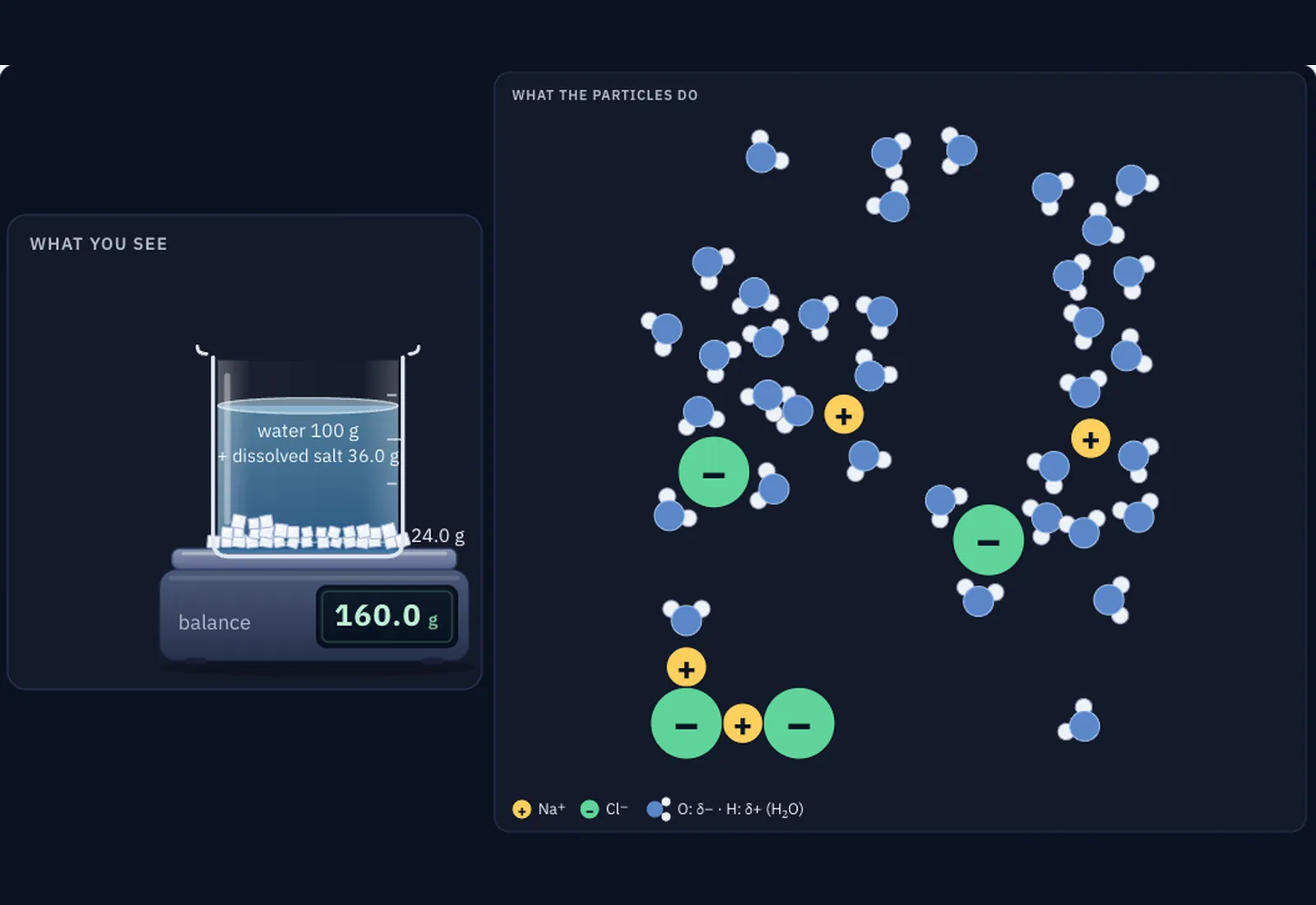
Why water takes in salt and sugar, but not oilWhat the particles do
A polar molecule has a partially negative end and a partially positive end because its bonds are polar and the shape of the molecule does not cancel their effects. Water, HCl and ethanol are polar molecules. Hexane (C₆H₁₄), iodine (I₂) and oil molecules are non-polar. Carbon tetrachloride, CCl₄, has polar C–Cl bonds, but the four bonds are arranged symmetrically and cancel each other’s effects, so the molecule is non-polar.
An ionic substance dissolves in water when the attraction between its ions and polar water molecules compensates for the attraction between ions in the crystal. The spread of ions through the solution increases disorder and helps dissolving, as with sodium chloride in the previous lesson. Sugar and ethanol have –OH groups in their molecules. Hydrogen bonds form between these groups and water molecules, so their molecules mix among the water molecules.
Non-polar molecules attract one another only through weak London forces. To take in an oil molecule, water would have to give up hydrogen bonds between its own molecules and gain weak attractions in their place. The gain is too small, the water molecules stay grouped together, and the oil forms a layer. In hexane, iodine molecules find similar neighbours, also held together by London forces, and dissolve.
For the curious
The rule works for gases too. Oxygen, whose molecules are non-polar, dissolves about 20 times better in hexane than in water.
Dissociation or ionisation: how it is writtenHow it is written
Sodium chloride is already made of ions in the crystal, and water simply separates them. The process is called dissociation:
NaCl(s) → Na⁺(aq) + Cl⁻(aq)
Hydrogen chloride is made of molecules. When it dissolves in water, ions appear through a reaction: the HCl molecule gives a proton to a water molecule and the polar H–Cl bond breaks. The process is called ionisation:
HCl(g) + H₂O(l) → H₃O⁺(aq) + Cl⁻(aq)
The reaction is practically complete, so hydrochloric acid is a strong acid and a strong electrolyte, and the solution conducts electricity. Sugar dissolves as whole molecules and does not form ions:
C₁₂H₂₂O₁₁(s) → C₁₂H₂₂O₁₁(aq)
Where the rule stops
The rule says what usually happens, not how much dissolves. Calcium carbonate in limestone is an ionic substance and barely dissolves in water. Ethanol is polar and yet dissolves tens of times more non-polar iodine than water does. “Polar” does not mean unlimited solubility, and “non-polar” does not mean insoluble.
Non-polar solvents need care. Hexane is a highly flammable liquid, and carbon tetrachloride, once used for cleaning, is classified as toxic and hazardous to the ozone layer. In the laboratory they are used under a fume hood; they must not be handled at home.
Worked example
Ions from 3.65 g of hydrogen chloride
A total of 3.65 g of hydrogen chloride, HCl, dissolves in water. How many moles of ions form?
Molar mass: M(HCl) = 1 + 35.5 = 36.5 g/mol. Amount of substance: n = 3.65 ÷ 36.5 = 0.1 mol HCl.
From the equation HCl + H₂O → H₃O⁺ + Cl⁻, one mole of HCl gives one mole of H₃O⁺ ions and one mole of Cl⁻ ions. That gives 0.1 mol H₃O⁺ and 0.1 mol Cl⁻, a total of 0.1 + 0.1 = 0.2 moles of ions.
Check: HCl molecules no longer exist in the solution, and the number of moles of ions is twice the number of moles of HCl, as in the equation. By comparison, 0.1 moles of sugar, M(C₁₂H₂₂O₁₁) = 342 g/mol, or 34.2 g, gives 0.1 moles of molecules in solution, with no ions.
In Romania
Iodine tincture from the pharmacy
The Bucharest manufacturer Tis Farmaceutic lists the ingredients of its iodine tincture: iodine, potassium iodide and 96% ethyl alcohol, for external use. Iodine is non-polar and dissolves in water at just 0.03 g per 100 mL, at 20 °C. In ethanol, 27.1 g dissolves per kilogram at 25 °C, tens of times more. For this reason iodine is kept dissolved in alcohol.
The tincture is a product for the skin, with a label and directions from the pharmacist; it is not prepared at home.
In short
- Ionic substances and substances with polar molecules dissolve in polar solvents (water); substances with non-polar molecules dissolve in non-polar solvents (hexane): like dissolves like.
- Molecules with polar bonds can be non-polar if their shape cancels the effects of the bonds: CCl₄ is non-polar, water is polar.
- Sugar and ethanol dissolve in water through hydrogen bonds between –OH groups and water molecules.
- An ionic substance dissociates: NaCl(s) → Na⁺(aq) + Cl⁻(aq). Hydrogen chloride ionises: HCl + H₂O → H₃O⁺ + Cl⁻.
- The rule is a guide: polar ethanol also dissolves non-polar iodine, and some ionic substances barely dissolve.
Common mistakes
WrongMolecules with polar bonds are always polar.
RightShape matters too: in CCl₄ the four polar C–Cl bonds are arranged symmetrically and cancel each other’s effects, so the molecule is non-polar.
WrongHydrogen chloride dissolves like NaCl, by dissociation.
RightHCl contains no ions before dissolving. H₃O⁺ and Cl⁻ ions appear through the molecule’s reaction with water, so the process is ionisation.
WrongWater dissolves any ionic substance in any amount.
RightThe rule is a guide. Calcium carbonate barely dissolves in water, and every substance has a limit to how much dissolves.
Test yourself
7 questions. For the first 6 you see the explanation at once, with the paragraph of the lesson that supports it; for the written ones you compare with a good answer.
Which of these substances dissolves well in hexane?
Answer
c) Iodine. Iodine has non-polar molecules and dissolves in hexane, a non-polar solvent. Salt, sugar and HCl dissolve in polar solvents.
Why is the CCl₄ molecule non-polar, even though its C–Cl bonds are polar?
Answer
b) Because the four bonds are arranged symmetrically and cancel each other’s effects. The polarity of a molecule depends on its bonds and its shape. In CCl₄, symmetry cancels the effects of the four polar bonds.
What happens when hydrogen chloride dissolves in water?
Answer
b) The HCl molecule gives a proton to a water molecule and H₃O⁺ and Cl⁻ form. HCl is made of molecules. Ions appear through a reaction with water, so the process is ionisation, not dissociation.
A classmate says that ethanol, being polar, cannot dissolve non-polar iodine. Which answer is correct?
Answer
b) The classmate is wrong: ethanol dissolves tens of times more iodine than water does. The “like dissolves like” rule is a guide, not a law without exceptions.
A 7.3 g sample of hydrogen chloride, M(HCl) = 36.5 g/mol, dissolves completely in water. How many moles of ions (H₃O⁺ and Cl⁻ together) form?
molAnswer
0.40 mol. n(HCl) = 7.3 ÷ 36.5 = 0.2 mol. Each mole of HCl gives one mole of H₃O⁺ and one mole of Cl⁻, so 0.2 · 2 = 0.4 moles of ions.
Place each substance under its type of molecule.
Answer
Polar molecule: H₂O; HCl; Ethanol.
Non-polar molecule: I₂; C₆H₁₄ (hexane); CCl₄.
Water, HCl and ethanol are polar. Iodine, hexane and CCl₄ are non-polar, CCl₄ because of its symmetry.
You put salt, sugar and oil in water. Explain what happens to each substance’s particles and why.
A good answer
Salt separates into Na⁺ and Cl⁻ ions, attracted by polar water molecules. Sugar dissolves as whole molecules, linked to water by hydrogen bonds between the –OH groups and water. Oil has non-polar molecules, which attract one another through weak London forces; water does not give up its hydrogen bonds for them, so oil forms a separate layer.
A complete answer links each substance to its type of particles (ions, polar molecules with –OH, non-polar molecules) and their attraction to water.
Terms
- polar molecules
- Molecules with a partially negative end and a partially positive end, because their shape does not cancel the effects of their polar bonds.
- polar solvent
- A solvent made of polar molecules, such as water or ethanol; it dissolves ionic substances and substances with polar molecules.
- non-polar solvent
- A solvent made of non-polar molecules, such as hexane; it dissolves substances with non-polar molecules.
- miscible
- Liquids that mix in any proportion and form a single layer.
- dissociation
- The separation of an ionic substance’s ions from the crystal by water.
- ionisation
- The formation of ions through a reaction between a substance’s molecules and water, as with HCl.
Sources and link to the programme
- OpenStax – Chemistry 2e, 11.3 Solubility – the “like dissolves like” rule; miscible and immiscible liquids (ethanol miscible with water; oil and petrol immiscible with water); oxygen about 20 times more soluble in hexane than in water
- OpenStax – Chemistry 2e, 11.2 Electrolytes – HCl molecules react with water to form H₃O⁺ and Cl⁻; practically complete reaction, hence a strong electrolyte
- OpenStax – Chemistry 2e, 11.1 The Dissolution Process – sugar dissolving as whole molecules; calcium carbonate, an ionic compound that barely dissolves
- PubChem – Iodine – iodine solubility: 0.03 g per 100 mL of water at 20 °C; 27.1 g/kg in ethanol and 13.2 g/kg in n-hexane at 25 °C
- PubChem – Sodium chloride – sodium chloride: 36.0 g per 100 g of water and 0.065 g per 100 g of ethanol, at 25 °C
- PubChem – Ethanol – ethanol is miscible with water
- PubChem – Hexane – hexane: highly flammable liquid (H225), practically insoluble in water
- PubChem – Carbon tetrachloride – hazard classification: toxic (H301, H311, H331) and hazardous to the ozone layer (H420)
- Tis Farmaceutic – Tinctură de iod – composition of the Bucharest manufacturer’s iodine tincture: iodine, potassium iodide, 96% ethyl alcohol, for external use
From the programme: “Dissolving ionic substances in water”; “Dissolving substances with polar molecules in water”; “Polar and non-polar solvents” (MI: Mathematics–informatics (2 hours)). Specific competences followed: 2.4, 2.5, 5.4.