Chapter 7 · The covalent bondLesson 7.5SN Natural sciences (3 hours) · beyond your profile
Notions of stereochemistry; the valence-shell electron-pair repulsion (VSEPR) model: BX3, CX4, water, ammonia and carbon dioxide
How to find a molecule’s shape without seeing it: count electron regions
Water, ammonia and methane each have eight valence electrons around the central atom. Why do they have different shapes?
Before you read: what do you think?
Tie four equally inflated balloons together at their ends. What shape do they take if you let them move freely?
See the answer
The balloons form a tetrahedron. In a flat square, neighbours would sit at 90° and press harder against each other; in a tetrahedron, all four pairs of balloons are the same distance apart, as far apart as possible. Methane takes the same shape.
Blow up four balloons and tie their ends together. Left free, they settle at the corners of a pyramid with four equal faces. A methane molecule has the same shape for the same reason: parts that repel spread as far apart as they can.
Tied balloons settle into placeWhat you see
Two balloons tied at the ends lie in a straight line, opposite each other. Three balloons settle into a flat triangle, with 120° between them. Four balloons form a tetrahedron, with an angle of about 109.5° between any two.
Each arrangement is the one in which the balloons press least against each other. The same rule applies to electron pairs in a molecule, with one difference: electrons repel at a distance, through the electric force between like charges, without touching.
Electron regions around the central atom repelWhat the particles do
The VSEPR model (valence shell electron pair repulsion) starts with the Lewis structure. Count the electron regions around the central atom: each bond, single, double or triple, is one region, and each lone pair is another. The regions repel and spread as far apart as possible.
A double or triple bond is a single region because all its pairs point towards the same neighbouring atom.
Two regions give a linear shape, with an angle of 180°: the carbon in CO₂ has two double bonds, so two regions. Three regions give a trigonal planar shape, with 120°: the boron in BF₃ and BCl₃ has three bonds and no lone pairs, with fewer than eight electrons around it. Four regions give a tetrahedron, with 109.5°: the carbon in CH₄ and CCl₄ has four bonds.
Lone pairs narrow the angle between bondsWhat the particles do
The nitrogen in NH₃ has three bonds and one lone pair, so four regions, like methane. A lone pair belongs to one atom and takes up more space than a bonding pair, which is held between two nuclei. It therefore repels the other regions more strongly, and the H–N–H angle falls to about 107°.
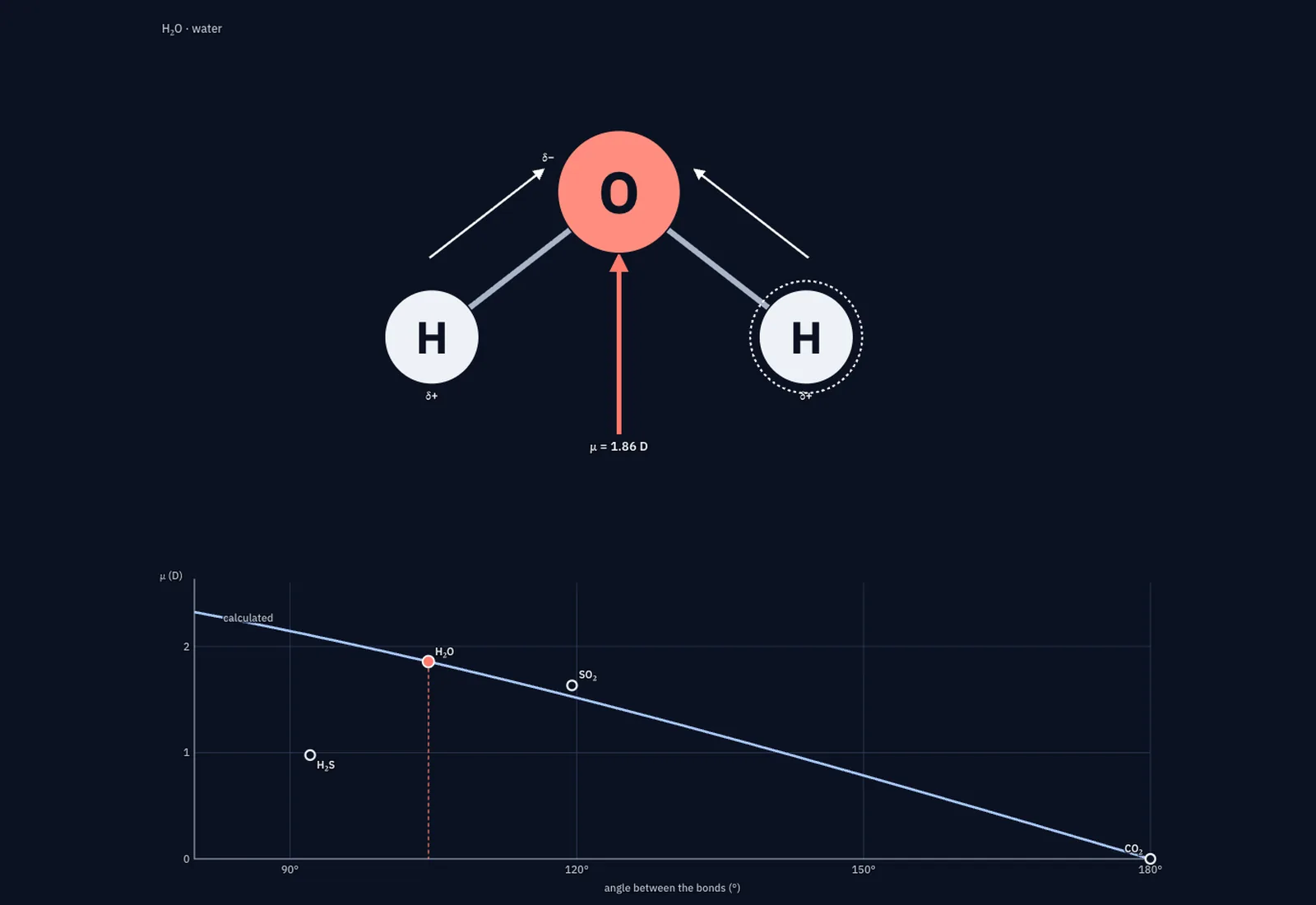
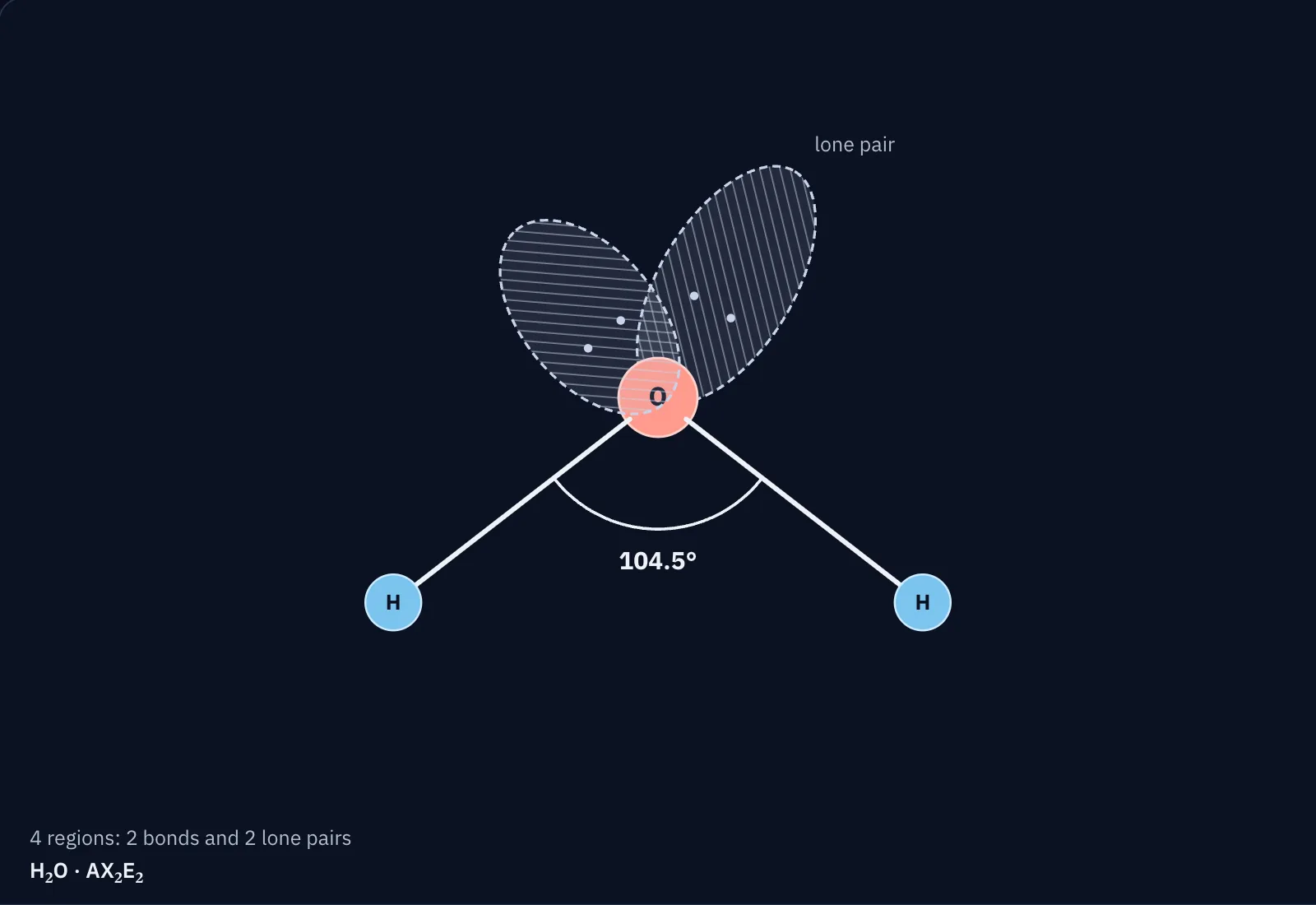
The oxygen in H₂O has two bonds and two lone pairs. The two lone pairs push even harder, and the H–O–H angle is 104.5°.
There are two things to distinguish. Electron pair geometry shows where all the regions sit, including lone pairs. Molecular shape shows where the atoms sit. NH₃ and H₂O have the same electron pair geometry, tetrahedral, but different shapes: NH₃ is trigonal pyramidal, with nitrogen at the apex of a pyramid, while H₂O is bent.
| Molecule | Regions | Notation | Electron pair geometry | Shape of the molecule | Angle | Kind of value |
|---|---|---|---|---|---|---|
| CO₂ (carbon dioxide) | 2 (2 bonds) | AX₂ | linear | linear | O=C=O 180° | from geometry |
| BF₃ (boron trifluoride) | 3 (3 bonds) | AX₃ | trigonal planar | trigonal planar | F–B–F 120° | from geometry |
| CH₄ (methane) | 4 (4 bonds) | AX₄ | tetrahedral | tetrahedral | H–C–H 109.5° | from geometry |
| NH₃ (ammonia) | 4 (3 bonds, 1 lone pair) | AX₃E | tetrahedral | trigonal pyramidal | H–N–H ≈ 107° | measured, rounded |
| H₂O (water) | 4 (2 bonds, 2 lone pairs) | AX₂E₂ | tetrahedral | bent | H–O–H 104.5° | measured |
With four regions, from CH₄ to NH₃ and to H₂O, one bond after another is replaced by a lone pair, and the angle falls from 109.5° to ≈ 107° and to 104.5°. With two or three regions, the programme has CO₂ and BF₃, both without lone pairs; the swap shows at four regions.
Diagram and measurements. The molecule is a diagram, built from angles: 180° (linear), 120° (trigonal planar) and 109.5° (tetrahedral, cos θ = −1 ÷ 3) come from the geometry of electron regions that repel; ≈ 107° in NH₃ and 104.5° in H₂O are measured (106.67° and 104.48°, rounded as in the lesson). The model shows in which direction the angle departs, not its value. The two bonds of the printed angle lie in the plane of the picture, so the drawn angle is the printed one; the other bonds and the lone pairs are in perspective, and the lobes of the lone pairs are schematic. Atoms have no colour: they are drawn hugely enlarged.
Sources and credits. The H–N–H and H–O–H angles: NIST Computational Chemistry Comparison and Benchmark Database (CCCBDB), tables of experimental angles, source, work of the US government, public domain. The H–O–H angle of 104.5°, the same in OpenStax, Chemistry 2e, section 7.6, source (the value only, as a cited fact). Queried on 16.11.2026.
Writing the shape: AX₂, AX₃, AX₄, AX₃E and AX₂E₂How it is written
In the usual notation, A is the central atom, X is an atom bonded to it, and E is a lone pair. X and E represent roles, not elements. BX₃ means a boron atom bonded to three identical X atoms (for example fluorine or chlorine); with carbon, four identical X atoms (hydrogen or chlorine) give CH₄ and CCl₄.
CO₂ is AX₂ (linear, 180°), BF₃ is AX₃ (trigonal planar, 120°), CH₄ and CCl₄ are AX₄ (tetrahedral, 109.5°), NH₃ is AX₃E (trigonal pyramidal, 107°), H₂O is AX₂E₂ (bent, 104.5°).
The rule above gives the shape and the direction in which the angle changes. The exact angle is measured; the model does not calculate it.
For the curious
The tetrahedral angle of 109.5° comes from geometry: its cosine is −1 ÷ 3, or approximately −0.333. Any other angle between four equal directions would bring two of them closer together.
Worked example
The shape of a water molecule
Find the shape of a water molecule and explain why its angle is not 109.5°.
Valence electrons: oxygen has 6, each hydrogen has 1, so there are 6 + 2·1 = 8 electrons in total, or 8 ÷ 2 = 4 pairs.
Two pairs bond oxygen to the hydrogens, and two remain on oxygen as lone pairs. Oxygen has four regions, so AX₂E₂.
Four regions arrange themselves tetrahedrally. There are three atoms: two hydrogens and one oxygen, so the shape is bent.
The two lone pairs push harder than the bonding pairs, and the angle falls below 109.5°. The measured value is 104.5°.
Check with ammonia: (5 + 3·1) ÷ 2 = 4 pairs, three bonding pairs and one lone pair, so AX₃E, pyramidal. The angle must lie between that of water and the tetrahedral angle: 107° lies between 104.5° and 109.5°.
In Romania
Stationery shop balloons as a model of a molecule
The model needs no laboratory, just balloons from any stationery or party shop. Inflate four balloons moderately to the same volume, tie their ends in pairs, then tie them all together. The balloons settle into a tetrahedron; three balloons tied together form a flat triangle, and two form a straight line.
The activity uses no substances. An overinflated balloon can burst, and uninflated balloons and pieces of burst balloons can choke a small child: collect them immediately and keep them away from small children. The activity can be done in class or at home, with string and a little patience.
In short
- The VSEPR model: electron regions around the central atom (bonds and lone pairs) repel and spread as far apart as possible.
- A double or triple bond is a single region. Two regions give a linear shape (180°, CO₂), three give a trigonal planar shape (120°, BF₃), and four give a tetrahedron (109.5°, CH₄ and CCl₄).
- Lone pairs take up more space: NH₃ has an angle of about 107°, and H₂O an angle of 104.5°.
- Electron pair geometry includes lone pairs; molecular shape describes only the atoms. NH₃ is trigonal pyramidal, and H₂O is bent.
- Notation: CO₂ is AX₂, BF₃ is AX₃, CH₄ is AX₄, NH₃ is AX₃E, H₂O is AX₂E₂.
Common mistakes
WrongCarbon in CO₂ has two double bonds, so four electron regions.
RightA double bond is one region because both its pairs point towards the same atom. CO₂ has two regions and is linear.
WrongA water molecule is tetrahedral because oxygen has four electron pairs.
RightThe electron pairs have tetrahedral geometry, but molecular shape is read from the atoms. With two hydrogens and one oxygen, the molecule is bent.
WrongThe angle in water is 109.5°, as in methane.
RightThe two lone pairs repel more strongly, and the measured H–O–H angle is 104.5°.
Test yourself
8 questions. For the first 7 you see the explanation at once, with the paragraph of the lesson that supports it; for the written ones you compare with a good answer.
How many electron regions does carbon in CO₂ have in the VSEPR model?
Answer
b) Two. Each double bond is one region, however many pairs it has, so carbon has two regions and the molecule is linear.
What is the shape of an ammonia molecule, NH₃?
Answer
d) Trigonal pyramidal. Nitrogen has four regions, three bonding and one lone pair. The atoms form a pyramid with nitrogen at the apex.
Why is the H–O–H angle in water smaller than the tetrahedral angle?
Answer
b) Because the two lone pairs on oxygen push harder than the bonding pairs. A lone pair belongs to one atom and takes up more space than a bonding pair; the angle falls from 109.5° to 104.5°.
Which notation correctly describes a water molecule?
Answer
c) AX₂E₂. Oxygen has two bonds (X) and two lone pairs (E).
How many valence electron pairs does an ammonia molecule, NH₃, have? Nitrogen has 5 valence electrons, each hydrogen has 1.
pairsAnswer
4 pairs. 5 + 3·1 = 8 electrons, or 8 ÷ 2 = 4 pairs: three bonding pairs and one lone pair.
Put the steps for finding a molecule’s shape in order.
Answer
The correct order:
- Count the valence electrons and divide them into pairs
- Work out how many pairs are bonding and how many are lone pairs
- Count the electron regions at the central atom
- Arrange the regions as far apart as possible to give the electron pair geometry
- Read the molecular shape from the positions of the atoms
Read the molecular shape last, once you know where all the regions sit.
Place each molecule under its matching shape.
Answer
Linear (180°): CO₂.
Trigonal planar (120°): BF₃; BCl₃.
Tetrahedral (109.5°): CH₄; CCl₄.
CO₂ has two regions, BF₃ and BCl₃ have three, and CH₄ and CCl₄ have four.
Methane, ammonia and water all have four electron regions at the central atom. Explain why their angles are 109.5°, 107° and 104.5°.
A good answer
All three have tetrahedral electron pair geometry. In methane, all four regions are bonding pairs, so the angle is the tetrahedral angle, 109.5°. In ammonia, one region is a lone pair, which takes up more space and narrows the angle to about 107°. Water has two lone pairs, and the angle falls to 104.5°.
A complete answer names the common electron pair geometry and says that lone pairs repel more strongly than bonding pairs.
Terms
- VSEPR
- A model that predicts molecular shape from repulsion between electron regions at the central atom.
- electron region
- A bond (single, double or triple) or a lone pair around the central atom.
- lone pair
- A pair of valence electrons that belongs to one atom and does not form a bond.
- electron pair geometry
- The arrangement in space of all electron regions around the central atom.
- molecular shape
- The arrangement in space of the atoms in a molecule.
- tetrahedron
- A solid with four equal triangular faces; the angle between two directions towards its vertices is 109.5°.
Sources and link to the programme
- OpenStax – Chemistry 2e, 7.6 Molecular Structure and Polarity – electron regions, electron pair geometry and molecular structure; angles CH₄ 109.5°, NH₃ 106.8° (rounded in the text to 107°), H₂O 104.5°, BF₃ 120°, CO₂ 180°; a single, double or triple bond counts as one region
- OpenStax – Chemistry 2e, 7.3 Lewis Symbols and Structures – boron in BF₃ has fewer than eight valence electrons
- Universitatea din Washington – VSEPR balloons (demonstrație) – balloons tied together, taking shapes that correspond to the VSEPR model
From the programme: “Notions of stereochemistry; the valence-shell electron-pair repulsion (VSEPR) model: BX3, CX4, water, ammonia and carbon dioxide” (SN: Natural sciences (3 hours)). Specific competences followed: 5.4.