Reactions with a change in oxidation number
Chapter 3
Redox reactions and electrochemical cells – who loses electrons and who gains them
Who loses electrons and who gains them, and how do you get a current out of that?
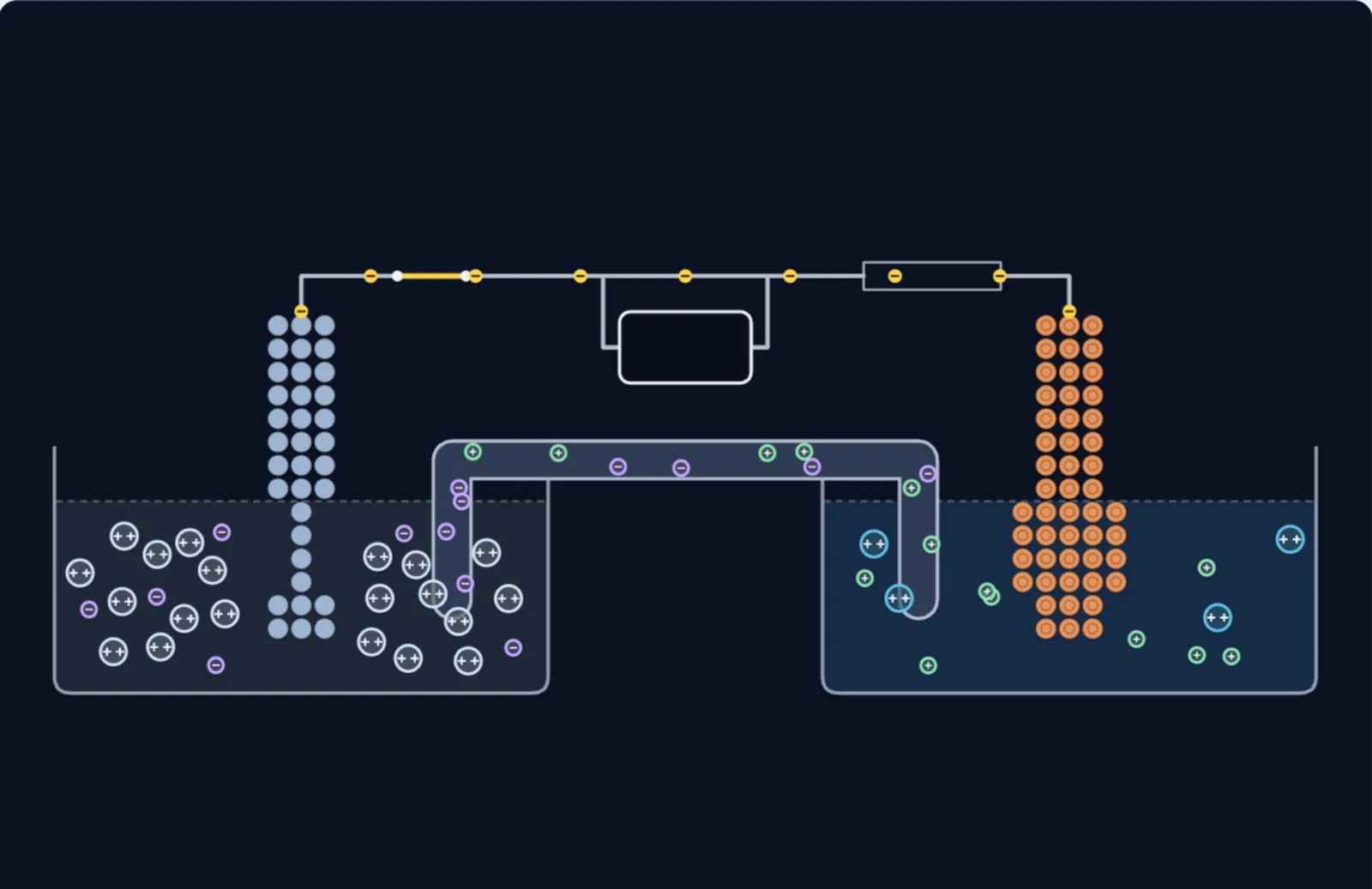
Zinc in one beaker, copper in another, a wire between them and a bridge between the solutions. The picture beside this text shows, one after another, what the particles do at the zinc, in the bridge, at the copper and at the voltmeter. Start with a prediction, then close the circuit.
Two metals, two solutions, a wire still disconnected
The zinc strip stands in a zinc sulfate solution, the copper strip in a copper sulfate solution. The salt bridge joins the solutions, and the voltmeter, connected between the strips, reads 1.10 V. The wire through the load is disconnected: no current flows.
When you connect the wire, which strip is used up?
At the zinc, atoms go into solution as ions
What you see. The zinc strip gets thinner. What the particles do. Atoms at the surface give up two electrons each and go into solution as Zn²⁺ ions. The electrons stay in the metal and leave through the wire. This is oxidation: the zinc is the anode and the negative pole.
How it is written. Zn → Zn²⁺ + 2e⁻
The counters in the corner of the picture count what has been drawn so far. Every zinc atom that leaves puts two electrons into the wire.
At the copper, ions from the solution take up electrons
What you see. Copper is deposited on the copper strip, and the blue of the solution fades. What the particles do. Cu²⁺ ions reach the strip, take up two electrons each from the wire and settle as atoms. This is reduction: the copper is the cathode and the positive pole.
How it is written. Cu²⁺ + 2e⁻ → Cu
Each Cu²⁺ ion deposited takes up as many electrons as one zinc atom sent: two.
Electrons go through the wire, ions through the bridge
Only electrons pass through the wire and the strips. Only ions pass through the solutions and the bridge: anions (−) towards the zinc beaker, cations (+) towards the copper beaker. Each solution stays neutral.
Without the bridge, the zinc solution would gain a positive charge and the copper solution a negative one, and the electrons would stop flowing. Remove the bridge and watch the voltmeter.
The voltmeter reads 1.10 V, and the notation says who is who
What you see. The voltmeter is connected between the two strips. With the bridge in place it reads 1.10 V, whether the switch of the load is open or closed. Without the bridge it shows nothing.
The value comes from the table of standard electrode potentials, at 1 mol/L and 25 °C: +0.34 − (−0.76) = 1.10 V. A real cell with a current through it gives less. Each dot in the picture stands for billions of particles.
How it is written. (−) Zn | Zn²⁺ || Cu²⁺ | Cu (+). The single bar | is the boundary between electrode and solution, the double bar || is the bridge. The overall equation: Zn + Cu²⁺ → Zn²⁺ + Cu
For the same number of electrons, 65 g of zinc used up gives 64 g of copper deposited
A zinc atom sends two electrons and a copper ion takes up two: as many copper atoms are deposited as zinc atoms are used up. The masses are in the ratio of the molar masses, 65 : 64.
For 0.10 mol of zinc: n(e⁻) = 2 · 0.10 = 0.20 mol, about 1.2·10²³ electrons through the wire; m(Zn) = 0.10 · 65 = 6.5 g; m(Cu) = 0.10 · 64 = 6.4 g.
The bars in the picture are at the same scale and show that the difference is small. Change the amount and watch the numbers.
In any pair, the metal higher in the series is the negative pole
The bars show the standard potential of each metal, at 1 mol/L and 25 °C. Choose two metals, by tapping their names or one of the pairs below: the one with the lower potential is the negative pole, and the table voltage is the difference between them.
For example, magnesium and copper: Mg is the negative pole, and the table voltage is 2.71 V. A real cell with a current through it gives less.
The phone battery: from the mAh on the label to grams of lithium
The label on a battery gives its capacity in mAh, the electric charge it can deliver. In a lithium-ion battery Li⁺ ions pass between the electrodes, and electrons pass through the phone's circuit.
For the curious. One mole of electrons carries a charge of F = 96,485 C, the Faraday constant, only named here. From mAh you get to moles of electrons, then to grams of lithium. mAh
The number stays on your phone: it is not sent and not stored. Until you type one, the picture uses the example of 3,000 mAh.
Now you explain
A galvanised nail and a copper wire are pushed into a lemon, apart from each other, and joined by a wire. The picture shows the potentials of the two metals.
Explain, in a few sentences, which is the negative pole, what happens to the nail and what happens to the wire. Remember that there are no Cu²⁺ ions in a lemon.
Compare with an answer
Zinc is higher in the series, so the nail is the negative pole and is oxidised: Zn → Zn²⁺ + 2e⁻. The electrons go through the wire to the copper, and in the juice the charge is carried by ions. At the copper, H⁺ ions from the juice take up the electrons and give hydrogen; the copper is not used up and no copper is deposited, because the solution has no Cu²⁺. The voltage cannot be calculated from the table of the Daniell cell, because the solution is different.
The lesson on the Daniell cell · The lesson on the activity series · The lesson on the lithium-ion battery