A map with a single question
Why are Wallachia's oldest monasteries where they are?
Drop three marks on the map where you think they stood. Then let the charters place them, in the order they appear in the documents, and try the explanations one by one.
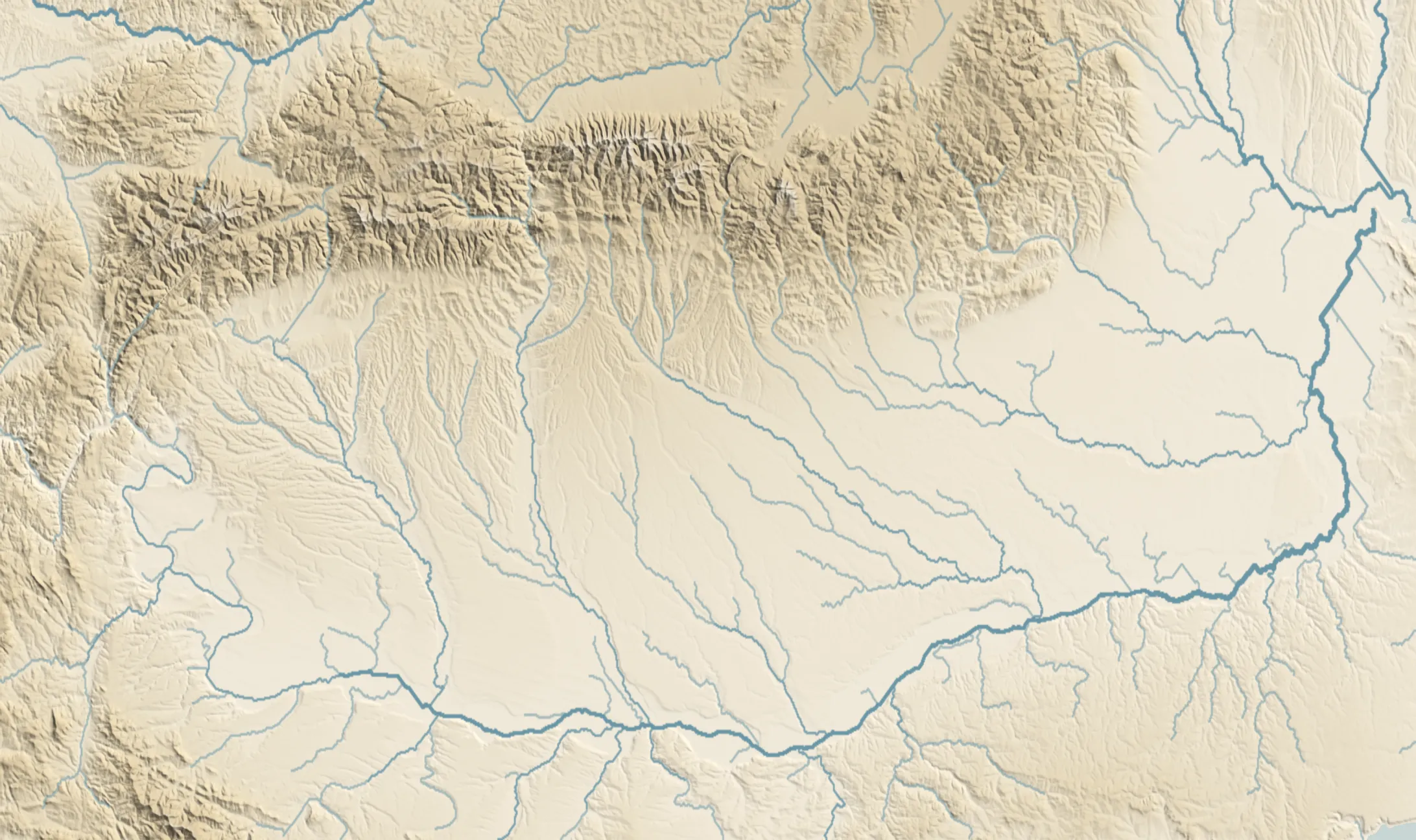
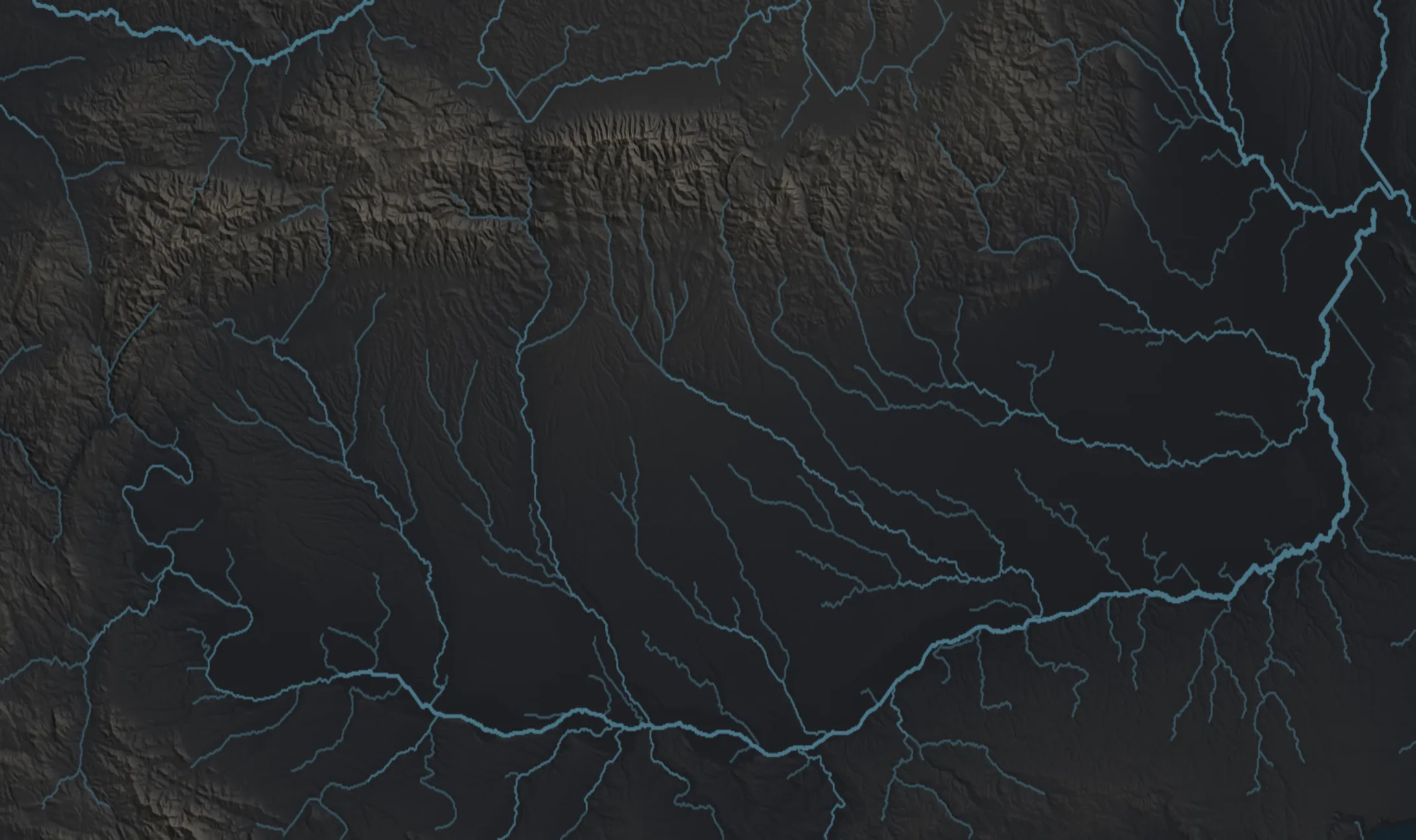
Where do you think they stood?#
The map shows only the relief and the rivers between the Carpathians and the Danube, without borders. In the 14th century, Wallachia had no fixed outline: the prince's power rested on ties with local communities and boyars, and its extent took shape gradually.
Drop three marks where you think the first monasteries were raised.
Drop three marks.
The order in which they appear in the documents#
Each dot appears in the year of the first surviving document that names the monastery. Filled dots carry a date written in the act; hollow ones have a date supplied by the editors from the content. By 1500 the documents attest 16 houses and a licence to build one more, at Licura; 14 of them can be placed on the map.
The year on the map is not a founding year. It is the first time a monastery enters the written record; it may be much older.
In the hills and the plain, not in the mountains#
Of the 14 houses attested by 1500 and placed on the map, 10 stand in the hills, four in the plain, none in the mountains, above 800 metres. The highest is Bistrița, at the foot of the mountains.
The plain is not empty: Snagov, on a lake, Bolintin, "in the great forest", Glavacioc and Târgșor all appear before 1500.
And the first on the list, Vodița, stands on the very bank of the Danube.
How you guessed
The explanations, tried one by one
Did they guard the passes to Transylvania?#
Of the houses attested by 1500, Cozia and, if its identification holds, Ostrov, next to it, lie in the Olt corridor to Transylvania, and Vodița near the Iron Gates. On the roads from Rucăr to Bran and along the Prahova, none appears in this period.
No charter read gives a monastery a guarding task. Where the link to the passes appears, it is about money: in 1415 Mircea gives Cozia the customs at Genune, and the customs exemption for its carts, given around 1406 (editors' dating) and again in 1419, is renewed in 1451 "at markets, at fords or on the mountain roads".
The documents do not support it.
Did they keep away from the Danube, for fear of the Ottomans?#
The chronology does not fit. Vodița (about 1374), Tismana (1385), Cozia and Cotmeana (1388) are in the documents before the Ottomans held fortresses on the Danube: Nicopolis was theirs at the siege of 1396, the tsardom of Vidin ended that same year, and Giurgiu was taken in 1417 or, by more recent research, in 1420. Vodița is on the Danube itself.
Later, the Danube brings monasteries income: Tismana receives the Calafat customs (1480), and Bolintin is exempted from customs at Brăila, Dârstor and Giurgiu (between 1479 and 1480). A charter of Mircea's from 1409 is written at Giurgiu itself.
The dates show no avoidance of the Danube.
Did they stand close to the prince?#
Charters say where they were written. In the first volume of Wallachian documents, the oldest act dated at Argeș is from 1369, at Târgoviște from 1418, at Bucharest from 1459. Of the 14 houses on the map attested by 1500, 12 lie within 61 kilometres of Argeș or Târgoviște; the farthest of them is Snagov.
The two outside are Vodița and Tismana, in the west, more than 130 kilometres away. Snagov is also borderline in time: its first charter, placed by the editors between 1407 and 1418, may be older than the first act dated at Târgoviște.
It is the clearest pattern on the map, but it misleads in one respect: we see the monasteries through the prince's grants, so we mostly see the prince's monasteries. And proximity does not say why they were founded there.
The best fit, with a caveat.
What ties the two in the west together?#
Vodița and Tismana appear in the same acts. Dan I's charter of 1385 requires that "the rule and custom of Nicodim" be kept at Tismana. From 1387 the two are confirmed together, in the same act of Mircea's.
The king of Hungary, Sigismund, grants the monks of Vodița free passage in 1418, then protects both houses, in acts the editors date to 1419 and 1428; the 1419 act is written at Vodița itself. The acts tie both to Severin and to the neighbouring kingdom.
It explains the western pair, not the rest.
Were they seeking the forest and solitude?#
Only one charter says so plainly: Bolintin is "the monastery in the great forest" (1437). Snagov stands on a lake.
But there is no map of 15th-century forests. Without one, the explanation cannot be tested across the whole map.
It cannot be tested.
Or do we only see what the archive kept?#
Much of what we know comes from grants kept by the monasteries themselves; some acts reach us only as copies in their registers, like Cozia's charter of 1388. A house that lost its papers does not appear here, however old it was.
So the map shows where the prince gave and where the monks kept, and that favours exactly the "close to the prince" pattern.
It has to be kept in mind for every answer.
What ties them to the roads: customs#
The documents do not draw roads. They name places where goods paid customs: Câmpulung and "the Brăila road" in the privilege for the Brașov merchants of 1368, Slatina in 1369, Rucăr and Dâmbovița in 1413.
The lines show revenues the charters tie to a place: the Calafat customs and the Râmnic salt for Tismana, Bolintin's exemptions at the Danube fords. Other revenues have no certain place on the map: the Genune customs for Cozia (1415), the Prahova customs for Snagov (1464).
Some monasteries received customs revenue or customs exemptions, alongside villages, land and salt.
And after 1550?#
The square dots are 12 well-known later foundations. Their years are those of today's buildings, of the foundation or of a first mention, not of the first surviving document, so they do not compare directly with the round dots.
Foundations still appear at Bucharest, where princes issue acts from 1459, and in the Oltenian plain near Craiova. But the map does not all move down: Arnota stands higher than any house attested before 1500.
Tradition and record: how far apart the years are#
For some monasteries, tradition gives a year far older than the first act. For others, today's church makes them look younger than the community that appears in the documents.
- Cotmeana Monastery: tradition 1292 (architectural argument); first document 20 May 1388
- Tismana Monastery: tradition 1364 (Wikipedia list of monasteries; LMI: 1377–1378); first document 3 October 1385
- Govora Monastery: tradition 1440s (the Vlad Dracul tradition); first document 26 September 1485
- Tânganu Monastery: tradition 1470s (the Radu cel Frumos tradition); first document 6 July 1530
- Dealu Monastery: tradition 1499 (Radu cel Mare's church (LMI)); first document 17 November 1431
- Clocociov Monastery: tradition 1645 (today's church (LMI)); first document between 1512 and 1521 (editors' dating)
tradition or building yearfirst document
All 36 documentary entries by 1550#
The first surviving document that names each house as a monastery, with the edition where it is found. The edition is cited by document number.
| Monastery | First document | Issued by | Edition | On the map |
|---|---|---|---|---|
| Vodița Monastery Vladislav I's charter carries no date; the editors place it around 1374. It stands on the Danube bank at the Iron Gates. The act rules that after Nicodim the hegumen is to be elected by the monks. | about 1374 (editors' dating) | Vladislav I (Vlaicu) | DRH B I, no. 6; DIR B XIII–XV, no. 20 | yes |
| Tismana Monastery The first act dates from 3 October 1385: Dan I says he found the monastery unfinished, begun "from the foundations" by his father, Radu voivode, and completed it. The dates 1364 and 1377 do not appear in the documents read. | 3 October 1385 | Dan I | DRH B I, no. 7; DIR B XIII–XV, no. 22 | yes |
| Cozia Monastery The charter of 20 May 1388: Mircea raises the monastery on the Olt "from the foundations". In 1415 he gives it the customs at Genune. | 20 May 1388 | Mircea the Elder | DRH B I, no. 9; DIR B XIII–XV, no. 26 and 27 | yes |
| Cotmeana Monastery It appears in the same 1388 charter, placed under Cozia, so it already existed. The often-quoted 1292 comes from architecture, not from a document. | 20 May 1388 | Mircea the Elder | DIR B XIII–XV, no. 26 | yes |
| Snagov Monastery Mircea's charter is undated; the editors place it between 1407 and 1418. The often-quoted 1408 is a point chosen from that range. | between 1407 and 1418 (editors' dating) | Mircea the Elder | DRH B I, no. 34; DIR B XIII–XV, no. 40 | yes |
| Strugalea Monastery Its existence is certain (a charter of 1409, issued at Giurgiu), but the site is not identified. | 11 May 1409 | Mircea the Elder | DRH B I, no. 35; DIR B XIII–XV, no. 48 | no: site not identified |
| Dealu Monastery The community appears in 1431, in a grant by Alexandru Aldea, almost 70 years before Radu cel Mare's church (1499–1501). | 17 November 1431 | Alexandru Aldea | DRH B I, no. 72; DIR B XIII–XV, no. 79 | yes |
| Bolintin Monastery "The Annunciation monastery in the great forest", says Vlad Dracul's charter of 1437; the first known grant is from 1433. Today's site is identified from "across the Argeș, facing Bucșani". | 15 March 1433 | Alexandru Aldea | DRH B I, no. 75; DIR B XIII–XV, no. 84 | yes, approximate site |
| Sărăcinești hermitage Known only from a mention, in a later act, of a confirmation by Vlad Dracul. The site is not identified. | January to August 1437 (editors' dating) | Vlad Dracul (mentioned in a later act) | DRH B I, no. 79 | no: site not identified |
| Licura (licence to found) In 1440, Vlad Dracul allows the hieromonk Dorotei to raise a monastery at Licura, "within the bounds of Râmnic". It is a licence to build, not proof that the house was built. | 16 September 1440 | Vlad Dracul | DRH B I, no. 91; DIR B XIII–XV, no. 98 | no: site not identified |
| Glavacioc Monastery The first surviving act is Vlad Dracul's, of 1441. The attribution to Mircea the Elder rests on no document found. | 14 May 1441 | Vlad Dracul | DRH B I, no. 94; DIR B XIII–XV, no. 101 | yes |
| Govora Monastery The first act is a deed written at the monastery in 1485 by the hegumen Iosif. No document ties it to Vlad Dracul; the first princely grant dates from 1488. | 26 September 1485 | hegumen Iosif Govoreanul (private act) | DRH B I, no. 196; DIR B XIII–XV, no. 186 | yes |
| Bistrița Monastery (Vâlcea) The first dated act, of 16 March 1494, confirms "the gifts of the Craiovești brothers", the Oltenian boyars who endowed it. | 16 March 1494 | Vlad Călugărul | DRH B I, no. 247; DIR B XIII–XV, no. 233 | yes |
| Tutana Monastery It appears indirectly in 1497, as a party to an exchange of estates: "the monks of Tutana". | 1 April 1497 | Radu the Great | DIR B XIII–XV, no. 259 | yes |
| St Nicholas Monastery, Târgșor Radu cel Mare exempts it in 1497 from dues and from all customs. The point is the town's; which of the ruins there was the monastery is not known. | 4 June 1497 | Radu the Great | DRH B I, no. 275; DIR B XIII–XV, no. 260 | yes, approximate site |
| Râncăciov Monastery Radu cel Mare confirms an estate to it in 1498: "the monastery called Râncăciov, dedicated to the Ascension". | 19 July 1498 | Radu the Great | DRH B I, no. 285; DIR B XIII–XV, no. 269 | yes, approximate site |
| Ostrov Monastery, Călimănești In 1500, Radu cel Mare gives "the Ostrov monastery" money, wine from the Râmnic tithe and grain from Olt county. The link to the island at Călimănești is an inference. | 26 April 1500 | Radu the Great | DRH B I, no. 300; DIR B XIII–XV, no. 285 | yes |
| Nucet Monastery | September to December 1501 (editors' dating) | Radu the Great | DRH B II, no. 9 | yes |
| Iezer Monastery | 23 May 1501 | Radu the Great | DRH B II, no. 4; DIR B XVI/1, no. 3 | no: identification uncertain |
| Valea Monastery | 1 September 1506 | Radu the Great | DRH B II, no. 49; DIR B XVI/1, no. 36 | yes |
| Brădet hermitage | 14 May 1506 | Radu the Great | DIR B XVI/1, no. 31 | yes, approximate site |
| Vișina Monastery | between 1512 and 1521 (editors' dating) | Neagoe Basarab | DRH B II, no. 97 | yes |
| Clocociov Monastery | between 1512 and 1521 (editors' dating) | Neagoe Basarab | DRH B II, no. 96; DIR B XVI/1, no. 87 | yes |
| Corbii de Piatră rock monastery | 23 June 1512 | Neagoe Basarab | DRH B II, no. 103; DIR B XVI/1, no. 78 | yes |
| Cornet Monastery | 11 January 1515 | Neagoe Basarab | DRH B II, no. 133 | yes |
| Curtea de Argeș Monastery Neagoe Basarab's monastery appears in a grant of 7 January 1517. | 7 January 1517 | Neagoe Basarab | DRH B II, no. 148; DIR B XVI/1, no. 119 | yes |
| Mărgineni Monastery | 22 November 1517 | Neagoe Basarab | DRH B II, no. 165 | yes |
| Gura Motrului Monastery | 13 January 1519 | Neagoe Basarab | DRH B II, no. 176; DIR B XVI/1, no. 140 | yes |
| Seaca-Mușetești Monastery | 16 September 1519 | Neagoe Basarab | DRH B II, no. 189; DIR B XVI/1, no. 151 | yes, approximate site |
| Potoc Monastery | 10 January 1520 | Neagoe Basarab | DRH B II, no. 191; DIR B XVI/1, no. 153 | no: identification uncertain |
| Dobrușa hermitage | 2 September 1520 | Neagoe Basarab | DRH B II, no. 198 | yes, approximate site |
| Vărbila Monastery | between 1526 and 1527 (editors' dating) | Radu de la Afumați | DIR B XVI/2, no. 28 | no: identification uncertain |
| Sadova Monastery | 1530, June to August (month supplied by the editors) | Vlad Înecatul | DIR B XVI/2, no. 82 | yes |
| Tânganu Monastery Tradition credits Radu cel Frumos, in the 1470s, but the first document dates from 1530. | 6 July 1530 | Vlad Înecatul | DIR B XVI/2, no. 85 | yes, approximate site |
| Fântânele Monastery | between 1542 and 1544 (editors' dating) | Radu Paisie | DRH B IV, no. 115; DIR B XVI/2, no. 282 | no: site not identified |
| Mislea Monastery | April 1543 | Radu Paisie | DRH B IV, no. 138; DIR B XVI/2, no. 303–304 | yes |
What we do not know#
- The year on the map is that of the first surviving act. It does not say when the monastery was founded.
- Strugalea, Licura, Sărăcinești and Fântânele have no identified site; Iezer, Potoc and Vărbila have only uncertain identifications.
- For Snagov, Vodița, Nucet and a few others, the year is an editors' dating, not a date written in the act.
- The dates of today's buildings (Cozia, Dealu, Govora and those after 1550) come mostly from the List of Historic Monuments and were not checked against inscriptions.
- There is no map of forests, nor one of princely estates, for this period; that is why two explanations stay open.
How the map was made, and the sources#
The map runs to 1550, as far as the document volumes read. "The oldest" are the 16 houses attested by 1500, that is, in the first volume.
For each monastery I looked for the first act in which the name denotes a monastery: a grant, a confirmation, a hegumen, an act written "at the monastery". Village names did not count, nor notes "from the monastery's register", which only show where a copy was kept.
Dates in angle brackets in the edition are the editors', set from the content; on the map they are hollow dots. Volume III (1526–1535) was not available; for those years the older series, "Documente privind istoria României", was used.
Sites come from the List of Historic Monuments, OpenStreetMap and Wikidata. Where the identification with a present-day site is only an inference, the house is in the table, not on the map.
- Documenta Romaniae Historica, B. Țara Românească, vol. I (1247–1500), ed. P. P. Panaitescu and D. Mioc, Bucharest, 1966; vol. II (1501–1525), 1972; vol. IV (1536–1550), 1981. The regests, in the digital library of Lucian Blaga University of Sibiu. digital-library.ulbsibiu.ro
- Documente privind istoria României, B. Țara Românească, 13th–15th centuries (1953) and 16th century, vols. I–II (1951–1952): the texts in translation, for acts whose regest was unclear. digital-library.ulbsibiu.ro
- Șerban Papacostea, "Trade Routes and State-Building", Revista istorică XXIX (2018), no. 5–6, pp. 417–474: the texts of the privileges for the Brașov merchants (1368, 1369, 1413).
- Mihai Maxim, the entries "Yergöğü" (Giurgiu) and "İbrâil" (Brăila), TDV İslâm Ansiklopedisi. islamansiklopedisi.org.tr
- The List of Historic Monuments (LMI), for the dates of today's buildings and the sites of the monasteries, through the "Oldest monasteries" atlas on this site. mariuscomper.uk
- Relief: NOAA NCEI DEM Global Mosaic, 15 arc-seconds; the rivers are computed from the same terrain model. www.ncei.noaa.gov
More on the site: the atlas of Romania's oldest monasteries, by building date, and the Atlas of Romanian history.