Barcelona · Montjuïc
The hill Barcelona took its stone from
The Roman wall, the Cathedral, Santa Maria del Mar and Gaudí's houses used stone cut from Montjuïc, the hill by the port. That is what the books say. When geologists put six Roman carvings "in Montjuïc stone" under the microscope, two turned out to be other rocks: one a beach rock, the other a sandstone from somewhere else.
The relief below is real, measured by airborne laser in 2022.
Where the stone is
Barcelona sits on a plain of much younger sediments, laid down by the sea and by rivers, between the Collserola hills and the sea. Montjuïc is different: a block of sandstone and conglomerate deposited about 15 million years ago, in the middle Miocene, by a delta carrying sand down from Collserola. On the geological map of Catalonia it is the only sandstone of its kind on the city's plain, about 3.3 square kilometres, shown here in ochre.
The layer quarried most, which geologists call the Castell unit, covers about 70% of the hill's sandstone. Quarrymen told two grades apart: blanquet, "the whitish", hard and compact, and rebuig, "the reject", softer and crumblier.
Where you can see the hill was cut
Stone was taken from Montjuïc until the 1950s. In the terrain model, slopes steeper than 45 degrees on the sandstone, coloured red-brown, add up to about 15 hectares. Not all of them are quarries: they also include the sea cliff, road cuttings and stadium walls. Geologists write that quarry scars show mostly on the western slope and that some were turned into arenas and theatres.
Two places are named plainly. The Teatre Grec, built for the 1929 International Exposition, stands on the site of an old quarry. So does the Fossar de la Pedrera, in the cemetery on the hill: for decades a common grave for the poor, for those killed in the bombing of Barcelona during the Civil War and for hundreds of people executed by the Franco regime between 1939 and 1952, among them the president of the Generalitat, Lluís Companys, in 1940. The memorial, designed by Beth Galí, opened in 1985.
A Roman quarry, possibly older than Barcino
In 1989 and 1990, works for the Olympic Games uncovered 220 square metres of a stepped Roman quarry on the south-western slope, with a rock face about 50 metres long and 10 metres high. Blocks came out as prisms, cut both vertically and horizontally.
From 31 October 2024, a dig ahead of a housing block at the corner of carrer dels Ferrocarrils Catalans and carrer de Vilageliu i Gavaldà found the same face continuing: 30 metres long, 5 high and 4.5 wide, with pick marks, wedges and pieces of iron stuck in the rock. The City Council dates it to the 2nd–1st century BC. The Roman colony of Barcino was founded around 15–10 BC, so stone may have been cut here before the city existed. Studies of the pottery are expected to confirm the date.
The dig also found the layers upside down: Iberian household rubbish from the 3rd century BC lies on top of Roman quarry waste from the 1st century BC. The archaeologists think the Romans, digging higher up, dumped earth holding Iberian layers onto the parts already worked.
The terrain model dates from 2022, so it shows the ground before the dig. The red square marks the plot; the shape of the face has not been published. An 8 by 3 metre stretch of the face was kept in the building's second basement. The archaeologists also made a 3D model of the face by photogrammetry, for research and teaching.
From the hill into the city
For the Roman period, Montjuïc sandstone is counted as the main material of the wall of Barcino, and what survives of the Temple of Augustus, four columns still standing in a courtyard on carrer del Paradís, is attributed to it too. The City Council calls it the main source of stone for the Barcelona plain and for the Roman towns of Baetulo (Badalona) and Iluro (Mataró).
Geologist Eduard Roca's list goes on with the Cathedral, Santa Maria del Mar, Santa Maria del Pi, Sant Pau del Camp, the Palau de la Generalitat, the City Hall, the University's historic building and the Rec Comtal canal. In the Modernista years, Montjuïc stone came back into decorative building: the Hospital de Sant Pau, Palau Güell, the Sagrada Família, Casa Batlló, Casa Milà, Casa Vicens, Park Güell. The list says only that Montjuïc stone was among the stones used.
The dotted arcs link the hill to each building. They are not routes: nobody knows which way each block travelled. For the Roman period, the geologists write that blocks were probably shipped, because the quarry then stood on the shore.
Which Barcelona buildings used Montjuïc stone?
Choose a building. The map flies to it and tells you how the link is known.
Choose a building: 19
| The Roman wall of Barcino | Documented in the literature, not tested |
|---|---|
| Temple of Augustus, carrer del Paradís | Documented in the literature, not tested |
| Two men in togas, found in the Roman wall | Tested under the microscope |
| A woman in a toga, found in the Roman wall | Attributed by eye, disproved under the microscope |
| Barcelona Cathedral | Documented in the literature, not tested |
| Santa Maria del Mar | Documented in the literature, not tested |
| Santa Maria del Pi | Documented in the literature, not tested |
| Sant Pau del Camp | Documented in the literature, not tested |
| Palau de la Generalitat | Documented in the literature, not tested |
| City Hall (Casa de la Ciutat) | Documented in the literature, not tested |
| The Rec Comtal irrigation canal | Documented in the literature, not tested |
| University of Barcelona, historic building | Documented in the literature, not tested |
| Hospital de Sant Pau | Documented in the literature, not tested |
| Palau Güell | Documented in the literature, not tested |
| Sagrada Família | Documented in the literature, not tested |
| Casa Batlló | Documented in the literature, not tested |
| Casa Milà | Documented in the literature, not tested |
| Casa Vicens | Documented in the literature, not tested |
| Park Güell | Documented in the literature, not tested |
Could you tell Montjuïc stone by eye?
Nearly every attribution on that list was made by looking at the stone. The geologists Lluís Casas, Roberta Di Febo and David Parcerisa wanted to see how well that works. They chose six Roman pieces believed to be carved in Montjuïc sandstone, took a crumb of about 0.2 cubic centimetres from an old break on each, and looked at it under the microscope in thin section.
Try it yourself before you see the answer.
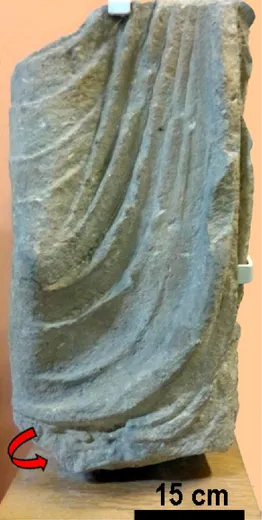
Man in a toga (MAC-19008)
Found in Barcelona's Roman wall, at Baixada de Sant Miquel.
The answer
Montjuïc sandstone. Its feldspar and quartz grains have the rim grown inside the rock.
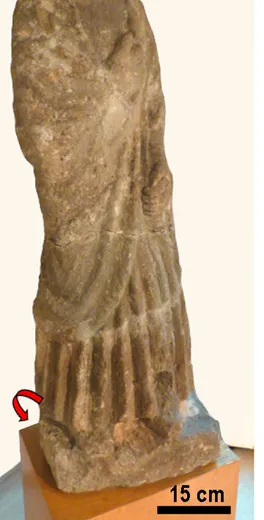
Woman in a toga (MAC-19018)
Found in the Roman wall, at Baixada de Viladecols.
The answer
Not from Montjuïc. No rims on the grains, bits of limestone, a fine calcite cement: it matches beachrock, a cemented beach sand like that cored in Barcelona's port.
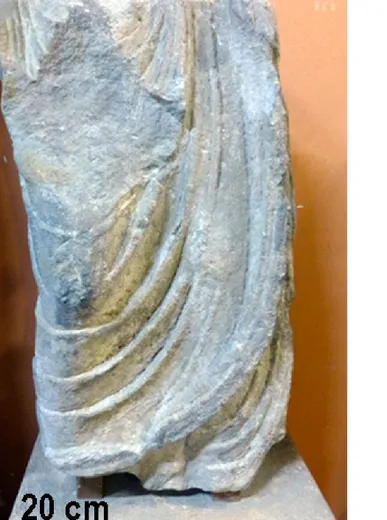
Man in a toga (MAC-19075)
Found with the first one, at Baixada de Sant Miquel.
The answer
Montjuïc sandstone. It has the marks of the Castell unit, the layer worked in the hill's quarries.
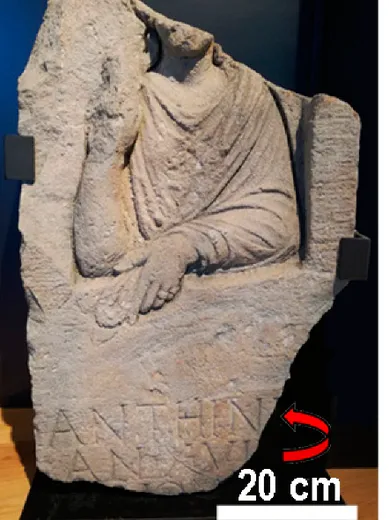
Gravestone with a portrait of the dead man
Found between Zona Franca and Bellvitge, 6–7 km from Barcino. Now in the museum at Cerdanyola.
The answer
Montjuïc sandstone. The rimmed feldspar gives it away.
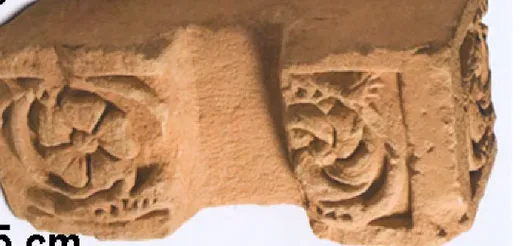
Frieze with acanthus scrolls
Found at Terrassa, 25 km away, next to the next piece. Both were thought to come from one funerary monument.
The answer
Not from Montjuïc. The feldspar has no rim, the grains are pressed into each other and the rock is too rich in quartz: it is a Triassic sandstone from the Catalan coastal ranges.
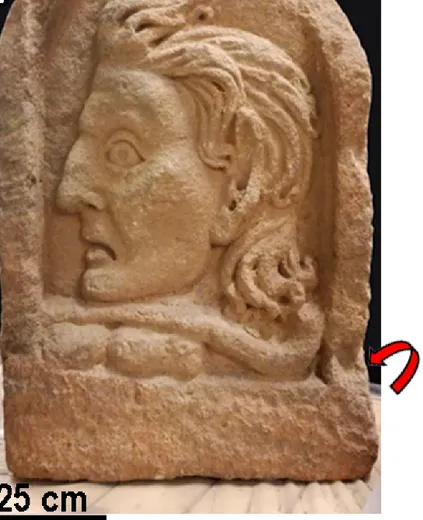
Acroterion with a satyr's head
Found at Terrassa, next to the frieze.
The answer
Montjuïc sandstone. It is Montjuïc stone, though the frieze beside it, the same colour, is not. The two pieces are not cut from the same stone.
Photographs: Casas, Di Febo and Parcerisa, Minerals, 2020, figure 6, CC BY 4.0. The red arrow marks where the sample was taken.
How to recognise Montjuïc stone under the microscope

Montjuïc sandstone hardened in a particular way. After the sand settled, new crusts of the same mineral grew on the quartz and potassium feldspar grains, inside the rock. They fill the gaps and give the stone its hardness. The rim on the feldspar is the surest sign: it shows best in cathodoluminescence, when the sample is hit with electrons and some grains glow, in colours that depend on their make-up. Fractures filled with chalcedony and the near absence of limestone help too.
With this test, Casas and colleagues found Montjuïc sandstone where nobody was looking for it: in a tessera from a Roman mosaic, probably the first evidence that the Romans also cut stone at the foot of the south-eastern cliff, and in the sand mixed into the clay of a 13th-century pottery workshop on carrer dels Carders.
Their conclusion is short: not every Roman sculpture from Barcino counted as Montjuïc stone is from Montjuïc, and everything attributed to it by eye deserves a second look. The 2020 study did not test any of the buildings on the list above.
Millstones and sand for scouring pots
From the 11th century, Montjuïc stone was also made into millstones and hand mills, sold around Barcelona and also in Majorca, Murcia, Roussillon, Provence and Genoa.
The hill also gave terra d'escudelles, a fine sand for scouring pots and pans. It is first recorded in 1586–1587 and stayed in use until the mid-20th century, about as long as the quarries.
It was also from Montjuïc, in 1792, that the astronomer Pierre Méchain read the latitude from the stars for the survey from which the metre was derived: He hid a number that would not fit. On how the city grew across the plain under Cerdà's plan: Barcelona planned gardens inside its blocks.
What is still unknown
How much stone the hill lost cannot be read from the terrain model: it would take knowing the shape of Montjuïc before the quarries. That is why no volume appears here.
Nobody knows which part of the hill each building's stone came from, or how much of each building is Montjuïc stone. The buildings on the list have not been tested under the microscope, and the test on the Roman pieces shows that an attribution made by eye can be wrong.
The face found in 2024 still awaits the pottery study that should confirm its date. Whether it supplied the first buildings of the Roman town remains an open question.
Data and sources
How to read the map. The relief and the slopes are measured. Ochre shows the sandstone on the geological map. The red square is the Roman quarry dug up by archaeologists. A filled circle is a place where the stone was tested under the microscope, an open circle a building on a list but untested, a struck-through circle a piece believed to be Montjuïc stone that is not. The dotted arcs show only the link, not the path the stone took.
- Measured relief and slopes
- Sandstone on the geological map
- Excavated
- Tested under the microscope
- Documented, untested
- Disproved under the microscope
- A link, not a route
Relief. The 25-centimetre LiDAR terrain model of the metropolitan area, flown in 2022, from the Institut Cartogràfic i Geològic de Catalunya (ICGC), CC BY 4.0, reduced here to 1.5 metres on the hill and 4 metres in the city, with no vertical exaggeration. Buildings do not appear: the model shows the ground.
Geology, water, addresses. The 1:50,000 geological map of Catalonia and the 2023 land cover map, both ICGC, CC BY 4.0. At this scale the edge of the sandstone can be off by a few tens of metres. Buildings sit at their official address, placed with the ICGC geocoder. Positions of the Teatre Grec and the Fossar de la Pedrera: OpenStreetMap (ODbL).
The stone. Lluís Casas, Roberta Di Febo, David Parcerisa, "Petrographic Markers for Archaeometric Identification of Montjuïc Sandstone, the Flagship Stone of Barcelona (NE Spain)", Minerals 10(2):154, 2020, CC BY 4.0. This is the source for the geology of the hill, the grades of stone, the 1989–1990 quarry, the list of buildings (after Eduard Roca, 2000 and 2003; Alessandro Ravotto, 2017; Miguel Ángel Gutiérrez Behemerid, 1991; Masriera and colleagues, 2005), the test of the Roman pieces and their photographs.
The 2024–2025 quarry. Ajuntament de Barcelona, "Descoberta una pedrera romana dels segles II-I aC a la falda de Montjuïc", 19 June 2025.
Teatre Grec and Fossar de la Pedrera. Ajuntament de Barcelona: Teatre Grec; Fossar de la Pedrera.