BUCHAREST · FROM HORSES TO LIGHT RAIL
The trams of Bucharest
You board the 41 never knowing horses ran on your street: at the end of the 19th century Bucharest had ten horse-tram lines, 313 horses, 49 cars and six million riders a year. Then, on 9 December 1894, the overhead wire changed everything — and in March 1906 students overturned cars and made barricades of them. The map below rebuilds all ten lines, street by street.
In short: the concession dates from 3/15 July 1871, the first lines from 28 December 1872; the horse network grew to 10 lines and 46 kilometres of track; the electric line (Grozăvești power plant, 9 December 1894) replaced them gradually, and the horses vanished — the encyclopaedia contradicts itself (1904 in one paragraph, 1929 in another), while BMIM gives 1929. Today 19 lines and 141 kilometres of double track remain. Search your street below and see which horse line crossed it.
See the line map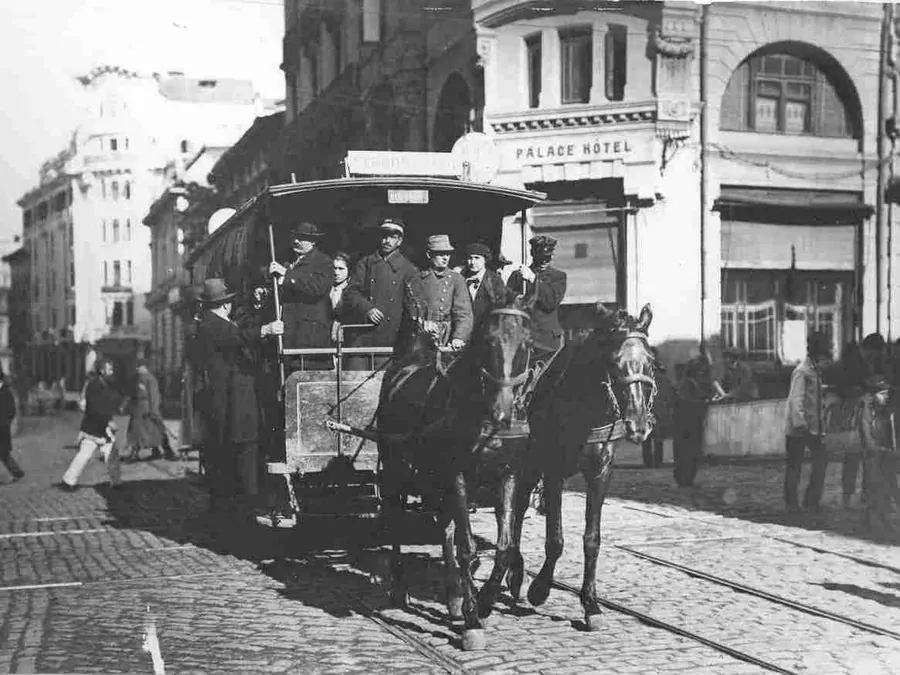
The line map: horses, the wire and the ghosts
Green are the 10 horse lines (1872–1929), rebuilt from the Bucharest Museum Bulletin's street lists. Blue is the first electric line, of 9 December 1894. Amber are the ghosts: three 1890s proposals never built. Drag the slider or press play and see what ran in the chosen year — in 1890, say, there was no electric wire yet.
The list beside the map tells the same story, with the same data.
- Horse lines
- 1894 electric
- Ghost proposals
Map background: © OpenStreetMap contributors (ODbL).
Ten lines, 313 horses
The horse network at its peak: 10 lines — numbered 1–5 and 8–12, numbers 6 and 7 missing from the source and not invented — 46,000 metres of track, 49 cars, 313 horses, 350 staff. The busiest: Popa Tatu, with 1.5 million riders a year.
9 December 1894: the overhead wire
The first electric line: 5 kilometres, 500 volts, 8 Siemens & Halske motors — from the Grozăvești plant along the Dâmbovița quay, Regina Maria Bridge, Elisabeta, Carol and Pache Protopopescu. The horses pull on for two or three decades, then vanish: the encyclopaedia contradicts itself (1904 and 1929), while BMIM gives 1929.
Today: 19 lines
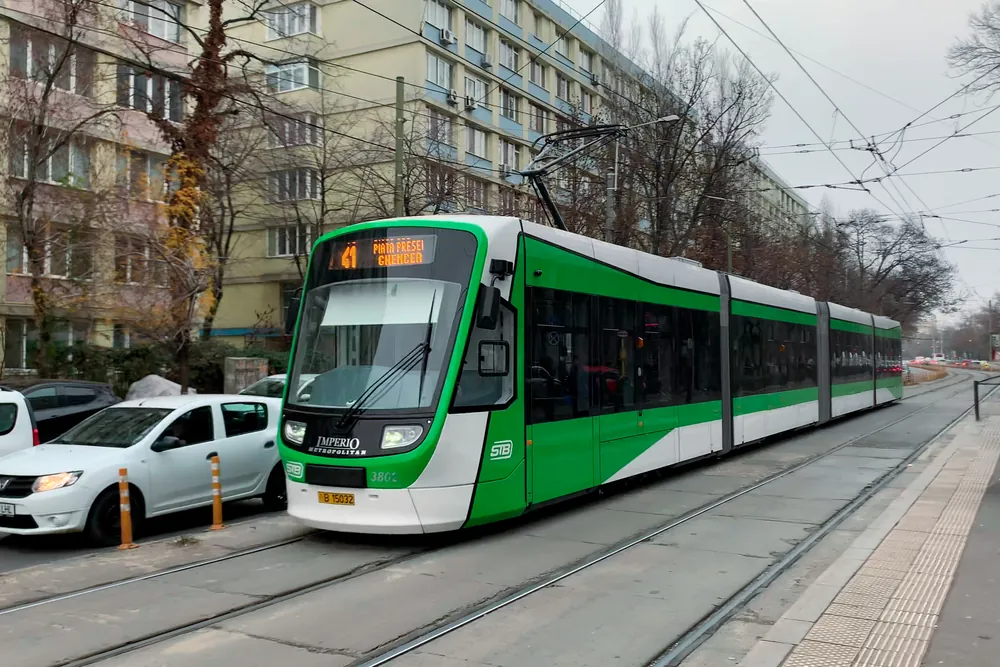
141 kilometres of double track (2019), 19 lines in March 2026, a single “light rail” — the 41, Ghencea–Piața Presei — and the first Astra Imperio cars, entering service on the 41 on 10 December 2022. The map shows the old network, rebuilt from sources; today's STB routes are not drawn, they are listed in the text below.
The horse lines are rebuilt from the BMIM street descriptions (display only, not survey): each stop is the centre of today's same-named street, and long segments (Romană–Teilor) mean the source gives no route detail. The electric line shows the first 1894 route; its window (1894–2026) means unbroken electric traction, not the same route. The ghosts are unbuilt 1890s proposals, on the 1890–1900 window.
Ten horse lines and one overhead wire
From the 1871 concession to the 1906 barricades — and to the only light rail.
It all starts with a paper: on 3/15 July 1871 the city grants the “American railway” concession, for 45 years, with foreign capital. Works last into the spring of 1872, and the first lines — Moșilor Road – St. George Square and St. George Square – Griviței Road — open on 28 December 1872. The network grows with the city: in July 1891 the Teilor–Rahovei stretch is announced, after a fight between 50 merchants fearing losses and 800 residents wanting “the speed of a road”. The fare is 15 bani a stop, double for the full run, and the coachmen get city-hall rules: no drunks, no dogs, no winter smoking, stops on request — but never on a slope or a curve.
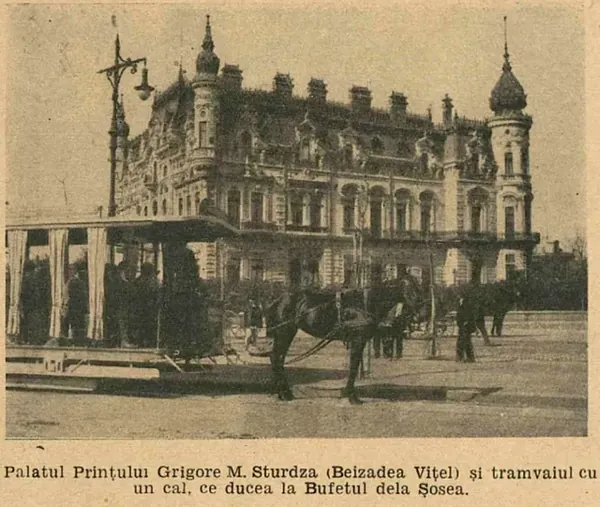
At its peak the horse network has 10 lines: 1 (St. Friday Cemetery–Gara de Nord–Moșilor Barrier), 2 (Călărașilor Barrier–Victoriei), 3 (Victoriei–Bufet), 4 (St. George–Lânăriei), 5 (St. George–Dorobanți Barrier), 8 (Oppler–Teilor), 9 (Bragadiru–Moșilor), 10 (Victoriei–Bellu), 11 (Storehouses–Dudești), 12 (Filaret–Luter). Under them: 46,000 metres of track, 49 cars, 313 horses, 350 staff — 90 conductors, 90 coachmen, 60 pavers, 10 inspectors. The New Society runs some 270,000 trips a year and carries 6 million riders; the just-started electric serves one million, but first place still goes to a horse line — Popa Tatu, with 1.5 million. In 1902 the city asks for headways: the average is 10 minutes at most — line 5 runs over 15, line 12 at 8, electric 14 at 7.
The electric line is born hard. The act of 30 November 1890 asks the New Society for an electric line on the Boulevard within three years; the plant is built in 1892 at Grozăvești, on one pogon granted free, and burns oil for the turbines — a national first. The problem is current collection: with no sewers, the underground sits in water and refuse, and accumulators are too heavy. The Orăscu commission picks the overhead wire — 9-metre poles on the street axis, wires at 5 metres — after a two-year quarrel with owners who wanted the poles on the pavement. On 9 December 1894 the 5-kilometre, 500-volt line opens to the public: 8 Siemens & Halske motors, green at first, then yellow, with doors on both sides — the left ones sealed for good after the first accidents. The opposition thunders that the “hanged wires” are “hideous” and may “strike people and animals dead”; citizens gather hundreds of signatures for the electric, because it pays better.
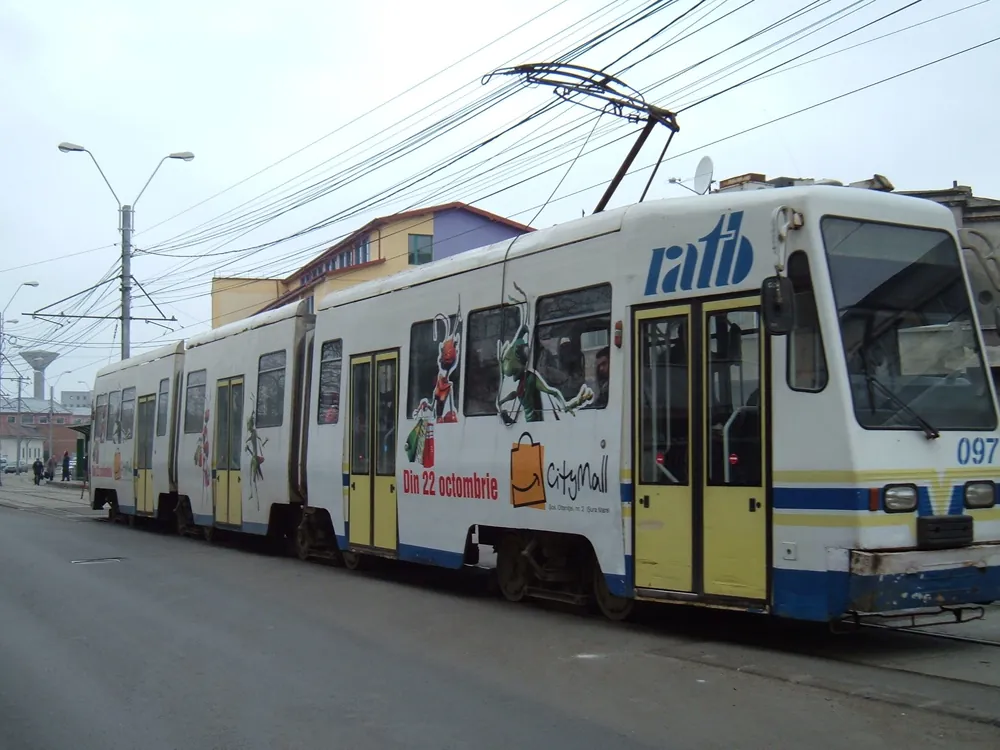
In March 1906 the tram enters political history: at the protests against French-language theatre, 4 cars become barricades — two overturned on Regală street, two on Academiei, to block the Interior Ministry, with students and the tricolour on top. The horses then leave the stage slowly: the encyclopaedia contradicts itself — 1904 in one paragraph, 1929 in another — while BMIM clearly gives 1929 (the horses had stopped running as early as 1919, because of the war). The page states the dispute out loud. Today 19 lines remain, says the encyclopaedia (March 2026), but it lists only 15 routes — 1, 4, 5, 7, 10, 11, 21, 23, 25, 27, 32, 41, 44, 47, 53 — because the count shifts with the works: 141 kilometres of double track (2019), a single “light rail” (the 41, from 1998), the last Tatra T4R cars withdrawn in 2019, and the first Romanian double-articulated tram, the V3A (1971, URAC), still on rails as the V3A-93.
The people: the mayor, the concessionaire and the coachman
A mayor who cuts a boulevard in four months, the concessionaire who strings the wire, and 90 coachmen with city-hall rules.
Pake Protopopescu: the boulevard in four months
Mayor, auction, a new 26-year concession — and Pache Protopopescu Boulevard, from Colței to Obor, in 4 months for 3 million lei.
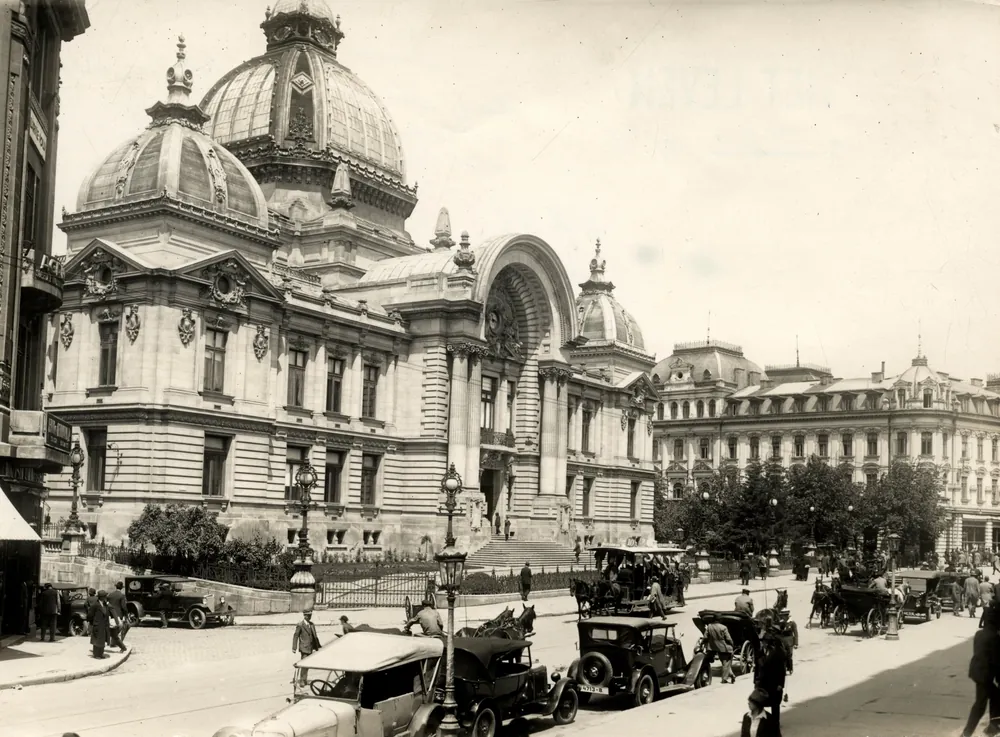
Several bid at the auction for the new concession; Ercole Grazia-Dei and Frederico Thalasso take it (the other two, Keun and Otlet, cede their rights), for 26 years. And the boulevard the electric would run on — from Colței to Obor — is finished, BMIM writes, “in a very short time of 4 months and at a minimal expense of 3 million lei”. Iorga saw it as “an avenue of triumph among market-town cottages”.
On the roughly 12-metre boulevard, the electric cars (2 metres wide) left over 3 metres between them and the carriages — but the war of the poles lasted two years: owners wanted them centred, the Council on the pavements, and in the end they went on the axis, with a single cable tunnel. The only admitted drawback: the 9-metre poles “obstructed the army's parade at festivities”.
Thalasso: the man of the overhead wire
Frederico Thalasso takes the electric concession alone; the Grozăvești plant burns oil — a national first.
The Grazia-Dei–Thalasso partnership does not hold: the first cedes to the second, who takes all assets and liabilities and carries the city-hall contract. Meanwhile the Grozăvești power plant — one pogon granted free by the city — starts in 1892 burning oil for the turbines, “for the first time in the country”.
Collection remained: with no sewers, the underground sat in water and refuse, and accumulators were too heavy. The Orăscu commission picks the overhead wire, the concessionaires first demand sewers and cubic-stone paving for the whole Boulevard, the city refuses — it had never pledged them — and consensus comes: poles on the edges, then on the axis. The Siemens & Halske cars ordered by Thalasso reach the rails on 9 December 1894.
The coachman: 90 men with rules
90 coachmen and 90 conductors; city hall writes their rulebook — no drunks, no dogs, no winter smoking.
The New Society's rules, kept in the State Archives, read like a code of manners on rails: no boarding beyond bench and platform seats; no boarding for the dirty-clothed, dogs, drunks; nobody hanging off the steps; conductors stop at stations and on request — but never on slopes, ramps or curves. The rider shows the ticket for inspection: 15 bani a stop, double for the full run.
In 1902 the average headway is 10 minutes at most, but it varies: line 5 (Dorobanți–St. George) runs over 15 minutes, “and the line was not very long”; line 12 (Filaret–Luter) at 8; electric 14 at 7. Accidents come from speed and from “the coachmen's failure to sync with boarding riders”: on Colței there is a dangerous curve, with tragic accidents, and agents are ordered to keep the cars as slow as possible there.
Which horse line ran on your street?
Type your street: the page knows, for 4,878 streets, which of the 10 horse lines crossed it around 1890 — and on which streets only unbuilt ghost proposals remain. Only 34 streets had horse lines (37 with the 1894 electric); 4 more sit only on ghosts; the rest, nothing — there were only ten lines.
On Calea Moșilor Line 1 Line 9
Horse lines: Line 1, Line 9. Ghost proposals (unbuilt): Line G2 (proposal).
Streets and points are OpenStreetMap (October 2026); line routes are rebuilt from the BMIM descriptions (display only). If your street's name changed since 1890, try the old form: Calea Moșilor, Calea Victoriei, Calea Rahovei.
Eight streets, ten lines
- Calea Moșilor — lines 1 and 9 — the artery of the first 1872 line; plus ghost G2, proposed by Balș and unbuilt.
- Calea Victoriei — lines 2, 3, 10, 11 and 12 — the busiest street of the horse network.
- Bulevardul Regina Elisabeta — lines 8, 12 and 14 — the 1894 electric ran here, by Cișmigiu.
- Strada Lipscani — line 1 — past Pake Protopopescu's house, says BMIM.
- Calea Griviței — line 1 — plus ghosts G1 (Singer) and G3 (Ștefănescu), unbuilt.
- Bulevardul Carol I — lines 10 and 14 — horses toward Bellu and the electric wire toward Obor.
- Calea Văcărești — line 4 — toward Lânăriei, over V. Alecsandri bridge.
- Șoseaua Colentina — line 8 — the Teilor terminus, by Colentina Hospital.
Method: how we know
Every year on the page has a source; every sketch is marked as a sketch.
The backbone is the Bucharest Museum Bulletin (BMIM XX, 2006): the 1871 concession (Slade's Belgian society, 45 years), the first lines of spring 1872 (three routes, about 20 km), all 10 horse routes street by street, the statistics (46,000 m of track, 49 cars, 313 horses, 6 million riders), the 1902 headways, the electric line (Grozăvești plant 1892, 9 December 1894, 5 km, 500 V, Siemens & Halske), the March 1906 barricades and the three ghost proposals — all with archive references. The page's exact dates (3/15 July 1871, 28 December 1872) and the two inaugural routes come from encyclopaedia, corroborated by tundria — BMIM gives only the year and the spring. Today's years (141 km of double track in 2019, 19 lines in March 2026, line 41, Astra Imperio) come from encyclopaedia, with the caveat said out loud: the article lists only 15 routes.
The geometry is rebuilt, not surveyed: each stop is the centre of today's same-named street (OpenStreetMap, October 2026, 4,878 streets), and segments join the stops in BMIM order. Where the old name is gone, the page says what it did: the Teilor by Colentina Hospital is anchored on Colentina Road (today's Teilor Street is another, in the south); “Viting” is read as Witting (an OCR error, geographic fit); Basarab Road is approximated with Orhideelor; Bonaparte with Iancului. The lookup only matches street names; it measures no distances. Of Ștefănescu's 4 proposed lines, the map shows only Pantelimon–Gară (BMIM gives no route detail; “Gară” is anchored on Gara de Nord).
What we do not know we do not invent: why numbers 6 and 7 are missing (the source is silent), when the last horses vanished (the encyclopaedia gives both 1904 and 1929; BMIM gives 1929), the exact length of the first electric line (5 km BMIM, 6.5 km encyclopaedia — we took BMIM, with its route). Horse-line era years are “by 1890 at latest” for the complete routes (the attested list; the first stretch dates from 1872, but the insistently demanded stations were unlinked until after 1889); the ghosts' window is the 1890s.
Quiz: six questions from the page
All answers are above, source included. Three of six is human; six of six is from the horse days.
Old questions, short answers
When did the first tram run in Bucharest?
On 28 December 1872: Moșilor Road – St. George Square and St. George Square – Griviței Road. The concession is older — 3/15 July 1871 — but a year and a half of works stood between paper and rails.
How many horses pulled the trams?
313 horses and 49 cars, at the end of the 19th century — on 46,000 metres of track, with 350 staff: 90 conductors, 90 coachmen, 60 pavers, 10 inspectors.
Why are lines 6 and 7 missing?
Nobody knows: the source (BMIM) lists 10 lines numbered 1–5 and 8–12 and never says why 6 and 7 are missing. The page does not invent them.
When did the horse trams vanish?
The encyclopaedia contradicts itself — 1904 in one paragraph, 1929 in another — while BMIM gives 1929. All three mentions are on the page; the dispute is open.
What happened in March 1906?
At the protests against French-language theatre, 4 cars became barricades: two overturned on Regală street, two on Academiei, to block the Interior Ministry. Students with the tricolour climbed on top.
Is line 41 light rail?
The only one deserving the name, since 1998: separated track, high speeds, station stops only, headways of minutes at peak. Lines 1, 21 and 32 are only “close”, on stretches.
What was line 14?
The first electric, of 9 December 1894: 5 kilometres and 500 volts, from the Grozăvești plant along the Dâmbovița quay, Regina Maria Bridge, Elisabeta, Carol and Pache Protopopescu — with 8 Siemens & Halske motors, green, then yellow.
Sources
- BMIM XX (2006) — concesiunea 1871, primele linii 1872, cele 10 trasee, statistici, frecvențe 1902, electrica 1894, baricadele 1906, fantomele / the 1871 concession, first 1872 lines, all 10 routes, statistics, 1902 headways, the 1894 electric, the 1906 barricades, the ghosts
- Wikipedia — Tramvaiul din București: 141 km cale dublă (2019), 19 linii (2026), linia 41, Astra Imperio / double track, lines, line 41, Astra Imperio
- Tundria — rețeaua 1993–2024, 1872–1929 caii / network 1993–2024, 1872–1929 horses
- OpenStreetMap (ODbL), octombrie 2026 — 4.878 de străzi, geometria de fond / 4,878 streets, background geometry