Chapter 8 · Animals: forms, functions, environments
Why are a sea sponge, a bee and a bear all animals?
- Size
- from 1 mm to 30 m
- Level
- organism
- Time
- hundreds of millions of years
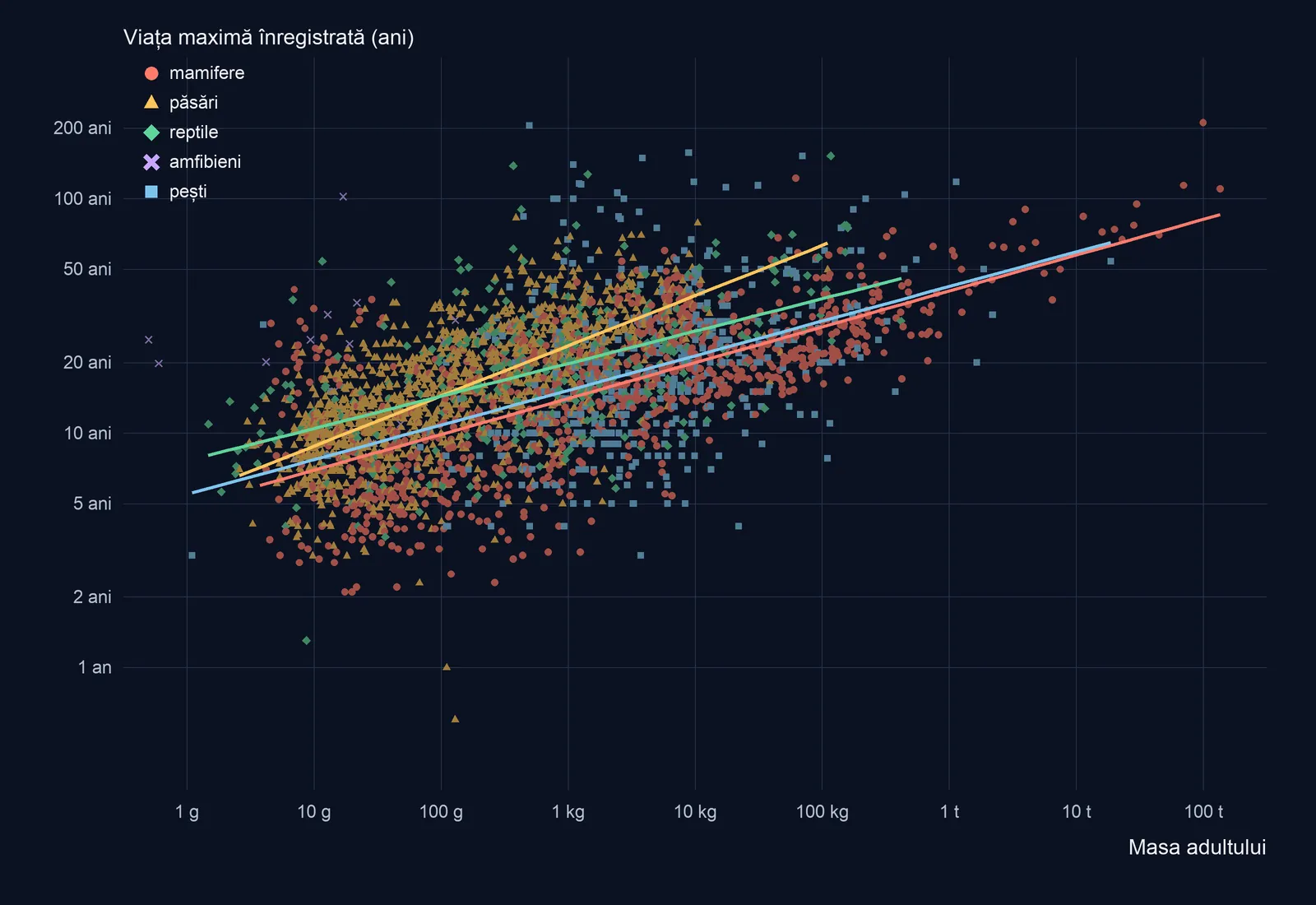
Each dot is a vertebrate species: how much an adult weighs and how long the oldest known individual lived. There are 3,123 species from the AnAge database, from salamanders of half a gram to the blue whale. Touch a dot to weigh the animal.
A bat and a mouse weigh the same
The greater mouse-eared bat, known in Romanian as the common bat, weighs 28.55 g. The yellow-necked mouse, a rodent of Romania’s forests, weighs 29.4 g. Both also live in Romania.
How long did the oldest known individual of each species live?
From half a gram to 136 tonnes
The oldest known greater mouse-eared bat lived 37.1 years, in the wild. The oldest yellow-necked mouse, 4.5 years, in captivity. The bat lived 8.2 times longer.
The chart shows 997 mammals, 1,330 birds, 355 reptiles, 18 amphibians and 423 fish. The lightest species is a North American salamander, at 0.5 g; the heaviest, the blue whale, at 136 t, which is 272 million times heavier.
On each axis, one gridline means ten times more than the one before. The lifespan shown is the species’ record, not its usual lifespan: 50% of the records come from captivity, where animals are shielded from predators and hunger.
Larger animals usually live longer
The Eurasian shrew, at 9 g, lived at most 3.2 years. The brown bear, at 277.5 kg, lived 40 years, and the African bush elephant, at 4.8 t, 65 years.
The line is the equation AnAge uses for mammals: t = 4.88 · M0.153, with M in grams and t in years. For a mass ten times larger, the predicted lifespan is 1.42 times as long.
The brown bear sits close to the line: 1.2 times the lifespan its mass predicts. The points scatter on both sides, though: the line shows a tendency, not a rule.
Most bats and most birds live longer than the mammal line predicts
The white circles mark the 96 species of bats. Of these, 88 species have a record above the mammal line, and half of all 96 live at least 1.7 times longer than their mass predicts. Brandt’s bat, at 7 g, lived 41 years, 6.2 times longer than its mass predicts.
Birds have their own line, higher up: at 100 g, the bird line gives 14.4 years and the mammal line 9.9 years. 82% of the bird species on the chart have a record above the mammal line.
What do the two groups have in common? Bats and most birds fly. Hypothesis: an animal that easily escapes predators lives long enough for the pace of its ageing to matter. A study across the bat family tree found that species that hibernate live longer; among both hibernating and non-hibernating species, those that use caves live longer (Wilkinson and Adams, 2019).
Some cold-blooded animals have outlived every mammal of their size in AnAge
The beluga sturgeon of the Danube weighs 1.14 t as an adult, and its age record is 118 years, 2.7 times longer than the fish line predicts. The Aldabra giant tortoise: 117.2 kg as an adult, a record of 152 years. In a deep-sea fish of the Pacific, Sebastes aleutianus, the adult weighs only 495 g, and the age record is 205 years. The Greenland shark has 392 years in AnAge, but no mass, so it appears only on the left-hand axis.
Mammals keep their bodies warm: in the 381 species with a body temperature in AnAge, it lies between 30.7 °C and 40.1 °C. Lines drawn through AnAge’s metabolic-rate measurements (343 species of mammals and only 14 species of reptiles, measured at 16.4–32.4 °C) give an estimate: at rest, a 1 kg mammal uses about 16 times as much energy as a 1 kg reptile.
A slow metabolism does not automatically mean a long life: at 1 t, the fish line gives 42 years and the mammal line 40 years.
No class stands above another
The lit band shows the masses that both mammals and fish reach: from 3.77 g to 18.7 t, 6.7 orders of magnitude. Within the same band, the points of the classes mix.
Humans, with 122.5 years, live 4.6 times longer than their mass predicts. Even so, 9 species on the chart have lived longer still: five fish, three reptiles and one mammal, the bowhead whale, with 211 years. The largest species, the blue whale, has a record of 110 years.
Each class has small and large species, with short and long lives. A “ladder of progress”, with one class always above the others, does not appear on the chart: lifespan is compared species by species, like any other trait.
Now you explain
The naked mole-rat weighs 35 g, about as much as a house mouse (20.5 g). It does not fly. Its record is 31 years, 3.7 times longer than the mammal line predicts; the house mouse’s is 4 years. It lives in colonies, in tunnels underground, in the Horn of Africa.
Which idea from the bats and birds would fit here? What would you compare to check it?
Compare with an answer
Closed tunnels shield it from most predators, as flight shields bats and birds. The same hypothesis fits: where few animals die of outside causes, evolution can favour bodies that age more slowly. To check it, you would compare, at the same mass, several species that live underground with their relatives at the surface. The chart shows an association, not a cause.
The lesson on birds and mammals, with the worked example and questions