
Chapter 6 · Bacteria, protists, fungiLesson 6.1
Classifying organisms and the tree of life: from species to domain
How can a botanist in Japan know exactly which flower a forester in Zărnești, a town at the foot of Piatra Craiului, is talking about, when they share not a single word?
- Size
- from 100 nm to 30 m
- Level
- single-celled organisms and communities
- Time
- 20 minutes and billions of years
Before you read: what do you think?
A dolphin, a shark and a human. Which two are more closely related?
See the answer
The dolphin and the human. A dolphin is a mammal: it breathes air with lungs and feeds its young on milk, just like a human, and their common ancestor is more recent than the one both share with the shark. The dolphin’s fish-like shape is an adaptation to swimming that arose separately.
On the limestone ridges of Piatra Craiului, a mountain range in the Southern Carpathians, grows a small pink carnation that lives nowhere else on Earth. Locals call it garofița Pietrei Craiului, the Piatra Craiului pink; a German tourist would call it something else, a Japanese one something else again. For every botanist in the world, though, it has a single name: Dianthus callizonus.
A two-word name for every species
The Swedish naturalist Carl Linnaeus (Carl von Linné) brought order to the names of living things. In 1735 he published Systema Naturae, a 12-page booklet that sorted plants and animals into categories. In 1753, in Species Plantarum, he gave each of the more than 5,900 plant species it described a two-word name, and in the 10th edition of Systema Naturae (1758) he did the same for animals.
The system is called binomial nomenclature: the first word is the name of the genus, the second is the epithet that sets the species apart from the other species in the same genus. The name is written in italics, the genus with a capital letter, the epithet in lower case: Dianthus callizonus, Homo sapiens. The genus Dianthus includes all the pinks; callizonus picks out only the one from Piatra Craiului.
Sometimes the name is followed by who described the species and in what year: the European bison is Bison bonasus (Linnaeus, 1758). The brackets show that Linnaeus described it under a different genus name, and the species was later moved to the genus Bison.
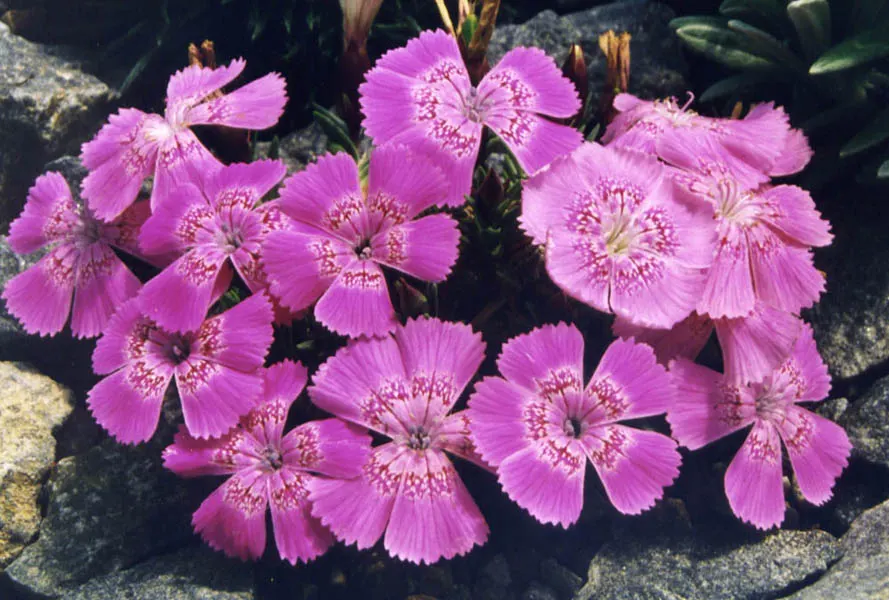
Photo: Ghislain118, CC BY-SA 3.0, source. Unchanged.

The ranks of classification, from species to domain
Similar, related species are grouped into a genus, genera into a family, and so on, in ever broader categories. Their order, from smallest to largest, is: species, genus, family, order, class, phylum, kingdom, domain. Each rank contains the one below it.
An actual group of organisms placed at one of these ranks is called a taxon: the genus Dianthus, the pink family and the class of mammals are all taxa. The smaller the rank two organisms share, the more features they have in common. The pink and the bison share only the domain; two species of pink share everything up to the genus.
Three domains and seven kingdoms
In 1990 the microbiologists Carl Woese, Otto Kandler and Mark Wheelis proposed, on the basis of comparing molecules from cells, that all living things be divided into three domains: Bacteria, Archaea and Eukarya. Bacteria and archaea are prokaryotes; every organism with a nucleus, from an amoeba to an oak to a human, belongs to the domain Eukarya. The differences between the three domains run deeper than those between plants and animals.
Below the domain come the kingdoms. Schools use seven: Bacteria and Archaea among the prokaryotes, then Protozoa, Chromista, Fungi, Plants and Animals among the eukaryotes. This is the classification proposed in 2015 by a group of taxonomists led by Michael Ruggiero.
Plants, animals and fungi each match one branch of the tree of life, with a common ancestor of its own. Protozoa and Chromista are working groups that gather organisms from different branches; the border between them has moved several times. Even in the 2015 classification, ciliates and sporozoans, usually taught under protozoa, are placed in Chromista. Tests use these groups; it is worth knowing that they are a convention.
How to read a tree of life
A phylogenetic tree shows who descends from whom. It starts from a root, the ancestor of every organism in the drawing. Each point where a branch splits in two stands for a common ancestor, from which two separate lineages set out. At the tips of the branches sit organisms alive today.
Two groups are more closely related the more recent their common ancestor. Groups that start from the same point are called sister groups. If you rotate the branches around a branching point, the information does not change; what counts is the connections, whatever the distance between the names on the page. Branch length shows time only if the drawing has a timescale.
A tree is not a ladder. Today’s bacterium has been evolving for just as long as today’s human, only on another branch. No organism at the tips is the ancestor of another, and none is “higher”: each is adapted to its own way of life.
Similar shape can mislead. Dolphins and sharks have long bodies and fins because both swim fast, but a dolphin breathes with lungs and suckles its young, like every mammal. To work out relationships, scientists compare many features, fossils and molecules, never a single trait.
Worked example
Where the pink and the bison meet
Place the two species on the ranks of classification, from the bottom up.
Piatra Craiului pink: species Dianthus callizonus, genus Dianthus, family Caryophyllaceae (the pink family), order Caryophyllales, class Magnoliopsida (dicotyledons), phylum Tracheophyta (vascular plants), kingdom Plants, domain Eukarya.
European bison: species Bison bonasus, genus Bison, family Bovidae (bovids), order Artiodactyla (even-toed ungulates), class Mammalia (mammals), phylum Chordata (chordates), kingdom Animals, domain Eukarya.
Compare them row by row. Up to the kingdom, every rank differs; the first rank they share is the domain Eukarya. Conclusion: the pink and the bison have in common the eukaryotic cell, with a nucleus. A bison and a cow (Bos taurus) would share everything up to the family, so they are much closer relatives.
In Romania
The pink that lives only on Piatra Craiului
The Piatra Craiului pink (Dianthus callizonus) is an endemic species: it grows only in the Piatra Craiului massif, on sunny rocks in the lower alpine zone and at the upper edge of the meadows. It flowers in July and August and has become the symbol of Piatra Craiului National Park, founded in 1990.
The species was described in 1851 by the botanists Heinrich Wilhelm Schott and Theodor Kotschy, in a botanical journal published in Berlin, from specimens collected in Transylvania. Its scientific name has stayed the same ever since, so an article from 1851 and one from today are talking about the same plant.
Because it lives on a single massif, a species like this can vanish completely if its home is destroyed. Romanian researchers have studied how to propagate it in the laboratory from plant fragments, to keep a reserve away from the mountain.
In short
- Binomial nomenclature, introduced by Linnaeus, uses two words: the genus name, with a capital letter, and the species epithet, in lower case, both written in italics.
- The ranks of classification, from smallest to largest, are: species, genus, family, order, class, phylum, kingdom, domain.
- The three domains are Bacteria, Archaea (prokaryotes) and Eukarya (organisms with a nucleus).
- The kingdoms used in school are Bacteria, Archaea, Protozoa, Chromista, Fungi, Plants and Animals; Protozoa and Chromista are working groups, each made of several branches of the tree.
- On a phylogenetic tree, each branching point is a common ancestor; two groups are more closely related the more recent their common ancestor.
- A tree is not a ladder: today’s organisms have been evolving for the same length of time, and none is superior to another.
Common mistakes
WrongBacteria are the ancestors of humans, because they are simpler.
RightToday’s bacteria are contemporaries of humans and have been evolving for just as long, on another branch. Humans and bacteria share a very ancient common ancestor that no longer exists.
WrongA dolphin is a fish, because it is shaped like a fish and lives in water.
RightA dolphin is a mammal: it breathes with lungs and suckles its young. The fish shape is an adaptation to swimming that arose separately in dolphins and in fish.
WrongThe scientific name is written Dianthus Callizonus.
RightThe genus takes a capital letter, the species epithet a lower-case one, and both are written in italics: Dianthus callizonus.
Check yourself
Seven questions. For the first six you see the explanation at once, with the paragraph of the lesson that supports it; for the written ones you compare with a good answer.
Which is the correct way to write the scientific name of humans?
Answer
c) Homo sapiens. The genus Homo comes first and has a capital letter; the epithet sapiens is lower case; both are written in italics.
On a phylogenetic tree, what does the point where a branch splits in two stand for?
Answer
b) A common ancestor of the lineages that start there. Present-day organisms sit at the tips. Branching points are common ancestors; the tree does not show “more evolved” species.
Which statement about the group Protozoa is correct?
Answer
c) It is a working group that gathers organisms from different branches. Protozoa are eukaryotes, not prokaryotes, and they do not form a single branch. Schools keep them as a group because they are easy to study together.
On a tree, A and B start from the same branching point, and C splits off from them closer to the root. The drawing is rotated, and now B sits next to C. Which are the closest relatives?
Answer
c) A and B, because they have the most recent common ancestor. Rotating the branches does not change the connections. A and B are still sister groups.
How many ranks does classification have from species to domain, counting both the species and the domain?
ranksAnswer
8 ranks. Species, genus, family, order, class, phylum, kingdom, domain: eight ranks.
Arrange the ranks of classification from the broadest to the smallest.
Answer
The correct order:
- domain
- kingdom
- phylum
- class
- order
- family
- genus
- species
Each rank contains the one beneath it: a kingdom holds several phyla, a family several genera.
A bat flies on wings, like a sparrow. A classmate says the bat is a bird. Explain why he is wrong and what should be compared to find out what the bat is related to.
A good answer
Wings only show that both fly; a similarity of shape can arise separately, on different branches. A bat has hair, gives birth to live young and suckles them, so it is a mammal, more closely related to humans than to sparrows. To work out relationships, you compare many features, fossils and molecules, and look for the most recent common ancestor.
A complete answer says that a single similarity does not prove relationship, gives the bat’s mammal features and names the criterion: the most recent common ancestor, worked out from many features.
Practical work for this lesson
- The same tree, a different drawing – Case study with a schematic tree, 25–30 minutes
Terms
- binomial nomenclature
- The scientific name of a species, made of the genus name and the species epithet, written in italics.
- species
- The basic rank of classification: similar organisms that can interbreed and have fertile offspring.
- taxon
- An actual group of organisms placed at one rank of classification, for example the genus Dianthus.
- domain
- The broadest rank of classification; the living world has three domains: Bacteria, Archaea and Eukarya.
- kingdom
- The rank below the domain; schools use seven kingdoms.
- phylogenetic tree
- A branching drawing that shows the lines of descent between groups of organisms and their common ancestors.
- common ancestor
- The organism from which two or more lineages descend; on a tree, the point where the branches split.
- endemic species
- A species that lives only in one particular place, for example on a single mountain massif.
Sources and link to the programme
- Linda Hall Library – Scientist of the Day: Carl Linnaeus – Systema Naturae 1735, a 12-page booklet; Species Plantarum 1753, more than 5,900 species with binomial names, the starting point of botanical nomenclature; the 10th edition (1758–1759), the starting point of zoological nomenclature
- The Linnean Society – Who was Linnaeus? – Linnaeus introduced the binomial system, with two names for each species
- OpenStax – Biology 2e, 20.1 Organizing Life on Earth – the domain–kingdom–phylum–class–order–family–genus–species hierarchy; how to write a binomial name; reading a tree: root, branching point, sister groups, rotation does not change the information, branches do not show time; unrelated organisms can look alike
- Woese, Kandler, Wheelis (1990), PNAS – Towards a natural system of organisms: proposal for the domains Archaea, Bacteria, and Eucarya – the proposal of the three domains based on molecular comparisons; the differences between domains run deeper than those between kingdoms
- Ruggiero et al. (2015), PLOS ONE – A higher level classification of all living organisms – the seven-kingdom classification (Archaea, Bacteria, Protozoa, Chromista, Fungi, Plantae, Animalia); Chromista widened with alveolates and other former protozoa
- ICZN – International Code of Zoological Nomenclature, Article 51 – the author’s name goes in brackets when the species has been moved to another genus
- GBIF – Bison bonasus (Linnaeus, 1758) – the valid name of the European bison and its classification: Animalia, Chordata, Mammalia, Artiodactyla, Bovidae, Bison
- GBIF – Dianthus callizonus Schott & Kotschy – the classification of the pink: Plantae, Tracheophyta, Magnoliopsida, Caryophyllales, Caryophyllaceae, Dianthus
- IPNI – Dianthus callizonus Schott & Kotschy – the description of the species by Schott and Kotschy in Botanische Zeitung (Berlin) 9: 192, 1851; specimens from Transylvania
- Radio România Internațional – Piatra Craiului National Park – the pink is unique to the park and its symbol, and grows on sunny rocks in the lower alpine zone; the national park was founded in 1990
- Buta et al. (2009), Journal of Plant Development 16: 81–86 – Description of some spontaneous species and the possibilities of use them in the rocky gardens (Alexandru Ioan Cuza University of Iași; archived copy) – Dianthus callizonus flowers in July–August (“Bloom in the period of July-August”)
- Revue Roumaine de Biologie – Biologie Végétale 48 (2005), micropropagation of Dianthus callizonus – Dianthus callizonus, a rare endemic of the Piatra Craiului massif; in vitro propagation for conservation
From the programme: “Diversity of the living world – overview. The tree of life and the classification of organisms” (common core). Specific competences addressed: 1.1, 1.2, 2.2.