
Chapter 6 · Bacteria, protists, fungiLesson 6.7CS
Diversity of protozoa and Chromista algae: parasites, partners and algal blooms
How can water full of oxygen-producing algae end up, by morning, without enough oxygen for the fish?
- Size
- from 100 nm to 30 m
- Level
- single-celled organisms and communities
- Time
- 20 minutes and billions of years
Before you read: what do you think?
In 1987, in Canada, more than 100 people fell ill after eating mussels, and three died. Which organism produced the toxin?
See the answer
A diatom, a microscopic alga with a silica wall, of the genus Pseudo-nitzschia. It produces domoic acid, and the mussels, which feed by filtering water, built it up in their bodies during a bloom. The symptoms included memory loss, hence the name of the illness: amnesic shellfish poisoning.
Many termites eat wood, but cannot digest the cellulose in it by themselves. The cellulose is broken down by flagellate protists that live in their gut, and the termite uses the resulting substances. Microscopic organisms have all kinds of relationships with the rest of the living world, from partnership to parasitism.
Free-living, partner and parasitic protozoa
Most protozoa live free in water and soil, where they eat bacteria, small algae and organic debris and are in turn food for small animals. Others live in close association with another organism. When both partners gain, the relationship is called mutualism: the flagellates in the gut of some termites break down cellulose, and the termite gives them shelter and food. When one lives at the expense of the other and makes it ill, the relationship is called parasitism.
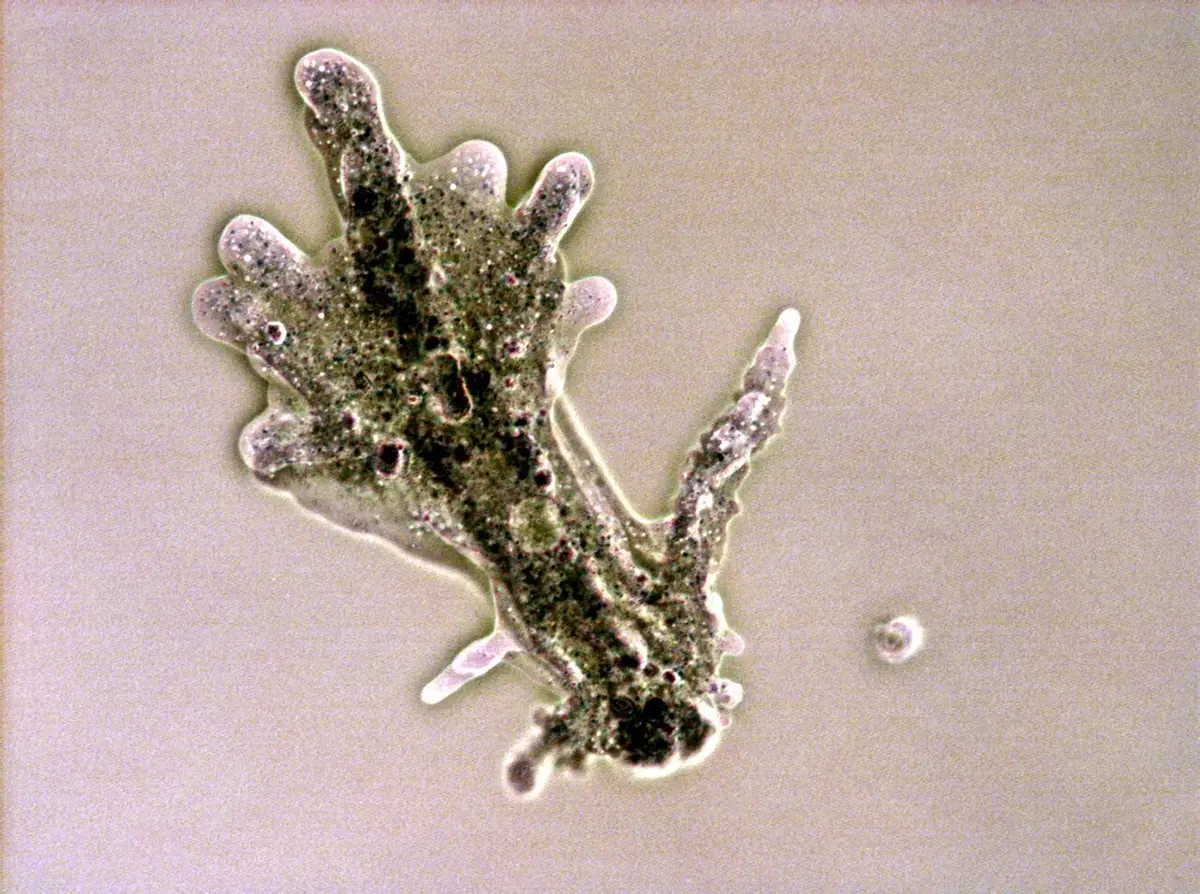
Photo: Cymothoa exigua, CC BY-SA 3.0, source. Resized.

Adaptations to a parasitic life
A parasite has to get from one host to another. Many intestinal protozoa do this as a cyst, a cell with a thick wall that can survive outside the body. Giardia lives in the small intestine and causes diarrhoea; its cysts survive for several months in cold water and enter the body through contaminated water or food, or on unwashed hands. Entamoeba histolytica lives in the large intestine, can destroy its wall and causes amoebic dysentery; it too spreads by cysts.
Toxoplasma gondii passes through several hosts. It reproduces sexually only in the gut of cats and other felines, which are the definitive host and shed resistant forms in their faeces. Birds, rodents and humans are intermediate hosts: in their bodies the parasite forms cysts in the muscles and the brain, which can stay for life. Most healthy people who are infected have no symptoms, but an infection that occurs during pregnancy can pass to the baby, which is why doctors give pregnant women advice on prevention.
Other parasites use a vector, an animal that carries them from one host to another. The malaria plasmodium is carried by the female Anopheles mosquito. Trypanosoma brucei, the agent of sleeping sickness in Africa, is carried by the tsetse fly and changes the proteins on its cell surface with every cycle of infection, so the body’s defences fail to get rid of it.
Chromista algae: producers at the base of the food web
Diatoms are single-celled algae with a wall of silicon dioxide, like a glass box with fine patterns. Together with dinoflagellates and multicellular algae, photosynthetic protists carry out around a quarter of Earth’s photosynthesis and feed a large share of aquatic animals. Large brown algae, such as kelps and their relatives, have structures that resemble those of plants: a holdfast, a kind of small stem and broad blades; in the giant kelps of the Pacific, the stem reaches 60 m.
Dinoflagellates are single-celled algae with two flagella. Some live inside the cells of corals: they give them substances made by photosynthesis and receive shelter. When corals lose these algae, they bleach and can die. Other dinoflagellates multiply in huge numbers and turn the sea red, and the toxins of some species kill fish, birds and marine mammals.
For the curious
The flagella of dinoflagellates lie in grooves, between plates of cellulose. Some give off light when the water is stirred. In the classification used by Ruggiero and colleagues (2015), dinoflagellates, ciliates and sporozoans were moved into Chromista, together with diatoms and brown algae; school textbooks keep ciliates and sporozoans under protozoa.
Algal blooms: when there are too many nutrients
An algal bloom is the very rapid multiplication of certain photosynthetic organisms, which turn the water green, brown or red. Nutrients, plenty of light and warm water favour it. When nutrients, above all the nitrogen and phosphorus from fertilisers and waste water, reach a lake or a sea in excess, the water undergoes eutrophication: it becomes enriched in nutrients and produces far more biomass.
Many blooms are harmless. A bloom can do harm without toxins: the layer of algae shades the organisms beneath it, and dead algae sink to the bottom, where decomposers break them down and use up the dissolved oxygen. At night photosynthesis stops, but respiration goes on. The water becomes hypoxic, meaning it has too little oxygen, and animals that cannot leave die. Some species also produce toxins, such as the domoic acid of Pseudo-nitzschia diatoms. The colour of the water does not show whether a bloom is toxic. Freshwater blooms are often caused by cyanobacteria, which are bacteria, not Chromista algae.
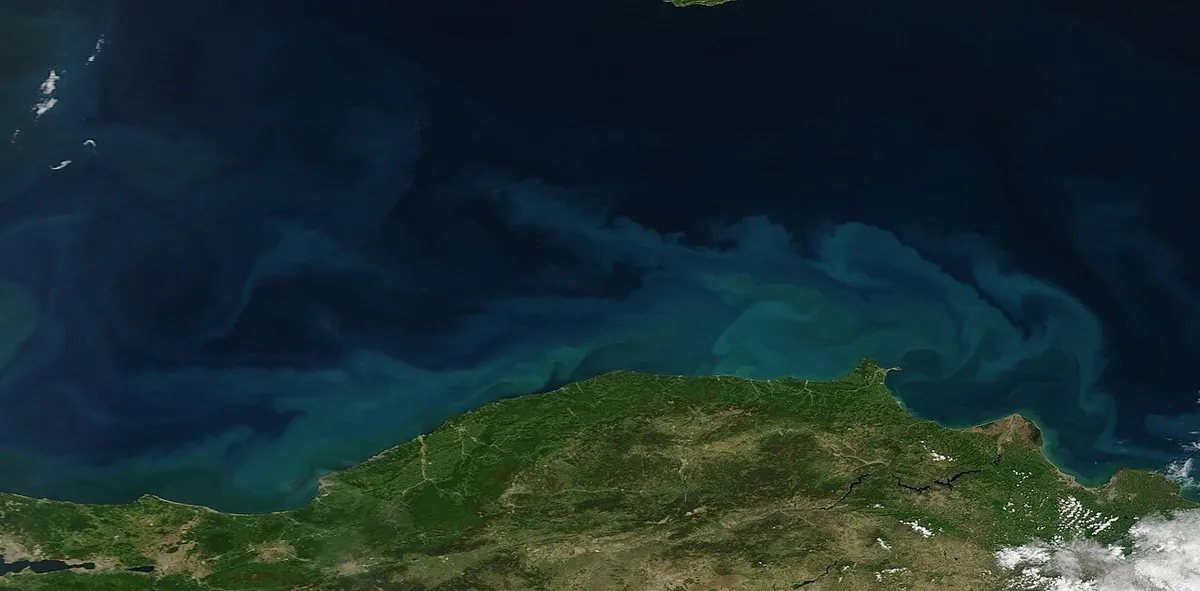
Photo: MODIS Land Rapid Response Team, NASA GSFC, Public domain, source. Cropped and resized.

Worked example
Oxygen in a eutrophic lake, day and night
In a sample calculation, with values chosen for the exercise, the dissolved oxygen at the surface of a lake with a bloom is 9 mg/L at 16:00 and 3 mg/L at 04:00.
The fall is 9 − 3 = 6 mg/L in 12 hours, that is, 6 ÷ 12 = 0.5 mg/L per hour. By day, the algae produce more oxygen by photosynthesis than they use, and the value rises. At night, the algae, the animals and the decomposers only respire, and the value falls.
That is why, in a eutrophic lake, oxygen is lowest at dawn. Two values do not prove the cause on their own: a conclusion needs measurements on several days, at several depths, together with the water temperature.
In Romania
The Black Sea off Constanța
From the 1960s, the Danube carried more and more nutrients from farming and waste water into the north-western Black Sea; it brought almost 75% of the nutrients that area received. Near the Danube Delta, the concentration of phosphates at the surface rose about tenfold, from 1–2 µM in the 1960s to 10–20 µM in the 1970s and 1980s.
Blooms became more frequent and changed in make-up. On the western coast, the share of dinoflagellates in blooms rose from about 15% before 1970 to about 60% in the 1980s and 1990s, while that of diatoms fell. After 1970, blooms appeared regularly in summer as well as in spring.
On the north-western shelf of the sea, hypoxia at the bottom often appears in summer, and in the worst years it reaches as far as the bay at Constanța, Romania’s main port. At a station 20 nautical miles off Constanța, where the water has been analysed monthly since 1963, nitrates fell from about 15 µM in the early 1980s to 4–5 µM in the early 1990s.
In short
- Protozoa can be free-living, in mutualism (the flagellates in the gut of some termites) or parasitic (Giardia, Entamoeba histolytica, Toxoplasma gondii, Trypanosoma, Plasmodium).
- A cyst is a thick-walled form that survives outside the body; many intestinal protozoa spread this way.
- In Toxoplasma gondii, the cat is the definitive host, and humans, birds and rodents are intermediate hosts; a vector carries the parasite from one host to another, like the Anopheles mosquito in malaria, which is also the definitive host of plasmodium.
- Diatoms, with a wall of silicon dioxide, and brown algae are Chromista algae, producers at the base of aquatic food webs.
- An algal bloom is the very rapid multiplication of certain photosynthetic organisms, favoured by excess nutrients (eutrophication), light and warmth.
- A bloom can cause hypoxia through respiration and decomposition, even without toxins; some species, such as Pseudo-nitzschia diatoms, produce toxins.
Common mistakes
WrongAlgae produce oxygen, so the more algae there are, the more oxygen the water has.
RightBy day, yes. At night the algae only respire, and dead algae are broken down in a process that uses oxygen, so a bloom can leave the water without oxygen.
WrongThe cat is the vector of toxoplasmosis.
RightThe cat is the definitive host: the parasite reproduces sexually in its gut. A vector is an animal that carries the parasite from one host to another, like the mosquito in malaria; the mosquito is at the same time the definitive host of plasmodium, because the parasite reproduces sexually inside it.
WrongIf the water has turned green or red, the bloom is toxic.
RightThe colour only shows that there are many photosynthetic organisms. Whether there are toxins can be found out only by identifying the species and by laboratory tests.
Check yourself
Seven questions. For the first six you see the explanation at once, with the paragraph of the lesson that supports it; for the written ones you compare with a good answer.
What role does the cyst play in the life of Giardia?
Answer
b) It is the thick-walled form that survives outside the body and passes on the parasite. The cyst survives for months in cold water. People are infected by swallowing cysts with water or food or from their hands.
In Toxoplasma gondii, which is the definitive host?
Answer
c) Cats and other felines. The definitive host is the one in which the parasite reproduces sexually. Humans and rodents are intermediate hosts, and the mosquito plays no part in toxoplasmosis.
How can a bloom without toxins kill the fish in a lake?
Answer
b) Dead algae are broken down in a process that uses oxygen, and at night respiration goes on without photosynthesis. Decomposition and night-time respiration use up the dissolved oxygen, and the water becomes hypoxic.
The bloom in a freshwater lake is caused by cyanobacteria. What are these organisms?
Answer
a) Bacteria. Cyanobacteria are photosynthetic prokaryotes, in the domain Bacteria. Causing a bloom does not change their classification.
In a lake, dissolved oxygen falls from 8 mg/L at 20:00 to 2 mg/L at 06:00. By how many mg/L does it fall per hour, on average?
mg/L per hourAnswer
0.6 mg/L per hour. The total fall is 8 − 2 = 6 mg/L, over 10 hours: 6 ÷ 10 = 0.6 mg/L per hour.
Put in order the stages by which excess nutrients leave a lake without oxygen.
Answer
The correct order:
- Nitrogen and phosphorus from fertilisers reach the lake
- The algae multiply very fast (a bloom)
- The algae die and sink to the bottom
- Decomposers break down the dead algae and use up the oxygen
- The water becomes hypoxic and the animals die
This is the chain of eutrophication: nutrients, bloom, death of the algae, decomposition that uses oxygen, hypoxia.
A pond next to a heavily fertilised field turns green every July, and on some mornings dead fish appear at the edge. Explain the link between the field, the colour of the water and the dead fish, and suggest a measurement that would test the explanation.
A good answer
Nitrogen and phosphorus from the fertilisers wash into the pond with rainwater and cause eutrophication: the algae multiply very fast, and the water turns green. At night the algae only respire, and dead algae are broken down in a process that uses oxygen, so towards morning the water becomes hypoxic and the fish die. To test this, measure the dissolved oxygen in the evening and at dawn, on several days and at several depths.
A complete answer names the nutrients and eutrophication, explains the fall in oxygen through respiration and decomposition, links the fish deaths to the morning and suggests measuring oxygen at different times of day.
Terms
- mutualism
- A relationship between two species in which both gain.
- parasitism
- A relationship in which one organism lives at the expense of another, called the host, and harms it.
- cyst
- A thick-walled resting form of a single-celled organism that survives outside the body.
- definitive host
- The host in which a parasite reproduces sexually.
- algal bloom
- The very rapid multiplication of certain photosynthetic organisms, which colour the water.
- eutrophication
- The enrichment of a body of water with nutrients, above all nitrogen and phosphorus, followed by a sharp rise in biomass.
- hypoxia
- The state of water that holds too little dissolved oxygen for many animals.
Sources and link to the programme
- OpenStax – Biology 2e, 23.4 Ecology of Protists – the protists in the termite gut break down cellulose; photosynthetic protists carry out about 25% of Earth’s photosynthesis; Plasmodium needs a mosquito and a vertebrate; Trypanosoma brucei, the tsetse fly, sleeping sickness, the change of surface glycoproteins with every cycle
- OpenStax – Biology 2e, 23.3 Groups of Protists – diatoms with a silicon dioxide wall; brown algae with holdfast, stipe and blades, the stipe of kelps up to 60 m; dinoflagellates with two flagella and cellulose plates, bioluminescence, red tides and toxins; the parabasalids in the termite gut
- CDC DPDx – Giardiasis – cysts, the resistant forms that spread giardiasis, survive several months in cold water; trophozoites in the small intestine; spread through contaminated water, food and hands
- CDC – About Giardia – Giardia causes diarrhoea
- CDC DPDx – Amebiasis – Entamoeba histolytica: cysts are the infective form; trophozoites in the large intestine can invade the lining; dysentery
- CDC DPDx – Toxoplasmosis – felines are the only known definitive hosts; oocysts shed in faeces; intermediate hosts birds and rodents; cysts in muscle and brain that can remain for life
- CDC – About Toxoplasmosis – most healthy people have no symptoms; an infection during pregnancy can pass to the baby
- WHO – Malaria (fact sheet) – malaria is caused by Plasmodium and spread by female Anopheles mosquitoes
- Ruggiero et al. (2015), PLoS ONE – A higher level classification of all living organisms – Chromista widened to include the alveolates (dinoflagellates, ciliates, sporozoans), previously considered protozoa
- NOAA – Harmful Algal Blooms – blooms are favoured by nutrients, high temperatures and plenty of light; cyanobacteria often cause freshwater blooms; diatoms and dinoflagellates, the most common harmful marine species; some blooms deplete oxygen
- NOAA – Are all algal blooms harmful? – not all blooms are harmful; a bloom can do harm without toxins, through lack of oxygen and shading
- NOAA – What is a dead zone? – excess nutrients cause overgrowth of algae; dead algae are broken down in a process that uses oxygen; hypoxia
- FAO (2004) – Marine biotoxins, Amnesic Shellfish Poisoning – domoic acid produced by Pseudo-nitzschia diatoms; Prince Edward Island, Canada, 1987: three deaths and more than 100 cases after eating mussels; memory loss among the symptoms
- Oguz (2005), Oceanography – Long-term impacts of anthropogenic forcing on the Black Sea ecosystem – nutrient enrichment from the 1960s; the Danube, almost 75% of the nutrient input to the north-western sea; phosphates from 1–2 µM in the 1960s to 10–20 µM in the 1970s–1980s near the Danube Delta; dinoflagellates from about 15% to about 60% of blooms on the western coast; regular summer blooms after 1970; nitrates at the station 20 nautical miles off Constanța, measured monthly since 1963: about 15 µM in the early 1980s, 4–5 µM in the early 1990s
- Capet, Beckers & Grégoire (2013), Biogeosciences – Drivers, mechanisms and long-term variability of seasonal hypoxia on the Black Sea northwestern shelf – seasonal bottom hypoxia on the north-western shelf, which in bad years extends towards the bay at Constanța
From the programme: “Diversity of protozoa: examples of representative species, interactions and adaptations”; “Chromista – diversity of algae: examples of representative species, interactions and adaptations (e.g. algal blooms)” (specialism, Natural Sciences). Specific competences addressed: 1.1, 1.2, 2.1, 4.1.