Chapter 6 · The worlds you discover under the microscope
How many kinds of life fit in a drop of water?
- Size
- from 100 nm to 30 m
- Level
- single-celled organisms and communities
- Time
- 20 minutes and billions of years
A single bacterium, put in a vessel with food and kept warm, can split in two every 20 minutes. Press “Wait 20 minutes” and watch how fast the number grows. Then compare the calculation with a real culture, measured in a laboratory.
One bacterium doubles every 20 minutes
The rod beside the text is a cell of Escherichia coli, a bacterium that also lives in the human gut. It is about 2 µm long and weighs about 1 picogram: a thousandth of a billionth of a gram.
In ideal laboratory conditions, the number of E. coli cells doubles every 20 minutes.
If nothing stopped them, how long would it take for them all to weigh as much as a 70 kg person? (70 kg is an example.)
Each cell splits into two identical cells
A bacterium has no nucleus, so it does not divide by mitosis. It multiplies by direct division (binary fission): the cell grows, copies its DNA, pinches in at the middle and splits into two identical daughter cells.
After one doubling there are two cells, after two doublings four, after three eight. The formula is N = N₀ × 2ⁿ, where n is the number of doublings. After two hours, which is six doublings, each cell has become 2⁶ = 64.
After 10 hours, more than a billion cells
Ten hours is 30 doublings: 2³⁰ = 1,073,741,824 cells. At about 1 µm³ each, together they would fill 1.07 mm³ and weigh 1.07 mg.
If the doubling went on in the same way, after 18 hours and 40 minutes (56 doublings) the culture would weigh as much as a 70 kg person. After a day it would weigh 4,722 tonnes, and after 44 hours and 20 minutes it would outweigh the Earth, which has a mass of 5.97 × 10²⁴ kg.
The Earth is not covered in bacteria. Something stops the doubling.
In a vessel, the food runs out and waste builds up
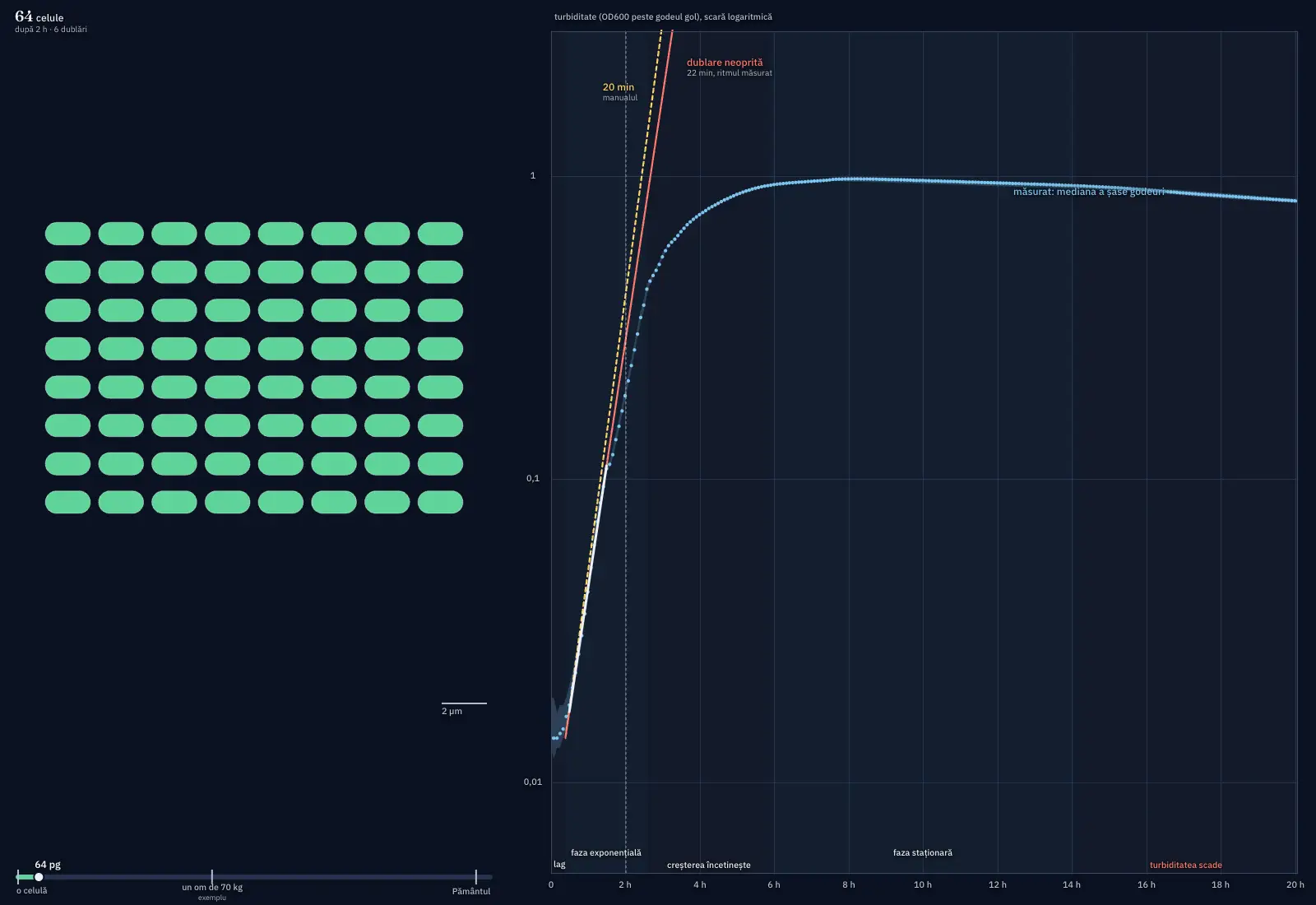
The blue dots are a real measurement: the turbidity of six cultures of E. coli in LB nutrient broth at 37 °C, read every five minutes for 20 hours. The more cells, the cloudier the liquid.
The red line starts from the same point and keeps doubling at the rate of the fastest hour measured. At first, the two run together. After two hours and 39 minutes, the real culture was at half the line, and then it levels off on a plateau while the line leaves the frame.
In a closed vessel, growth usually stops because the cells use up the food in the medium and their waste builds up. Only turbidity was measured here: the food left and the waste were not measured in this culture. At the end of the measurement, the red line would be about 10¹⁴ times above the plateau.
Measured: one doubling every 22 minutes, then ever more slowly
On a logarithmic scale, each doubling climbs by the same amount, so exponential growth shows as a straight line. The steepest hour of measurements, between minutes 29 and 89, gives a doubling every 22 minutes; each culture taken separately gives between 21.5 and 24.1 minutes. An estimated background was subtracted from the readings; with a slightly lower or higher background, the result stays between 22 and 24 minutes.
The lesson gives 20 minutes, in ideal laboratory conditions, and the measurement gives 22: almost the same rate, in an ordinary broth, at 37 °C. The rate does not stay constant, however. In the second hour, a doubling takes 30 minutes, in the third 39, and after almost six hours the turbidity hardly rises any more.
The phases are marked only where they show in the data: the lag phase (the first 23 minutes), the exponential phase, the slowing and the stationary phase. Towards the end, turbidity falls slowly: at 20 hours it is 16% below the maximum. Turbidity does not tell living cells from dead ones, so these data cannot show the death (decline) phase, in which more cells die than form.
That is why cooked food is not left out for more than two hours
The bacteria that spoil food, and some that cause disease, multiply in the same way, by direct division. The World Health Organization recommends that cooked food should not stay at room temperature for more than two hours, and should be chilled quickly, preferably below 5 °C. Between 5 °C and 60 °C, microorganisms grow and multiply very fast.
Two hours is six doublings at 20 minutes each: every cell becomes 64. Some bacteria cause disease only once they reach very large numbers, others even in small numbers.
The same multiplication makes yoghurt: milk thickens and turns sour because two bacteria grow together in it, Streptococcus thermophilus and Lactobacillus delbrueckii subsp. bulgaricus.
Now explain it yourself
The same bacteria are put in a fridge, below 5 °C. How would their curve compare with the one measured at 37 °C? What would change in the formula N = N₀ × 2ⁿ after two hours?
Compare with an answer
In the cold, multiplication slows down a lot or stops: below 5 °C and above 60 °C, the growth of microorganisms is slowed or stopped. In two hours far fewer doublings would take place, so n would be smaller and the curve would climb much more slowly. The fridge only buys time: some dangerous microorganisms grow even below 5 °C.
The lesson on bacteria and archaea, with the worked example and questions