Chapter 10 · Acids, bases, pHLesson 10.2TC Core curriculum (1 hour a week) · beyond your profile
Calculating the pH of aqueous solutions of strong monoprotic acids and strong monoprotic bases
Why three pH units mean a thousand times more ions
Lemon juice has a pH of 2.25 and sparkling mineral water 5.25. How much more acidic is the lemon juice?
Before you read: what do you think?
A pH meter reads 2.25 in lemon juice and 5.25 in Perrier mineral water. How many times more H₃O⁺ ions per litre does the lemon juice have?
See the answer
The difference is three pH units, and each unit means a factor of ten: 10 · 10 · 10 = 1,000. The pH scale is logarithmic, so a small number expresses a large ratio.
Lemon juice has a pH of 2.25 and Perrier sparkling mineral water has a pH of 5.25. The difference looks small: just three units on a scale from 0 to 14. Yet a pH meter shows that lemon juice contains a thousand times more H₃O⁺ ions than the mineral water in the same volume.
How to turn a concentration into pH
The concentration of H₃O⁺ ions in a solution can be 1 mol/L in a concentrated acid or 10⁻¹⁴ mol/L in a base. Concentration is converted to pH: the negative of the base-ten logarithm of the hydronium ion concentration.
pH = −lg[H₃O⁺]
Concentration is in mol/L, and pH has no unit. If [H₃O⁺] = 10⁻³ mol/L, then pH = −lg 10⁻³ = 3. For the hydroxide ion there is a parallel quantity, pOH.
pOH = −lg[HO⁻]
The ionic product of water, [H₃O⁺]·[HO⁻] = 10⁻¹⁴ at 25 °C, gives the relationship pH + pOH = 14 when logarithms are taken. Pure water has [H₃O⁺] = 10⁻⁷ mol/L, so pH = 7. The solution is acidic at pH < 7, neutral at pH = 7 and basic at pH > 7, all at 25 °C.
For the curious
A pH meter responds to hydrogen ion activity. In the dilute solutions used in exercises, this is close to the concentration, so pH ≈ −lg[H₃O⁺]; in concentrated products, it is not.
Strong acid, strong base: ion concentration equals solution concentration
A strong monoprotic acid, such as HCl, ionises completely and releases one proton per molecule. Each mole of acid produces one mole of H₃O⁺ ions, so [H₃O⁺] = c, where c is the molar concentration of the acid. A strong base with one HO⁻ per formula unit, such as NaOH, dissociates completely.
NaOH(s) → Na⁺(aq) + HO⁻(aq)
For a strong base, [HO⁻] = c. Calculating pH takes four steps: find c; write [HO⁻] = c; calculate pOH = −lg[HO⁻]; find pH = 14 − pOH.
Example: NaOH with c = 4.0·10⁻³ mol/L. Here pOH = −lg(4.0·10⁻³) ≈ 2.40, because lg 4.0 ≈ 0.60. This gives pH = 14 − 2.40 = 11.60.
One pH unit means a factor of ten: when pH rises by 1, [H₃O⁺] falls tenfold; for 2 units it falls a hundredfold, and for 3 units a thousandfold. An acid at pH 2 has a hundred times more H₃O⁺ ions in the same volume than one at pH 4.
An acid, however dilute, cannot reach pH 8
Put c = 10⁻⁸ mol/L, the concentration of a very dilute strong acid, into the formula and you get pH = 8: a basic solution made from an acid. That result is impossible, because the formula leaves out the water.
Pure water contains 10⁻⁷ mol/L of H₃O⁺ ions, produced by its ionisation. At an acid concentration below 10⁻⁷ mol/L, the ions produced by water outnumber those from the acid and cannot be ignored. The relationship [H₃O⁺] = c applies only when c is much greater than 10⁻⁷ mol/L.
An acid, however dilute, never has a pH above 7. A base, however dilute, never falls below pH 7.
For the curious
For c = 10⁻⁸ mol/L, a calculation that includes water gives [H₃O⁺] ≈ 1.05·10⁻⁷ mol/L, or pH ≈ 6.98. The solution remains slightly acidic. The calculation calls for a quadratic equation, which you will meet later.
| Liquid | pH | How it is known |
|---|---|---|
| drain-unblocking gel | 12.5–14 | declared (MELLERUD, safety data sheet) |
| ammonia solution 0.1 mol/L | 11.10 | typical or reference value (PubChem, Merck Index) |
| sodium hydrogencarbonate 0.1 mol/L | 8.30 | typical or reference value (PubChem, Merck Index) |
| seawater (average) | 8.10 | typical or reference value (EPA) |
| tap water | 7.81 | measured (Metrohm AN-T-074) |
| Dorna Izvorul Alb, Romanian bottled water | 7.71 | declared (Coca-Cola România (Dorna)) |
| pure water | 7.00 | typical or reference value (OpenStax, Chemistry 2e, 14.2) |
| UHT milk | 6.74 | measured (Metrohm AN-I-032) |
| raw milk | 6.65 | measured (Metrohm AN-I-032) |
| clean rain | 5.60 | typical or reference value (EPA) |
| Perrier, sparkling water | 5.25 | measured (Reddy et al., JADA 2016) |
| coffee (one sample) | 5.11 | measured (Reddy et al., JADA 2016) |
| acid rain | 4.2–4.4 | typical or reference value (EPA) |
| orange juice | 3.81 | measured (Reddy et al., JADA 2016) |
| Coca-Cola Classic | 2.37 | measured (Reddy et al., JADA 2016) |
| lemon juice | 2.25 | measured (Reddy et al., JADA 2016) |
| Tenfold dilutions | HCl concentration | pH, calculated, HCl | pH, calculated, NaOH at the same concentration | H₃O⁺ per billion water molecules, HCl | Percentage of the H₃O⁺ ions that come from water, HCl |
|---|---|---|---|---|---|
| 0 | 0.1 mol/L | 1.00 | 13.00 | 1,800,000 | under 1% |
| 1 | 10⁻² mol/L | 2.00 | 12.00 | 180,000 | under 1% |
| 2 | 10⁻³ mol/L | 3.00 | 11.00 | 18,000 | under 1% |
| 3 | 10⁻⁴ mol/L | 4.00 | 10.00 | 1,800 | under 1% |
| 4 | 10⁻⁵ mol/L | 5.00 | 9.00 | 180 | under 1% |
| 5 | 10⁻⁶ mol/L | 6.00 | 8.00 | 18.2 | under 1% |
| 6 | 10⁻⁷ mol/L | 6.79 | 7.21 | 2.91 | 38% |
| 7 | 10⁻⁸ mol/L | 6.98 | 7.02 | 1.89 | 90% |
| 8 | 10⁻⁹ mol/L | 7.00 | 7.00 | 1.81 | 99% |
| 9 | 10⁻¹⁰ mol/L | 7.00 | 7.00 | 1.80 | 100% |
| NaOH 0.100 mol/L added to 20.0 mL of HCl 0.100 mol/L | pH, calculated |
|---|---|
| 0.0 mL | 1.00 |
| 10.0 mL | 1.48 |
| 19.95 mL | 3.90 |
| 20.0 mL | 7.00 |
| 20.05 mL | 10.10 |
| 30.0 mL | 12.30 |
| 40.0 mL | 12.52 |
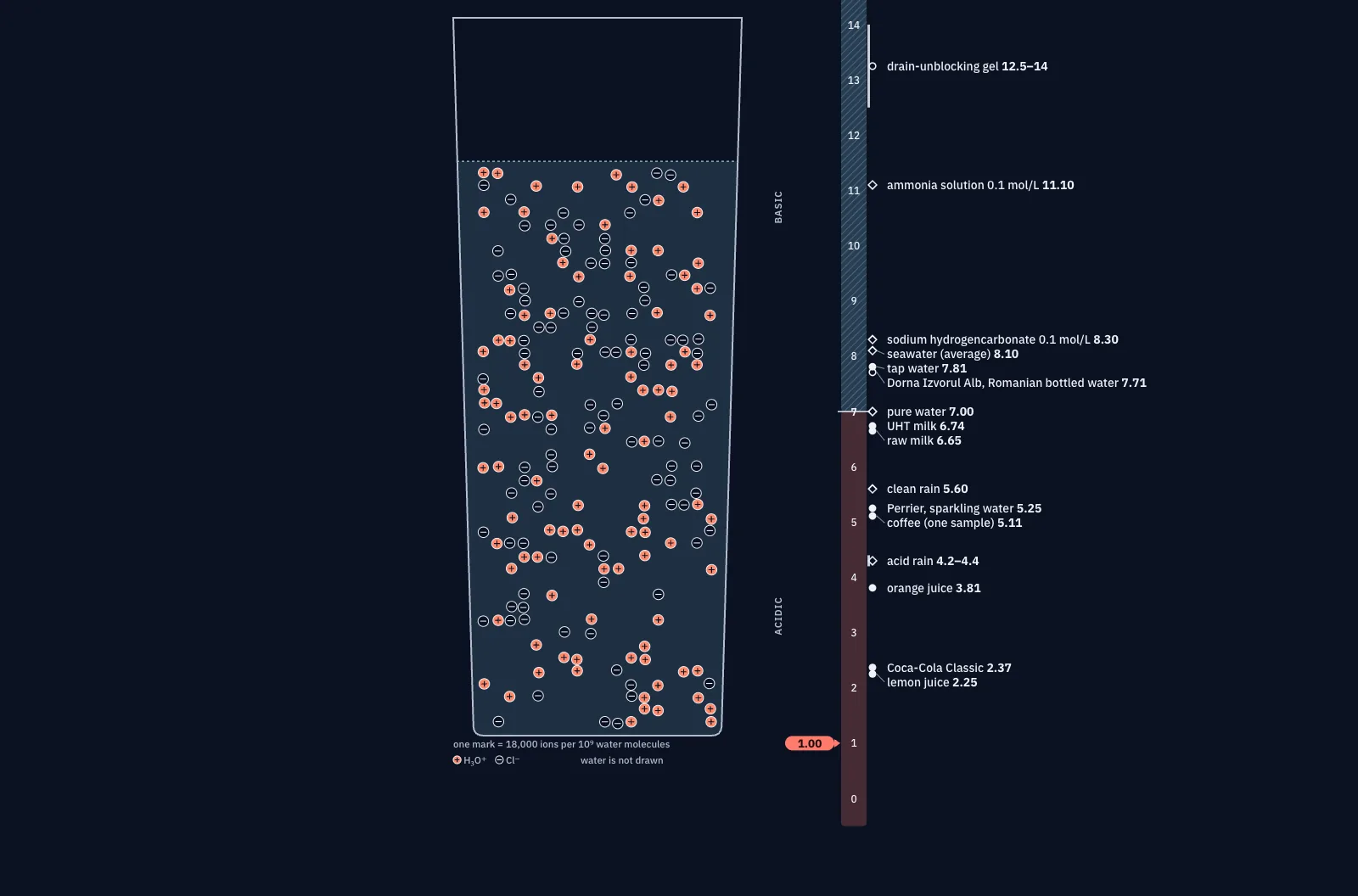
Calculation and measurements. An idealised calculation, in concentrations, for a strong acid and a strong base at 25 °C, with the ionic product of water Kw = 1.0·10⁻¹⁴: the charge balance [H₃O⁺] + [Na⁺] = [HO⁻] + [Cl⁻] gives the pH even close to 7, where the simple formula [H₃O⁺] = c fails. A filled dot on the scale is a value measured with a pH meter, an empty circle one declared by the maker or in the safety data sheet, a diamond a typical value from a source or from a reference table; another brand gives another number. The ions are drawn, not photographed: they have no colour, they are drawn enormously enlarged and far fewer than in reality (one mark stands for 18,000 ions per billion water molecules, then for 180 and for 1.8 as the solution is diluted; the key is written under the glass), and the water molecules are missing. Hydrochloric acid and sodium hydroxide are used only by the teacher; here they are a calculation.
Sources and credits. Measured values of the liquids: Reddy A. et al., “The pH of beverages in the United States”, Journal of the American Dental Association, 2016 (PubMed Central, PMC4808596); Metrohm, application notes AN-I-032 (milk) and AN-T-074 (tap water). Declared values: Coca-Cola România, the Dorna page; MELLERUD, safety data sheet for the drain-unblocking gel (10 August 2023). Values quoted from: EPA, “What is acid rain?” and “Understanding the science of ocean and coastal acidification”; PubChem (Merck Index, through HSDB), sodium hydrogencarbonate 0.1 mol/L and ammonia solution 0.1 mol/L; OpenStax, Chemistry 2e, section 14.2 (pure water). Kw at 25 °C: OpenStax, Chemistry 2e, 14.1. Molar mass of water: the school atomic masses of the book.
What you see: the pH of liquids around youWhat you see
The following values were measured with a pH meter at 25 °C in commercial products: lemon juice 2.25; Coca-Cola Classic 2.37; orange juice 3.81; coffee 5.11; Perrier sparkling mineral water 5.25. Raw milk measured 6.65, UHT milk 6.74, and tap water analysed in a Metrohm laboratory 7.81 (the mean of ten measurements). Each value belongs to the product measured; another brand gives another number.
The producer’s page states a pH of 7.71 for Dorna Izvorul Alb mineral water. A sodium hydroxide drain-cleaning gel has a pH between 12.5 and 14 at 20 °C, according to its safety data sheet. Between the lemon and the gel, [H₃O⁺] differs by a factor of more than ten billion.
An acid–base indicator is a substance whose colour depends on pH. Phenolphthalein is colourless below pH 8.3 and crimson above it. Methyl orange is red in acid and yellow in base. Litmus is red in acid and blue in base. Universal indicator paper contains a mixture of dyes and has a colour scale on the packet.
Red cabbage juice contains anthocyanins, which are red in acid and blue in base. A safe observation at home: add a few drops of juice to a glass of vinegar, one of lemon juice and one of water with a little bicarbonate, keeping each liquid separate. The colour gives a pH range, while a pH meter gives a value. Precision: ± 0.2 units for a portable meter, ± 0.002 for a laboratory meter.
For the curious
An indicator’s transition range is the pH range in which its colour changes. Methyl orange: 3.1–4.4, from red to yellow. Litmus: 5–8, from red to blue. Phenolphthalein: 8.3–10.0, from colourless to crimson. Tables differ by a few tenths.
Basic values from reference tables: 0.1 mol/L sodium bicarbonate solution, pH 8.3; 0.1 mol/L ammonia solution, pH 11.1; surface seawater, mean pH 8.1.
Why clean rain is slightly acidic
Clean rainwater has a pH of around 5.6 because carbon dioxide from the air dissolves in it and forms carbonic acid, a weak acid. Acid rain usually has a pH between 4.2 and 4.4.
It forms when sulfur dioxide and nitrogen oxides, released mainly by burning fossil fuels, react with water in the atmosphere to produce sulfuric and nitric acids. Both are strong acids.
Worked example
pH of an HCl solution before and after dilution
In a calculation example, 0.365 g of HCl is dissolved in water to make 500 mL of solution. What is its pH? What is the pH after a hundredfold dilution?
Molar mass: M(HCl) = 1 + 35.5 = 36.5 g/mol. Amount of acid: n = 0.365 ÷ 36.5 = 0.010 mol. Concentration: c = 0.010 ÷ 0.500 = 0.020 mol/L.
HCl is a strong monoprotic acid, so [H₃O⁺] = c = 2.0·10⁻² mol/L. Then pH = −lg(2.0·10⁻²) ≈ 1.70, because lg 2.0 ≈ 0.30.
After a hundredfold dilution, [H₃O⁺] = 2.0·10⁻⁴ mol/L, and pH ≈ 3.70.
Check: 0.020 mol/L lies between 0.10 and 0.010 mol/L, so the pH must be between 1 and 2, and 1.70 fits. After a hundredfold dilution, pH rises by two units: 1.70 + 2 = 3.70.
In Romania
The pH of rain in Brașov and water from Dorna
In March 2021, the Brașov Environmental Protection Agency measured the pH of precipitation in a residential area by potentiometry. The nine samples had values between 3.54 and 5.91; seven were between 5.38 and 5.91, close to the 5.6 of clean rain. The samples at pH 3.54 and 3.76 had about 115 and 70 times more H₃O⁺ ions, respectively, than clean rain at pH 5.6 in the same volume.
On the producer’s page, Dorna Izvorul Alb mineral water from Țara Dornelor has a pH of 7.71, so it is slightly basic. A pH meter can check any label.
In short
- pH = −lg[H₃O⁺] and pOH = −lg[HO⁻]; at 25 °C, pH + pOH = 14. The solution is acidic at pH < 7, neutral at pH = 7 and basic at pH > 7.
- For a strong monoprotic acid, [H₃O⁺] = c, so pH = −lg c. For a strong base with one HO⁻, [HO⁻] = c, so pOH = −lg c and pH = 14 − pOH.
- One pH unit means a factor of ten in [H₃O⁺]: three units mean a thousandfold difference.
- An acid, however dilute, has no pH above 7, because water alone produces 10⁻⁷ mol/L of H₃O⁺ ions. The formula [H₃O⁺] = c holds only when c is much greater than 10⁻⁷ mol/L.
- Indicators change colour with pH: phenolphthalein is colourless below pH 8.3 and crimson above; methyl orange is red in acid and yellow in base; litmus is red in acid and blue in base.
- Clean rain has a pH of around 5.6, and acid rain 4.2–4.4.
Common mistakes
WrongA very dilute acid at 10⁻⁸ mol/L has a pH of 8.
RightWater produces 10⁻⁷ mol/L of H₃O⁺ ions, more than the acid. The pH stays below 7, at about 6.98.
WrongpH 2 is twice as acidic as pH 4.
RightThe difference is two units, or ten times ten: pH 2 has a hundred times more H₃O⁺ ions than pH 4 in the same volume.
WrongFor a strong base, pH is −lg c.
RightThe formula −lg c gives pOH, because c is the concentration of HO⁻ ions. Then pH = 14 − pOH.
Test yourself
7 questions. For the first 6 you see the explanation at once, with the paragraph of the lesson that supports it; for the written ones you compare with a good answer.
A pupil calculates the pH of an HCl solution with c = 10⁻⁸ mol/L and gets 8. What is correct?
Answer
b) The formula does not apply: water produces 10⁻⁷ mol/L of H₃O⁺, and pH stays below 7. At an acid concentration below 10⁻⁷ mol/L, H₃O⁺ ions from water outnumber those from the acid. Dilution brings pH closer to 7 without passing it.
How does [H₃O⁺] change when pH falls from 5 to 3?
Answer
c) It increases 100 times. Two pH units mean 10 · 10 = 100. The H₃O⁺ ion concentration increases a hundredfold.
An HCl solution has a pH of 2. What is its pH after a tenfold dilution with water?
Answer
a) 3. [H₃O⁺] falls tenfold, so pH rises by one unit: from 2 to 3.
What is the pH of an HCl solution with c = 5.0·10⁻³ mol/L? Round to two decimal places.
Answer
2.30. [H₃O⁺] = c = 5.0·10⁻³ mol/L, so pH = −lg(5.0·10⁻³) ≈ 2.30, because lg 5.0 ≈ 0.70.
What is the pH of a NaOH solution with c = 4.0·10⁻³ mol/L, at 25 °C? Round to two decimal places.
Answer
11.60. [HO⁻] = c = 4.0·10⁻³ mol/L, pOH ≈ 2.40, and pH = 14 − 2.40 = 11.60.
Sort each liquid by whether it is acidic, neutral or basic at 25 °C.
Answer
Acidic: Lemon juice, pH 2.25; Clean rain, pH 5.6.
Neutral: Pure water, [H₃O⁺] = [HO⁻]; Solution with [H₃O⁺] = 10⁻⁷ mol/L.
Basic: Dorna Izvorul Alb mineral water, pH 7.71; Drain-cleaning gel, pH 12.5–14.
The solution is acidic below pH 7, neutral at pH 7 and basic above pH 7.
A classmate says: “If I dilute an HCl solution a billionfold, I reach pH 9, so the solution becomes basic.” Explain the mistake.
A good answer
The calculation −lg c accounts only for the acid. At such a high dilution, the H₃O⁺ ions from the acid are far fewer than the 10⁻⁷ mol/L produced by the water itself. Water remains neutral, and the solution has a pH very close to 7, slightly below 7. Without added base, the solution cannot become basic.
A complete answer mentions the ionisation of water (10⁻⁷ mol/L) and the fact that the pH of a dilute acid approaches 7 without passing it.
Terms
- pH
- A quantity expressing the acidity of a solution: pH = −lg[H₃O⁺], with no unit.
- pOH
- A quantity defined by pOH = −lg[HO⁻]; at 25 °C, pH + pOH = 14.
- strong monoprotic acid
- An acid that releases one proton per molecule and ionises completely in water, for example HCl.
- strong base with one HO⁻ (monoprotic, monoacidic)
- A base that dissociates completely in water and gives one HO⁻ ion per formula unit, for example NaOH. The programme calls it a “strong monoprotic base”, and some exercise books call it a “monoacidic base”.
- acid–base indicator
- A substance whose colour changes with the pH of the solution.
- acidic, neutral, basic solution
- A solution has a pH below 7, equal to 7 or above 7, respectively, at 25 °C.
Sources and link to the programme
- OpenStax – Chemistry 2e, 14.2 pH and pOH – definition of pH = −lg[H₃O⁺] and pOH; pH + pOH = 14.00 at 25 °C; the pH meter and its precision; pH of pure water, 7.00
- OpenStax – Chemistry 2e, 14.1 Brønsted-Lowry Acids and Bases – ionic product of water, 1.0·10⁻¹⁴ at 25 °C; [H₃O⁺] = [HO⁻] = 1.0·10⁻⁷ mol/L in pure water
- OpenStax – Chemistry 2e, 14.3 Relative Strengths of Acids and Bases – strong acids ionise completely in water; strong bases dissociate completely into hydroxide ions
- OpenStax – Chemistry 2e, 14.7 Acid-Base Titrations – phenolphthalein: colourless below pH 8.3, red or pink above; methyl orange: red in acid, yellow in base; universal indicator paper contains a mixture of indicators and has different colours at different pH values
- Reddy A. et al. – The pH of beverages in the United States, Journal of the American Dental Association, 2016 – pH values measured with a pH meter at 25 °C: lemon 2.25; Coca-Cola Classic 2.37; orange juice 3.81; coffee 5.11; Perrier 5.25
- Metrohm – Application Note AN-I-032, lapte și produse lactate lichide – measured pH of raw milk (6.65) and UHT milk (6.74), six samples
- Coca-Cola România – Dorna, apă minerală naturală – pH 7.71 stated by the producer for Dorna Izvorul Alb
- MELLERUD – Fișă cu date de securitate: gel pentru desfundat țevi și chiuvete (10 august 2023) – pH between 12.5 and 14 at 20 °C for a sodium hydroxide drain-cleaning gel
- EPA – What is acid rain? – normal rain has a pH around 5.6 because of dissolved carbon dioxide; acid rain usually has a pH between 4.2 and 4.4; sulfur dioxide and nitrogen oxides form sulfuric and nitric acids
- APM Brașov – Raport privind starea mediului în județul Brașov, martie 2021 – pH of precipitation in Brașov, measured by potentiometry, nine samples: 3.54–5.91
- Chemguide – Acid-base indicators – transition ranges: methyl orange 3.1–4.4 (red, yellow), litmus 5–8 (red, blue), phenolphthalein 8.3–10.0 (colourless, pink)
- PubChem – Sodium bicarbonate – pH 8.3 for a fresh 0.1 mol/L solution, at 25 °C (Merck Index, via HSDB)
- PubChem – Ammonium hydroxide – pH 11.6 at 1.0 N, 11.1 at 0.1 N and 10.6 at 0.01 N for ammonia solution (Merck Index, via HSDB)
- EPA – Understanding the science of ocean and coastal acidification – mean ocean pH: about 8.1 today, about 8.2 before 1700
- Wikipedia – pH indicator – anthocyanins in red cabbage: red in acid, blue in base; litmus: red in acid, blue in base
- Metrohm – Application Note AN-T-074, apa de la robinet (iulie 2020) – measured pH of tap water: 7.81, mean of ten measurements (location not stated)
From the programme: “Calculating the pH of aqueous solutions of strong monoprotic acids and strong monoprotic bases” (TC: Core curriculum (1 hour a week)). Specific competences followed: 1.5, 4.5, 5.5, 6.5.