Chapter 4 · The atomLesson 4.4MI Mathematics–informatics (2 hours) · beyond your profile
Electron configurations of chemical elements in periods 1, 2 and 3 of the periodic table
How to write the configuration of any element from hydrogen to argon
You are told that an atom has three unpaired electrons in its outer shell. How do you find the element?
Before you read: what do you think?
The energy needed to remove the first electron from an atom generally increases from sodium to argon. What happens between magnesium and aluminium, which has one more proton?
See the answer
For magnesium, the measured energy is 7.65 eV; for aluminium it is 5.99 eV. The last electron of magnesium is in 3s; that of aluminium is in 3p, a higher-energy subshell. The drop is measured evidence that the third shell has subshells.
If you removed the first electron from each atom in the third period, from sodium to argon, you would record eight values. They do not rise steadily: at aluminium and sulfur they fall. The explanation appears in the electron configuration, written by subshell and in boxes.
How subshells fill from hydrogen to argon
The electrons of a neutral atom fill subshells in the order 1s, 2s, 2p, 3s, 3p. An s subshell holds at most 2 electrons; a p subshell holds at most 6. The sum of the superscripts in the configuration equals the atomic number Z.
Shorthand puts the configuration of the noble gas before the element in square brackets. [He] means 1s², and [Ne] means 1s²2s²2p⁶. Sodium, with Z = 11, is [Ne] 3s¹, and argon, with Z = 18, is [Ne] 3s²3p⁶.
First period: H 1s¹; He 1s². Second period: Li [He] 2s¹; Be [He] 2s²; B [He] 2s²2p¹; C [He] 2s²2p²; N [He] 2s²2p³; O [He] 2s²2p⁴; F [He] 2s²2p⁵; Ne [He] 2s²2p⁶. Third period: Na [Ne] 3s¹; Mg [Ne] 3s²; Al [Ne] 3s²3p¹; Si [Ne] 3s²3p²; P [Ne] 3s²3p³; S [Ne] 3s²3p⁴; Cl [Ne] 3s²3p⁵; Ar [Ne] 3s²3p⁶.
Boxes show how many electrons are unpaired
In a box diagram, each orbital is a box and each electron an arrow. Two electrons in the same box have opposite arrows (the Pauli principle). In a subshell with several boxes, electrons first enter one per box, with parallel arrows, and only then pair up (Hund’s rule).
For 2p³ in nitrogen, the diagram has three boxes with one arrow each: three unpaired electrons. For 2p⁴ in oxygen, one box has two arrows and the other two have one each: two unpaired electrons. In neon, 2p⁶, all the boxes are full and no electrons are unpaired.
The number of unpaired electrons rises from 1 to 3 as the p subshell fills halfway, then falls to 0: B 1, C 2, N 3, O 2, F 1, Ne 0. The same sequence repeats in the third period: Al 1, Si 2, P 3, S 2, Cl 1, Ar 0.
The differentiating electron, valence electrons and position in the table
The differentiating electron is the last electron placed in the atom, following the filling order. In sodium it is 3s¹, in aluminium 3p¹, in chlorine 3p⁵. Valence electrons are those in the outer shell, the shell with the highest n. Chlorine, [Ne] 3s²3p⁵, has 2 + 5 = 7 valence electrons.
The configuration determines the position in the table. The outer shell number is the period number: from Na to Ar, the third period. For elements whose differentiating electron is in s or p (the main groups), the number of valence electrons gives the group: 1 or 2 electrons means group 1 or 2, while 3, 4, 5, 6, 7, 8 electrons means groups 13, 14, 15, 16, 17, 18. Chlorine, with 7 electrons, is in the third period, group 17; magnesium, with 2, is in the third period, group 2. Helium, with 2 electrons in its full first shell, is in group 18.
For the curious
Successive ionisation energies confirm the number of valence electrons. In aluminium, the first three electrons require 5.99, 18.83 and 28.45 eV, while the fourth requires 119.99 eV, four times as much: three electrons are in the outer shell, and the fourth is in [Ne].
Many ions have a noble gas configuration
Most simple ions of the first three periods have a noble gas configuration. Na⁺, Mg²⁺ (magnesium has Z = 12) and Al³⁺ have 1s²2s²2p⁶, as do O²⁻ and F⁻. Cl⁻, S²⁻ and P³⁻ have 1s²2s²2p⁶3s²3p⁶, like argon. Species with the same number of electrons and the same configuration are called isoelectronic, although their nuclei differ.
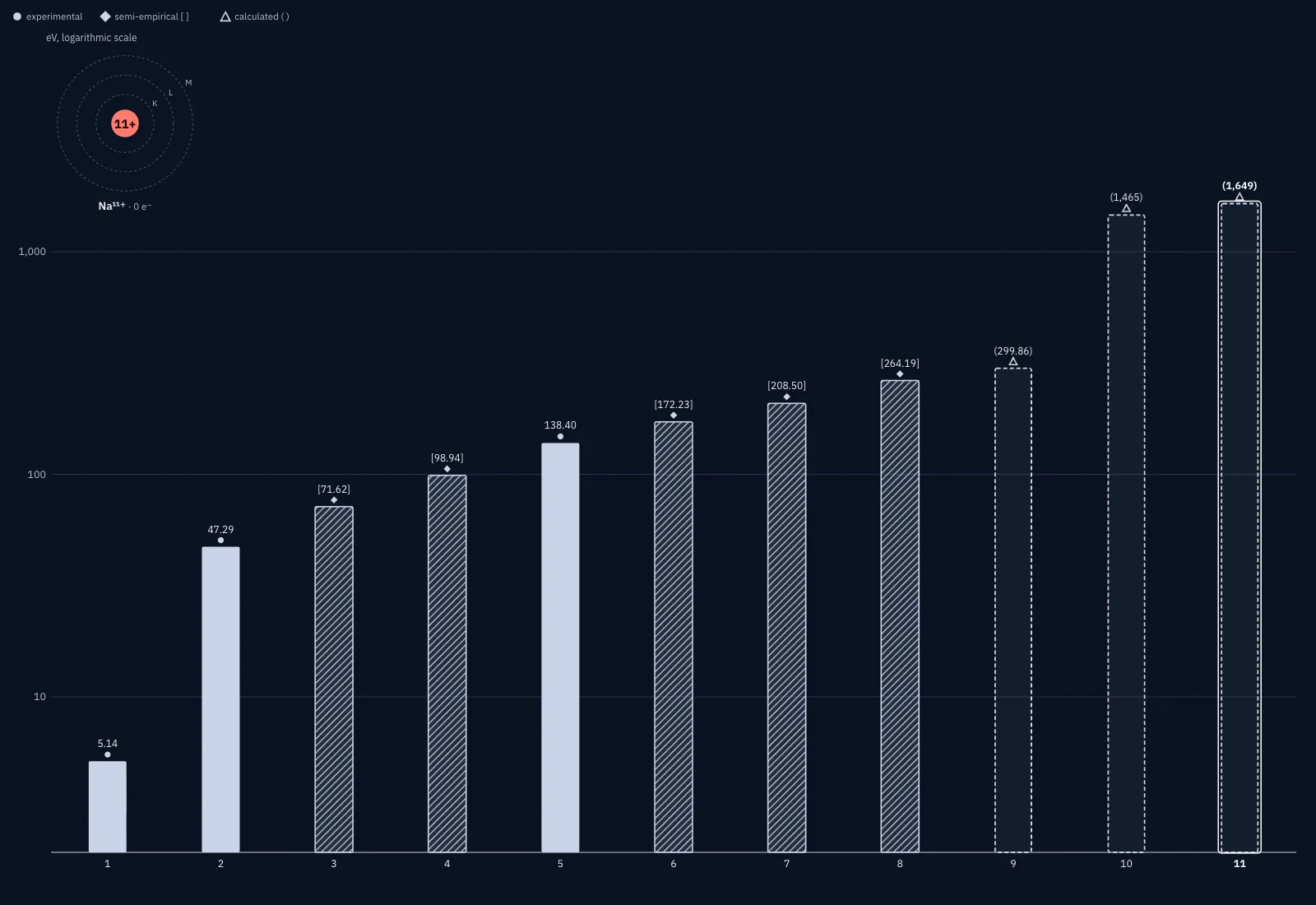
The reason is energy. Sodium gives up its first electron easily (5.14 eV), but the second requires 47.29 eV, more than nine times as much, because this second electron belongs to the full second shell, [Ne].
The energies for removing the first electron in the third period, from Na to Ar, are: 5.14; 7.65; 5.99; 8.15; 10.49; 10.36; 12.97; 15.76 eV. The drop at aluminium occurs because the electron removed is 3p, less tightly bound than 3s. The drop at sulfur occurs because, in 3p⁴, one box has two electrons that repel each other, and one comes away more easily.
For the curious
Not all ions have a noble gas configuration: Fe²⁺ is [Ar] 3d⁶ and Fe³⁺ is [Ar] 3d⁵ (the lesson on the fourth period).
Worked example
Find the element
A neutral atom has five electrons in its third shell, three of them unpaired. What is the element, what is its configuration and what is the configuration of its ion with three negative charges?
Step 1: the outer shell is the third, so the element is in the third period, and the five electrons are 3s²3p³.
Step 2: Z = 10 + 2 + 3 = 15, so the element is phosphorus. Its configuration is [Ne] 3s²3p³, that is 1s²2s²2p⁶3s²3p³.
Step 3: in 3p³, each of the three boxes has one electron, so there are three unpaired electrons. The information fits.
Step 4: the P³⁻ ion has 15 + 3 = 18 electrons, with the configuration 1s²2s²2p⁶3s²3p⁶, the same as argon. Check: 2 + 2 + 6 + 2 + 6 = 18 electrons.
In Romania
Aluminium from Slatina
In Slatina, Olt county, ALRO has produced primary aluminium by electrolysis of aluminium oxide for over 60 years. Aluminium has Z = 13 and the configuration [Ne] 3s²3p¹, so it has three valence electrons.
In aluminium oxide, Al₂O₃, each Al³⁺ ion has lost these three electrons and has 1s²2s²2p⁶. Each O²⁻ ion has gained two electrons and also has 1s²2s²2p⁶. All five ions in the formula are isoelectronic with neon, and the charges balance: 2 · (+3) + 3 · (−2) = 0.
During electrolysis, each Al³⁺ ion gains three electrons back:
Al³⁺ + 3e⁻ → Al
In short
- The filling order for periods 1–3 is 1s, 2s, 2p, 3s, 3p; s holds 2 electrons and p holds 6.
- [He] means 1s², [Ne] means 1s²2s²2p⁶; sodium is [Ne] 3s¹, and phosphorus is [Ne] 3s²3p³.
- A box holds at most two electrons with opposite arrows (Pauli); in a subshell, electrons first fill the boxes one at a time (Hund).
- The differentiating electron is the last electron placed; valence electrons are those in the outer shell.
- The ions Na⁺, Mg²⁺, Al³⁺, O²⁻, F⁻ are isoelectronic with neon, and Cl⁻, S²⁻, P³⁻ with argon.
Common mistakes
WrongIn oxygen, 2p⁴ means that all four electrons are paired.
RightThe four electrons occupy three boxes: one with two arrows and two with one each. Oxygen has two unpaired electrons.
WrongThe Na⁺ ion has 11 electrons, like the sodium atom.
RightNa⁺ has lost one electron and has 10, or 1s²2s²2p⁶. The number of protons, 11, does not change.
WrongAll 15 electrons of phosphorus are valence electrons.
RightOnly the electrons in the outer shell, 3s²3p³, are valence electrons: 5. The other ten are in [Ne].
Test yourself
8 questions. For the first 7 you see the explanation at once, with the paragraph of the lesson that supports it; for the written ones you compare with a good answer.
What is the electron configuration of a chlorine atom, Z = 17?
Answer
a) [Ne] 3s²3p⁵. Chlorine has 17 electrons: 10 from [Ne], 2 in 3s and 5 in 3p.
How many unpaired electrons does a sulfur atom, [Ne] 3s²3p⁴, have?
Answer
d) 2. In 3p⁴, one box has two electrons and the other two have one each: two unpaired electrons.
Which ion is isoelectronic with argon?
Answer
b) Cl⁻. Cl⁻ has 17 + 1 = 18 electrons, like argon. The other three ions have 10 electrons, like neon.
A neutral atom has the configuration [Ne] 3s²3p³. How many electrons does it have in total?
electronsAnswer
15 electrons. [Ne] has 10 electrons, and 3s²3p³ adds another five, so 10 + 5 = 15.
How many valence electrons does a silicon atom, [Ne] 3s²3p², have?
electronsAnswer
4 electrons. The valence electrons are those in the third shell, 3s²3p²: 2 + 2 = 4.
Put the subshells in the order in which electrons fill them.
Answer
The correct order:
- 1s
- 2s
- 2p
- 3s
- 3p
Filling follows increasing subshell energy.
Sort the elements by the number of unpaired electrons in the neutral atom.
Answer
1 unpaired electron: B; F.
2 unpaired electrons: C; O.
3 unpaired electrons: N; P.
The number rises until the p subshell is half full, then falls: B 1, C 2, N 3, O 2, F 1; in phosphorus, 3p³ has three unpaired electrons.
The first ionisation energy falls from beryllium (9.32 eV) to boron (8.30 eV), although boron has one more proton. Explain the drop using the configurations.
A good answer
Beryllium is [He] 2s², and boron is [He] 2s²2p¹. The electron removed from boron is in 2p, a subshell with higher energy than 2s, so it is less tightly bound to the atom and requires less energy.
A complete answer names the 2s and 2p subshells and says that the 2p electron has higher energy.
Terms
- electron configuration
- The distribution of electrons in an atom or ion among subshells, written with the shell number, subshell letter and number of electrons.
- differentiating electron
- The last electron placed in an atom, following the order in which subshells fill.
- valence electrons
- The electrons in the outer shell of an atom.
- unpaired electrons
- Electrons that occupy a box alone, without a partner of opposite spin.
- isoelectronic
- Having the same number of electrons and the same configuration, but different nuclei.
- Pauli principle
- An orbital holds at most two electrons, with opposite spins.
- Hund’s rule
- In a subshell, electrons first occupy one orbital each, with parallel spins, and only then pair up.
Sources and link to the programme
- NIST – Atomic Spectra Database, Ground States and Ionization Energies (Na–Ar) – ground-state configurations of atoms from sodium to argon and the first ionisation energy of each
- NIST – Atomic Spectra Database, Ground States and Ionization Energies (sodiu) – successive ionisation energies of sodium: 5.14 eV for the first electron and 47.29 eV for the second (experimentally determined values)
- OpenStax – Chemistry 2e, 6.4 Electronic Structure of Atoms (Electron Configurations) – the Pauli principle, Hund’s rule, box diagrams and ion configurations
- ALRO – Leading European Aluminium Producer, Slatina – ALRO has produced primary aluminium in Slatina for over 60 years by electrolysis of aluminium oxide
From the programme: “Electron configurations of chemical elements in periods 1, 2 and 3 of the periodic table”; “Correlations between the electron configurations of chemical elements in periods 1, 2 and 3 and their positions in the periodic table”; “Electron configurations of chemical elements in periods 1, 2, 3 and 4 of the periodic table”; “Correlations between the electron configurations of chemical elements in periods 1, 2, 3 and 4 and their positions in the periodic table” (MI: Mathematics–informatics (2 hours)). Specific competences followed: 1.3, 3.3, 2.3.