Chapter 11 · GasesLesson 11.1TC Core curriculum (1 hour a week) · beyond your profile
Characterising the gaseous state
What pushes against a balloon, and what to do if you smell gas
You cannot see anything inside an inflated balloon. What pushes against its walls, and where does it push harder?
Before you read: what do you think?
The air inside an inflated balloon pushes against its walls. Where does it push harder?
See the answer
The pressure is practically the same on all the walls. Air particles move in all directions, at speeds of around 500 m/s, and strike the wall from every side. The weight of the air in the balloon is too small to make a visible difference.
Seal the tip of a needleless syringe with your finger and press the plunger. The air compresses up to a point, then pushes back harder and harder. You cannot see anything in the syringe, but you can feel a gas pushing. The same invisible pressure is present in the pipe to a cooker, where natural gas does not even smell on its own.
A gas fills the space it findsWhat you see
A gas has no shape or volume of its own: it fills its container. The air in a balloon takes the shape of the balloon, while the same amount of air, released into a room, would spread throughout it.
A gas compresses easily. In a sealed syringe, the plunger can move a long way down, while a syringe full of water would barely compress.
A gas diffuses: the smell of warm bread from one corner of a kitchen reaches the opposite corner after a few minutes, without anyone stirring the air.
Where pressure comes fromWhat the particles do
In the gaseous state, particles (molecules or atoms) are very far apart compared with their size, and move constantly in all directions. Nitrogen molecules in air have speeds of around 500 m/s at room temperature. They collide with each other and with the walls of the container.
Each collision pushes the wall a little. A vast number of collisions produces a continuous force, and pressure is this force divided by the area of the wall: p = F ÷ S. Particles strike from every side, so the pressure is the same on all the walls.
More particles in the same volume, or faster particles, mean more collisions and harder impacts, so the pressure is greater. Absolute temperature is a measure of the mean kinetic energy of the particles: at a higher temperature, particles are faster on average. They do not get bigger when heated.
An ideal gas is a model: particles with no volume that do not attract each other. Real gases approach this model at low pressures and well away from their condensation temperature.
| Quantity | Value | How it is obtained |
|---|---|---|
| Volume and pressure at 48 units | 29 1/8 inches of mercury | measured by Boyle, 1662 |
| Volume and pressure at 24 units | 58 13/16 inches of mercury | measured by Boyle, 1662 |
| Volume and pressure at 12 units | 117 9/16 inches of mercury | measured by Boyle, 1662 |
| The product p · V over the 25 rows | between 1,396 and 1,415, mean 1,408 | calculated from the measurements |
| Pressure given by the formula at 24 units, 20 °C | 58.7 inches of mercury | calculated: 1,408 ÷ 24 |
| Pressure given by the formula at 24 units, 40 °C | 62.7 inches of mercury | calculated: p ÷ T constant |
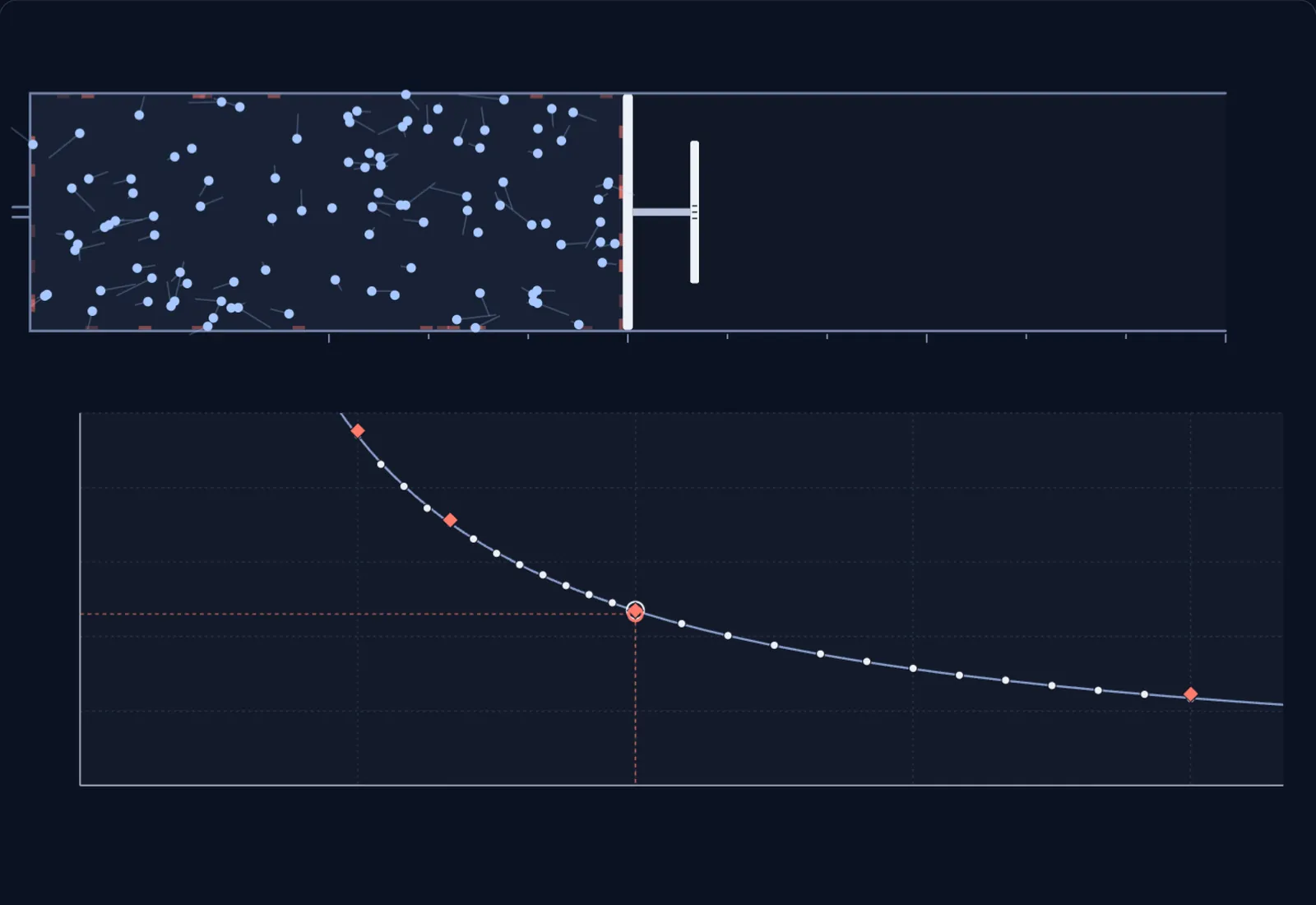
| Pressure counted in the cylinder | shown in the picture, next to the value of the formula | counted from the hits of the particles |
| Pressure at constant volume, compared with 20 °C | at 40 °C 1.07 times, at 50 °C 1.10 times, at 100 °C 1.27 times, at 200 °C 1.61 times | calculated: T ÷ 293, with T in kelvin |
| Volume of one mole at 0 °C and 1 atm | 22.4 L | calculated: V = nRT ÷ p = 1 · 0.082 · 273 ÷ 1 |
| Mean molar mass of dry air | 28.96 g/mol | calculated: 0.78 · 28 + 0.21 · 32 + 0.01 · 40 |
| Partial pressures of dry air at 1 atm | N₂ 0.78 atm, O₂ 0.21 atm, Ar 0.01 atm | calculated: pi = xi · ptotal |
| Volume of the air (units) | Pressure measured by Boyle (inches of mercury) | In decimals | p · V |
|---|---|---|---|
| 48 | 29 1/8 | 29.125 | 1,398 |
| 46 | 30 9/16 | 30.5625 | 1,406 |
| 44 | 31 15/16 | 31.9375 | 1,405 |
| 42 | 33 1/2 | 33.5 | 1,407 |
| 40 | 35 5/16 | 35.3125 | 1,413 |
| 38 | 37 | 37 | 1,406 |
| 36 | 39 5/16 | 39.3125 | 1,415 |
| 34 | 41 5/8 | 41.625 | 1,415 |
| 32 | 44 3/16 | 44.1875 | 1,414 |
| 30 | 47 1/16 | 47.0625 | 1,412 |
| 28 | 50 5/16 | 50.3125 | 1,409 |
| 26 | 54 5/16 | 54.3125 | 1,412 |
| 24 | 58 13/16 | 58.8125 | 1,412 |
| 23 | 61 5/16 | 61.3125 | 1,410 |
| 22 | 64 1/16 | 64.0625 | 1,409 |
| 21 | 67 1/16 | 67.0625 | 1,408 |
| 20 | 70 11/16 | 70.6875 | 1,414 |
| 19 | 74 1/8 | 74.125 | 1,408 |
| 18 | 77 7/8 | 77.875 | 1,402 |
| 17 | 82 3/4 | 82.75 | 1,407 |
| 16 | 87 7/8 | 87.875 | 1,406 |
| 15 | 93 1/16 | 93.0625 | 1,396 |
| 14 | 100 7/16 | 100.4375 | 1,406 |
| 13 | 107 13/16 | 107.8125 | 1,402 |
| 12 | 117 9/16 | 117.5625 | 1,411 |
Measurements and model. The white points are the 25 measurements Boyle published in 1662: the volume of air trapped in a tube, in equal units marked on the tube, and the total pressure, in inches of mercury. The cylinder is a model: 100 particles, hard discs of a very small diameter compared with the cylinder, with no attraction between them, and elastic walls; they are drawn much larger and far fewer than in reality, and atoms and molecules have no colour. The pressure counted is the sum of the impulses of the hits on the walls, divided by the length of the walls and by the number of steps of the model. A single constant, fixed at the start, turns it into inches of mercury or into atmospheres; the red diamonds are the values counted at the volumes where the piston stayed. The curve is calculated: p · V = 1,408 at 20 °C, the mean of Boyle’s 25 products; Boyle did not keep the temperature under control, and the 20 °C is the choice of this picture. The temperature of the model is held constant by the walls, as in a tube in a room; heating is here only a calculation.
Sources and credits. Robert Boyle’s values from A Defence of the Doctrine Touching the Spring and Weight of the Air (1662), public domain, read from two transcriptions compared row by row: Carmen Giunta, Le Moyne College source and ChemTeam source. Composition of dry air: NASA, Earth Fact Sheet source. The constant R = 0.082 L·atm/(mol·K) and the molar masses are those of the book.
Four quantities describe the state of a gasHow it is written
The state of a gas is described by state variables: pressure p, volume V, temperature T and amount of substance n.
Pressure is measured in pascals (1 Pa = 1 N/m²), atmospheres or millimetres of mercury: 1 atm = 101,325 Pa = 760 mmHg. One bar is exactly 100,000 Pa.
The volume of a gas is the volume of its container. It is measured in litres or cubic metres: 1 m³ = 1,000 L.
In gas equations, temperature is expressed in kelvin: T(K) = t(°C) + 273. The exact value of the constant is 273.15; in class it is rounded to 273.
Normal conditions are 0 °C (273 K) and 1 atm. Avogadro’s law states that equal volumes of different gases, at the same pressure and temperature, contain the same number of molecules. The particles are far apart, so the volume is practically independent of their type. This gives the molar volume: at normal conditions, 1 mol of any gas occupies 22.4 L, so VM = 22.4 L/mol, and V = n · VM.
Smell gas at home: what to do and why
Methane, the main component of natural gas, has no smell. Mercaptans, substances with a strong smell, are added to the gas so that a leak can be detected. The smell you notice comes from this odorant.
The danger is an explosion. Methane mixed with air, at about 5–15% by volume, explodes in the presence of a spark or a flame. A spark can come from a switch or an electrical appliance.
The steps given by the distributor, in this order: do not operate switches or use sockets, electronic devices or sources of flame; open the windows; turn off the gas supply; leave the room immediately; notify the distributor on its emergency number; call 112.
Open windows ventilate the room, but do not guarantee that the mixture has left the explosive range; that is why you leave the room and do not use the lift. The distributor’s safety page says to call the emergency numbers from outside the building.
For the curious
According to the distributor, installing automatic gas detectors in homes is required by law. A detector connected to a solenoid valve can close the valve and shut off the building’s gas supply when it detects a leak.
The value of 22.4 L/mol is for an ideal gas at the normal conditions used in school; NIST gives 22.414 L/mol at 273.15 K and 101.325 kPa. Real gases differ slightly from this value, depending on the substance.
Worked example
The same state in different units
A gas is in a 500 mL container at 27 °C and 380 mmHg. Express the pressure in atm and Pa, the temperature in K and the volume in L. What volume does 0.25 mol of the same gas occupy at normal conditions?
Pressure in atm: 380 ÷ 760 = 0.5 atm. In pascals: 0.5 · 101,325 ≈ 50,663 Pa, rounded to the nearest whole number.
Temperature: T = 27 + 273 = 300 K.
Volume: 500 mL = 0.5 L.
For 0.25 mol at normal conditions, V = 0.25 · 22.4 = 5.6 L. Check: 5.6 L is a quarter of 22.4 L, and 0.25 mol is a quarter of a mole.
In Romania
A distributor’s emergency numbers
On 19 March 2026, Distrigaz Sud Rețele, a gas distributor, and the Department for Emergency Situations launched the campaign “Sometimes, later can be too late!”. The steps above come from the campaign material.
The distributor can be reached on 0800 877 778 (free, round the clock), 021 9281 and 031 9031 (charged, round the clock). It serves 20 counties in southern and central Romania and Bucharest. Other areas have different distributors and numbers; 112 is the single emergency number.
The distributor also says that authorised ANRE operators carry out a technical check of the installation at least every 2 years and an inspection at least every 10 years. ANRE is the energy regulator.
In short
- A gas fills the volume of its container, compresses easily and diffuses; its particles are very far apart and move constantly.
- Pressure is the force exerted by particles colliding with the wall, divided by area: p = F ÷ S; it is the same on all walls.
- The state variables are p, V, T and n; 1 atm = 101,325 Pa = 760 mmHg, 1 m³ = 1,000 L, T(K) = t(°C) + 273.
- At normal conditions (0 °C, 1 atm), 1 mol of any gas occupies 22.4 L; equal volumes of gases, at the same p and T, have the same number of molecules (Avogadro’s law).
- If you smell gas: do not operate switches or use flames, open the windows, turn off the gas, leave and, from outside the building, notify the distributor and call 112.
Common mistakes
WrongThe air in a balloon pushes harder on the bottom because it is heavy.
RightGas pressure comes from particles colliding with the walls and is the same on all walls. The weight of the gas in a balloon makes no visible difference.
WrongIf a gas is at 0 °C, its temperature is zero, so I put zero into the equation.
RightGas equations use temperature in kelvin: 0 °C means 273 K.
WrongNatural gas smells bad, so the smell comes from methane.
RightMethane has no smell. The smell comes from mercaptans added to the gas so that a leak can be detected.
Test yourself
7 questions. For the first 6 you see the explanation at once, with the paragraph of the lesson that supports it; for the written ones you compare with a good answer.
What produces the pressure of a gas enclosed in a balloon?
Answer
b) Gas particles colliding with the walls. Collisions exert a continuous force on the wall; force divided by area is pressure.
One mole of helium and one mole of carbon dioxide are at normal conditions. What volume does each occupy?
Answer
d) Each occupies 22.4 L. The particles are far apart, so the volume is practically independent of the type of gas: 1 mol occupies 22.4 L at normal conditions.
Why must you not operate switches when you smell gas?
Answer
a) A spark can ignite the mixture of methane and air. Methane mixed with air explodes in the presence of a spark, and a switch can produce one.
The pressure of a gas is 1.5 atm. What is it in mmHg?
mmHgAnswer
1,140 mmHg. 1 atm = 760 mmHg, so 1.5 · 760 = 1,140 mmHg.
What volume does 0.5 mol of oxygen occupy at normal conditions? Give your answer in litres.
LAnswer
11.2 L. V = n · VM = 0.5 · 22.4 = 11.2 L.
Put the distributor’s steps for when you smell gas in order, from first to last.
Answer
The correct order:
- Do not operate switches or use sockets, electronic devices or sources of flame
- Open the windows
- Turn off the gas supply
- Leave the room immediately
- Notify the distributor on its emergency number
- Call 112
First avoid any spark, then ventilate and turn off the gas, then leave; call the emergency numbers from outside the building, as the distributor says.
A classmate wants to turn on the kitchen light to see where the smell of gas is coming from. Explain what could go wrong and what they should do instead.
A good answer
A switch can produce a spark, and methane mixed with air at about 5–15% by volume explodes in the presence of a spark. Instead of turning on the light, they should open the windows, turn off the gas supply, leave the room and call the distributor and 112.
A complete answer links the spark to the explosion limits of methane and lists the measures: windows, turning off the gas, leaving and making the calls.
Terms
- pressure
- Force exerted per unit area; in a gas, the result of particles colliding with the walls.
- state variables
- The quantities that describe the state of a gas: pressure, volume, temperature and amount of substance.
- ideal gas
- A model of a gas made of particles with no volume and no attraction between them.
- normal conditions
- A pressure of 1 atm and a temperature of 0 °C (273 K).
- molar volume
- The volume occupied by 1 mol of gas; at normal conditions, 22.4 L/mol.
- Avogadro’s law
- Equal volumes of different gases, at the same pressure and temperature, contain the same number of molecules.
- mercaptans
- Strong-smelling substances added to natural gas so that leaks can be detected.
Sources and link to the programme
- OpenStax – Chemistry 2e, 9.1 Gas Pressure – pressure units: 1 atm = 101,325 Pa = 760 torr; 1 bar = exactly 100,000 Pa
- OpenStax – Chemistry 2e, 9.2 Relating Pressure, Volume, Amount, and Temperature: The Ideal Gas Law – Avogadro’s law; molar volume of approximately 22.4 L at 273.15 K and 1 atm
- OpenStax – Chemistry 2e, 9.5 The Kinetic-Molecular Theory – speed of nitrogen molecules at room temperature, approximately 500 m/s (519 m/s at 303 K); pressure as an effect of collisions with walls
- Distrigaz Sud Rețele – comunicat de presă, campania „Uneori, mai târziu poate fi prea târziu!”, 19 martie 2026 – steps when gas is smelled, emergency numbers, checks every 2 years and inspections every 10 years, mandatory detectors, area served
- Distrigaz Sud Rețele – Siguranța instalației de utilizare – measures for gas leaks; emergency numbers 021 9281, 031 9031 (charged) and 0800 877 778 (free) must be called from outside the building
- PubChem – Methane – methane is odourless; mixtures with air explode between approximately 5% and 15% by volume
- Transgaz – Natural gas quality (cerințe minime de calitate, Anexa 5 la Regulamentul de măsurare a gazelor) – mercaptan content of natural gas in the transmission system: minimum 8 mg/m³ at standard conditions
- NIST – CODATA, molar volume of ideal gas (273.15 K, 101.325 kPa) – molar volume of ideal gas at 273.15 K and 101.325 kPa: 22.414 L/mol
- ANRE – Ordinul nr. 89/2018, normele tehnice pentru sistemele de alimentare cu gaze naturale (formă actualizată) – the automatic natural gas detector operates the valve through a solenoid valve
From the programme: “Characterising the gaseous state”; “State variables; the law of partial pressures” (TC: Core curriculum (1 hour a week)). Specific competences followed: 1.6, 2.6, 3.6, 4.6, 5.6, 6.6.