Chapter 2 · Chemical reactionsLesson 2.2TC Core curriculum (1 hour a week) · beyond your profile
Oxidation number
What number does sulfur have in sulfuric acid?
Oxygen in water and in hydrogen peroxide is counted differently. How do you find the oxidation number of each atom in a formula?
Before you read: what do you think?
In hydrogen peroxide, H₂O₂, hydrogen has N.O. +1. What is the N.O. of each oxygen atom?
See the answer
Each oxygen atom has −1. The sum must be 0: 2 · (+1) + 2x = 0, so x = −1. Peroxides are an exception to the usual rule of −2.
Pour a little 3% hydrogen peroxide from the pharmacy onto a slice of raw potato and foam appears: oxygen is released. The formula of hydrogen peroxide, H₂O₂, looks like that of water, H₂O, but their oxygen is counted differently: −1 in the first and −2 in the second. The number that makes the difference is called the oxidation number.
A number you calculate
The oxidation number (N.O.) of an atom in a substance is the conventional charge it would have if its bonds to different atoms were treated as ionic, with the electrons in each bond assigned to the atom that attracts them more strongly. The electrons in bonds between identical atoms are shared equally.
It is a counting convention, not a measured charge. In CO₂ carbon has N.O. +4, but the molecule contains no carbon ions with four positive charges: the bonds are covalent, with shared electrons. The number is useful because it shows which atoms lose and which gain electrons in a reaction.
In text, N.O. is written with the sign first: +6, −2, 0. In a formula, it is placed above the symbol. An ion’s charge is written with the sign after the number: Na⁺, SO₄²⁻. You say “sulfur at N.O. +6”. In names, N.O. is written in Roman numerals in brackets: in iron(III) oxide, iron has N.O. +3.
The rules, in order
Apply the rules in the order below; when two conflict, the higher one wins.
1. Atoms in an elemental substance have N.O. 0: Na, H₂, O₂, S₈. 2. A monatomic ion has an N.O. equal to its charge: Na⁺ has +1, Cl⁻ has −1. 3. Fluorine has −1 in all compounds.
4. Alkali metals have +1, and alkaline earth metals have +2. 5. Hydrogen has +1, except in metal hydrides, where it has −1: NaH (Na +1, H −1). 6. Oxygen has −2, except in peroxides (−1, as in H₂O₂ and Na₂O₂) and OF₂ (O +2, F −1).
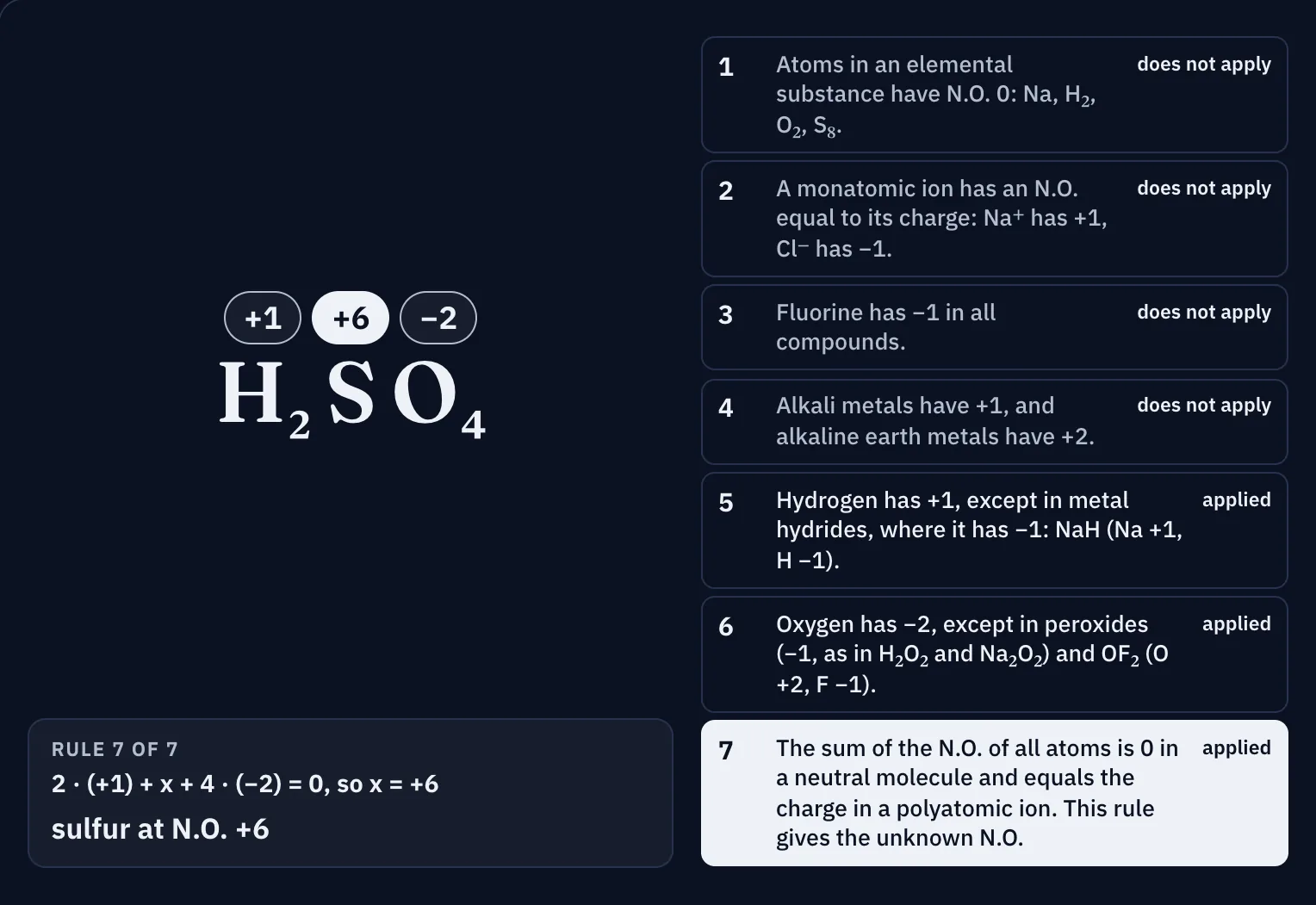
7. The sum of the N.O. of all atoms is 0 in a neutral molecule and equals the charge in a polyatomic ion. This rule gives the unknown N.O.
For the curious
Where the −1 for oxygen in H₂O₂ comes from: the structure is H–O–O–H. The electrons in each O–H bond are assigned to the more electronegative oxygen, so each oxygen receives one electron from hydrogen. The O–O bond joins identical atoms, and its electrons are shared equally. Each oxygen thus ends up at −1.
How to find the unknown N.O.
Write x for the unknown N.O. and set up the sum using rule 7. In H₂SO₄, hydrogen has +1 and oxygen −2, so 2 · (+1) + x + 4 · (−2) = 0, giving x = +6. In the SO₄²⁻ ion the sum equals the charge: x + 4 · (−2) = −2, so again x = +6.
In KMnO₄: +1 + x + 4 · (−2) = 0, so manganese has N.O. +7. In K₂Cr₂O₇: 2 · (+1) + 2x + 7 · (−2) = 0, so each chromium atom has +6. In NH₄⁺: x + 4 · (+1) = +1, so nitrogen has N.O. −3; the ion’s charge, 1+, is not the N.O. of nitrogen. In H₂O₂: 2 · (+1) + 2x = 0, so x = −1.
The sum is also a check: if you had given oxygen in H₂O₂ a value of −2, the sum would not have been 0, a sign that rule 6 has an exception here.
| Formula | N.O. of the atoms | Sum by rule 7 | What the picture says |
|---|---|---|---|
| H₂SO₄ | H +1, S +6, O −2 | 2 · (+1) + x + 4 · (−2) = 0, so x = +6 | sulfur at N.O. +6 |
| KMnO₄ | K +1, Mn +7, O −2 | +1 + x + 4 · (−2) = 0, so x = +7 | manganese at N.O. +7 |
| K₂Cr₂O₇ | K +1, Cr +6, O −2 | 2 · (+1) + 2x + 7 · (−2) = 0, so 2x = 12 and x = +6 | chromium at N.O. +6 |
| NH₄⁺ | N −3, H +1 | x + 4 · (+1) = +1, so x = −3 | nitrogen at N.O. −3 |
| H₂O₂ | H +1, O −1 | 2 · (+1) + 2x = 0, so 2x = −2 and x = −1 | H +1, O −1: peroxide, an exception to rule 6 |
| Fe₃O₄ | Fe +8/3, O −2 | 3x + 4 · (−2) = 0, so 3x = 8 and x = +8/3 | iron at N.O. +8/3. The value is an average. A single atom has a whole-number N.O.; the average appears when the formula does not show the atoms separately. The oxide contains both iron at N.O. +2 and iron at N.O. +3, in a ratio of 1 to 2, and can be written FeO·Fe₂O₃. |
| SO₄²⁻ | S +6, O −2 | x + 4 · (−2) = −2, so x = +6 | sulfur at N.O. +6 |
| HNO₃ | H +1, N +5, O −2 | +1 + x + 3 · (−2) = 0, so x = +5 | nitrogen at N.O. +5 |
| NaH | Na +1, H −1 | +1 + (−1) = 0 | Na +1, H −1 |
| OF₂ | O +2, F −1 | x + 2 · (−1) = 0, so x = +2 | O +2, F −1: an exception to rule 6 |
| C₂H₅OH | ? | 2x + 6 · (+1) + (−2) = 0, so 2x = −4 and x = −2 | The rules cannot settle this formula: it is the formula of an organic compound with several carbon atoms. The carbon atoms can have different N.O., and the formula does not show the bonds; the sum gives only an average. The structure of the molecule is needed. |
| NH₄NO₃ | ? | 2x + 4 · (+1) + 3 · (−2) = 0, so 2x = 2 and x = +1 | The rules cannot settle this formula: N appears in two places in the formula and can have a different N.O. in each. The sum gives only the average, +1. |
| Rule | Text of the rule |
|---|---|
| 1 | Atoms in an elemental substance have N.O. 0: Na, H₂, O₂, S₈. |
| 2 | A monatomic ion has an N.O. equal to its charge: Na⁺ has +1, Cl⁻ has −1. |
| 3 | Fluorine has −1 in all compounds. |
| 4 | Alkali metals have +1, and alkaline earth metals have +2. |
| 5 | Hydrogen has +1, except in metal hydrides, where it has −1: NaH (Na +1, H −1). |
| 6 | Oxygen has −2, except in peroxides (−1, as in H₂O₂ and Na₂O₂) and OF₂ (O +2, F −1). |
| 7 | The sum of the N.O. of all atoms is 0 in a neutral molecule and equals the charge in a polyatomic ion. This rule gives the unknown N.O. |
Calculation. The rules of the lesson, applied in order to the formula you choose or type. The oxidation number is a counting convention, not a measured charge: in H₂SO₄ there are no sulfur ions with six positive charges. If the rules are not enough (two unknowns, an organic compound, a value that makes no sense), the picture says so instead of guessing; for fractional values, as in Fe₃O₄, the number is an average.
Sources and credits. The rules and examples: the lesson on the oxidation number. Element symbols and names: CIAAW, abridged table of standard atomic weights 2024 (source); group number, used only to check the possible values: the periodic table of the elements, IUPAC numbering 1–18.
Values that look strange
In Fe₃O₄ the sum is 3x + 4 · (−2) = 0, so x = +8/3. This value is an average. The oxide contains both iron at N.O. +2 and iron at N.O. +3, in a ratio of 1 to 2, and can be written FeO·Fe₂O₃. A single atom has a whole-number N.O.; the average appears when the formula does not show the atoms separately.
The subscript in S₈ shows how many atoms are in the molecule, and the N.O. of each atom is 0.
Worked example
One element, several oxidation numbers
Find the N.O. of nitrogen in NH₃, N₂, NO, NO₂ and HNO₃. Apply rule 7 in each case.
NH₃: x + 3 · (+1) = 0, so x = −3. N₂ is an elemental substance: 0. NO: x + (−2) = 0, so x = +2. NO₂: x + 2 · (−2) = 0, so x = +4. HNO₃: +1 + x + 3 · (−2) = 0, so x = +5.
Nitrogen has N.O. −3 in NH₃, 0 in N₂, +2 in NO, +4 in NO₂ and +5 in HNO₃.
The same calculation gives sulfur: −2 in H₂S, 0 in S, +4 in SO₂, +6 in H₂SO₄. For chlorine: −1 in HCl, +1 in HClO, +5 in KClO₃, +7 in HClO₄. An element has several possible N.O. values; in each compound, the value comes from the sum, not from memory.
In Romania
Hydrogen peroxide from the pharmacy
Hydrogen peroxide is a solution of hydrogen peroxide, H₂O₂, in water; the most widely used solutions are 3% and 6%. The peroxide readily decomposes into water and oxygen:
2H₂O₂ → 2H₂O + O₂
In H₂O₂ oxygen has N.O. −1. In the products, some oxygen reaches −2 in H₂O, and some reaches 0 in O₂. Of four oxygen atoms at −1, two move to −2 and two to 0, and the sum remains −4. The bubbles on the slice of raw potato are oxygen gas from this reaction, which an enzyme in the potato speeds up.
In short
- Oxidation number (N.O.) is the conventional charge an atom would have if its bonds to different atoms were ionic; it is a counting convention, not a measured charge.
- An elemental substance has N.O. 0; a monatomic ion has an N.O. equal to its charge; fluorine has −1; alkali metals have +1 and alkaline earth metals +2.
- Hydrogen has +1 (−1 in metal hydrides); oxygen has −2 (−1 in peroxides, +2 in OF₂).
- The sum of N.O. is 0 in a molecule and equals the charge in a polyatomic ion; it gives the unknown N.O.
- N.O. is written with the sign first (+6, −2), an ion’s charge with the sign last (2−); in Fe₃O₄ iron has an average N.O. of +8/3.
Common mistakes
WrongOxygen always has N.O. −2.
RightIn ordinary compounds it has −2, but in peroxides it has −1 (H₂O₂, Na₂O₂) and in OF₂ it has +2. The sum of N.O. tells you whether you chose the right rule.
WrongNitrogen in NH₄⁺ has N.O. +1 because the ion has a charge of 1+.
RightThe ion’s charge is the sum of the N.O. of its atoms. From x + 4 · (+1) = +1, nitrogen has −3.
WrongSulfur in H₂SO₄ is a sulfur ion with six positive charges, so the acid contains sulfur ions.
RightN.O. +6 is the result of a counting convention. In the sulfuric acid molecule the bonds are covalent and there are no isolated sulfur ions.
Test yourself
7 questions. For the first 6 you see the explanation at once, with the paragraph of the lesson that supports it; for the written ones you compare with a good answer.
What is the N.O. of manganese in KMnO₄?
Answer
c) +7. Potassium has +1, oxygen −2: +1 + x + 4 · (−2) = 0, so x = +7.
What is the N.O. of oxygen in H₂O₂?
Answer
d) −1. Hydrogen has +1 and the sum must be 0: 2 · (+1) + 2x = 0, so x = −1.
In which formula does chlorine have N.O. +5?
Answer
b) KClO₃. In KClO₃: +1 + x + 3 · (−2) = 0, so x = +5. HClO₄ has +7, HClO has +1, HCl has −1.
What is the N.O. of chromium in K₂Cr₂O₇? Give the number without a sign.
Answer
6. 2 · (+1) + 2x + 7 · (−2) = 0, so 2x = 12 and x = +6.
Put the formulas in order of the N.O. of nitrogen, from lowest to highest.
Answer
The correct order:
- NH₃
- N₂
- NO
- NO₂
- HNO₃
The N.O. of nitrogen is −3 in NH₃, 0 in N₂, +2 in NO, +4 in NO₂ and +5 in HNO₃.
Place each oxygen atom under its N.O.
Answer
−2: O in H₂O; O in CuO.
−1: O in H₂O₂; O in Na₂O₂.
0: O in O₂; O in O₃.
Oxygen has −2 in water and oxides, −1 in peroxides and 0 in the elemental substance.
A classmate says: “In SO₄²⁻ sulfur has N.O. 2− because the ion has a charge of 2−.” What is the mistake, and how do you find the correct N.O. of sulfur?
A good answer
The ion’s charge is the sum of the N.O. of all its atoms, not the N.O. of sulfur. Oxygen has −2, and four atoms give −8. From x + 4 · (−2) = −2, x = +6, so sulfur has N.O. +6.
A complete answer distinguishes the ion’s charge from the N.O. of an atom and uses rule 7 to calculate it.
Terms
- oxidation number
- The charge an atom in a substance would have if its bonds to different atoms were treated as ionic.
- elemental substance
- A substance made of atoms of one element, for example Na, O₂, S₈; its atoms have N.O. 0.
- polyatomic ion
- An ion made of several bonded atoms, for example SO₄²⁻ or NH₄⁺.
- peroxide
- A compound in which oxygen has N.O. −1, for example H₂O₂ or Na₂O₂.
- metal hydride
- A compound of hydrogen with a metal, in which hydrogen has N.O. −1, for example NaH.
- average N.O.
- The mean N.O. of atoms of the same element in a formula; it can be fractional, as in Fe₃O₄ (+8/3).
Sources and link to the programme
- OpenStax – Chemistry 2e, 4.2 Classifying chemical reactions – the definition of oxidation number and the rules for elements, monatomic ions, hydrogen, oxygen (peroxides), halogens; the sum equal to the charge of the species
- IUPAC Gold Book – oxidation state – oxidation state is the charge of an atom after ionic approximation of bonds between different atoms; bonds between identical atoms are shared equally
- IUPAC Gold Book – oxidation number – oxidation number is largely synonymous with oxidation state
- Medlife – Apa oxigenată: beneficii, proprietăți, utilizări – the formula H₂O₂, 3% and 6% solutions as the most widely used, decomposition into water and oxygen
- Royal Society of Chemistry – Testing for enzymes – hydrogen peroxide placed on potato or liver releases oxygen, accelerated by the enzyme catalase
- Wikipedia – Iron(II,III) oxide – Fe₃O₄ contains Fe²⁺ and Fe³⁺ ions and is sometimes written FeO·Fe₂O₃
From the programme: “Oxidation number”; “Rules for determining oxidation numbers” (TC: Core curriculum (1 hour a week)). Specific competences followed: 3.1.