Chapter 4 · The atomLesson 4.5SN Natural sciences (3 hours) · beyond your profile
Electron configurations of chemical elements in periods 1, 2, 3 and 4 of the periodic table
Why 4s fills before 3d, and chromium and copper are exceptions
In argon, the third shell holds 8 electrons, although it has room for 18. Where does the 19th electron, in potassium, go?
Before you read: what do you think?
Potassium (Z = 19) comes after argon. Where does its 19th electron go?
See the answer
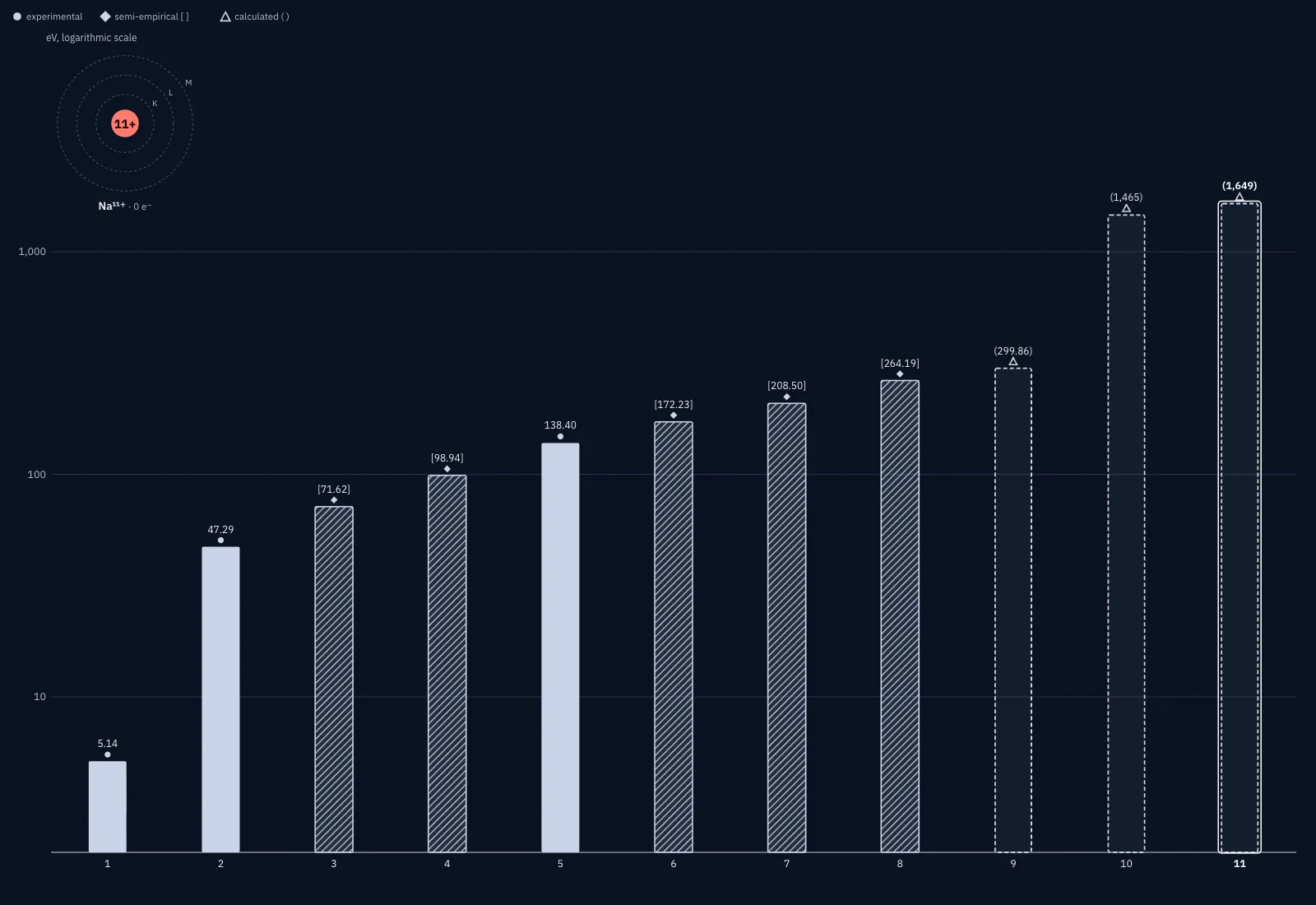
The electron enters 4s. Measurements show this: removing the first electron from potassium takes just 4.34 eV, and the second 31.63 eV, as for an atom with a single electron outside a core with the argon configuration.
The copper in electrical wires has 29 electrons. The filling order learned so far predicts 3d⁹4s². Spectra of the copper atom show 3d¹⁰4s¹. Period 4 is where a simple rule meets a measurement and is corrected.
Potassium and calcium: 4s before 3d
After argon, [Ar] = 1s²2s²2p⁶3s²3p⁶, with 18 electrons, the 4s subshell fills before 3d. Measurements show it. In potassium, removing the first electron takes 4.34 eV, and the second 31.63 eV: one electron is outside the [Ar] core. In calcium, removing the first two electrons takes 6.11 and 11.87 eV, and the third 50.91 eV: two electrons are outside the core.
The n + l rule says the same: 4s has n + l = 4, and 3d has n + l = 5. Potassium is [Ar] 4s¹, calcium is [Ar] 4s². In scandium, removing the first three electrons takes 6.56, 12.80 and 24.76 eV, and the fourth 73.49 eV. Of the three electrons outside the core, two are in 4s and one is in 3d.
From scandium to krypton: 3d, then 4p
From scandium to zinc, the 3d subshell fills, with five orbitals. These are d-block elements, called transition metals in textbooks. Sc [Ar] 3d¹4s²; Ti [Ar] 3d²4s²; V [Ar] 3d³4s²; Cr [Ar] 3d⁵4s¹; Mn [Ar] 3d⁵4s²; Fe [Ar] 3d⁶4s²; Co [Ar] 3d⁷4s²; Ni [Ar] 3d⁸4s²; Cu [Ar] 3d¹⁰4s¹; Zn [Ar] 3d¹⁰4s². In writing, 3d comes before 4s because subshells are grouped by shell; the filling order stays the same.
From gallium to krypton, 4p fills: Ga [Ar] 3d¹⁰4s²4p¹; Ge [Ar] 3d¹⁰4s²4p²; As [Ar] 3d¹⁰4s²4p³; Se [Ar] 3d¹⁰4s²4p⁴; Br [Ar] 3d¹⁰4s²4p⁵; Kr [Ar] 3d¹⁰4s²4p⁶. Period 4 has 2 + 10 + 6 = 18 elements because 4s, 3d and 4p fill.
The period is 4, the number of the outer shell. For Sc–Zn, the group is the number of 3d and 4s electrons: iron, 6 + 2, is in group 8; copper, 10 + 1, in group 11; zinc, 10 + 2, in group 12. For Ga–Kr, the group is 10 plus the number of valence electrons: bromine, with 7, is in group 17.
The exceptions: chromium and copper
The simple order would give chromium [Ar] 3d⁴4s² and copper [Ar] 3d⁹4s². The configurations determined experimentally at NIST are [Ar] 3d⁵4s¹ for chromium and [Ar] 3d¹⁰4s¹ for copper. One electron moves from 4s to 3d, and the total remains correct: 18 + 5 + 1 = 24 for chromium and 18 + 10 + 1 = 29 for copper.
The classroom explanation: a half-filled 3d subshell (five electrons) or a full one (ten electrons) has lower energy than the alternative. This is a memory aid: the energies of 4s and 3d are close, and the actual configuration depends on the total energy of the atom. The rule does not predict every exception in the periodic table.
For the curious
Exceptions also occur further along the table. Niobium (Z = 41) would be [Kr] 5s²4d³ by the simple order, but its measured configuration is [Kr] 5s¹4d⁴.
When cations form, 4s electrons leave first
The metals from scandium to zinc form cations by losing 4s electrons first, then 3d electrons if needed. Fe²⁺ is [Ar] 3d⁶, Fe³⁺ is [Ar] 3d⁵, Cu⁺ is [Ar] 3d¹⁰, Cu²⁺ is [Ar] 3d⁹, and Zn²⁺ is [Ar] 3d¹⁰. This is the rule used in textbooks. Gallium and germanium lose their 4p electrons first. An ion is not obtained by simply deleting the last symbol in the atom’s configuration.
Worked example
Iron and its ions
Write the configuration of iron (Z = 26) and its ions Fe²⁺ and Fe³⁺, and count the unpaired electrons in Fe³⁺.
Step 1, after the core: 26 − 18 = 8 electrons. First 4s fills with 2, then 3d with 6. The configuration is [Ar] 3d⁶4s².
Step 2: Fe²⁺ has 26 − 2 = 24 electrons. The two 4s electrons leave, giving [Ar] 3d⁶. Check: 18 + 6 = 24.
Step 3: Fe³⁺ has 26 − 3 = 23 electrons. The third electron leaves 3d, giving [Ar] 3d⁵. Check: 18 + 5 = 23.
Step 4: in 3d⁵, the five electrons occupy the five orbitals singly (Hund’s rule), so Fe³⁺ has five unpaired electrons.
In Romania
Copper from Roșia Poieni
At Roșia Poieni, in the commune of Lupșa, Alba County, CupruMin operates an open-pit mine at Romania’s largest copper deposit. The deposit has an average copper content of about 0.36%.
At this content, one tonne of copper takes at least 100 ÷ 0.36 ≈ 278 t of ore. Copper has Z = 29 and the configuration [Ar] 3d¹⁰4s¹, one of the two exceptions in period 4. The Cu²⁺ ion in copper compounds has 29 − 2 = 27 electrons and the configuration [Ar] 3d⁹: the 4s electron and one 3d electron leave.
In short
- After [Ar], 4s fills (K, Ca), then 3d (Sc–Zn), then 4p (Ga–Kr); period 4 has 2 + 10 + 6 = 18 elements.
- 4s fills before 3d: n + l is 4, compared with 5, and the ionisation energies of K and Ca show 1 and 2 electrons outside the [Ar] core.
- Exceptions: Cr is [Ar] 3d⁵4s¹, and Cu is [Ar] 3d¹⁰4s¹; a half-filled or full 3d subshell is the classroom explanation.
- Cations of Sc–Zn metals lose 4s electrons first: Fe²⁺ is [Ar] 3d⁶, Fe³⁺ is [Ar] 3d⁵, Cu²⁺ is [Ar] 3d⁹, Zn²⁺ is [Ar] 3d¹⁰.
- For Sc–Zn, the group is the number of 3d and 4s electrons (Fe, group 8); for Ga–Kr, the group is 10 plus the valence electrons.
Common mistakes
WrongPotassium has the configuration [Ar] 3d¹ because the third shell has room for more electrons.
RightPotassium is [Ar] 4s¹. The 4s subshell fills before 3d, and measurements show one electron outside the [Ar] core.
WrongFe²⁺ has the configuration [Ar] 3d⁴4s² because the ion loses the last two electrons written.
RightFe²⁺ is [Ar] 3d⁶: the two 4s electrons leave. The ion’s configuration is not obtained by deleting the last symbols written.
WrongCopper is [Ar] 3d⁹4s², following the simple order.
RightThe measured configuration is [Ar] 3d¹⁰4s¹. One 4s electron moves to 3d, and the total, 29, stays the same.
Test yourself
8 questions. For the first 7 you see the explanation at once, with the paragraph of the lesson that supports it; for the written ones you compare with a good answer.
What is the configuration of iron, Z = 26?
Answer
c) [Ar] 3d⁶4s². After [Ar], 8 electrons remain: 6 in 3d and 2 in 4s.
What is the configuration of the Fe³⁺ ion?
Answer
b) [Ar] 3d⁵. Fe loses 2 electrons from 4s and then one from 3d: [Ar] 3d⁶4s² becomes [Ar] 3d⁵.
Why is potassium [Ar] 4s¹ rather than [Ar] 3d¹?
Answer
b) Because 3d has n + l = 5, greater than 4 for 4s, so 4s fills first. The subshell with the lower n + l fills first, and measurements show one electron outside the [Ar] core.
How many electrons does the Cr³⁺ ion have (Z = 24)?
electronsAnswer
21 electrons. The chromium atom has 24 electrons and loses three: 24 − 3 = 21.
How many elements are in period 4?
elementsAnswer
18 elements. 4s fills (2 electrons), then 3d (10) and 4p (6): 2 + 10 + 6 = 18.
Put the subshells in filling order, starting with 3p.
Answer
The correct order:
- 3p
- 4s
- 3d
- 4p
n + l is 4 for 4s, 5 for 3d and 5 for 4p; when the sums are equal, the lower n fills first, so 3d comes before 4p.
Does the measured configuration of each atom follow the simple filling order (4s before 3d), or is it an exception? Sort each element.
Answer
Follows the simple order: Ti, [Ar] 3d²4s²; Fe, [Ar] 3d⁶4s²; Zn, [Ar] 3d¹⁰4s².
Exception to the simple order: Cr, [Ar] 3d⁵4s¹; Cu, [Ar] 3d¹⁰4s¹.
Chromium and copper have one electron in 4s and the rest in 3d.
Explain why chromium is [Ar] 3d⁵4s¹ rather than [Ar] 3d⁴4s², and state a limit of the classroom explanation.
A good answer
Chromium has 24 electrons: 18 in [Ar] and 6 in 3d and 4s. One electron moves from 4s to 3d, giving 3d⁵, a half-filled subshell; the total remains 24. The explanation is a memory aid: the energies of 4s and 3d are close, and it does not predict every exception.
A complete answer checks the electron count, describes the movement of one electron from 4s to 3d and states that the explanation is approximate.
Terms
- transition metal
- A d-block element in which the 3d subshell fills (scandium–zinc) in period 4, as textbooks call these elements; IUPAC does not count zinc as a transition element.
- [Ar] core
- The argon configuration, 1s²2s²2p⁶3s²3p⁶, abbreviated in square brackets.
- n + l rule
- Subshells fill in increasing order of the sum n + l; when sums are equal, the one with lower n fills first.
- half-filled subshell
- A subshell in which each orbital holds one electron, for example 3d⁵.
- unpaired electrons
- Electrons that occupy an orbital alone, without a partner of opposite spin.
Sources and link to the programme
- NIST – Atomic Spectra Database, Ground States and Ionization Energies (H–Kr, configurații fundamentale) – ground-state configurations of elements from potassium to krypton, including Cr [Ar] 3d⁵4s¹ and Cu [Ar] 3d¹⁰4s¹
- NIST – Atomic Spectra Database, Ground States and Ionization Energies (K, Ca, Sc) – successive ionisation energies of potassium (4.34; 31.63 eV), calcium (6.11; 11.87; 50.91 eV) and scandium (6.56; 12.80; 24.76; 73.49 eV)
- OpenStax – Chemistry 2e, 6.4 Electronic Structure of Atoms (Electron Configurations) – 4s filling before 3d, the Cr and Cu exceptions and the explanation involving a half-filled or full subshell, and the configuration of Fe²⁺ ions through loss of 4s electrons
- Wikipedia – Aufbau principle – the n + l rule
- Wikipedia – Roșia Poieni copper mine – location in the commune of Lupșa, Alba County; open-pit mine operated by CupruMin
- Cupru Min – fișă de prezentare a societății (Departamentul pentru proiecte de infrastructură și investiții străine) – the Roșia Poieni deposit: over a billion tonnes of ore with an average copper content of 0.36%
From the programme: “Electron configurations of chemical elements in periods 1, 2, 3 and 4 of the periodic table”; “Correlations between the electron configurations of chemical elements in periods 1, 2, 3 and 4 and their positions in the periodic table” (SN: Natural sciences (3 hours)). Specific competences followed: 1.3, 2.3, 3.3, 4.3, 5.3.