Chapter 8 · Between moleculesLesson 8.4TC Core curriculum (1 hour a week) · beyond your profile
Physical properties of water
Why ice floats and lakes freeze from the top
For almost every substance, the solid sinks in its own liquid. Ice floats on water. What makes water special, and what are the consequences?
Before you read: what do you think?
An ice cube of 100 g at 0 °C melts completely. How does the volume of the resulting water compare with that of the cube?
See the answer
Mass is conserved, but volume decreases: ice has a density of 0.917 g/cm³, so the cube occupies 100 ÷ 0.917 ≈ 109 cm³, while the liquid water at 0 °C occupies nearly 100 cm³. The volume of the water is about 8% smaller.
In a glass, ice cubes float, with most of each cube submerged. Lake Bâlea, 2,034 m up in the Făgăraș Mountains, freezes from the top down in winter, and blocks are cut from its ice for the Ice Hotel. The ice stays on the surface, forming a layer that insulates the water beneath.
Unusually high temperatures for such a small molecule
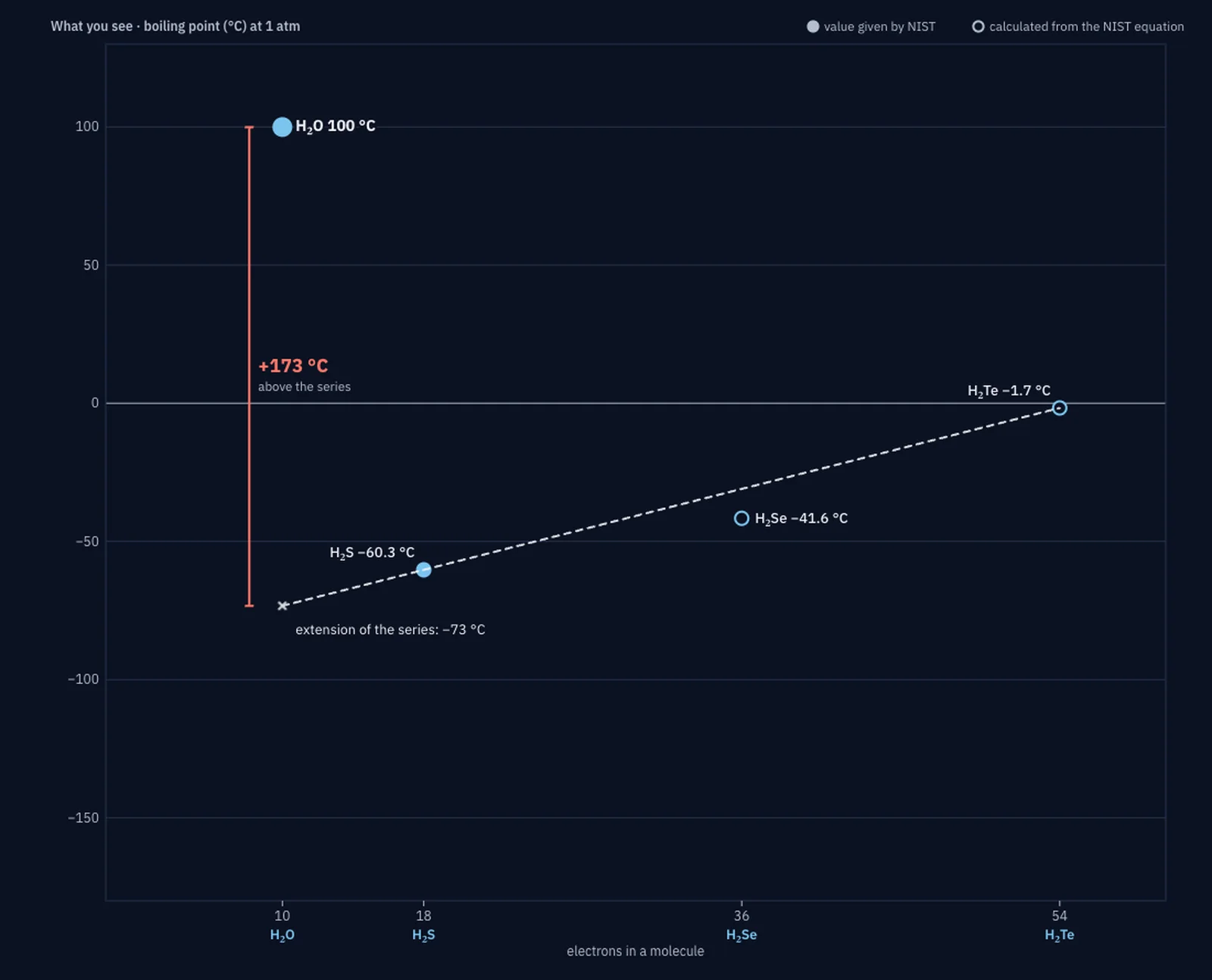
At a pressure of 1 atm, water freezes at 0 °C and boils at 100 °C. For a molecule of 18 g/mol, those values are unusually high: H₂S, with M = 2 + 32 = 34 g/mol, boils at −60 °C, and CH₄, at 16 g/mol, boils at −161.5 °C. The cause is the network of hydrogen bonds between water molecules. Evaporating one mole of water takes 40.7 kJ.
Ice is less dense than liquid waterWhat you see
Ice floats. Its density at 0 °C is 0.917 g/cm³, compared with nearly 1.000 g/cm³ for liquid water. Density is calculated using ρ = m ÷ V, so the same mass of water takes up more space as ice.
What happens to molecules when water freezesWhat the particles do
In ice, hydrogen bonds hold the molecules in a lattice of hexagonal rings with empty spaces. As ice melts, some of the bonds break, the molecules move closer together and the volume decreases. As the water warms further, it contracts until 3.98 °C, or about 4 °C, where its density is at a maximum of 1.000 g/cm³. Above 4 °C it expands, like most liquids: at 25 °C its density is 0.997 g/cm³.
In a lake, water at the surface cools and sinks as long as it is denser than the water below. Water at 4 °C, the densest, reaches the bottom. When the surface temperature falls below 4 °C, the water expands and stays above, and at 0 °C ice forms and floats. A layer of ice insulates the water below, where plants and animals can survive the winter without freezing. The increase in volume on freezing, about 9%, can burst a bottle full of water.
Water heats up and cools down slowlyHow it is written
Specific heat capacity, c, is the heat needed to warm 1 g of a substance by 1 K. For liquid water at 25 °C, c = 4.18 J/(g·K), one of the highest values among liquids. Heat absorbed or released is calculated using Q = m · c · ΔT.
Because c is high, water takes in a lot of heat without warming much. The specific heat capacity of water is about five times that of sand, so land cools faster than the sea.
Surface tension and the polar solvent
Molecules at the surface of water are attracted to their neighbours only from the sides and from within, and the surface behaves like an elastic skin. The surface tension of water is 72 mN/m at 25 °C, nearly three times that of ethanol, 22 mN/m. That is why a dry steel needle placed carefully on the surface of water stays there, and some insects walk on water without sinking. It is also why a drop of water is spherical: a sphere has the smallest surface area for a given volume.
Water is also a good solvent for ionic substances such as NaCl and polar substances such as sugar, because its polar molecules form strong attractions with ions and hydrogen bonds with polar molecules.
For the curious
A safe observation: place a dry sewing needle on a fork and slowly lower the fork horizontally into water. If the needle stays on the surface, carefully withdraw the fork. Touch the surface with a drop of detergent: the surface tension falls and the needle sinks.
Worked example
What happens when 1.00 L of water freezes
One litre of water at 4 °C freezes in a freezer. What volume does the ice occupy, and what fraction of the piece of ice floats above the water?
Mass: the density at 4 °C is 1.000 g/cm³, and 1.00 L = 1,000 cm³, so m = 1.000 · 1,000 = 1,000 g.
Volume of ice: V = m ÷ ρ = 1,000 ÷ 0.917 ≈ 1,091 cm³ ≈ 1.09 L. The increase is (1,091 − 1,000) ÷ 1,000 ≈ 0.091, or 9%.
Submerged fraction: a piece of ice floats with the fraction ρ(ice) ÷ ρ(water) = 0.917 ÷ 1.000 = 0.917 submerged, or 91.7%. Above the water, 100 − 91.7 = 8.3% remains.
Check: ice increases in volume by 9%, so a full, sealed bottle placed in the freezer can crack.
In Romania
Lake Bâlea and Omu Peak
Lake Bâlea, at an altitude of 2,034 m, freezes in winter. The Ice Hotel at Bâlea was built from bricks of ice cut from the surface of the glacial lake: the ice stays on the surface, where it can be cut.
Altitude also changes the boiling point of water. The station on Omu Peak, at 2,504 m, has a pressure of 746 hPa in the standard atmosphere, compared with 1,013 hPa at sea level. At 746 hPa water boils at about 92 °C, not 100 °C: it boils when its vapour pressure equals the air pressure, and the air there exerts less pressure.
In short
- Water freezes at 0 °C and boils at 100 °C at 1 atm, unusually high values for a small molecule, because of hydrogen bonds.
- Ice (0.917 g/cm³) is less dense than liquid water (nearly 1.000 g/cm³) and floats; water has its maximum density at about 4 °C.
- Lakes freeze from the surface down, and ice insulates the water below.
- Water has a high specific heat capacity, c = 4.18 J/(g·K); Q = m · c · ΔT. The sea cools more slowly than land.
- The surface tension of water, 72 mN/m, holds a needle on the surface and gives a drop its spherical shape. Water dissolves ionic and polar substances, and at altitude it boils below 100 °C.
Common mistakes
WrongWater is densest at 0 °C.
RightLiquid water is densest at about 4 °C. At 0 °C ice forms, and it is less dense (0.917 g/cm³).
WrongIce occupies the same volume as the water it formed from, because mass is conserved.
RightMass is conserved, but ice has a volume about 9% greater, because the hydrogen-bond lattice has empty spaces.
WrongWater boils at 100 °C everywhere.
Right100 °C is the value at 1 atm. The lower the pressure at altitude, the lower the temperature at which water boils.
Test yourself
8 questions. For the first 7 you see the explanation at once, with the paragraph of the lesson that supports it; for the written ones you compare with a good answer.
Why does ice float on liquid water?
Answer
b) Because ice has a density of 0.917 g/cm³, lower than that of liquid water. The same mass of water occupies a larger volume as ice, so its density is lower.
At what temperature is liquid water at its maximum density, at normal pressure?
Answer
a) About 4 °C. Below 4 °C water expands because hydrogen bonds begin to form the lattice with empty spaces.
Why does a deep lake not freeze all the way to the bottom in an ordinary winter?
Answer
d) Because ice forms at the surface, floats and insulates the water below. The less dense ice stays on top and insulates the water below.
Which property explains why a dry steel needle can sit on the surface of water?
Answer
c) High surface tension. Attractions between molecules at the surface give it elastic resistance.
How much heat does 200 g of water absorb as it warms from 20 °C to 45 °C? Use c = 4.18 J/(g·K). Give your answer in kJ, to one decimal place.
kJAnswer
20.9 kJ. ΔT = 45 − 20 = 25 K; Q = 200 · 4.18 · 25 = 20,900 J = 20.9 kJ.
A bottle contains 500 g of water at 4 °C (500 cm³, ρ = 1.000 g/cm³). The water freezes completely. What volume does the resulting ice occupy, in cm³? Use ρ(ice) = 0.917 g/cm³. Round to the nearest whole number.
cm³Answer
545 cm³. V = m ÷ ρ = 500 ÷ 0.917 ≈ 545 cm³, about 45 cm³ more than the 500 cm³ of water.
Put in order what happens in a lake as it cools in winter.
Answer
The correct order:
- Water at the surface cools and sinks as it becomes denser
- Water at 4 °C, the densest, reaches the bottom
- Water at the surface falls below 4 °C and stays on top
- At 0 °C ice forms at the surface
- The ice layer insulates the water below
The maximum density at 4 °C means ice forms at the surface.
Why does water boil below 100 °C on a mountain peak? Link your answer to pressure.
A good answer
Water boils when its vapour pressure equals the pressure of the air above it. On a mountain peak the air pressure is lower, for example 746 hPa on Omu Peak, so the pressures become equal at a lower temperature, about 92 °C. The O–H bonds do not break; hydrogen bonds between molecules break.
A complete answer says that boiling depends on external pressure and that the temperature falls as pressure falls, with a numerical example.
Terms
- density
- The ratio of the mass of a substance to its volume, ρ = m ÷ V.
- specific heat capacity
- The heat needed to warm 1 g of a substance by 1 K.
- surface tension
- The force per unit length that makes the surface of a liquid behave like an elastic membrane.
- expansion
- An increase in the volume of a body, for example on heating or when water freezes.
- polar solvent
- A solvent made of polar molecules, such as water, which dissolves ionic and polar substances well.
Sources and link to the programme
- NIST Chemistry WebBook – Fluid properties, Water (1 atm) – liquid water density, maximum (999.97 kg/m³) between 3 and 5 °C; boiling at 1 atm at 373.12 K (99.97 °C)
- NIST Chemistry WebBook – Fluid properties, Water (74,6 kPa) – boiling temperature at 74.6 kPa (746 hPa): 364.8 K (91.6 °C); specific heat capacity at 25 °C, 4.18 J/(g·K), from the same source
- PubChem – Water – maximum density at 3.98 °C; ice at 0.917 g/cm³ at 0 °C; surface tension 71.97 dyn/cm at 25 °C; enthalpy of vaporisation 9.717 kcal/mol (40.7 kJ/mol)
- LibreTexts – Structure of Ice (CK-12) – table of water density from 0 to 25 °C (0.9998 at 0 °C liquid; 1.000 at 4 °C; 0.9971 at 25 °C; ice 0.9168); hexagonal structure with open spaces
- OpenStax – Biology 2e, 2.2 Water – highest specific heat capacity among common liquids; about five times that of sand; less dense ice insulates water in lakes
- OpenStax – Chemistry 2e, 10.2 Properties of Liquids – surface tension: water 71.99 mN/m, ethanol 21.97 mN/m at 25 °C; steel needle and insects sitting on water
- NASA Glenn – Earth atmosphere model – standard atmosphere pressure formula, also used in the Geography book: 746 hPa at 2,504 m
- Antena 3 CNN – Hotelul de Gheață „Europa”, de la Bâlea Lac – hotel built from ice bricks cut from the surface of the glacial lake
- Geoecomar – Ecosisteme semiînchise: lacul alpin Bâlea – Lake Bâlea, the largest glacial lake in the Făgăraș Mountains, at an altitude of about 2,040 m (other sources: 2,034 m)
From the programme: “Physical properties of water”; “Solubility of methanol, ethanol and sucrose in water; physical properties of water” (TC: Core curriculum (1 hour a week)). Specific competences followed: 1.4, 2.4, 2.5, 4.4, 5.4, 6.4.