Chapter 7 · The covalent bondLesson 7.6SN Natural sciences (3 hours) · beyond your profile
Single, double and triple covalent bonds; the lengths of these bonds
Why a triple bond between carbon atoms is shorter than a single bond
In ethane, the carbon atoms are joined by one line; in acetylene, by three. What do the lines mean, and why does the distance between the atoms change?
Before you read: what do you think?
One half of a molecule can rotate relative to the other around the bond between the two carbon atoms. In which molecule is rotation free at room temperature?
See the answer
Only in ethane. The single bond is a σ bond, with the same shape in every position of the two halves of the molecule. The double bond also contains a π bond, whose overlap is disrupted if one half twists.
A welder cuts steel with an acetylene–oxygen flame that reaches about 3,300 °C. The acetylene molecule, C₂H₂, has three lines between its two carbon atoms. In ethane, C₂H₆, there is one line between the carbon atoms. The number of lines determines how close the atoms are and how hard the bond is to break.
One, two or three pairs between the same two atoms
Two atoms can share one, two or three pairs of electrons. They form a single bond (one pair, one line), a double bond (two pairs, two lines) or a triple bond (three pairs, three lines). Examples: H–H and C–C in ethane, CH₃–CH₃; C=C in ethene, CH₂=CH₂, and C=O in CO₂; C≡C in acetylene, HC≡CH, N≡N in nitrogen and C≡N in hydrogen cyanide, HCN. The total number of bonds an atom forms is its covalency: carbon forms four bonds, nitrogen three, oxygen two and hydrogen one. Carbon’s four bonds can be four single bonds, two single and one double, two double, or one single and one triple.
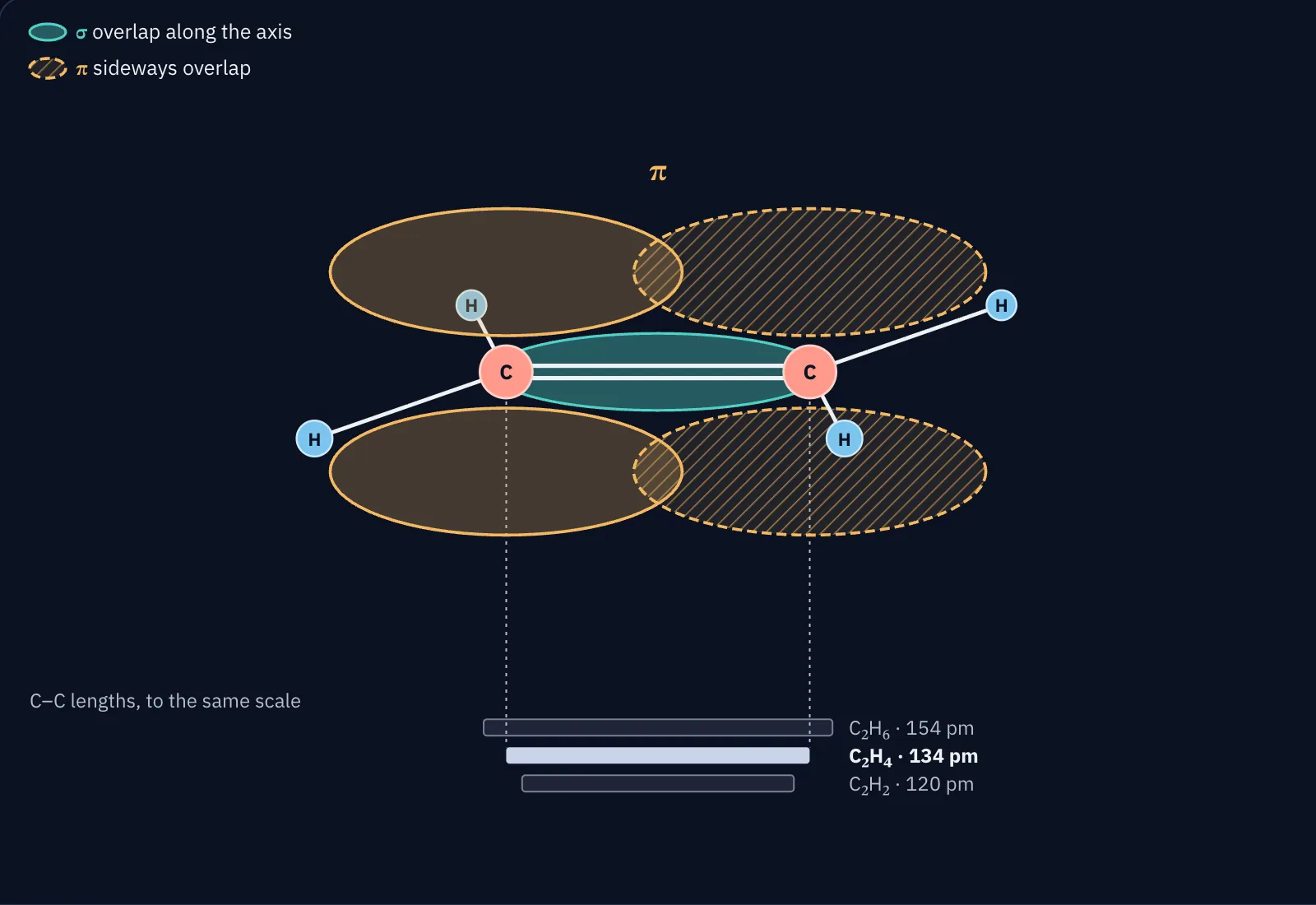
The more pairs between two atoms, the closer the atoms are and the harder the bond is to break. The average values for carbon: C–C has a length of 154 pm and an energy of 345 kJ/mol, C=C has 134 pm and 611 kJ/mol, and C≡C has 120 pm and 837 kJ/mol. A picometre (pm) is 10⁻¹² m, so 154 pm = 0.154 nm.
The energy does not increase in proportion to the number of pairs. From C–C to C=C the average energy increases by 611 − 345 = 266 kJ/mol, and from C=C to C≡C by 837 − 611 = 226 kJ/mol, less than the 345 kJ/mol of the first pair. Added pairs contribute less than the first.
σ and π bonds differ in how orbitals overlapWhat the particles do
A σ (sigma) bond forms when two orbitals overlap along the axis joining the nuclei. The electron cloud is symmetric around the axis, so rotating one atom around it does not change the overlap: rotation around a single σ bond is easy. An orbital is a region where an electron is highly likely to be found, not an orbit.
A π (pi) bond forms by the sideways overlap of two parallel p orbitals. The electron cloud lies above and below the axis. Sideways overlap is weaker than overlap along the axis, and rotating one atom around the axis disrupts it: rotation around a double bond is blocked.
At most one σ bond exists between two atoms. A single bond is one σ, a double bond is one σ and one π, and a triple bond is one σ and two π. The two π bonds of a triple bond lie in perpendicular planes.
| Molecule | C–C bond | Average length | Average energy | Between the carbons | In the molecule | Rotation about the bond |
|---|---|---|---|---|---|---|
| ethane (C₂H₆) | single bond | 154 pm | 345 kJ/mol | 1σ | 7σ | free |
| ethene (C₂H₄) | double bond | 134 pm | 611 kJ/mol | 1σ + 1π | 5σ and 1π | blocked |
| ethyne (acetylene) (C₂H₂) | triple bond | 120 pm | 837 kJ/mol | 1σ + 2π | 3σ and 2π | blocked |
Rotation is free: the single bond is a σ bond, with the same shape in every position of the two halves of the molecule. Rotation is blocked: twisting one half of the molecule disrupts the sideways overlap of the π bond. In ethyne, rotation is blocked: twisting disrupts the sideways overlap of both π bonds.
Average measurements and diagram. The C–C lengths are average values from bond tables (154, 134 and 120 pm; average energies 345, 611 and 837 kJ/mol), not the length in one particular molecule, and are drawn to scale, between the centres of the carbon atoms; the C–H length and the size of the balls are a diagram, like the angles in the drawing. The σ and π clouds are regions of probability for the electrons, not orbits. Rotation is shown only as an attempt: where the π bond would be twisted, its lobes come apart, and the molecule does not stay twisted. Atoms have no colour: they are drawn hugely enlarged.
Sources and credits. Average bond lengths and energies: OpenStax, Chemistry 2e, section 7.5, source (only the six numbers, as cited facts), queried on 16.11.2026. The number of σ and π bonds and the rotation: after the lesson on multiple bonds and OpenStax, section 8.3, source.
How to count σ and π bonds in a moleculeHow it is written
Draw the formula with all its bonds, including those to hydrogen. Each single bond is σ; each double or triple bond has one σ and, in addition, one or two π bonds.
Ethane, C₂H₆: six C–H and one C–C, giving 7σ and no π. Ethene, C₂H₄: four C–H and one C=C, giving 5σ and 1π. Acetylene, C₂H₂: two C–H and one C≡C, giving 3σ and 2π. Carbon tetrachloride, CCl₄: four C–Cl, giving 4σ. Nitrogen, N₂: 1σ and 2π. Carbon dioxide, O=C=O: 2σ and 2π.
Ethane and CCl₄ have no π bonds; ethene, acetylene, N₂ and CO₂ do.
The shapes fit the VSEPR model: in ethane, carbon has four σ bonds and angles of about 109.5°; in ethene, three σ bonds in a plane, at 120°; in acetylene, two σ bonds in a straight line, at 180°.
For the curious
The acetylide ion, C₂²⁻, in calcium carbide also has a triple bond. The explanation involves carbon’s hybrid orbitals, covered later.
Worked example
Σ and π in HCN and propene
Hydrogen cyanide has the formula H–C≡N. The single C–H bond is one σ, and the triple C≡N bond has one σ and two π. Total: 2σ and 2π.
Propene, CH₃–CH=CH₂, has nine atoms. Six C–H bonds (three at CH₃, one at CH, two at CH₂) are σ. Of the two bonds between carbon atoms, one is single, C–C, or one σ, and one is double, C=C, or one σ and one π. Total: 6 + 1 + 1 = 8σ and 1π.
Check: in a molecule without rings, the number of σ bonds is the number of atoms minus one: 9 − 1 = 8. For HCN too: 3 − 1 = 2. The π bonds do not count in this check.
In Romania
Carbide from Târnăveni, acetylene and the welder’s flame
Acetylene for welding is made from carbide, CaC₂, which reacts with water: CaC₂ + 2H₂O → C₂H₂ + Ca(OH)₂. Carbide is made from lime and coke in an electric furnace at over 2,000 °C.
In 2006, Carbid-Fox in Târnăveni was the only carbide producer in Romania; early that year, production stopped because electricity to the factory had been cut off. The company entered court-ordered liquidation and was sold in 2009 for 4.5 million euros.
One mole of CaC₂ gives one mole of C₂H₂. From M(CaC₂) = 40 + 2·12 = 64 g/mol and M(C₂H₂) = 2·12 + 2·1 = 26 g/mol, 1,000 g of pure carbide gives 1,000 · 26 ÷ 64 ≈ 406 g of acetylene.
In short
- Two atoms can share one, two or three pairs: a single, double or triple bond.
- Average lengths and energies: C–C 154 pm and 345 kJ/mol, C=C 134 pm and 611 kJ/mol, C≡C 120 pm and 837 kJ/mol. The more pairs, the shorter and stronger the bond.
- A σ bond forms by overlap along the axis and allows rotation; a π bond forms by sideways overlap of p orbitals, is weaker and blocks rotation.
- Single = σ; double = σ + π; triple = σ + 2π.
- Ethane: 7σ; ethene: 5σ and 1π; acetylene: 3σ and 2π; CCl₄: 4σ; N₂: 1σ and 2π; CO₂: 2σ and 2π; HCN: 2σ and 2π.
Common mistakes
WrongA triple bond means three identical σ bonds.
RightA triple bond is one σ and two π. The π bonds have a different shape and are weaker than σ.
WrongA C=C bond is twice as strong as a C–C bond.
RightThe average energy of a C=C bond is 611 kJ/mol, less than twice 345 kJ/mol. The second pair is more weakly bonded than the first.
WrongWhen counting σ bonds, only bonds between carbon atoms count.
RightCount all single bonds, including C–H and C–Cl, and one from each multiple bond.
Test yourself
7 questions. For the first 6 you see the explanation at once, with the paragraph of the lesson that supports it; for the written ones you compare with a good answer.
How many σ and π bonds does a nitrogen molecule, N≡N, have?
Answer
c) 1σ and 2π. A triple bond is one σ and two π.
Why is rotation around the C=C bond in ethene blocked?
Answer
c) Because twisting disrupts the sideways overlap of the π bond. A π bond forms by the sideways overlap of two parallel p orbitals; twisting one half of the molecule disrupts the overlap.
What is the correct order of the lengths of the bonds between carbon atoms?
Answer
b) C–C > C=C > C≡C. The more pairs between the atoms, the shorter the distance between them: 154, 134 and 120 pm.
How many σ bonds does an ethane molecule, C₂H₆, have in total?
σ bondsAnswer
7 σ bonds. Six C–H bonds and one C–C bond, all single and therefore all σ: 6 + 1 = 7.
By how many kJ/mol is the average energy of a C=C bond (611 kJ/mol) greater than that of a C–C bond (345 kJ/mol)?
kJ/molAnswer
266 kJ/mol. 611 − 345 = 266 kJ/mol, less than the 345 kJ/mol of the C–C bond.
Place each molecule in the correct category.
Answer
No π bonds: C₂H₆ (ethane); CCl₄.
At least one π bond: C₂H₄ (ethene); C₂H₂ (acetylene); N₂; CO₂.
Only molecules with double or triple bonds have π bonds.
Explain why the energy of a C=C bond (611 kJ/mol) is less than twice the energy of a C–C bond (2 · 345 = 690 kJ/mol).
A good answer
A double bond is one σ and one π. The π bond forms by sideways overlap, which is weaker than the overlap along the axis of the σ bond. So going from C–C to C=C adds less energy than the first pair: 611 − 345 = 266 kJ/mol.
A complete answer says that a double bond is σ + π and that the sideways overlap of π is weaker.
Terms
- single, double, triple bond
- A covalent bond formed by one, two or three pairs of electrons, respectively, shared between the same two atoms.
- σ (sigma) bond
- A bond formed by orbital overlap along the axis between nuclei; it allows the atoms to rotate around the axis.
- π (pi) bond
- A bond formed by sideways overlap of two parallel p orbitals; it is weaker than σ and blocks rotation.
- bond length
- The average distance between the nuclei of two bonded atoms, measured in picometres (pm).
- bond energy
- The energy needed to break one mole of bonds, expressed in kJ/mol.
- orbital
- A region around the nucleus where an electron is highly likely to be found.
Sources and link to the programme
- OpenStax – Chemistry 2e, 7.5 Strengths of Ionic and Covalent Bonds – average bond energies C–C 345, C=C 611, C≡C 837 kJ/mol and lengths 154, 134, 120 pm; a bond of higher order is shorter and stronger
- OpenStax – Chemistry 2e, 8.3 Multiple Bonds – definitions of σ and π bonds, rotation around a single bond and its restriction at a double bond, counting σ and π in ethene (5σ, 1π) and acetylene (3σ, 2π)
- Wikipedia – Acetylene – acetylene–oxygen flame above 3,600 K (about 3,330 °C); production from carbide and water; linear molecule with one σ and two π bonds between the carbon atoms
- Wikipedia – Calcium carbide – acetylide ion with a triple bond; carbide made in an electric furnace at over 2,000 °C; reaction CaC₂ + 2H₂O → C₂H₂ + Ca(OH)₂
- Ziarul Financiar – Carbid Fox posts 1.43m euro losses in Q1 – Carbid-Fox Târnăveni, the only carbide producer in Romania in 2006; production stopped early that year because the electricity supply was cut off
- Bursa – Societatea Carbid Fox din Târnăveni a fost vândută cu 4,5 milioane de euro – sale in July 2009 of the company in court-ordered liquidation for 4.5 million euros
From the programme: “Single, double and triple covalent bonds; the lengths of these bonds”; “The sigma and pi covalent bonds”; “The molecules of ethane, ethene, acetylene (ethyne) and carbon tetrachloride”; “Type of hybridisation according to the number of sigma and pi bonds formed by the carbon atom” (SN: Natural sciences (3 hours)). Specific competences followed: 5.4.