Solutions
Chapter 9
Solutions – where the salt goes
Where does the salt go when you put it in water?
You put a teaspoonful of salt in water, stir, and after a minute the salt can no longer be seen. Is it still in the glass? In the magnifying window you see a corner of a crystal, magnified millions of times, and the balance says how much the whole thing weighs. Start with a guess.
What does the balance show after dissolving?
The glass holds 90.0 g of water. On the dish are 10.0 g of salt. You stir until the last crystal disappears. What does the balance show?
The crystal comes apart ion by ion
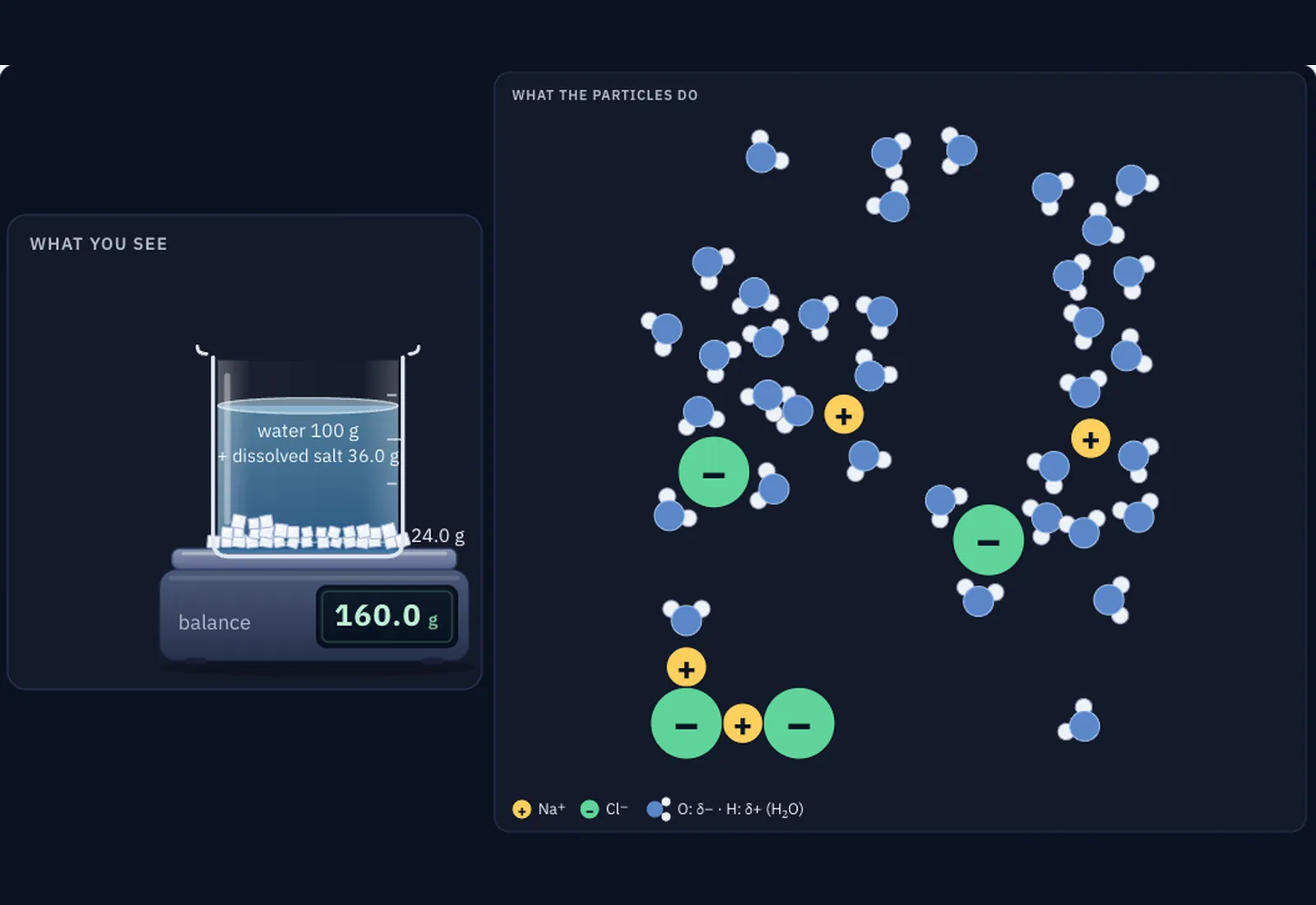
The magnifying window shows a corner of the salt crystal: Na⁺ ions, with a + sign, and Cl⁻ ions, with a − sign, arranged alternately. There are no NaCl molecules between them.
The water molecule is polar. Next to a Na⁺ ion it turns with its oxygen (δ−), next to a Cl⁻ ion with its hydrogens (δ+). Pulled from several sides, the ions at the edge leave one at a time, each surrounded by water molecules.
In the solution there are as many + ions as − ions, so the total charge stays zero.
The balance shows 100.0 g
Nothing has left the glass: 90.0 g of water and 10.0 g of salt make 100.0 g of solution. The concentration is c = md · 100 ÷ ms = 10 · 100 ÷ 100 = 10.0%.
Dissolving is written:
NaCl(s) → Na⁺(aq) + Cl⁻(aq)
The letter (s) marks the solid, (aq) marks the ion surrounded by water. Each NaCl unit gives one Na⁺ ion and one Cl⁻ ion: the 10.0 g of salt are 10.0 ÷ 58.5 = 0.171 mol of each ion.
The concentration rises with every spoonful
The glass is new: 100 g of water, at 25 °C. The balance adds exactly the mass you put in. The concentration is calculated from the mass of the solution, not the mass of the water.
After seven spoonfuls (35 g) all the salt is dissolved and c = 25.9%.
After 36.0 g, the salt stays on the bottom
At 25 °C, at most 36.0 g of salt dissolve in 100 g of water. The eighth spoonful, 40 g in all, leaves 4.0 g on the bottom, however much you stir. The solution is saturated: c = 36.0 · 100 ÷ 136.0 = 26.5%. The balance shows 140.0 g, because the crystals on the bottom are weighed too.
The ions do not stand still: ions leave the crystal on the bottom, and ions return from the solution. In the model, at saturation leaving and returning are equally likely, so the crystal does not shrink and the concentration stops rising.
Heat helps table salt a little and potassium nitrate a lot
The same 100 g of water, with 80 g of substance. The values are measured; heating solutions is done by the teacher in the laboratory and is not repeated at home.
Table salt: 37.0 g dissolve at 60 °C, compared with 36.0 g at 25 °C, 1.0 g more. 43.0 g are left on the bottom instead of 44.0 g.
Potassium nitrate: 38.3 g at 25 °C and 109.2 g at 60 °C, 2.85 times as much, 70.9 g more. All 80 g dissolve, and on cooling to 25 °C 41.7 g crystallise again.
On a mineral water label, the charges balance
Mineral water is a solution of ions, and the label gives them in mg/L. Type the values from your own bottle. Each value is divided by the molar mass (Ca 40, Mg 24, Na 23, K 39, HCO₃⁻ 61, SO₄²⁻ 96, Cl⁻ 35.5, NO₃⁻ 62) to give mmol/L; then it is multiplied by the charge of the ion, because Ca²⁺ brings two charges.
The values are not sent and not saved. A difference of up to 5% can come from rounding and from ions not listed on the label. A larger one may point to a missing or wrong value, but the balance does not say which.
Explain: why does a salt lake leave a white crust in August?
The glass stands in for the lake: 100 g of water with 30.0 g of dissolved salt, at 25 °C (a worked example, not a particular lake). Evaporation removes only water; the salt stays. Each press removes 10 g of water.
Use the solubility: the first crystals appear when the mass of the water falls below 30.0 · 100 ÷ 36.0 = 83.3 g. At 80 g of water, 1.2 g are left on the bottom; at 70 g, 4.8 g.
Explain the white crust briefly, with the ions, the water and the solubility. The full lesson: Where does salt go when it dissolves?.