Chapter 8 · AnimalsLesson 8.4
Arthropods: arachnids, crustaceans and insects, with their skeleton on the outside
Why is a spider not an insect, even though both have jointed legs and a hard outer covering?
- Size
- from 1 mm to 30 m
- Level
- organism
- Time
- hundreds of millions of years
Before you read: what do you think?
A crayfish is shut inside a hard shell that cannot stretch. How does it grow?
See the answer
It sheds its shell. The outer skeleton of arthropods does not grow, so from time to time the animal leaves it behind, grows fast while the new covering is soft, and then the new covering hardens. This is called moulting.
On a windowsill you sometimes find a whole spider, legs and all, but hollow inside. It is its old covering: the spider has grown and left its outer skeleton behind. Crayfish, crabs, bees and beetles grow the same way, because they are all arthropods.
A skeleton on the outside and legs with joints
Arthropods have a segmented body, and the segments are joined into a few regions, each with its own job. They have jointed legs, made of pieces linked by joints; that is where the group’s name comes from, since it means ‘jointed legs’.
The body is covered by an exoskeleton, an outer skeleton that contains chitin. The exoskeleton protects the organs, anchors the muscles and reduces water loss, which has allowed many arthropods to live on land. The exoskeleton does not grow. That is why arthropods grow by moulting: every so often they shed the old covering, grow while the new one is soft, and then it hardens.
Arthropods have an open circulatory system: the heart pumps blood into the body cavity, where it bathes the organs. They are the largest phylum of animals, with over a million described species, and insects are the largest class.
Arachnids: the spider, the scorpion, the tick
An arachnid’s body has two regions: the cephalothorax, made of the head and thorax joined together, and the abdomen. Adults have four pairs of legs and no antennae. The first pair of appendages are the chelicerae; in spiders they end in fangs through which they inject venom into their prey. The second pair are the pedipalps.
The European garden spider (Araneus diadematus) has pale spots on its back arranged in the shape of a cross. The female is 6.5–20 mm long. It spins circular webs from silk made by glands at the end of its abdomen and catches mainly insects. Arachnids breathe with book lungs, sacs with stacked leaves like the pages of a book, or with tracheae.
The castor bean tick (Ixodes ricinus) feeds on blood. It goes through four stages: egg, larva, nymph and adult; the larva has three pairs of legs, while the nymph and the adult have four. The tick can transmit the agents of Lyme disease and of tick-borne encephalitis. The scorpion is an arachnid too.
Crustaceans: the crayfish and the crab
Most crustaceans live in water and breathe through gills. The noble crayfish (Astacus astacus) has its head and thorax joined into a cephalothorax covered by a carapace. It has two pairs of antennae and two compound eyes, each on a movable stalk.
On the cephalothorax it has five pairs of walking legs; the first pair, much larger, ends in pincers. The gills are attached at the base of the legs, under the carapace. The abdomen has small appendages and ends in a tail fan, which the crayfish uses to swim rapidly backwards when it flees. The crab is a crustacean too, from the same group as the crayfish.
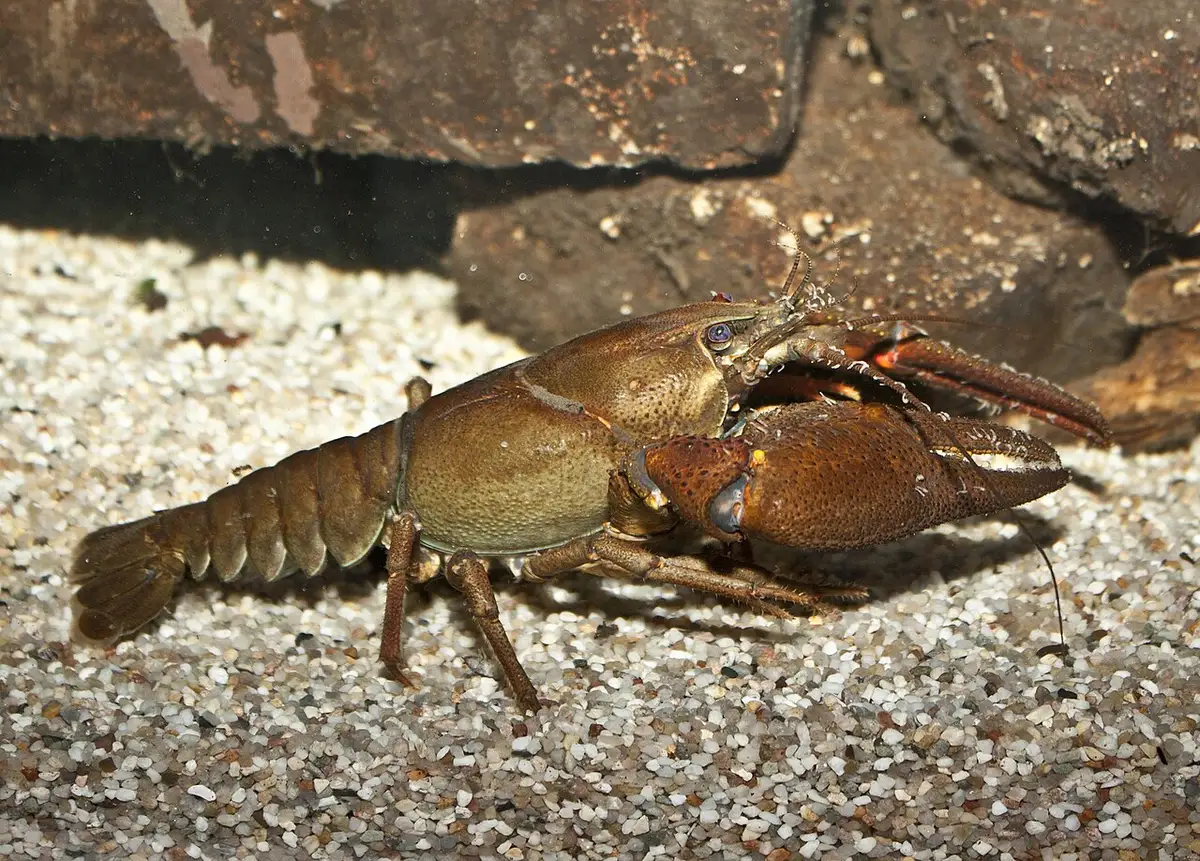
Photo: Dragon187, CC BY-SA 3.0, source. Resized.

Insects: three regions, six legs, wings
An insect’s body has three regions: head, thorax and abdomen. On the head are a pair of antennae, two compound eyes and simple eyes. The thorax carries three pairs of legs and, in most adult insects, two pairs of wings. The honeybee (Apis mellifera) and the ladybird are examples.
Insects breathe through tracheae, branching tubes that carry air straight to the tissues and open to the outside through small holes, the spiracles. Wastes are removed by the Malpighian tubules.
Many insects go through complete metamorphosis: egg, larva, pupa, adult. The larva looks completely different from the adult, as a caterpillar does from a butterfly. Butterflies, beetles, flies and ants develop this way. Other insects, such as crickets and cockroaches, have incomplete metamorphosis: the egg hatches into a larva called a nymph, which resembles the adult but has no wings, and grows gradually through a series of moults.
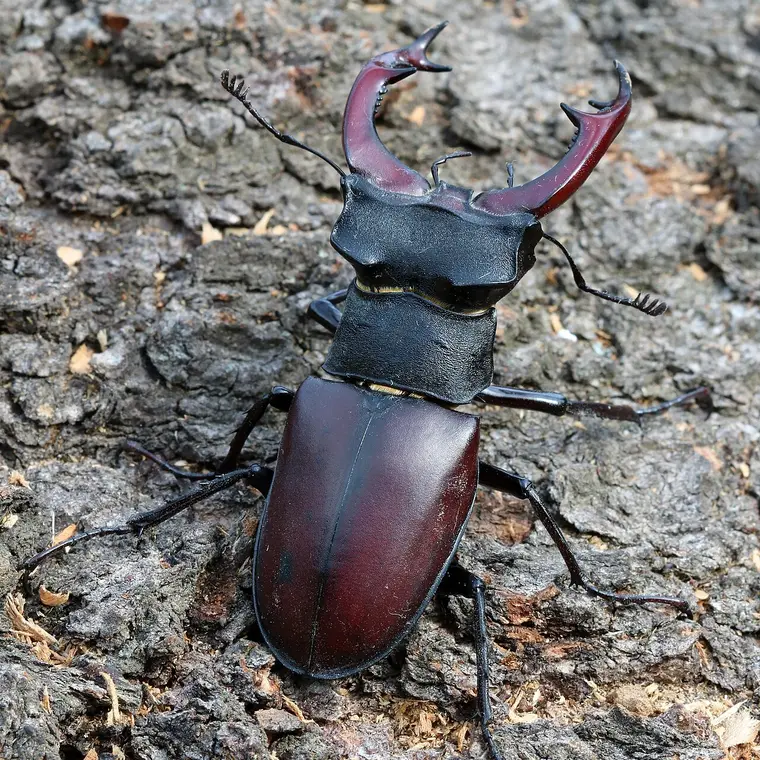
Photo: George Chernilevsky, Public domain, source. Cropped and resized.

Why arthropods matter
Insects pollinate plants: about 75% of the types of food crops depend to some extent on pollinators, especially bees and other insects. Arthropods break down organic remains and are food for fish, birds and mammals. Small crustaceans are at the base of many food chains in water. Some insects are crop pests, and some arthropods, such as ticks and mosquitoes, transmit the agents of certain diseases.
Worked example
A three-question identification key
You have a small animal with a hard covering and jointed legs. Answer three questions in turn.
Question 1: does it have antennae? If it has no antennae and has four pairs of legs, it is an arachnid.
Question 2: does it have two pairs of antennae and breathe through gills? Then it is a crustacean.
Question 3: does it have one pair of antennae, three pairs of legs and a body divided into head, thorax and abdomen? Then it is an insect.
Try it at home or in the school grounds: put a ladybird or an ant in a clear jar, look at it with a magnifying glass, count the legs and the body regions, then let it go where you found it. Watch out for the stage: a tick larva has only three pairs of legs and is still an arachnid, and a caterpillar does not look like an adult insect. The key is reliable for adults.
In Romania
The honeybee and the stag beetle
Romania has one of the largest populations of honeybees in the European Union. In 2023 there were 1,714,000 hives on farms in Romania, second only to Italy, which had almost 1.9 million, according to Eurostat data. Across the whole Union there were 9.4 million hives on farms. The statistics count only hives on farms, so the real number is higher.
The stag beetle (Lucanus cervus) is a large beetle that lives in oak forests in hilly areas. The female lays her eggs in cracks in the bark and in the roots of dead trees, and the larvae feed on rotting wood for up to five or six years before becoming adults, which can be seen from April to September. It is a species of Community interest (Annex II of the EU Habitats Directive), for which Natura 2000 sites are designated, and in Romania’s alpine region its conservation status is considered unfavourable. Dead wood left in the forest is food for its larvae.
In short
- Arthropods have a segmented body, jointed legs and an exoskeleton that contains chitin; they grow by moulting and have an open circulatory system.
- Arachnids (the European garden spider, the scorpion, the tick) have a cephalothorax and an abdomen, four pairs of legs, chelicerae and no antennae; they breathe with book lungs or tracheae.
- Crustaceans (the noble crayfish, the crab) have a cephalothorax covered by a carapace, two pairs of antennae and breathe through gills; the crayfish has five pairs of walking legs, the first with pincers.
- Insects have a head, thorax and abdomen, one pair of antennae, three pairs of legs and, usually, two pairs of wings; they breathe through tracheae.
- Complete metamorphosis has four stages (egg, larva, pupa, adult); in incomplete metamorphosis, the nymph resembles the adult and grows through a series of moults.
- Arthropods pollinate, break down remains and feed other animals; some are pests or transmit the agents of certain diseases.
Common mistakes
WrongA spider is an insect.
RightA spider is an arachnid: its body has two regions, it has four pairs of legs and no antennae. Insects have three regions, three pairs of legs and one pair of antennae.
WrongA crayfish grows little by little, along with its shell.
RightThe shell does not grow. The crayfish grows only after moulting, while the new covering is still soft.
WrongThe caterpillar and the butterfly are two different animals.
RightThe caterpillar is the butterfly’s larva. Through complete metamorphosis, the larva becomes a pupa, and the adult butterfly emerges from the pupa.
Check yourself
Seven questions. For the first six you see the explanation at once, with the paragraph of the lesson that supports it; for the written ones you compare with a good answer.
Why does an arthropod have to moult in order to grow?
Answer
a) Because the exoskeleton does not grow along with it. The chitin exoskeleton is rigid. The animal sheds it, grows while the new covering is soft, and then the new covering hardens.
An animal has a body with two regions, four pairs of legs and no antennae. Which group does it belong to?
Answer
c) Arachnids. Two regions (cephalothorax and abdomen), four pairs of legs and no antennae are features of arachnids.
On a leaf you find a very small tick with only three pairs of legs. What is it?
Answer
b) A tick larva, so still an arachnid. A tick larva has three pairs of legs; the nymph and the adult have four. The leg count only makes sense once you know the stage.
In 2023, Romania had 1,714,000 hives on farms, and the European Union had 9.4 million. What percentage of the hives on the Union’s farms were in Romania? Round to a whole number.
%Answer
18 %. 1,714,000 ÷ 9,400,000 × 100 ≈ 18.2%, which is about 18%.
Put the stages of a butterfly’s complete metamorphosis in order.
Answer
The correct order:
- Egg
- Larva (caterpillar)
- Pupa
- Adult (butterfly)
In complete metamorphosis, the larva does not resemble the adult; the transformation takes place in the pupa stage.
Choose the class of each arthropod.
Answer
Arachnids: European garden spider; Tick.
Crustaceans: Noble crayfish; Crab.
Insects: Honeybee; Stag beetle.
The spider and the tick have four pairs of legs and no antennae; the crayfish and the crab have two pairs of antennae and gills; the honeybee and the stag beetle have three pairs of legs and one pair of antennae.
A fruit grower sprays trees in blossom with a substance that kills every insect that touches the flowers. Explain what may happen to the apple harvest in autumn.
A good answer
Bees and other insects visit apple blossom and carry pollen from one flower to another. If the insects die, many flowers stay unpollinated and do not turn into fruit, so the harvest falls. The apple is one of the crops that depend to some extent on pollinators. Bees from nearby hives may die too.
A complete answer names pollination, the link between a pollinated flower and a fruit, and the effect on bees.
Practical work for this lesson
- Identify the example and keep the exception – Case study on characters, 30–35 minutes
Terms
- exoskeleton
- An outer skeleton that covers an arthropod’s body, protects it and reduces water loss.
- chitin
- A hard, tough substance in the exoskeleton of arthropods.
- moulting
- The periodic shedding of the old exoskeleton, which allows an arthropod to grow.
- cephalothorax
- A body region made of the head and thorax joined together, in arachnids and crustaceans.
- chelicerae
- The first pair of appendages of arachnids, used to grab food; in spiders they have venomous fangs.
- tracheae
- Branching tubes through which air reaches an insect’s tissues directly.
- complete metamorphosis
- Development in four stages, egg, larva, pupa and adult, in which the larva does not resemble the adult.
- incomplete metamorphosis
- Development in which the nymph resembles the adult, has no wings and grows gradually through a series of moults.
Sources and link to the programme
- OpenStax – Biology 2e, 28.6 Arthropods – jointed legs, chitin exoskeleton, moulting, protection against drying out, segments joined into regions, open circulatory system, over a million described species, insects the largest class; chelicerates without antennae, chelicerae and pedipalps, venomous fangs, blood-feeding ticks and mites, book lungs; mostly aquatic crustaceans, cephalothorax, two pairs of antennae, gills, compound eyes; insects with three regions, three pairs of legs, one pair of antennae, wings on the thorax, Malpighian tubules, tracheae; complete metamorphosis in ants, beetles, flies, butterflies and incomplete in cockroaches and crickets; role as pollinators
- OpenStax – Concepts of Biology, 15.3 Flatworms, Nematodes, and Arthropods – tracheae opening through spiracles, book lungs like the pages of a book, the thorax carries the wings and three pairs of legs, exoskeleton replaced as the animal grows
- Animal Diversity Web – Araneus diadematus – four pairs of legs, cross-shaped spots, circular web, diet of arthropods, females 6.5–20 mm
- Animal Diversity Web – Arachnida – two body regions, tracheae or book lungs, spinnerets for silk in spiders
- ECDC – Ixodes ricinus, factsheet for experts – four stages (egg, larva, nymph, adult), larvae with three pairs of legs, nymphs and adults with four, feeding on blood, transmits the agents of Lyme disease and tick-borne encephalitis
- Lander University, Invertebrate Anatomy OnLine – Procambarus (racul) – two pairs of antennae, cephalothorax covered by a carapace, five pairs of walking legs with the first pair bearing pincers, gills attached at the base of the legs under the carapace, tail fan for swimming backwards, compound eyes on stalks, moulting
- FAO – Global Action on Pollination Services for Sustainable Agriculture – about 75% of the types of food crops depend on pollinators
- FAO Newsroom – Bee-ing grateful to our pollinators – apples are among the crops that depend on pollinators
- Eurostat (20 May 2026) – EU beehives up to record 9.4 million – 2023: 9.4 million hives on EU farms; Italy almost 1.9 million, Romania 1.7 million; only hives on farms are counted
- Agerpres (20 May 2026) – Italia și România pe primele locuri în UE la numărul de stupi – the exact figure for Romania according to Eurostat: 1.714 million hives in 2023, compared with 1.470 million in 2020
- LIFE ROSALIA (Romania) – Lucanus cervus – oak forests in hilly areas, eggs in bark cracks and in the roots of dead trees, larvae feeding on rotting wood for up to five or six years, adults visible from mid-April to September, Annex II of the Habitats Directive, unfavourable-bad status (U2) in Romania’s alpine biogeographical region
From the programme: “Animals. Invertebrates: sponges, cnidarians (coelenterates), worms (flat, round, segmented), molluscs (snails, bivalves, cephalopods), arthropods (arachnids, crustaceans, insects) - general characteristics – comparative overview (morphology, nutrition, relation, reproduction), examples of representative species, habitats, importance in ecosystems” (common core). Specific competences addressed: 1.1, 1.2, 2.2, 3.1.