Chapter 7 · PlantsLesson 7.1
Red algae and green algae: bodies without roots, stems or leaves
If an alga is red, does it still photosynthesise? And what exactly is the green film on the shady side of a tree?
- Size
- from 1 mm to 62.5 m
- Level
- organism
- Time
- hundreds of millions of years
Before you read: what do you think?
How deep have red algae been found in clear tropical seas?
See the answer
Below 250 m: red algae have been found at a depth of 260 m. Like all algae they have chlorophyll, but they also have a red pigment, phycoerythrin, which absorbs green and blue-green light, the light chlorophyll uses poorly.
After a storm, the beach at Constanța, on the Black Sea, is left with heaps of soft green algae, like lettuce leaves. On the shady side of a lime tree in the schoolyard there is a green powder that comes off on your finger. Both are green algae, and both make their own food from light, water and carbon dioxide.
A body called a thallus
An alga’s body is a single cell, cells joined in threads, or cells forming a flat blade. However large it grows, it has no roots, stem or leaves, and no conducting vessels. A body like this is called a thallus. An alga on a rock can hold on by an anchoring part that grips like a root, without having a root’s structure.
Algae live in fresh water, in salt water or in damp places on land. The water holds their body up and brings them mineral salts, so they need no tissues for support or transport.
“Algae” is a school group: a name used for simple photosynthetic organisms that live mostly in water. It is not a branch of the tree of life: green algae are close relatives of land plants, while red algae form a separate branch.
Green algae: the same pigments as land plants
Green algae have chlorophyll a and b and yellow-orange pigments (carotenoids), the same as land plants. They store food as starch and have a cell wall containing cellulose. They make their own organic substances by photosynthesis: they are autotrophic organisms.
Chlamydomonas is a single-celled, pear-shaped green alga with two flagella and a light-sensitive red eyespot, which it uses to swim towards light. Pleurococcus is the green powder on shady tree trunks and walls: tiny cells stuck together by a mucilage that holds them in place. Water silk (Spirogyra) forms slimy green masses in ponds, made of threads of cells placed end to end, each with one or more chloroplasts twisted into a spiral. Sea lettuce (Ulva) has a broad multicellular thallus, like a sheet. Chlorella is a single-celled green alga, spherical, without flagella and smaller than a hundredth of a millimetre, used in photosynthesis research and as a food supplement.
Green algae reproduce asexually, by fragmentation of the thallus or by spores, and sexually, by the fusion of gametes. In water silk, two threads lying side by side join up through bridges, and the contents of one cell pass into the neighbouring cell: this kind of reproduction is called conjugation.
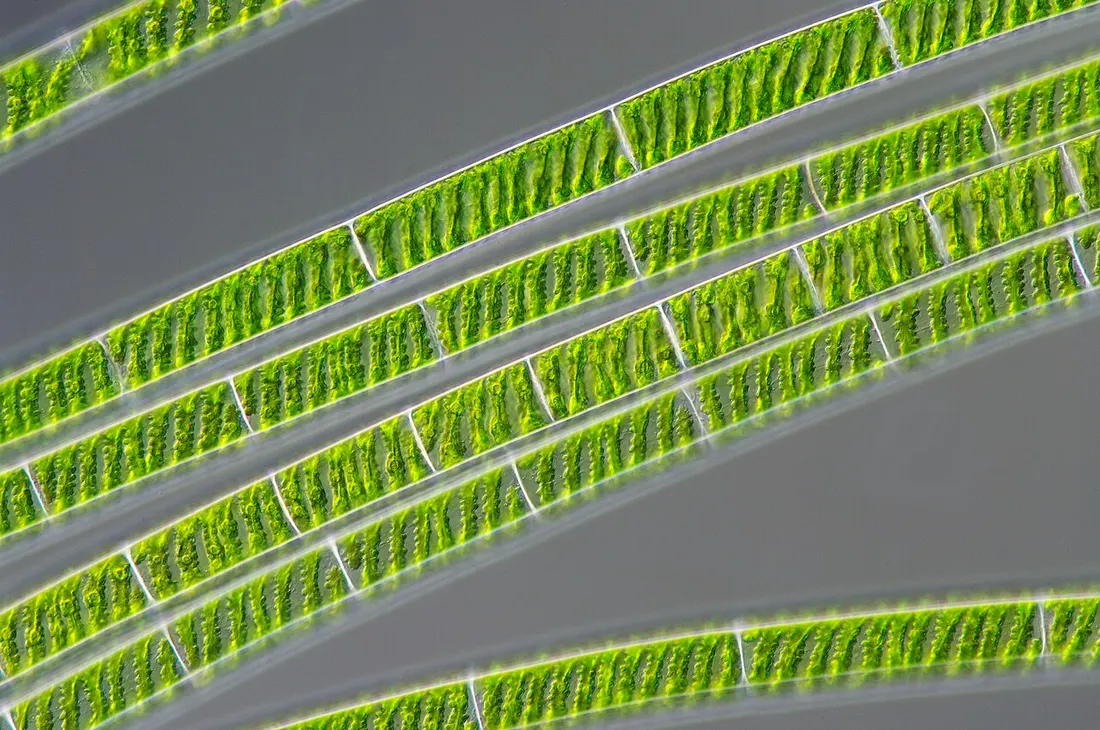
Photo: Wiedehopf20, CC BY-SA 4.0, source. Resized.

Red algae: red outside, green inside
Red algae have chlorophyll too, but a red pigment called phycoerythrin masks the green. Phycoerythrin absorbs green and blue-green light, which chlorophyll uses poorly. Red algae have been found at great depths, down to 260 m in clear tropical seas; others live in fresh water or on land. They have no flagella at any stage of their life.
Examples: Porphyra, with a thin thallus, from which the dried seaweed sheets used for sushi are made; Ceramium, with fine branches, common on stones in the Black Sea; Phyllophora, which can cover large stretches of the seabed. From the cell walls of some red algae (Gelidium, Gracilaria) comes agar, a substance that sets like jelly and on which bacteria are grown in microbiology laboratories.
What algae do in an ecosystem
Algae are producers: they make organic matter from mineral substances and release oxygen. Snails, crustaceans, larvae and fish feed on them, and large thalli shelter small animals. When water receives too many nutrients from farming and sewage, some fast-growing green algae multiply out of control; after they die, their decomposition uses up the oxygen in the water.
Worked example
How much the seaweed flora of the coast has changed
Researchers at the “Grigore Antipa” National Institute for Marine Research and Development in Constanța compared the lists of algae and marine plants on the Romanian coast. By the early 1960s, 162 species had been described. In the 1960s, 85 could still be identified, and in 2012 only 30 were reported.
The difference from the original list: 162 − 30 = 132 species. As a percentage: 132 ÷ 162 × 100 ≈ 81%. In 2012, 30 species were reported, against the 162 described up to the 1960s.
The survivors are mostly short-lived, fast-growing algae such as sea lettuce (Ulva), Cladophora and Ceramium, which cope well with changes in salinity and with nutrient-laden water. The number of species “found” also depends on how many samples were taken, so the drop shows a trend, not a complete inventory.
In Romania
The algae of the coast and Zernov’s field of red algae
On the stones and breakwaters of the Romanian coast today, the main algae are sea lettuce (Ulva rigida and Ulva intestinalis), Cladophora and red algae of the genus Ceramium. Storm waves tear them off and throw them onto the beach, where they pile up in summer.
On the north-western shelf of the Black Sea, north of the mouths of the Danube, there was once a huge field of red algae: the Phyllophora field described in 1909 by the biologist Zernov. The algae covered more than 10,000 km², down to a depth of 70 m. In the 1970s and 1980s, nutrient-laden water caused blooms of microscopic algae that shaded the seabed, and the lack of oxygen at depth destroyed almost the whole field.
After 1990, the amount of nutrients fell. In 2008, Phyllophora was back over much of its former area, but it covered at most 13.3% of the seabed, against 100% in 1966.
In short
- The body of an alga is a thallus: it has no roots, stem, leaves or conducting vessels; it can be single-celled, made of threads or shaped like a blade.
- Green algae have chlorophyll a and b, store starch and are close relatives of land plants; examples: Chlamydomonas, Chlorella, Pleurococcus, water silk, sea lettuce.
- Red algae have chlorophyll and phycoerythrin, a red pigment that absorbs green and blue-green light; examples: Porphyra, Ceramium, Phyllophora.
- Algae are autotrophic: they make organic substances by photosynthesis and release oxygen.
- Algae reproduce by fragmentation, by spores and sexually; in water silk, sexual reproduction is called conjugation.
- Algae are producers in water and give animals food and shelter, and agar is extracted from some red algae.
Common mistakes
WrongRed algae don’t photosynthesise, because they aren’t green.
RightRed algae have chlorophyll, but the red pigment phycoerythrin masks it. They photosynthesise, and phycoerythrin absorbs green light, which chlorophyll uses poorly.
WrongThe part sea lettuce uses to hold on to a stone is a root.
RightIt is an anchoring part of the thallus. It has no conducting vessels and does not take up water the way a root does; algae have no roots, stems or leaves.
WrongGreen algae are all microscopic.
RightSome are single-celled, like Chlamydomonas, but sea lettuce has a thallus the size of your palm or bigger, and water silk forms masses you can see in ponds.
Check yourself
Seven questions. For the first six you see the explanation at once, with the paragraph of the lesson that supports it; for the written ones you compare with a good answer.
Why can a red alga photosynthesise?
Answer
b) Because it has chlorophyll, masked by the red pigment phycoerythrin. The red colour comes from phycoerythrin, which masks chlorophyll without replacing it.
What is a thallus?
Answer
d) A body with no roots, stem, leaves or conducting vessels. The body of an alga, single-celled or multicellular, is not divided into organs and has no vessels.
Which algae are the closest relatives of land plants?
Answer
a) Green algae. Green algae have the same pigments (chlorophyll a and b), the same storage starch and the same cellulose wall as land plants.
What is the name of sexual reproduction in water silk, in which the contents of one cell pass into a cell of a neighbouring thread?
Answer
c) Conjugation. Fragmentation is asexual; pollination and double fertilisation happen in seed plants.
On the Romanian coast, 162 species of algae and marine plants had been described, and in the 1960s 85 were identified. By what percentage is the second total smaller than the first? Round to a whole number.
%Answer
48 %. 162 − 85 = 77 species; 77 ÷ 162 × 100 ≈ 47.5%, or about 48%.
Put each feature with the group of algae it belongs to.
Answer
Green algae: Chlorophyll a and b, no red pigment; Water silk; Some species have flagella.
Red algae: Phycoerythrin; Source of agar; Phyllophora.
Red algae have phycoerythrin, have no flagella and give agar; green algae have only chlorophyll a and b and carotenoids, and some, like Chlamydomonas, have flagella.
A seawater aquarium holds a green alga and a red alga. The aquarium is moved to a room where the light comes through green glass, which lets through almost nothing but green light. Which alga will have more light to use, and why?
A good answer
Besides chlorophyll, the red alga has phycoerythrin, which absorbs green light. The green alga has only chlorophyll a and b and carotenoids, and chlorophyll uses green light poorly: it reflects it, which is why leaves and the alga look green. Behind the green glass, the red alga can use a larger share of the light it receives.
A complete answer names phycoerythrin, says what light it absorbs and explains why chlorophyll uses green light poorly.
Terms
- thallus
- A body with no roots, stem, leaves or conducting vessels, like that of algae.
- phycoerythrin
- A red pigment of red algae that absorbs green and blue-green light and masks the colour of chlorophyll.
- autotroph
- An organism that makes its own organic substances from mineral substances, for example by photosynthesis.
- conjugation
- Sexual reproduction in which the contents of one cell pass into a neighbouring cell and fuse with it, as in water silk.
- agar
- A substance extracted from the cell walls of some red algae that forms a gel; it is used to grow bacteria in the laboratory.
- producer
- An organism that makes organic matter from mineral substances and forms the base of food chains.
Sources and link to the programme
- OpenStax – Biology 2e, 23.3 Groups of Protists (Archaeplastida) – red algae: phycoerythrin masks chlorophyll, no flagella, found at a depth of 260 m, agar from the cell wall used for bacterial media; Chlamydomonas single-celled with two flagella and an eyespot; Ulva multicellular; green algae as relatives of land plants
- OpenStax – Biology 2e, 25.2 Green Algae: Precursors of Land Plants – green algae have chlorophyll a and b and carotenoids like land plants, store starch, have a cellulose wall; asexual (fragmentation, spores) and sexual reproduction; Spirogyra filamentous, related to land plants
- Takano et al. (2019), Scientific Reports – Identification of 13 Spirogyra species by traits of sexual reproduction – Spirogyra lives in fresh water all over the world; sexual reproduction by conjugation
- Wikipedia – Phycoerythrin – phycoerythrin absorbs green and blue-green light (peaks at about 495 and 545–566 nm)
- Wikipedia – Chlorella – Chlorella: single-celled, spherical green alga without flagella, 2–10 µm; used as a food supplement and in research on CO₂ assimilation (Calvin)
- Oxford Botanic Garden – Plants 400: Pleurococcus – the green film on the shady side of trees and walls is the alga Pleurococcus; the cells stick together by a mucilage that holds them in place
- FAO – The seaweed industry – Porphyra (nori) as a food seaweed; agar extracted from Gelidium and Gracilaria
- INCDM „Grigore Antipa” – Nicolaev, Timofte, Zaharia (2012), Macrophytes from the Romanian littoral – 162 species described, 85 identified in the early 1960s, 30 in 2012; the remaining flora dominated by opportunistic species (Ulva, Cladophora, Ceramium), tolerant of changes in salinity and nutrients
- Analele Științifice ale Universității „Al. I. Cuza” Iași (2025) – Ulva species from the Romanian Black Sea coast – Ulva rigida and Ulva intestinalis are the quantitatively dominant species on the Romanian coast in recent years
- Stevens et al. (2019), Frontiers in Marine Science – Partial recovery of macro-epibenthic assemblages on the north-west Black Sea shelf – Zernov’s Phyllophora field: described in 1909, over 10,000 km², down to about 70 m; lost in the 1970s–1980s through eutrophication, shading and hypoxia; partial recovery, maximum cover 9% (2006) and 13.3% (2008) against 100% in 1966
From the programme: “Plants: red algae, green algae, mosses, ferns, gymnosperms, angiosperms – general features – comparative overview (morphology, nutrition, reproduction), examples of representative species, habitats, importance in ecosystems” (common core). Specific competences addressed: 1.1, 1.2, 2.1.