
Chapter 8 · AnimalsLesson 8.2
Worms: flat, round and segmented, free-living or parasitic
What do the earthworm in the garden, the planarian under the stones of a stream and the tapeworm in a human gut have in common, apart from a long body?
- Size
- from 1 mm to 30 m
- Level
- organism
- Time
- hundreds of millions of years
Before you read: what do you think?
The pork tapeworm lives in the human gut and can be between 2 and 7 metres long. How does it feed?
See the answer
It absorbs food through the surface of its body. The tapeworm has no gut at all: it lives surrounded by food the host has already digested and takes it in directly. Its head, the scolex, has suckers and hooks that hold it in place; it has no mouth.
The earthworm, the planarian and the tapeworm are all called worms, because they have a soft, long body. Inside, they are built very differently. The planarian and the tapeworm have a flat body and no cavity between the organs, the large roundworm has a gut with a mouth and an anus, and the earthworm’s body is divided into dozens of almost identical rings.
Three germ layers and a left half
Unlike cnidarians, worms are triploblastic: their body forms from three germ layers. The middle layer gives rise to the muscles and many internal organs. They have bilateral symmetry: a single plane divides the body into two halves, left and right, like mirror images. They have a front end, where nerve cells and sense organs are concentrated, and a back end.
‘Worms’ is a school name for three different phyla: flatworms, roundworms and segmented worms. The long shape arose separately in each of them. Many worms are free-living; only some species are parasites.
Flatworms: the planarian, the tapeworm, the liver fluke
Flatworms have a flattened body and no cavity between the body wall and the organs. They have no circulatory or respiratory system: oxygen reaches the cells by diffusion, which is why the body stays thin. Wastes are removed by flame cells. Most are hermaphrodites.
The planarian (genus Dugesia) lives freely in fresh water, under stones. It is a predator, with two simple eyes at the front and a branched digestive cavity with a single opening. A piece cut from it regrows its head or tail.
The pork tapeworm (Taenia solium) lives in the human small intestine. On the scolex, its tiny head, it has four suckers and a crown of hooks. The rest of the body is a chain of about 1,000 proglottids, segments full of reproductive organs and, towards the end, of eggs. It has no gut. The eggs leave the human body in the faeces, and pigs swallow them with dirty food. Larvae enclosed in cysts form in the pig’s muscles, and people become infected by eating raw or undercooked pork.
The liver fluke (Fasciola hepatica) is up to 3 cm long and lives in the bile ducts of the liver in sheep and cattle, sometimes in people. Its larvae develop in a water snail, then become enclosed in cysts on water plants, from where they are eaten along with the grass.
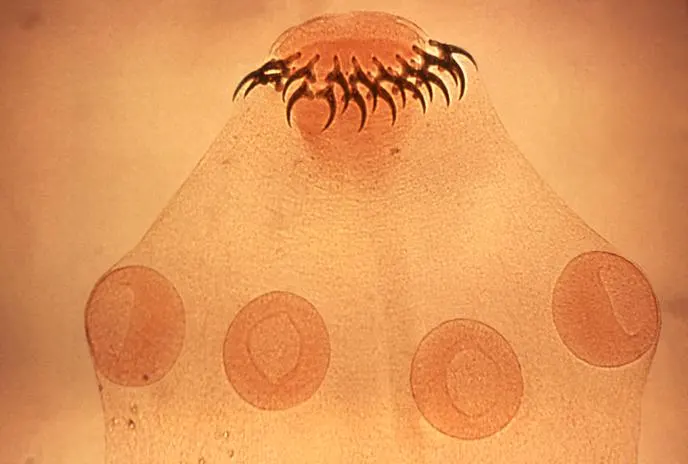
Photo: CDC, Public Health Image Library (ID 5262), Public domain, source. Unchanged.

Roundworms: the large roundworm, the threadworm, the trichina worm
Roundworms, or nematodes, have a body that is round in cross-section, unsegmented and covered by a cuticle, which they moult as they grow. They have a complete gut, with a mouth at one end and an anus at the other. In most species the sexes are separate. Over 28,000 species have been described, many of them free-living in soil and water.
The large roundworm (Ascaris lumbricoides) lives in the human gut; the female is 20–35 cm long. The eggs leave in the faeces and become infective after a few weeks in the soil. People become infected by swallowing eggs from unwashed vegetables or dirty hands.
The threadworm (Enterobius vermicularis) is up to 13 mm long. At night the female leaves the gut and lays her eggs on the skin around the anus, where they cause itching. The eggs get onto hands, underwear and objects, and the infection is found mostly in children.
Adult trichina worms (Trichinella spiralis) live in the gut, and the female is just 2.2 mm long. Their larvae migrate into the muscles and become enclosed in cysts. People become infected by eating raw or undercooked pork or wild boar meat.
Segmented worms: the earthworm and the leech
The body of the earthworm (Lumbricus terrestris) is divided into segments, the rings you can see from outside. Each segment has four pairs of chaetae, short bristles the earthworm uses to grip the walls of its burrow. It has a fluid-filled body cavity, circular and longitudinal muscles and a closed circulatory system, with five pairs of pulsing vessels. It breathes through its moist skin and dies if its skin dries out.
The earthworm is a hermaphrodite, but it mates with another earthworm and exchanges sperm with it. The eggs develop in a cocoon made by the clitellum, the thickened band near the front of the body. By burrowing and swallowing soil, earthworms loosen the soil, aerate it, help water soak in and mix plant remains into it.
Leeches have suckers at both ends. Many feed on blood, as the medicinal leech (Hirudo medicinalis) does.
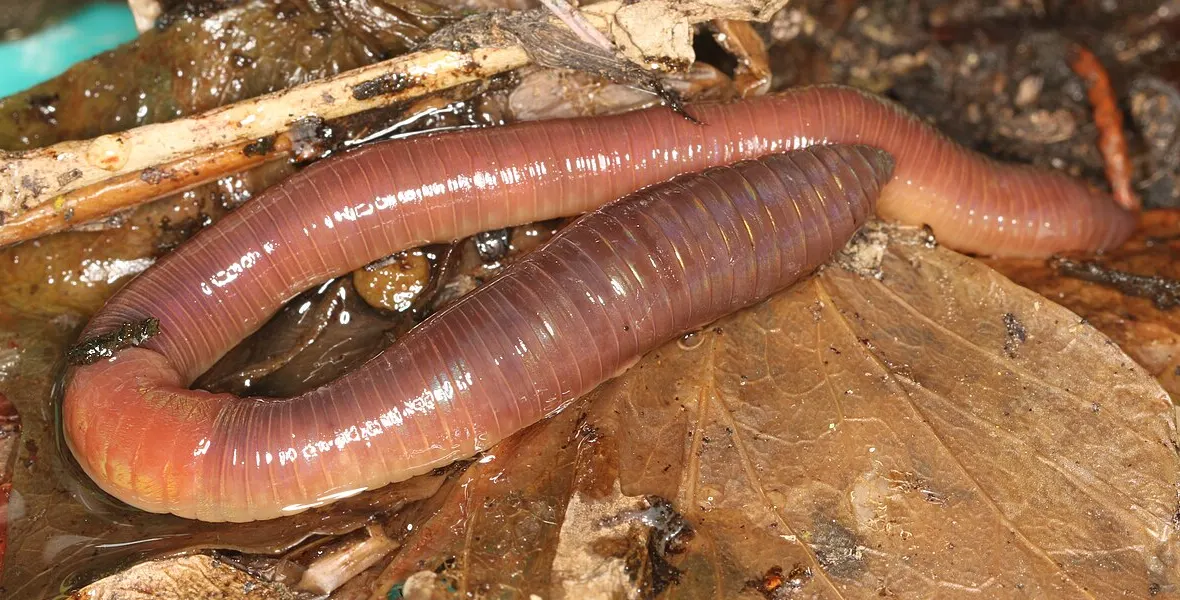
Photo: Donald Hobern, CC BY 2.0, source. Cropped and resized.

Adaptations to parasitism, and prevention
Parasitic worms have organs for attachment (suckers, hooks), coverings that resist digestive enzymes and huge numbers of eggs. Some have no gut, and many have an intermediate host, in which the larvae live, and a definitive host, in which the adult lives. Infection is prevented by hand-washing, well-washed vegetables, safe drinking water, and meat that has passed veterinary inspection and is well cooked. When signs of illness appear, it is for a doctor to decide.
Worked example
How many eggs a large roundworm lays
A female large roundworm can lay about 200,000 eggs a day. How many eggs can she lay in a week?
Step 1: multiply the number of eggs per day by the number of days: 200,000 × 7 = 1,400,000 eggs.
Step 2: interpret the result. The eggs are not infective straight away; they need a few weeks in warm, moist soil. That is why the large roundworm spreads where faeces reach the soil and vegetables grown in that soil are eaten unwashed.
This is a sample calculation using the maximum value given by the source, not a number measured in a particular patient. The calculation shows why a huge number of eggs is an adaptation to parasitism: the species survives even if, out of millions of eggs, very few reach a new host.
In Romania
The trichina worm and the pig slaughtered at home
Romania recorded 57 cases of trichinellosis in 2024, 31 in 2023 and 16 in 2022, according to the Health Statistics Yearbook of INSP, Romania’s public health institute. In the past the disease was far more common: between 1986 and 2007, of 56,912 cases reported in Europe, 28,564 were in Romania, most of them in the 1990s.
In an infectious diseases hospital in Transylvania, the source of infection was known for 524 patients: for 92% it was meat from pigs raised at home, for the rest wild boar meat. Pigs slaughtered at home do not go through the veterinary inspection of abattoirs, which is why INSP recommends sending a meat sample to an authorised veterinary centre for trichinoscopy, an examination under the microscope, and eating the meat only after a negative result.
Salting, smoking and drying do not reliably kill trichina larvae, and freezing may not kill them in game meat. The meat must be cooked through, to above 71 °C throughout; a food thermometer shows whether it has reached this temperature.
In short
- Worms are triploblastic and have bilateral symmetry; ‘worms’ is a school group that brings together three phyla: flatworms, roundworms and segmented worms.
- Flatworms have a flattened body with no cavity and no circulatory system; the planarian is free-living, while the tapeworm (a scolex with suckers and, in the pork tapeworm, hooks; proglottids; no gut) and the liver fluke are parasites.
- Roundworms have an unsegmented body with a cuticle and a complete gut, with a mouth and an anus; the large roundworm, the threadworm and the trichina worm are human parasites.
- Segmented worms have a segmented body; the earthworm has chaetae and a closed circulatory system, breathes through its skin, is a hermaphrodite and loosens the soil.
- Parasites have attachment organs, many eggs and often an intermediate host; infections are prevented by hygiene, washed vegetables, and meat that has passed veterinary inspection and is well cooked.
Common mistakes
WrongAll worms are parasites.
RightThe earthworm, the planarian and many soil nematodes are free-living. Parasitism is a way of life of some species, not a feature of all worms.
WrongIf you cut an earthworm in two, you get two earthworms.
RightThe earthworm reproduces sexually, through eggs laid in a cocoon. Regeneration from small pieces is typical of the planarian, a flatworm.
WrongSalted or smoked meat no longer has trichina in it.
RightSalting, smoking and drying do not reliably kill trichina larvae. Pork from a pig raised at home is tested first, and then cooked through, to above 71 °C throughout.
Check yourself
Seven questions. For the first six you see the explanation at once, with the paragraph of the lesson that supports it; for the written ones you compare with a good answer.
How does a large roundworm differ from a tapeworm?
Answer
a) The roundworm has a complete gut, with a mouth and an anus; the tapeworm has no gut. The large roundworm is a nematode, with a gut running from mouth to anus. The tapeworm is a flatworm that absorbs food through the surface of its body; the pork tapeworm has a scolex with suckers and hooks.
Why does an earthworm die if it stays a long time on dry tarmac in the sun?
Answer
a) Because it breathes through its skin, which has to stay moist. The earthworm has no special breathing organs; gases pass through its moist skin. Dry skin stops gas exchange.
How do people become infected with the trichina worm?
Answer
b) By eating raw or undercooked pork or wild boar meat. Trichina larvae sit enclosed in cysts in the animal’s muscles. People swallow them with meat that has not been cooked enough.
A female large roundworm lays about 200,000 eggs a day. How many million eggs can she lay in 30 days?
millionAnswer
6 million. 200,000 × 30 = 6,000,000 eggs, that is, 6 million.
Put the stages in the life cycle of the pork tapeworm in order.
Answer
The correct order:
- A person with a tapeworm passes eggs and proglottids in their faeces.
- A pig swallows the eggs with dirty food.
- Larvae enclosed in cysts form in the pig’s muscles.
- A person eats raw or undercooked pork containing larvae.
- In the person’s gut, the larva attaches by its scolex and grows into an adult tapeworm.
People are the definitive host, in which the adult lives; the pig is the intermediate host, in which the larvae live. The cycle is broken by hygiene and by meat that has passed veterinary inspection and is well cooked.
Choose the group of each worm.
Answer
Flatworms: Planarian; Liver fluke.
Roundworms: Threadworm; Trichina worm.
Segmented worms: Earthworm; Leech.
The planarian and the liver fluke have a flattened body; the threadworm and the trichina worm are unsegmented nematodes with a cuticle; the earthworm and the leech have a body divided into segments.
In a vegetable garden, fresh manure mixed with human faeces is used as fertiliser, and the lettuce is eaten after only a quick rinse. Explain what risk arises and how it can be stopped, using what you know about the life cycle of the large roundworm.
A good answer
The faeces may contain large roundworm eggs, which become infective after a few weeks in the soil. The eggs stick to the lettuce leaves, and people swallow them if the lettuce is not washed well. The risk stops if human faeces do not reach the soil, if vegetables are washed well and if hands are washed after working in the garden.
A complete answer follows the path of the eggs (faeces, soil, vegetables, mouth) and suggests measures that break this path.
Terms
- triploblastic
- Describes an animal whose body forms from three germ layers.
- bilateral symmetry
- An arrangement of body parts such that a single plane divides the body into two halves, left and right, mirror images of each other.
- scolex
- The head of a tapeworm, with suckers and, in the pork tapeworm, hooks, by which it attaches to the gut wall.
- proglottid
- A segment of a tapeworm’s body, with reproductive organs; the proglottids at the end are full of eggs.
- cuticle
- The tough outer covering of roundworms, replaced by moulting as the animal grows.
- chaetae
- Short, stiff bristles on the earthworm’s segments, which it uses to grip as it moves.
- clitellum
- A thickened band near the front of an earthworm’s body, which makes the cocoon in which the eggs develop.
- intermediate host
- The organism in which a parasite’s larvae live; the adult lives in the definitive host.
Sources and link to the programme
- OpenStax – Biology 2e, 27.2 Features Used to Classify Animals – triploblastic, bilateral symmetry and cephalisation; acoelomate flatworms, pseudocoelomate nematodes, coelomate annelids
- OpenStax – Biology 2e, 28.3 Flatworms, Rotifers, and Nemerteans – flatworms: three germ layers, flat body because of diffusion, no circulatory or respiratory system, flame cells, hermaphrodites, predatory planarians with ocelli and regeneration, tapeworms with no gut, scolex and proglottids, intermediate host, flukes with a snail as host
- OpenStax – Biology 2e, 28.5 Nematodes and Tardigrades – nematodes: cuticle, moulting, complete gut, longitudinal muscles only, over 28,000 species, free-living forms in soil, Ascaris and Trichinella
- OpenStax – Concepts of Biology, 15.3 Flatworms, Nematodes, and Arthropods – scolex and proglottids in the tapeworm; nematodes with separate sexes in many species
- OpenStax – Biology 2e, 28.4 Mollusks and Annelids – annelids: segmentation, chaetae, clitellum, hermaphroditism with cross-fertilisation, cocoon, closed circulatory system, gas exchange through the skin, leeches with suckers at both ends, feeding on blood
- Lander University, Invertebrate Anatomy OnLine – Lumbricus terrestris – four pairs of chaetae per segment, clitellum and cocoon, hermaphrodite exchanging sperm, five pairs of contractile vessels, breathing through the epidermis, circular and longitudinal muscles
- Lander University, Invertebrate Anatomy OnLine – Dugesia – the planarian Dugesia, a free-living freshwater flatworm
- FAO – Earthworms (factsheet, Global Soil Partnership) – earthworms increase soil porosity and aeration, water infiltration and nutrient recycling
- CDC DPDx – Taeniasis – Taenia solium: 2–7 m, about 1,000 proglottids, scolex with four suckers and two rows of hooks, humans the definitive host, pigs the intermediate host, infection through raw or undercooked meat
- WHO – Taeniasis/cysticercosis (fact sheet) – the pork tapeworm’s life cycle; prevention: hygiene, food safety, meat inspection, raising pigs without free roaming
- CDC DPDx – Fascioliasis – Fasciola hepatica: up to 30 mm, in the bile ducts, hosts sheep and cattle, sometimes humans; larvae in water snails, cysts on aquatic plants
- CDC DPDx – Ascariasis – Ascaris lumbricoides: females 20–35 cm, about 200,000 eggs a day, eggs become infective in the soil after 18 days to several weeks
- WHO – Soil-transmitted helminth infections (fact sheet) – eggs reach the soil in faeces, mature in about 3 weeks, are swallowed from unwashed vegetables or from hands; prevention through hygiene education and sanitation
- CDC DPDx – Enterobiasis – Enterobius vermicularis: females 8–13 mm, eggs laid at night around the anus, itching, spread by hands, underwear and objects, mostly in children
- CDC DPDx – Trichinellosis – Trichinella: adults in the gut (females 2.2 mm, males 1.2 mm), larvae encysted in striated muscle, infection through undercooked meat, pigs and wild boar
- INSP, via DSP Gorj – Informare despre trichineloză (December 2025) – 57 cases in 2024, 31 in 2023, 16 in 2022 (Health Statistics Yearbook 2024, INSP); pigs raised at home do not go through veterinary inspection; trichinoscopy at authorised centres; salting, smoking and drying do not destroy the larvae; cooking to above 71 °C throughout the meat
- CDC – Preventing trichinellosis – salting, drying, smoking or microwaving do not consistently kill the worms; a food thermometer shows whether the safe temperature has been reached; freezing may not kill all the worms in game meat, because some resist freezing
- Retrospective Survey of Human Trichinellosis in a Romanian Infectious Diseases Hospital, Life 13 (2023), PMC – 1986–2007: 56,912 cases in Europe, 28,564 in Romania, mostly in 1990–1999; source known for 524 patients: domestic pork 92.37%, wild boar 7.63%; a hospital in Transylvania
From the programme: “Animals. Invertebrates: sponges, cnidarians (coelenterates), worms (flat, round, segmented), molluscs (snails, bivalves, cephalopods), arthropods (arachnids, crustaceans, insects) - general characteristics – comparative overview (morphology, nutrition, relation, reproduction), examples of representative species, habitats, importance in ecosystems” (common core). Specific competences addressed: 1.1, 1.2, 2.2.