Chapter 5 · The periodic tableLesson 5.2MI Mathematics–informatics (2 hours) · beyond your profile
Atomic radius; variation of atomic radius for elements in the main groups
Why atoms shrink across a period and ions differ in size from their atoms
Sodium loses an electron and chlorine gains one. Which ion is larger than the atom it came from, and by how much?
Before you read: what do you think?
A chlorine atom has a radius of 100 pm. It gains an electron and becomes a chloride ion, Cl⁻. What is the radius of the ion?
See the answer
The chloride ion has a radius of 181 pm, much greater than the atom’s 100 pm. The nucleus still has 17 protons, but there are 18 electrons, which repel one another and take up more space.
A crystal of table salt contains alternating sodium and chloride ions. The sodium ion is much smaller than the sodium atom, and the chloride ion is much larger than the chlorine atom. The distance between neighbouring ions in the crystal is measured with X-rays, and the ionic radii in tables were deduced from such distances.
What an atomic radius means
An atom’s electron cloud has no sharp edge, so its radius is defined through a measurement. The atomic radius (in these tables, the covalent radius) is half the distance between the nuclei of two identical bonded atoms. It is measured in picometres: 1 pm = 10⁻¹² m. An atom with a radius of 100 pm has a diameter of 200 pm, so about 5 million atoms would fit in a line one millimetre long (10⁹ ÷ 200 = 5·10⁶).
For the curious
Textbook values differ according to the type of radius. For sodium, one table gives a covalent radius of 160 pm, while the radius measured between unbonded atoms that just touch is 227 pm. Always use the same type of radius in a comparison.
Atoms shrink across a period
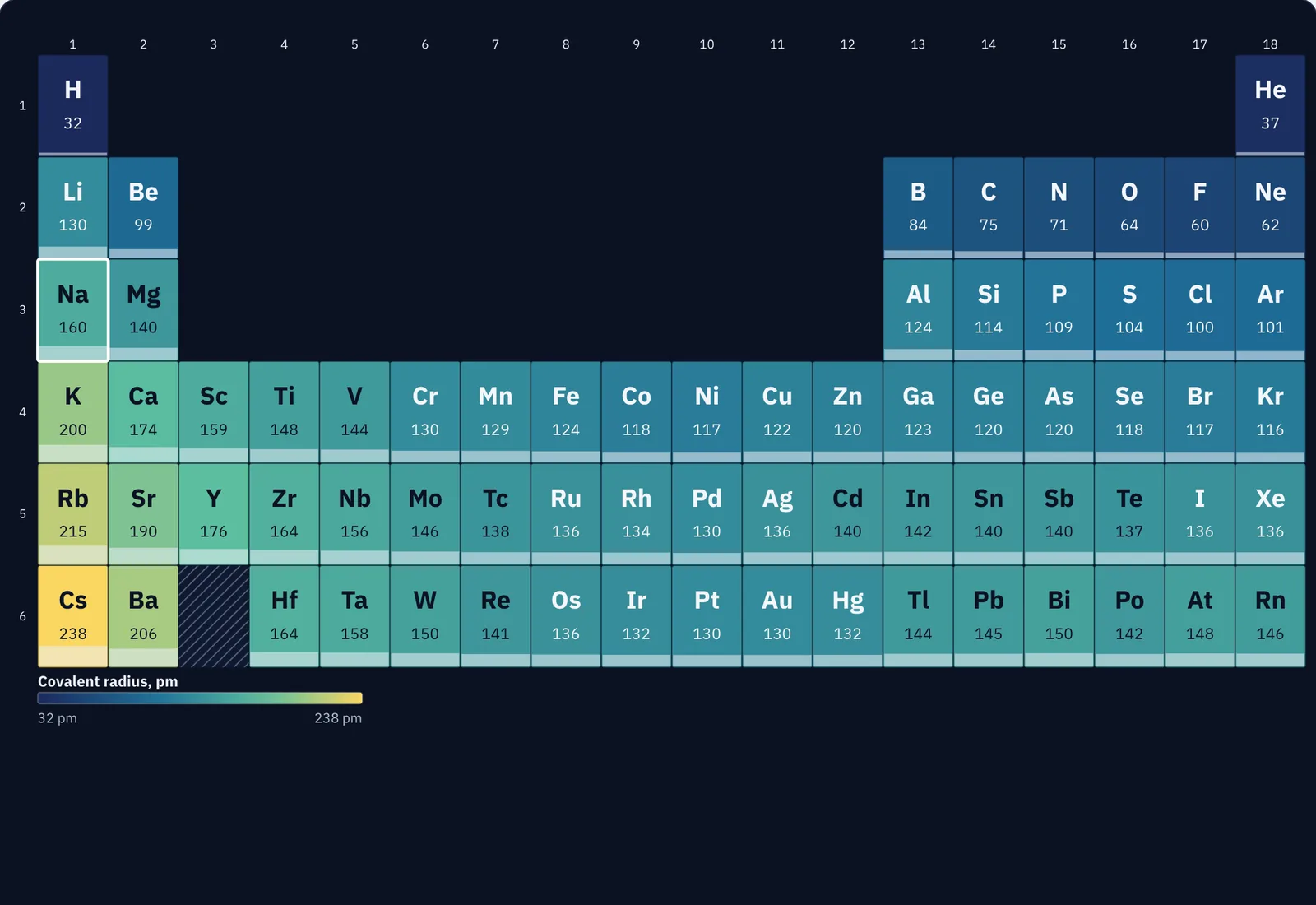
In period 3, atomic radius decreases from sodium to chlorine: Na 160 pm, Mg 140 pm, Al 124 pm, Si 114 pm, P 109 pm, S 104 pm, Cl 100 pm.
All these elements have three occupied shells. From one element to the next, the number of protons in the nucleus increases by one, and the new electron enters the same outer shell. Electrons in the same shell shield one another only a little, so the nucleus attracts the outer electrons more strongly. In a simplified model, the net attraction is the nuclear charge minus the number of inner electrons: for sodium 11 − 10 = 1+, and for chlorine 17 − 10 = 7+. The outer electrons are pulled closer to the nucleus and the atom shrinks.
Atoms grow down a group
In group 1, radius increases from lithium to caesium: Li 130 pm, Na 160 pm, K 200 pm, Rb 215 pm, Cs 238 pm. In group 17: F 60 pm, Cl 100 pm, Br 117 pm, I 136 pm.
A new shell appears at each step down the group. In the simplified model, the net attraction on the outer electron stays the same (for group 1 it is 1+: lithium 3 − 2, sodium 11 − 10, potassium 19 − 18), but the electron is in a more distant shell, and the inner shells take up more space too. The radius increases.
| Z | Symbol | Element | Period | Group | Covalent radius, pm | First ionisation energy, kJ/mol | Electronegativity (Pauling) |
|---|---|---|---|---|---|---|---|
| 1 | H | hydrogen | 1 | 1 | 32 | 1,312.0 | 2.20 |
| 2 | He | helium | 1 | 18 | 37 | 2,372.3 | – |
| 3 | Li | lithium | 2 | 1 | 130 | 520.2 | 0.98 |
| 4 | Be | beryllium | 2 | 2 | 99 | 899.5 | 1.57 |
| 5 | B | boron | 2 | 13 | 84 | 800.6 | 2.04 |
| 6 | C | carbon | 2 | 14 | 75 | 1,086.5 | 2.55 |
| 7 | N | nitrogen | 2 | 15 | 71 | 1,402.3 | 3.04 |
| 8 | O | oxygen | 2 | 16 | 64 | 1,313.9 | 3.44 |
| 9 | F | fluorine | 2 | 17 | 60 | 1,681.0 | 3.98 |
| 10 | Ne | neon | 2 | 18 | 62 | 2,080.7 | – |
| 11 | Na | sodium | 3 | 1 | 160 | 495.8 | 0.93 |
| 12 | Mg | magnesium | 3 | 2 | 140 | 737.8 | 1.31 |
| 13 | Al | aluminium | 3 | 13 | 124 | 577.5 | 1.61 |
| 14 | Si | silicon | 3 | 14 | 114 | 786.5 | 1.90 |
| 15 | P | phosphorus | 3 | 15 | 109 | 1,011.8 | 2.19 |
| 16 | S | sulfur | 3 | 16 | 104 | 999.6 | 2.58 |
| 17 | Cl | chlorine | 3 | 17 | 100 | 1,251.2 | 3.16 |
| 18 | Ar | argon | 3 | 18 | 101 | 1,520.6 | – |
| 19 | K | potassium | 4 | 1 | 200 | 418.8 | 0.82 |
| 20 | Ca | calcium | 4 | 2 | 174 | 589.8 | 1.00 |
| 21 | Sc | scandium | 4 | 3 | 159 | 633.1 | 1.36 |
| 22 | Ti | titanium | 4 | 4 | 148 | 658.8 | 1.54 |
| 23 | V | vanadium | 4 | 5 | 144 | 650.9 | 1.63 |
| 24 | Cr | chromium | 4 | 6 | 130 | 652.9 | 1.66 |
| 25 | Mn | manganese | 4 | 7 | 129 | 717.3 | 1.55 |
| 26 | Fe | iron | 4 | 8 | 124 | 762.5 | 1.83 |
| 27 | Co | cobalt | 4 | 9 | 118 | 760.4 | 1.88 |
| 28 | Ni | nickel | 4 | 10 | 117 | 737.1 | 1.91 |
| 29 | Cu | copper | 4 | 11 | 122 | 745.5 | 1.90 |
| 30 | Zn | zinc | 4 | 12 | 120 | 906.4 | 1.65 |
| 31 | Ga | gallium | 4 | 13 | 123 | 578.8 | 1.81 |
| 32 | Ge | germanium | 4 | 14 | 120 | 762.2 | 2.01 |
| 33 | As | arsenic | 4 | 15 | 120 | 944.5 | 2.18 |
| 34 | Se | selenium | 4 | 16 | 118 | 941.0 | 2.55 |
| 35 | Br | bromine | 4 | 17 | 117 | 1,139.9 | 2.96 |
| 36 | Kr | krypton | 4 | 18 | 116 | 1,350.8 | – |
| 37 | Rb | rubidium | 5 | 1 | 215 | 403.0 | 0.82 |
| 38 | Sr | strontium | 5 | 2 | 190 | 549.5 | 0.95 |
| 39 | Y | yttrium | 5 | 3 | 176 | 599.9 | 1.22 |
| 40 | Zr | zirconium | 5 | 4 | 164 | 640.1 | 1.33 |
| 41 | Nb | niobium | 5 | 5 | 156 | 652.1 | 1.6 |
| 42 | Mo | molybdenum | 5 | 6 | 146 | 684.3 | 2.16 |
| 43 | Tc | technetium | 5 | 7 | 138 | 702.4 | 2.10 |
| 44 | Ru | ruthenium | 5 | 8 | 136 | 710.2 | 2.2 |
| 45 | Rh | rhodium | 5 | 9 | 134 | 719.7 | 2.28 |
| 46 | Pd | palladium | 5 | 10 | 130 | 804.4 | 2.20 |
| 47 | Ag | silver | 5 | 11 | 136 | 731.0 | 1.93 |
| 48 | Cd | cadmium | 5 | 12 | 140 | 867.8 | 1.69 |
| 49 | In | indium | 5 | 13 | 142 | 558.3 | 1.78 |
| 50 | Sn | tin | 5 | 14 | 140 | 708.6 | 1.96 |
| 51 | Sb | antimony | 5 | 15 | 140 | 830.6 | 2.05 |
| 52 | Te | tellurium | 5 | 16 | 137 | 869.3 | 2.1 |
| 53 | I | iodine | 5 | 17 | 136 | 1,008.4 | 2.66 |
| 54 | Xe | xenon | 5 | 18 | 136 | 1,170.4 | 2.60 |
| 55 | Cs | caesium | 6 | 1 | 238 | 375.7 | 0.79 |
| 56 | Ba | barium | 6 | 2 | 206 | 502.8 | 0.89 |
| 72 | Hf | hafnium | 6 | 4 | 164 | 658.5 | 1.3 |
| 73 | Ta | tantalum | 6 | 5 | 158 | 728.4 | 1.5 |
| 74 | W | tungsten | 6 | 6 | 150 | 758.8 | 1.7 |
| 75 | Re | rhenium | 6 | 7 | 141 | 755.8 | 1.9 |
| 76 | Os | osmium | 6 | 8 | 136 | 814.2 | 2.2 |
| 77 | Ir | iridium | 6 | 9 | 132 | 865.2 | 2.2 |
| 78 | Pt | platinum | 6 | 10 | 130 | 864.4 | 2.2 |
| 79 | Au | gold | 6 | 11 | 130 | 890.1 | 2.4 |
| 80 | Hg | mercury | 6 | 12 | 132 | 1,007.1 | 1.9 |
| 81 | Tl | thallium | 6 | 13 | 144 | 589.4 | 1.8 |
| 82 | Pb | lead | 6 | 14 | 145 | 715.6 | 1.8 |
| 83 | Bi | bismuth | 6 | 15 | 150 | 702.9 | 1.9 |
| 84 | Po | polonium | 6 | 16 | 142 | 811.8 | 2.0 |
| 85 | At | astatine | 6 | 17 | 148 | – | 2.2 |
| 86 | Rn | radon | 6 | 18 | 146 | 1,037.1 | – |
| Germanium | Atomic mass | Density, g/cm³ |
|---|---|---|
| silicon (Si), neighbour | 28.085 | 2.33 |
| gallium (Ga), neighbour | 69.723 | 5.91 |
| arsenic (As), neighbour | 74.922 | 5.75 |
| tin (Sn), neighbour | 118.710 | 7.29 |
| Mean of the four neighbours (calculated) | 72.86 | 5.32 |
| Mendeleev, predicted in 1871 | 72 | 5.5 |
| Winkler, measured in 1886 | 72.3 | 5.469 |
| Today’s value | 72.630 | 5.323 |
| Ion | Ionic radius, pm (Shannon, coordination 6) |
|---|---|
| Li⁺ | 76 |
| Na⁺ | 102 |
| K⁺ | 138 |
| Rb⁺ | 152 |
| Cs⁺ | 167 |
| Mg²⁺ | 72 |
| Ca²⁺ | 100 |
| Al³⁺ | 53.5 |
| O²⁻ | 140 |
| S²⁻ | 184 |
| F⁻ | 133 |
| Cl⁻ | 181 |
| Br⁻ | 196 |
| I⁻ | 220 |
Table values and calculation. Values from tables: the covalent radius and the first ionisation energy are measured, and the Pauling electronegativity is a relative scale, deduced from bond energies; all three are those of the Royal Society of Chemistry table. The atomic masses are CIAAW. The ionic radii (Na⁺ 102 pm, Cl⁻ 181 pm) are the Shannon effective radii for six-fold coordination, deduced from the distances in crystals by a convention. Mendeleev’s prediction (1871) and Winkler’s measurement (1886) are the values printed in 1901; the mean of the four neighbours is a calculation done in front of you. A lighter colour means a larger value, and the height of the bar in the cell shows the same thing. Hatched cells have no value in the table. Melting point follows no simple rule and is not coloured here as a trend. The lanthanides and the seventh period are not in the picture.
Sources and credits. Covalent radius, first ionisation energy, Pauling electronegativity and density: values cited from the element pages of the Royal Society of Chemistry (periodic-table.rsc.org), consulted on 2026-11-16; cross-checked against the PubChem Periodic Table (NIST, a work of the US government). Atomic masses: CIAAW, abridged table 2024. Ionic radii: R. D. Shannon, Acta Crystallographica A32, 751 (1976), database of Imperial College London. Mendeleev (1871) and Winkler (1886): Popular Science Monthly, vol. 59 (1901), p. 162, public domain.
A cation is smaller than its atom, an anion larger
Sodium, 2,8,1, loses its outer electron and becomes Na⁺, 2,8: the ion has one fewer shell. The ionic radius of Na⁺ is 102 pm, compared with 160 pm for the atom. Magnesium (140 pm) forms Mg²⁺ at 72 pm, and aluminium (124 pm) forms Al³⁺ at 53.5 pm. A cation is smaller than the atom it came from: it has fewer shells, and the same nuclear charge attracts fewer electrons.
Chlorine, 2,8,7, gains an electron in the same shell and becomes Cl⁻, 2,8,8. The nucleus still has 17 protons, but there are 18 electrons, which repel one another: the radius reaches 181 pm, compared with 100 pm for the atom. An anion is larger than the atom it came from.
Atomic and ionic radii are obtained by different methods, so their difference shows the direction of change well, rather than an exact percentage.
Ions with the same number of electrons, different radii
The ions O²⁻, F⁻, Na⁺, Mg²⁺ and Al³⁺ each have ten electrons and the configuration 2,8. They are called isoelectronic ions. Their numbers of protons differ: 8, 9, 11, 12 and 13. For the same number of electrons, a nucleus with more protons pulls them in more strongly, so the radius decreases: O²⁻ 140 pm, F⁻ 133 pm, Na⁺ 102 pm, Mg²⁺ 72 pm, Al³⁺ 53.5 pm.
Worked example
Rank ions by radius
Put these ions in descending order of radius: Na⁺, Mg²⁺, F⁻, O²⁻, Al³⁺.
Step 1: count the electrons. Na⁺: 11 − 1 = 10. Mg²⁺: 12 − 2 = 10. F⁻: 9 + 1 = 10. O²⁻: 8 + 2 = 10. Al³⁺: 13 − 3 = 10. All the ions are isoelectronic, with the configuration 2,8.
Step 2: rank them by number of protons: O²⁻ has 8, F⁻ has 9, Na⁺ has 11, Mg²⁺ has 12, Al³⁺ has 13. The more protons, the smaller the radius, so O²⁻ > F⁻ > Na⁺ > Mg²⁺ > Al³⁺.
Check against the table: 140 > 133 > 102 > 72 > 53.5 (pm). Among these isoelectronic ions, the radius of Na⁺ exceeds that of Mg²⁺ by 102 − 72 = 30 pm, using values from the same measurement method.
In Romania
The radii of ions in salt from Praid
The Praid salt mine extracted rock salt, a rock made mainly of the mineral halite, which is crystallised sodium chloride; after the floods of May 2025, extraction is temporarily stopped. A cube of halite is a lattice of Na⁺ and Cl⁻ ions that touch. The edge of the sodium chloride unit cell measures 564.02 pm, so the distance between neighbouring Na⁺ and Cl⁻ ions is half that: 564.02 ÷ 2 = 282.01 pm.
The sum of the ionic radii in the table is 102 + 181 = 283 pm. The difference from the measured distance is 283 − 282.01 = 0.99 pm, less than 0.4%. For the cell edge, the radii give 2 · 283 = 566 pm, compared with the measured 564.02 pm: close values, though not identical. The agreement shows that the table is consistent with the measurement; it does not independently confirm it, because the ionic radii were deduced from distances of this kind.
In short
- Atomic radius is half the distance between the nuclei of two identical bonded atoms; it is measured in pm.
- Across a period, atomic radius decreases: the shells stay the same, but nuclear charge increases (Na 160 pm, Cl 100 pm).
- Down a group, atomic radius increases because a new shell appears (Li 130 pm, Cs 238 pm).
- A cation is smaller than the atom it came from (Na 160 pm, Na⁺ 102 pm); an anion is larger (Cl 100 pm, Cl⁻ 181 pm).
- For isoelectronic ions, radius decreases as the number of protons increases: O²⁻ > F⁻ > Na⁺ > Mg²⁺ > Al³⁺.
Common mistakes
WrongThere are more electrons across a period, so the atom grows.
RightThe number of protons also increases, and the new electrons enter the same shell. The nucleus attracts them more strongly, and the radius decreases from sodium (160 pm) to chlorine (100 pm).
WrongAn atom that gains an electron gets smaller because it becomes more “full”.
RightThe anion is larger than the atom: the nucleus stays the same, and the electrons repel one another. The chlorine atom has a radius of 100 pm, the chloride ion 181 pm.
WrongThe Na⁺ ion is the same size as the Na atom; only the charge differs.
RightThe Na⁺ ion has one fewer shell and a radius of 102 pm, compared with 160 pm for the atom.
Test yourself
8 questions. For the first 7 you see the explanation at once, with the paragraph of the lesson that supports it; for the written ones you compare with a good answer.
Which sequence puts the atomic radii in descending order?
Answer
a) Na > Mg > Al. In period 3, nuclear charge increases from Na to Al, while the outer electrons stay in the same shell, so the radius decreases.
Why does atomic radius increase from lithium to caesium?
Answer
b) Because a new shell appears at each step down the group. All group 1 elements have one valence electron and, in the simplified model, the same net attraction, but the electron is in an increasingly distant shell.
Which statement about chloride and sodium ions is correct?
Answer
c) Cl⁻ is larger than the chlorine atom, Na⁺ smaller than the sodium atom. Na⁺ loses a shell, while Cl⁻ gains an electron in the same shell, increasing the repulsion between electrons.
What do the ions O²⁻, F⁻, Na⁺, Mg²⁺ and Al³⁺ have in common?
Answer
c) The same number of electrons, ten. They all have the configuration 2,8, so they have ten electrons, but different numbers of protons (8, 9, 11, 12, 13), so their radii differ.
How many pm larger is the radius of Na⁺ (102 pm) than that of Mg²⁺ (72 pm)? Give your answer in pm as a whole number.
pmAnswer
30 pm. 102 − 72 = 30 pm. The two ions have the same ten electrons, but Mg²⁺ has 12 protons, compared with 11 in Na⁺.
The sum of the ionic radii of Na⁺ (102 pm) and Cl⁻ (181 pm) exceeds the measured Na⁺–Cl⁻ distance in the crystal, 282.01 pm. By how many pm? Round to one decimal place.
pmAnswer
1.0 pm. 102 + 181 = 283 pm, and 283 − 282.01 = 0.99 pm, or 1.0 pm to one decimal place.
Put the ions in descending order of radius, from largest to smallest.
Answer
The correct order:
- O²⁻
- F⁻
- Na⁺
- Mg²⁺
- Al³⁺
They have the same configuration, 2,8, but from oxygen to aluminium the number of protons increases from 8 to 13, and the radius decreases.
In a few sentences, explain why Mg²⁺ (72 pm) is smaller than Na⁺ (102 pm), even though both have ten electrons.
A good answer
Both ions have the configuration 2,8, so they have the same ten electrons in the same shells. Magnesium has 12 protons, sodium 11, so the magnesium nucleus attracts those ten electrons more strongly and pulls them closer. That is why Mg²⁺ has a smaller radius.
A complete answer states that the ions have the same number of electrons in the same shells, compares the numbers of protons (12 and 11), and concludes that the stronger attraction reduces the radius.
Terms
- atomic radius
- Half the distance between the nuclei of two identical bonded atoms (covalent radius); measured in picometres.
- ionic radius
- The radius of an ion, determined from distances between ions in crystals.
- picometre
- A unit of length equal to 10⁻¹² m.
- cation
- A positively charged ion formed by the loss of electrons; it is smaller than the atom.
- anion
- A negatively charged ion formed by gaining electrons; it is larger than the atom.
- isoelectronic ions
- Ions (or atoms) with the same number of electrons and the same configuration, but different numbers of protons.
Sources and link to the programme
- Royal Society of Chemistry – Sodium (covalent radius, non-bonded radius) – sodium covalent radius, 160 pm, and non-bonded radius, 227 pm; definition of covalent radius
- Royal Society of Chemistry – Chlorine – chlorine covalent radius, 100 pm
- Royal Society of Chemistry – Aluminium – aluminium covalent radius, 124 pm
- Royal Society of Chemistry – Caesium – caesium covalent radius, 238 pm; the other elements in groups 1 and 17 and period 3 appear on their own pages in the same table
- R. D. Shannon (1976), Acta Cryst. A32, 751 – effective ionic radii; database: abulafia.mt.ic.ac.uk/shannon (the server answers on http only) – effective ionic radii, defined with O²⁻ radius = 140 pm (Shannon); the values used here, at coordination number 6, are: Na⁺ 102, Mg²⁺ 72, Al³⁺ 53.5, O²⁻ 140, F⁻ 133, Cl⁻ 181 pm
- OpenStax – Chemistry 2e, 6.5 Periodic Variations in Element Properties – radius trends across a period and down a group; cations smaller and anions larger than their atoms; isoelectronic ions
- Wikipedia – Sodium chloride (from the CRC Handbook of Chemistry and Physics) – cubic lattice constant of sodium chloride: 564.02 pm
- Wikipedia (română) – Salina Praid – Praid salt mine extracts rock salt, a rock made mainly of halite
From the programme: “Atomic radius; variation of atomic radius for elements in the main groups”; “Ionic radius; comparison with the radius of the atom from which the ion is formed (for elements in the main groups)” (MI: Mathematics–informatics (2 hours)). Specific competences followed: 1.3, 2.3, 4.3, 5.3.