Chapter 12 · Chemistry problemsLesson 12.3TC Core curriculum (1 hour a week) · beyond your profile
Stoichiometric calculations will be carried out using the chemical formula and the equation of a chemical reaction, with purity, yield, excess of a reactant, percentage concentration by mass and molar concentration of solutions
From vinegar in a glass to gas in a balloon: the multi-step problem
You pour vinegar over eggshell on a scale, and the mass falls. What left the glass, and how much?
Before you read: what do you think?
A glass of vinegar sits on a kitchen scale. You put a broken eggshell into it. What does the scale show while it bubbles?
See the answer
The scale shows a smaller mass. The shell contains calcium carbonate, which reacts with acetic acid in the vinegar to produce carbon dioxide. The gas escapes into the air, and its mass is missing from the scale. Total mass is conserved, but some has left the glass.
The bubbles in the glass of vinegar and eggshell are carbon dioxide escaping from the liquid. The scale beneath the glass registers it: the mass falls as the gas escapes. The same chain of reasoning solves multi-step test problems that start with a solution and end with a gas volume.
A method for any multi-step problem
A long problem is a chain of short conversions linked by the equation. The mole is the common quantity: convert each quantity to moles, use the equation to move from one substance to another, then convert the moles to the quantity required.
The method: (1) the given data and the quantity required, with units; (2) the balanced equation; (3) the moles of known substances; (4) the mole ratio from the coefficients, checking the limiting reactant if two quantities are given; (5) the moles of the substance sought; (6) the quantity required, with its unit, rounded at the end.
For a solution, only the dissolved substance is converted to moles; the water is left out: md = c · ms ÷ 100. Here md is the mass of dissolved substance, c is the percentage concentration by mass, and ms is the mass of solution.
Conversions for step (3):
from mass: n = m ÷ M
from a solution of known percentage concentration: md = c · ms ÷ 100, then n = md ÷ M
from a solution of known molar concentration: n = cM · V, with V in litres
from a gas at normal conditions: n = V ÷ VM, with VM = 22.4 L/mol
When the sample is impure, apply purity before any other step, as with limestone. When yield is given, apply it to the product at the end.
| Vinegar poured (g) | Balance (g) | CO₂ escaped (g) | Limiting reactant | Acetic acid left (mol) | Reactions drawn |
|---|---|---|---|---|---|
| 0 | 5.0 | 0.0 | — | 0.000 | 0 |
| 10 | 14.7 | 0.3 | the acid | 0.000 | 5 |
| 20 | 24.3 | 0.7 | the acid | 0.000 | 10 |
| 30 | 34.0 | 1.0 | the acid | 0.000 | 15 |
| 40 | 43.7 | 1.3 | the acid | 0.000 | 20 |
| 50 | 53.4 | 1.6 | the acid | 0.000 | 25 |
| 60 | 63.0 | 2.0 | the acid | 0.000 | 30 |
| 70 | 73.0 | 2.0 | the shell | 0.013 | 31 |
| 100 | 103.0 | 2.0 | the shell | 0.058 | 31 |
| 150 | 153.0 | 2.0 | the shell | 0.133 | 31 |
| Shell (g) | CaCO₃ in the shell | CO₂ escaped with 150 g of vinegar (g) | Balance (g) |
|---|---|---|---|
| 2 | 92% | 0.8 | 151.2 |
| 5 | 92% | 2.0 | 153.0 |
| 10 | 92% | 4.0 | 156.0 |
| 5 | 95% | 2.1 | 152.9 |
| 5 | 100% | 2.2 | 152.8 |
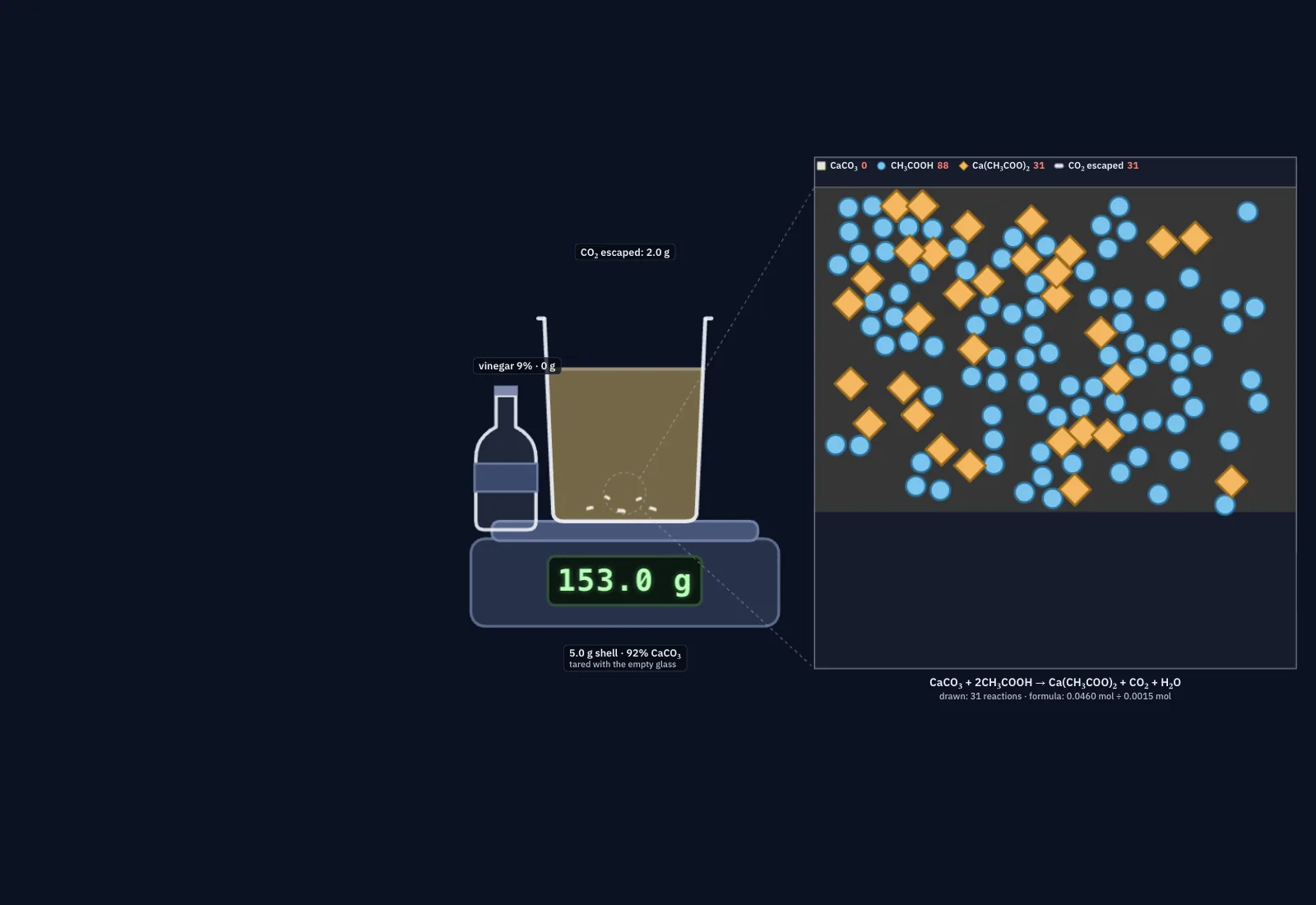
Shell of 5.0 g with 92% CaCO₃ (4.6 g, 0.046 mol) and vinegar with 9% acetic acid by mass (the assumption of the exercise). Calculated; the balance is tared with the empty glass. The equation: CaCO₃ + 2CH₃COOH → Ca(CH₃COO)₂ + CO₂ + H₂O. One drawn particle stands for 0.0015 mol.
Calculation. An exact calculation from the atomic masses of the book, for 5 g of shell with 92% CaCO₃ (the white shells analysed in the cited study had 91%, the brown ones 95%; the literature cited by the study gives 92–97%) and vinegar with 9% acetic acid by mass, the assumption of the exercise: labels in Romania say “9%” or “9 degrees”. The rest of the shell does not react in the calculation. The balance is tared with the empty glass. The drop on a real balance can be smaller than the calculated one, because some of the CO₂ stays dissolved in the liquid. Atoms and molecules have no colour: they are drawn enormously enlarged and far fewer than in reality, one particle for every 0.0015 mol; the water in the vinegar is not drawn.
Sources and credits. Strength of the vinegar: the Carrefour România product title, “Oțet 9% 1 L Vinalcool”, and the Auchan România page, “Oțet de Bistrița, 9 grade, 1 L” (read on 2026-11-16); the mass basis of the 9% is the assumption of the exercise. CaCO₃ content of the shell: values quoted from C. O. Ogah, K. U. Nwaeze, O. O. Adetifa, Journal of Basic and Social Pharmacy Research 2(2), 27–34 (2021): 91% for the white shells and 95% for the brown ones they analysed, 92–97% in the literature they cite. Atomic masses: CIAAW, the rounded values of the book.
Gas volume: normal conditions and other conditions
VM = 22.4 L/mol applies only at normal conditions: 0 °C and 1 atm. Under other conditions, find the volume from the ideal gas equation, pV = nRT, with R = 0.082 L·atm/(mol·K), p in atm, V in litres, and temperature in kelvins: T(K) = t(°C) + 273.
The same number of moles occupies different volumes at different temperatures. At 27 °C and 1 atm, one mole of gas has V = 1 · 0.082 · 300 ÷ 1 = 24.6 L, more than 22.4 L at 0 °C. The question must therefore state the conditions, and the answer must repeat them.
Check the order of magnitude: one mole of gas occupies about 22–25 L at ordinary temperatures, so 0.2 mol should give roughly 4–5 L. An answer of 40 L or 0.4 L points to an error in units or decimal places.
For the curious
In practice, a gas collected over water also contains water vapour, and some CO₂ dissolves in water. The vapour increases the measured volume and dissolving decreases it; to compare with the volume calculated from the equation, subtract the vapour pressure and account for the dissolved gas.
Neutralisation with molar concentrations and volumes
When molar concentrations and volumes are given, find the amount directly: n = cM · V. For NaOH + HCl → NaCl + H₂O, the ratio is 1 : 1. If 25 mL of 0.2 mol/L HCl is neutralised with 0.1 mol/L NaOH, n(HCl) = 0.2 · 0.025 = 0.005 mol, so n(NaOH) = 0.005 mol, and V = 0.005 ÷ 0.1 = 0.05 L, or 50 mL.
An order-of-magnitude check helps: the base is twice as dilute as the acid, so its volume must be twice as large, 2 · 25 = 50 mL.
Significant figures and rounding
The answer cannot be more precise than the data. If the mass is given to three significant figures, write the answer to three. Round once, at the end; keep one extra digit along the way. The problem states how many decimal places to round to, for example “rounded to one decimal place”, and the rounded result is written with ≈. Write the unit with every result; a number without a unit does not answer the problem. Example: 0.2 mol and 22.4 L/mol give 4.48 L, but if 0.2 mol is the value with one significant figure, write 4 L.
Worked example
Limestone, hydrochloric acid, gas volume
Add 100 g of 14.6% HCl solution to 25 g of limestone of 80% purity. What volume of CO₂ is released at normal conditions and at 27 °C and 1 atm? CaCO₃ + 2HCl → CaCl₂ + CO₂ + H₂O.
CaCO₃: mpure = 25 · 80 ÷ 100 = 20 g, and n = 20 ÷ 100 = 0.2 mol.
HCl: md = 100 · 14.6 ÷ 100 = 14.6 g; M(HCl) = 1 + 35.5 = 36.5 g/mol; n = 14.6 ÷ 36.5 = 0.4 mol.
Limiting reactant: CaCO₃ gives 0.2 ÷ 1 = 0.2, and HCl gives 0.4 ÷ 2 = 0.2. The values are equal, so the reactants are in stoichiometric proportions and both are consumed.
Ratio: 1 mol of CaCO₃ gives 1 mol of CO₂, so n(CO₂) = 0.2 mol.
Normal conditions: V = 0.2 · 22.4 = 4.48 L. At 27 °C: T = 27 + 273 = 300 K and V = 0.2 · 0.082 · 300 ÷ 1 = 4.92 L.
Answer: 4.48 L at 0 °C and 1 atm; 4.92 L at 27 °C and 1 atm.
In Romania
In the kitchen: eggshell on a scale
Weigh a glass containing 150 g of vinegar with 9% acidity (as on shop labels; for the calculation, 9% acetic acid by mass) alongside a 5 g eggshell broken into pieces. Pour the shell into the vinegar and wait until no bubbles remain visible: the scale reads less. Kitchen ingredients, no risk.
Calculation: the shell contains 91–95% CaCO₃; at 92%, mpure = 5 · 92 ÷ 100 = 4.6 g, and n = 4.6 ÷ 100 = 0.046 mol. The equation is CaCO₃ + 2CH₃COOH → Ca(CH₃COO)₂ + CO₂ + H₂O. Acid in the vinegar: md = 150 · 9 ÷ 100 = 13.5 g, or 13.5 ÷ 60 = 0.225 mol, more than 2 · 0.046 = 0.092 mol, so the acid is in excess. Theoretically, 0.046 mol of CO₂ forms: m = 0.046 · 44 = 2.024 g ≈ 2.0 g. If some CO₂ remains dissolved, the decrease is smaller. The approximately 2 g is a calculation, not a measurement.
In short
- The multi-step problem: data, balanced equation, moles, mole ratio, required quantity with unit.
- Conversions to moles: n = m ÷ M; md = c · ms ÷ 100; n = cM · V (V in litres); n = V ÷ VM, with VM = 22.4 L/mol at 0 °C and 1 atm.
- Under other gas conditions use pV = nRT, with R = 0.082 L·atm/(mol·K) and T(K) = t(°C) + 273.
- Apply purity at the start and yield at the end; when two reactant quantities are given, find the limiting reactant.
- In the neutralisation NaOH + HCl → NaCl + H₂O, 1 mol of base neutralises 1 mol of acid: n = cM · V.
- Round at the end, to a precision no greater than that of the data.
Common mistakes
WrongOne mole of gas always occupies 22.4 L.
Right22.4 L/mol applies only at 0 °C and 1 atm. At 27 °C and 1 atm, one mole occupies 24.6 L.
WrongThe mass of HCl solution is converted directly to moles of HCl.
RightOnly the mass of dissolved substance in the solution is converted to moles: md = c · ms ÷ 100, then n = md ÷ M.
WrongThe eggshell cannot lose mass, because mass is conserved.
RightTotal mass is conserved, but CO₂ leaves the glass and is no longer on the scale; that is why the mass in the glass falls.
Test yourself
8 questions. For the first 7 you see the explanation at once, with the paragraph of the lesson that supports it; for the written ones you compare with a good answer.
What mass of HCl is in 200 g of a 14.6% solution?
Answer
b) 29.2 g. md = c · ms ÷ 100 = 14.6 · 200 ÷ 100 = 29.2 g. Only the mass of dissolved substance in the solution is converted to moles.
When can VM = 22.4 L/mol be used?
Answer
c) At 0 °C and 1 atm. 22.4 L/mol is the molar volume at normal conditions, 0 °C and 1 atm.
A gas has t = 27 °C. What value is used for T in pV = nRT?
Answer
b) 300 K. T(K) = t(°C) + 273 = 27 + 273 = 300 K. Temperature in the ideal gas equation is in kelvins.
An eggshell (CaCO₃) is put in a glass of vinegar on a scale. Why does the mass shown on the scale fall?
Answer
b) Carbon dioxide escapes from the glass. CaCO₃ reacts with acetic acid to form CO₂, which escapes into the air. Its mass is missing from the scale.
An eggshell contains 4.6 g of pure CaCO₃, which reacts completely with vinegar: CaCO₃ + 2CH₃COOH → Ca(CH₃COO)₂ + H₂O + CO₂. What mass of CO₂ forms theoretically? M(CaCO₃) = 100 g/mol, M(CO₂) = 44 g/mol; round to one decimal place, in grams.
gAnswer
2.0 g. n(CaCO₃) = 4.6 ÷ 100 = 0.046 mol, so n(CO₂) = 0.046 mol, and m = 0.046 · 44 = 2.024 g ≈ 2.0 g.
25 mL of 0.2 mol/L HCl solution is neutralised with 0.4 mol/L NaOH solution. What volume of NaOH is used, in mL?
mLAnswer
12.5 mL. n(HCl) = 0.2 · 0.025 = 0.005 mol; the ratio is 1 : 1, so n(NaOH) = 0.005 mol and V = 0.005 ÷ 0.4 = 0.0125 L = 12.5 mL.
Put the steps in order for a problem that starts with an acid solution and asks for a gas volume.
Answer
The correct order:
- Write the data and the quantity required, with units
- Write the balanced equation
- Use c% and the mass of solution to find the mass of acid, then the moles
- Use the mole ratio from the equation to find the moles of gas
- Convert the moles of gas to volume
- Write the answer with its unit and round at the end
The method goes from the data to the equation, then to moles and the required quantity; rounding comes last.
For 0.2 mol of CO₂, a classmate calculated 4.48 L using 22.4 L/mol, but the question asks for the volume at 27 °C and 1 atm. R = 0.082 L·atm/(mol·K) is given. What needs correcting, and how?
A good answer
22.4 L/mol applies only at 0 °C and 1 atm. At 27 °C, T = 300 K, and the volume comes from pV = nRT: for 0.2 mol, V = 0.2 · 0.082 · 300 ÷ 1 = 4.92 L.
A complete answer states that VM = 22.4 is for normal conditions, converts the temperature to kelvins and uses pV = nRT.
Terms
- percentage concentration by mass
- The mass of dissolved substance in 100 g of solution: c = md · 100 ÷ ms.
- molar concentration
- The amount of dissolved substance, in moles, in one litre of solution: cM = n ÷ V.
- molar volume
- The volume of one mole of gas; at normal conditions (0 °C, 1 atm), VM = 22.4 L/mol.
- normal conditions
- The temperature 0 °C and pressure 1 atm, used at school for gas volumes.
- ideal gas equation of state
- The relationship pV = nRT between pressure, volume, amount and absolute temperature of a gas.
- neutralisation
- The reaction between an acid and a base, forming a salt and water.
Sources and link to the programme
- OpenStax – Chemistry 2e, 9.3 Stoichiometry of Gaseous Substances, Mixtures, and Reactions – gas volume from amount of substance, pV = nRT and molar volume
- OpenStax – Chemistry 2e, 4.5 Quantitative Chemical Analysis – n = cM · V and calculations in titration and neutralisation
- J. Ogah, K. Nwaeze, O. Adetifa – Analysis of Brown and White Chicken Eggshells for Content of Calcium Carbonate (2021) – eggshell contains approximately 91% CaCO₃ (white) and 95% (brown), within the 92–97% range in the literature
- Carrefour România – Oțet 9% 1 L Vinalcool – 1 L of food vinegar sold with 9% acidity in the product title
- Auchan România – Oțet de Bistrița, 9 grade, 1 L – product description: “Acidity: 9 degrees”, 1 L of food vinegar
From the programme: “Stoichiometric calculations will be carried out using the chemical formula and the equation of a chemical reaction, with purity, yield, excess of a reactant, percentage concentration by mass and molar concentration of solutions” (TC: Core curriculum (1 hour a week)). Specific competences followed: 5.1.