Projects built from registers, datasets and public records. Before citing a number, check the source, what it measures, its time period and what it cannot show.
Follow money and local decisions
Contracts, procurement and votes you can look up in published data.
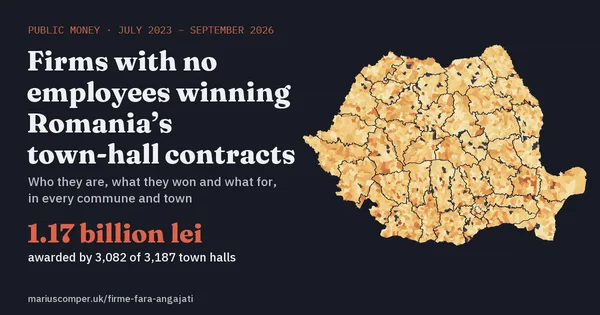
3,082 of Romania’s 3,187 town halls awarded contracts to firms that reported no employees: 1.17 billion lei between July 2023 and September 2026. The list for every commune and town, with what was bought and a card for each firm.
Nearly 600,000 direct purchases each quarter follow Benford's law, while the legal cap remains clear in the amounts. SEAP data from 2022–2024 shows what the method can tell us, plus a tool for checking your own numbers.
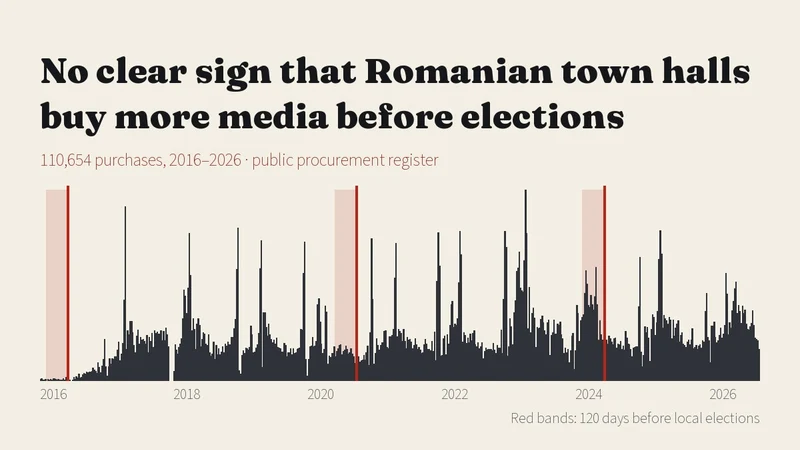
110,654 media and advertising purchases by Romanian town halls, 2016–2026. A test written in advance finds no clear sign of a rise before the 2020 and 2024 local elections. Find any town hall.
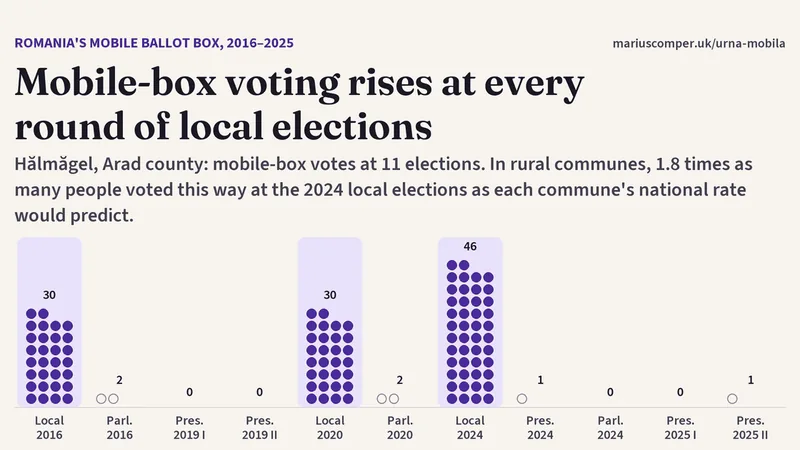
How many people voted at the mobile ballot box in every Romanian commune and town at 11 elections from 2016 to 2025. At the 2024 local elections, rural communes had 1.8 times as many as their national rate would predict; in 130 communes and towns the box collected more votes than the mayor's winning margin.
Map institutions and public services
See where services, infrastructure and recorded gaps are concentrated.
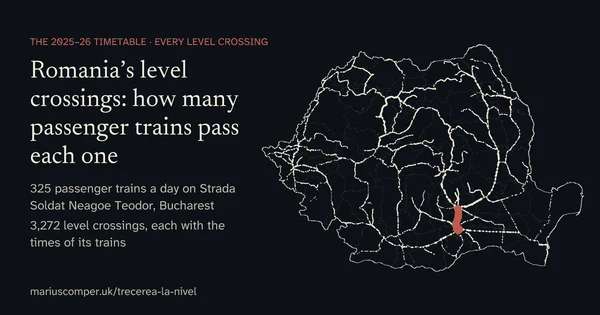
Every train in the 2025–26 timetable placed on its line: 325 passenger trains a weekday cross Strada Marmurei and Strada Soldat Neagoe Teodor in Bucharest, and all ten of the busiest crossings lie between Bucharest and Ploiești. A day-clock for each of the 3,272 level crossings with passenger trains.
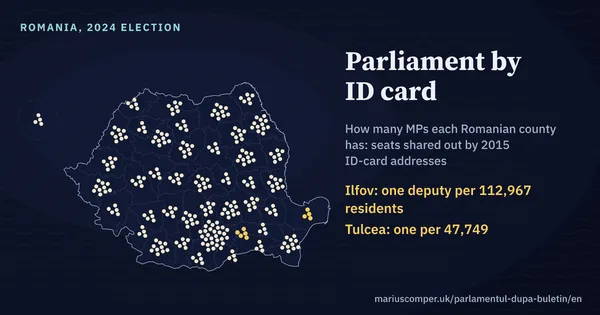
Romania's 308 home seats in the Chamber of Deputies match exactly, and only, how many people had their ID-card address in each county on 1 January 2015. For the 2024 election the law called for 2023 figures, and the ID-card population is 2.9 million higher than the number who live in Romania. On a map where each dot is a deputy, the seats without people turn hollow, then move: Ilfov, with one deputy per 112,967 residents, would go from 5 to 9. A card for every county and for Romanians abroad, the Venice Commission rule, the Senate and the full table. In Romanian and English.
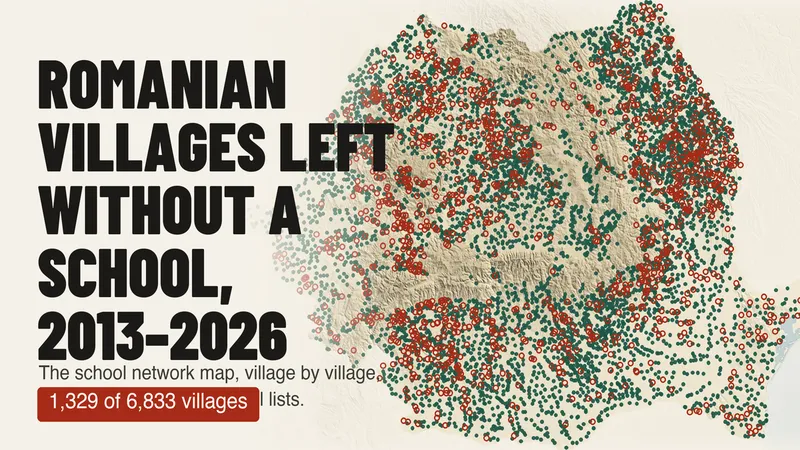
Of 6,833 villages with a school on the Ministry of Education's 2013–14 list, 1,329 have none in 2025–26. A map of every village over 13 years, and why the official count of rural schools (−76%) does not mean as many schools closed.
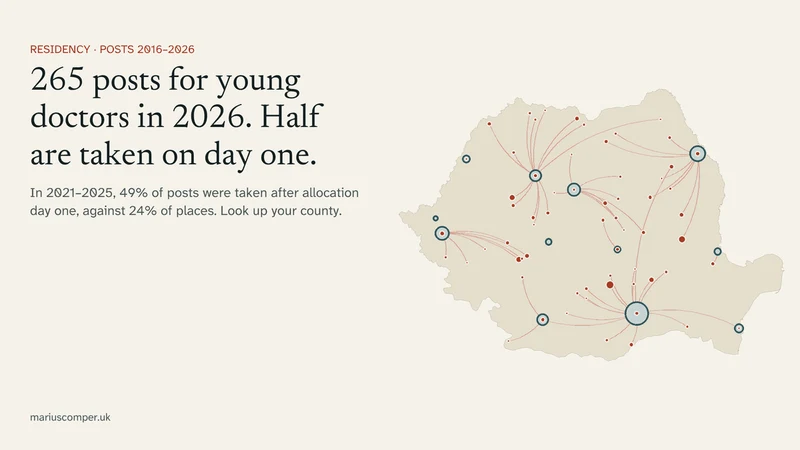
Every list of resident posts from the Ministry of Health, 2016 to 2026, on a map, with the day each post was taken in 2020–2025. A post is an open-ended employment contract with the unit that advertises it; in 2021–2025, 49% of posts were taken after allocation day one, against 24% of places. Look up a county, town or specialty.
Examine population and health records
Compare registers carefully, checking definitions, coverage and missing data.
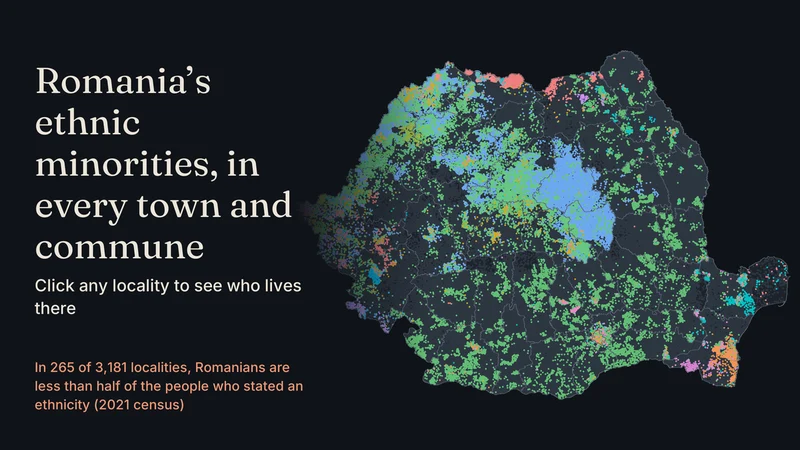
Ethnic Romanians are less than half of the residents who stated an ethnicity in 265 of Romania’s 3,181 localities. Every minority by locality from the 2021 census, county maps back to 1930. Search your town.
Find your commune or town and compare three places in other counties with a similar profile. An atlas of 3,181 localities grouped using ten indicators of population, housing, employment, land and budgets.
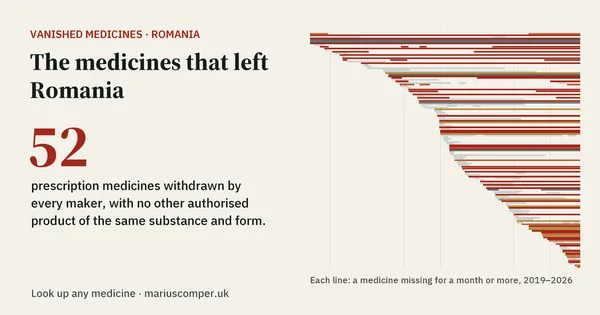
55 prescription medicines were withdrawn from Romania by every maker, with no other authorised product of the same substance and form. 3,231 shortage notices rebuilt, searchable by medicine.
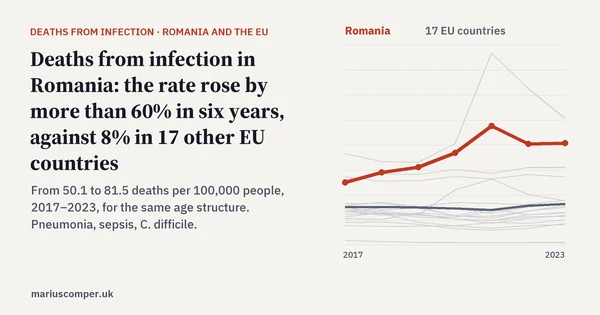
Pneumonia, sepsis and C. difficile recorded as the cause of death, 2017–2023, age-standardised: in Romania, from 50.1 to 81.5 per 100,000 people; at 50–64, almost six times the rate of the comparison EU countries.