Marius Comper · Health

Your body, explained.

Hearts and neurons, hospitals and medicines, hearing and sight. Each work starts from one question about the body and follows it through the data to the end.

Start with the most beautiful.

Six works chosen for visual power, depth and finish: maps, atlases and stories showing everything this page can do.

Five shelves through the body.

Each shelf shows the theme's four finest works, hand-picked. Open any shelf to see the full list in the library.

All 109 works, newest first.

The complete list in publication order, 25 at a time.

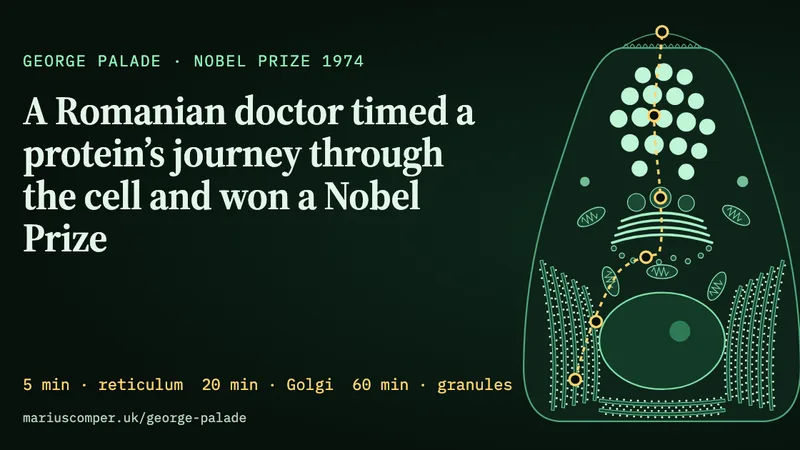
  1. A Romanian doctor timed a protein's journey through the cell and won a Nobel Prize

    In 1953 George Palade described the grains on the cell's membranes, the ribosomes, and with Lucien Caro and James Jamieson he measured how many minutes new proteins take from the ribosome to the granules. The name ribosome was proposed at a 1958 meeting, and the year he left for America depends on the source. The story, in nine chapters, with games.

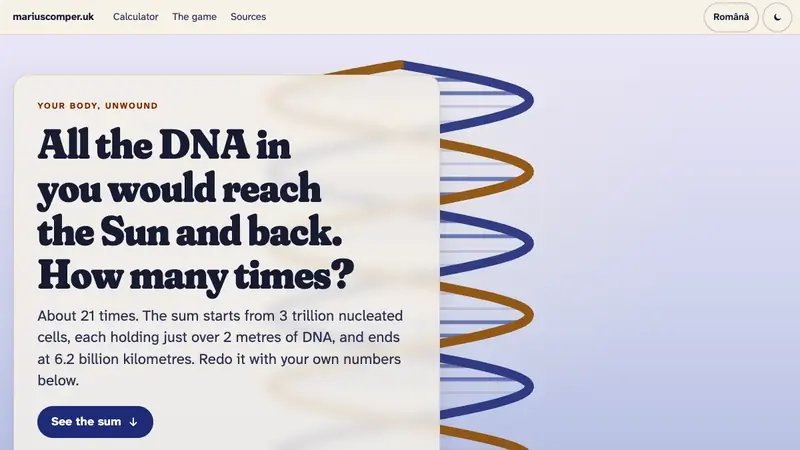
  2. All the DNA in you would reach the Sun and back. How many times?

    About 21 times: 6.2 billion kilometres of DNA in 3 trillion nucleated cells. Guess first, then redo the sum with your own numbers and learn why the 600-trips myth no longer stands.

  3. The black snow of Copșa Mică

    Two works made Copșa Mică Europe's most polluted town: soot, lead in air, soil and children's blood. The figures, from the studies, plus the plume map and the lab bench.

  4. A blue whale’s heart can beat twice a minute

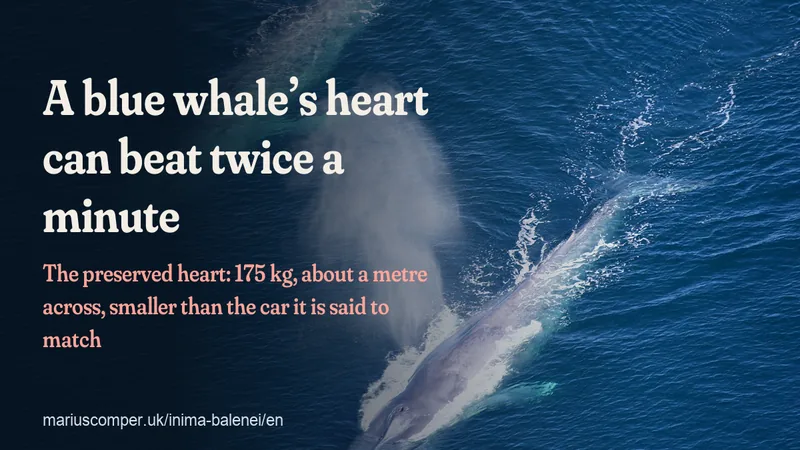
    The heart preserved in Toronto was weighed at 175 kg and is about a metre across, far less than the car it is said to match. Stand beside it, put your hand in its aorta and hear it beat, from 2 a minute in a dive to 37 at the surface.

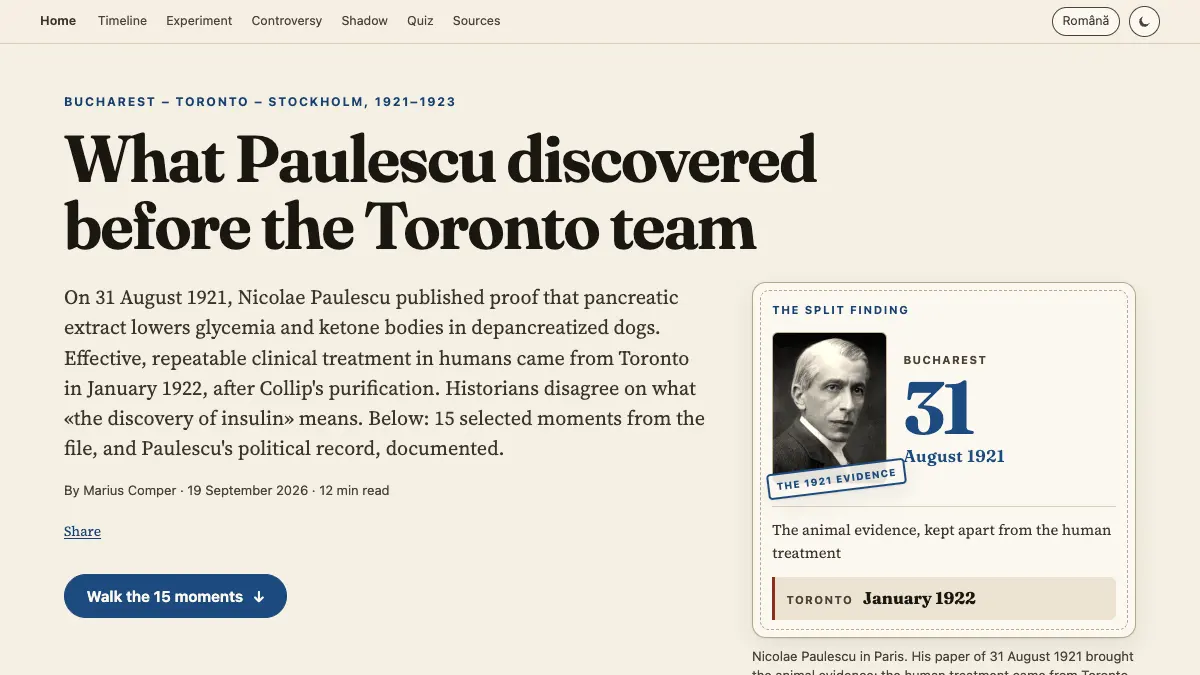
  5. What Paulescu discovered before the Toronto team

    Paulescu published the animal evidence in 1921; Toronto achieved effective clinical treatment in January 1922. The day-by-day record, documented.

  6. Stay-Awake Brain: 24-hour timeline, BAC comparison cards, PVT, caffeine calculator

    Sleep-deprivation research as an interactive 24-hour timeline: the wake-hours slider, BAC comparison cards, a PVT reaction-time distribution, a caffeine calculator — the science of “17–19 hours ≈ the drink-driving line” and its limits.

  7. Thermal baths in Romania: Felix, Sovata, Herculane, Covasna, Tușnad — prices, verdict

    5 spa resorts compared: water type, entry price, treatment base and measured access from Oradea, Cluj, Brașov, Bucharest. Official tariffs.

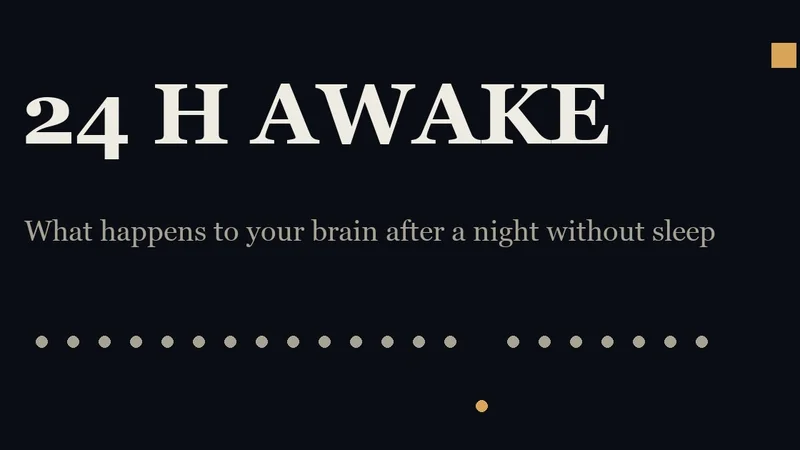
  8. What Happens If You Don't Sleep for 24 Hours?

    After one night without sleep, the brain doesn't switch off — but attention becomes unstable. Follow hour by hour what we know and what we don't: adenosine, reaction time, the alcohol comparison and the glymphatic debate.

  9. Blood Pressure Numbers Explained: What 120/80 Really Means

    Enter 138/84 and see what the cuff is measuring: the peak and trough of one arterial pressure wave, pulse pressure, why ESC 2024 and AHA/ACC 2025 disagree, and how to measure at home.

  10. Tens of Picoamperes in the Dark

    In darkness, rod ion channels remain open; a 20 pA illustrative model shows why light can reduce energy consumption by more than 75% in mammalian rods.

  11. Magnesium citrate vs. malate vs. glycinate: which one actually absorbs better

    Ten forms of magnesium, one named study behind each claim: who paid for it, how many people it studied, what it actually measured. For bisglycinate, malate, and taurate, this research found no independent human trial in healthy adults of comparable size to the ones behind citrate.
  12. Diseases treated once, not every day

    How CAR-T cell engineering went from a last-resort leukemia treatment to early evidence that some cancers and autoimmune diseases might be reset rather than managed for life.
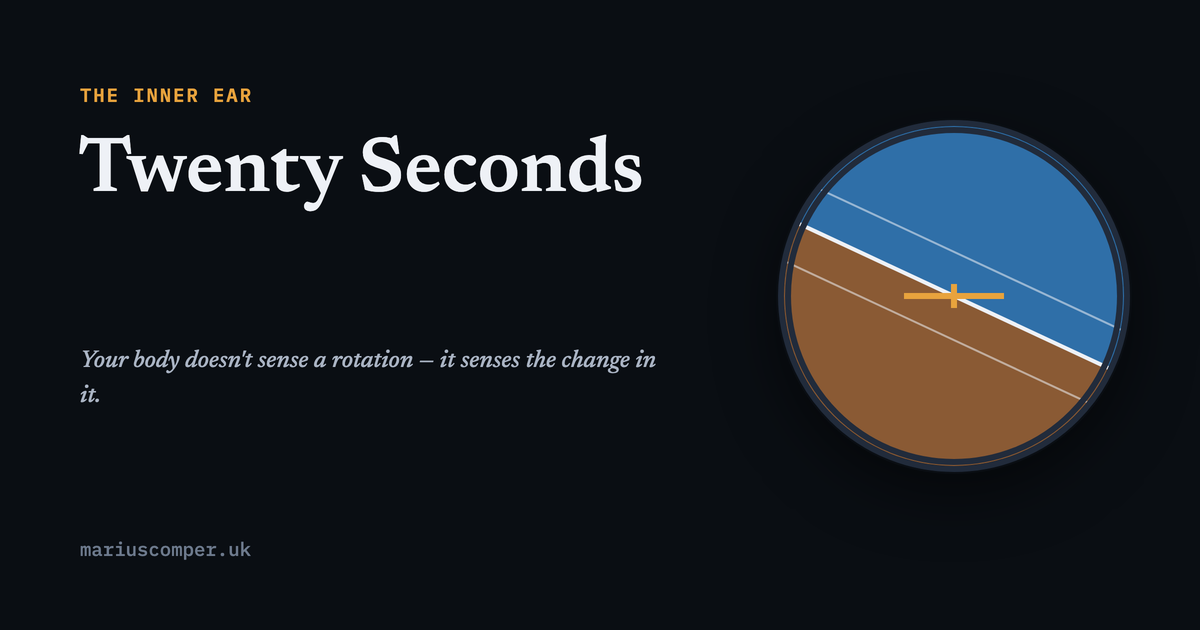
  13. The Clock Inside Your Inner Ear

    Spin in a chair and stop dead: you feel a rotation that isn't there. Keep turning instead, and the sensation disappears entirely — an interactive physical model of the inner ear shows why, and how a pilot ends up in a graveyard spiral believing they're flying straight.
  14. One Volt per Centimetre: The Skin's Epithelial Battery and the Electric Field That Heals Wounds

    Skin maintains a 20–50 mV potential; a wound collapses local resistance and creates a 100–200 V/m field that mechanically steers keratinocytes to the cut long before chemical gradients can diffuse.

  15. The Blind Spot in the Middle of Your Vision

    A fist held at arm's length covers ten degrees of sky — the rule astronomers have used for centuries. The same ruler, turned on your own eye, finds a real gap with no photoreceptors: 6.28 degrees on average, over twelve times wider than the full moon.

  16. Why You're Taller in the Morning Than at Night

    In the controlled study, the peak was measured at 07:30, the trough at 00:00, and 80% of the mean 19.3 mm variation occurred within the first 3 hours after getting up.

  17. Why brain freeze hurts your forehead

    Eating fast roughly doubles the risk of brain freeze (27.4% vs 12.5%, RR 2.2). A Doppler study shows the pain arrives with a surge in cerebral artery blood flow, misrouted to the forehead through trigeminal convergence.

  18. Why Menopause Shifted Thirteen Times More Than Puberty

    Puberty barely moved across twenty-five years of Norwegian generations. Menopause moved thirteen times more — and almost nobody talks about that.

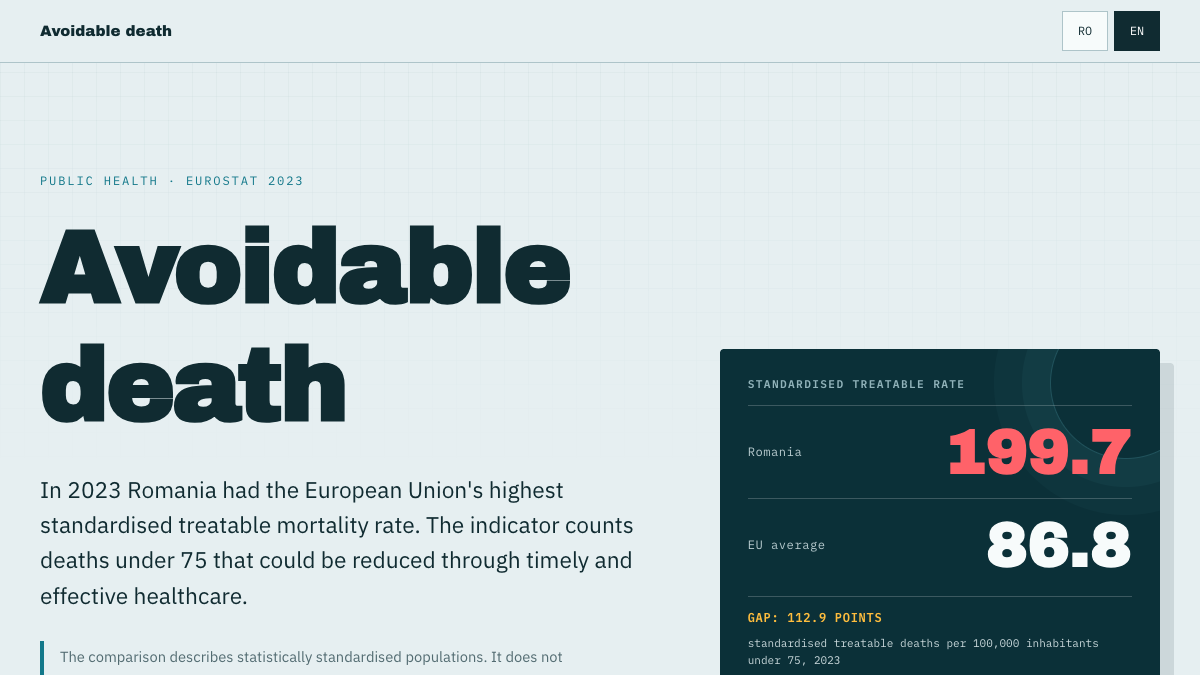
  19. When distance to the hospital starts to matter

    In Petrila, a Hunedoara town with its own hospital, adjusted mortality is 54% above expectations — the highest in the country. Find your locality and see how close you really are to a functioning hospital.

  20. The Forbidden Left Hand: left-handedness, measured with real data

    Left-handedness looked like it tripled over the twentieth century. A survey of over a million Americans and British film footage from 1900–1906 independently place the historical low around 1900; school pressure may explain part of the later recovery, but the data do not establish a single cause.

  21. Atlas of Medical Deserts

    In Arbore, a commune of 8,173 people in Suceava, the last doctor left in 2019 and was never replaced. Look up your locality and see what medical services it has, today and twenty years ago.

  22. The vessel that was supposed to disappear

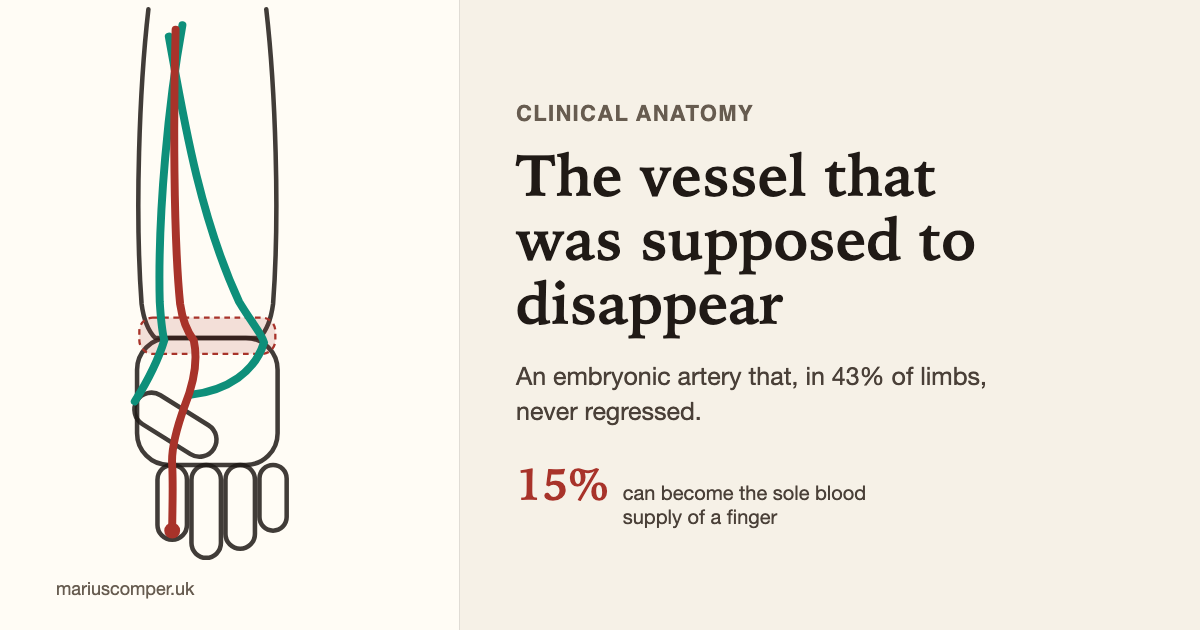
    An artery in the forearm is supposed to regress before birth. In a cadaveric study, it persisted in 43% of limbs, and in 15% it could become, via the carpal tunnel, the sole blood supply of a finger.

  23. What Romanians die of

    A canvas of a thousand dots, one for every 242 deaths, that rearranges itself when you switch from counting people to counting years lost. Four views, a ranking of causes in two orders, and the distance from Europe broken down.

  24. The Two Clocks Inside the Menstrual Cycle

    The part after ovulation varies by just 4.9 days across the study's five groups; the part before it varies by 16.4 days.

  25. The air machines of the Carpathians: when architecture was the only prescription

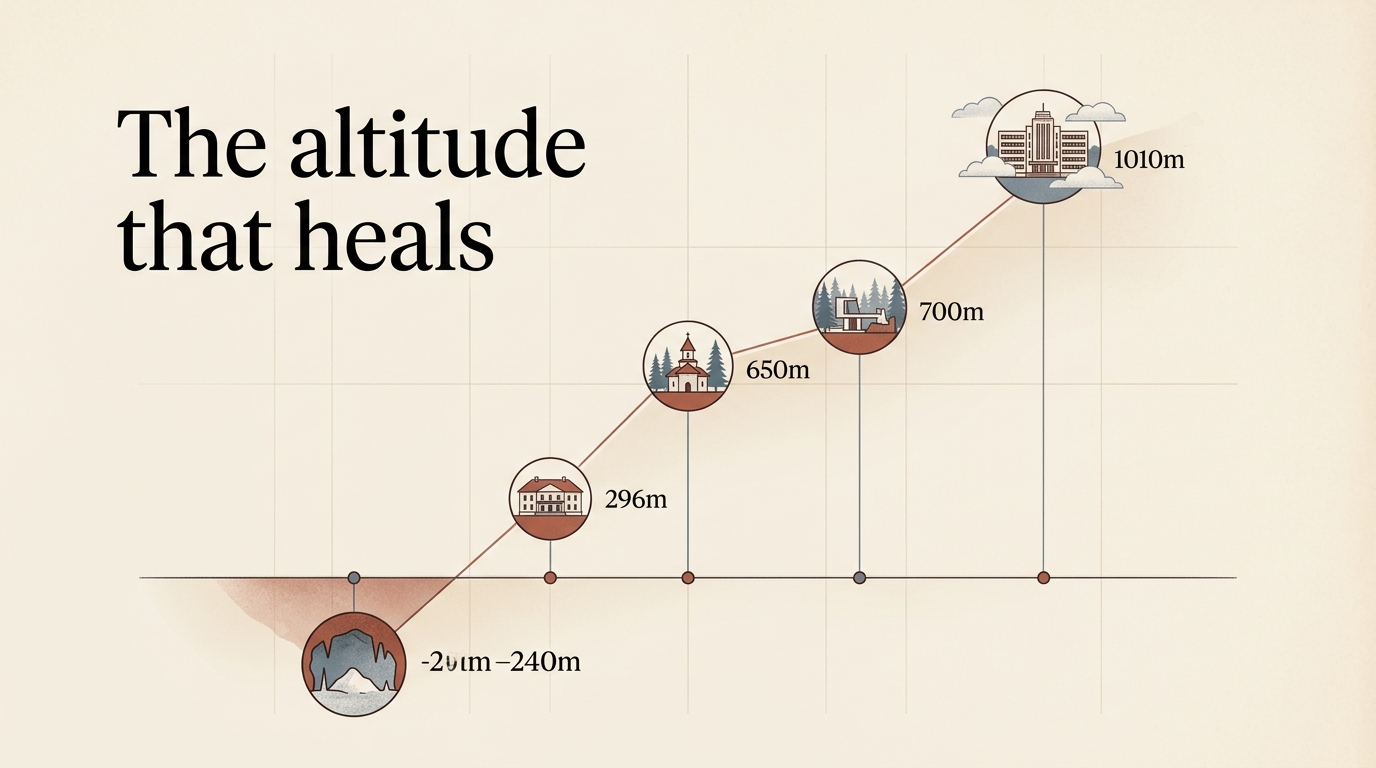
    In the 1930s, when tuberculosis had no chemical cure, Romania erected a network of machine-like buildings across the Carpathian Mountains and deep underground. From −240 metres underground to +1,010 metres on the ridge, five monumental structures rendered obsolete by a single molecule.