BUCHAREST · FROM THE OUTER FAIR TO OBOR HALL
The markets of Bucharest
You buy tomatoes at Obor without knowing the fair moved five times to get there — from the Sibilelor, the Olari, the Mogoș Cross and further still. You pass Matache without knowing the iron-and-brick hall was pulled down in 2013, or cross Unirii without knowing the Great Hall stood until 1986. Six markets feed the city today; the map below shows them all, plus the ghosts.
In short: the oldest Bucharest market is Obor — heir of the Outer Fair, moved around since the 17th century until the 1865–1868 systematisation, crowned with Obor Hall in 1936. The Organic Regulation drew six markets inside the town and four of 12,000 square stânjeni each at the causeway heads. The iron-and-brick halls — Amzei (1872), Matache (1886–1898), Traian (1896), the Central Halls (1872–1986) — anchored modern commerce. Search your street below and see which is yours.
See the market map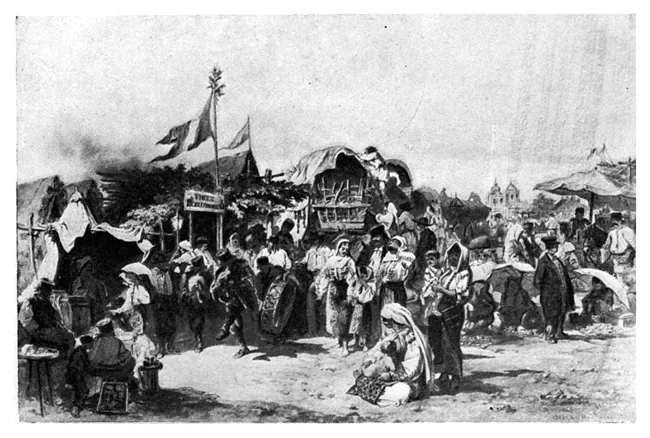
The market map, then and now
Green are the 6 markets of today, with OpenStreetMap perimeters. Amber are the ghosts: four of the Outer Fair's five halts, the Moși Field, the Central Halls. Drag the slider or press play and see what existed in the chosen year — in 1869, say, there was not a single hall standing, but the Moși filled the field.
The list beside the map tells the same story, with the same data.
- Markets today
- Ghosts
- The fair's road
Map background: © OpenStreetMap contributors (ODbL).
The fair's road
Five halts in two centuries: by the Sibilelor in the 17th century, by the Olari in the early 18th, at the Mogoș Cross (1718–1719), at the Old Obor (1768) and at Popa Lazăr — the New Obor (1854). Four have map points, joined by the amber line; the Mogoș Cross has no coordinates and stays text-only.
The Moși Field
The dashed rectangle north of Obor Hall is the Moși Field — an indicative sketch of the 24 pogoane and 22 prăjini redeemed by the town in 1890–1891. The Moși were held here and, from 1865, the national exhibition.
The Central Halls
The dashed rectangle at Unirii sketches the Central Halls: the meat halls of October 1872, with the fruit, fish and poultry halls added by 1899. The Great Hall stood alone until the summer of 1986.
Today
Six agro-food markets — Obor, Amzei, Matache, Traian, Dorobanți, Floreasca — with today's perimeters from OpenStreetMap. Type your street below and see which is yours.
Green perimeters are OpenStreetMap (display only, not cadastre). Dashed-rectangle ghosts are indicative sketches, not measured boundaries. Fair points are anchor churches: Sibilelor (with Saints), Olari (approximate, Olari street), Old Obor (Traian 204), Popa Lazăr. Floreasca, whose birth year is unknown, stays lit at every slider year.
Obor: the fair that moved five times
No Bucharest market has travelled so much. The Outer Fair fled the growing town for two centuries, until the town caught up and locked it in a hall.
The beginning is beyond the barrier: in the 17th century the Outer Fair was held by the Sibilelor — the church with saints on today's Calea Moșilor — and by the early 18th century it had already moved to the Olari. It was the cattle and country-cart fair, held on Tuesdays and Fridays (Del Chiaro, in 1718, caught Wednesday-and-Saturday days — the rhythm changed on the road, we know not when). Here too, at the town's edge, the condemned were beheaded under Brâncoveanu; the custom stopped only under Grigore IV Ghica.
The second move came with the cattle: in 1718–1719 the cattle obor is at the Mogoș Cross, and the Old Obor church — today Traian 204 — is built in 1768 right beside it. In 1854 the parish moves to Popa Lazăr, become the New Obor. Meanwhile the fair had slipped onto the Colentina estate, over the Moși Field: the field of the dead remembered on Whit Saturday (Giurescu's account) or of Matei Basarab's battle with Radu Iliaș on 25 October 1632 (Mucenic's) — the origin is disputed to this day, and this page does not settle it.
The town catches up with the fair in 1865: the council begins systematisation with Scarlat Ghica, in 1868 the field becomes non aedificandi, and in 1871 engineer Matraca counts 32 illegal buildings on it. Then comes the quarter-century quarrel: the estate belongs to the St. Dumitru church of Colentina (the 1839 donation), 7,000 families petition for the field back on 10 July 1868, the town expropriates it for hygiene on 1 July 1886, and payment comes only on 16 November 1890 — 500,000 lei deposited, the town takes possession on 20 November, Royal Decree 193/1891 seals it all.
The 20th century crowns the move: the Moși Hall (before 1923), Obor Station (after 1930), and on 1 November 1936 the cornerstone of Obor Hall — Octav Doicescu's design (7,500 m²) is dropped, the hall is raised by Horia Creangă with Haralamb Georgescu, with a welded steel skeleton, the steel from Reșița, a “unique case”. The Moși Thursday (Joia Moșilor) had meanwhile gathered princes and kings — Bibescu raised triumphal arches in 1843–44, Carol I noted the Moși in his memoirs in 1867, the national exhibition filled the field from 1865 with 1,200 exhibits. In 1934, when the hall was already on the drawing board, a kilo of potatoes cost 3.10 lei in Bucharest, and white bread 7.75 — the year-round average, not the autumn quote.
The halls: iron, brick and demolitions
Between 1872 and 1936 Bucharest walled its commerce in iron-and-brick halls, on the model of the Paris Halles. Some stand today; two fell to the bulldozer — one in 1986, one in 2013.
Amzei: the market on Iancu Ghica's ground
Since 1841 on Iancu Ghica's ground, halls finished in 1872 — and named for a founder who sacrificed his whole fortune on a church.
Before Amzei there was the Market on Neculescu's ground, by the Mogoșoaia Causeway: it ran from 1831 to 1841, when Amzei Market was founded in its place, on Iancu Ghica's ground. The parish took its name from the Amzei church — built by former colonel Nicolae Dărăscu but named for its second founder, Amza Năescu, his relative and testamentary executor, who contributed decisively to raising the church (1808–1810), sacrificing his entire fortune to it.
The Amzei Market halls were finished in 1872, together with the Central Halls — the town's first iron-and-brick generation. The market works today on the same spot, between Calea Victoriei and Piața Romană.
Matache: the hall that lost in 2013
Open ground at Berzei since the early 19th century, a type-design hall between 1886 and 1898, a historic monument demolished in 2013.
At the Berzei–Popa Tatu crossing there was, at least since the first half of the 19th century, a maidan — unbuilt public ground for commerce, with many wells and an islet-property then owned by Marin Măcelaru (the Borroczyn plan, 1846–1852). The site's market name — Matache Măcelaru — comes from a butcher too; whether it is the same man, our sources do not say.
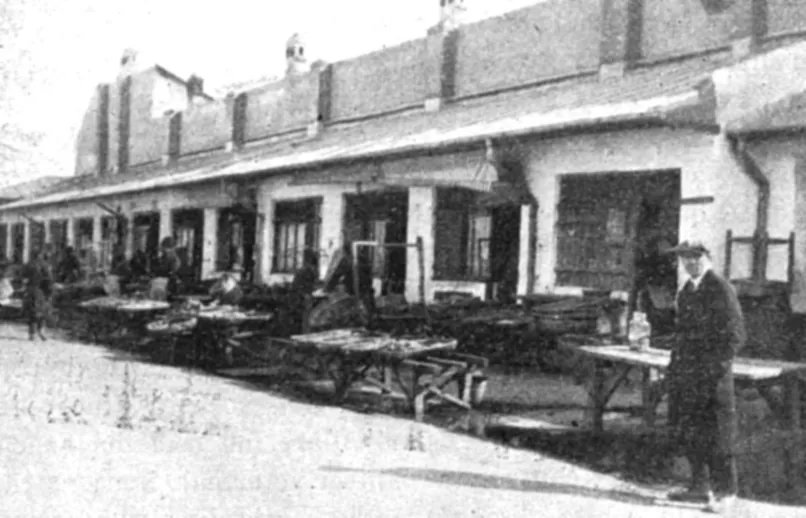
The council built Matache Hall from a type design, in two stages: the southern end in 1886, the rest in 1898, through contractor Ion Nicolau — the contract says “extension to the Grivița hall”, as it was also called. The engine was the North Station (then Târgoviște Station): the station's urbanisation ripened the site. In 1940 the general mayor ordered the hall rebuilt — extended towards Berzei, partly raised a floor, a west canopy — and the hall held into the 21st century.
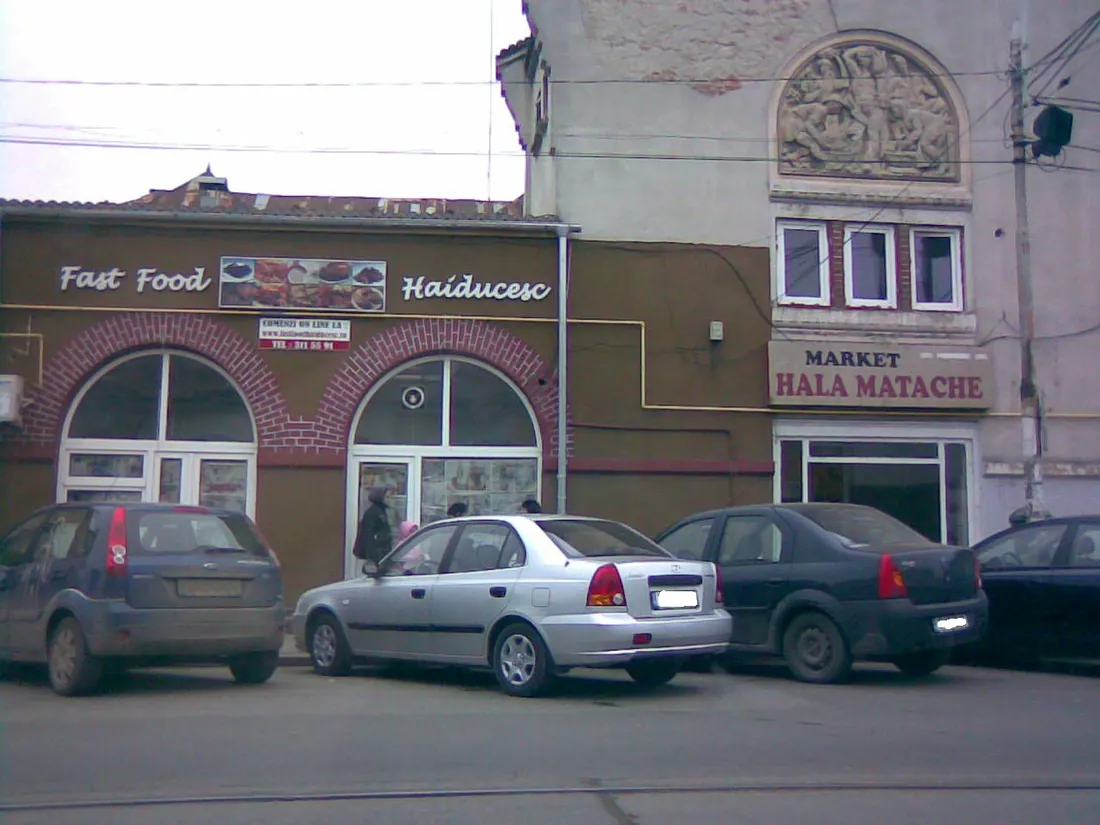
The end is recent and documented: expropriated and evacuated in February 2011, defended by protests in 2012, Matache Hall — historic monument LMI B-II-m-B-18181 — was demolished in 2013, for the new Uranus Boulevard. Today's market carries its name on the same site.
Traian: the hall that escaped
Shacks in the late 19th century, an iron-and-brick hall since 1896 — Matache's counterpart on Calea Călărașilor.
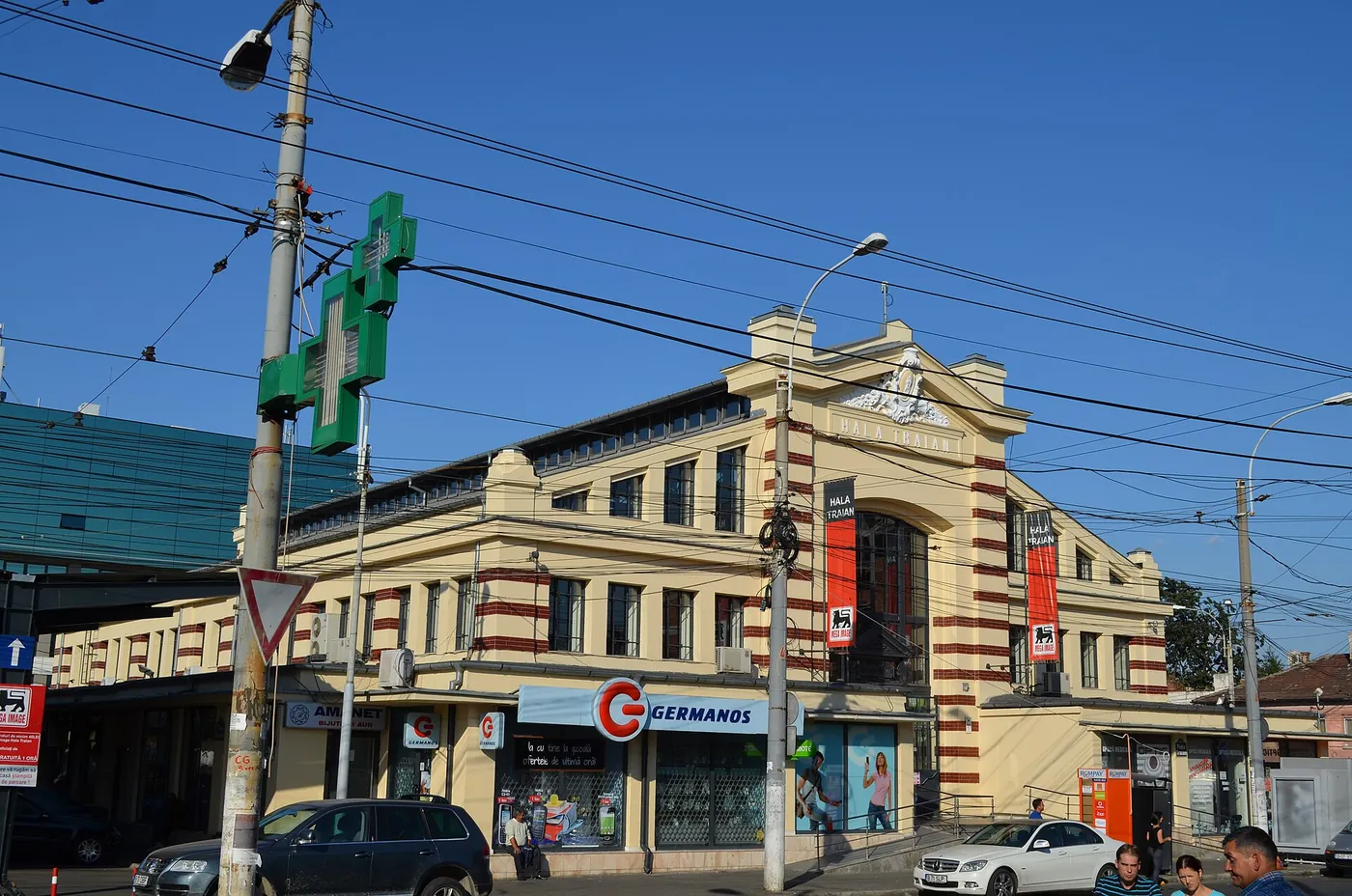
Neither Matache nor Traian market is on the Borroczyn plan: they were founded in the second half of the 19th century, starting as mere shacks. The Traian hall — iron and brick — was finished in 1896, per Giurescu (Gligor puts the works between 1896 and 1914; the difference stays on the page, unarbitrated).
“A temple of food”, as Dan-Silviu Boerescu calls it — with its Calea Călărașilor counterpart precisely in Traian Hall — the hall works today, with its painted-iron interior and stalls under the skylight: you can see it on a market morning.
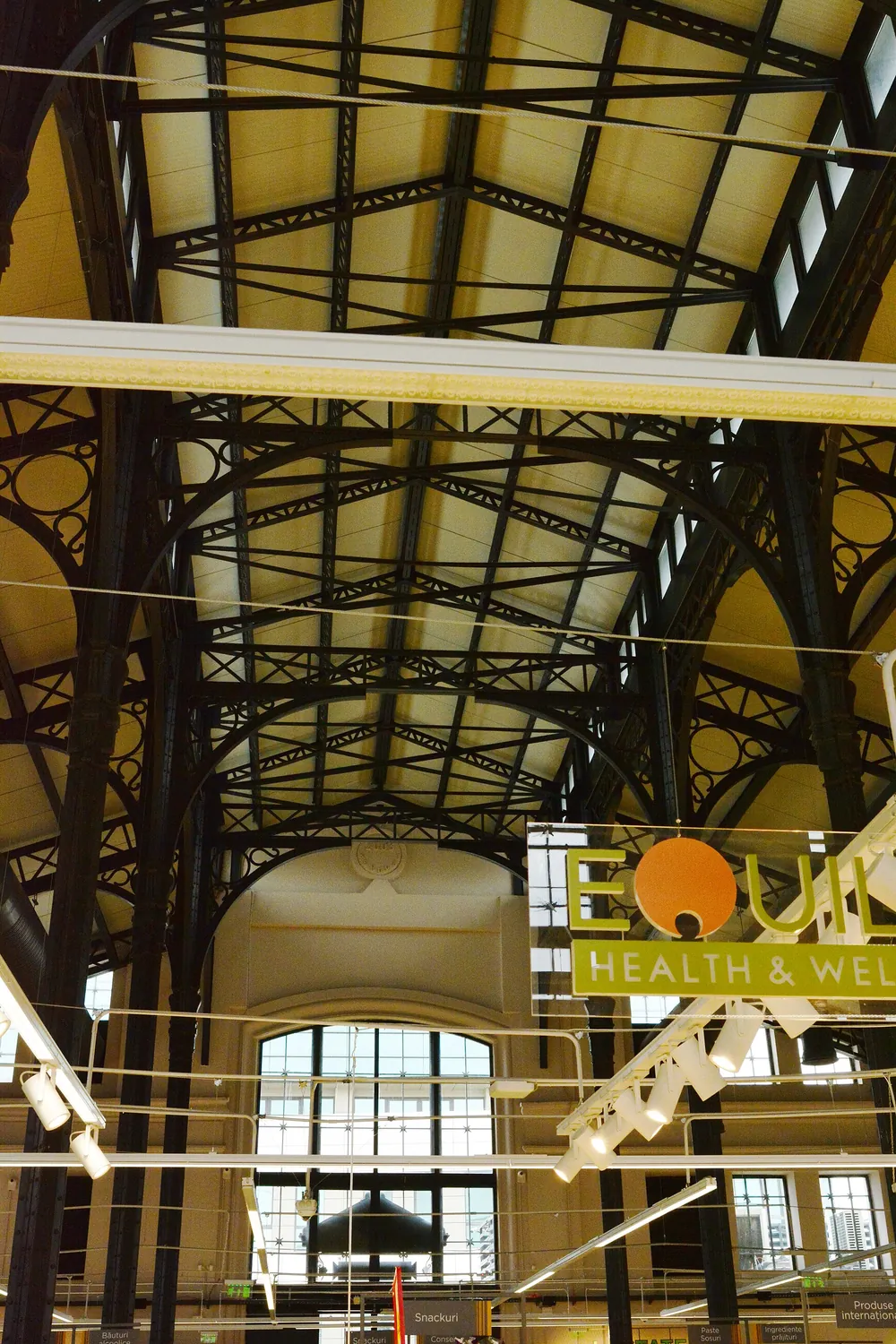
The Great Market: the hall that stood until 1986
The Central Halls on the site of today's Piața Unirii — begun under Cuza, finished in October 1872, pulled down in the summer of 1986.
The Great Market was the town's commercial belly — later under the double name of Ghica Market (meat, fish, poultry), left of the Dâmbovița, and Bibescu Market (vegetables and fruit), right of it, per Giurescu. And there the Central Halls were walled: the meat halls, finished after lawsuit, arbitration and successive delays (contractor: Alexis Godillot) in October 1872, on the model of the Paris Halles. Then came the fruit hall (1883), the fish hall (1888), the poultry hall (1899) and the artificial-ice factory (1903).
Across the Dâmbovița, at the foot of the Metropolitan Hill, lay the Bibescu-Vodă greengrocery — modernised in 1906, demolished under Carol II together with the small Unirii halls. The Great Hall stood alone until the summer of 1986, when systematisation swept it too. Today's Piața Unirii is on its site — and Halelor street keeps its name a few steps away.
The Regulation: six markets inside, four at the causeway heads
The Organic Regulation drew the capital's commerce on paper: six great markets inside, four of 12,000 square stânjeni each at the causeway heads.
The text, as Giurescu keeps it, is plain: the town reserves “six great markets” inside — for meat, greens, fruit, fish, maize — and four markets of 12,000 square stânjeni each “at the heads of the great causeways, where the villagers' carts may come”. Stan (BMIM VII, 1969) gives the list of heads: Mogoșoaiei, the Outer Fair's, Șerban Vodă and Caliței. With one reservation from Giurescu: the ten markets “were not all founded”.
The 20th century filled the map with new markets: after 1918 came Filantropia, Domeniilor, Chibrit, Dorobanți and Ghencea — Dorobanți, the interwar quarter's market, is the only one of this wave to enter our map with papers. Floreasca appears with no birth year — on the map it stays lit at every year: we found no founding year in trusted sources, so we invent none.
Which market is your street's?
Type your street and number: the page has measured ahead, for 4,878 streets and 113,584 addresses, which of the 6 markets is nearest — and 175 of today's addresses sit on ghosts: on the Moși Field or the Central Halls. Distances are approximate, to the market's centre.
On Strada Berzei Matache Market
Nearest market for 50 of 50 numbers: Matache Market. Distance is approximate, to the market's centre.
Numbers on the street
Points are OpenStreetMap (October 2026); market perimeters likewise (display only). Ghosts are indicative sketches. If your number is missing, write to us.
Seven streets, seven markets
- Strada Ziduri Moși — Obor, of course: 7 of 7 numbers, and 6 sit on the Moși Field — number 4 is 64 m from the market.
- Strada Halelor — nearest is Traian, but all 7 numbers sit on the Central Halls ghost.
- Strada Berzei — Matache, 50 of 50 numbers — the butcher's site, 123 m at best.
- Calea Călărașilor — Traian, 58 of 58 numbers, down to 38 m from the market.
- Calea Victoriei — Amzei, 54 of 57 numbers — the market round the corner from the Mogoșoaia Causeway.
- Strada Covaci — nearest is Traian, but 18 of 19 numbers sit on the Central Halls.
- Strada Halele Obor — a single number, 228 m from Obor — and on the Moși Field, as the name says.
Method: how we know
Every year on the page has a source; every sketch is marked a sketch.
The backbone is historiography: Constantin C. Giurescu, Istoria Bucureștilor (1966), for the Regulation, foundings and halls; Cezara Mucenic, “Târgul de Afară–Târgul Moșilor–Obor” (BMIM XIX, 2005), for the Obor thread; Revista Monumentelor Istorice (2010) for Matache Hall, from National Archives files. The Central Halls' end (summer 1986), the post-1918 market wave and the 1934 prices come from today's press with named period sources (bucharest.ro) — we render them attributed, as found.
Modern geometry is OpenStreetMap (October 2026): 6 market perimeters, display only, not cadastre. The dashed-rectangle ghosts (Moși Field, Central Halls) are indicative sketches we drew from the texts' landmarks — not measured boundaries. Fair points are churches and streets geocoded today: Sibilelor (with Saints church), Olari (street, approximate), Old Obor (Traian 204), Popa Lazăr.
The lookup measures, for 4,878 streets and 113,584 addresses, the nearest market (haversine to the market centre) and two ghost-membership tests. The client only reads the build-time answers; it computes nothing. What we do not know we do not invent: Floreasca has no birth year on the page, and disagreements between sources (market days, the Traian works' end, the Moși origin) stay visible, unarbitrated.
Quiz: six questions from the page
Every answer is above, source included. Three of six is human; six of six is Moși-grade.
Old questions, short answers
Which is Bucharest's oldest market?
Obor: the direct heir of the Outer Fair, attested since the 17th century by the Sibilelor, then moved by the Olari, the Mogoș Cross, the Old Obor and Popa Lazăr, systematised in 1865–1868 and crowned with Obor Hall in 1936.
Why is it called Obor?
The obor was the cattle's fenced ground at the Outer Fair — “the Outer Fair's Obor” appears in 1702, the cattle obor moves to the Mogoș Cross (1718–1719), then to the Old Obor (1768) and the New Obor (1854). The cattle's name stayed the market's name. (Word etymologies live on the Piață–Târg–Bazar page.)
When was Matache Hall demolished?
In 2013 — a historic monument (LMI B-II-m-B-18181), expropriated and evacuated in February 2011, demolished despite the 2012 protests, for the new Uranus Boulevard. The hall had been walled in two stages, 1886 and 1898.
Where was the Great Market?
On the site of today's Piața Unirii: the Central Halls (meat, October 1872), with the fruit (1883), fish (1888), poultry (1899) halls and the ice factory (1903). The Great Hall stood until the summer of 1986. Halelor street keeps its name.
Who was Amza?
Amza Năescu, second founder of the Amzei church: relative of former colonel Nicolae Dărăscu and his testamentary executor, he sacrificed his entire fortune to raising the church (1808–1810). Parish and then market (1841) took his name from the church.
Who was Matache?
Matache Măcelaru, the butcher who named the market and the hall: in Dan-Silviu Boerescu's retelling, the merchant Matache Loloescu, with a butcher's shop at Buzești and Grivița from around 1879, dead around 1900. On the Borroczyn plan (1846–1852) the maidan owner was however Marin Măcelaru — whether it is the same man, our sources do not say.
Which markets did the Organic Regulation draw?
Six great markets inside the town and four of 12,000 square stânjeni each at the causeway heads: Mogoșoaiei, the Outer Fair's, Șerban Vodă and Caliței — with Giurescu's reservation that they were not all founded.
Sources
- Constantin C. Giurescu, Istoria Bucureștilor (1966) — Regulamentul, întemeierile, halele / the Regulation, foundings, halls
- Cezara Mucenic, „Târgul de Afară–Târgul Moșilor–Obor”, BMIM XIX (2005) — firul Oborului / the Obor thread
- Maria Stan, „Târgul de Afară de la capul Podului Mogoșoaiei”, BMIM VII (1969) — lista celor patru capete de pod / the four causeway-heads list
- Revista Monumentelor Istorice 1–2/2010, „Buzești–Berzei” — Hala Matache, după Arhivele Naționale / from National Archives files
- Dan-Silviu Boerescu (ujmag) — evocarea lui Matache Loloescu, „Templu al mâncării”, demolarea 2013 / the Loloescu retelling, demolition 2013
- Tronaru Iulia, Bucureștiul interbelic: piețele toamna (24 sep 2026) — Hala Mare 1986, valul de după 1918, prețuri 1934 / Great Hall 1986, post-1918 wave, 1934 prices
- OpenStreetMap (ODbL), octombrie 2026 — 6 perimetre + 113.584 adrese / 6 perimeters + 113,584 addresses