Biology IX RO
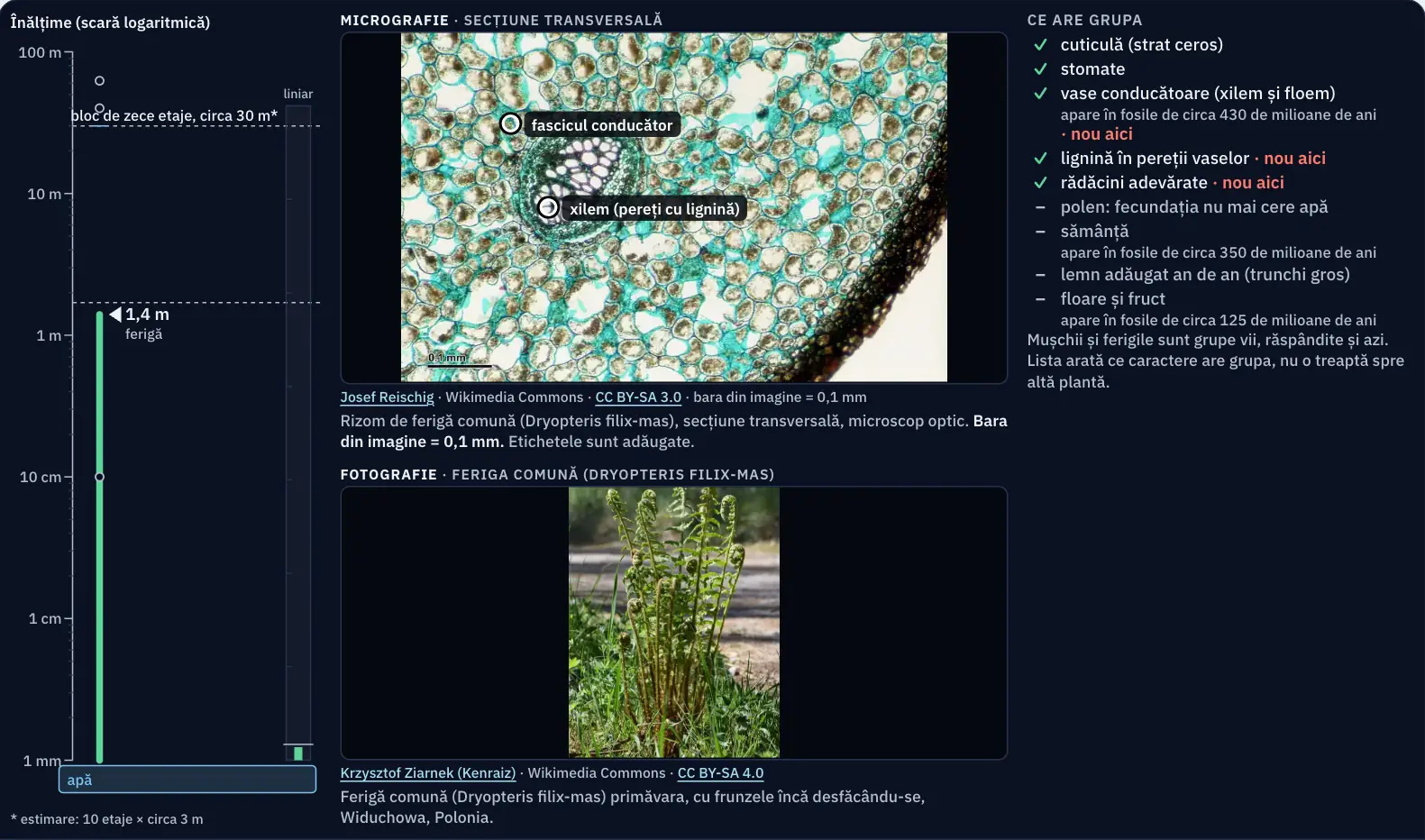
Height ruler from 1 mm to 100 m, with a 1.7 m person and a ten-storey block of flats as reference marks, set at the male fern’s 140 cm; beside it, the real cross-section through the fern’s rhizome, with one vascular bundle, the photograph of the male fern and the list of characters: the fern has a cuticle, vascular tissue, lignin and roots, but no pollen, seed, flower or fruit.

Chapter 7 · Plants: built for life

What did a plant need to be able to live on land?

Size
from 1 mm to 62.5 m
Level
organism
Time
hundreds of millions of years

At the foot of a spruce tens of metres tall sits a cushion of moss a few centimetres high. Both are green land plants. The ruler beside the text runs from 1 mm to 100 m; at each stop you see, under the microscope, the real stem of the plant and what had to exist for it to stand so high.

Common haircap moss rarely grows taller than 30 cm

Common haircap moss (Polytrichum commune), one of the largest mosses, is usually 5–10 cm tall and only rarely grows past 30 cm. The dotted line on the ruler is a person 1.7 m tall.

The green band shows how tall it usually grows, and the small tick above it, the tallest ever found.

Why is there no moss as tall as a person?

In water, an alga needs neither a skeleton nor pipes

Spirogyra (water silk) forms green masses in ponds, made of filaments of cells joined end to end, each cell with one or more chloroplasts twisted into a spiral. Its body is called a thallus: it has no root, stem, leaves or vascular tissue.

Water supports its body and brings it mineral salts. Taken out of the water, the alga collapses and dries out: it has no supporting tissue and no cuticle.

Green algae are close relatives of land plants. An alga is not an unfinished tree: it is suited to life in water.

A moss has a cuticle, but no true vascular tissue and no lignin

On land, a plant loses water by evaporation. A moss has a cuticle on its surface, a waxy layer that slows the loss of water. Stomata, the pores that open and close, appear in mosses only on the sporogon, the sporophyte.

In the micrograph, the centre of the stem has only simple conducting cells, as the author of the image marked them. Without vascular tissue, water passes from cell to cell, and this route works well only over short distances. Without lignin, the stem has nothing to support a tall body. These two missing features limit the height of mosses.

The first bryophytes, the liverworts, relatives of the mosses, probably appeared about 450 million years ago. Mosses still live today, from the foot of spruce trees to peat bogs.

With vascular tissue and lignin, the fern lifts fronds up to 140 cm long

The male fern (Dryopteris filix-mas) has true roots, an underground stem called a rhizome, and fronds up to 140 cm long. The micrograph of the rhizome shows a vascular bundle.

Xylem carries water and mineral salts from the roots towards the leaves, and lignin makes its walls hard and keeps them open. The first fossils with vascular tissue are about 430 million years old.

A fern has no seeds: it multiplies by spores, formed in sori, the brown dots on the underside of the fronds. The male gamete swims to the female gamete, so fertilisation needs water. That is why ferns grow mostly in damp, shaded places.

Pollen and seed cut reproduction loose from water

Silver fir and spruce are gymnosperms: the ovules, and later the seeds, sit uncovered on the scales of the cone, not enclosed in an ovary. Pollen carries the male gamete without water, and the seed holds an embryo, food for it and a protective coat. The first seed plants appear in fossils about 360 million years old.

Pollination, the transport of pollen, and fertilisation, the union of gametes, are two separate steps: in pine, fertilisation takes place more than a year after pollination.

To reach 50–60 m, the height a spruce usually attains, a plant also needs a thick trunk of wood: xylem with lignin, added year after year. The wood of conifers is made mainly of tracheids; the micrograph shows pine wood, with a resin canal.

The tallest silver fir measured in Romania until then stood at 62.5 m: at Șinca Veche, Brașov county, measured in 2013, according to HotNews, a Romanian news site, which quotes the team of “Ștefan cel Mare” University of Suceava and WWF Romania.

Flower and fruit are about reproduction; height is about wood

Oak and beech, which form the forests of the hills, are angiosperms: they have flowers, and their ovules are enclosed in the ovary, which after fertilisation becomes a fruit. The first flowering plants appear in fossils about 125 million years old.

Oak wood has, besides fibres and tracheids, wide vessels: the round holes in the micrograph.

On the ruler, the oak does not outgrow the fir. A group that appeared later has other characters, without being “taller” or “better”; mosses, ferns and conifers live alongside it.

Now explain it yourself: trees without seeds

In the period called the Carboniferous, relatives of horsetails and clubmosses formed swamp forests with trees over 30 m tall. They had no seeds and no pollen.

What allowed them to grow so tall? And why did they live in swamps?

Compare with an answer

They had vascular tissue with lignin: the vessels lifted the water to the top, and the lignin strengthened the stem. Height depends on vascular tissue and lignin. Without pollen and seeds, the male gamete had to swim, so fertilisation needed water: that is why they grew in wet places.

The lesson on gymnosperms: the seed, pollen and the conifers of Romania

Micrograph and photograph. The micrographs and photographs are real, from Wikimedia Commons, with the author and licence on each image. The heights come from the lessons of the chapter and their sources (for oak and beech, from the European atlas of forest tree species, JRC 2016). The ruler is logarithmic, with a linear strip beside it that keeps the true proportions; the 1.7 m person is a reference mark, and the height of the block of flats is an estimate: 10 storeys × about 3 m. The labels on the micrographs were added. The magnification that the source states for the pine and oak wood refers to the microscope, not to the image on screen.

Sources and credits. Jon Houseman and Matthew Ford, “Spirogyra filaments.jpg”, Wikimedia Commons, file page: source; licence CC BY-SA 4.0, licence text: source; changes: resized. Phonon.b, “Spirogyra water surface and water inside.jpg”, Wikimedia Commons, file page: source; licence CC BY-SA 4.0, licence text: source; changes: resized. Jon Houseman and Matthew Ford, “Moss stem.jpg”, Wikimedia Commons, file page: source; licence CC BY-SA 4.0, licence text: source; changes: resized. Hans Hillewaert, “Polytrichum commune .jpg”, Wikimedia Commons, file page: source; licence CC BY-SA 4.0, licence text: source; changes: resized. Josef Reischig, “Rhizome (255 02) Male fern (Dryopteris filix-mas); cross-section.jpg”, Wikimedia Commons, file page: source; licence CC BY-SA 3.0, licence text: source; changes: resized. Krzysztof Ziarnek (Kenraiz), “Dryopteris filix-mas kz03.jpg”, Wikimedia Commons, file page: source; licence CC BY-SA 4.0, licence text: source; changes: resized; cropped at the top by 8% of the height. Berkshire Community College Bioscience Image Library, “Gymnosperm Stem Resin Duct in Three Year Pinus (36279470746).jpg”, Wikimedia Commons, file page: source; licence CC0, licence text: source; changes: resized. Crusier, “Abies alba Wisła 1.jpg”, Wikimedia Commons, file page: source; licence CC BY-SA 3.0, licence text: source; changes: resized. Berkshire Community College Bioscience Image Library, “Woody Dicot Stem Cross Section Quercus Wood 40x (34991087693).jpg”, Wikimedia Commons, file page: source; licence CC0, licence text: source; changes: resized. Cristian-Mihail Miehs, “Stejarul multisecular din Cajvana.jpg”, Wikimedia Commons, file page: source; in the public domain; changes: resized.

The same data, as a table
GroupExampleHeight (from the sources)cuticle (waxy layer)stomatavascular tissue (xylem and phloem)lignin in the walls of the vesselstrue rootspollen: fertilisation no longer needs waterseedwood added year by year (thick trunk)flower and fruit
Green algaSpirogyra (water silk)no height of its own: water supports its thallusnonononononononono
Mosscommon haircap moss (Polytrichum commune)usually 5–10 cm, rarely over 30 cmyesin mosses, only on the sporophytenonononononono
Fernmale fern (Dryopteris filix-mas)fronds up to 140 cm longyesyesyesyesyesnononono
Gymnospermsilver fir (Abies alba) and Norway spruce (Picea abies)Norway spruce usually reaches 50–60 m at most; tallest silver fir measured in Romania: 62.5 myesyesyesyesyesyesyesyesno
Angiospermpedunculate oak (Quercus robur) and European beech (Fagus sylvatica)oak and beech usually reach 30–40 m; beech, in some places, up to 50 myesyesyesyesyesyesyesyesyes
ImageWhat it showsScaleAuthor, licence and changes
Micrograph, green algaOne cell from a filament of Spirogyra (water silk), under the light microscope, with one or more ribbon-shaped chloroplasts twisted into a spiral. Not a section: the filament is a single row of cells joined end to end.black bar in the corner = 0.02 mm, according to the author’s descriptionJon Houseman and Matthew Ford, CC BY-SA 4.0; resized
Photograph, green algaMasses of Spirogyra on the surface and inside a pond of still water (Japan).–Phonon.b, CC BY-SA 4.0; resized
Micrograph, mossCross-section through the stem of a moss (the species is not identified by the author), light microscope. In the centre, a bundle of simple conducting cells without lignin; this is not true vascular tissue.black bar in the corner = 0.2 mm, according to the author’s descriptionJon Houseman and Matthew Ford, CC BY-SA 4.0; resized
Photograph, mossCommon haircap moss (Polytrichum commune), seen from above, Bruges, Belgium.–Hans Hillewaert, CC BY-SA 4.0; resized
Micrograph, fernCross-section through the rhizome of the male fern (Dryopteris filix-mas), bright-field light microscope. The vascular bundle has xylem with strengthened walls, surrounded by phloem.bar in the image = 0.1 mmJosef Reischig, CC BY-SA 3.0; resized
Photograph, fernMale fern (Dryopteris filix-mas) in spring, its fronds still unrolling, Widuchowa, Poland.–Krzysztof Ziarnek (Kenraiz), CC BY-SA 4.0; resized; cropped at the top by 8% of the height
Micrograph, gymnospermCross-section through the wood of a three-year-old pine stem (Pinus), light microscope. The wood is made mainly of tracheids, crossed by rays of living cells (parenchyma); the resin canal is surrounded by cells that produce resin. Fir wood is also made mainly of tracheids, but has no resin canals.no scale bar; magnification under the microscope as stated by the source: 100×Berkshire Community College Bioscience Image Library, CC0; resized
Photograph, gymnospermSilver fir (Abies alba) in the Silesian Beskids, Poland. The road at its foot gives an idea of its height.–Crusier, CC BY-SA 3.0; resized
Micrograph, angiospermCross-section through oak wood (Quercus), light microscope, stained with haematoxylin and safranin. The large, round vessels are in the wood formed in spring; between them are fibres with thick walls and tracheids.no scale bar; magnification under the microscope as stated by the source: 40×Berkshire Community College Bioscience Image Library, CC0; resized
Photograph, angiospermThe centuries-old oak of Cajvana, Suceava county (Quercus robur). The people beside the trunk give the scale.–Cristian-Mihail Miehs, public domain; resized