
Drawing the map…
- church, monastery
- mosque
- palace, forum, public building
- gone
- wall still visible today
- lost wall, reconstructed course
- fire, siege, earthquake
- built-up area (from satellite, after 1975)
One city, three names, almost 2,700 years
Constantinople, Tsarigrad, IstanbulThe whole history of the city, on one peninsula
Whoever held this corner of land between two seas could, for 2,700 years, put a toll on the road between the Black Sea and the Mediterranean and on the crossing between Asia and Europe. The map shows today's shore and hills. As you move down the page the years pass: walls, churches and mosques go up, districts burn, and the city's name changes in the corner of the map, in the script of whoever holds it.
The story begins in 660 BCBefore the city
The place#
Two seas and a strait between them. At its southern end, a deep inlet and a tongue of hilly ground with water on three sides.
The geography
Why here: a deep harbour and water on three sides#
At the southern end of the Bosphorus, a long, narrow inlet cuts deep into the land: the Golden Horn, a harbour out of the current of the strait.
Between the inlet and the Sea of Marmara lies a tongue of hilly ground. It has water on three sides, so an enemy coming by land can attack it from one side only. The Greek historian Polybius put it this way in the 2nd century BC: by sea the city is better placed than any other in the known world; by land, worse than any.
The map shows today's shore. The banks have been filled in at many points, most of all on the Marmara, at Yenikapı, where the rectangular bulge in the shore is recent landfill.
c. 6500–5600 BC
The first known people: a village under the silt of a harbour#
Between 2004 and 2013 the dig for the underground station at Yenikapı ran into an ancient harbour, built in the time of the emperor Theodosius I and silted up for centuries. In the mud lay 37 ships of the 5th to 11th centuries.
Beneath the harbour the archaeologists reached a Neolithic village of 6500–5600 BC: remains of wooden houses, burials, urns of burnt bone and hundreds of footprints kept in the clay. These people lived here some five thousand years before the first Greek settlers.
The dating differs by author (6500–5600 or 6400–5800 BC).
7th century BC – AD 324
Byzantion#
A Greek city that, over almost a thousand years, more than once put a toll on the ships of the strait and was taken in turn by Persians, Spartans, Athenians and Romans.
c. 660 BC, by tradition
When was Byzantion founded? "Opposite the blind"#
Settlers from Megara, a town near Athens, establish themselves on the tip of the peninsula. Jerome's Chronicle, compiled a thousand years later, puts the founding in 660/659 BC.
The Megarians had already founded Chalcedon on the Asian shore, where Kadıköy is today. Herodotus says they did so 17 years earlier (Jerome's Chronicle makes it about 26) and reports the remark of a Persian general, Megabazus: the Chalcedonians must have been blind, to choose the worse shore with the better one in front of them.
Tradition: no archaeological layer of the 7th century BC fixes the year. Byzas, the founder of legend, appears only in much later writers. The dashed wall is a reconstruction; no stretch of it has been found.
c. 513 BC
The Persians cross the Bosphorus on a bridge of boats#
The Persian king Darius I marches against the Scythians and crosses into Europe on a floating bridge built by the engineer Mandrocles of Samos. Herodotus places it halfway between Byzantion and the mouth of the Black Sea. The exact spot is not known.
Byzantion comes under the Persians. It joins the revolt of the Ionian cities, and in 493 BC its people flee before the Phoenician fleet, which burns the empty city. In 478 BC the Spartan Pausanias, leading a Greek fleet, drives out the Persian garrison.
5th–3rd centuries BC
What the city lived on: a tenth of the strait's cargo#
Athens's grain came from the Black Sea, past Byzantion. Athens and Sparta took the city from each other several times. In 390/389 BC the Athenian Thrasybulus farmed out here the one-tenth duty on ships coming from the Black Sea.
In 220 BC, squeezed by the tribute it paid the Gauls settled in Thrace (80 talents a year, according to Polybius), Byzantion again put a toll on the strait. Rhodes, whose fleet lived by trade, declared war and forced it to give the toll up.
340–339 BC
Philip of Macedon fails to take the city#
Philip II, father of Alexander the Great, suddenly besieges Byzantion while the city's soldiers and war engines are away helping its neighbours at Perinthus. Athens, Chios, Cos and Rhodes send help, and Philip lifts the siege.
A story first written down in the 6th century AD says that a light in the sky on a dark night gave away the Macedonian attack, and that in thanks to the goddess Hecate the city put the crescent and star on its coins. Coins of Byzantion with a crescent and star exist; no source close to the siege mentions the miracle.
The siege: recorded (Diodorus). The light in the sky and the origin of the crescent: late tradition.
1st century AD
A free city, then a provincial one#
Byzantion was for a long time an ally of Rome and kept its autonomy. In AD 53 its envoys complained in the senate that their burdens were too heavy, and the emperor Claudius remitted the tribute for five years.
Under Vespasian (69–79) the city loses its status as a free city and passes under the administration of a Roman province.
AD 193–196
Three years of siege, then the walls are pulled down#
In the war for the throne of Rome, Byzantion sides with Pescennius Niger, the rival who lost. Septimius Severus besieges it for three years. Cassius Dio, who saw them, describes walls of squared stone, harbours closed with chains and, towards the end, people eating soaked hides.
After the surrender the soldiers and magistrates are executed, the walls are demolished and the city is reduced to a village subject to Perinthus.
After AD 196
Did Severus rebuild? The Hippodrome and the baths, according to late writers#
Writers of the 6th century and later say that Severus relented and rebuilt the city: the public baths of Zeuxippus, a colonnaded street and the first form of the Hippodrome. They also say the city was for a time called Antonina, after the emperor's son.
No writer of Severus's own time mentions any of these works. What is certain is that a century later Constantine found a walled city here, which he had to besiege.
Late tradition (Zosimus, Malalas, Hesychius). The course of the wall is a reconstruction.
324 – 450
New Rome#
An emperor picks a capital halfway between the Danube and the Euphrates and fills it with the statues of other cities.
324 – 11 May 330
Who founded Constantinople, and when#
In 324 Constantine defeats his rival Licinius at Chrysopolis, on the opposite shore. He stays. He enlarges Byzantion and encloses it with a new wall from sea to sea, which the historian Zosimus places fifteen stadia, almost three kilometres, beyond the old one.
Just outside the old gate he lays out a round forum with a column of porphyry at its centre; the column still stands, at Çemberlitaş. On Monday 11 May 330 the city is inaugurated with chariot races in the Hippodrome. Jerome's Chronicle notes drily: Constantinople was adorned by stripping nearly every other city.
Constantine dies in 337 and is buried in the church of the Holy Apostles, where emperors will be buried for seven centuries.
Nothing of Constantine's wall is visible above ground. The dashed course is a reconstruction through the points the sources give.
330 – 381
Was it ever officially called "New Rome"?#
From the start the city bore Constantine's name. In 381 a council of 150 bishops rules that the bishop of Constantinople ranks next after the bishop of Rome, "because the city is New Rome". The ecumenical patriarch's title keeps the phrase to this day.
That the emperor himself gave the name by law is stated by one historian only, Socrates, a century after Constantine. No text of such a law survives.
From 332 the citizens receive free bread made from Egyptian grain. The first church of Hagia Sophia is consecrated on 15 February 360, beside the older Hagia Eirene.
373
The water comes from more than 200 kilometres away#
The peninsula has little water of its own. Under the emperor Valens, in 373, a channel reaches the city bringing water from the springs of Thrace; a study of 2008 gives it 215 kilometres. In the 5th century the system is extended to Vize. The total length of the channels is estimated, depending on the study, at between 426 and 592 kilometres.
The arcaded bridge that crosses the valley between two hills, the aqueduct of Valens, can still be seen above a boulevard.
by 4 April 413
How long the Theodosian walls are, and who built them#
The city had grown beyond Constantine's wall. Under the prefect Anthemius, regent for the child emperor Theodosius II, a new wall goes up further west. A law of 4 April 413 speaks of its towers as finished.
The inner wall had 96 towers. Its line, measured on today's map from the Marble Tower to Blachernae, is 5.9 kilometres long.
Until 1453 no enemy army forced its way across it.
When the work began is not known; the years 404–408 are inferred. The length is measured on the course mapped in OpenStreetMap; the TDV encyclopaedia gives 5,630 metres.
c. 425
An inventory: 14 regions, 322 streets, 4,388 great houses#
A Latin text of about 425, the Notitia Urbis Constantinopolitanae, describes the city region by region. At the end it adds up: five palaces, 14 churches, eight public baths, 153 private baths, 20 public bakeries and 120 private ones, 322 streets and 4,388 "domus", great houses; exactly what the word counted is not certain.
Between the two walls huge open-air reservoirs are dug so that the city has water during a siege: that of Aetius in 421; that of Aspar will follow in 459. A law of 425 pays 31 teachers of grammar, rhetoric, philosophy and law from public funds.
439 – 447
57 towers down, rebuilt in sixty days#
In 439 Theodosius II orders walls along the seaward sides too. In 447 an earthquake brings down much of the land wall, with 57 towers, just when Attila's Huns are in the Balkans.
The prefect Constantine rebuilds it and adds a second, outer wall and a moat. Two inscriptions at one gate, in Greek and in Latin, boast that the work took sixty days.
The historian Cyril Mango doubted that the sea walls were actually built in 439.
527 – 565
Justinian's city#
In a few days the centre of the city burns. In less than six years a church rises in its place with a dome unmatched in the Christian world. Five years after that the plague arrives.
13 – 18 January 532
The Nika riot: 30,000 dead in the Hippodrome#
The Blues and the Greens, the rival supporters of the chariot teams, unite against the emperor under the cry "Nika", "Conquer". Hagia Sophia, Hagia Eirene, the baths of Zeuxippus and the entrance of the palace burn. The crowd proclaims another emperor.
On Sunday 18 January the troops of the generals Belisarius and Mundus trap the crowd in the Hippodrome. Procopius, a contemporary, writes that more than thirty thousand people died that day.
The death toll differs by source: 30,000 (Procopius), 35,000 (Chronicon Paschale), 50,000 (John Lydus).
February 532 – December 537
How long Hagia Sophia took to build#
A month after the riot Justinian begins a new cathedral on the site of the burnt one, on a plan never tried before: a huge dome on four piers. The builders are Anthemius of Tralles and Isidore of Miletus. The church is inaugurated at the end of December 537, after less than six years. The dome is 31 to 33 metres across, and its crown is some 55 metres above the floor.
Next to it, under the court of a basilica, the emperor digs a covered cistern that stores the aqueduct's water for the summer. It has 336 columns and can be visited: Yerebatan.
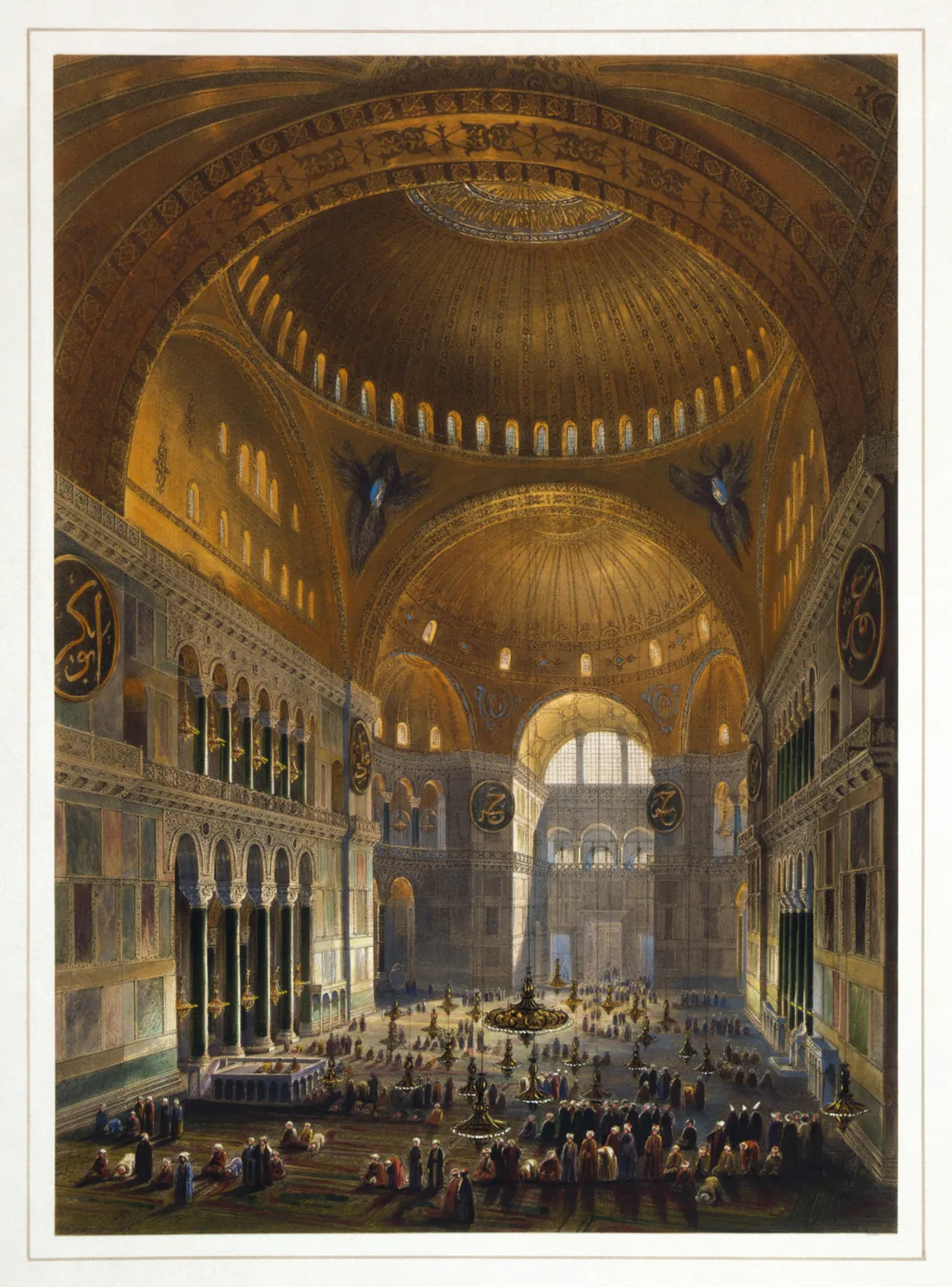
Under the dome. The dome we see is not the first. The dome of 537 fell on 7 May 558, after an earthquake. Isidore the Younger rebuilt it higher, by twenty to thirty feet according to the chroniclers, and the church was consecrated again on 24 December 562.Lithograph by Louis Haghe after Gaspare Fossati, 1852. Library of Congress. Public domain, via Wikimedia Commons. spring – summer 542
The plague: "ten thousand dead a day"#
Bubonic plague reaches the city in 542 and lasts four months. Procopius, who was there, writes that the deaths rose to five thousand a day, then to more than ten thousand. John of Ephesus says that those counting the dead stopped at 230,000.
That the plague struck the city is not in doubt. How great the destruction was is debated: a study of 2019 argues, from papyri, coins, laws and pollen, that the pandemic's effects were far smaller than was thought; other historians reject its conclusion.
Before the plague the city had, by estimates, between 375,000 and 500,000 people. By the estimates, it did not reach that number again until the 16th century.
7th–9th centuries
The besieged city#
The empire loses Egypt, Syria and much of the Balkans. Three times, huge armies reach the walls. The city stands, but it shrinks.
29 July – 7 August 626
Avars at the walls, Persians on the other shore#
The emperor Heraclius is away with the army in the east. The khagan of the Avars attacks the land walls with siege towers and sends the Slavs' boats onto the Golden Horn. A Persian army under Shahrbaraz camps at Chalcedon but has no means of crossing the strait.
The defence is led by the patrician Bonus and the patriarch Sergius. The Avars cut the aqueduct and burn the churches outside the walls, then withdraw. A year later the quarter of Blachernae, whose church of the Virgin had been left outside the wall, is enclosed by a new one.
Church tradition links the Akathist hymn, sung standing in Lent, to this deliverance. The hymn's author and date are disputed.
654 – 718
The Arab fleets and the "sea fire"#
The caliphate tries to take the city from the sea. The chronicler Theophanes speaks of seven years of attacks and credits the invention of "sea fire", the burning liquid thrown from ships and later called Greek fire, to Callinicus, an architect from Syria. Handbooks date the siege to 674–678; the historian Marek Jankowiak moves it to 667–669.
The great siege comes in 717. On 15 August the army of Maslama camps before the land walls, and on 1 September the fleet arrives. The emperor Leo III's fire-ships, a hard winter, famine and a Bulgar attack end the siege exactly a year later, on 15 August 718.
This is also the first time the chain closing the mouth of the Golden Horn is mentioned.
The chroniclers' figures (1,800 ships, 80,000 men) are conventional and cannot be checked.
c. 750
How many people were left: perhaps 40,000#
In 740 an earthquake brings down much of the land walls. In 746–747 the plague returns; the dead are buried in dry cisterns, vineyards and gardens inside the old walls.
Historians estimate the population after the plague at about 40,000 (Cyril Mango) or, by other estimates, 70,000, against roughly half a million two centuries earlier. The emperor Constantine V brings families from Greece and the islands to repopulate the city.
The aqueduct cut by the Avars in 626 lies unused for 140 years. It is repaired only in 766 or 767, after a drought, by 6,900 workmen brought from across the empire.
No census exists; both estimates are inferred from the water supply, the burials inside the walls and the resettlement.
813 – 842
A Bulgar khan at the Golden Gate, and the sea walls rebuilt#
In July 813 the khan Krum appears before the land walls, makes sacrifices by the Golden Gate and asks to fix his lance in it. Refused, he lays waste the surroundings and leaves. He had neither a fleet nor siege engines.
Between 821 and 823 the rebel Thomas the Slav besieges the city for more than a year and gets his fleet past the chain of the Golden Horn. After this fright the emperor Theophilos (829–842) raises the walls along the shores. His name appears in more inscriptions on the walls than that of any other emperor.
The dashed stretches of the sea walls are reconstructions: on the Marmara they join the surviving pieces, and on the Golden Horn they follow today's bank.
860 – 1180
The Queen of Cities#
The city is rich again and full of foreigners. In the Norse sagas it will be Miklagard, "the Great City"; in the Slavs' chronicles Tsarigrad, "the Emperor's City". The Greeks call it, simply, the City.
18 June 860
Two hundred boats come down the Bosphorus#
The emperor and the fleet are away against the Arabs when a Rus' fleet of about two hundred boats enters the Bosphorus and plunders the suburbs, the monasteries and the Princes' Islands. The patriarch Photios preaches two sermons on the attack. The Rus' leave without trying the walls.
They return in 941 under Igor of Kiev. The imperial fleet is away again; fifteen old galleys, fitted with fire-throwers at bow, stern and sides, burn their boats.
The Russian chronicle tells of one more attack, in 907: prince Oleg is said to have moved his ships on wheels and hung his shield on the city gate. No Byzantine source mentions it.
860 and 941: recorded by witnesses (Photios, Liudprand). 907: only in the Primary Chronicle, written two centuries later.
17 September 949
An Italian envoy before the throne that rises into the air#
Liudprand, the envoy of an Italian prince, is received by the emperor Constantine VII in the Magnaura hall of the Great Palace. He describes a gilded bronze tree with singing birds, gilded lions that roar and beat their tails, and a throne that rises to the ceiling.
The palace covered the terraces between the Hippodrome and the sea. Beside it the city's guilds worked by written rules: the Book of the Eparch, of about 912, separates raw-silk merchants, silk dressers and weavers into distinct guilds.
988
The axe-bearing guard from the north#
During a revolt that had reached the Asian shore, the emperor Basil II receives from Vladimir of Kiev a corps of Rus' and Scandinavian warriors and with them defeats the rebels at Chrysopolis, today's Üsküdar. This corps is usually regarded as the beginning of the emperors' Varangian Guard.
Among those who served in it, half a century later, was Harald Hardrada, the future king of Norway.
989 – 1054
Hagia Sophia: a dome repaired by an Armenian and a bull left on the altar#
An earthquake, usually dated to October 989, brings down the western part of the dome. According to an Armenian chronicler the repair is directed by the architect Trdat, who rebuilds 15 of the 40 ribs. The church reopens in 994.
On 16 July 1054 Cardinal Humbert, the pope's legate, lays on the altar of Hagia Sophia a bull excommunicating the patriarch Michael Keroularios. The patriarch's synod answers in kind. Historians no longer treat that day as the break between East and West: the pope had been dead since April, and contemporaries took little notice. The excommunications were lifted in 1965.
1082 – 1170
Venetians, Pisans and Genoese get wharves on the Golden Horn#
In return for the help of the Venetian fleet, the emperor Alexios I Komnenos gives the Venetians wharves and houses on the south bank of the Golden Horn and freedom from customs duty. The grant is usually dated to 1082. The Pisans get a quarter next door in 1111, the Genoese in 1170.
The court moves to the Blachernae palace in the north-west corner. On the hill the emperor John II builds the Pantokrator monastery; its rule of 1136 provides for a hospital of fifty beds in five wards, one of them for women.
The traveller Benjamin of Tudela notes, around 1170, that the Jews live across the inlet, at Pera: about 2,000 Rabbanites and 500 Karaites, divided by a fence. The city then had, by one modern estimate, between 300,000 and 400,000 people; others start at 200,000.
1171 – 1185
The hatred of the Latins#
On 12 March 1171, in a single day, the Venetians across the empire are arrested and their goods confiscated. In April 1182 the crowd and the soldiers of the usurper Andronikos Komnenos fall on the Italian quarters and kill residents, priests and the sick. The number of dead is not known.
Three years later the same Andronikos, deposed, is paraded through the city on a mangy camel and killed in the Hippodrome. The Venetians forgot none of this.
1203 – 1261
1204#
The first army from outside to storm the city's walls, almost nine hundred years after Constantine, is a Christian one, brought on Venetian ships.
July 1203 – April 1204
The chain is broken and the city burns three times#
The Fourth Crusade, bound for Jerusalem, arrives before the city on 23 June 1203. In early July the crusaders take the tower at Galata to which the chain was fixed, and break it. The Venetian ships enter the Golden Horn.
On 17 July the Venetians set fire to the districts by the wall to cover their retreat. On 19 August an attack on the mosque of the Muslim merchants starts a fire that burns for two days, from the Golden Horn almost to the Marmara. The third fire is set on the night of 12 April 1204, when the city falls.
The historian Thomas Madden measured the damage from the eyewitness descriptions: the three fires burnt about one-sixth of the area within the walls and left some 130,000 people homeless.
The areas and the number left homeless are modern estimates (Madden, 1992), on an assumed population of 400,000.
13 – 15 April 1204
Three days of plunder#
Niketas Choniates, a senior official and a witness, describes the altar of Hagia Sophia broken to pieces and pack animals led into the sanctuary to carry the loot. The city's bronze statues are melted down for coin. The relics of the palace chapel leave for the West; the Crown of Thorns reaches the king of France in 1238.
The four gilded bronze horses on St Mark's basilica in Venice had stood until then in the Hippodrome. On 16 May 1204 Baldwin of Flanders is crowned emperor in Hagia Sophia.
No witness of 1204 describes the removal of the horses; the link rests on Venetian tradition and modern scholarship.
25 July – 15 August 1261
The city is taken back in one night, by some 800 men#
The Latin Empire lasted 57 years and lived by selling off what was left. In the summer of 1261 the Venetian fleet and most of the garrison are away. The general Alexios Strategopoulos, sent from Nicaea on other business, hears of it and enters the city by night with some 800 soldiers, helped from inside. The Latin emperor flees by sea.
On 15 August the emperor Michael VIII Palaiologos enters on foot through the Golden Gate, behind the icon of the Virgin Hodegetria.
1261 – 1452
The shrunken city#
The walls are the same, but travellers will see fields and orchards inside them. The money is made across the inlet, in the Genoese colony.
1267 – 1348
Galata: a Genoese town facing the capital#
In 1267 Michael VIII gives the Genoese Galata, on the north bank of the Golden Horn. In 1304 they are allowed to fortify it. In 1348, taking advantage of a civil war, they hurriedly build on the highest point the tower they call the Tower of Christ: today's Galata Tower, since raised and rebuilt several times.
When the emperor tried, in 1348, to lower his customs duties so as to draw the ships back, the Genoese crossed the inlet and burnt the shipyard.
A few pieces of Galata's walls survive; the rest was pulled down in the 19th century.
c. 1315 – 1347
New mosaics in a poor empire#
Theodore Metochites, the grand logothete, who ran the treasury, restores the church of the Chora monastery and covers it in mosaics and frescoes; the work is finished before 1321. In one mosaic he himself holds out the model of the church to Christ.
On 19 May 1346 part of the dome of Hagia Sophia collapses. The state has no money; the repair is done by 1354, from a public collection. At the coronation of 1347, the chronicler Gregoras writes, the stones in the crown were glass: the real ones had been pawned to Venice. That same summer Italian ships bring the Black Death from the Crimea.
1394 – 1422
The Ottomans close the ring#
The Ottoman state already holds both shores of the Marmara. In 1394 Sultan Bayezid I begins a blockade that lasts eight years and builds the castle of Anadolu Hisarı on the Asian shore of the Bosphorus (in 1390/91 or 1394/95, depending on the source). The city is saved because Timur defeats and captures Bayezid near Ankara on 28 July 1402.
In 1422 Murad II besieges the land walls with bombards, wooden towers and mines. The general assault is beaten off at the outer wall, and the sultan leaves to put down a revolt in Asia Minor. The last large repair of the walls, under John VIII, carries dates on its towers from 1433 to 1444.
1403 – 1437
What travellers saw: wheat fields inside the walls#
The Castilian ambassador Ruy González de Clavijo writes in 1403 that the city is not inhabited throughout: in the middle are enclosures with corn fields and orchards, and people live mostly near the sea. The Burgundian Bertrandon de la Broquière, in 1432, sees more open ground than built.
The Castilian Pero Tafur, in 1437, finds the inhabitants "sad and poor" and the emperor's palace in a bad state.
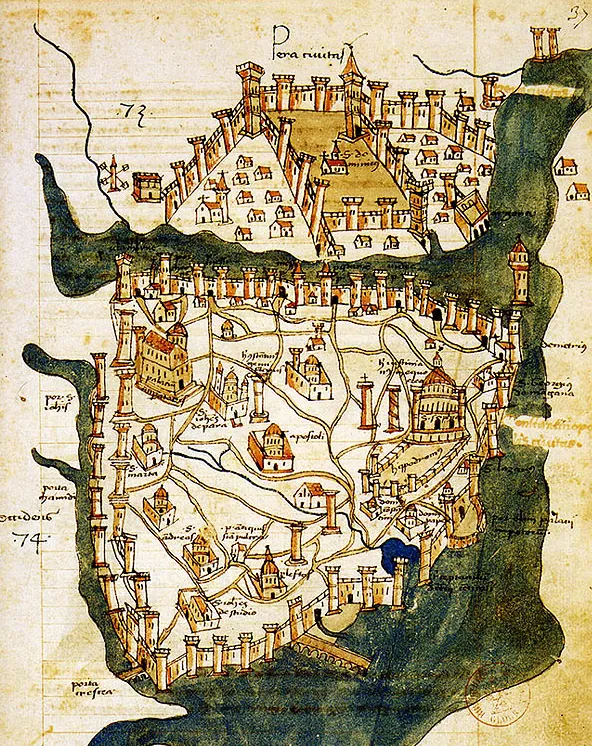
The oldest surviving map of the city. The Florentine priest Cristoforo Buondelmonti drew it around 1422. It is the oldest surviving map of the city and the only one known from before the Ottoman conquest. Hagia Sophia, the Hippodrome and the columns are visible and, beyond the Golden Horn, Genoese Pera.Cristoforo Buondelmonti, Liber insularum Archipelagi, c. 1422, copy held at the Bibliothèque nationale de France. Public domain, via Wikimedia Commons. 1452 – 1453
1453#
A sultan aged 21, an emperor with a few thousand defenders and a wall a thousand years old.
spring – August 1452
"The cutter of the strait": a castle built in four to five months#
Mehmed II builds on the European shore of the Bosphorus, facing his great-grandfather's castle, the fortress of Rumeli Hisarı. It was called Boğazkesen, "the cutter of the strait". An inscription shows it finished in July–August 1452.
In November its guns sink a Venetian grain ship that ignored the order to stop. The captain, Antonio Rizzo, is impaled. The passage to the Black Sea is now under the sultan's guns. This is the narrowest stretch of the Bosphorus: see the castle on the map of the strait.
April 1453
4,773 Greeks and about 200 foreigners#
That is what George Sphrantzes, the confidant of the emperor Constantine XI, counted in secret when he drew up the list of men able to bear arms. The Genoese Giovanni Giustiniani had arrived in January with 700 men and been given command of the land walls.
For the sultan's army the witnesses give figures between 160,000 and 300,000; a Turkish chronicler speaks of no more than 80,000 fighting men. The great gun, set before the Gate of St Romanus, threw a stone ball of about 1,200 pounds, more than half a ton.
The chain is drawn across the mouth of the Golden Horn on 2 April. The bombardment of the land walls lasts almost two months.
The number of defenders: from Sphrantzes's authentic chronicle. An expanded 16th-century version gives 4,973 Greeks and barely 2,000 foreigners; it is not clear whether Giustiniani's men are in the count.
night of 21–22 April 1453
The chain was not broken. The ships went over the hill#
On 20 April three Genoese ships and an imperial grain transport fight off the Ottoman fleet and enter the harbour behind the chain. Mehmed dismisses his admiral.
Two nights later the sultan moves ships overland, on a prepared track, from the shore of the Bosphorus over the hill behind Galata down into the Golden Horn: 67 according to the chronicler Kritovoulos, 72 according to the Venetian surgeon Nicolò Barbaro. The wall on the inlet, the weakest, now has to be defended too. The ships' road, on the map of the Bosphorus.
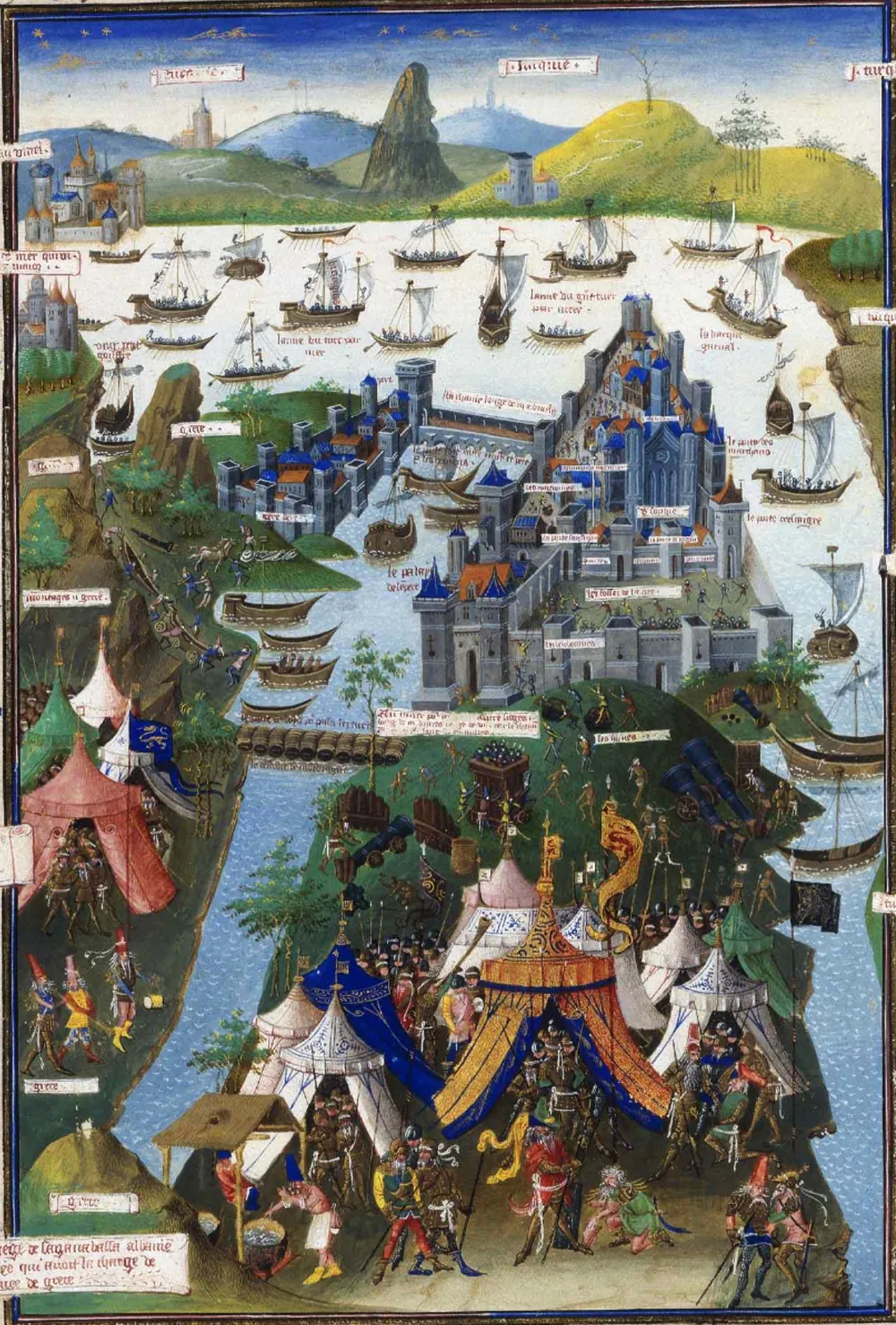
The siege, painted after 1455. A Burgundian miniaturist painted the siege a few years after the conquest, without having seen the city. He still put in what was being told in the West: on the left, the ships hauled over the hill.Miniature by Jean Le Tavernier, after 1455, in the manuscript of Bertrandon de la Broquière's journey. Bibliothèque nationale de France. Public domain, via Wikimedia Commons. 22 – 29 May 1453
Tuesday 29 May 1453#
On 22 May the full moon rises with a piece missing: a partial eclipse, which NASA's catalogue confirms. The defenders take it as a sign. On the evening of 28 May, according to later accounts, Greeks and Latins, at odds for months over the union of the churches, pray together in Hagia Sophia.
The assault begins in the night, in three waves; the last is the janissaries. Giustiniani is wounded and leaves his post, and the defence at the stockade before the Gate of St Romanus gives way. By morning the city is the sultan's.
No eyewitness account of the death of Constantine XI survives. Sphrantzes, his friend, writes that he was elsewhere, on the emperor's orders. The grave is not known.
The story of the Kerkoporta, a gate left open, appears in one chronicler only, Doukas, who was not there.
1453 – 1600
Kostantiniyye#
The sultan did not change the city's name. He repopulated it, gave it a market and a palace at its centre, and struck coins "in Constantinople" for more than four centuries, with a break in the 18th century when they read Islambol.
29 May – 1 June 1453
How long the sack lasted, and when Hagia Sophia became a mosque#
Mehmed had promised his soldiers three days of plunder. The chronicler Kritovoulos, a Greek who entered the sultan's service, counts about 4,000 dead and more than 50,000 captives and says the sack lasted from dawn until evening. The historian Halil İnalcık concludes that it stopped after 30 May.
The sultan rides into the city, goes to Hagia Sophia, reassures the people sheltering there and declares the church the city's great mosque. The first Friday prayer is held a few days later. Ayasofya remains the chief mosque until 1934.
The day of the sultan's entry differs by source: 29 or 30 May. The sources say only "Friday" for the first prayer; 1 June is a calendar reckoning.
1453 – 1477
A nearly empty city, filled with people brought by force#
A register of December 1455, only partly preserved, lists 918 houses in 22 quarters; 291 are marked empty or ruined. Mehmed proclaims an amnesty for those who fled and settles his own share of the captives along the Golden Horn. On 6 January 1454 he recognises Gennadios Scholarios as patriarch, to bring the Greeks back.
Then come the deportations. After each conquest part of the population is moved to the capital: Greeks from the Morea and the islands, people of Trebizond, Armenians and Greeks from Karaman, people of Caffa.
The count of 1477 finds 14,803 households in the city and 1,521 in Galata. In the city 8,951 are Muslim, 3,151 Greek and 1,647 Jewish. After 1492 the Jews expelled from Spain arrive; in 1493, by the date the book carries, two of them print the first book here, in Hebrew.
The count of 1477 leaves out soldiers, clerics, students and slaves. That Mehmed then gave the communities a charter of self-government is a later tradition; only the recognition of the patriarch is documented.
1456 – 1478
A bazaar, a mosque on the site of the Holy Apostles and a palace on the tip of the peninsula#
In 1456 it is decided to build a bedesten, a vaulted hall with fifteen domes for valuable goods. The Grand Bazaar grows up around it. At the Golden Gate the wall of Theodosius gets an inner fortress: Yedikule, "Seven Towers".
The church of the Holy Apostles, where the emperors were buried, had been given to the patriarch, who gave it up in 1455. On its site, between 1463 and 1470, Mehmed builds his mosque, with colleges, a hospital, a soup-kitchen and a market.
In 1459 the sultan tells his dignitaries each to choose a district and build there a mosque, an inn, a bath and a market. For himself he chooses the tip of the peninsula, the old acropolis: Topkapı Palace. The inscription on its gate carries the year 1478.
1509
The "little doomsday"#
That is what the chronicles called the earthquake of 1509. The walls are badly damaged, minarets fall, 109 mosques and 1,070 houses are ruined. Estimates of the dead run from 5,000 to 13,000. To rebuild, 37,000 workers are brought from Anatolia and 29,000 from the Balkans.
The mosque of Bayezid II, finished four years earlier on the site of the forum of Theodosius, is the city's second great imperial mosque.
The date differs by source: 22 August or 10 September 1509.
1538 – 1566
Sinan builds the mosques on the crests#
Under Süleyman, the chief architect Sinan builds the great mosques on the crests of the hills. The Şehzade mosque, built for the sultan's dead son, is finished in 1548. The Süleymaniye, on part of the gardens of the Old Palace, is begun in 1550 and opened on 15 October 1557.
Between 1554 and 1563 the Kırkçeşme system of aqueducts is built, bringing water from the Belgrade forest, north of the city. For about 1535 the historian Ömer Lütfi Barkan estimates some 80,000 households in the city, five times the count of 1477.
The 80,000 households are Barkan's estimate, not a count; İnalcık thinks his five people per household too many.
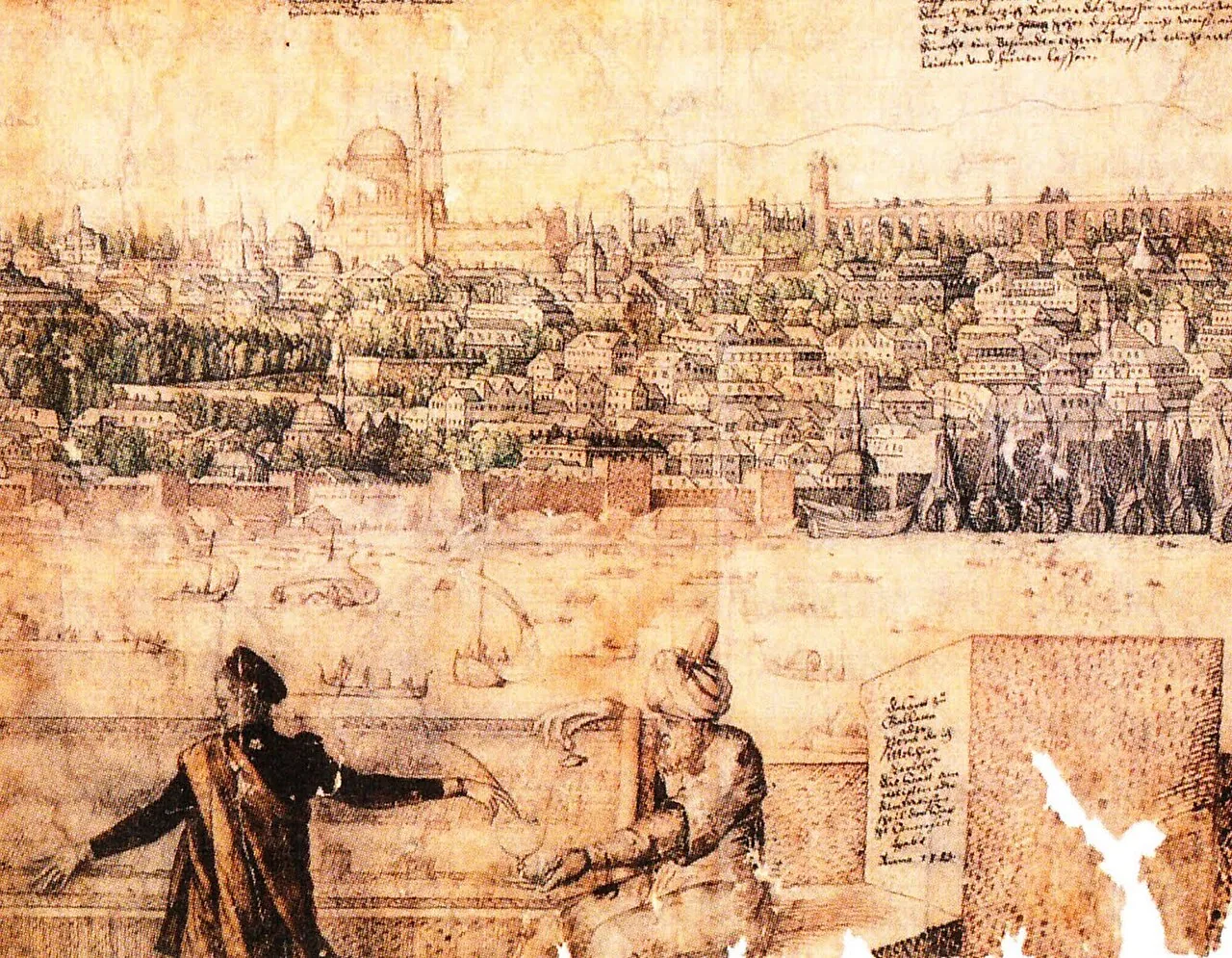
Süleyman's city, seen from Galata. Melchior Lorck, a draughtsman from Flensburg who came with a Habsburg embassy, drew the city from the hill of Galata and put himself in the drawing; the panorama carries the year 1559. The whole original is more than 11 metres long. The mosque on the crest is the Süleymaniye, opened in 1557.Melchior Lorck, Prospect of Constantinople, 1559 (detail). Leiden University Library. Public domain, via Wikimedia Commons. 1554 – 1580
The first coffeehouses, and an observatory pulled down by order of the sultan#
The historian Peçevi writes that the first coffeehouses were opened at Tahtakale, near the harbour, by a merchant from Aleppo and another from Damascus, in the year 962 of the Hijra (1554–1555). In 1568 they are banned, together with the taverns. They do not disappear.
From 1577 the chief astronomer Taqi al-Din works in an observatory on the heights of Tophane. After a fatwa saying that observatories bring disaster on their countries, an imperial order of 22 January 1580 has it demolished, instruments and all.
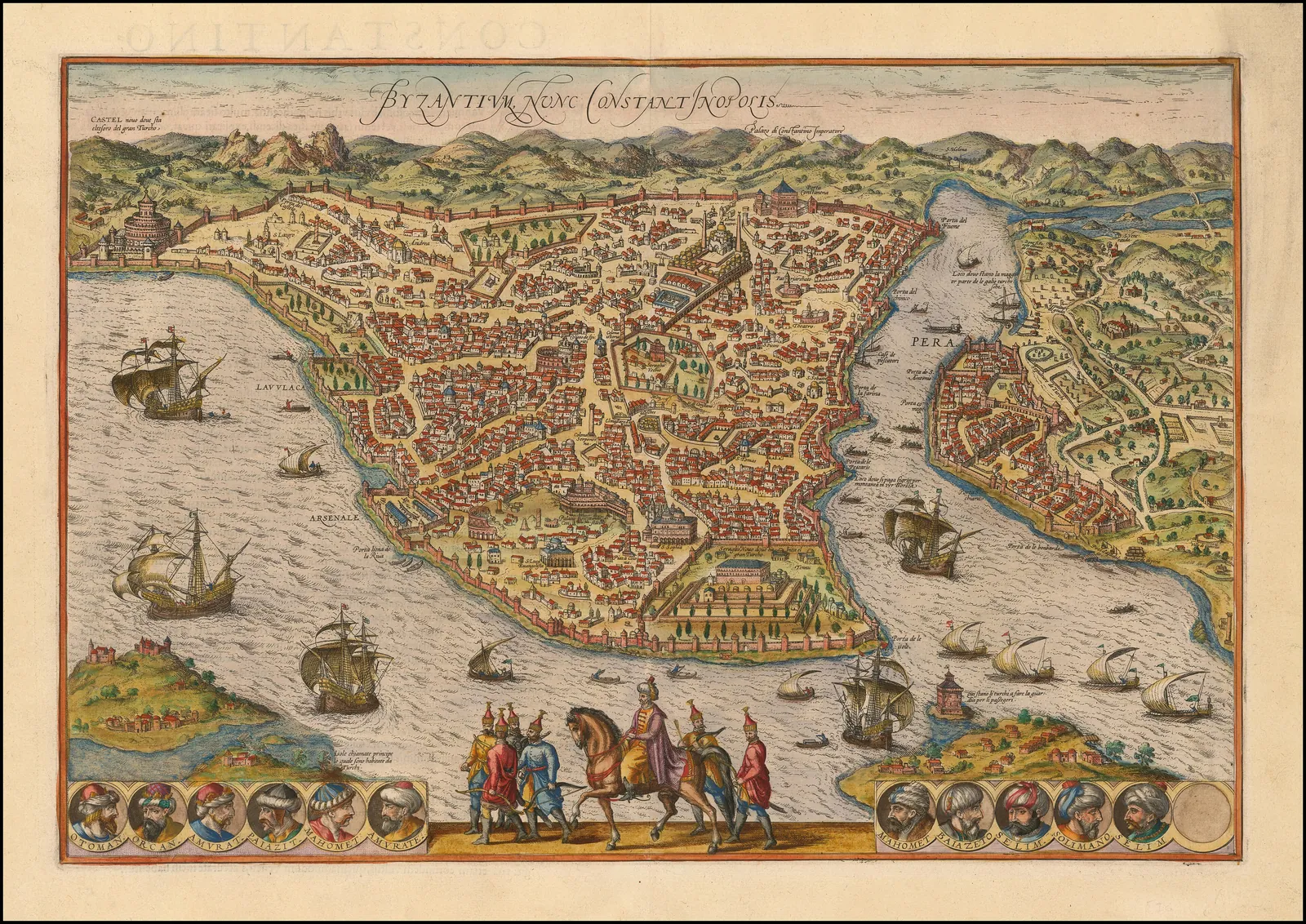
The city in an atlas of 1572. This is how the Ottoman capital looked in an atlas printed at Cologne in 1572. The title gives it two names: "Byzantium, now Constantinopolis". Top right, across the Golden Horn, Galata with its tower.Georg Braun and Frans Hogenberg, Civitates Orbis Terrarum, 1572. Public domain, via Wikimedia Commons. 1600 – 1800
Fire and wood#
The houses are of wood and the streets narrow. Every few decades a great fire takes whole districts, and the city is rebuilt, again in wood.
1609 – 1622
Six minarets by the Hippodrome, and a sultan strangled at Yedikule#
Between 1609 and 1617 Ahmed I builds the mosque known today as the Blue Mosque, beside the Hippodrome. It has six minarets, which no Ottoman mosque had had.
On 19 May 1622 the janissaries revolt. The next day Sultan Osman II, aged 17, is seized, paraded on a nag through the city under insults, taken to Yedikule and strangled there.
1633 – 1665
Forty-nine hours of fire#
On 2 September 1633 a fire started by a ship-caulker near the Cibali gate burns about a fifth of the city. Murad IV pulls down the coffeehouses, on the pretext that they are a fire risk, and bans tobacco.
On 24 July 1660 the fire starts in a shop by the Firewood Gate, west of Eminönü, and burns for 49 hours, as far as the Süleymaniye, Kumkapı, Samatya and the Hippodrome. The historian Marc David Baer speaks of two-thirds of the city destroyed and as many as 40,000 dead; İnalcık gives 4,000.
In the burnt district the sultan's mother completes the mosque begun in 1598 and left unfinished: Yeni Cami, the "New Mosque", opened in 1665.
The death toll of 1660 differs tenfold between the two historians.
1511 – 1673
The plague returns every few years#
İnalcık lists heavy epidemics in 1511, 1526, 1561, 1584, 1586, 1590, 1592, 1599, 1625, 1637, 1648, 1653 and 1673. For 1592 and 1648 the sources speak of a thousand deaths a day.
The thousand deaths a day are figures reported by chronicles, not counts.
1455 – 1821
Tsarigrad#
Wallachia and Moldavia, the two principalities that later formed Romania, paid tribute to the sultan for more than four centuries. For Romanians this was the city where a throne was bought, where the tribute was paid and where a prince could end his life in front of the sultan. They called it Țarigrad.
1521
What does Țarigrad mean? The oldest Romanian text already names it#
The letter of Neacșu of Câmpulung, the oldest text that survives in Romanian, which scholars date to June 1521, reports that "some craftsmen from Țarigrad" have undertaken to get some Turkish ships through a narrow place. The name comes from Church Slavonic, Цѣсарьградъ: "the emperor's city". The tsar in the name is the caesar in Constantinople; the word has nothing to do with the tsars of Russia.
The Moldavian chroniclers Grigore Ureche and Miron Costin use it throughout their chronicles. By 1929 the Romanian dictionary of Lazăr Șăineanu listed it as the "old" Romanian name of the city.
Vlad the Impaler and his brother Radu were not hostages here. Sultan Murad II took them as hostages in the early 1440s and sent them to a fortress in Anatolia: the chronicler Doukas calls it Nymphaion, the Ottoman tradition Eğrigöz. Vlad came back in 1448. The city was still Byzantine.
1455 – 1602
The tribute, the sheep and the princes' houses in the Phanar#
According to the Turkish encyclopaedia of Islam (TDV), Moldavia pays tribute from September 1455: 2,000 gold coins a year under Petru Aron, 4,000 under Stephen the Great, 12,000 after Süleyman's campaign of 1538. The throne itself cost far more. In the 18th century the two countries were called "Istanbul's larder": before 1584 at least 500,000 sheep a year came from them.
The princes kept trusted agents in the city, the capuchehaie, who took the tribute to the treasury. The Moldavians had a residence between the Phanar and Karagümrük, Bogdan Saray; Dimitrie Cantemir dates it to about 1504. The Wallachians had one in the Phanar, Vlah Saray. Its church housed the Ecumenical Patriarchate between 1586 and 1597, before the Patriarchate settled, about 1600 (1602 in TDV), where it still is.
Of Bogdan Saray only the lower floor of its chapel remains. A German traveller, Stephan Gerlach, says the property was bought in 1518.
1633 – 1716
Princes shut in the Seven Towers and killed before the sultan's eyes#
At Yedikule, the Seven Towers, writes Cantemir, no one could be held except by order of the sultan himself. Vasile Lupu of Moldavia was kept there after 1653. In 1633 Miron Barnovschi, prince of Moldavia, had been beheaded "in view of the Divan", the sultan watching from a window; the chronicler Miron Costin, whose father was among the imprisoned nobles, tells it.
In 1714 Constantin Brâncoveanu, prince of Wallachia since 1688, is deposed, brought to the city with his family and held at Yedikule. On 15 August, the feast of the Dormition, he is beheaded before Sultan Ahmed III, after his four sons and his counsellor Ianache Văcărescu. That day, in full.
Two years later his successor, Ștefan Cantacuzino, and Cantacuzino's father are strangled at night, in prison.
The eyewitness accounts do not name the place of the execution of 1714; the historian Mihai Maxim puts it at the Yalı kiosk, on the shore by today's Sirkeci station. The date is Old Style.
1688 – 1711
A Moldavian prince who wrote down the Turks' music#
Dimitrie Cantemir comes to the city in 1688, a hostage for his father, and stays, with one break, until 1710. He studies at the Patriarchate's school and at the palace school. Around 1700 he writes in Turkish a treatise on music, with more than 350 pieces set down in a notation of his own. The Turks call him Kantemiroğlu. His life, on a map.
In 1711, now prince of Moldavia, he goes over to the Russians. The Porte no longer trusts native princes. From 1711 at Iași and from 1716 at Bucharest, until 1821, the thrones go to families of the Phanar, the quarter of the Patriarchate, most of them Greek.
1722 – 1755
Pavilions by the water, a printing press and a revolt#
Under Ahmed III the court lays out gardens and pavilions at Kağıthane, at the head of the Golden Horn. In July 1727 İbrahim Müteferrika is allowed to open the first Turkish printing press; the city's Jews, Greeks and Armenians had been printing for a long time.
In the autumn of 1730 a revolt that starts in Beyazıt square closes the Grand Bazaar and brings down the sultan. The Nuruosmaniye mosque, finished in 1755, brings the baroque to the city.
22 May 1766
The Conqueror's mosque falls and is built again#
The earthquake of 22 May 1766 brings down many houses and public buildings. The mosque of Mehmed II collapses; today's mosque is built on the same site, on a different plan, between 1767 and 1771.
In August 1782 a fire that starts at Cibali is reckoned one of the greatest disasters the city had seen.
1826 – 1914
The 19th century#
The city gets bridges, steamers, trams, railway stations and a tunnel. The sultans move from the old palace to the shore of the Bosphorus.
1821 – 1826
A patriarch hanged, and the end of the janissaries#
In 1821, after the Greek revolt in the Morea, the ecumenical patriarch Gregory V is hanged at Easter at the middle gate of the Patriarchate.
In June 1826 the janissaries, who for two centuries had been making and unmaking sultans, overturn their cauldrons as a sign of mutiny. The next day the troops loyal to Mahmud II, gathered at the Sultan Ahmed mosque, shell and burn their barracks. The corps is abolished.
1836 – 1856
The first bridge over the Golden Horn, and a new palace on the Bosphorus#
The first modern bridge over the inlet, on pontoons, is laid in 1836 between Azapkapı and Unkapanı; the one between Karaköy and Eminönü, the Galata Bridge, comes in 1844 or 1845. On 3 November 1839, in the garden of Gülhane, the edict is read that promises all subjects, whatever their religion, security of life and property.
From 1850–51 a steam-ferry company links the villages of the Bosphorus to the city. In 1856 the sultan leaves Topkapı for Dolmabahçe, a palace in the European style built by the Armenian architects Garabet and Nikogos Balyan.
5 November 1854
Florence Nightingale at Scutari#
In the Crimean War the Selimiye barracks at Üsküdar, on the Asian shore, is the British army's hospital. Florence Nightingale arrives there on 5 November 1854 at the head of a party of 38 women. The English called the place Scutari.
1865 – 1875
Cholera, two fires and a tunnel from Galata to Pera#
In the summer of 1865 cholera kills, according to the American minister, at least 30,000 people. In September a fire that starts at Hocapaşa burns in some 32 hours the area between the Marmara and the Golden Horn, from Beyazıt to Hagia Sophia. In June 1870 Pera, the European quarter, burns; an estimated two thousand people die.
After the fires the streets are widened and new houses are built of stone and brick. In 1871 horse trams appear. On 17 January 1875 the Tünel opens, an underground funicular of about 573 metres that climbs from Galata to Pera, often called the world's second underground urban railway, after London's.
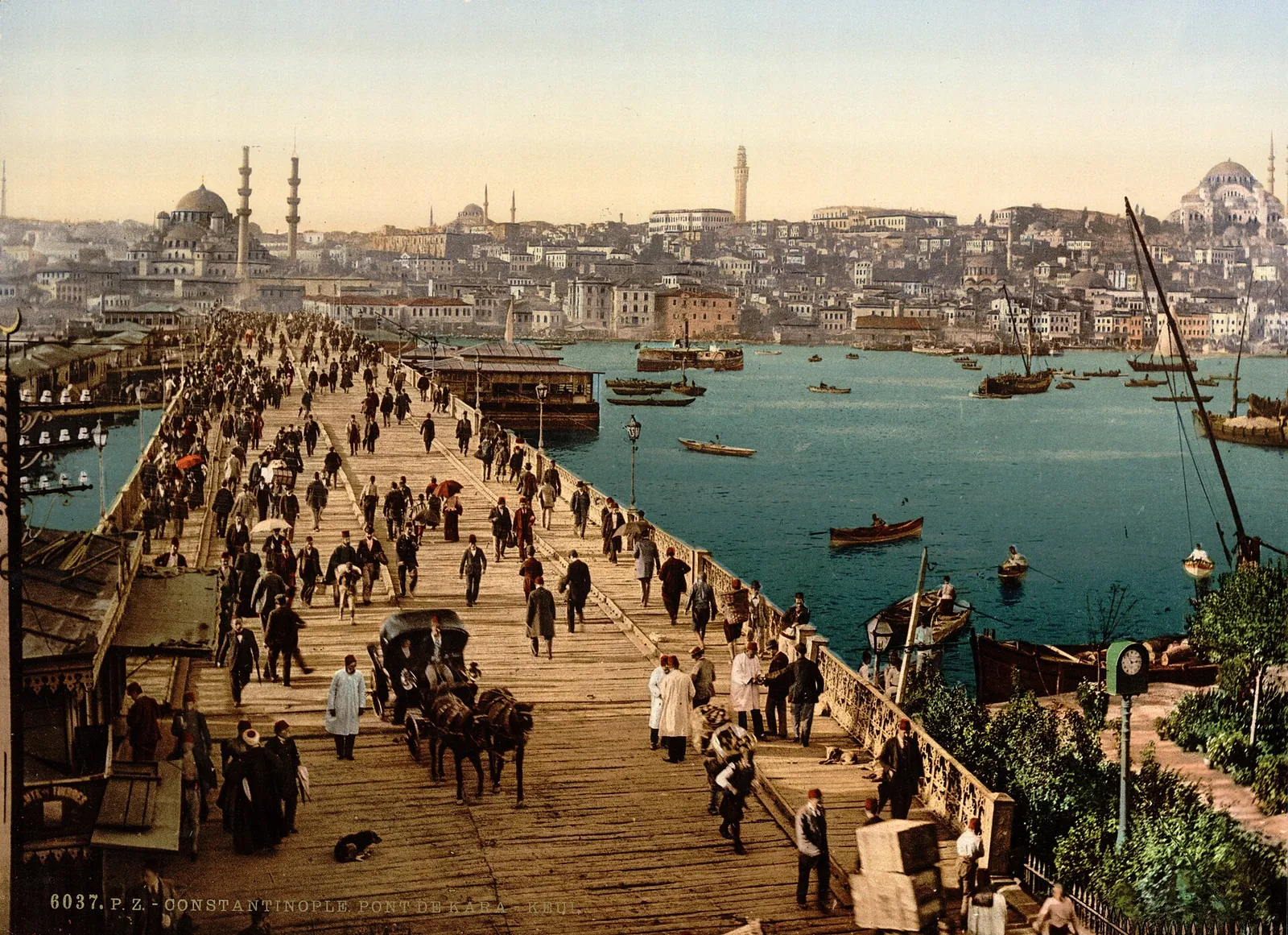
The Galata Bridge, about 1890. The pontoon bridge between Karaköy and Eminönü in the last decade of the 19th century. Behind it, Yeni Cami; on the hill, the Süleymaniye.Photochrom, Detroit Publishing Co., between 1890 and 1900. Library of Congress. Public domain, via Wikimedia Commons. 1876 – 1894
A constitution, the Russian army at the edge of the city and the train from Paris#
On 23 December 1876 the first Ottoman constitution is proclaimed. Article 2 says: "The capital of the Ottoman State is the city of Istanbul". In February 1878 the Russian army reaches San Stefano, today's Yeşilköy, close to the city; the peace is signed there.
In 1883 the first Orient Express leaves Paris. Passengers cross the Danube at Giurgiu, in Romania, and take the steamer from Varna. From 1889 the whole journey is by rail, to Sirkeci station.
The census of 1885 counts 873,565 inhabitants. Almost 60% of them had been born somewhere else.
1894 – 1914
An earthquake, a bank seized, eighty thousand dogs and electric light#
The earthquake of 10 July 1894 kills 276 people in the city, by the count of the seismologists Ambraseys and Finkel. On 26 August 1896 Armenian militants seize the headquarters of the Ottoman Bank in Galata; in the days that follow Armenians are killed in the streets across the city. The number of victims is not established.
In July 1908 the constitution is restored. In 1910 the municipality rounds up the street dogs, nearly 80,000 by the figure usually given, and takes them to the barren islet of Sivriada, where they are left to die.
Haydarpaşa station, the terminus of the line to Baghdad, is finished in 1908. In January 1914 the electric trams start running, and the plant at Silahtarağa, at the head of the Golden Horn, gives the city power.
1918 – 1955
No longer the capital#
After 1593 years the city is no longer a capital. And it loses a large part of its inhabitants who were not Turks.
November 1918 – March 1924
An Allied fleet anchors off the city#
After the armistice of 30 October 1918 an Allied fleet of more than fifty warships (55 or 61, depending on the source) anchors off Istanbul and lands troops: the first occupation since 1453. On 16 March 1920 the occupation becomes formal, and the British arrest deputies in the parliament itself.
The assembly in Ankara abolishes the sultanate on 1 November 1922. On the morning of 17 November the last sultan, Mehmed VI, leaves the city on a British battleship. The last Allied units withdraw on 2 October 1923; the Turkish army enters on 6 October. A week later, on 13 October, the capital is moved to Ankara.
On the night of 3 March 1924, after the abolition of the caliphate, the last caliph is put on a train at Çatalca, outside the city, and escorted to the border.
1927 – 1930
When did Constantinople become Istanbul? Not in 1930#
The name is five centuries older than the Ottoman conquest. Around 956 the Arab geographer al-Masudi noted that the Greeks call their city "bulin" and "stan bulin": "in the City", as an ordinary Greek says it, στην Πόλη. Ibn Battuta writes "Istambul" a century before 1453. Turks called it that all along, and the Ottoman constitution of 1876 names it as the capital under this name. On coins and in documents, though, the sultans also kept the Arabic form of Constantine's name, Kostantiniyye.
No law of 1930 changing the name is known. Something else happened: in 1929–1930 Turkey asked foreigners to stop writing "Constantinople". From the spring of 1930 the request covered all the old names: Angora, Smyrna, Adrianople.
The first census of the republic, in 1927, had found 691,000 people in the city, well under the estimate of about 1,200,000 for the war years.
The etymology "in the City" is a linguistic reconstruction, upheld by the most detailed recent study (Stachowski and Woodhouse, 2015). The Ottoman statistics of 1914, which cover Ottoman subjects only, give 909,978.
1934 – 1964
Hagia Sophia becomes a museum, and the city's Greeks leave#
A decree of 24 November 1934 ends the use of Hagia Sophia as a mosque and hands it to the museums.
The Treaty of Lausanne had exempted the Greeks of Constantinople from the population exchange of 1923. On the evening of 6 September 1955 crowds attack the shops on İstiklal street, then in other districts. 4,340 shops, 2,600 homes and 73 churches are wrecked. From March 1964, during the Cyprus crisis, Turkey expels the Greeks who hold Greek citizenship, most of them born in the city.
1950 – 2026
The megacity#
In three quarters of a century it goes from about one million people in the city to almost sixteen million in the province, and the city spreads far along both shores.
1975 – 2020
How far the city has spread: what the satellite sees#
After 1950 industry and people arriving from Anatolia fill the edges with "gecekondu", houses put up overnight. The population passes one million in the 1950s and two million in 1970.
The built-up areas now light up on the map, five years at a time, from satellite images. Within the frame of the map the surface covered by buildings grows from 185 km² in 1975 to 316 km² in 2020. The biggest jump is between 1990 and 2000.
Data: Global Human Settlement Layer (European Commission). Each 100 m cell lights up once buildings cover at least 20% of it. The images are of 1975, 1990, 2000, 2014 and 2018; the years between are interpolated. Those of 1975 miss scattered houses; demolitions do not show.
1973 – 2018
Three bridges and two tunnels between Europe and Asia#
The first bridge over the Bosphorus opens in the autumn of 1973, fifty years into the republic. After the second, of 1988, the city spreads north. On 29 October 2013 Marmaray opens, the rail tunnel under the strait; in 2016 the third bridge, at the mouth of the Black Sea, and a road tunnel.
The dig for the Marmaray station at Yenikapı ran into the harbour of Theodosius and, beneath it, the Neolithic village this page began with.
17 August 1999
The earthquake that came, and the one that is expected#
The magnitude 7.4 earthquake of 17 August 1999 had its epicentre about 80 kilometres from the city. By the official count it killed 17,127 people; the US Geological Survey's map shows 978 dead in the province of Istanbul, most of them in Avcılar, on the western edge.
The fault continues under the Sea of Marmara. A study published in Science in 2000 calculated, for Istanbul, a 62% (±15) probability of strong shaking in the following thirty years. A recalculation in 2004 gave 41% (±14) for the years 2004–2034.
2020 – 2026
Today#
On 24 July 2020, after 86 years as a museum, Hagia Sophia reopened as a mosque. The Chora church, with its 14th-century mosaics, followed on 6 May 2024.
At the end of 2025 the province of Istanbul had 15,754,053 inhabitants. The peninsula inside the walls, which once held the whole city, is now a single one of its districts, Fatih.
The wall of Theodosius can be walked from end to end. The column of Constantine stands where it was put in the year 330.
The map alone, from 660 BC to today#
The same map, without the text: a button that runs the years, a slider for any year and a map you can move with your finger. Touch a mark to learn what building it is, when it was built and what became of it.
What the city was called and who ruled it in a given year#
Type a year: the one you were born in, the year of a battle you learned at school, the year an ancestor might have arrived here with goods to sell. The answer comes from the same lists the map is drawn from.
How many emperors and sultans ruled from the city, and how they ended#
Between the dedication of 330 and the abolition of the sultanate in 1922, 127 reigns were held from this city: 91 reigns of East Roman emperors, 5 Latin emperors and 31 reigns of sultans. Each bar is one reign on a time axis; the colour shows how it ended.
Touch a bar to see who ruled then and how the reign ended.
Of the 91 reigns of emperors, only 39 ended with the natural death of the emperor on the throne. 38 ended in deposition, blinding or mutilation, murder, flight or death in battle, 8 in abdication, most often forced, and the other 6 otherwise. Among the sultans, 16 of 31 reigns ended with a natural death on the throne and 13 in deposition or killing.
The median reign of an emperor lasted 7.5 years; of a sultan, 13.9 years. The longest reign held from the city was that of Basil II the Bulgar-Slayer: almost 50 years.
| Name | Title | Reign | End of the reign |
|---|---|---|---|
| Constantine I | emperor | 330–337 | died on the throne |
| Constantius II | emperor | 337–361 | died on the throne |
| Julian | emperor | 361–363 | died in battle |
| Valens | emperor | 364–378 | died in battle |
| Procopius | emperor | 365–366 | killed |
| Theodosius I | emperor | 379–395 | died on the throne |
| Arcadius | emperor | 395–408 | died on the throne |
| Theodosius II | emperor | 408–450 | ended otherwise |
| Marcian | emperor | 450–457 | died on the throne |
| Leo I | emperor | 457–474 | died on the throne |
| Leo II | emperor | 474 | died on the throne |
| Zeno | emperor | 474–475 | deposed |
| Basiliscus | emperor | 475–476 | deposed |
| Zeno | emperor | 476–491 | died on the throne |
| Anastasius I | emperor | 491–518 | died on the throne |
| Justin I | emperor | 518–527 | died on the throne |
| Justinian I | emperor | 527–565 | died on the throne |
| Justin II | emperor | 565–578 | died on the throne |
| Tiberius II Constantine | emperor | 578–582 | died on the throne |
| Maurice | emperor | 582–602 | killed |
| Phocas | emperor | 602–610 | killed |
| Heraclius | emperor | 610–641 | died on the throne |
| Constantine III (Heraclius Constantine) | emperor | 641 | died on the throne |
| Heraclonas | emperor | 641 | deposed and mutilated |
| Constans II | emperor | 641–668 | killed |
| Constantine IV | emperor | 668–685 | died on the throne |
| Justinian II | emperor | 685–695 | deposed and mutilated |
| Leontius | emperor | 695–698 | deposed and mutilated |
| Tiberius III (Apsimar) | emperor | 698–705 | deposed |
| Justinian II | emperor | 705–711 | killed |
| Philippikos (Bardanes) | emperor | 711–713 | deposed and blinded |
| Anastasius II (Artemius) | emperor | 713–715 | deposed |
| Theodosius III | emperor | 715–717 | gave up the throne |
| Leo III the Isaurian | emperor | 717–741 | died on the throne |
| Artabasdos | emperor | 741–743 | deposed and blinded |
| Constantine V | emperor | 741–775 | died on the throne |
| Leo IV the Khazar | emperor | 775–780 | died on the throne |
| Constantine VI | emperor | 780–797 | deposed and blinded |
| Irene of Athens | empress | 797–802 | deposed |
| Nikephoros I | emperor | 802–811 | died in battle |
| Staurakios | emperor | 811 | gave up the throne |
| Michael I Rangabe | emperor | 811–813 | gave up the throne |
| Leo V the Armenian | emperor | 813–820 | killed |
| Michael II the Amorian | emperor | 820–829 | died on the throne |
| Theophilos | emperor | 829–842 | died on the throne |
| Michael III | emperor | 842–867 | killed |
| Basil I the Macedonian | emperor | 867–886 | ended otherwise |
| Leo VI the Wise | emperor | 886–912 | died on the throne |
| Alexander | emperor | 912–913 | died on the throne |
| Constantine VII Porphyrogenitus | emperor | 913–959 | died on the throne |
| Romanos I Lekapenos | emperor | 920–944 | deposed |
| Romanos II | emperor | 959–963 | died on the throne |
| Nikephoros II Phokas | emperor | 963–969 | killed |
| John I Tzimiskes | emperor | 969–976 | died on the throne |
| Basil II the Bulgar-Slayer | emperor | 976–1025 | died on the throne |
| Constantine VIII | emperor | 1025–1028 | died on the throne |
| Romanos III Argyros | emperor | 1028–1034 | ended otherwise |
| Michael IV the Paphlagonian | emperor | 1034–1041 | died on the throne |
| Michael V Kalaphates | emperor | 1041–1042 | deposed and blinded |
| Zoe Porphyrogenita | empress | 1042 | ended otherwise |
| Theodora Porphyrogenita | empress | 1042 | ended otherwise |
| Constantine IX Monomachos | emperor | 1042–1055 | died on the throne |
| Theodora Porphyrogenita | empress | 1055–1056 | died on the throne |
| Michael VI Bringas | emperor | 1056–1057 | gave up the throne |
| Isaac I Komnenos | emperor | 1057–1059 | gave up the throne |
| Constantine X Doukas | emperor | 1059–1067 | died on the throne |
| Romanos IV Diogenes | emperor | 1068–1071 | deposed and blinded |
| Michael VII Doukas | emperor | 1071–1078 | gave up the throne |
| Nikephoros III Botaneiates | emperor | 1078–1081 | gave up the throne |
| Alexios I Komnenos | emperor | 1081–1118 | died on the throne |
| John II Komnenos | emperor | 1118–1143 | ended otherwise |
| Manuel I Komnenos | emperor | 1143–1180 | died on the throne |
| Alexios II Komnenos | emperor | 1180–1183 | killed |
| Andronikos I Komnenos | emperor | 1183–1185 | killed |
| Isaac II Angelos | emperor | 1185–1195 | deposed and blinded |
| Alexios III Angelos | emperor | 1195–1203 | deposed |
| Isaac II Angelos | emperor | 1203–1204 | deposed |
| Alexios IV Angelos | emperor | 1203–1204 | deposed |
| Alexios V Doukas Murtzuphlos | emperor | 1204 | reign ended by the conquest of the city |
| Baldwin I of Flanders | Latin emperor | 1204–1205 | ended otherwise |
| Henry of Flanders | Latin emperor | 1206–1216 | died on the throne |
| Robert of Courtenay | Latin emperor | 1221–1228 | died on the throne |
| Baldwin II of Courtenay | Latin emperor | 1228–1261 | reign ended by the conquest of the city |
| John of Brienne | Latin emperor | 1229–1237 | died on the throne |
| Michael VIII Palaiologos | emperor | 1261–1282 | died on the throne |
| Andronikos II Palaiologos | emperor | 1282–1328 | deposed |
| Andronikos III Palaiologos | emperor | 1328–1341 | died on the throne |
| John V Palaiologos | emperor | 1341–1376 | deposed |
| John VI Kantakouzenos | emperor | 1347–1354 | gave up the throne |
| Andronikos IV Palaiologos | emperor | 1376–1379 | deposed |
| John V Palaiologos | emperor | 1379–1390 | deposed |
| John VII Palaiologos | emperor | 1390 | deposed |
| John V Palaiologos | emperor | 1390–1391 | died on the throne |
| Manuel II Palaiologos | emperor | 1391–1425 | died on the throne |
| John VIII Palaiologos | emperor | 1425–1448 | died on the throne |
| Constantine XI Palaiologos | emperor | 1449–1453 | died in battle |
| Mehmed II | sultan | 1453–1481 | died on the throne |
| Bayezid II | sultan | 1481–1512 | gave up the throne |
| Selim I the Grim | sultan | 1512–1520 | died on the throne |
| Suleiman I the Magnificent | sultan | 1520–1566 | died on the throne |
| Selim II | sultan | 1566–1574 | ended otherwise |
| Murad III | sultan | 1574–1595 | died on the throne |
| Mehmed III | sultan | 1595–1603 | died on the throne |
| Ahmed I | sultan | 1603–1617 | died on the throne |
| Mustafa I | sultan | 1617–1618 | deposed |
| Osman II | sultan | 1618–1622 | killed |
| Mustafa I | sultan | 1622–1623 | deposed |
| Murad IV | sultan | 1623–1640 | died on the throne |
| Ibrahim | sultan | 1640–1648 | deposed |
| Mehmed IV | sultan | 1648–1687 | deposed |
| Suleiman II | sultan | 1687–1691 | died on the throne |
| Ahmed II | sultan | 1691–1695 | died on the throne |
| Mustafa II | sultan | 1695–1703 | deposed |
| Ahmed III | sultan | 1703–1730 | deposed |
| Mahmud I | sultan | 1730–1754 | died on the throne |
| Osman III | sultan | 1754–1757 | died on the throne |
| Mustafa III | sultan | 1757–1774 | died on the throne |
| Abdulhamid I | sultan | 1774–1789 | died on the throne |
| Selim III | sultan | 1789–1807 | deposed |
| Mustafa IV | sultan | 1807–1808 | deposed |
| Mahmud II | sultan | 1808–1839 | died on the throne |
| Abdulmejid I | sultan | 1839–1861 | died on the throne |
| Abdulaziz | sultan | 1861–1876 | deposed |
| Murad V | sultan | 1876 | deposed |
| Abdulhamid II | sultan | 1876–1909 | deposed |
| Mehmed V Resad | sultan | 1909–1918 | died on the throne |
| Mehmed VI Vahideddin | sultan | 1918–1922 | deposed |
| Abdulmejid II | caliph | 1922–1924 | deposed |
All the names of the city#
None of these names replaced the one before it overnight. Five or six were in use at once, each in someone else's language and script.
| Name | Who called it that | Period, approximate |
|---|---|---|
| Βυζάντιον · Byzantion | in Greek; the name is held to be Thracian | 660 BC – 330 |
| Byzantium | in Latin | 146 BC – 330 |
| Κωνσταντινούπολις · Constantinople | in Greek: "Constantine's city" | 330 – 1453 |
| Constantinopolis | in Latin and in the West | 330 – 1930 |
| Νέα Ῥώμη · New Rome | an honorific, from 381 | 381 – 1453 |
| ἡ Πόλις · i Poli, "the City" | what Greeks call it | 400 – today |
| Stan bulin · Stan bulin, Istambul | as Arabs and Turks hear it from Greeks | 956 – 1453 |
| Miklagarðr · Miklagard | in Old Norse, in writing from c. 1190: "the Great City" | 1190 – 1300 |
| Цѣсарьградъ · Tsarigrad | among the Slavs: "the emperor's city" | 1100 – 1900 |
| قسطنطينيه · Kostantiniyye | the name on the sultans' coins and documents | 1453 – 1922 |
| استانبول · İstanbul | in Turkish, the everyday name | 1453 – 1922 |
| Κωνσταντινούπολη · Konstantinoupoli | in Greek | 1453 – today |
| Țarigrad | among Romanians, from Slavonic | 1521 – 1850 |
| اسلامبول · Islambol | on coins: "full of Islam" | 1703 – 1807 |
| Պոլիս · Bolis | in Armenian | 1453 – today |
| קושטא · Kushta | in Hebrew | 1500 – 1923 |
| İstanbul | in Turkish; asked of foreigners too from 1930 | 1922 – today |
How many times Constantinople was besieged#
There is no number historians agree on; it depends on what you count as a siege. The list below gathers what appears in the sources consulted, from Byzantion to 1453: 62 sieges, blockades, naval raids and forced entries.
Of these, 51 took place after 330. In that time the city was taken 16 times, 12 of them in civil wars, often through a gate opened from inside. An army from outside stormed its walls only twice: in April 1204 and in May 1453.
| Year | Attacker | Kind | Outcome |
|---|---|---|---|
| 511 BC | Persians under Otanes | from outside | city taken |
| 478 BC | Hellenic League fleet under Pausanias of Sparta | from outside | city taken |
| 475 BC | Athenians (under Cimon, per Plutarch) | from outside | city taken |
| 408 BC | Athenians under Alcibiades | from outside | city taken |
| 400 BC | The Ten Thousand (Greek mercenaries of Cyrus) | from outside | city taken |
| 340 BC–339 BC | Philip II of Macedon | from outside | beaten off |
| 193–196 | Army and fleet of Septimius Severus | civil war | city taken |
| 262 | Mutinous soldiers of Gallienus | civil war | city taken |
| 268–269 | Goths and Heruls (sea raiders from the Black Sea) | from outside | beaten off |
| 313 | Maximinus Daia | civil war | city taken |
| 324 | Constantine I, with the fleet under Crispus | civil war | city taken |
| 378 | Goths | from outside | beaten off |
| 400 | Gothic troops of the magister militum Gainas | civil war | beaten off |
| 481 | Theoderic Strabo, Gothic federate leader | from outside | beaten off |
| 487 | Theoderic the Amal, king of the Ostrogoths | from outside | siege lifted |
| 513 | Vitalian, rebel comes foederatorum, with Roman troops and Huns/Bulgars | civil war | left after payment or treaty |
| 514 | Vitalian, with an army and a fleet of 200 vessels | civil war | left after payment or treaty |
| 515 | Vitalian, by land and sea | civil war | beaten off |
| 559 | Kutrigur Huns under Zabergan | from outside | beaten off |
| 610 | Heraclius the Younger with the fleet of the exarchate of Africa | civil war | city taken |
| 626 | Avar khaganate with Slavs, Bulgars and Gepids; Sasanian Persian army at Chalcedon | from outside | beaten off |
| 654 | Umayyad governor Mu'awiya (fleet and army at Chalcedon) | from outside | siege lifted |
| 674–678 | Umayyad Caliphate, fleet based at Cyzicus (date disputed) | from outside | beaten off |
| 698 | Apsimar (Tiberius III) with the mutinous fleet from Africa | civil war | city taken |
| 705 | Justinian II with the Bulgar khan Tervel | civil war | city taken |
| 715 | Theodosius III with the Opsikion troops and Gotho-Graeci | civil war | city taken |
| 717–718 | Umayyad Caliphate | from outside | beaten off |
| 742–743 | Constantine V | civil war | city taken |
| 813 | Krum, khan of the Bulgars | from outside | beaten off |
| 821–823 | Thomas the Slav | civil war | beaten off |
| 860 | Rus' fleet of two hundred boats | from outside | beaten off |
| 907 | Oleg of Kiev (only in the Rus' chronicle) | from outside | left after payment or treaty |
| 913 | Symeon of Bulgaria | from outside | beaten off |
| 921 | Symeon of Bulgaria | from outside | beaten off |
| 924 | Symeon of Bulgaria | from outside | left after payment or treaty |
| 934 | Magyars | from outside | left after payment or treaty |
| 941 | Igor of Kiev (Rus') | from outside | beaten off |
| 1043 | Vladimir of Novgorod, son of Yaroslav of Kiev (Rus') | from outside | beaten off |
| 1047 | Leo Tornikios | civil war | beaten off |
| 1077 | John Bryennios for his brother, the rebel Nikephoros Bryennios | civil war | beaten off |
| 1081 | Alexios and Isaac Komnenos (rebel army) | civil war | city taken |
| 1097 | Godfrey of Bouillon's crusaders | from outside | beaten off |
| 1187 | Alexios Branas (rebel general) | civil war | beaten off |
| 1203 | Fourth Crusade (Franks and Venetians) for Alexios Angelos | from outside | city taken |
| 1204 | Fourth Crusade (Franks and Venetians) | from outside | city taken |
| 1235 | John III Vatatzes of Nicaea and Ivan Asen II of Bulgaria | from outside | beaten off |
| 1236 | John III Vatatzes of Nicaea and Ivan Asen II of Bulgaria | from outside | beaten off |
| 1260 | Michael VIII Palaiologos (Nicaea) | from outside | beaten off |
| 1261 | Alexios Strategopoulos for Michael VIII (Nicaea) | from outside | city taken |
| 1296 | Venice (fleet of Ruggiero Morosini) | from outside | beaten off |
| 1302 | Venice (Belletto Giustinian, with pirate ships) | from outside | left after payment or treaty |
| 1328 | Andronikos III Palaiologos | civil war | city taken |
| 1347 | John VI Kantakouzenos | civil war | city taken |
| 1348–1349 | Genoese of Galata | from outside | beaten off |
| 1354 | John V Palaiologos | civil war | city taken |
| 1376 | Andronikos IV with Genoese and Ottoman troops | civil war | city taken |
| 1379 | John V and Manuel with Venetian ships and an Ottoman army | civil war | city taken |
| 1390 | John VII Palaiologos with Ottoman backing | civil war | city taken |
| 1394–1402 | Bayezid I (Ottomans) | from outside | siege lifted |
| 1411 | Musa Çelebi (Ottoman prince) | from outside | siege lifted |
| 1422 | Murad II (Ottomans) | from outside | siege lifted |
| 1453 | Mehmed II (Ottomans) | from outside | city taken |
The buildings on the map: what still stands#
The map follows 80 buildings and structures. 12 of them are lost altogether or survive only as traces; on the map they stay as an empty outline.
| Building | Kind | On the map from | Fate |
|---|---|---|---|
| Hippodrome | forum, column, public place | 210 | still to be seen. Late writers credit its first form to Septimius Severus; enlarged by Constantine. Today it is a square, with the obelisk in place. |
| Baths of Zeuxippus | forum, column, public place | 210 | gone about 720 |
| Column of Constantine | forum, column, public place | 330 | still to be seen |
| Great Palace | palace | 330 | gone about 1300. Gradually abandoned for Blachernae; substructures and mosaics remain. |
| Milion | forum, column, public place | 330 | gone about 1500 |
| Hagia Eirene | church | 337 | still to be seen |
| Holy Apostles | church | 337 | gone in 1462. The emperors' burial church; the Fatih mosque stands on its site. |
| Hagia Sophia | church | 360 | still to be seen. The first church dates from 360; today's from 537. A mosque from 1453, a museum from 1934, a mosque again since 2020. |
| Aqueduct of Valens | water: cistern, aqueduct | 373 | still to be seen |
| Harbour of Theodosius | harbour | 390 | gone about 1200. Silted up in the Middle Ages; excavated 2004–2013 at Yenikapı. |
| Obelisk of Theodosius | forum, column, public place | 390 | still to be seen |
| Forum of Theodosius | forum, column, public place | 393 | gone about 1460 |
| Golden Gate | forum, column, public place | 413 | still to be seen. A triumphal arch built into the Theodosian wall; its date is disputed. |
| Column of Arcadius | forum, column, public place | 421 | gone in 1711. Taken down in 1711 (1715 in other accounts); the base survives. |
| Cistern of Aetius | water: cistern, aqueduct | 421 | still to be seen. The dry basin is now a stadium. |
| Theodosius Cistern | water: cistern, aqueduct | 443 | still to be seen |
| Column of Marcian | forum, column, public place | 452 | still to be seen |
| Stoudios monastery | church | 454 | still to be seen. Today a roofless ruin. |
| Cistern of Aspar | water: cistern, aqueduct | 459 | still to be seen |
| Church of the Virgin at Blachernae | church | 473 | gone in 1434. It burnt down. |
| Basilica Cistern (Yerebatan) | water: cistern, aqueduct | 532 | still to be seen |
| Sts Sergius and Bacchus | church | 536 | still to be seen |
| Monastery of Lips | church | 907 | still to be seen |
| Myrelaion | church | 922 | still to be seen |
| Blachernae Palace | palace | 1100 | gone in 1453 |
| Maiden's Tower | fortress | 1110 | still to be seen |
| Pantokrator monastery | church | 1136 | still to be seen |
| Kalenderhane | church | 1200 | still to be seen |
| St Mary of the Mongols | church | 1281 | still to be seen |
| Palace of the Porphyrogenitus (Tekfur) | palace | 1300 | still to be seen. The shell has been re-roofed; a museum since 2019. |
| Pammakaristos | church | 1310 | still to be seen |
| Chora | church | 1321 | still to be seen. The mosaics date from c. 1315–1321. A mosque again since 2024. |
| San Domenico (Arap Camii) | church | 1337 | still to be seen |
| Galata Tower | fortress | 1348 | still to be seen. The tower of 1348 has been raised and rebuilt several times. |
| Anadolu Hisarı | fortress | 1395 | still to be seen |
| Rumeli Hisarı | fortress | 1452 | still to be seen |
| Old Palace | Ottoman building | 1455 | gone about 1826. Istanbul University now stands on its site. |
| Yedikule (Seven Towers) | fortress | 1455 | still to be seen |
| Eyüp mosque | mosque | 1459 | still to be seen. Today's mosque dates from 1798–1800. |
| Grand Bazaar | Ottoman building | 1461 | still to be seen. The vaulted hall at its core was decided on in 1456 and built in the following years. |
| Fatih mosque | mosque | 1470 | still to be seen. The first mosque (1470) fell in the earthquake of 1766; today's dates from 1771. |
| Topkapı Palace | Ottoman building | 1478 | still to be seen |
| Bogdan Saray | Ottoman building | 1504 | gone about 1784. The residence of Moldavia's agents. It is said to have burnt in 1784; the lower floor of its chapel remains. |
| Bayezid mosque | mosque | 1505 | still to be seen |
| Haseki complex | mosque | 1539 | still to be seen |
| Şehzade mosque | mosque | 1548 | still to be seen |
| Mihrimah, Üsküdar | mosque | 1548 | still to be seen |
| Süleymaniye | mosque | 1557 | still to be seen |
| Rüstem Pasha mosque | mosque | 1561 | still to be seen |
| Mihrimah, Edirnekapı | mosque | 1566 | still to be seen |
| Sokollu Mehmed Pasha | mosque | 1572 | still to be seen |
| Observatory of Taqi al-Din | Ottoman building | 1577 | gone in 1580 |
| Ecumenical Patriarchate | church | 1602 | still to be seen. Today's church was rebuilt in 1720. |
| Blue Mosque | mosque | 1617 | still to be seen |
| Yeni Cami | mosque | 1665 | still to be seen |
| Spice Bazaar | Ottoman building | 1665 | still to be seen |
| Fountain of Ahmed III | Ottoman building | 1729 | still to be seen |
| Nuruosmaniye | mosque | 1755 | still to be seen |
| Laleli | mosque | 1764 | still to be seen |
| Selimiye Barracks | Ottoman building | 1803 | still to be seen. The first barracks (1803) burned in 1808; today's building was begun under Mahmud II. |
| Galata Bridge | modern structure | 1845 | still to be seen. The first bridge was of 1845; today's is the fifth. |
| Ortaköy mosque | mosque | 1854 | still to be seen |
| Dolmabahçe Palace | Ottoman building | 1856 | still to be seen |
| Beylerbeyi Palace | Ottoman building | 1865 | still to be seen |
| Çırağan Palace | Ottoman building | 1871 | still to be seen. Burned in 1910; rebuilt as a hotel in 1987–1991. |
| Tünel | modern structure | 1875 | still to be seen |
| Sirkeci station | modern structure | 1890 | still to be seen |
| Pera Palace | modern structure | 1895 | still to be seen |
| Bulgarian iron church | church | 1898 | still to be seen |
| Haydarpaşa station | modern structure | 1908 | still to be seen |
| Silahtarağa power station | modern structure | 1914 | still to be seen |
| Republic Monument, Taksim | modern structure | 1928 | still to be seen |
| Atatürk Bridge | modern structure | 1940 | still to be seen |
| Bosphorus Bridge (1973) | modern structure | 1973 | still to be seen |
| Fatih Sultan Mehmet Bridge (1988) | modern structure | 1988 | still to be seen |
| Marmaray tunnel (2013) | modern structure | 2013 | still to be seen |
| Yavuz Sultan Selim Bridge (2016) | modern structure | 2016 | still to be seen |
| Eurasia Tunnel | modern structure | 2016 | still to be seen |
| Istanbul Airport (2018) | modern structure | 2018 | still to be seen |
| Çamlıca mosque | mosque | 2019 | still to be seen |
How many people the city had through time#
Until 1885 there is no complete count of the inhabitants. Everything earlier is historians' estimates, given here as ranges with the names of those who made them. The Ottoman counts of 1844 and 1856, often quoted as censuses, cover men only.
| Year | People | What kind of figure | According to |
|---|---|---|---|
| 100 BC | 20,000 – 36,000 | estimate, Greek and Roman period | Cyril Mango; Tertius Chandler |
| 337 | 80,000 – 160,000 | estimate, Constantine's city | inferred from the bread rations |
| 400 | 300,000 – 400,000 | estimate, c. 400 | Yunus Koç, after Mango |
| 540 | 375,000 – 500,000 | estimate, before the plague of 542 | Jacoby; Mango; Magdalino |
| 750 | 25,000 – 70,000 | estimate, c. 750 | Mango (25,000–50,000); other estimates go up to 70,000 |
| 1100 | 200,000 – 250,000 | estimate, c. 1100 | Chandler; Haldon |
| 1200 | 150,000 – 400,000 | estimate, before 1204 | Chandler; Jacoby; Kaldellis |
| 1418 | 70,000 | stated in a speech of 1415–1421 | Joseph Bryennios |
| 1453 | 25,000 – 60,000 | estimate, on the eve of the conquest | reports of the time |
| 1477 | 60,000 – 100,000 | estimate from 16,324 households counted in 1477 | Schneider; Mehmet Öz |
| 1535 | 240,000 – 400,000 | estimate, c. 1535 | Barkan; İnalcık |
| 1573 | 300,000 | a Venetian diplomat's estimate, 1573 | Garzoni, accepted by İnalcık |
| 1700 | 300,000 – 800,000 | estimate, c. 1700 | İnalcık; Mantran |
| 1829 | 359,089 | count, 1829 | Karpat |
| 1885 | 873,565 | census, 1885 | the Ottoman census |
| 1914 | 909,978 | registered Ottoman subjects, 1914 | Ottoman statistics; with foreigners, estimates rise towards 1.2 million |
| 1927 | 691,000 | census, 1927 | the republic's first census |
| 1950 | 1,000,000 | the city, 1950, rounded | Metin Tuncel, TDV |
| 1980 | 2,854,000 | the city, 1980 | Metin Tuncel, TDV |
| 2000 | 8,829,915 | the city, census of 2000 | provisional results |
| 2025 | 15,754,053 | the province, 31 December 2025 | TÜİK, address register |
How the map is made, and what is not known#
What is measured and what is reconstructed
The shore is today's, from OpenStreetMap; the relief is from the Copernicus surface model, which includes roofs. The ancient shore was different in several places, above all at Yenikapı, where the harbour of Theodosius is now dry land.
Walls drawn as solid lines are those still visible, as mapped in OpenStreetMap. The line of the Theodosian land wall, measured this way, is 5,860 metres long; the TDV encyclopaedia gives 5,630 metres. Walls drawn dashed are gone. Their course is a reconstruction: the wall of Byzantion and that of Severus are approximate, and Constantine's is taken through the points the sources give (the gate at İsakapı, the Holy Apostles inside, the cisterns of Aetius and Aspar outside).
The marks for buildings sit at today's coordinates of the building or of its site. The year a mark appears is the year of completion where it is known; for lost buildings the year of loss is often approximate.
What is not known
The year Byzantion was founded. How many people lived in the city before 1885. How many died of plague in 542, in the fire of 1660 or in 1896. Where Darius's bridge stood. How the last emperor died and where he is buried. Exactly where the ships of 1453 crossed the hill.
Dates
Dates before 1582 are in the Julian calendar, as the sources give them. Ottoman Hijri years were converted by the authors cited; where the conversion spans two years the page uses the one in the source.
- TDV İslâm Ansiklopedisi, the articles "İstanbul" (Halil İnalcık, Feridun Emecen, Semavi Eyice, Metin Tuncel), "Ayasofya", "Sikke" and the articles on each mosque and palace.
- Sources in translation: Herodotus, Polybius, Cassius Dio, Zosimus, Socrates Scholasticus, Procopius, the Chronicon Paschale, Theophanes (through J. B. Bury), Liudprand, Anna Komnene, Niketas Choniates, Villehardouin, Clavijo, Sphrantzes, Nicolò Barbaro, Kritovoulos, Miron Costin, Ion Neculce, Dimitrie Cantemir.
- Alexander van Millingen, Byzantine Constantinople: The Walls of the City (1899); J. B. Bury, History of the Later Roman Empire (1889, 1923); Edwin Pears, The Destruction of the Greek Empire (1903); Donald Nicol, The Last Centuries of Byzantium.
- Thomas F. Madden, "The Fires of the Fourth Crusade in Constantinople, 1203–1204" (1992); Marek Jankowiak, "The first Arab siege of Constantinople" (2013); Marek Stachowski and Robert Woodhouse, "The Etymology of İstanbul" (2015); Tom Parsons et al., Science 288 (2000).
- History of Istanbul (Istanbul Metropolitan Municipality, istanbultarihi.ist); Zeynep Çelik, The Remaking of Istanbul (1986); Kemal Karpat, Ottoman Population 1830–1914 (1985); TÜİK, population by province on 31 December 2025.
- Map: © OpenStreetMap contributors (shore, walls); Copernicus DEM GLO-30 (ESA, relief); GHSL GHS-BUILT-S R2023A (European Commission, built-up areas 1975–2020). Reigns: Wikidata and the lists of emperors and sultans, checked against one another.
- On the same site: The Bosphorus, Harald Hardrada, Constantin Brâncoveanu, Dimitrie Cantemir, Orient Express, Ibn Battuta.