Sarmizegetusa Regia · myths under the lens
What did NOT happen at Sarmizegetusa
On a 1,200-metre mountain in Transylvania stand the sanctuaries of the Dacian capital: round temples, rectangular temples, and a ten-rayed andesite disc. Then come the stories: a calendar, solstice alignments, the god Zalmoxis, an empire of mystery. This page runs each story against the excavation record. Three measurements survive. The rest do not.
Four chapters, six claims
Chapter I
The hill
1803–1999 · gold diggers, scholars, UNESCO
- Chapter
- 1803–1804: the Austrian diggings
- Altitude
- 1,200 metres
- Fortresses in the system
- 6
- UNESCO list
- 906
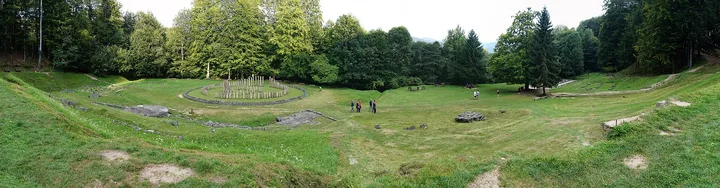
Sarmizegetusa Regia stands at Grădiștea de Munte, in Hunedoara county, on a 1,200-metre mountain in the Orăștie range. It was the capital and the military, religious and political centre of the Dacians before the wars with Rome, the core of a defensive system of six fortresses.
The idea of a Dacian fortification system here took shape in the 19th century, when the Austrian administration sent men to investigate hoards of precious metal. The imperial messengers officially reported the fortification and other stone constructions, and then came the scholars, the collectors, and the treasure hunters, each digging where they pleased.

The most extensive diggings before systematic research were the Austrian excavations of 1803 and 1804, and their aim was plain: gold. What they left behind is measured in missing context as much as in finds.
Systematic work came later and never really stopped: the Cluj museum's specialists have studied the site uninterruptedly for more than six decades. In 1999 the six fortresses entered the UNESCO list as entry 906, which is why the stones below can be checked against a published record instead of against legend.
The imperial messengers officially reported the existence of the fortification and of other stone constructions, and a lot of ancient artifacts.
MNIT, Dacian Fortresses of the Orăștie Mountains (official booklet)
Meanwhile, Meanwhile, on the other five hills, Costești, Blidaru, Piatra Roșie, Bănița and Căpâlna guarded the same capital.
Chapter II
The stones
Iron Age–106 · what the terrace actually holds
- Chapter
- destroyed in the Roman wars
- East of the citadel gate
- 100 metres
- Circular sanctuaries
- 2
- Quadrilateral sanctuaries
- 7 or 8
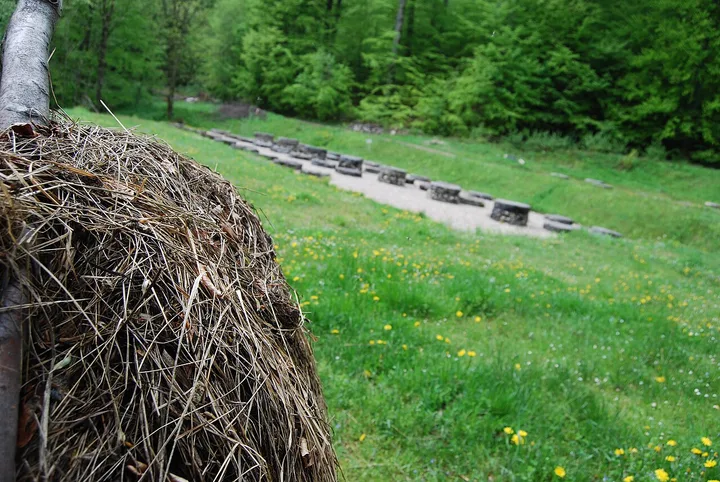
100 metres east of the citadel gate, a paved road leads to the terrace of the sanctuaries. The citadel wall itself, 3 metres thick and 4 to 5 metres high, a hexagon of unequal sides around 3 hectares, stands to the west. The temples stand apart, and that separation is part of their meaning.
The count is honest about its own uncertainty: two circular sanctuaries survive, and seven or eight quadrilateral ones. The Romans destroyed them so thoroughly that archaeologists cannot tell whether one ruin is a single large sanctuary or two small ones built close together.
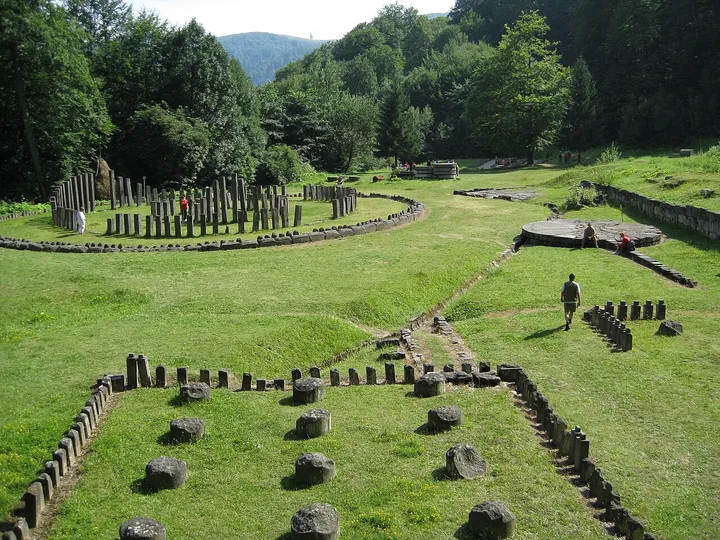

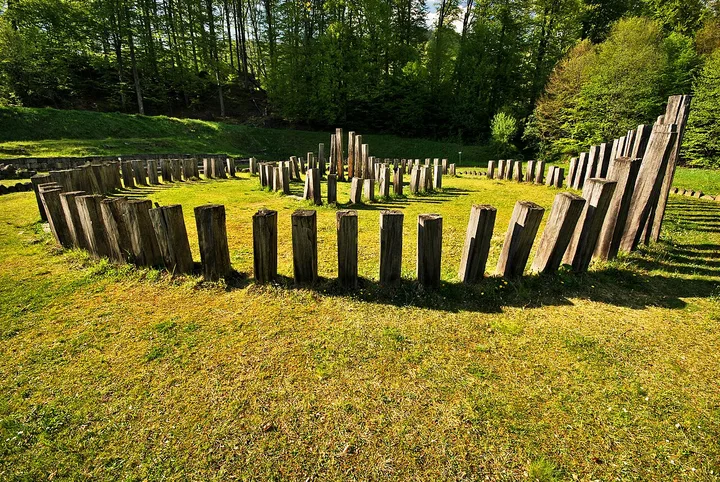
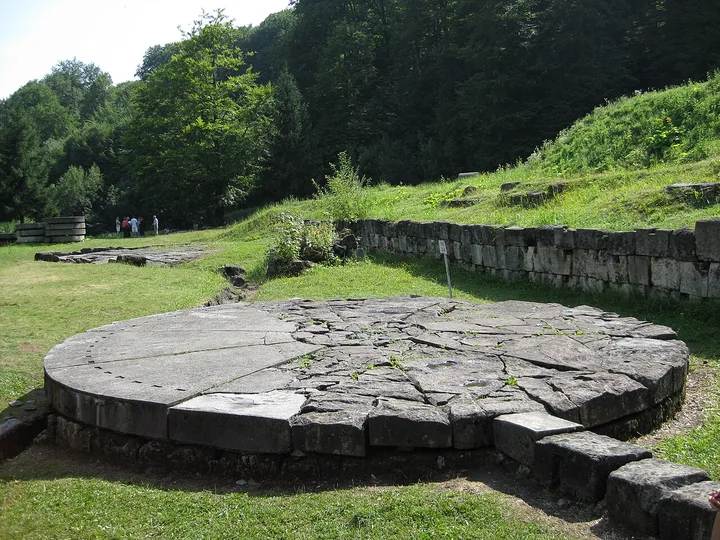
The Great Round Sanctuary is about 30 metres across: a D-shaped setting of timber posts inside a timber circle inside a low stone kerb, a layout one handbook compares to Stonehenge. West of it lies the andesite disc: 6.98 metres across, 0.30 metres thick at the rim, a 1.46-metre central monolith ringed by ten trapezoidal rays, each 2.76 metres long.
These are the largest and most important Dacian sanctuaries known, and their stones are the whole of the evidence. Everything else on this page is a claim about them, tested below, one by one.
utilisé comme autel de sacrifice
ActaMN 31-I (1994): the 'stone sun', used as a sacrificial altar
Meanwhile, Meanwhile, 100 metres west, the hexagon wall still follows the cliff edge it was built to follow.
Chapter III
The calendar
1994–present · the resemblance that became an instrument
- Chapter
- 1996: the 'possible' sundial
- Central disc
- 1.46 metres
- Rays
- 10
- Confirmed calendar functions
- 0
The round sanctuary is often called a calendar and the andesite disc a sundial, as if the Dacians had left an observatory on the mountain. The resemblance is genuine: the timber circles do recall Stonehenge, and a flat carved disc does invite a shadow to tell the time.
But resemblance is not an instrument. The sundial reading was published in 1996 under a title that begins with the word 'posibil' (possible), and the same stone is read, in the same literature, as an altar of sacrifice. A stone cannot be promoted from altar to observatory by enthusiasm.

The sanctuary's function is not even settled as a temple. Its first modern interpreter read the rectangular buildings as granaries on Roman analogies, then reversed himself and declared them temples, and a 2019 review calls the whole architecture an 'archaeological nightmare'. Nobody disputes the stones; everybody disputes what happened on them.
As for the solstice alignments claimed in popular archaeoastronomy: no published survey confirms a sunrise locked onto the disc. The bench below shows exactly where each reading stands: measured, possible, or missing.
UN POSIBIL CADRAN SOLAR
ActaMN 33-I (1996): the paper's own title, a possible sundial
Meanwhile, Meanwhile, in England, the monument the sanctuary is compared to keeps its own older arguments.
Chapter IV
The god
First century BC–106 · one source, no inscription
- Chapter
- Herodotus, book IV
- Informed ancient sources
- 1
- Inscriptions naming Zalmoxis at the site
- 0
- Capital of the kingdom
- Burebista to 106
The god attached to the sanctuaries is Zalmoxis, lord of Dacian immortality, and his entire ancient file fits in one book. Herodotus, Histories 4.93 to 96, is certainly the only informed source: the Getae 'who immortalize themselves', their daimon Zalmoxis, and a story from the Pontic Greeks that he was once a slave of Pythagoras who faked a resurrection from an underground chamber.
Herodotus himself does not buy it: he places Zalmoxis long before Pythagoras and leaves the tale with the Greeks who told it. Later antiquity only retells him. Beyond the literary versions there is, in one reviewer's phrase, absolutely no data showing a real cult of Zalmoxis.

At Sarmizegetusa itself, no inscription names him. The one famous inscribed object is a vase reading DECEBAL PER SCORILO (Decebalus, son of Scorilus): a king's name, not a god's. The link between the sanctuaries and Zalmoxis was built by modern books, not by excavation.
The kingdom those sanctuaries served is itself smaller than legend: Burebista moved the capital here from Argedava, and it stayed a capital for at least a century and a half, to the Roman siege of 105–106. Then the walls came down, a garrison moved in, and 40 kilometres away the Romans built a different city with a borrowed name: Ulpia Traiana Sarmizegetusa.
DECEBAL PER SCORILO
The vase inscription, in Roman letters: Decebalus, son of Scorilus
Meanwhile, Meanwhile, 40 kilometres away, the other Sarmizegetusa, the Roman one, was already confusing future archaeologists.
The test bench
Six claims about the sanctuaries, run against the excavation record. Pick a claim: the plan highlights the stones it depends on, and the verdict says what the record allows.
Claims to test
CONFIRMED The great round sanctuary is about 30 metres across
Measured in the excavation report: the 30-metre circle west of which the andesite disc lies.
CONFIRMED The andesite disc: 6.98 m, a 1.46 m centre, ten rays
Measured stone by stone: 6.98 m across, 0.30 m rim, ten trapezoidal rays of 2.76 m.
CONFIRMED The sanctuaries stand 100 m east of the gate
Terrace, paved road, gate: the published layout puts the temples 100 metres east.
UNPROVEN The round sanctuary is a Dacian calendar
A resemblance noted in one handbook, never an excavation result. No report confirms a calendar function.
UNPROVEN The andesite disc is a sundial
Its own author's word is 'possible'. The same stone is read as a sacrificial altar.
REFUTED This was the observatory of Zalmoxis
Zalmoxis has one source, Herodotus, and no cult evidence. No inscription links him to these stones.
Test the alignment
Four predictions about sunrise, shadow and stone. Call each one, then meet the survey.
-
1
Winter solstice
At dawn on the shortest day, the sun rises exactly over the andesite disc. The alignment is proven.
Reveal
Unproven. Popular archaeoastronomy claims the sunrise; the published surveys confirm only the stones. Verdict on the bench: claim 5.
-
2
The round ones
A guide counts the circular sanctuaries of the terrace. How many does the excavation record allow?
Reveal
Two. The seven-or-eight figure counts the quadrilateral sanctuaries, a different set of ruins.
-
3
Equinox
At the equinox the shadow falls on the central ray like clockwork: the disc is a calendar.
Reveal
A resemblance, not an instrument. The sundial paper calls itself possible, and the altar reading stands beside it.
-
4
The vase
The most famous inscription found at Sarmizegetusa names its owner in Roman letters. What does it read?
Reveal
DECEBAL PER SCORILO: Decebalus, son of Scorilus. No inscription at the site names Zalmoxis.
Answer a card to open the score.
The stones in figures
Every figure below is quoted from the survey record, and the page is checked against it.
- 1,200
- metres of altitude at Grădiștea de Munte
- 30
- metres across the Great Round Sanctuary
- 6.98
- metres across the andesite disc
- 10
- trapezoidal rays on the disc
- 106
- the fall of Sarmizegetusa
- 1,999
- UNESCO inscription, list 906
Three myths, retired
Each myth below had a long career. The verdicts come from the sources above.
The calendar stones
The circles look like instruments, so the story made them instruments: a calendar, a sundial, an observatory. But the calendar function appears in no excavation report, the sundial paper calls itself possible, and the alignments have no confirming survey. Resemblance is where the story starts; measurement is where it has to end.
The empire's capital-of-mystery
The legend wants a millennial imperial capital wrapped in secrets. The record shows a kingdom's capital for some 150 years, from Burebista to the siege of 105–106, then demolition, a Roman garrison, and a new Roman city 40 kilometres away that borrowed the name. Mystery is what remains when the garrison leaves with the archives.
The ancient-astronaut Dacia
No: there is no excavation evidence for visitors, energies, or tunnels under the terrace. There are andesite drums, limestone bases, iron tools, and painted vases: a flourishing Iron Age centre that the Romans found worth two wars to destroy. The stones need no aliens; they need readers.
Visiting? cetati-dacice owns the practical guide: map, access, tickets.
Sources and method
Every measurement on this page is quoted from excavation reports and surveys, paraphrased in our own words; short ancient quotations are public domain by age. Claims from archaeoastronomy papers appear as the claims side and are labelled as hypotheses.
What cannot be proven is marked unproven or refuted, never invented, never approximated. The schematic plan is drawn for this page from the report descriptions and has no topographic value.
The hill
- MNIT, Dacian Fortresses of the Orăștie Mountains (official booklet): the place, the 19th-century Austrian reports, the six fortresses, the UNESCO criteria
- Aurora Pețan, Excavations at Grădiștea Muncelului in 1803–1804: the Austrian administration dug for gold
- UNESCO list 906: Dacian Fortresses of the Orăștie Mountains, inscribed in 1999
The stones
The calendar
- Ephemeris Napocensis XXIX (2019): from granaries to temples; the 'archaeological nightmare' of Dacian architecture
- Szücs-Csillik et al., Archaeoastronomy case studies in Romania: the sacred-area map, the solar-cult hypotheses (the claims side)
- The Andesite Sun in the Carpathians: the circa 7-metre disc (the claims side)
The god
- L. Ruscu, Thraco-Dacica XXI (2000): Zalmoxis appears first in Herodotus, 'certainly the only informed source'
- The ancient reception of Zalmoxis: Herodotus 4.93–96; beyond the literary versions, 'absolutely no data' of a real cult (Marinov 2015)
- Classical Quarterly: Zalmoxis in Herodotus 4.94, the immortality guarantee and the Pythagoras-slave story
Images
- Sacred terrace panorama · Miehs, CC BY-SA 3.0 ro · Wikimedia Commons
- Great circular sanctuary · Calin Jorza, CC BY-SA 3.0 ro · Wikimedia Commons
- The andesite disc · Oroles, public domain · Wikimedia Commons
- Andesite sanctuaries · Oroles, public domain · Wikimedia Commons
- Limestone sanctuary · TudorTulok, CC BY-SA 3.0 · Wikimedia Commons
.jpg)