Open the project
Mamaliga from American maize — How a foreign grain became a national dish
Maize came from America and replaced millet and buckwheat. Pick a year and a crop, watch the fields change, then grind and stir the porridge yourself.
INGREDIENTS · MARKETS · KITCHENS
Follow ingredients through fields, markets, kitchens and records. Explore where history, taste, cooking tools and access to food meet.
Choose a documentary thread and see what the sources support, from ingredient to question.
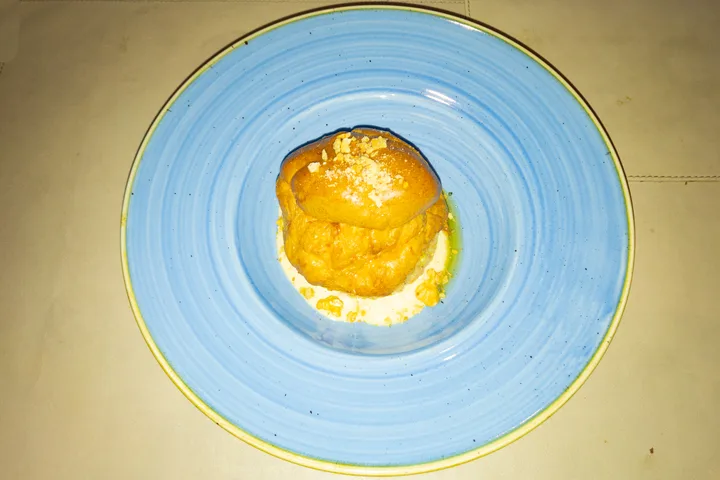
At the table · geometry
Compare two diameters and prices. The circles show area at the same scale; the price per square centimetre tells you what you pay for it.
The 40 cm pizza costs 8.6% less for the same area.
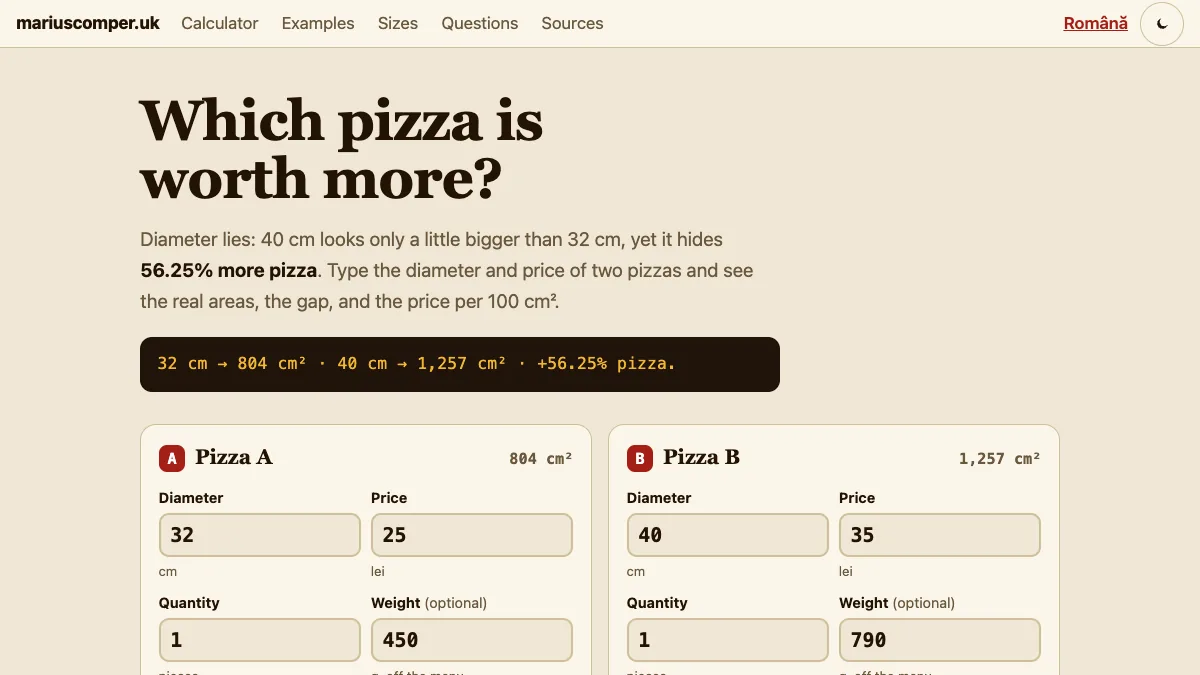
Area: 804.25 / 1,256.64 cm². Price per 100 cm²: 4.35 / 3.98 lei.
A disc’s area is π × diameter² / 4. These are example prices you can replace, rather than restaurant offers. Lei is Romania’s currency.
The full calculation and price comparison ↗One thread, three stops
Each route links a context to the records used and the projects that answer a concrete question. These steps guide your reading; they are not a literal map.
Maize is native to the Americas. Its source project follows changing crops in Romania and how maize became an ingredient in a dish now known as mămăligă. The sources do not reduce this change to one date.
A documentary thread, not a map of one journey or a story of an unchanging recipe.
Open the project
Maize came from America and replaced millet and buckwheat. Pick a year and a crop, watch the fields change, then grind and stir the porridge yourself.
Open the project
Romanian's basic food words trace to Latin. The heavy medieval wheeled plow's parts are mostly Slavic or Hungarian. An interactive diagram shows where the farming vocabulary splits.
Open the project
In 1971, Romanian corn puffs were launched as a new item with pecorino cheese. By 1998, the press called them traditional. A history of factories, patents and the Baia Mare production cluster, reconstructed from the archive.
American maize, potatoes and wheat have different agricultural and food histories. Their source projects keep the records and evidence for each change instead of describing an unchanging Romanian cuisine.
Open the project
Maize came from America and replaced millet and buckwheat. Pick a year and a crop, watch the fields change, then grind and stir the porridge yourself.
Open the project
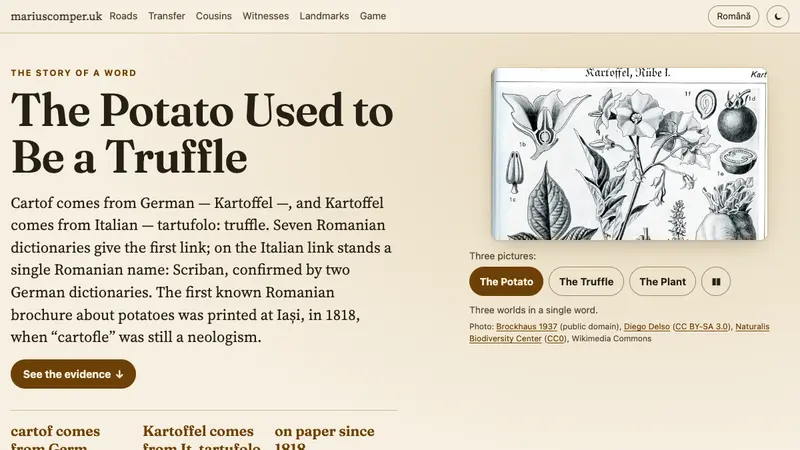
Cartof comes from German Kartoffel, and Kartoffel from Italian tartufolo: truffle. Seven Romanian dictionaries give the first link, Scriban alone the second. With the 1818 Iași brochure, four cousins around the world and a match-the-names game, in Romanian and English.
Open the project
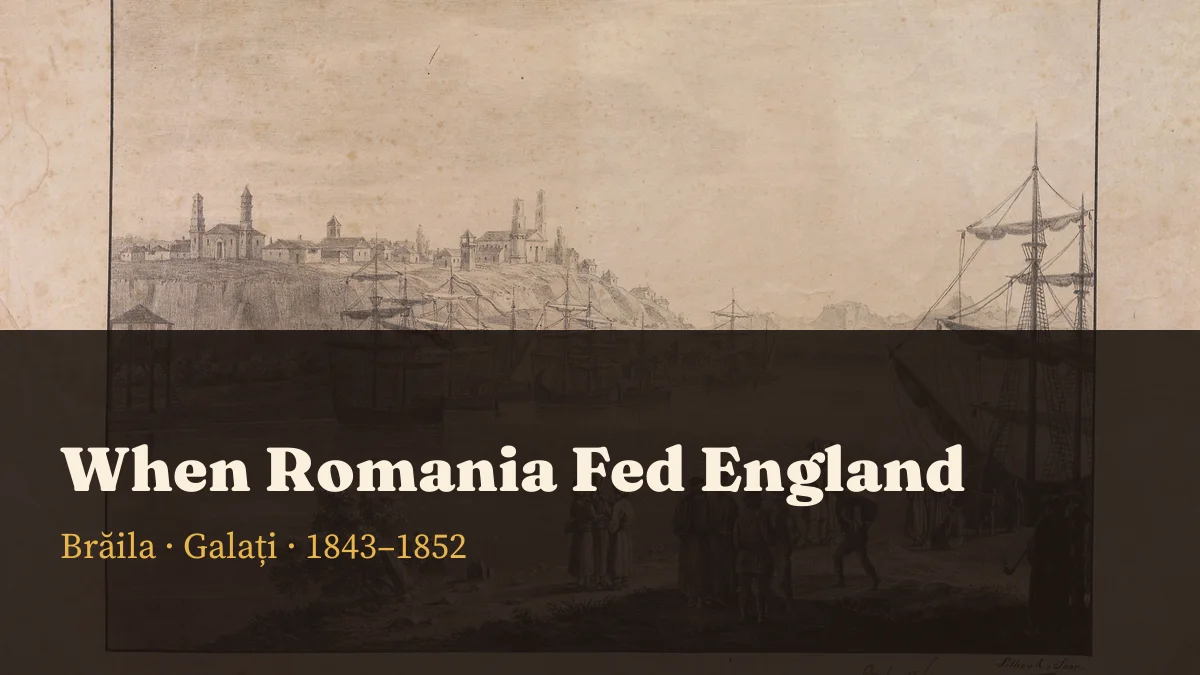
Ten harvests, two free ports and the 9-foot Sulina bar: how Brăila and Galați came to send hundreds of thousands of quarters of wheat to 1840s London.
Wheat exports, market stalls and a bread ration card do not measure the same thing. Compare figures only after checking period, units and who was included.
Open the project
Ten harvests, two free ports and the 9-foot Sulina bar: how Brăila and Galați came to send hundreds of thousands of quarters of wheat to 1840s London.
Open the project
Seat six stalls on the Cheapside side streets whose names still mean them — bread, milk, poultry, fish, iron, gold — with Stow's lines for witness, then follow ceap from bargain to bargain-basement on two dated proof rails.
Open the project
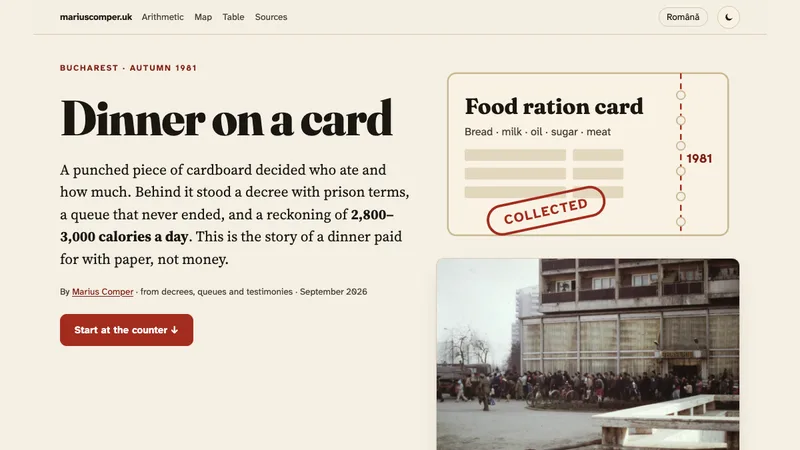
One card, one decree, one queue: a family dinner in 1981 Romania.
Open the project
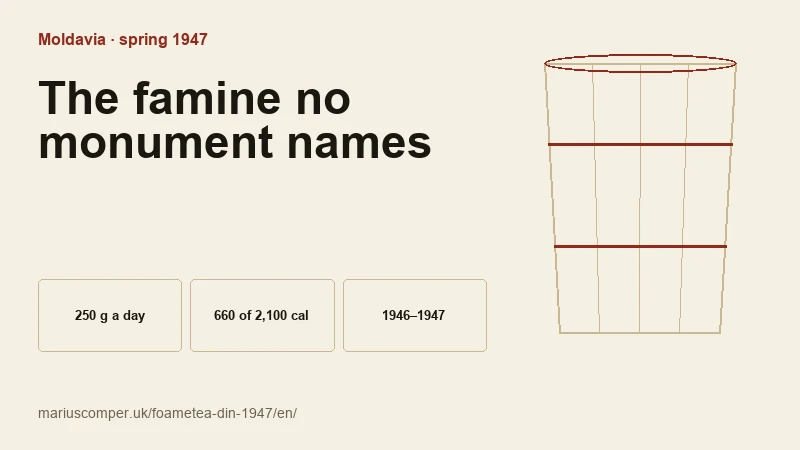
A 250-gram ration, trains guarded by gendarmes, and a famine with no death toll.
Open the project
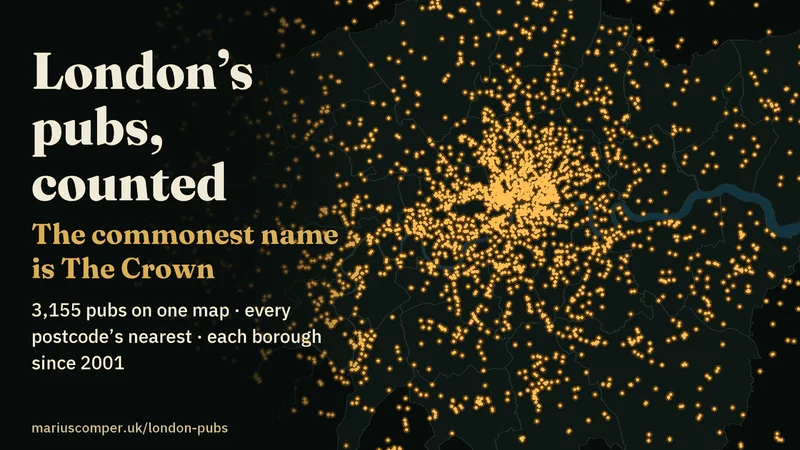
London’s commonest pub name is The Crown, ahead of the Prince of Wales and the Red Lion: 31 of the 3,155 pubs mapped by OpenStreetMap’s volunteers. Half of the city’s postcodes have a mapped pub within 286 m in a straight line, and the official count of pubs and bars fell from 4,835 in 2001 to 3,525 in 2024, with Hackney the only borough that rose. A map of London drawn only from its pubs, with a result and a picture for each of 217 postcode districts.
Fermentation, ageing and preservation have their own conditions. The projects compare mechanisms and records; they do not replace food-safety instructions.
Open the project
Compare Romanian pickles with Sichuan pao cai, follow four stages of fermentation in Chiojdu, and calculate brine concentration. The page includes a food-safety reference, not recipes.
Open the project
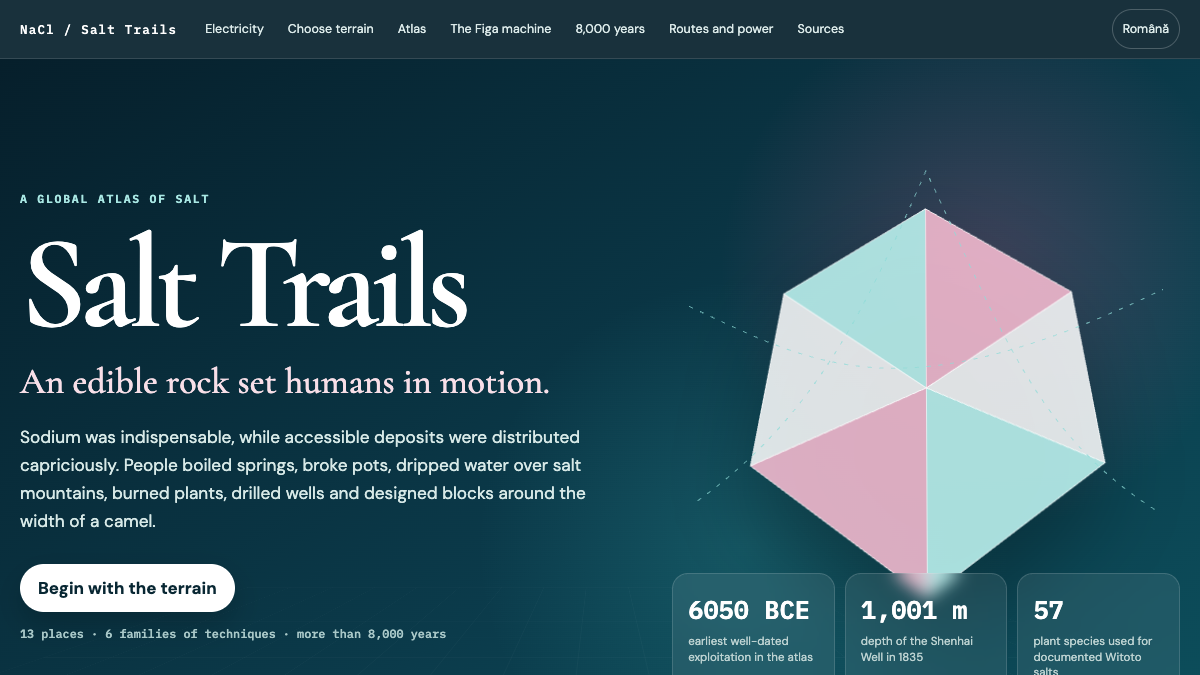
An edible rock set humans in motion.
Open the project
Plate L25 of the Bulgarian dialect atlas, taken apart layer by layer: five names for whey cheese, the word urda from the Pindus to the Tatras, and the theories of where it came from.
Open the project
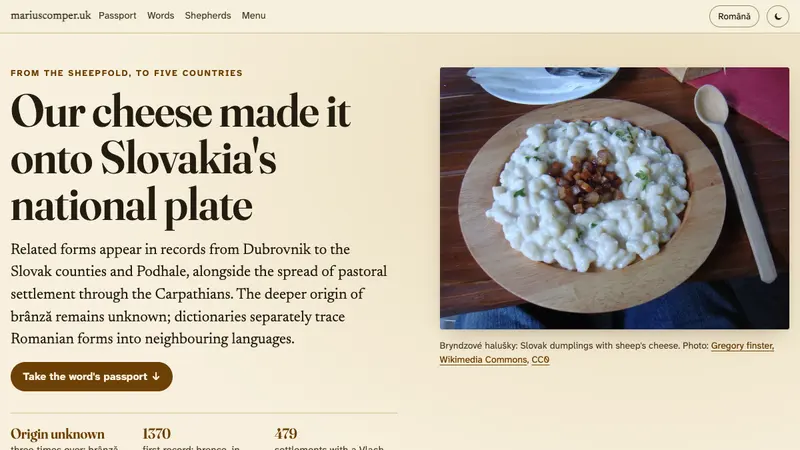
How Vlach shepherds carried three Romanian words over the Carpathians: brânză, turned bryndza in halušky, baci, the head shepherd from Poland to Moravia, and urdă, with five etymologies and no winner. Three dated attestations, six dishes, sheep climbing to 2,000 metres.
Chilli heat, ice-cream headache and the physics of buttered toast answer different questions about bodies and food. The pizza and microwave calculators use explicit units; none offers medical advice.
Open the project
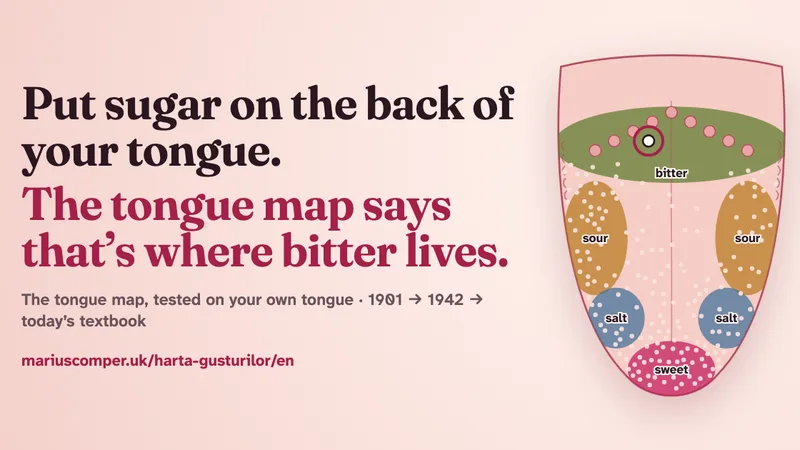
The textbook tongue map (sweet at the tip, bitter at the back) is wrong: every part of the tongue with taste buds tastes every taste. The test on your own tongue, a whole-class moment, and how four tables from 1901 became a map in 1942. In Romanian and English.
Open the project
Why spicy food burns without thermal injury: the biophysics of TRPV1, probabilistic activation-curve shifting, and the cold-water illusion.
Open the project
Eating fast roughly doubles the risk of brain freeze (27.4% vs 12.5%, RR 2.2). A Doppler study shows the pain arrives with a surge in cerebral artery blood flow, misrouted to the forehead through trigeminal convergence.
Open the project
A 40 cm pizza is not 25% bigger than a 32 cm one. It is 56.25% more pizza. Unless the price grows by at least that much, the large one is the better deal.
Open the project
Enter the label power and time plus your oven power and get the converted time, including why −20% becomes +25%.
Open the project
180° at 0.75 metres, ordinary table height; it would take almost 3 metres for 360° and a butter-up landing.
Food · 37 projects
Projects about ingredients, food history, drinks, taste, tools and access to food; each keeps the units and limits of its sources.
37 projects
↑ Back to the experienceTry a broader term or reset the search.
Meals and access to food
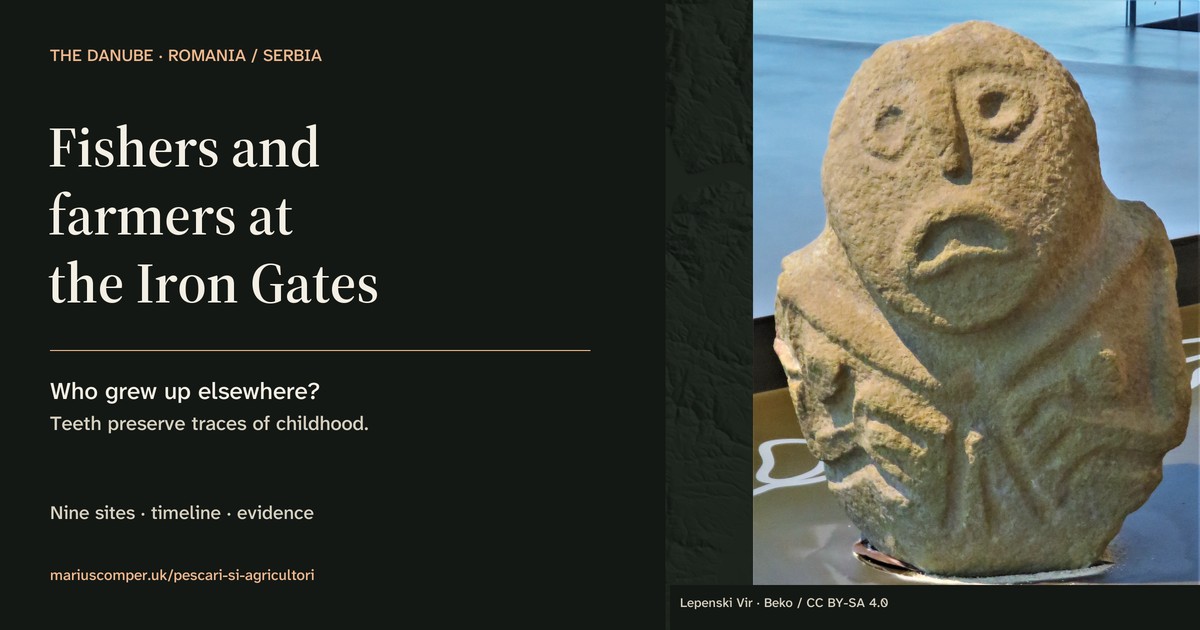
As farming began, teeth indicate more people raised in a different geological area. Nine sites on the gorge’s relief map, with sample phases, DNA, diet and precise sources.
Drinking places
London’s commonest pub name is The Crown, ahead of the Prince of Wales and the Red Lion: 31 of the 3,155 pubs mapped by OpenStreetMap’s volunteers. Half of the city’s postcodes have a mapped pub within 286 m in a straight line, and the official count of pubs and bars fell from 4,835 in 2001 to 3,525 in 2024, with Hackney the only borough that rose. A map of London drawn only from its pubs, with a result and a picture for each of 217 postcode districts.
Crops and agriculture
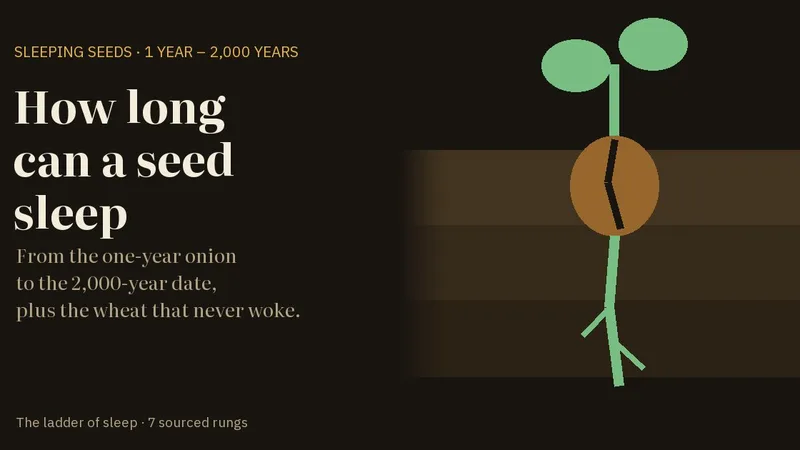
Some seeds sleep a year, others a few thousand. Climb the ladder of sleeping seeds, guess how many wake from the bottles buried in 1879 and catch the impostors: the mummy wheat and the lupine.
Taste and sensation
The textbook tongue map (sweet at the tip, bitter at the back) is wrong: every part of the tongue with taste buds tastes every taste. The test on your own tongue, a whole-class moment, and how four tables from 1901 became a map in 1942. In Romanian and English.
Coffee, tea and wine
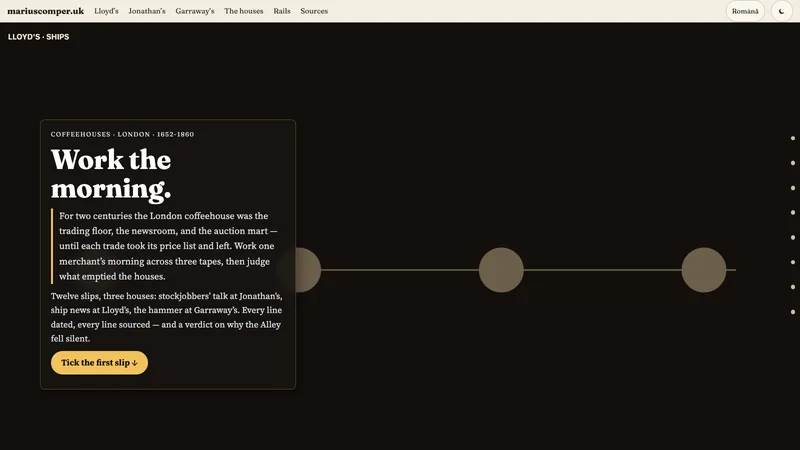
Tick twelve slips across three coffeehouse tapes — brokers’ talk at Jonathan’s, ship news at Lloyd’s, the auction hammer at Garraway’s — then judge what emptied the houses, on two dated proof rails.
Crops and agriculture
Cartof comes from German Kartoffel, and Kartoffel from Italian tartufolo: truffle. Seven Romanian dictionaries give the first link, Scriban alone the second. With the 1818 Iași brochure, four cousins around the world and a match-the-names game, in Romanian and English.
Meals and access to food
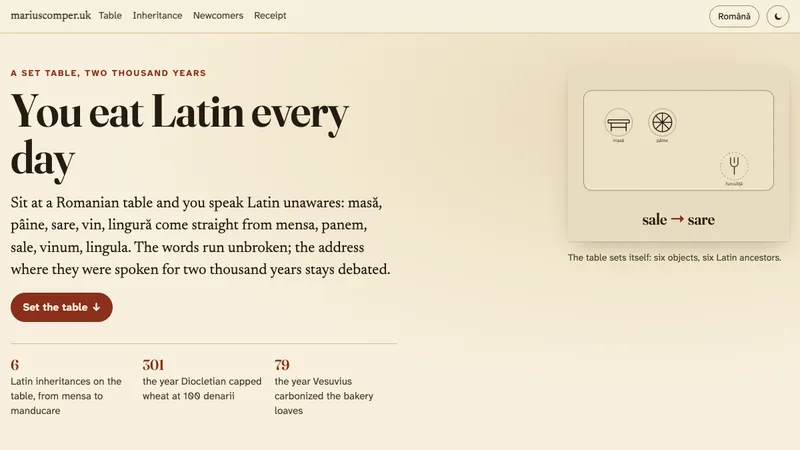
Masă, pâine, sare, vin, lingură: six Latin inheritances on the Romanian table, three newcomers and the Roman receipt of AD 301. With the table that sets itself, the etymological chains and the claims table.
Meals and access to food
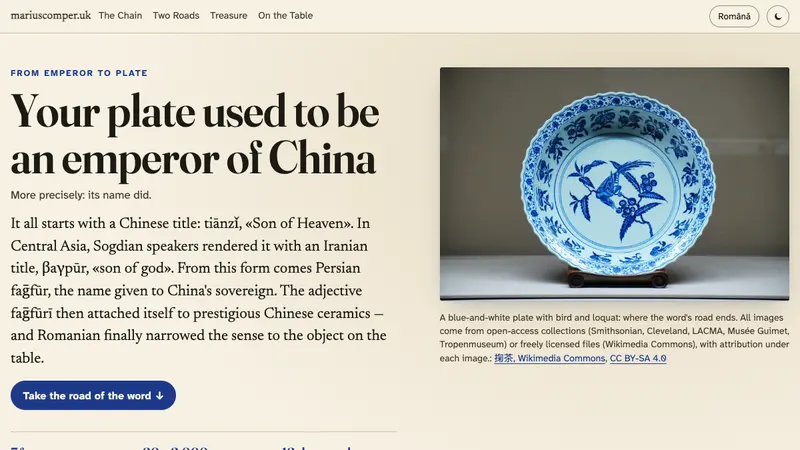
Where Romanian farfurie, “plate”, comes from: Ottoman farfuri, “porcelain”, and before it Persian faghfūr, the title given to the emperor of China. Turn a Ming dish to see the word’s seven forms, from 天子 to farfurie, each with its source. With the Chinese province that dictionaries invented, the map of the routes and the Topkapı collection.
Milk and dairy
How Vlach shepherds carried three Romanian words over the Carpathians: brânză, turned bryndza in halušky, baci, the head shepherd from Poland to Moravia, and urdă, with five etymologies and no winner. Three dated attestations, six dishes, sheep climbing to 2,000 metres.
Coffee, tea and wine
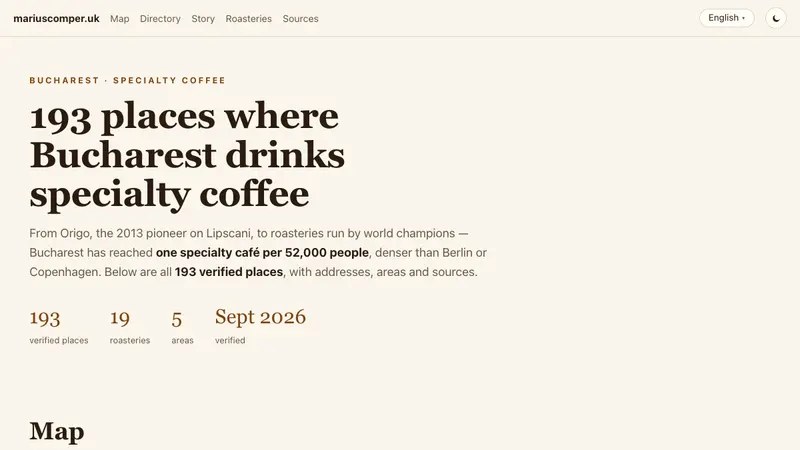
The complete Bucharest specialty-coffee map: 193 cafés and 19 roasteries, verified, with addresses, areas and sources. From Origo (2013) to world roasting champions.
Kitchen tools
A 40 cm pizza is not 25% bigger than a 32 cm one. It is 56.25% more pizza. Unless the price grows by at least that much, the large one is the better deal.
Food words and markets
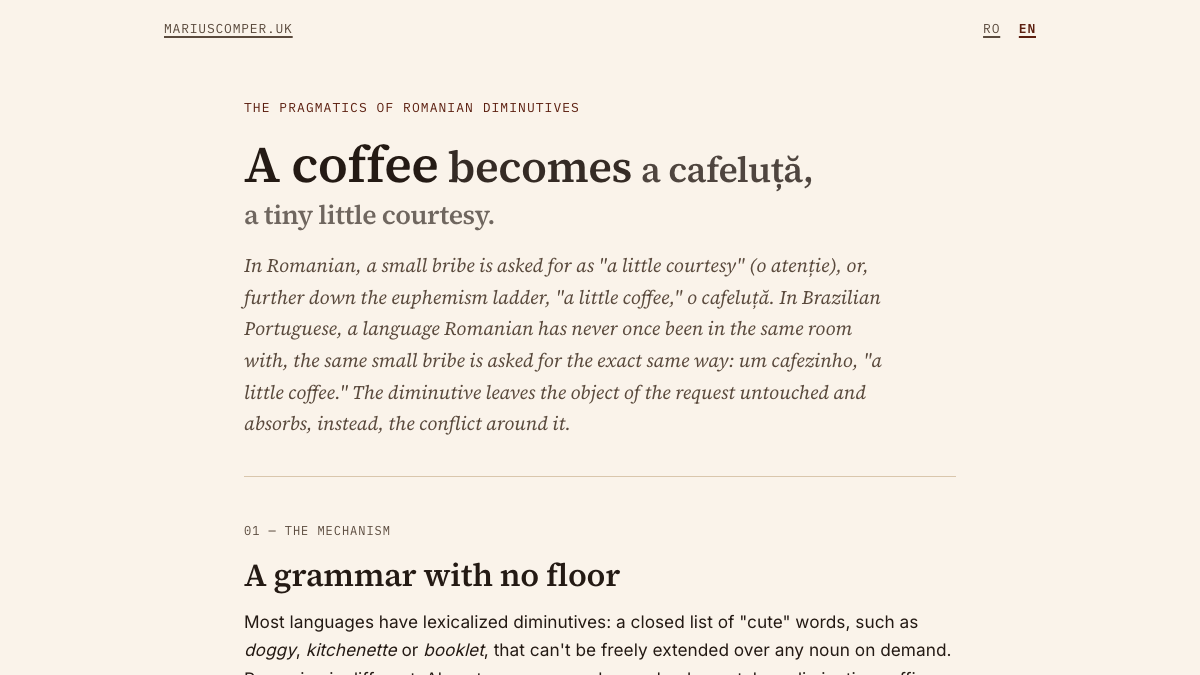
A Romanian diminutive leaves the object of a request untouched and absorbs, instead, the conflict around it. The phonetics of smallness, its reverse into contempt, contraband-coffee history, and an eleven-culture comparative atlas, with a word-by-word dissectable simulator.
Crops and agriculture
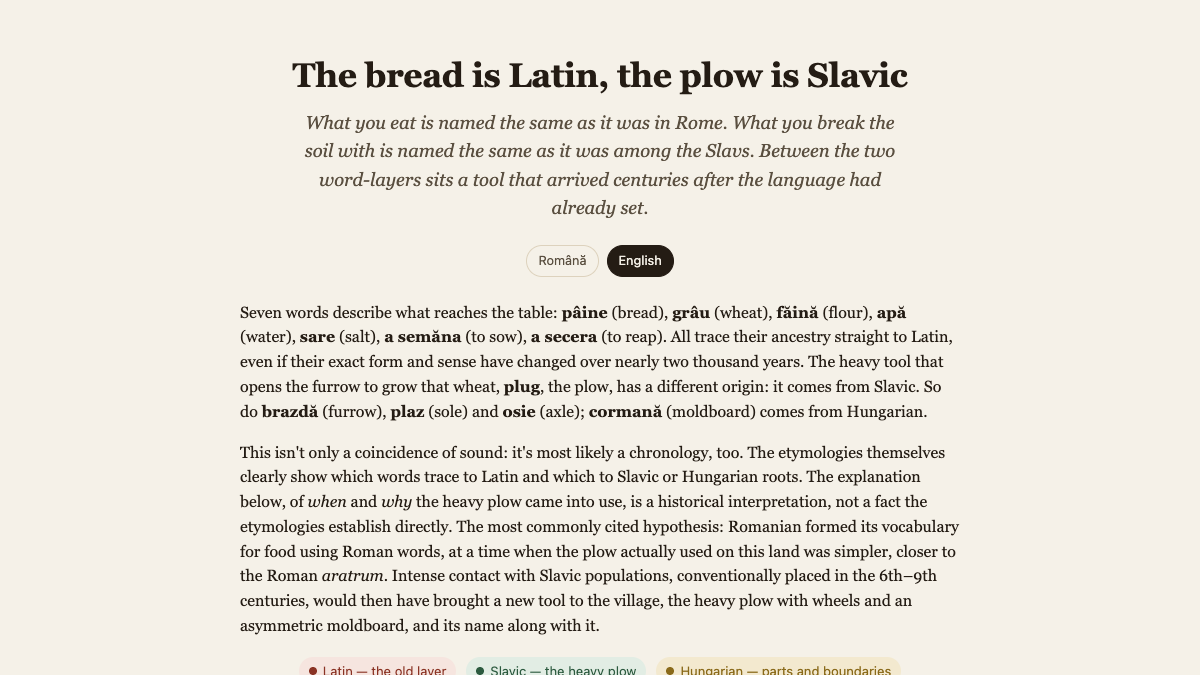
Romanian's basic food words trace to Latin. The heavy medieval wheeled plow's parts are mostly Slavic or Hungarian. An interactive diagram shows where the farming vocabulary splits.
Meals and access to food
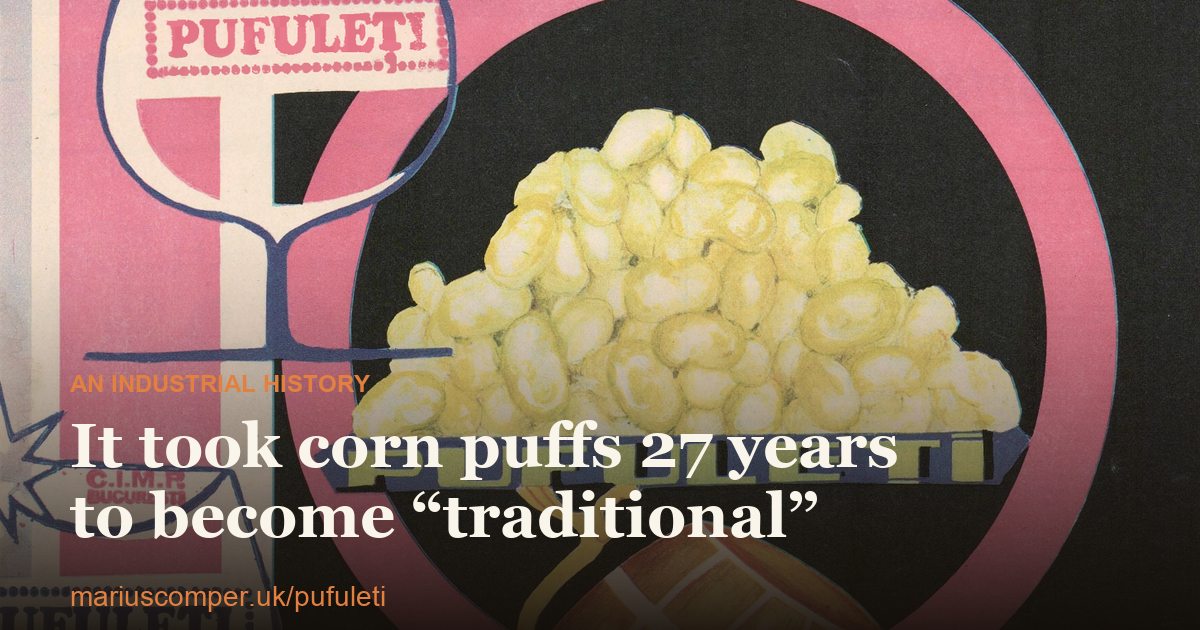
In 1971, Romanian corn puffs were launched as a new item with pecorino cheese. By 1998, the press called them traditional. A history of factories, patents and the Baia Mare production cluster, reconstructed from the archive.
Food rules and access
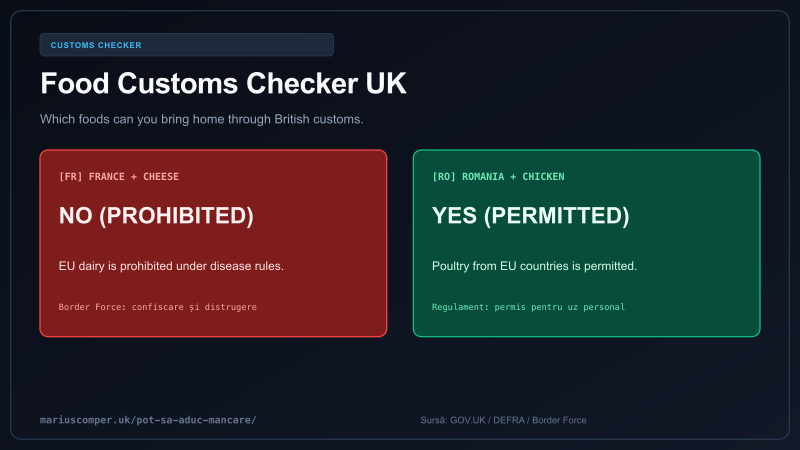
Cheese from France: no. Chicken from Romania: yes. What you can actually bring home in your luggage.
The physics of food
180° at 0.75 metres, ordinary table height; it would take almost 3 metres for 360° and a butter-up landing.
Taste and sensation
Why spicy food burns without thermal injury: the biophysics of TRPV1, probabilistic activation-curve shifting, and the cold-water illusion.
Milk and dairy
Butter melts at 34°C on the tongue, while industrial margarine melts at 44°C like wax: 150 years of chemistry, gastronomy, and clinical trials.
Coffee, tea and wine
125 ml reach the cup; the global-average coffee footprint is about 140 L.
Taste and sensation
Eating fast roughly doubles the risk of brain freeze (27.4% vs 12.5%, RR 2.2). A Doppler study shows the pain arrives with a surge in cerebral artery blood flow, misrouted to the forehead through trigeminal convergence.
The physics of food
Dry spaghetti usually breaks into at least three pieces under simple bending. Twist can quench the cascade because the torsional wave unloads energy faster.
Crops and agriculture
Romania has 1.7 million beehives, second place in the European Union. But hives per holding — the real measure of how concentrated an apiculture sector is — puts it mid-table, almost tied with Italy. Greece, with 31% fewer hives, holds nearly double.
Crops and agriculture
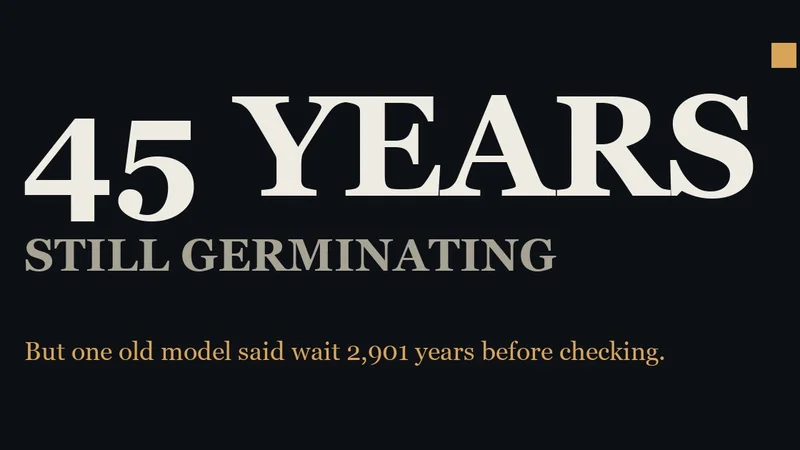
Frozen seeds can remain alive for decades — but not forever. Explore 40 years of real seed-bank germination data, see which crops lasted longest and discover why seed vaults must keep testing and regenerating their collections.
Preservation and fermentation
Compare Romanian pickles with Sichuan pao cai, follow four stages of fermentation in Chiojdu, and calculate brine concentration. The page includes a food-safety reference, not recipes.
Coffee, tea and wine
Browse Romania’s 35 DOC wine regions, check Recaș visitor packages and booking rules, and follow Cotnari’s five-step tasting method.
Meals and access to food
Explore 30 dishes from three Bucharest menus, with names, ingredients and allergen information. The guide also explains restaurant bills and tipping.
Kitchen tools
Enter the label power and time plus your oven power and get the converted time, including why −20% becomes +25%.
Crops and agriculture
Ten harvests, two free ports and the 9-foot Sulina bar: how Brăila and Galați came to send hundreds of thousands of quarters of wheat to 1840s London.
Food rationing
A 250-gram ration, trains guarded by gendarmes, and a famine with no death toll.
Water and drinks
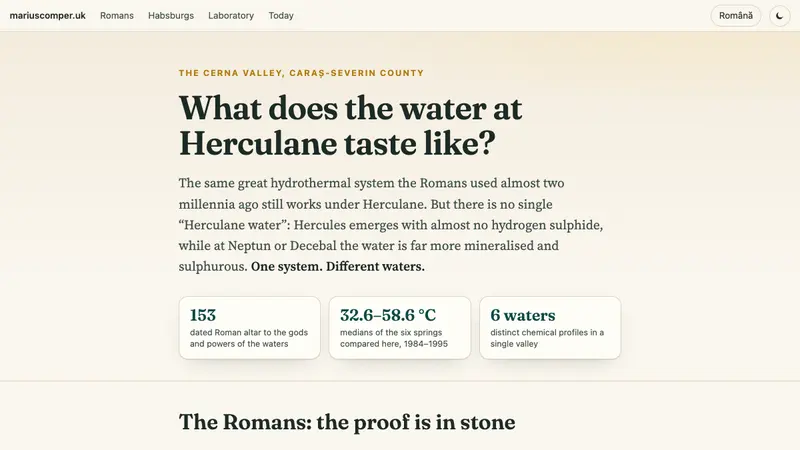
The same hydrothermal system for two millennia — but different waters spring by spring: Hercules without hydrogen sulphide, Neptun and Decebal strongly sulphurous. Two Roman stones, a 1773 analysis, and the modern lab.
Milk and dairy
Plate L25 of the Bulgarian dialect atlas, taken apart layer by layer: five names for whey cheese, the word urda from the Pindus to the Tatras, and the theories of where it came from.
Food words and markets
Pick a word and 107 languages of Europe and Asia light up, first the ones that say it almost like you.
Food words and markets
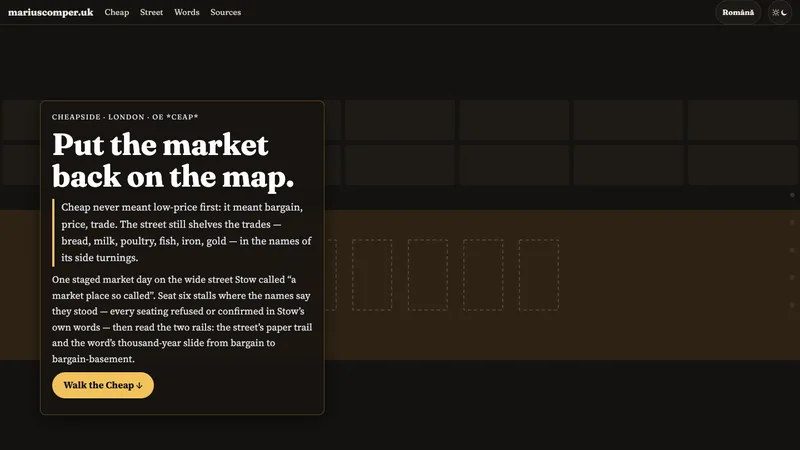
Seat six stalls on the Cheapside side streets whose names still mean them — bread, milk, poultry, fish, iron, gold — with Stow's lines for witness, then follow ceap from bargain to bargain-basement on two dated proof rails.
Crops and agriculture
Maize came from America and replaced millet and buckwheat. Pick a year and a crop, watch the fields change, then grind and stir the porridge yourself.
Water and drinks
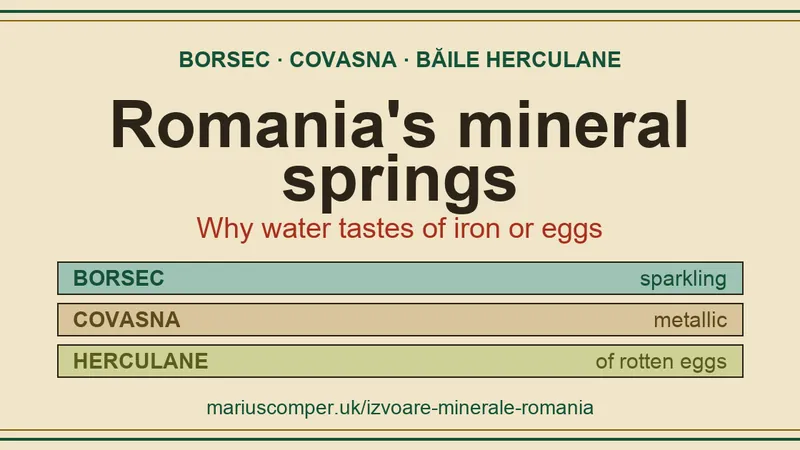
Three famous springs, three tastes: Borsec sparkles, Covasna brings gas and iron, Herculane smells of rotten eggs. Pour the blend and read the rock in the glass.
The collection covers crops, trade, ingredients, drinks, words, taste, kitchen tools and access to food. It also includes a few projects about bodily sensations where food is central. Water entries describe taste, composition or footprints; they are not potability recommendations. Current rules and medical sources stay with their own projects.
Reviewed · Collection as text
Open-access research on traditional maize foods in Europe.
Provisional National Institute of Statistics data; not a direct measure of consumption.
Sources and limits include research on maize, crop data and the history of mămăligă.
Compares distinct practices and shows calculations in the project.
Photograph dated 27 October 2018, CC BY 2.0; resized and cropped for this page.









.jpg)