A synthesis of 53 investigations
The speed of things
The ground under Bucharest is moving north-east at 26.4 millimetres a year. The Moon is drawing away at 38.3. At 5 pm, Bucharest's buses, trams and trolleybuses average 12.3 kilometres an hour. All of it is moving now, and your eye catches only a narrow band of it.
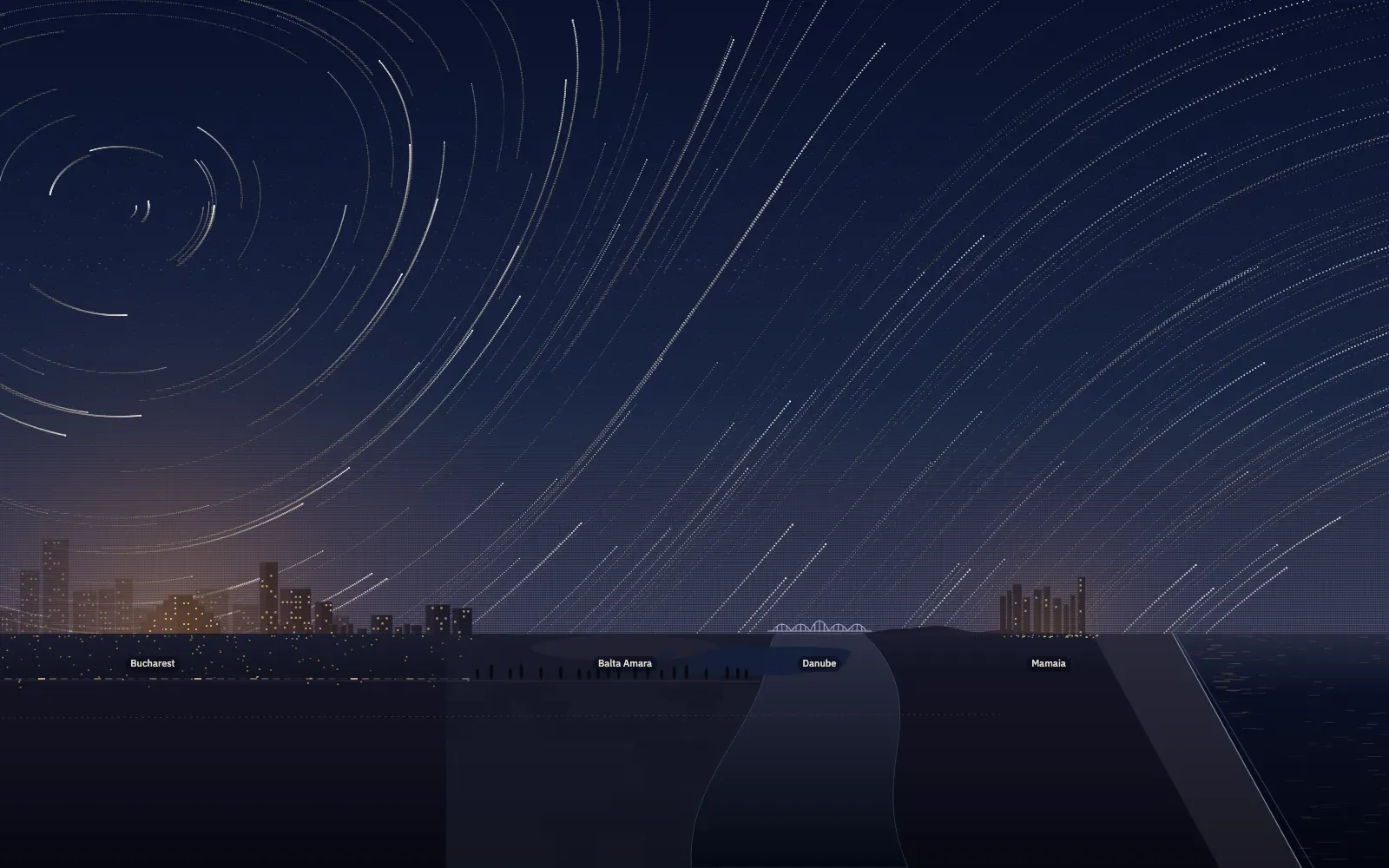
The drawing is a strip of south-east Romania, from Bucharest, the capital, to the Black Sea, on a July evening. Everything in it moves at the speed measured on its own page on this site. You change one thing: how much time passes in a second. The clock changes as you scroll, and you can drag it yourself from the corner of the drawing.
How long "now" lasts
In September, the page What We Know About Ourselves gathered a hundred propositions about Romanians from the research published here until then. Many more pages have appeared since, on beaches, lakes, storks, laws, coins, eclipses and earthquakes. Set side by side, many of them measure the same thing without having set out to: how fast something changes.
And speed decides whether you see the change. Left to tap a finger at their own pace, the median person taps once every 0.73 seconds. The median of 265 volunteers reading Romanian aloud is 5.6 syllables a second. A blink lasts 165 milliseconds on average, too short for you to notice it happened. Whatever moves a lot in such an interval you see as a streak; whatever moves very little, you see as standing still.
From: Inner tempo (3,576 people), How fast is Romanian spoken? (265 speakers, reading aloud, not conversation), The blink.
1 second = 1/20 of a second
Faster than the eye
At this clock, a summer storm over the Bărăgan, Romania's southern steppe, almost stands still. The drops creep down, the thunder crawls from the lightning towards you, and the light of the lightning still arrives all at once.
A raindrop is not shaped like a teardrop
6.5 m/s · a 2 mm dropAt 2 millimetres, a drop is a flattened bun falling at 6.5 metres a second, 24 kilometres an hour. Drizzle barely reaches 7 kilometres an hour.
From: No raindrop has ever looked like a teardrop. The speeds come from a formula fitted to Gunn and Kinzer's measurements of 1949.
Thunder covers a kilometre in three seconds
344 m/s at 20 °C · light: 299,792,458 m/sSound crosses the air at 344 metres a second at 20 degrees. Light covers three kilometres in ten millionths of a second, so the seconds between flash and thunder, divided by three, give the kilometres.
From: Nine seconds between the flash and the thunder. In winter sound is a little slower, 331.5 metres a second at zero degrees.
About 17 muons a second are passing through you
50 microseconds from 15 km up to the groundMuons are born high in the air and reach the ground before they decay because, at their speed, their clock runs 38 times slower. At sea level about one a minute crosses each square centimetre. The white lines in the drawing are them: at no clock on this page can they be seen as anything but streaks.
From: It is raining through you right now. The 17 a second is a simple estimate for a standing person.
A caress travels up the nerve almost as fast as the Danube flows
0.8 m/s · fast touch fibres: 59 m/sThe fibre that feels a caress carries its impulses at about 0.8 metres a second, slower than walking; the fast touch fibres carry theirs at about 59 metres a second. The brain answers a slow brush about 0.7 seconds after it touches the skin. Mothers stroke their babies at about 7.9 centimetres a second and fathers at 7.1, inside the range where the slow fibre fires most.
From: The speed of a caress. The Danube, for comparison: 0.85 metres a second at mean water in the Serbian stretch, from How long does Danube water take from source to sea.
A flock turns faster than its birds fly
20–40 m/s · the birds: 7–12 m/sIn real starling flocks a turn can cross 400 birds in a little over half a second, with no leader.
From: Thousands of starlings, no leader, after published measurements of flocks over Rome.
For the whole planet, "now" is 85 milliseconds wide
the Moon: 2.6 s · the Sun: 17 minNo news travels faster than light, so "now" has a width. For the whole planet the window is 85 milliseconds, about a twelfth of a second, and all of humanity fits inside it. For the Moon it is 2.6 seconds.
From: How small is the present? For the Sun, the page's text gives 17 minutes and its table 16.6.
1 second = 1 minute
Seconds and minutes: where things are decided
Emergencies live here. Instruments, hospitals and institutions measure them, and the gaps between them are counted in seconds and minutes.
Bucharest gets 27 seconds before the strong shaking
P wave: 6–8 km/s · the warning goes out after about 5 sRomania's big earthquakes come from Vrancea, a deep source under the Carpathian bend. Between the detection of the first wave and the arrival of the strong one, usually 27 seconds pass in Bucharest and 13 to 17 in Focșani. The warning goes out about five seconds after detection. For a quake 130 kilometres deep, the least time after the message goes to Gura Teghii, in Buzău county: 8.1 seconds.
From: How many seconds each Romanian town gets, for quakes 90–150 kilometres deep, four in five of those recorded.
A large untreated stroke costs 1.9 million neurons a minute
42% of Romanians live within an hour of a thrombectomyThe figure is Saver's estimate for a large untreated stroke evolving over about ten hours. Thrombectomy, pulling the clot out, is usually done within six hours. Only 42% of people in Romania live within an hour's drive of a hospital that does it; Galați, a city of over 200,000, is more than three hours away.
From: Time is brain. Drive times are computed without traffic.
Romania's phone alert usually comes half an hour after the siren in Ismail
median: at most 31 minutes, in 56 of 64 episodesIsmail is the Ukrainian port across the Danube, hit by Russian drones. The page insists the gap is not a delay: the Ukrainian alarm covers the whole district, while RO-ALERT goes out once radars see targets approaching Romanian airspace, and a drone needs time to reach the river. Of 767 alerts in the Ismail district, 705 had no RO-ALERT during them or in the half hour after.
From: Drones on the Danube, 1 February – 28 August 2026.
Half the emails to lost-wallet owners went out within 26 minutes
63% in the first hour, 88% in the first dayIn the lost-wallet experiment across 40 countries, money in the wallet raised the share of owners contacted in 38 of them. Most of those who wrote, wrote quickly.
From: The lost-wallet experiment.
A bank code lasts a few minutes; the money may leave days later
the pause before the first payment: 2–10 days in recent casesOnce the thieves start paying, they pay fast: in one case the same card was used twelve times in ten minutes. No source, though, measures the time from tapping the link to the emptied account.
From: You tapped the link, after the analysts cited there.
New proteins gather at the edge of the Golgi after 7 minutes
the granules show the label only at 57 minutesGeorge Palade, the doctor from Iași who won the Nobel, timed a protein's journey through the cell. In 1967, with James Jamieson, in slices of pancreas kept alive in a dish, new proteins were most numerous at the edge of the Golgi seven minutes after the medium was changed, while the granules showed the label only in the sample taken 57 minutes after labelling.
The ground under Bucharest rises and falls twice a day
about 28 cm a day · the crest: 31 minutes from Constanța to TimișoaraThe Moon and Sun pull on rock as well as on the sea. The crest of this rock tide travels east to west, so it reaches Timișoara, near the western border, 31 minutes after Constanța on the Black Sea. You feel nothing: in November 2026, along a kilometre of street, one end rises against the other by 87 micrometres at most.
From: The ground rises and falls twice a day (Romanian edition; the English one follows London). The values are computed, not measured on the spot.
1 second = 2 hours
Hours and days: the road
At two hours a second, evening turns to night in the time it takes to read a line. The buses become trails of light and the sky begins to turn. You are moving too: in Bucharest, turning with the Earth, at 1,195.7 kilometres an hour, 98% of the speed of sound (The four speeds you are moving at right now).
At 5 pm, Bucharest moves at 12.3 kilometres an hour
5–6 am: 18.7 km/h · 5–6 pm: 12.3 km/hMeasured on 26 October 2026, during the autumn school holiday, from the positions the vehicles broadcast, the city's buses, trams and trolleybuses were slowest between 5 and 6 pm. The lowest average speed on any stretch of street, 3.9 kilometres an hour, was at Piața Charles de Gaulle, below walking pace. The timetable knows: at 5 pm it allows trips 13.1 kilometres an hour, under the 15 of an unhurried cyclist.
At 5 pm, a bus at Piața Charles de Gaulle moves about as fast as a drop of Danube water: 2,860 kilometres in 32 days comes to about 3.7 kilometres an hour.
From: How fast Bucharest's buses really go (one working day, measured), the timetabled speeds and the Danube drop, where the 32 days are a model for a typical year: no published source gives the time from source to sea.
In 1820 the post travelled at 9 kilometres an hour on flat land
Bucharest to Sibiu: four days, in 1805The post speeds are a model fitted to the stage lists of the time. On land, people moved briskly; goods went by ox cart about five times slower, but the cart speed is a declared assumption, since no measured speed from those years was found.
From: The salt and wine road.
Paqe the stork flew 463 kilometres in a day
two sisters, 3,284 km, met again 27 metres apartAna and Paqe, two stork sisters from Kosovo, left four days apart, by different routes. Six weeks later, 3,284 kilometres from home, in eastern Sudan, they were 27 metres from each other. In the summer of 2018 Paqe spent 33 days in Romania.
From: Paqe and Ana, two stork sisters. Distances add straight lines between positions, so they are a lower bound.
Half a million birds crossed Bucharest in one night
54 km/h to the south-west, almost a kilometre upOn the night of 29 September 2026, weather radars watched the flock migrate south-west, unseen from the ground. The dots that cross the drawing after dark are those birds.
From: The night birds. The speed is the measured mean of the flock; the number of birds is very uncertain.
A drifter went right round the Black Sea in 141 days
the coastal current: up to 50 cm/s at the surfaceBetween 25 December 2001 and 15 May 2002, a satellite-tracked drifter covered 3,026 kilometres around the sea. Of those that passed the Romanian coast, the fastest reached land in Turkey after 13 days.
From: Where a bottle thrown into the sea ends up (Romanian edition; the English one follows the Atlantic). A drifter is not a bottle, and for the Romanian coast there are only 11 of them.
Romania's tax code promises six months' notice; it usually gives three days
44 of 149 acts applied from the day they appearedIn half of the 149 acts that changed the tax code, the first new rule applied within three days of appearing in the Official Gazette. Only four left the six months promised.
From: Six months' notice. Counted change by change, the median notice is seven days.
In a few weeks, Iași grew from 70,000 to over 300,000 people
December 1916When the capital moved to Iași during the First World War, the town took in a whole country, not counting the armies. The typhus that followed had, by estimates, 500,000 cases across Moldavia.
From: The whole country moved to Iași. The counts of the time are not certain.
1 second = 1 year
Years: the place
At a year a second, the drawing replays the summers from 1984 to 2026, over and over. Mamaia beach and Balta Amara lake take the shape the satellites saw that summer. The houses of Ilfov, the county around Bucharest, appear as the built-up area grows, and the marker under Bucharest sets off north-east.
In five summers, the sea took back 34 metres of the new beach
Mamaia Centre: first about 200 m gained in one winterIn the winter of 2020–21 dredgers pushed the water's edge in central Mamaia, Romania's main resort, about 200 metres out to sea. In the five summers since, the sea has taken back 34 metres; over the same summers, Mamaia North gained 18.
From: Romania's widened beaches from space, from Landsat and Sentinel-2. The satellite cannot see sand under water.
The satellites found no open water on Balta Amara four summers running
2022–2025 · usually about 7.0 km² in summerLandsat found no open water on the steppe lake near Buzău from 2022 to 2025, the longest run in the 43 summers the satellites have seen. In the summer of 2026 the water came back: 5.2 square kilometres.
From: The lakes that empty, and the lakes that fill with silt. The outline in the drawing is the one Landsat saw each summer.
The mine waste at Geamăna rose about 1.2 metres a year
by 2013 it had reached the church roofAround the buried church, the surface of the tailings from the Roșia Poieni copper mine rose by about 15 metres in some 13 years.
From: The mine waste that buried a village church. The rate is an average over a 1.2 km radius around the church.
Ilfov's built-up land grew two and a half times
26.4 km² in 1990 → 66.0 km² in 2018Between 1990 and 2018 the built-up area of Ilfov grew from 26.4 to 66.0 square kilometres, from satellite images. Half the land newly built in 1975–1990 lay within 7.6 kilometres of Piața Unirii, Bucharest's central square; in the 2010s, within 12.5.
From: Ilfov now has more ground under buildings than Bucharest.
All the ground under Romania's towns moves north-east at 26.4 millimetres a year
against the Eurasian plate: only 0.55 mm a yearThe median of 93 GPS stations in Romania gives 26.4 millimetres a year at a bearing of about 61°. The BUCU station in Bucharest has logged its position since 1999. The motion is the whole plate's: take the plate away and very little is left.
From: The ground under Romania's towns. The marker in the drawing is greatly enlarged so it can be seen.
The Moon draws away almost as fast as your fingernails grow
38.30 mm a year · fingernails: 41.6 mm a yearMeasured by laser, the mean distance grows by 38.30 millimetres a year, 92% of the rate at which nails grow. In a century the Moon draws away by 3.8 metres.
From: The Moon is leaving. The fingernail comparison rests on a single study of 22 adults, so it is approximate.
The same place tops two rankings made separately
Dumbrăvița: +866.2‰ in registered moves · −9.0 mm a year under the housesOn one page, Dumbrăvița, a commune on the edge of Timișoara in western Romania, has the largest net balance of registered moves from 1992 to 2025 relative to its population today. On another, it has the largest built-up area in Romania that is sinking: about two square kilometres, at a median 9.0 millimetres a year, at a steady pace.
The commune with the largest net balance of registered moves for its size is also where the ground under the houses is sinking over the largest area.
The two pages do not read each other. No published work found establishes the cause of the sinking, and the balance of moves is not the share of people who moved there.
From: Romania is moving, one commune at a time and Where the ground is sinking under Romanian homes, on Sentinel-1 radar measurements from 2020–2025.
Bucharest has four times as many tropical nights
the centre: 2.1 → 8.4 a summer · Galați: 5.5 → 28.9A tropical night is one that does not drop below 20 °C. Between the summers of 1961–1990 and 2016–2025, of the people living today, those in places with at least five such nights in an average summer would have been 4.5% with the summers of 1961–1990 and are 31% with those of 2016–2025.
From: The nights that no longer cool. The grid counts fewer than the weather stations, so the real numbers are probably higher.
What withdraws slowly
libraries: 2,636 → 1,382 · rail speed limits: 1,419 → 1,819 kmRomanian communes with a public library counted by the statistics office fell from 2,636 in 2007 to 1,382 in 2025. Track under speed restrictions grew from 1,419 to 1,819 kilometres between April 2021 and April 2026, and a quarter of it has not moved since 2021. In 2026, 182 stations and halts have no train at all. Below 600 metres, across the country, the last ten winters had 40% fewer snow days than the first ten measured; at 900–1,500 metres, where most ski runs start, 7% fewer.
From: Romania's village libraries (a library gone is one no longer counted in the statistics), The speed restrictions that never leave, Romania's stations without trains, Snow days at Romania's ski resorts.
1 second = about 30 years
Generations and centuries: what a family remembers
At this clock a lifetime passes in a few seconds, and everything drawn on the ground becomes too new: the beach seen from space, the lake and the houses of Ilfov have no time to appear. What changes over generations is read from other traces: old thermometers, blossom dates written down in Kyoto, buried coins, recipes.
The hottest year of grandparents' youth would now be a cool one
the planet: +1.02 °C · Romania: +2.08 °CThe last ten years, 2016–2025, were 1.02 degrees warmer worldwide than the 1951–1980 average, and 2.08 degrees warmer in Romania. For the planet, the last year cooler than the 1951–1980 mean was 1976.
From: The hottest year of grandparents' youth; the Romanian figure is on the Romanian edition, the English one follows England.
Kyoto's cherries bloom 11 days earlier than in the old centuries
15 April (812–1850) → 4 April (1996–2025)For 1,200 years someone in Kyoto has written down when the cherries bloom. The mean of the 667 springs from 812 to 1850 falls on 15 April; the mean of 1996–2025, on 4 April.
From: For 1,200 years, someone in Kyoto has written it down.
Around Timișoara, the summers of 2022–2025 were the driest since at least 1500
in 97% of 500 simulationsIn 97% of 500 simulations, a drought of four summers running like this had not happened there for at least five centuries.
From: The last time it was this dry. The proportions are the share of simulations in which it happens, not the probability of a historical fact.
A coin lived 59 years and travelled 503 kilometres
across the Mediterranean: 18.4% → 1.5%Of the half million coins buried between 325 and 950, one went into the ground on average 59 years after it was struck, a median 503 kilometres from its mint. After the Arab conquests only 1.5% had crossed between the north and south of the Mediterranean, against 18.4% before.
From: The end of Antiquity, told by half a million buried coins. The lines on the map are straight; each coin's road is lost.
Over five centuries for American ingredients to reach half the recipes
recipes with an American ingredient: 0% (England, c. 1390) → 32% (England, 1861) → 49% (Western Europe, today)Tomatoes, potatoes, peppers, paprika, maize, beans and sunflowers all came from America after 1492. What seems to be the first printed picture of maize appeared only in 1542. In southern Europe today, 65% of recipes use at least one American ingredient.
From: What Europeans ate before the discovery of America. Old and new cookbooks were not counted the same way.
A 6,500-year-old village is falling into a lake, piece by piece
at least 130 m before 1923 → under 34 m in 2019The settlement mound at Sultana–Malu Roșu, on the shore of Lake Mostiștea, was at least 130 metres long before 1923; in 2019 it was under 34.
From: A 6,500-year-old village is falling into a lake. The 130 metres is a lower bound.
Histria lost its sea: the shore advanced 10–15 metres a year
the sea is now 7.6 km from the acropolisThe Greek city was founded by the sea. The shore advanced fastest around 970–1230, and today open water lies 7.6 kilometres away in a straight line.
From: The Greek city that lost its sea. The dating of this land is disputed; researchers write "8 km inland".
The day grows longer by 1.78 thousandths of a second a century
in 136 BC the Earth ran 3 h 07 min – 3 h 23 min behind a perfect clockA little per century adds up to hours over millennia. The total eclipse of 136 BC fell on Babylon only if the Earth's rotation had fallen that far behind; on a planet that kept pace with an atomic clock, the shadow would have missed the city by about 3,100 kilometres.
From: The day is getting longer, from eclipse records between 709 BC and AD 1133.
1 second = 1 millennium
Millennia: what no memory can hold
At a thousand years a second the stars draw circles and nothing you know is left on the ground. Here the sea, the forests and the great animals move.
Hazel moved north at a kilometre a year or more
hazel and elm: ≥1,000 m/yr · lime, oak, beech: about 400After the Ice Age the trees returned to Europe at different paces. In some two thousand years the area where hazel grew went from 1,541,000 to 4,302,000 square kilometres.
From: When the trees came back to Europe, after Giesecke and colleagues, 2017.
The sea swallowed Doggerland at a centimetre a year
17 m in 2,000 years · 58 km² of land lost a yearBetween 10,500 and 8,500 years ago the sea rose 17 metres at Dogger Bank. The shore of the southern North Sea typically moved about 6 kilometres every 500 years: a few hundred metres in a human lifetime.
From: Doggerland. The rate is a calculation on the page's model. In South-East Asia, a meltwater pulse raised the sea 16 metres in 300 years (Sundaland).
In the Americas and on islands, the giants went soon after people arrived
south-west Australia: in under 4,000 yearsThe spores of the fungus that grows on the dung of big grazers fall away in under 4,000 years after people arrive. In the Americas about half the extinctions fall within 5,000 years of arrival; on islands, within a few centuries. In Australia and Eurasia they stretch over tens of thousands of years, and some researchers think most species had gone before people came.
The light that woke you left the Sun's core 170,000 years ago
about 35 cm an hour inside · 8 min 19 s to youEnergy works its way through the Sun very slowly: the distance divided by the whole time gives an average of about 35 centimetres an hour. Then it covers the distance to the Earth in 8 minutes and 19 seconds.
From: How old is the light that woke you? Estimates run from 10,000 to 170,000 years.
About 635 million years ago a day lasted some 21.9 hours
at least 72 million years ago: 23 h 31 min, from a single shellTidal layers in South Australia and the daily growth lines of a fossil shell from Oman keep the length of the day as it was. The reading of the rocks is disputed: another analysis of the same layers gives 20.56 hours.
From: The Moon is leaving.