One question, several recorded answers
The coding distinguishes substantial and token payments, labour, gift exchange and no consequential transfer. These are source categories, not verdicts about relationships.
Questions about social life
Choose a question. Compare recorded answers and see how many records are missing.
D-PLACE · ETHNOGRAPHIC ATLAS
Counts are records about societies with a code for the question. They do not count people or populations and do not measure how common a practice is today.
No code does not mean “no”. It means the answer is missing from the record used here.
The Ethnographic Atlas combines observations collected at different times; most dated records in the corpus fall between 1800 and 1965. Societies are not countries, and codes summarise sources and can lose detail.
Source: D-PLACE Ethnographic Atlas, v3.3.0. EA006 classifications draw on Murdock and Gray; EA043 is a derived classification documented by Gray. Open the data edition. Data licence: CC BY-NC 4.0.
The coding distinguishes substantial and token payments, labour, gift exchange and no consequential transfer. These are source categories, not verdicts about relationships.
Each answer counts records assigned to that category among records with an answer. The denominator and missing records appear beside the question so you can see the comparison’s coverage.
A category summarises a code and the sources behind it. It does not describe every person in a community, rank societies or say which practice is better.
Open the full atlas or explore related projects on kinship, language and community life.
Continue here
Anthropologists described 1,291 societies and coded every record under the same headings. The atlas sorts them by 54 everyday questions: who gives wealth to whom at a marriage, who inherits the land, where a baby sleeps, what is done with the bones. Three lenses (answer, region, language family), ten rare possibilities and a game: in which societies did people live most differently from what feels normal to you.
Continue here
Take the six questions every ethnographer asks about a family — how many spouses, where the couple moves after the wedding, who sleeps under one roof, what changes hands, what cousins are called, whose line you belong to — and give each the archive's commonest answer. You have built the average human society. In the archive of 1,291 societies coded by George Peter Murdock, it exists five times. The configuration you live in exists fourteen times, and the Romanian village of 1910 is one of them, alongside four Pueblo villages in New Mexico. Of the 909 societies coded on all six, 438 share their record with no other.
Continue here
Romanian has words for your child's in-laws, your godchild and your co-godparent, which English cannot say, and no word for an elder brother or a maternal uncle, which 70% of the world's languages have. The dictionary records that almost any kinship term may be said to a stranger. Ten rules of the kinship vocabulary, with an interactive map of 1,056 languages from Kinbank.
Anthropology · 151 projects
Search titles, descriptions and topic terms, or choose a theme.
151 projects
↑ Back to the experienceTry a broader term or reset the search.
Language and identity
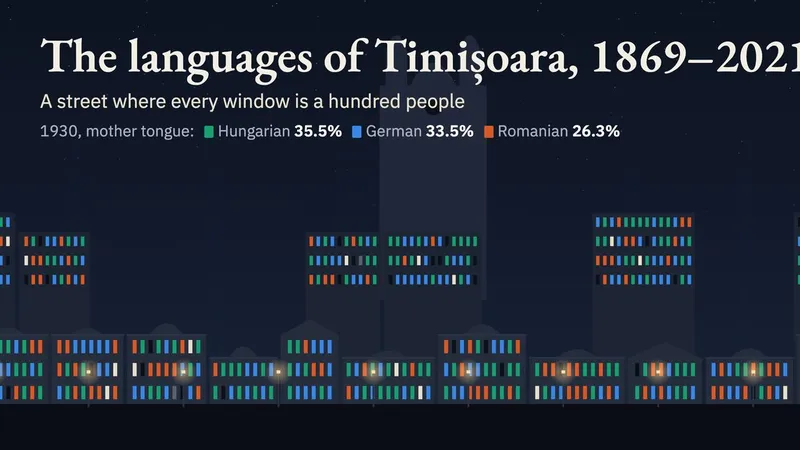
In 1910 the 6,728 Jews of Timișoara, a city in western Romania, mostly had Hungarian or German as their mother tongue: they appear only when language is set beside religion. The mother tongue, nationality and faith declared at every census from 1869 to 2021, one window for every hundred people.
Work and everyday life
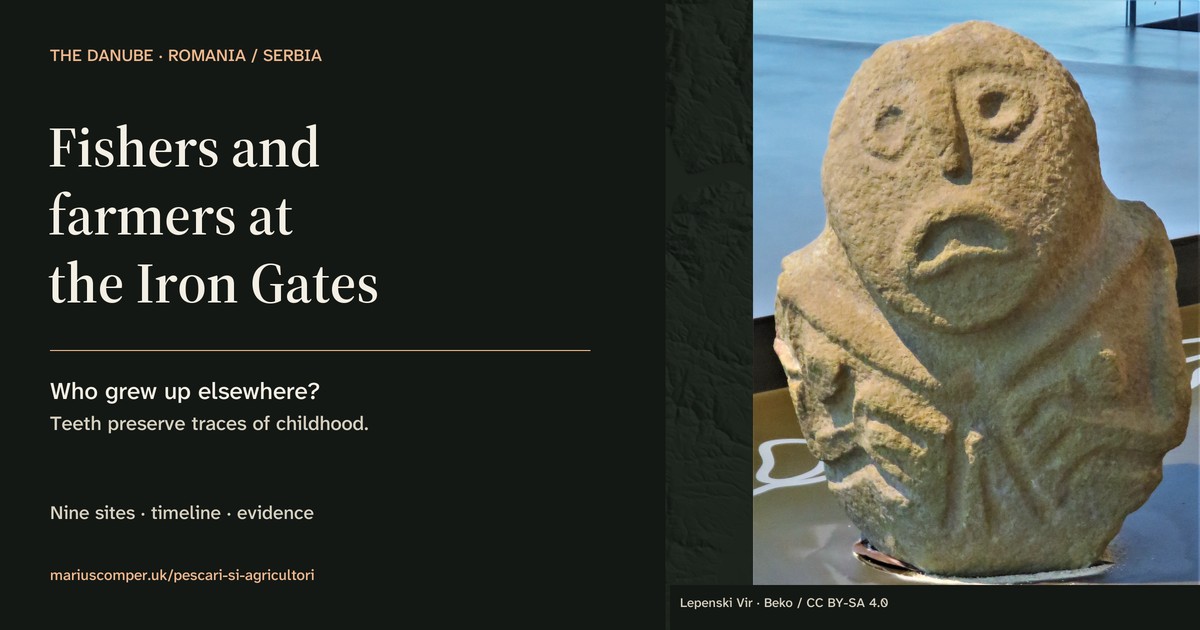
As farming began, teeth indicate more people raised in a different geological area. Nine sites on the gorge’s relief map, with sample phases, DNA, diet and precise sources.
Kinship and family
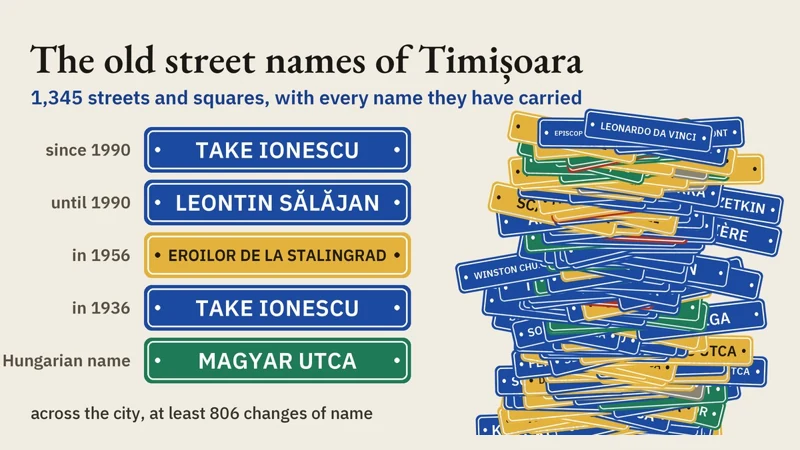
Bulevardul Take Ionescu was Magyar utca, then Heroes of Stalingrad, then Leontin Sălăjan. Every recorded name of the 1,345 streets of Timișoara, a city in western Romania, from the Hungarian names of before 1919 to now, searchable by street.
Places and ways of living
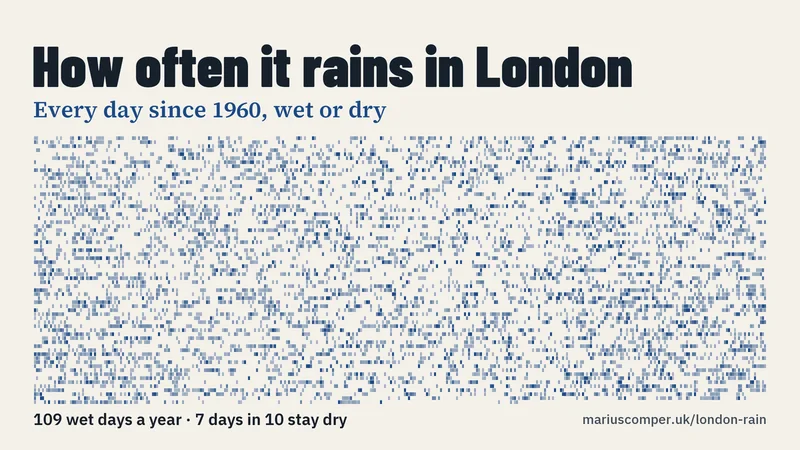
At Heathrow it rains, 1 mm or more, on three days in ten: 109 days a year. Paris, measured at Orly, gets the same; New York gets twice the rain on fewer wet days. Every day from 1 January 1960 to 31 August 2026 is one mark on a wall of days, any date can be followed year by year, and with a year of birth the page counts the birthdays it rained on.
Urban life and change
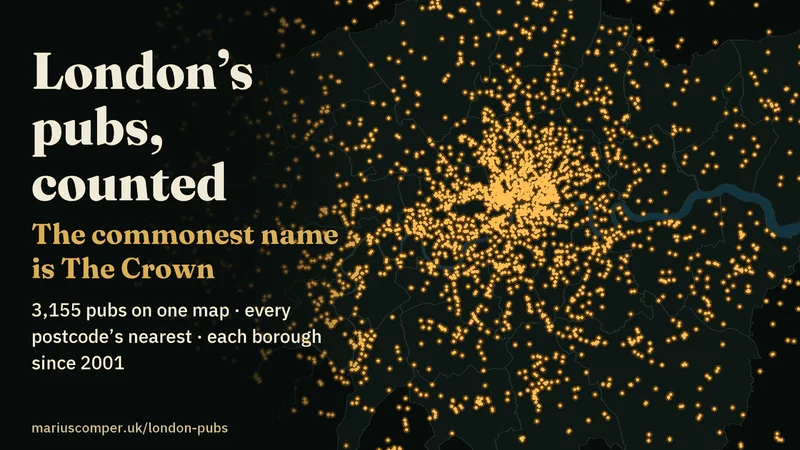
London’s commonest pub name is The Crown, ahead of the Prince of Wales and the Red Lion: 31 of the 3,155 pubs mapped by OpenStreetMap’s volunteers. Half of the city’s postcodes have a mapped pub within 286 m in a straight line, and the official count of pubs and bars fell from 4,835 in 2001 to 3,525 in 2024, with Hackney the only borough that rose. A map of London drawn only from its pubs, with a result and a picture for each of 217 postcode districts.
Kinship and family
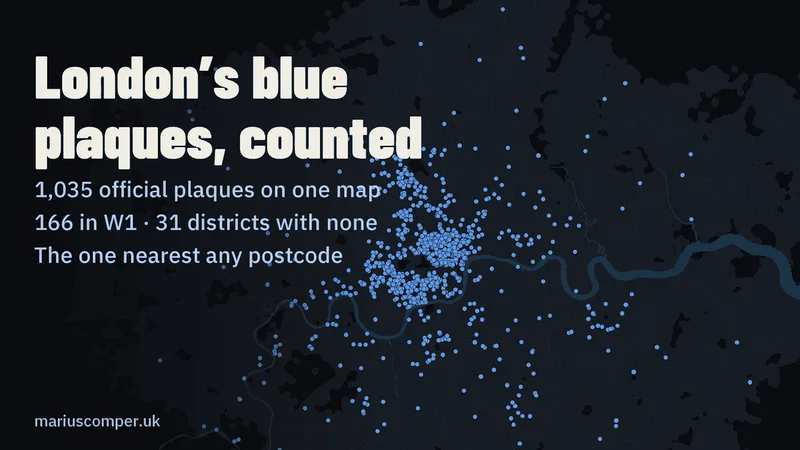
London’s official blue plaque scheme, run today by English Heritage, has 1,035 plaques: 166 are in W1, and 31 of the 120 London postal districts have none. 152 of the 1,010 plaques to a person honour a woman, and the median wait between death and plaque is 49 years. All 3,942 plaques on record, of every kind, on a map drawn from postcodes, with the plaque nearest any postcode and the words on it.
Kinship and family
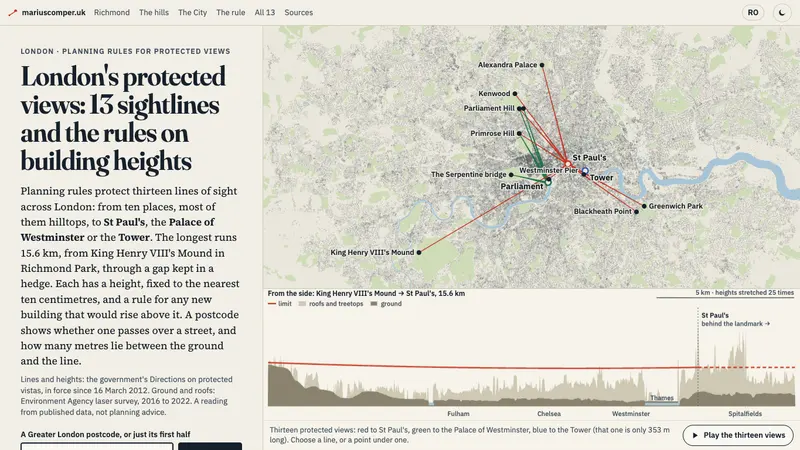
London's planning rules protect thirteen lines of sight to St Paul's, the Palace of Westminster and the Tower; the longest runs 15.6 km from a gap kept in a hedge in Richmond Park. All thirteen, drawn from the government's 2012 Directions, with the height limit under each, the real ground and roofs from laser survey, and a postcode look-up.
Places and ways of living
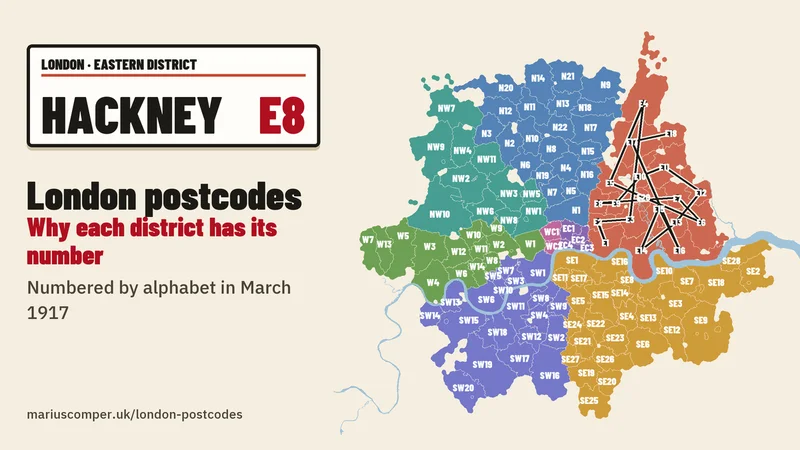
London's postcode numbers are alphabetical: in March 1917 the Post Office gave 1 to each district's main office and numbered the other delivery offices by name, so Hackney is E8 and SE2 is 15 km from SE1. All 120 districts on a map drawn from 110,673 postcodes, each with its own sentence and picture, and the 5,655 lines of the 1917 street list to search.
Language and identity
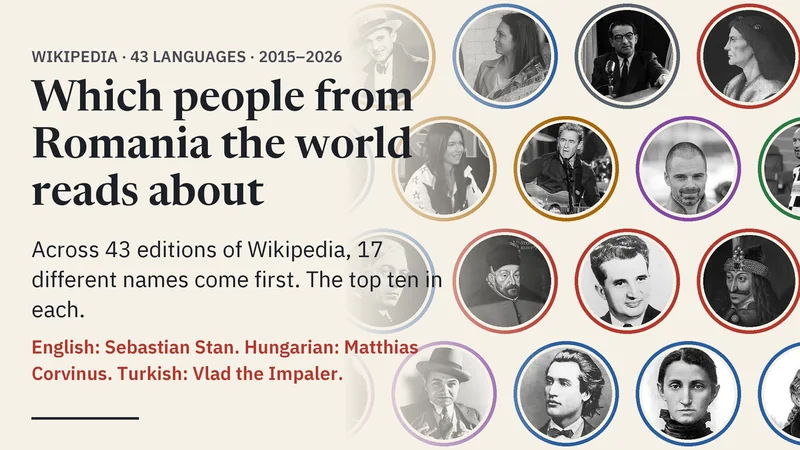
The most-read article about a person from Romania changes from one Wikipedia edition to the next: Sebastian Stan in English, Matthias Corvinus in Hungarian, Vlad the Impaler in Turkish, the poet Eminescu in Romanian. A wall of 43 languages shows the face at the top of each, its top ten names and the months when a name surged. In Romanian, English and Chinese.
Belief and ritual
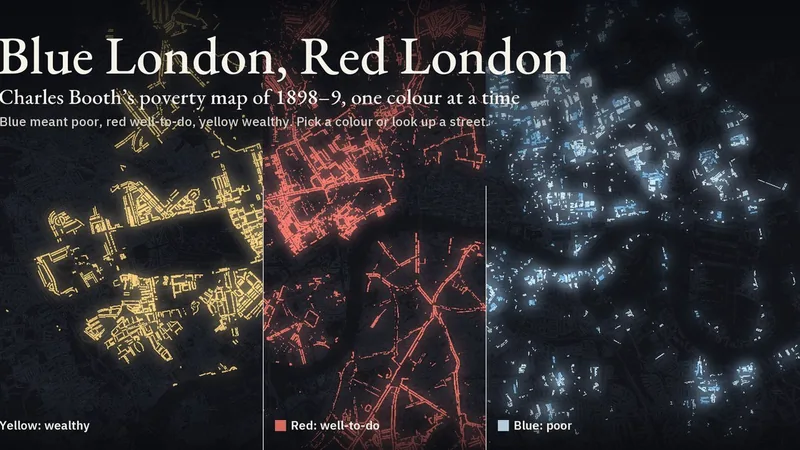
In 1898–9 Charles Booth’s investigators coloured London’s streets in seven colours, from black and blue for the poorest to yellow for the wealthy. Choose a colour to see where it was printed, or look up a street. In English and Romanian.
Places and ways of living
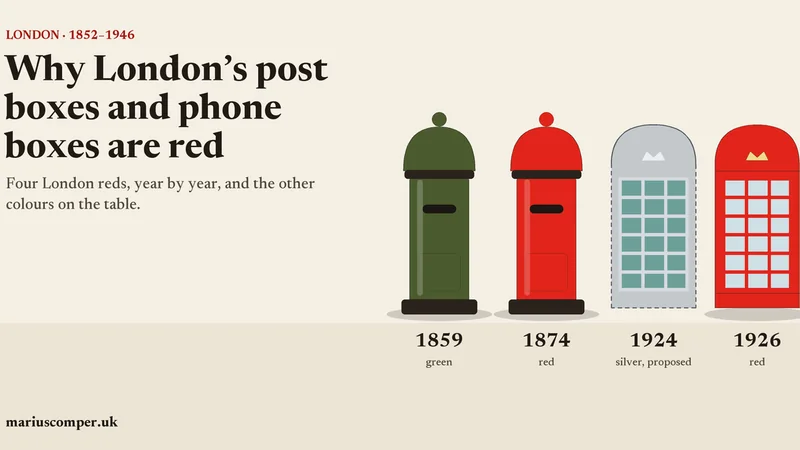
The British pillar box was red in Jersey in 1852, green from 1859 and red again from 1874, London first, and the phone box’s architect wanted it silver. This page follows four London objects, the post box, the phone box, the bus and the Underground logo, year by year from 1852 to 1946 through 18 entries from the record: what the Postal Museum, Historic England and BT Archives say at each change. On the way there is one question: what did Scott write in 1935 about red kiosks in the countryside?
Places and ways of living
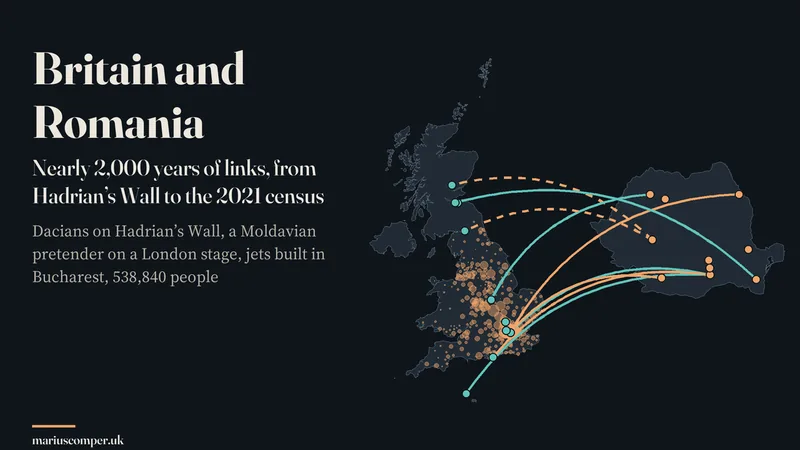
Twelve sourced stops on what Britain and Romania left in each other, from a hoard of nails in Scotland and Dacians on Hadrian’s Wall to jets built in Bucharest; at the end you look up how many Romania-born people live in your area of England or Wales.
Kinship and family
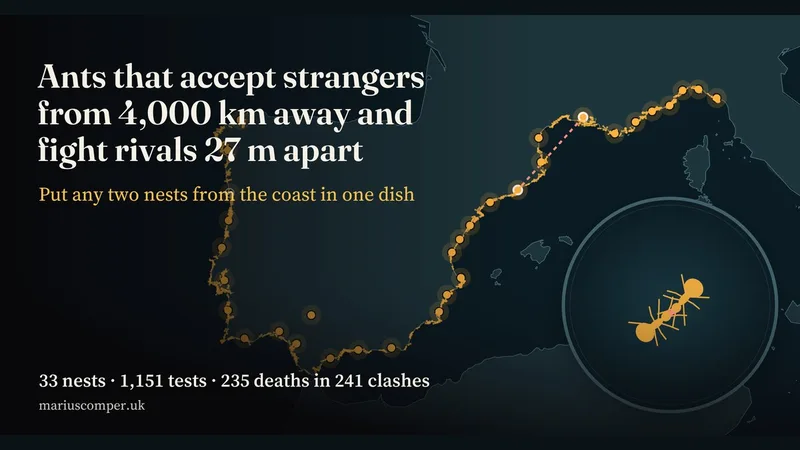
In 2000, 33 Argentine ant nests along the coast from Italy to the Atlantic were paired two at a time in a small vial. Ants of one supercolony never fought; between the two European supercolonies a worker died in 235 of 241 trials. Pick two nests on the map and see the result, then what was and was not tested.
Belief and ritual
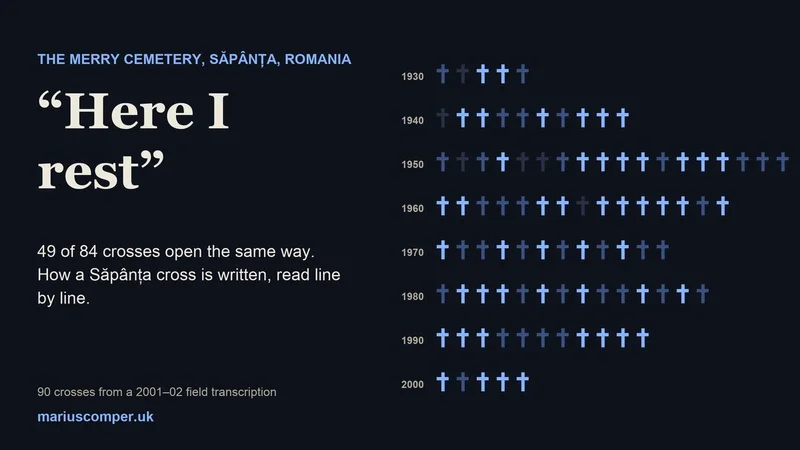
90 crosses from the Merry Cemetery, transcribed in the field in 2001–02 and read line by line: 49 of 84 verse crosses open with the same sentence and the typical line has seven or eight syllables, but spelling does not let the count prove more.
Tools and connections
A short, surprising fact by topic, with an “Another one” button and a direct link to the section that explains it. Thousands of verified facts from the site’s projects.
Urban life and change
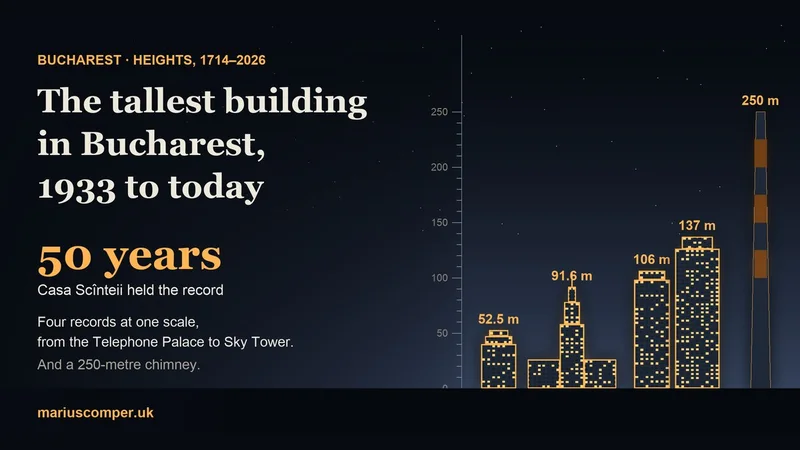
The Telephone Palace, Casa Scînteii, Tower Center International and Sky Tower drawn to one scale beside a ruler in metres, plus a 250 m chimney. You climb the ruler with the text, see who held the record and for how long, and choose the floors of your own block to find which record it would have broken.
Urban life and change
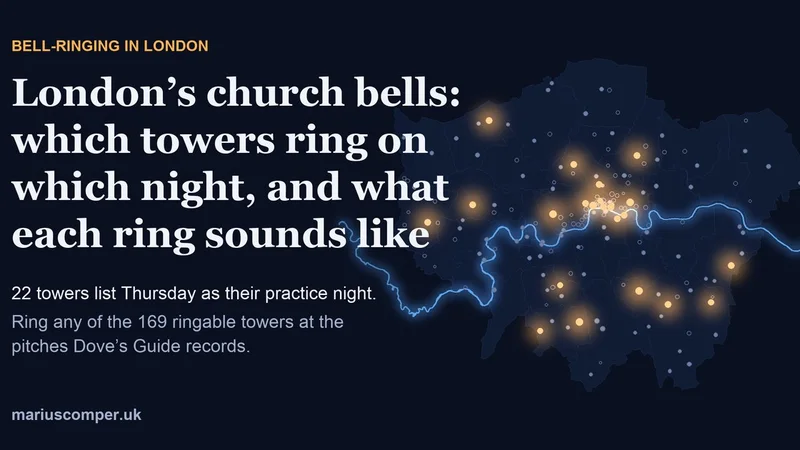
A night map of London's bell towers: pick a night and the towers listing a practice in Dove's Guide light up, tap one to hear its bells, synthesised at the frequencies in the ringers' database, while the order of the ropes changes row by row. Four towers, including St Mary-le-Bow, also have real openly licensed recordings.
Work and everyday life
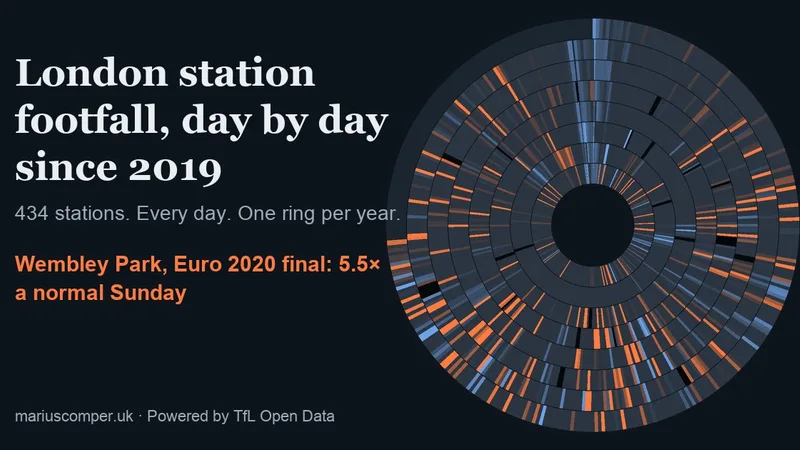
Daily tap counts at 434 London stations, January 2019 to September 2026, wound into rings: one ring per year, one slice per day. Southfields lights up for Wimbledon, Arsenal station follows the fixture list, Ladbroke Grove has no row on Carnival days, and on Christmas Day TfL counts zero Tube journeys. Pick your station and a date of your own.
Urban life and change
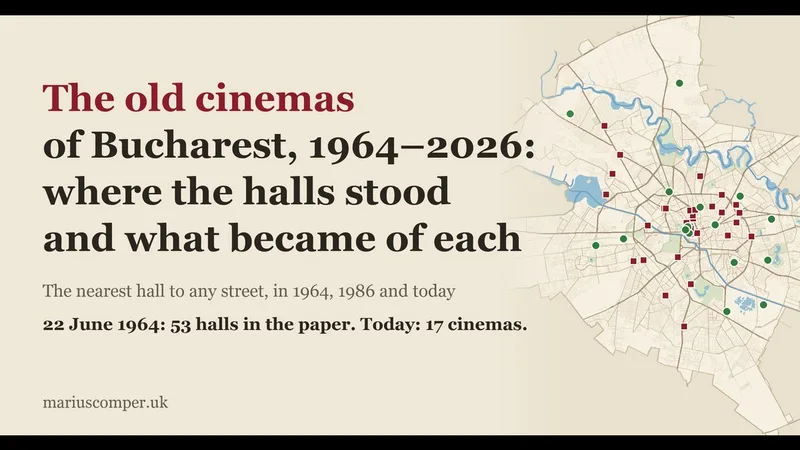
On 22 June 1964, Scînteia listed films in 53 Bucharest halls; today 17 cinemas run a regular programme, 11 in malls. A map of every hall, what it became, and a street search for 1964, 1986 and today.
Urban life and change
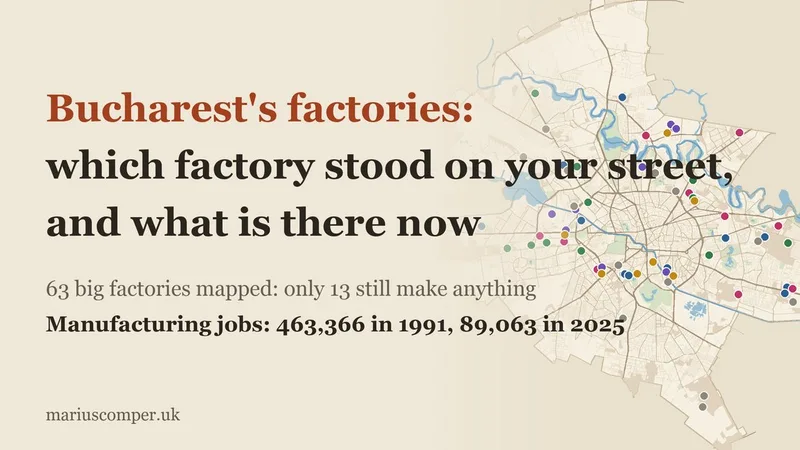
Type your street and see the big factories near you as they were and what stands there now: 63 factories, only 13 still make anything; the rest became malls, offices, flats or wait. In 1991, 463,366 manufacturing employees; in 2025, 89,063.
Places and ways of living
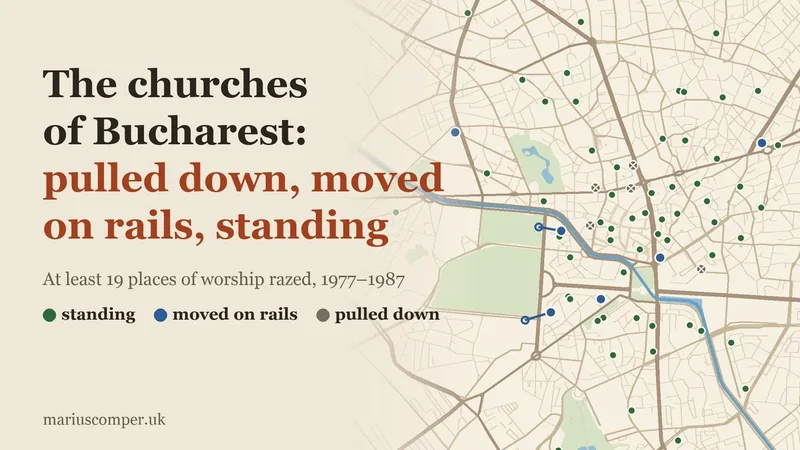
Type your street and see the old churches around you, the oldest of them, and the nearest church pulled down or moved on rails: 88 churches on today's map, from Curtea Veche (1558–1559) to Cuibul cu Barză, pushed 16 metres in 1988.
Urban life and change
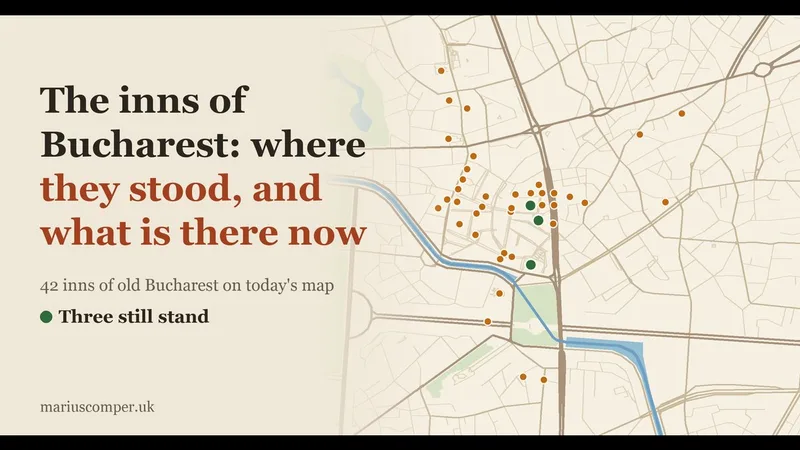
Type your street and see which inn stood near you and what stands on its site now: 42 inns of old Bucharest on today's map, from Șerban-Vodă (now the National Bank) to the three still standing.
Work and everyday life
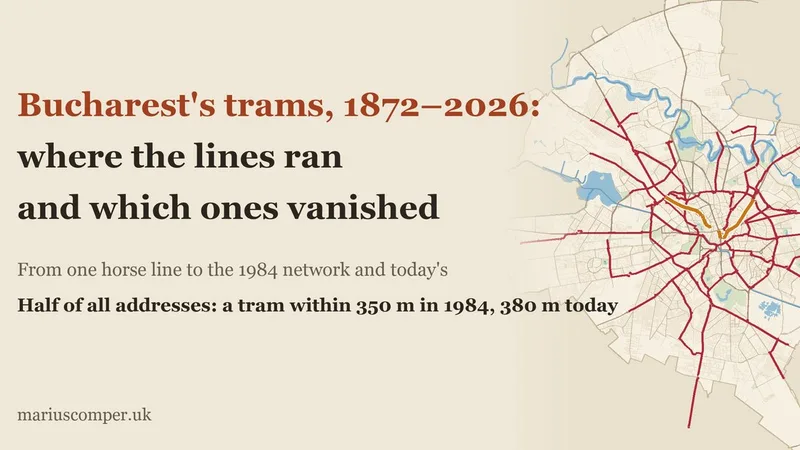
Type your street and see the nearest tram line in 1872, around 1910, in 1963, in 1984 and today, plus the line that disappeared near you. From the 1872 horse line to today's track under works.
Urban life and change
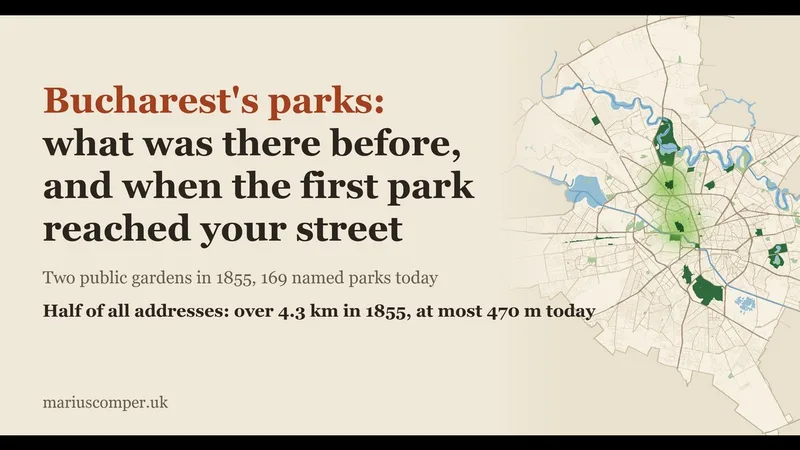
Type your street and see how a park came closer to your house, from 1855 to today, and what was on its ground before: drained ponds, clay pits, rubbish tips, demolished houses. 169 named parks on today's map, 20 with their history.
Kinship and family
Ten categories, two levels, 44 titles to earn with a clean sheet. Every question comes from a verified fact on the site.
Urban life and change
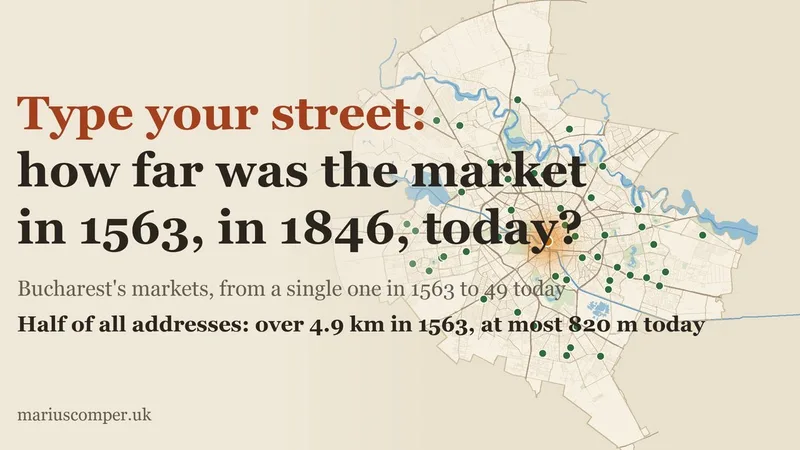
Type your street and see the nearest market in 1563, c. 1708, 1846, c. 1900, 1938 and today: from the bazaar by the Princely Court to today's 49 markets. Plus the Outer Fair that kept running from the city, the lost halls and Obor.
Belief and ritual
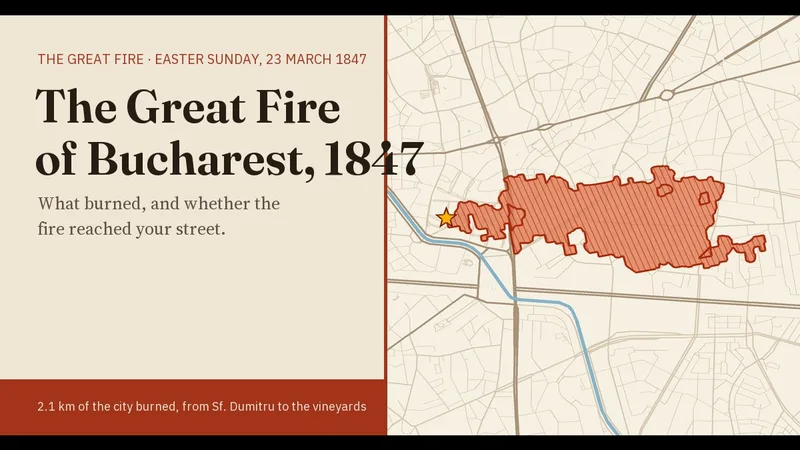
Easter Sunday, 1847: from a house by Sf. Dumitru, fire burned a 2.1 km strip of Bucharest out to the vineyards. The April 1847 burn plan fitted to today's streets: type an address to see whether the fire reached it, in what order places burned, and what building rules followed.
Work and everyday life
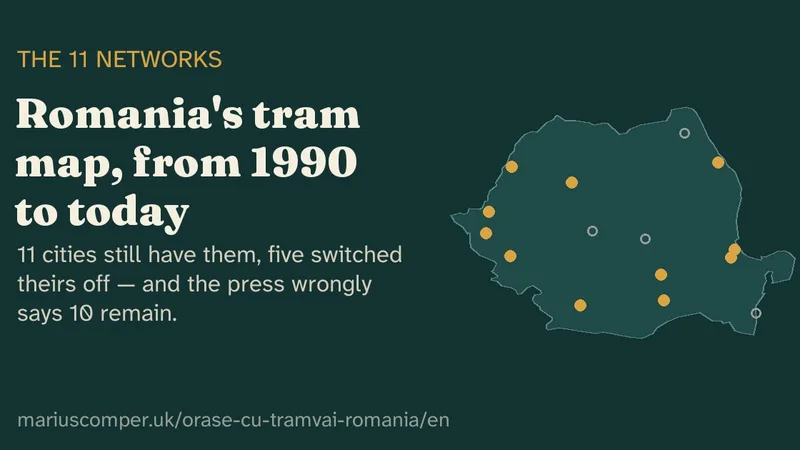
Eleven Romanian cities still run trams. See every network on a map, which cities gave up their trams, and why some sources wrongly say 10 remain.
Places and ways of living
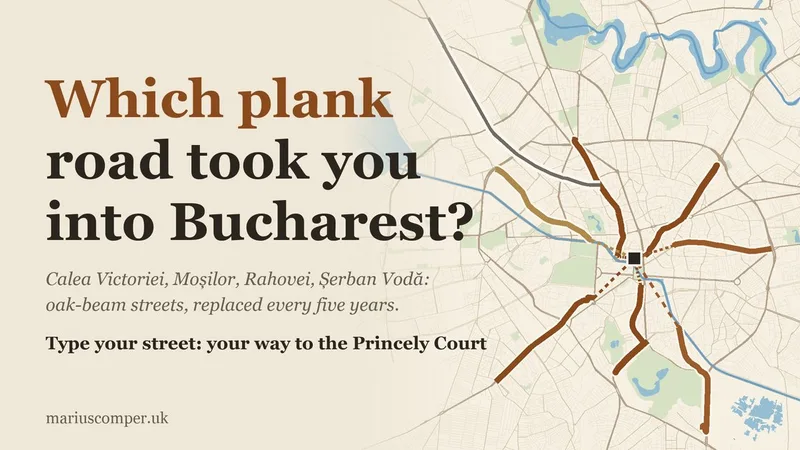
Calea Victoriei, Moșilor, Rahovei and Șerban Vodă were once "poduri": streets of oak beams, replaced every five or six years. Type your street and see which old road took you to the Princely Court, how far it was and what it was called over the years.
Population and communities
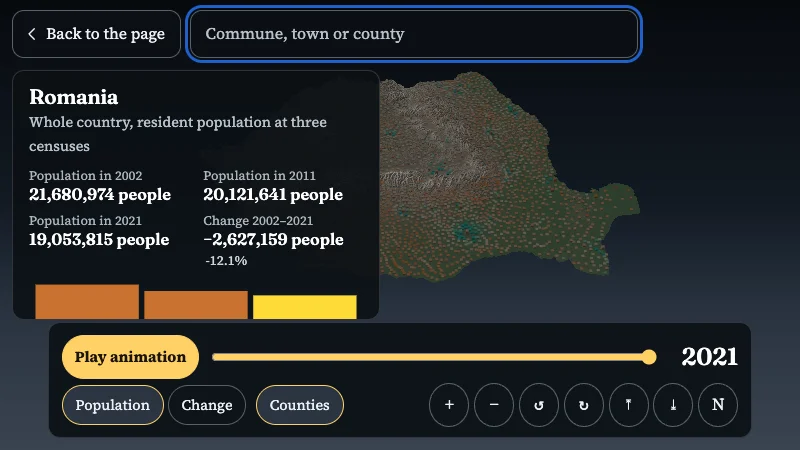
Search your commune or county and see on 3D terrain how its population fell or rose across the 2002, 2011 and 2021 censuses. Every commune is a column: height is population, colour is change. In Romanian and English.
Places and ways of living
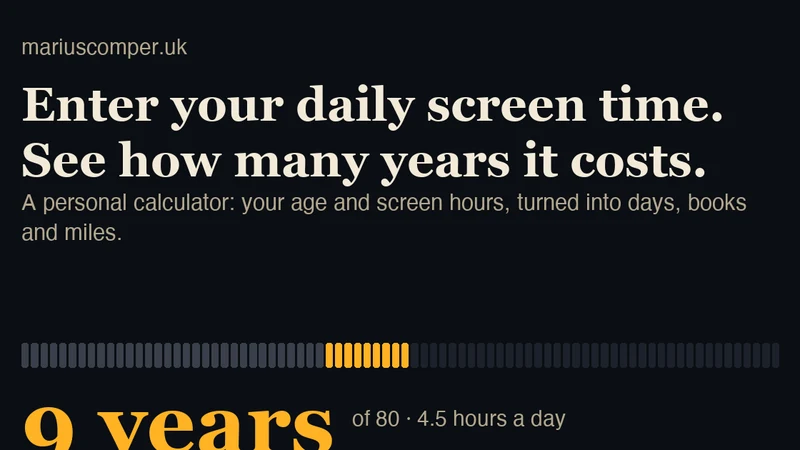
Enter your age and daily phone hours: the page shows what your number means across a year and by age 80 — whole days, unread books, laps of the Earth on foot.
Authority and rules
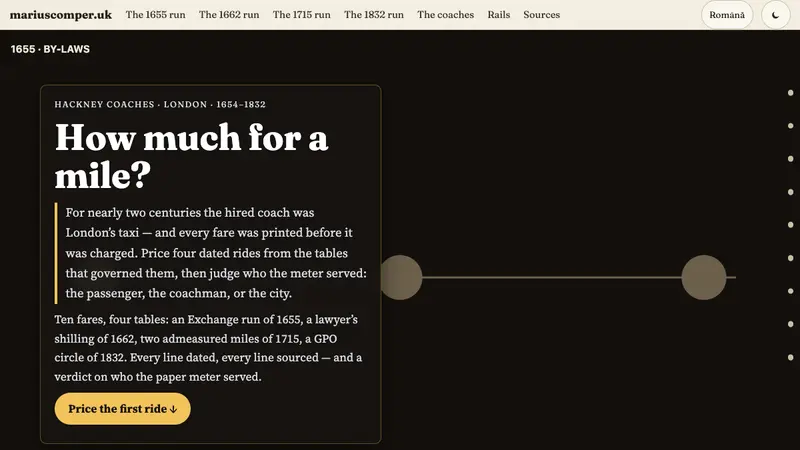
Price ten fares across four dated runs — an Exchange run of 1655, a lawyer's shilling of 1662, two admeasured miles of 1715, a GPO circle of 1832 — then judge who the paper meter served, on two dated proof rails.
Places and ways of living
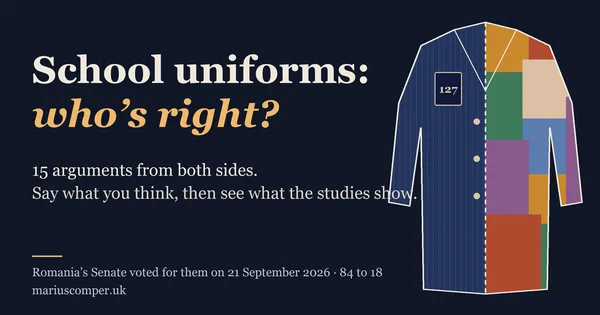
The 15 arguments from both sides of Romania's compulsory-uniform debate. Say what you think of each, then see what studies from the US, France, Kenya and England show. Plus what the Senate voted, what it would cost you and the uniform's history since 1552. In Romanian and English.
Work and everyday life
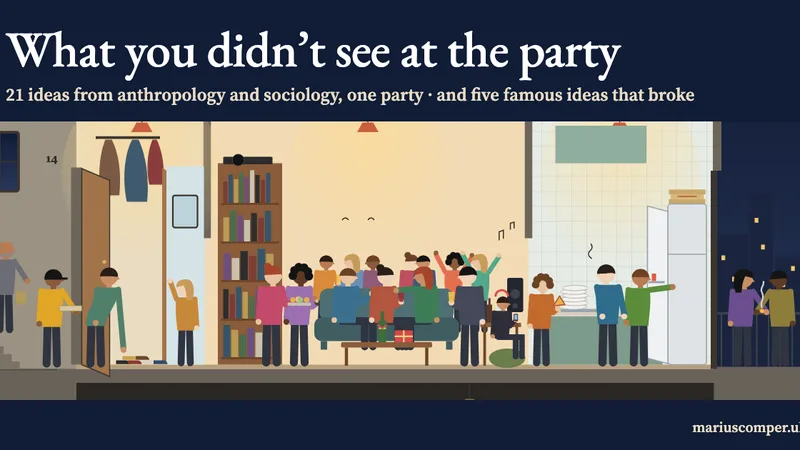
One party in a flat, seen through 21 ideas from anthropology and sociology, from Mauss’s gift to Granovetter’s weak ties: what each one shows, what evidence it rests on and where it stops. Plus five famous ideas that didn’t hold up. In Romanian and English.
Culture and shared practices
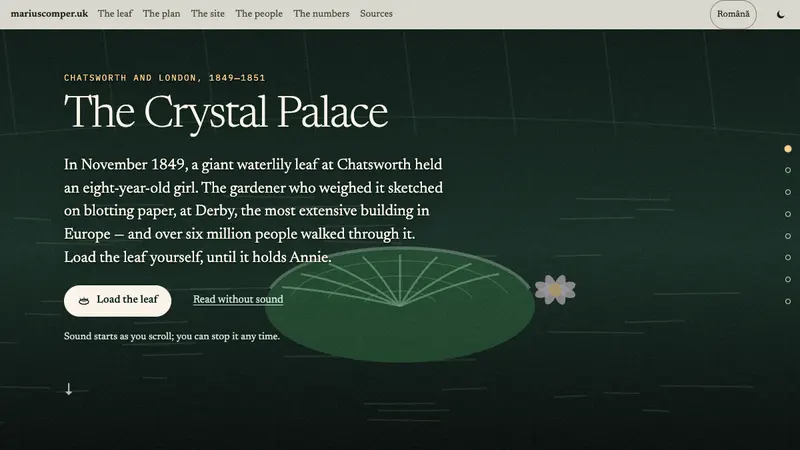
In November 1849, a giant waterlily leaf at Chatsworth held an eight-year-old girl. The gardener who weighed it sketched on blotting paper, at Derby, the most extensive building in Europe — and over six million people walked through it. Load the leaf yourself, until it holds Annie. In Romanian and English.
Places and ways of living
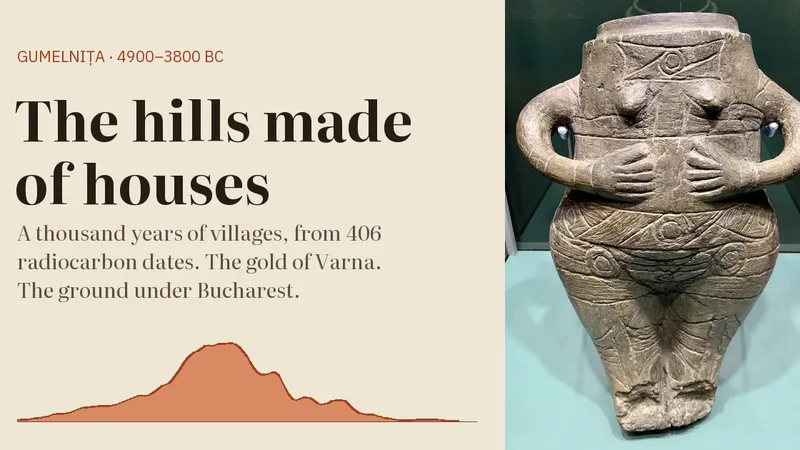
Between 4900 and 3800 BC on the Lower Danube, people built their houses one on top of another until their villages became mounds. A clock drawn from 406 radiocarbon dates, the gold of Varna, four people raised elsewhere and what has actually been found under Bucharest, in Romanian and English.
Work and everyday life
Tick twelve slips across three coffeehouse tapes — brokers’ talk at Jonathan’s, ship news at Lloyd’s, the auction hammer at Garraway’s — then judge what emptied the houses, on two dated proof rails.
Places and ways of living
June 1858: the Thames sinks, the heat bakes the banks, and Parliament's curtains soak in chloride of lime. Stand at Crossness at high water and open the sluice gates: a tide's worth of London sets off downriver on the ebb. In Romanian and English.
Places and ways of living
Run one drop of sewage through the 1858 city, then the interceptors: seven junctions with report-sourced refusals, two dated proof rails, and the verdict — the money, not the plan.
Belief and ritual
Bill each century's fair — 1400, 1600, 1700, 1850 — from 27 sourced acts, then judge what closed the field after the last proclamation: 722 years of fair at Smithfield on two dated proof rails.
Work and everyday life
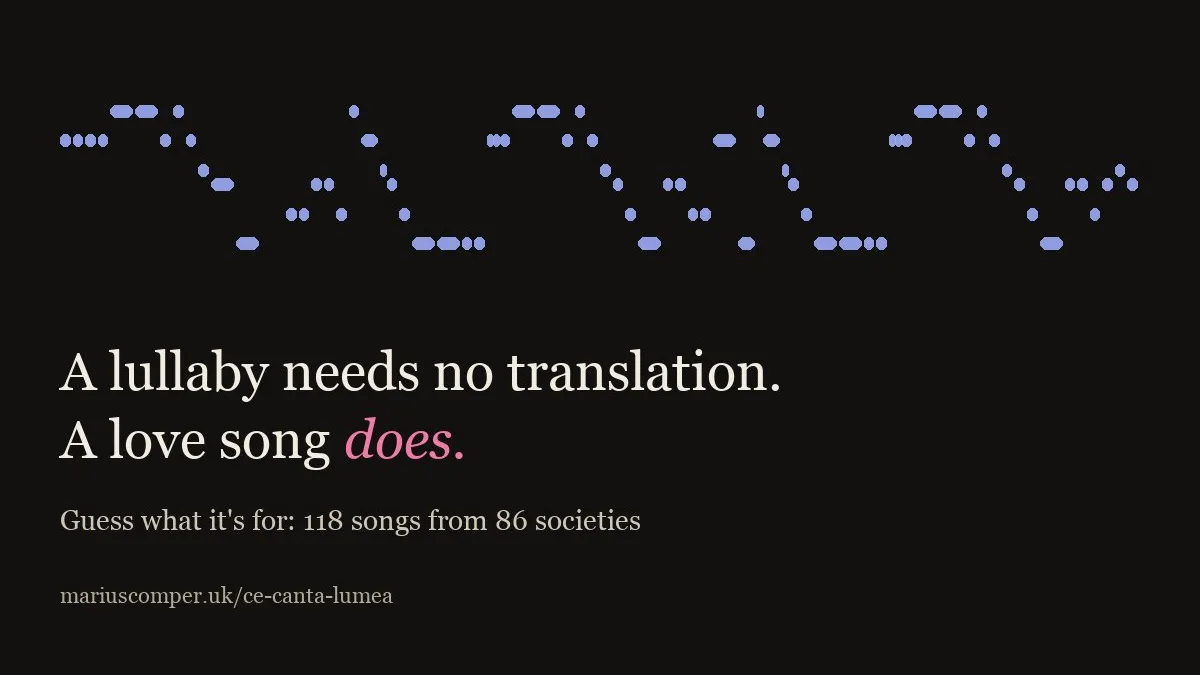
Hear melodies recorded around the world and guess whether each is for dancing, healing, love or putting a baby to sleep. Lullabies and dance songs are recognised anywhere; love songs barely above chance.
Authority and rules
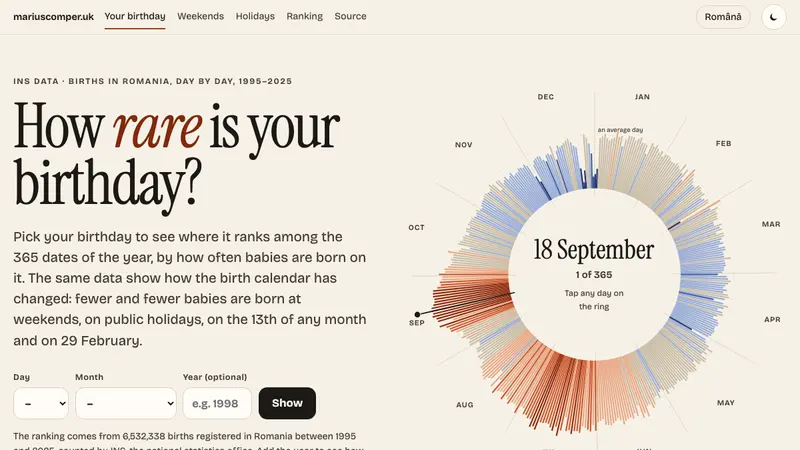
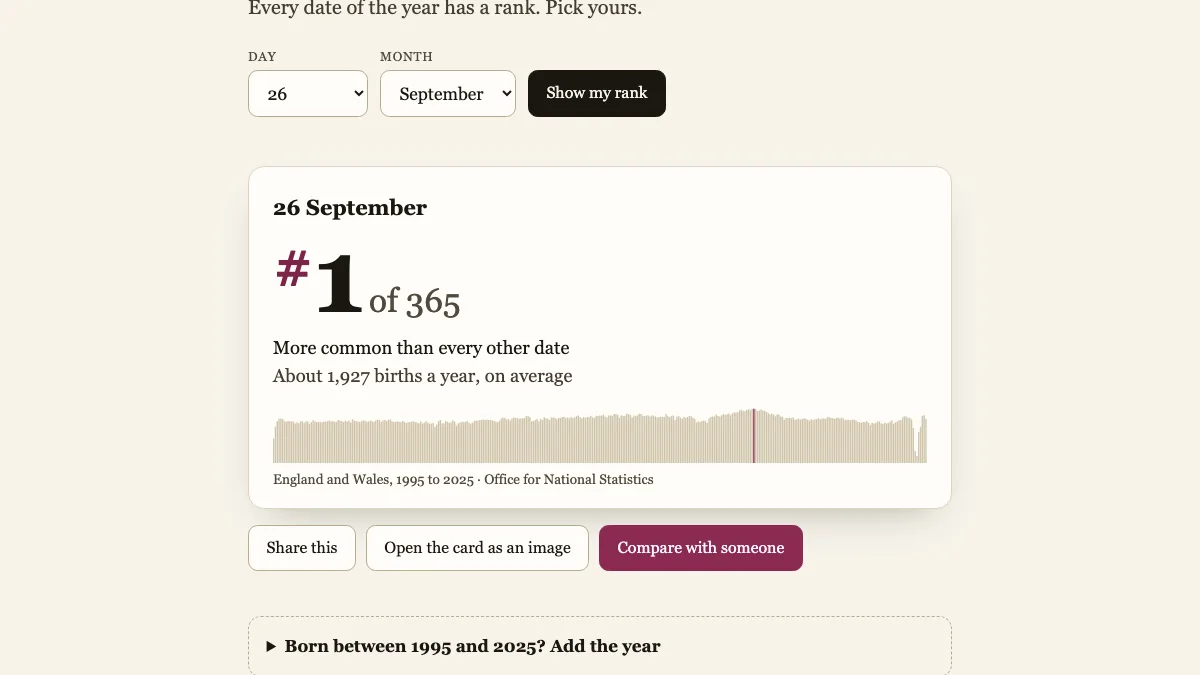
Pick a date and see where it ranks among the 365 of the year, from 6.5 million births recorded in Romania in 1995–2025. The same data show births moving away from weekends, new public holidays, the 13th and 29 February.
Belief and ritual
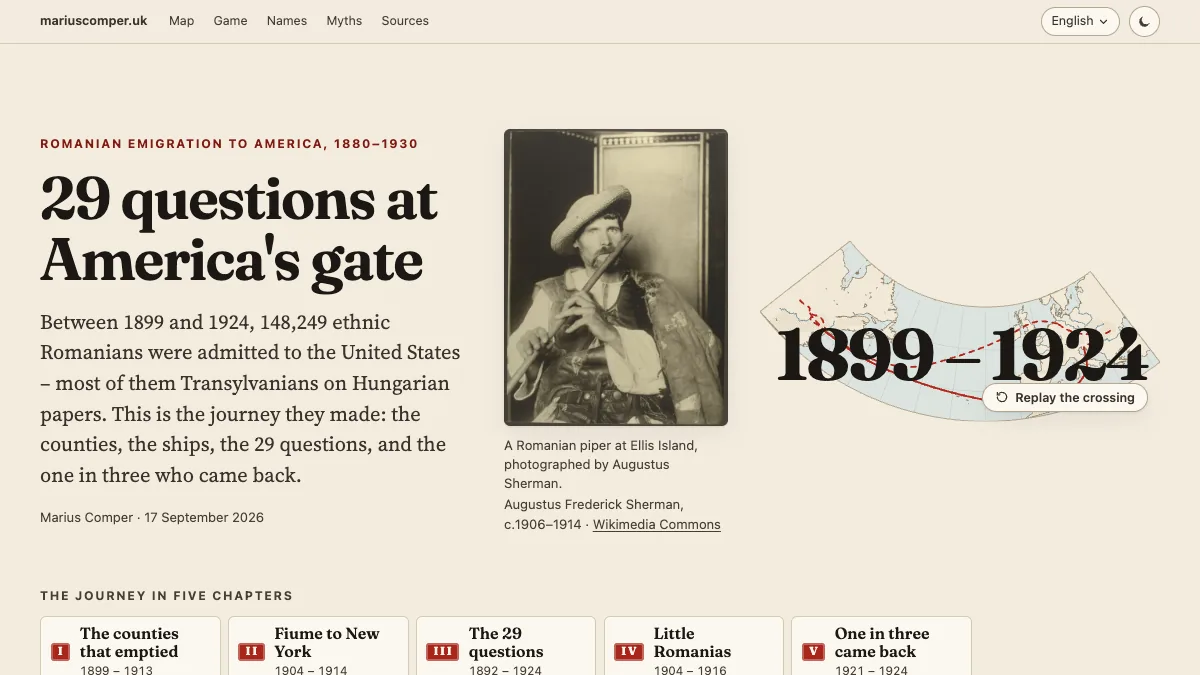
148,249 Romanians admitted between 1899 and 1924, the Fiume sailings, the Ellis Island inspection to try yourself, and nine real passengers to search by name.
Authority and rules
A Romanian diminutive leaves the object of a request untouched and absorbs, instead, the conflict around it. The phonetics of smallness, its reverse into contempt, contraband-coffee history, and an eleven-culture comparative atlas, with a word-by-word dissectable simulator.
Population and communities
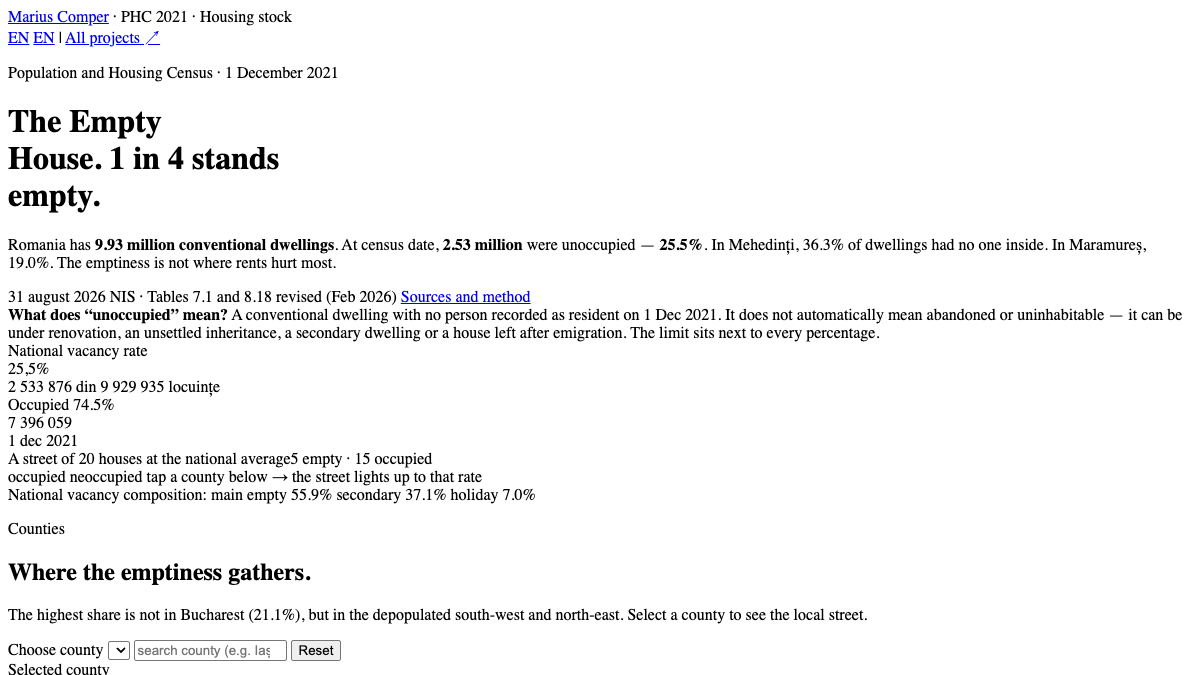
The 2021 Census counts 2.53 million unoccupied dwellings — 25.5% of the housing stock. In Mehedinți 36.3% are empty. County map, breakdown and why the rural empty stock does not solve city rents.
Places and ways of living
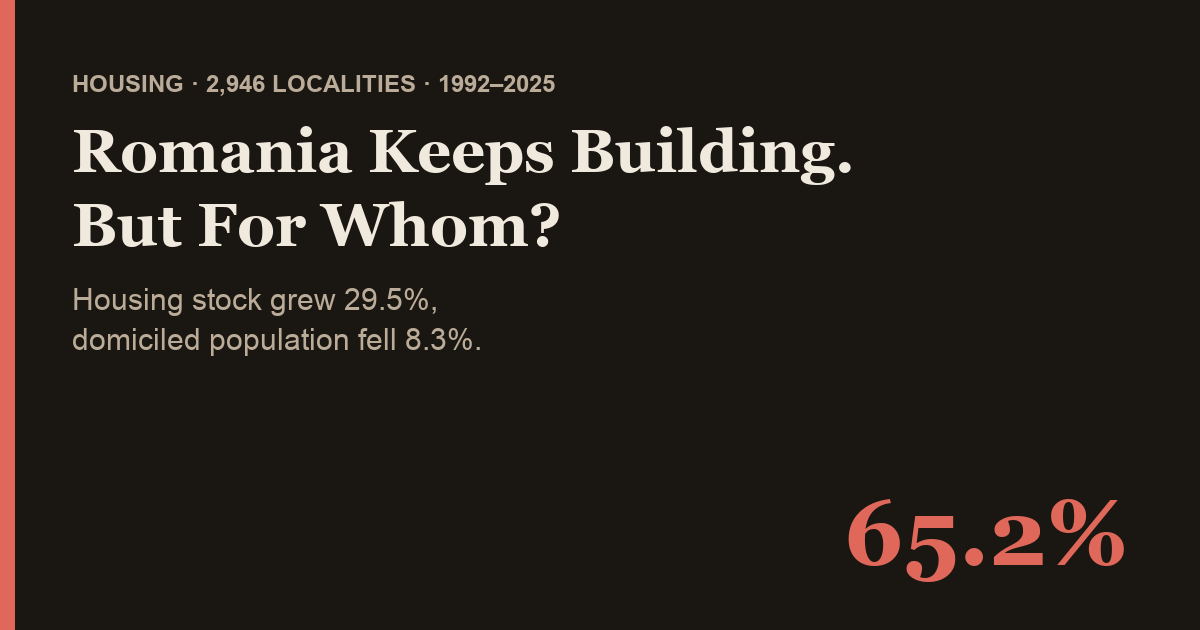
Romania's national statistics office counts, every year, how many dwellings exist in every locality. Since 1992 the housing stock has grown 29,5%, even as the domiciled population fell 8,3% — and in 65,2% of 2.946 localities, housing grew exactly where people left.
Kinship and family
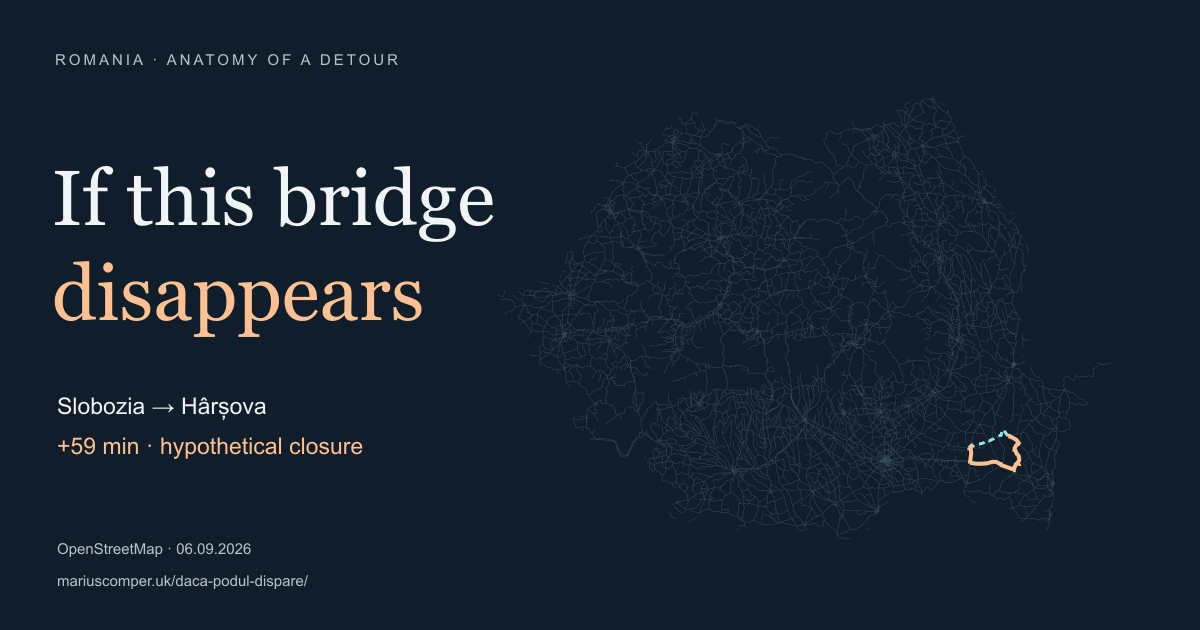
Slobozia–Hârșova, two towns in south-east Romania: closing Giurgeni–Vadu Oii Bridge would add 59 minutes in the model. Close it on the map and follow the detour.
Kinship and family
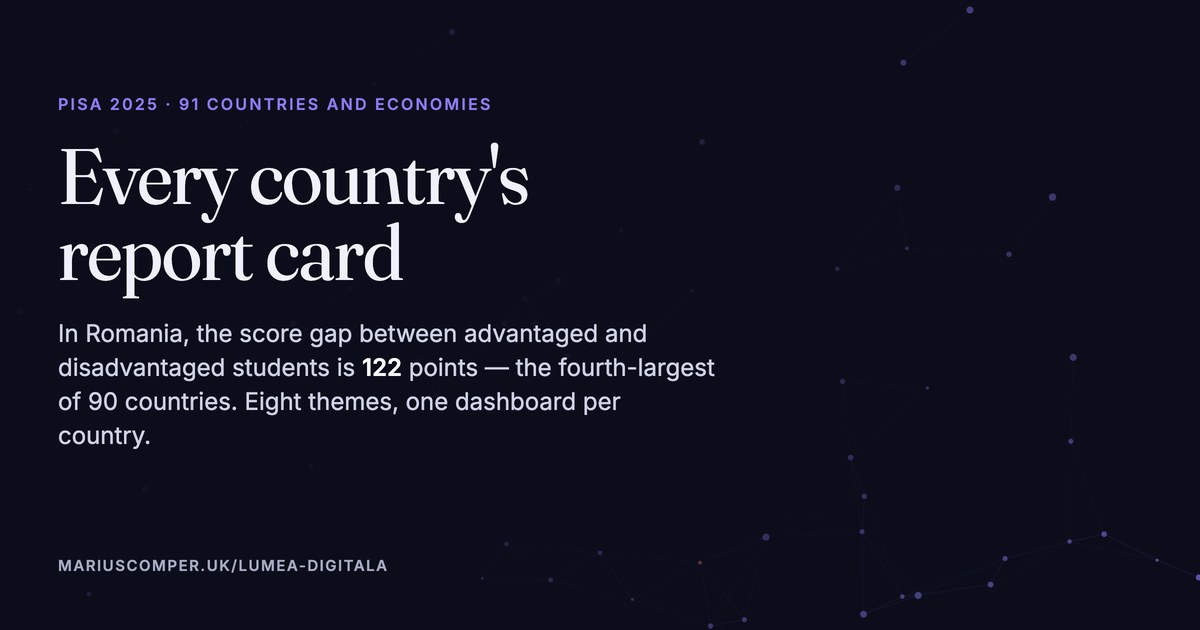
PISA 2025, across eight themes — performance, socio-economic equity, gender, AI and digital, engagement, climate, family, environment — for 91 countries and economies. Romania has one of the OECD's largest socio-economic gaps (122 points), despite strong family support and above-average AI-literacy teaching. Pick any country and see its own dashboard.
Culture and shared practices
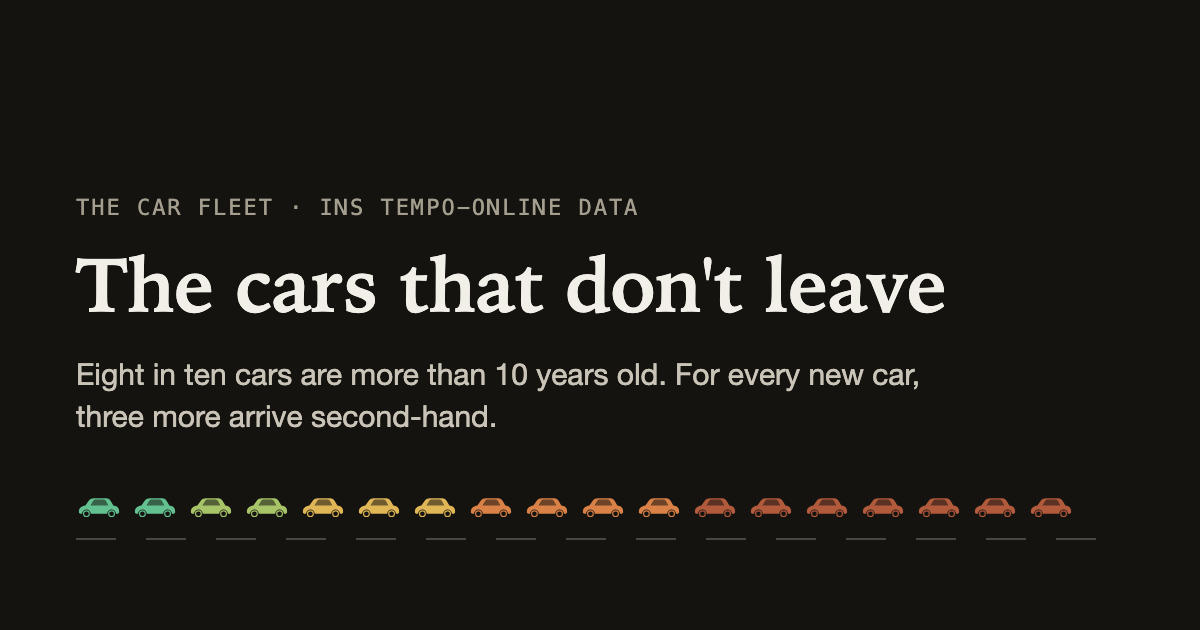
Eight in ten cars on Romanian roads are more than 10 years old, and for every new car sold, three more arrive second-hand from the West. Why the fleet keeps aging instead of renewing — in official Romanian statistics.
Language and identity
A source-grounded reading guide to Katherine Verdery's book, the 2,781-page Securitate file, and the identity surveillance built around an anthropologist in communist Romania.
Population and communities
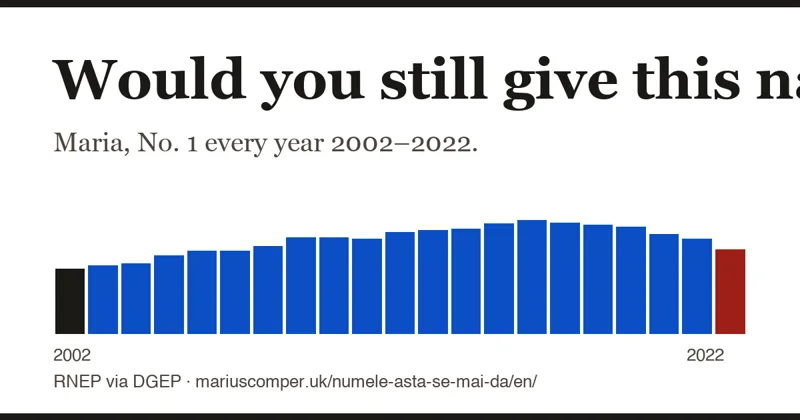
Maria ranked No. 1 in every year from 2002 to 2022. Type a first name and a birth year to see whether you belong to a crowd or a memory.
Places and ways of living
How a boundary or an estate was proved before the cadastre and the land register: 12 oath-helpers, surveyors, letters of curse, pre-emption and the Vrancea freeholders' trial against Treasurer Ruset (1801–1814), with the source of every claim.
Kinship and family
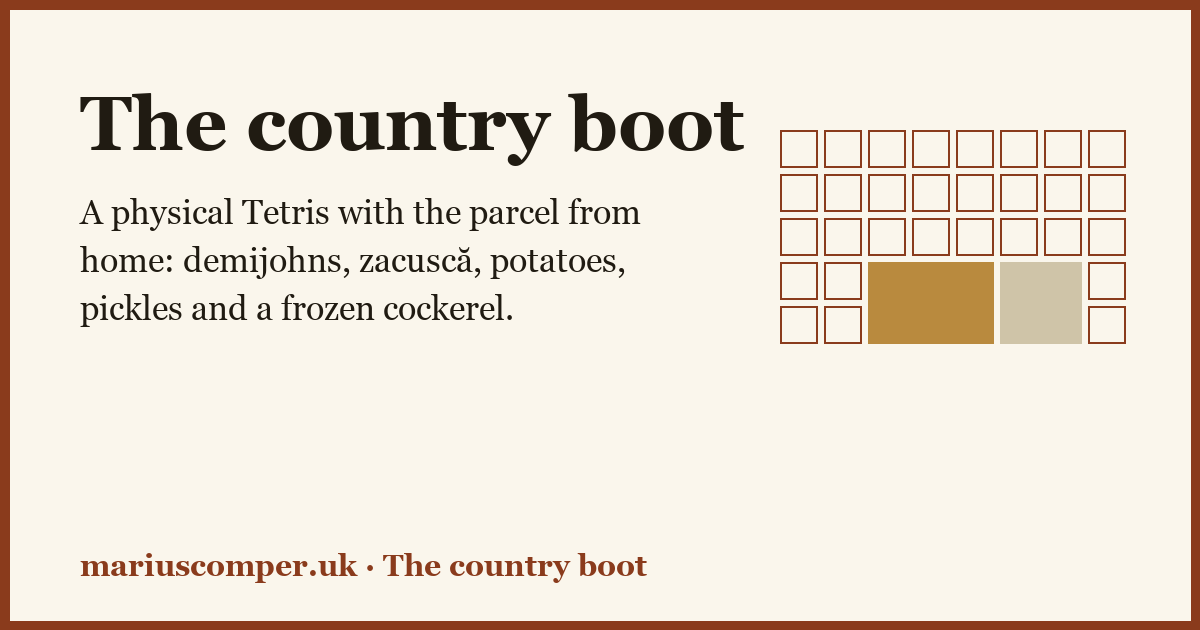
A physical Tetris with the parcel from home: two demijohns, fifteen jars of zacuscă, a sack of potatoes, a bucket of pickles and a frozen cockerel. Then, what the ritual says about short food chains and the informal subsistence economy.
Belief and ritual
Six lessons from psychological research over the past decade. Effects depend on context, beliefs do not always predict action, and credible findings need independent checks.
Kinship and family
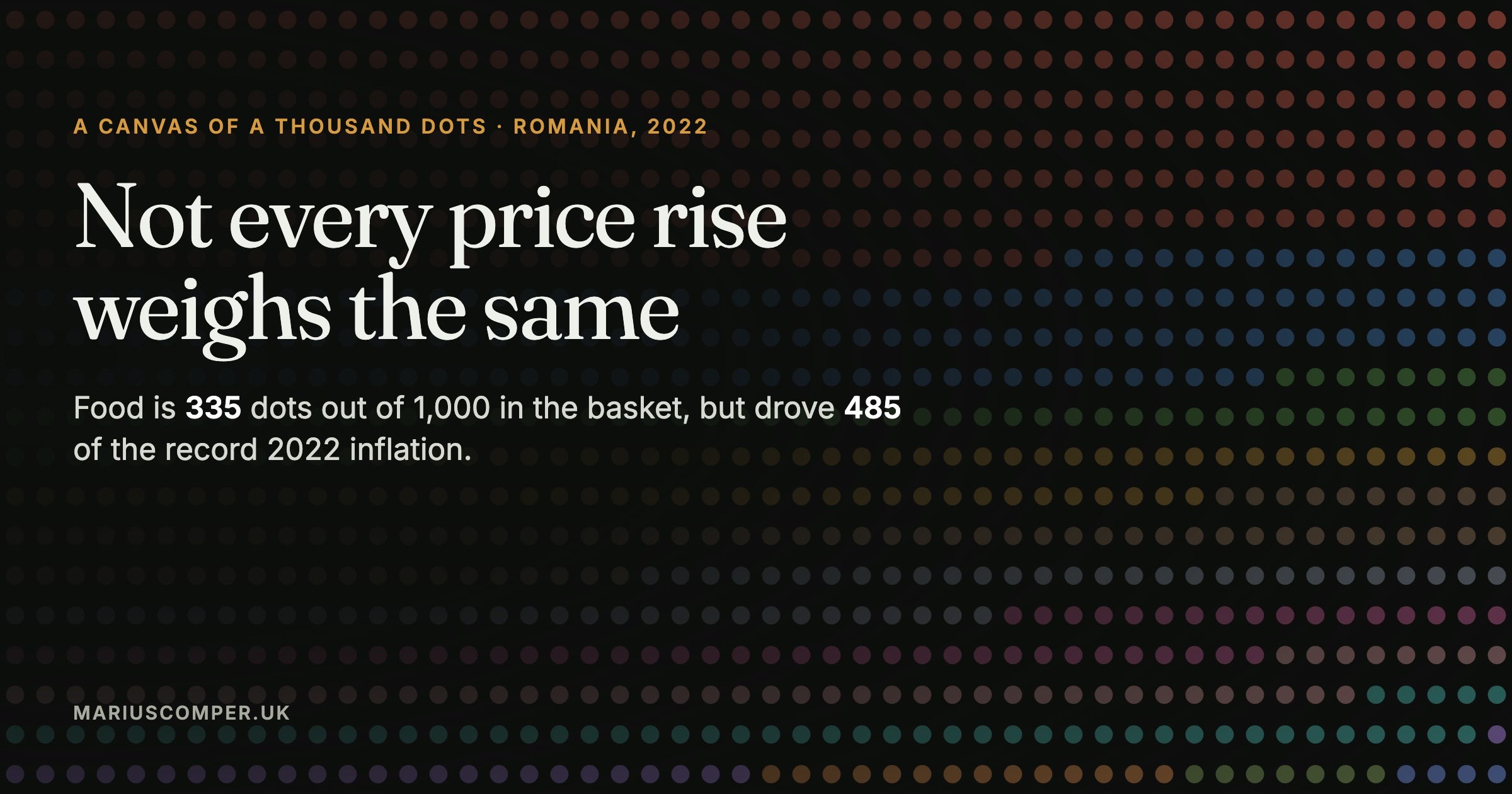
A Romanian household's basket, counted twice. Out of 1,000 dots, food is 335 by weight but drove 485 of the record 2022 inflation.
Authority and rules
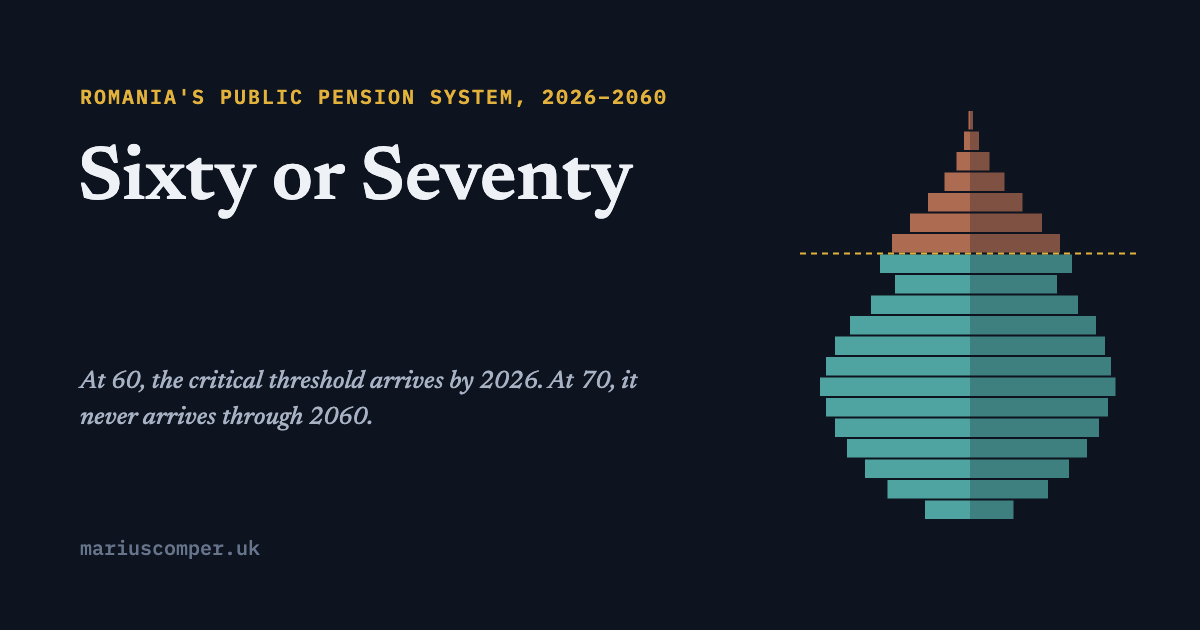
Set Romania's retirement age to 60, and the public pension system crosses 3% of GDP by 2026. Set it to 70, and it never does through 2060. An interactive demographic engine shows why retirement age matters more than the birth rate.
Belief and ritual
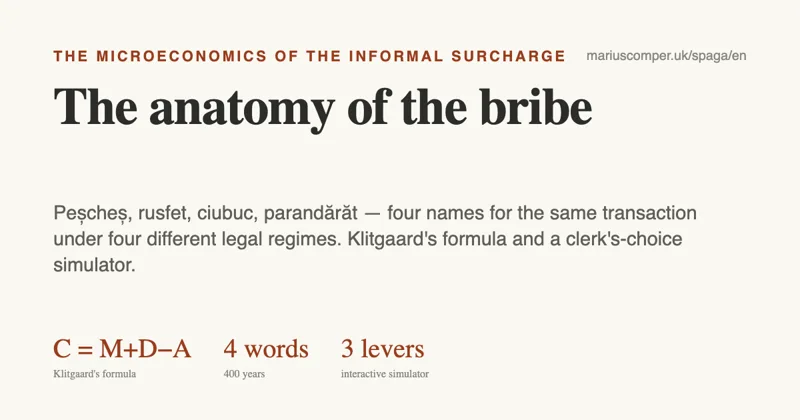
Four words, four legal regimes, one transaction: peșcheș, rusfet, ciubuc, parandărăt. Klitgaard's corruption formula and an interactive simulator of the decision to demand or pay an informal fee.
Kinship and family
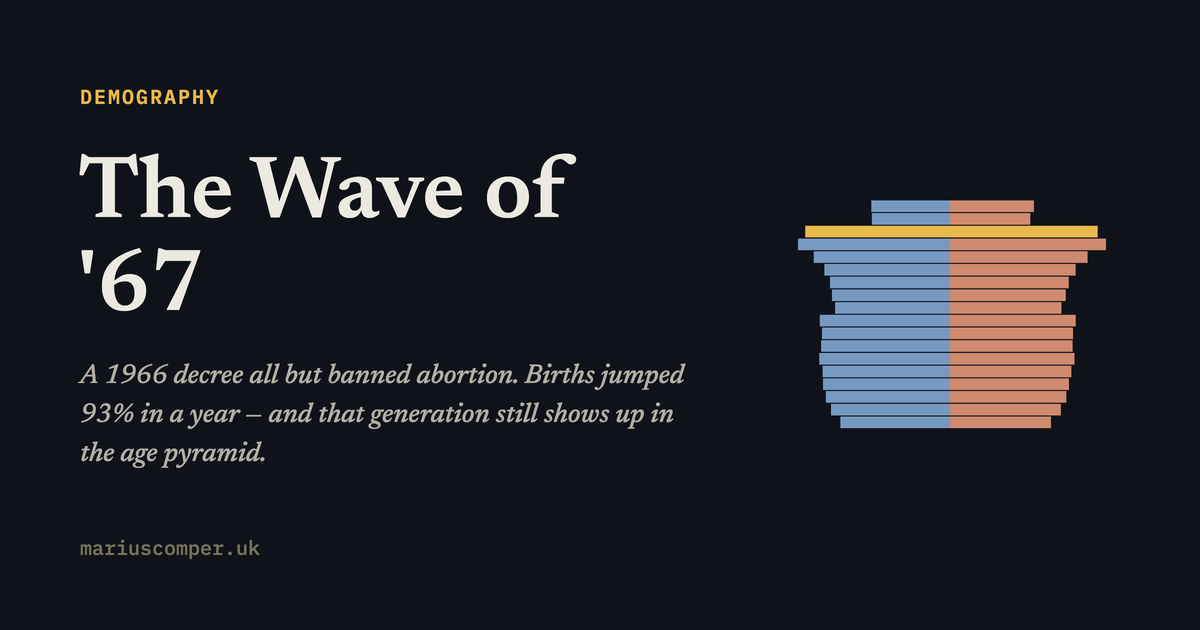
A 1966 decree all but banned abortion in Romania. Births jumped 93% in a single year, and that generation still dominates the country's age pyramid.
Kinship and family
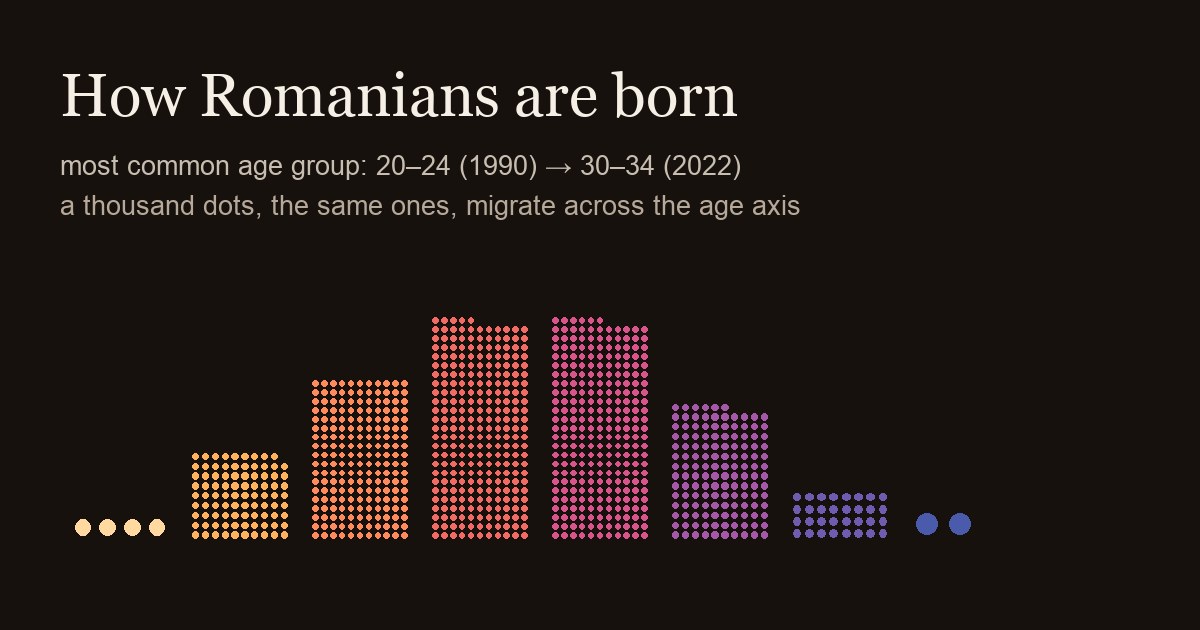
A thousand Romanian births, rearranged by the mother's age, show how the most common age group shifted from 20–24 to 30–34 between 1990 and 2022. Follow the same dots by year, birth order and county.
Work and everyday life
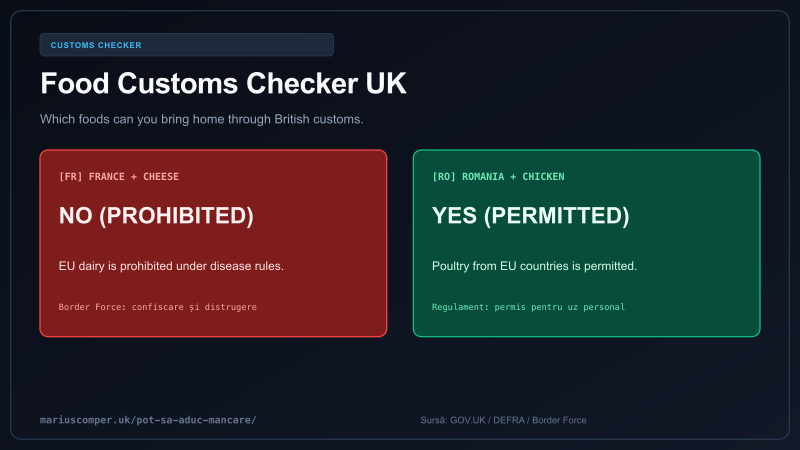
Pick where you are travelling from and what is in your bag to get an instant verdict: YES, NO, or YES UP TO X KG. UK rules produce counter-intuitive results: EU poultry is permitted while EU cheese and ham are banned; Indian mangoes pass freely while Turkish strawberries are seized without a plant-health certificate. Includes instant checker and 10-item customs quiz.
Work and everyday life
Romania holds Europe’s highest homeownership rate (95.3%) alongside its most overcrowded dwellings (40.5%), with just 1.1 rooms per person. A sociological investigation into the 1990 mass privatization, mortgages melted by hyperinflation, and the concrete flat drafted as a private welfare state of last resort.
Kinship and family
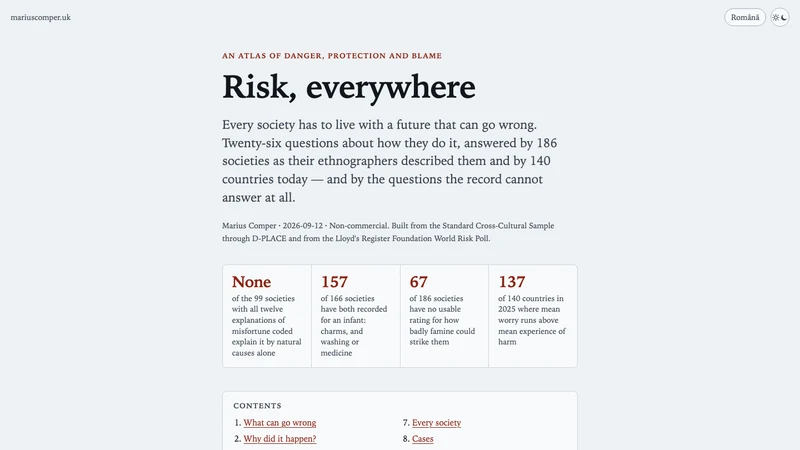
Twenty-six questions about how a society lives with a future that can go wrong: how badly famine can strike, why misfortune is thought to come, how an infant is shielded, who lends to whom, who can harm you by looking. Every answer comes from the 186 dated societies of the Standard Cross-Cultural Sample, with the number coded beside every count and the uncoded societies drawn into the same figure, plus a 140-country survey from 2025. Then every society's record, 11 cases read at their dates, 5 arguments and the questions nobody has coded.
Kinship and family
The anthropology of death, sorted by question: who may touch the body, whether the name may still be spoken, how long mourning lasts, where the spirits go, whether what relatives do after a death changes the afterlife. Every answer comes from the 186 dated societies of the Standard Cross-Cultural Sample and 137 Austronesian cultures in Pulotu, with the number coded beside every count and the uncoded societies drawn into the same figure. Then every society's record, a map, 21 cases read at their dates, 12 theoretical arguments and the questions nobody has coded.
Kinship and family
Anthropologists described 1,291 societies and coded every record under the same headings. The atlas sorts them by 54 everyday questions: who gives wealth to whom at a marriage, who inherits the land, where a baby sleeps, what is done with the bones. Three lenses (answer, region, language family), ten rare possibilities and a game: in which societies did people live most differently from what feels normal to you.
Kinship and family
From 1990 to 2025, Romania's National Institute of Statistics counted, for every locality, how many people registered a new address there and how many left. The map shows big cities standing still or shrinking, the communes around them growing by up to 56 per thousand a year, and several border population explosions linked to registered address changes.
Kinship and family
Per 100 children born in Romania between 2015 and 2019, the country has 85 primary-school pupils in the autumn of 2025: 91 in towns, 79 in communes. The map shows, for each of the 3,181 localities, how many pupils it has per 100 children born there, which children go to the next town and which towns gather them.
Work and everyday life
A year-by-year timeline of water, sewerage, gas and district-heating networks for 3,181 Romanian localities from 1990 to 2025. Modernity arrived in layers: 1,065 have piped water but no sewerage, and 56 of 382 district-heating systems remain.
Kinship and family
The median age of each of Romania’s 3,181 localities, computed from the registered population by single year of age (INS, POP107D), on a map with every real boundary. Search your locality, see how old it is against the country and the county, its age fingerprint in one hundred squares, its pyramid by sex and its path from 1992 to 2026. In 528 localities there are now more registered people aged 80 or over than children under 10; in 1992 there were 9.
Kinship and family
Of every thousand deaths in Romania, 545 come from diseases of the heart and the blood vessels. Counted as years of life lost before 75, the same diseases come to 297, and where the red used to be there rise the liver, the road and the first days of life.
Kinship and family
One hundred propositions about Romanians, in ten chapters, each deduced from at least two independent measurements: land, place, kin, house and money, rule and faith, state, time, body, language, word and play. From river names to the 5.00 grade, from the house bought in cash to the 3.1 million who left. With each deduction and limit in plain sight and a map of its 134 sources.
Belief and ritual
In 1886 Marian printed the first large collection of Romanian folk charms. In 43 of 56 texts in the main collection the patient is named. ‘As… so…’ is a command by likeness, one of eleven.
Kinship and family
When the national currency lost three quarters of its purchasing power in a single year, Soviet military optics became a reserve asset and a pyramid scheme absorbed a third of the country's cash. Four physical artifacts show how households improvised capitalism before commercial banking and cable TV.
Kinship and family
In 1892 Simion Florea Marian records that the first rite after birth releases the house. The priest sprinkles. Then anyone may enter. The mother stays inside the farm boundary for forty days. The child takes a first step into church only then.
Culture and shared practices
In 1882 Simion Florea Marian read at the Academy the first Romanian book on colour, dyeing and custom. Wool turns red only after it has been yellowed. The last shade follows the bath before it. The names sit on the liquors: gălbinele, albăstrele, flori, negrelă.
Kinship and family
In 1892 Simion Florea Marian set the Romanian funeral out in 36 chapters. The family lays cloth on the doorstep, at the gate and across the stream; the coffin passes; the cloth is given as pomană. The body lies in the house for three days. The soul, according to most, passes 24 aerial customs. The bones are washed at three, five or seven years.
Kinship and family
In 1915 the Romanian Academy printed more than four thousand folk beliefs collected in villages and put the name of an entire people on the cover. The numbering reaches 4,549, with six labels skipped: 4,543 printed entries. I reconstructed them from the OCR export and the scan, tied them to the places where they were heard, and read them as a system of rules. One in four is a prohibition, and 795 of the entries with a locality attribution point to Țepu, in Tecuciu county.
Places and ways of living
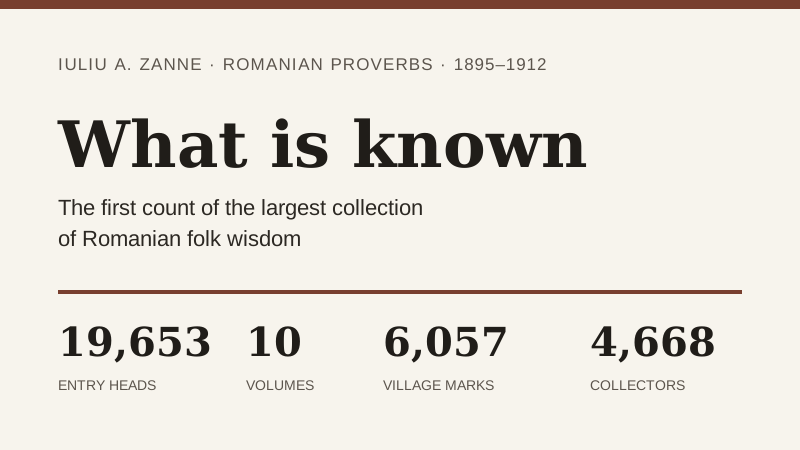
19,653 entry heads from «Proverbele românilor», the ten volumes Iuliu A. Zanne published between 1895 and 1912, counted for the first time: the bestiary, the body, God and the devil, the collectors’ map.
Kinship and family
Take the six questions every ethnographer asks about a family — how many spouses, where the couple moves after the wedding, who sleeps under one roof, what changes hands, what cousins are called, whose line you belong to — and give each the archive's commonest answer. You have built the average human society. In the archive of 1,291 societies coded by George Peter Murdock, it exists five times. The configuration you live in exists fourteen times, and the Romanian village of 1910 is one of them, alongside four Pueblo villages in New Mexico. Of the 909 societies coded on all six, 438 share their record with no other.
Kinship and family
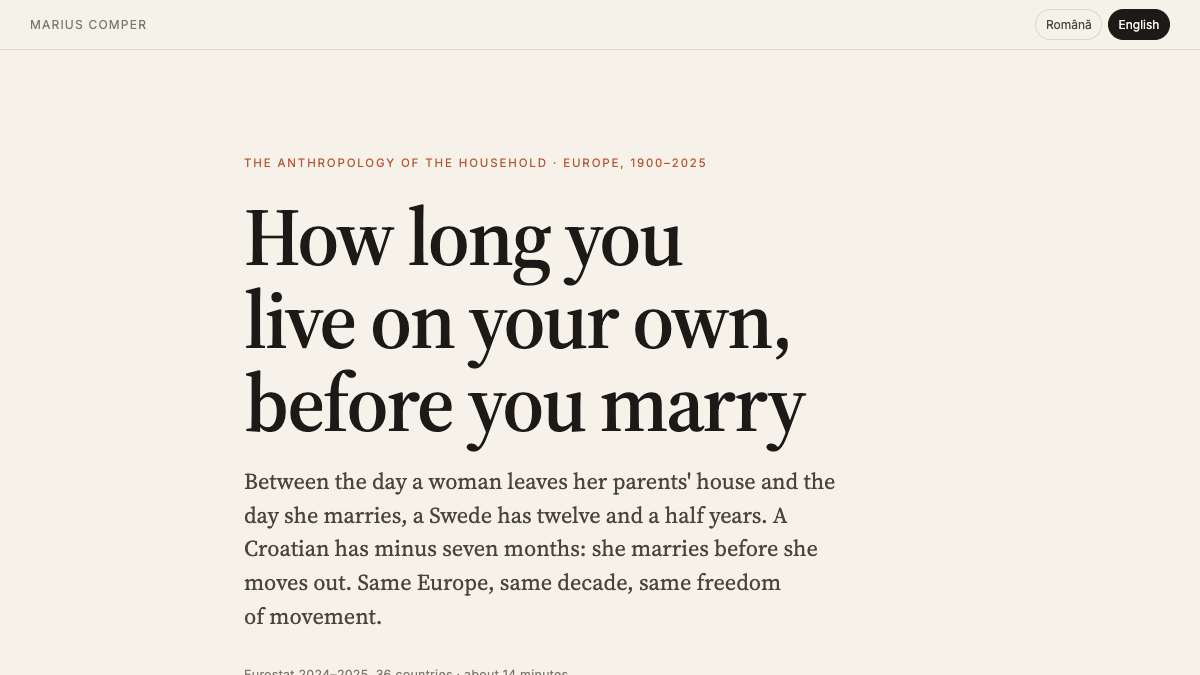
Between the day a woman leaves her parents’ house and the day she marries, a Swede has 12.6 years, a Romanian 3.1, and a Croatian minus seven months: she marries before she moves out. The line John Hajnal drew in 1965 from Saint Petersburg to Trieste still captures 95% of the marriage pattern and only 60% of the household one, because the household axis has rotated sixty degrees and now divides north from south. An instrument that rotates the line across 36 countries.
Kinship and family
Over 8.4 million Romanians live in prefabricated concrete panel blocks. Decree-Law 61/1990 privatized socialist state housing, creating the EU's highest homeownership rate (>95.3%) while sparking an unprecedented structural paradox: absolute sovereignty inside the door, and an unceasing war of attrition in the stairwell. An anthropological investigation across 36 unwritten rules, the Saturday morning hammer drill panopticon, the interactive noticeboard, and a stairwell friction audit.
Kinship and family
Every year, over 100,000 weddings and 150,000 baptisms power an unwritten €2 billion shadow credit union. The cash envelope is a zero-interest loan maturing across a generation. Ten unwritten laws of the wedding ledger, an interactive mental algorithm simulator, and the 30-year lifecycle of a moral credit union explicitly shielded from statutory income tax under Article 62 of the Romanian Fiscal Code.
Kinship and family
Romanian has words for your child's in-laws, your godchild and your co-godparent, which English cannot say, and no word for an elder brother or a maternal uncle, which 70% of the world's languages have. The dictionary records that almost any kinship term may be said to a stranger. Ten rules of the kinship vocabulary, with an interactive map of 1,056 languages from Kinbank.
Kinship and family
42 unwritten social rules, 12 simulated dilemmas, 3 anthropological treatises, and a cross-cultural matrix inspired by Kate Fox’s Watching the English.
Authority and rules
Why the same act seems less appropriate around peers or a boss. Change the audience and explore a study of 25,384 people across 90 societies.
Language and identity
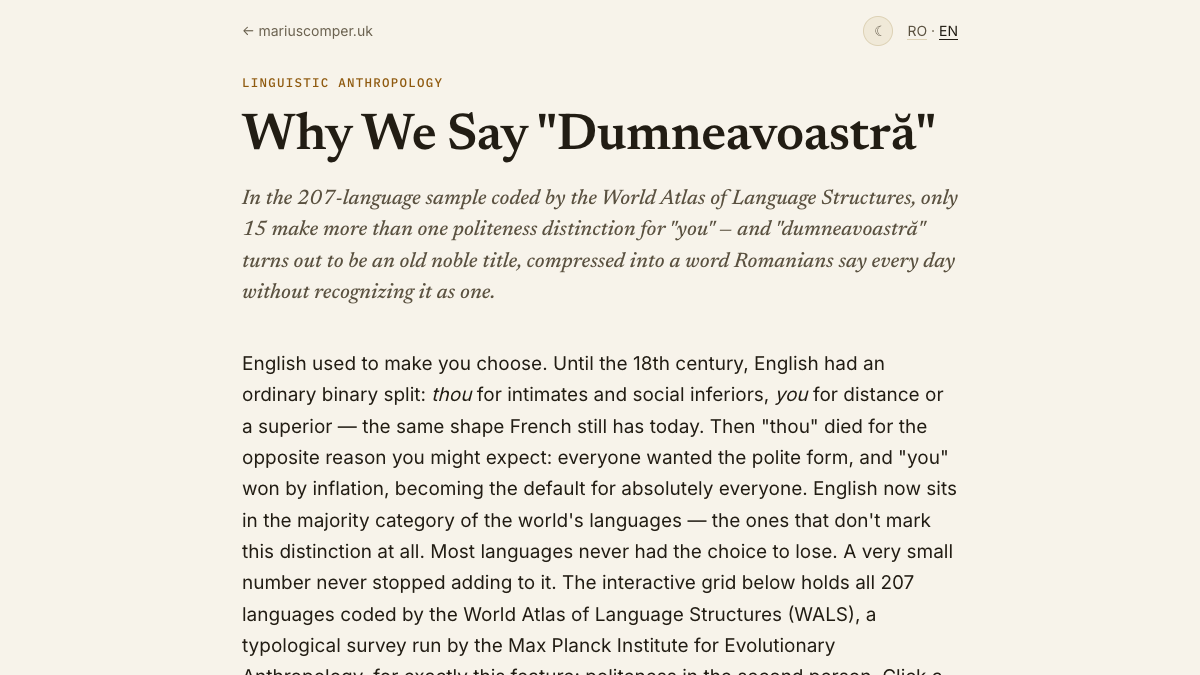
"Dumneavoastră" comes from "domnia voastră" — an old noble title compressed into a word said every day. Only 15 of the 207 languages coded by the World Atlas of Language Structures make more than one politeness distinction for "you." Romanian is the only Romance language on the list. Interactive map of all 207 languages.
Language and identity
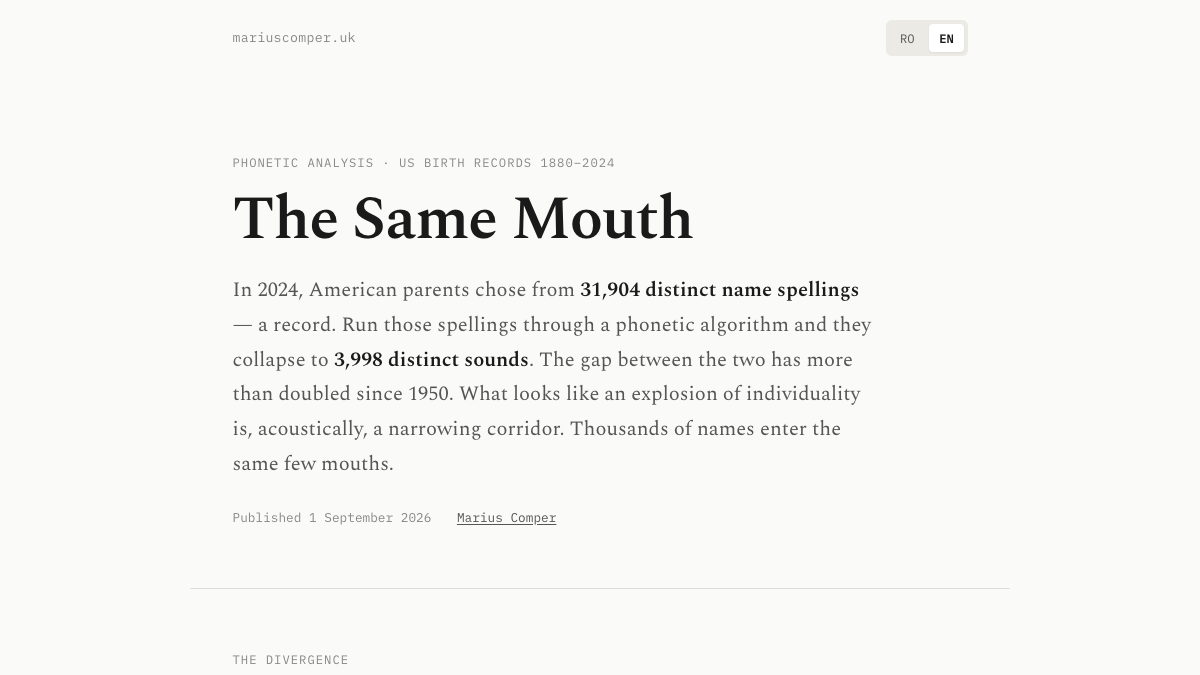
US birth records contain 31,904 distinct baby-name spellings in 2024, but a phonetic algorithm reduces them to 3,998 sounds. The interactive charts trace how the gap has widened since 1950.
Belief and ritual
From 2013 to 2025, the World Bank's personal remittances received indicator exceeded net foreign direct investment in nine of thirteen years. The indicator is broader than money sent by the diaspora and does not identify the sender's citizenship. The interactive balance shows both series in the same currency and time window.
Population and communities
The atlas compares age structure across 305 NUTS-2 regions for SSP1–SSP5 and the years 2020–2100. Under SSP2, the 15–64 share across Romania's eight regions moves from 63.3–66.7% to 46.7–48.9%; the values are conditional scenarios, not forecasts.
Population and communities
In the 2020 population grid, 91.0% of people live south of Bucharest. The ridge is the 25 to 26° N band, with 278 million people. Move the parallel.
Kinship and family
By generation 30, a family tree requires 1,073,741,824 ancestors, while Earth held only 320 million people in 1100 AD. Travel through 40 generations on the ancestry spindle.
Kinship and family
Lift the food supply of 177 countries and trace their crops to their primary regions of diversity.
Kinship and family
Men in South and North Korea, born in 1930, were the same average height. The 1996 generation is 2.9–3.4 cm apart, and South Korean women hold the world's largest century-long rise in height: 20.2 cm. Pick any two countries and compare them on their own growth wall.
Kinship and family
Thirty generations back you have, in theory, over a billion ancestors — more people than existed on Earth when Genghis Khan died, in 1227. Pick where your grandparents or great-grandparents came from, and the tool shows a distribution of the generations where a shared ancestor could sit, built from real historical corridors like the Golden Horde over Moldavia or the Crimean Khanate over the Budjak steppe.
Language and identity
Find your commune or town and compare three places in other counties with a similar profile. An atlas of 3,181 localities grouped using ten indicators of population, housing, employment, land and budgets.
Kinship and family
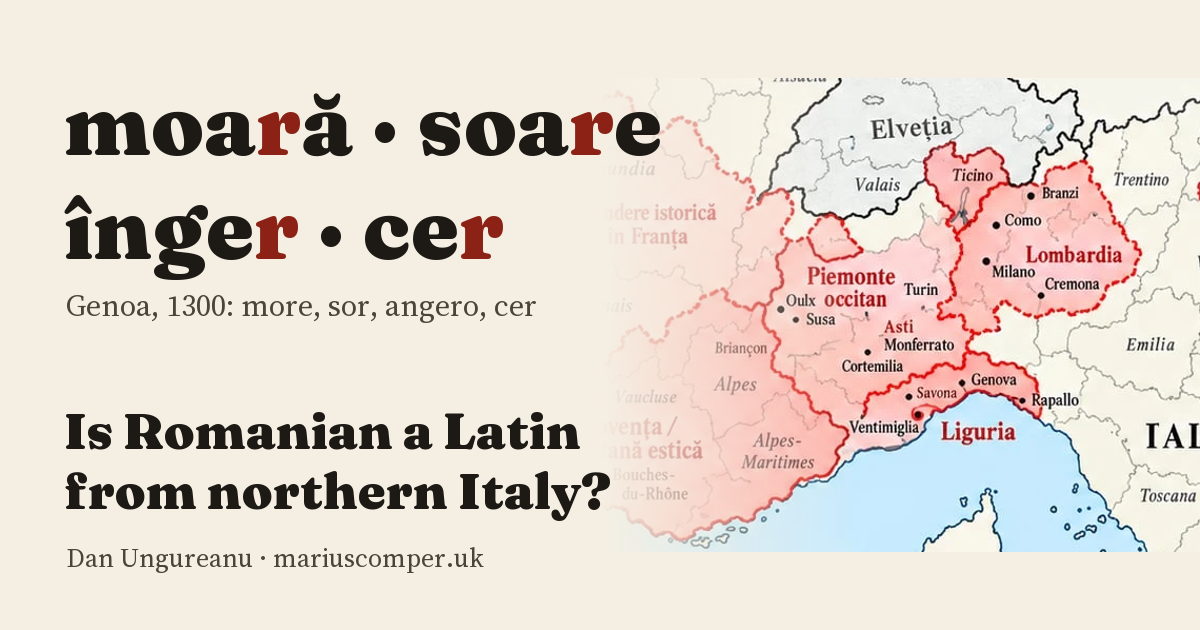
Linguist Dan Ungureanu argues that Romanian is a northern-Italian Latin that split off after AD 500, with almost no word provably Dacian. His three ideas, shown on words: the Reichenau glosses, Genoese rhymes of 1300 and 189 substrate words.
Language and identity
712 localities, each with its own tourist year traced month by month from INS TEMPO data, 2023-2025. Nearly a third of all reported nights in Romania fall in July and August alone, yet a clustering algorithm separates localities most cleanly into just two shapes of year: a nearly season-free group (597 localities, including the ski resorts) and a coast-dominated one (115 localities).
Kinship and family
The European survey on income and living conditions asks, every few years, whether you have a relative, friend or neighbour outside your household you could ask for help. In 2022, 293 people in 1,000 in Romania said no — the highest share of the 33 countries; the Union average is 112 and Norway's is 24. A few questions later in the same interview, Romania gives the Union's highest rating for trust in other people. The reader answers the question first, then sees where the answer falls. The shortfall does not gather in one group: Romania's richest fifth is worse off than the Union's poorest fifth.
Work and everyday life
Romania has 87,220 km of public road, and 20,959 of them are gravel or bare earth. Almost all sit on the local network: 99.4% of the unsurfaced kilometres are county or communal roads, where the share is 30.2%, against 0.7% on national roads. A county map, the four surface classes year by year since 2000, and the streets of 319 towns.
Kinship and family
In 1990, nearly three in ten Romanian brides were under 20. In 2025, it's one in twenty-two. An interactive grid shows how the age at which Romanians marry has shifted, year by year.
Authority and rules
Romania has, again, the EU's highest road death rate. But over 25 years, no other member state has cut its rate by less. The race toward zero, year by year, 27 countries.
Kinship and family
Nearly 600,000 direct purchases each quarter follow Benford's law, while the legal cap remains clear in the amounts. SEAP data from 2022–2024 shows what the method can tell us, plus a tool for checking your own numbers.
Kinship and family
Romania's labour shortage is a set of matching failures. A source-backed map of skills, care, place, formal work and migration.
Belief and ritual
At 18, 21 and 25, support can change sharply for care leavers. Vulnerability does not disappear on schedule.
Places and ways of living
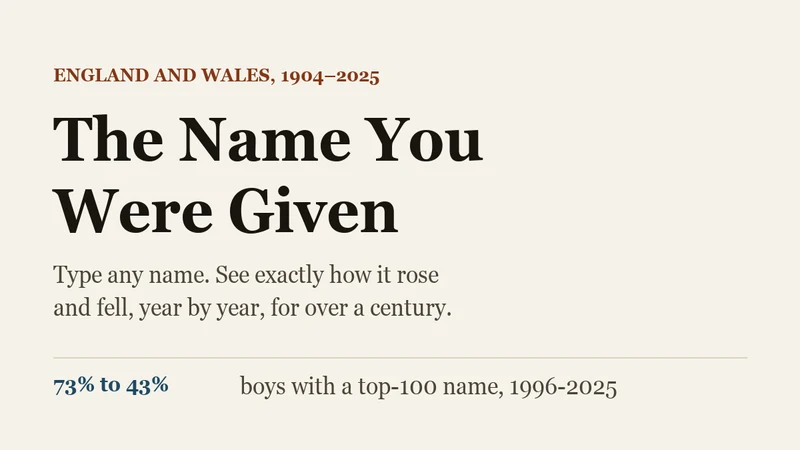
England and Wales baby-name registers, 1904–2025. Type any first name to see its exact rank and count trajectory — and how the 100 most popular names covered 73% of boys born in 1996 but only 43% in 2025.
Places and ways of living
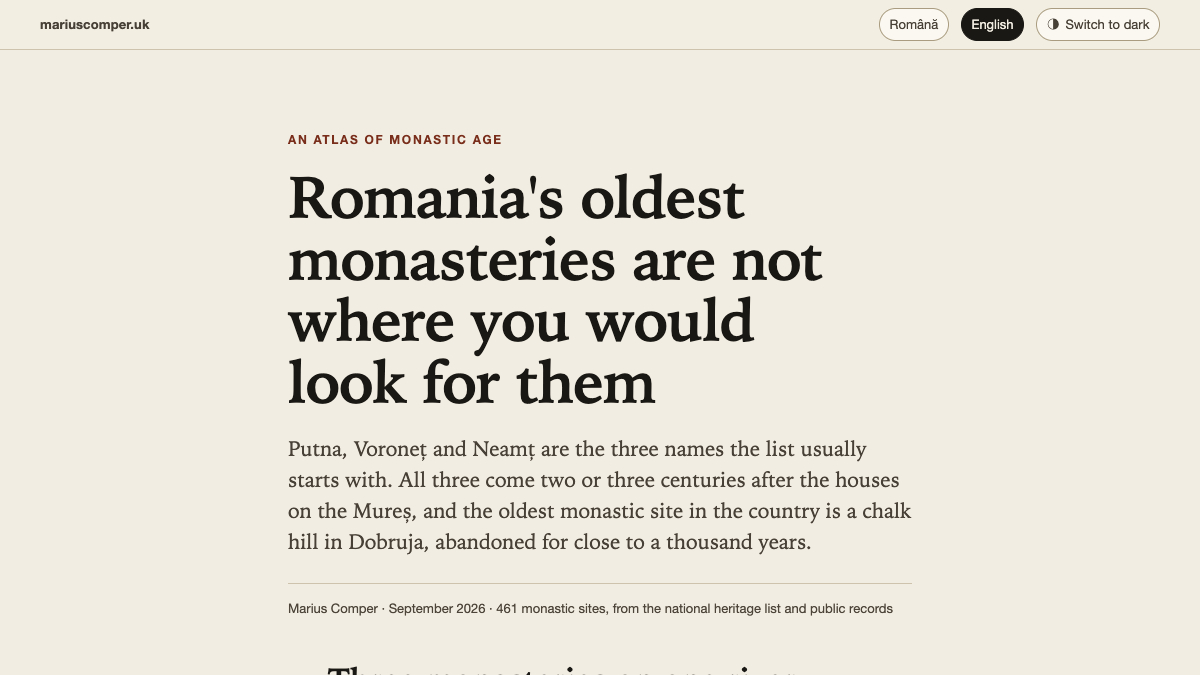
Along fifty-four kilometres of the Mureș, three monastic houses enter the written record within six years: Hodoș-Bodrog in 1177, Igriș in 1179, Bizere in 1183. One has monks, one has grass, one has an archaeological trench. The map starts in 992 and runs a thousand years across 461 dated, located sites from the national heritage list.
Authority and rules
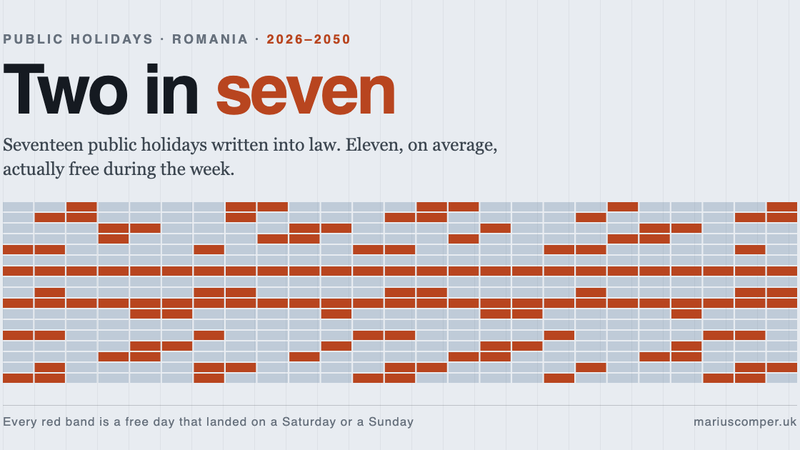
Romania writes more public holidays into law than any other EU country, seventeen of them. On average five a year land on a Saturday or a Sunday. Compare twenty-eight national calendars and see what one rule would change.
Places and ways of living
Pick a day and month and see where it ranks among the 365 dates of the year in England and Wales, how many babies are born on it, and whose birthday is rarer. Every birth from 1995 to 2025, from the ONS.
Urban life and change
What to see in Maramures: Sighet Memorial 25 lei, Planetarium 20, Mineralogy 20, Sapanta with no official fare, Mocanita in the dedicated guide. Measured access.
Belief and ritual
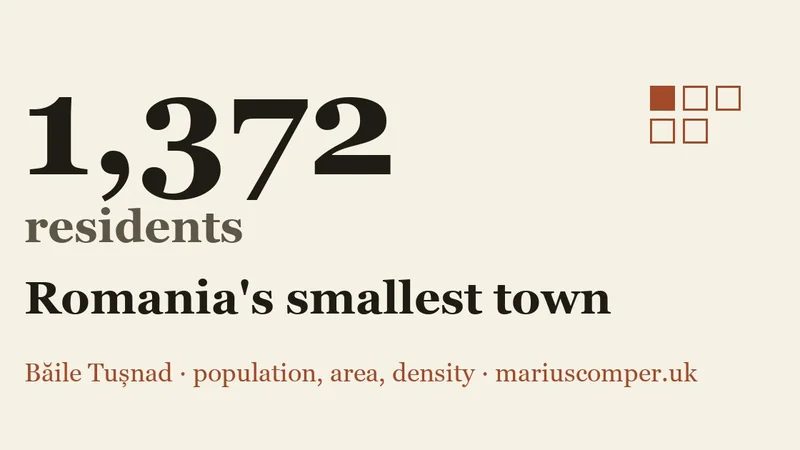
What is Romania's smallest town? All 319 towns and municipalities ranked by resident population, administrative area and density, from census and boundary data.
Work and everyday life
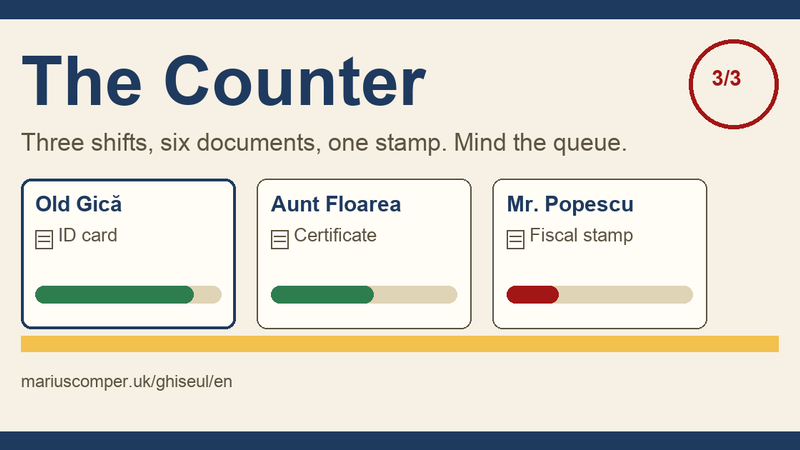
A pace-and-focus arcade game about everyday bureaucracy: six documents, impatient queues and three ever-busier shifts. Meet the quota or count the walkouts.
Work and everyday life
Single-person monthly budget simulator for Bucharest: observed food basket, official STB passes, PMB taxi rates, ECB conversion to yuan; no rent figures (portal terms), you enter yours.
Belief and ritual
Compare tuition and admission conditions at four Romanian medical schools with English-language programmes. The guide explains how to check accreditation, diploma recognition and the steps Chinese graduates may need for licensing in China.
Work and everyday life
Compare Romania and China by local time, exchange rates, ten World Bank indicators, bilateral trade and the distance between their capitals. Each figure includes its source and year.
Work and everyday life
Compare Romanian pickles with Sichuan pao cai, follow four stages of fermentation in Chiojdu, and calculate brine concentration. The page includes a food-safety reference, not recipes.
Kinship and family
Explore 30 dishes from three Bucharest menus, with names, ingredients and allergen information. The guide also explains restaurant bills and tipping.
Belief and ritual
What the red-white March string and the June bathing ban are: six customs, every date sourced; the syncretism box; visitor flags for what you can see and where not to go.
Belief and ritual
A relocation router: 3 questions route you onto one of 7 legal roads — D/AM1, D/AM2, Blue Card, study, digital nomad, reunification, business. Each road with documents, the first official step, and the lie that traps most people.
Work and everyday life
In Rome: about 2,520 m². In the Transylvanian cadastre: 5,754.64. The ploughing day unites them — and a word story in which jug, inherited from Latin, is older than iugăr, re-borrowed late.
Places and ways of living
A multidisciplinary atlas of what a total solar eclipse reveals about nature, minds, societies, institutions and knowledge.
Kinship and family
In 2024, women were the majority of tertiary graduates in the EU. Change the denominator to see where the difference between fields sits.
Places and ways of living
The 2021 census placed 19,053,815 resident inhabitants in 3,181 municipalities, towns and communes. Half live in 204 places, half in 2,977. Move the fulcrum along the beam or type a locality.
Work and everyday life
The Bektashi headquarters in Tirana exists, a diplomatic status was requested, a sovereign state is only proposed: no public act up to 2 October 2026. From Hacıbektaş to Tirana, Sarı Saltuk's tomb at Babadag and the real area: 27 acres, almost 11 hectares.
Authority and rules
The destinations of every Romanian airport, 2001–2024, from Eurostat. Luton has been the country's top destination since 2015. Pick an airport and a year and read the departures board; every airport has its own page with all its routes.
Kinship and family
A bilingual atlas of desire: body, cues, anticipation, pleasure, sex, relationships, culture, technology and self-regulation.
Authority and rules
Romania’s mapped street names, ranked by the number of distinct local administrative units in which each canonical name appears.
Work and everyday life
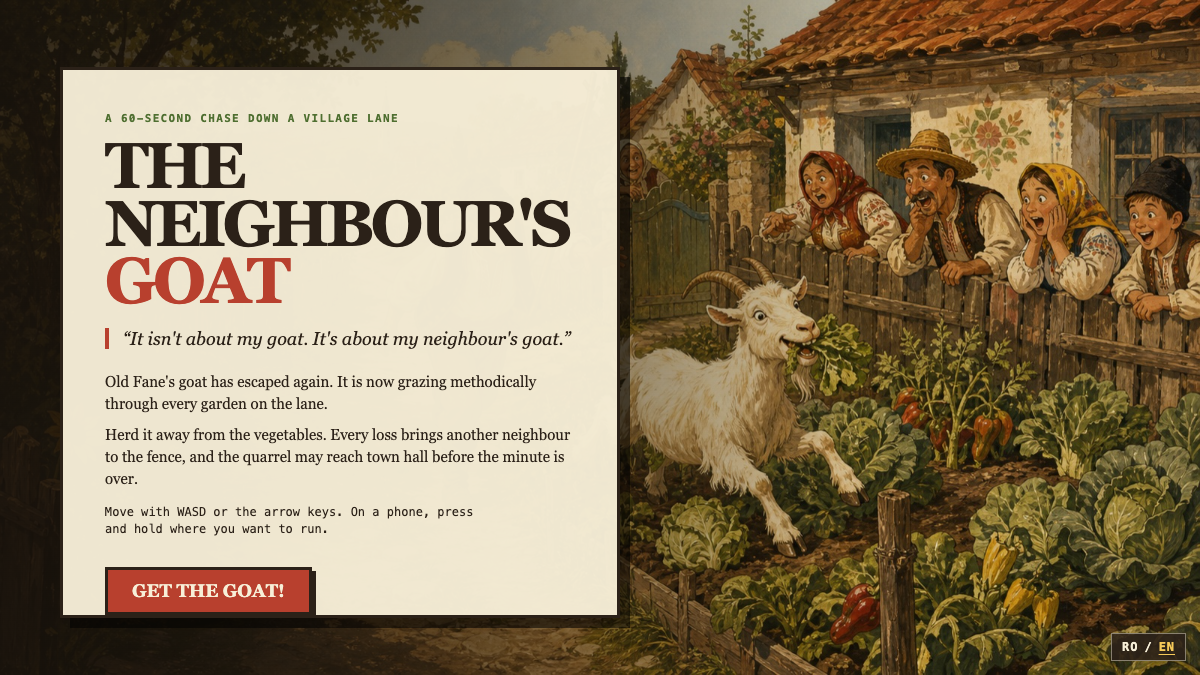
A 60-second village chase: herd Fane's goat out of six gardens before the vegetables disappear or the quarrel reaches town hall.
Authority and rules
A multidisciplinary synthesis of gossip as a mechanism of reputation, governance, cooperation and social order.
Kinship and family
An interdisciplinary analysis of social conventions, reproductive strategy and coordination traps around male-imposed body modification on women.
Culture and shared practices
A documented cultural history of farting, from Sumerian jokes to modern patents.
Work and everyday life
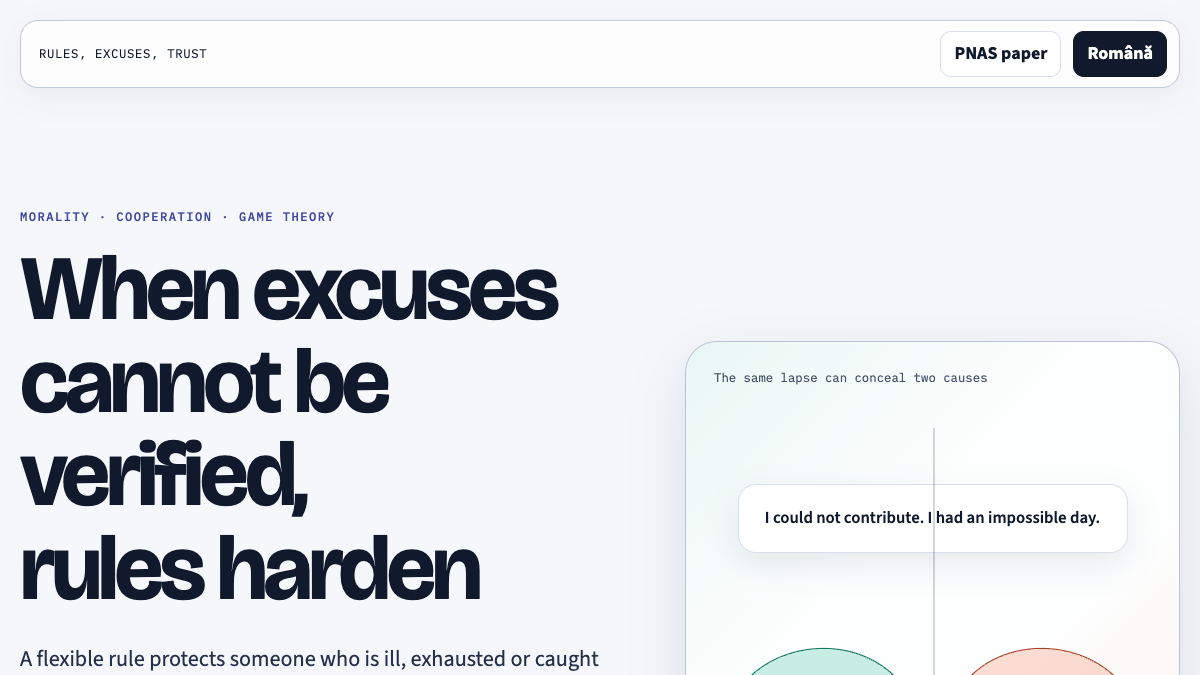
A PNAS model explains why rigid moral rules can protect cooperation when people's motives remain hidden.
Kinship and family
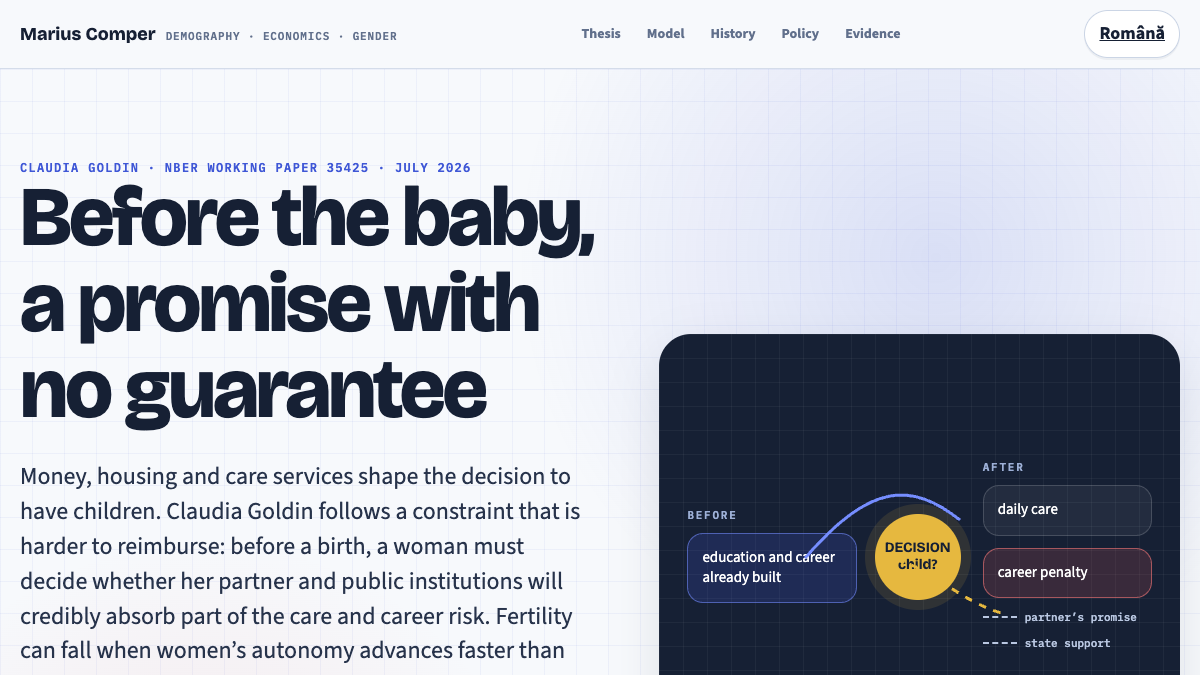
Claudia Goldin argues that part of low fertility is a credible commitment problem: women's autonomy advanced faster than the sharing of family work.
Population and communities
Thirty-one letters each carry a verified statistic about Romania, spanning alcohol, migration, education, health and infrastructure.
Work and everyday life
An independent, source-linked guide for workers recruited from Nepal, Bangladesh and Sri Lanka: what Romanian authorities say, what to verify, what to preserve, and where uncertainty remains.
Kinship and family
A documented story of the Palmares communities, the 21,000 figure, Macaco, colonial war and the split of 1678.
Places and ways of living
A map of urda and izvara opens three questions about whey technology, the movement of vocabulary and how a local distribution becomes history.
Places and ways of living
How Granollers turned a brickmakers’ wager into a participatory Festa Major, and how other Catalan towns adapted the form.
Work and everyday life
An analysis of Pokémon cards as game, memory, social badge, speculative asset and target for fraud and theft.
Belief and ritual
The Romanian folk sky, collected by Ion Otescu in 1896 through a map posted to village schoolteachers, drawn here over real star positions: 39 figures, four of them inside the same Orion.
Belief and ritual
138 Romanian folk tales from Wikisource, each stretched from zero to one hundred so you can see where poverty, the forest, the dragon, the wedding and the closing formula fall.
Culture and shared practices
A snapshot of Romanian chess in August 2026: 45 of the 310 teenagers who played in 2016 still play today, while the active staircase empties sharply after 18.
Authority and rules
Western and Orthodox Easter can be zero days apart, seven, 28 or 35. Pick a year and see where both fall, and the year they share a day for the last time.
Authority and rules
Place eight fragments — verses and details — on their street, then call five Gin Acts, 1729–1751, against what the gallons did: Hogarth, Fielding and Webb on two dated proof rails.
Work and everyday life
Maize came from America and replaced millet and buckwheat. Pick a year and a crop, watch the fields change, then grind and stir the porridge yourself.
Culture and shared practices
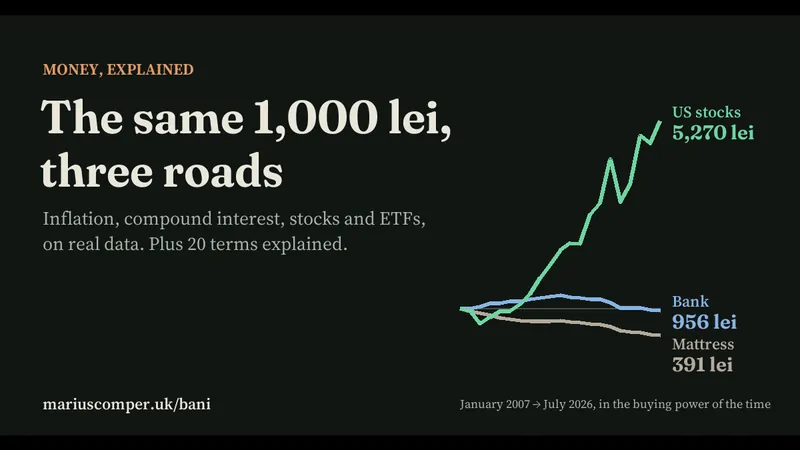
What happens to money kept at home, in the bank or in shares, on real Romanian data: inflation, compound interest, ETFs, 2026 taxes. Plus a 23-term glossary with calculators.
Belief and ritual
Six life-and-death dilemmas, 60 seconds, then the map tells you which corner of the world judges exactly like you. Built on the Moral Machine data (MIT, Nature 2018): ~40 million decisions, 3 moral clusters.
Authority and rules
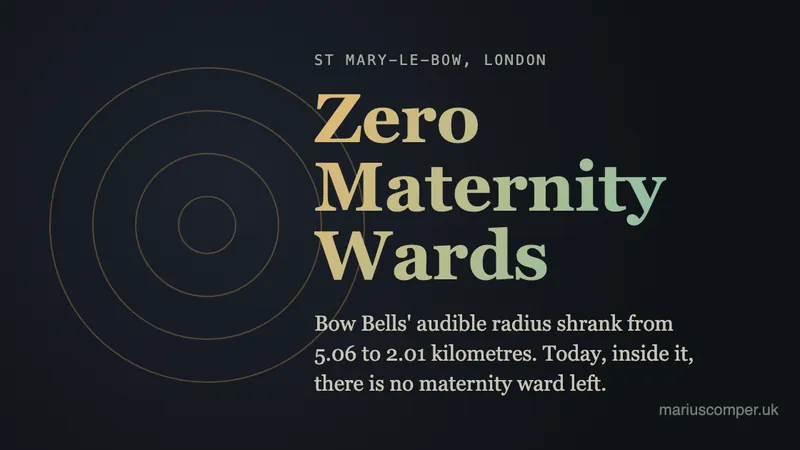
A true Cockney had to be born within earshot of the bells of St Mary-le-Bow. In 1851 that radius was 5.06 kilometres. In 2012 it was 2.01 — and inside it, no maternity ward remains.
Work and everyday life
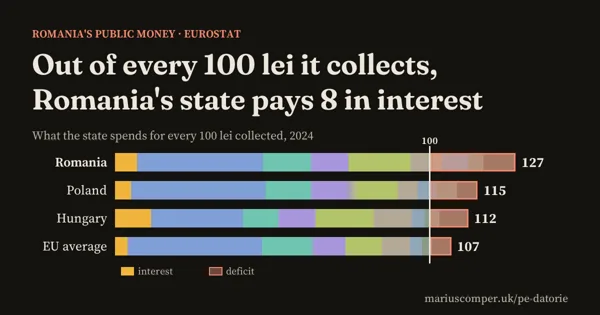
Romania's public money, 1995–2025: spending per 100 lei collected, the deficit, interest against Poland, Hungary and the EU average, governments on one timeline, the EU excessive deficit procedure and the sovereign rating. With a game: build your own deficit package from the 14 real 2025 measures.
Kinship and family
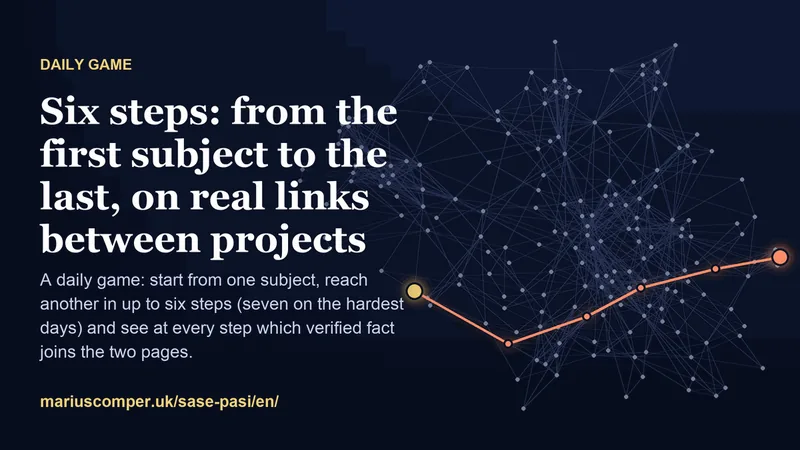
Every day: a start, a target and up to six steps. At each step you pick a real link between two projects on this site, with the verified facts side by side.
Places and ways of living
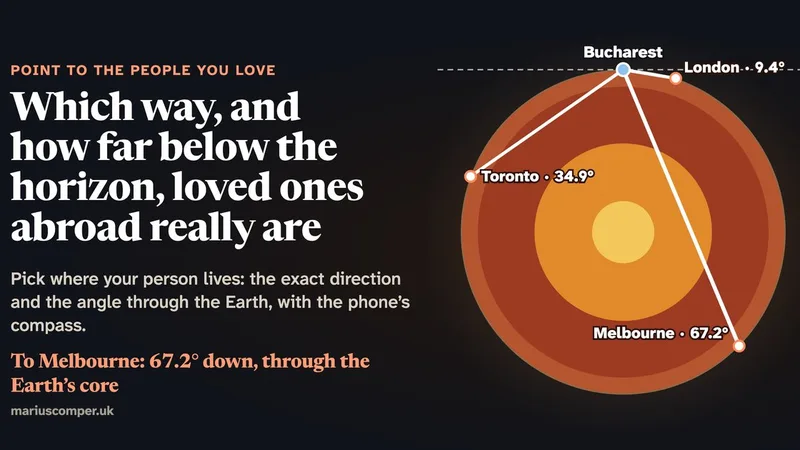
Which way to turn and how many degrees to lower your arm to point straight at someone you love in another country. From London, New York is at 288° and 25.0° below the horizon; the straight line dips 601 km into the Earth.
Places and ways of living
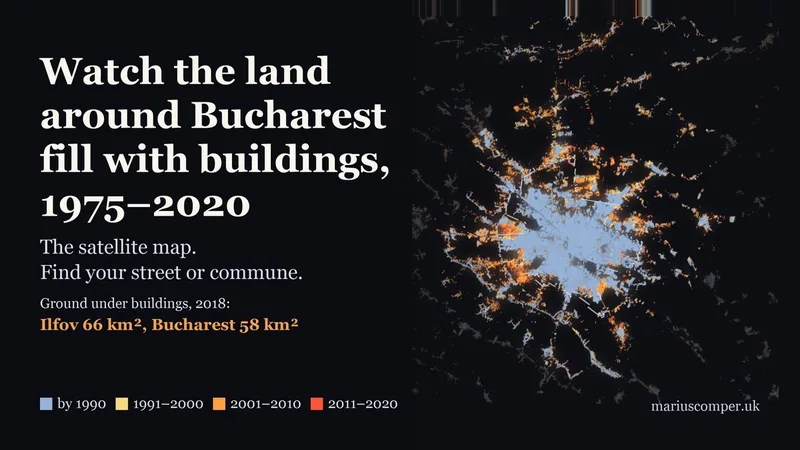
Ilfov now has more ground under buildings than Bucharest itself: since 1990, buildings have covered 42.1 km² of new ground in Ilfov and 11.1 km² in the city. The 1975–2020 satellite map for every street, neighbourhood and commune, with census population.
This collection brings together relevant projects from the site’s library. Each entry has a title, a description and a link to its available edition. The complete projects carry their sources and evidence limits.
Reviewed · Collection as text
The Ethnographic Atlas and coding schemes used here.
Current data edition; values for EA006 and EA043 were checked against this release.