A birthday on the globe
1 April on the globe: what happened in the world on this day, and who was born
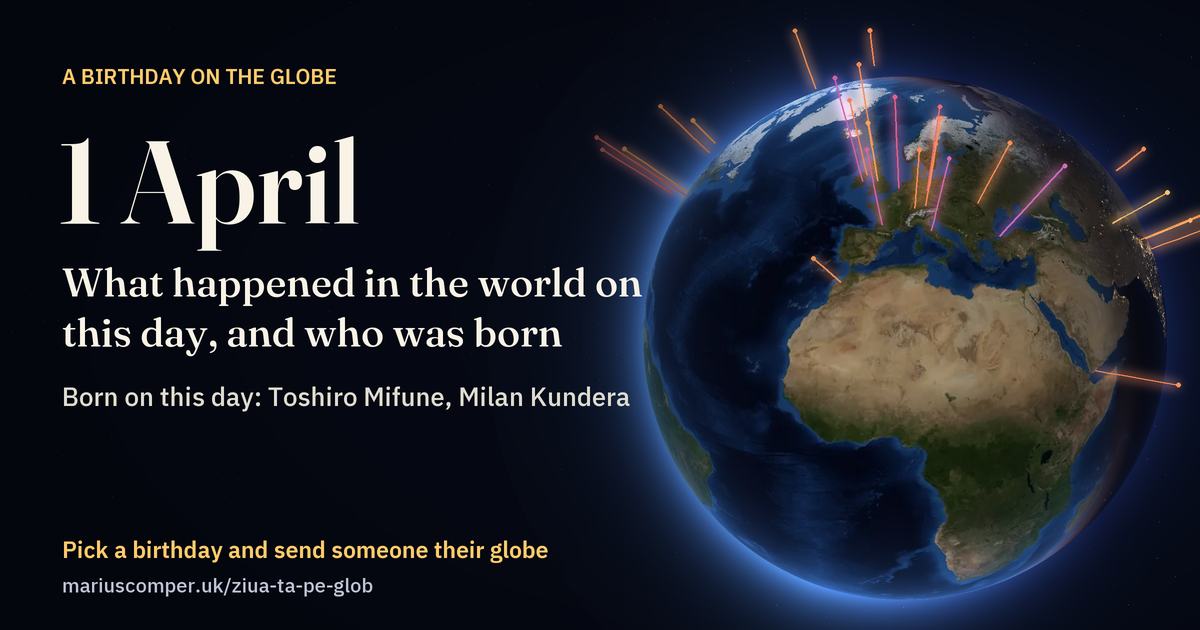
For 1 April, the English Wikipedia lists 71 events and 217 births. 29 of the events stand at their places as rays of light; nine more are dashed circles, where the sentence links only to a country or a sea. The taller the ray, the longer ago it happened. The people born that day come further down, as blue points.
A birthday, yours or someone else’s:
Turn it into a greetingScroll: the globe turns to each place
The day you were born, on the globe.
Three things from your day
Scroll: your day first, then 1 April through the years
The Earth on 1 April
The picture on the globe was assembled by NASA from satellite photographs taken in April 2004: the snow, the ice and the green are those of the month.
On 1 April the Sun passes straight overhead at noon along the parallel of 4.7° north. In London, the day lasts about 13 hours.
Beyond 85° north the Sun no longer sets; beyond 85° south it no longer rises.
The line between day and night is tilted on the globe exactly as on this day of the year. On the dark side you can see the lights of towns.
Europe · 1292–1294 papal election
1293
Robert Winchelsey left England for Rome to be consecrated Archbishop of Canterbury, but a papal vacancy delayed the ceremony.
On the map: 1292–1294 papal election.
Europe · St. Nicholas Church, Leipzig
1725
J. S. Bach's later Easter Oratorio in its first version is performed at the Nikolaikirche in Leipzig on Easter Sunday.
On the map: St. Nicholas Church, Leipzig.
Europe · Faroe Islands
1948
Faroe Islands gain autonomy from Denmark.
On the map: Faroe Islands.
Also on the day’s list of Wikipedia in Chinese.
Asia · Aden
1937
Aden becomes a British crown colony.
On the map: Aden.
Also on the day’s list of Wikipedia in Romanian and Chinese.
Asia · Jim Corbett National Park
1973
Project Tiger, a tiger conservation project, is launched in the Jim Corbett National Park, India.
On the map: Jim Corbett National Park.
Oceania · Koror
1922
Under the South Seas Mandate, Japan set up a government in Koror, precipitating large-scale Japanese settlement in Palau.
On the map: Koror.
North America · San Felipe, Texas
1833
The Convention of 1833, a political gathering of settlers in Mexican Texas to help draft a series of petitions to the Mexican government, begins in San Felipe de Austin.
On the map: San Felipe, Texas.
North America · United States Air Force Academy
1954
United States President Dwight D. Eisenhower authorizes the creation of the United States Air Force Academy in Colorado Springs, Colorado.
On the map: United States Air Force Academy.
1 April
What the other Wikipedias remember#
For these years the English list has nothing on this day. The events below come from the same day’s lists on Wikipedia in Romanian and Spanish and were translated for this page.
From Wikipedia in Romanian · Hollywood Walk of Fame
2002
The American writer Ray Bradbury receives the 2,193rd star on the Hollywood Walk of Fame.
On the map: Hollywood Walk of Fame.
Translated from the list on Wikipedia in Romanian.
The article on Wikipedia in Romanian: Hollywood Walk of Fame
From Wikipedia in Spanish · Bilbao
2007
In Bilbao, the last opening of the Deusto Bridge takes place.
On the map: Bilbao.
Translated from the list on Wikipedia in Spanish.
1 April
Born on 1 April#
The English Wikipedia lists 217 births for this day. The blue points are the birthplaces of 58 of these people: those written about in the most Wikipedia editions, where Wikidata gives a place of birth.
Born on 1 April
1920
Toshiro Mifune, Japanese actor (died 1997)
Place of birth: Qingdao.
Born on 1 April
1929
Milan Kundera, Czech-French novelist, poet, and playwright (died 2023)
Place of birth: Královo Pole.
Born on 1 April
1908
Abraham Maslow, American psychologist and academic (died 1970)
Place of birth: Brooklyn.
Born on 1 April
1927
Ferenc Puskás, Hungarian footballer and manager (died 2006)
Place of birth: Budapest.
Born on 1 April
1578
William Harvey, English physician and academic (died 1657)
Place of birth: Folkestone.
Born in Britain and Ireland
1961
Susan Boyle, Scottish singer
Place of birth: Blackburn.
Born in Britain and Ireland
1875
Edgar Wallace, English journalist, author, and playwright (died 1932)
Place of birth: Greenwich.
Born in Britain and Ireland
1997
Asa Butterfield, English actor
Place of birth: Islington.
1 April
Number one in the charts that week
At the cinema
An animal recorded that day
The record can be seen in GBIF, which brings together wildlife records from around the world.
All your birthdays
The weather that day
Data: Met Office Hadley Centre (HadCET); NOAA (GHCN-Daily, Mauna Loa).
Above the Earth
Sources: Jonathan McDowell, GCAT (launches); GFZ Potsdam (Kp index). Days are counted in Universal Time.
Football that day
International matches played that day:
Source: the “International football results” dataset kept by Mart Jürisoo (CC0).
Also that day
The earthquake’s page at the USGS
Source: the USGS catalogue. The day is counted in Universal Time (UTC).
In those days
Make a link for someone
Type the name, pick the day and the year of birth. The link opens straight on their day, with their name in the greeting.
The link carries the name, date and place typed here; anyone who gets it can see them.
Put another birthday beside it
Your mother’s, your child’s, a friend’s: the two days appear side by side.
Below: 1 April through the years.
The whole globe of the day
Drag the globe to turn it. Touch a ray or a point to read what happened there.
Everything Wikipedia lists for 1 April
The list is the English Wikipedia’s, in its own wording, as it stood in October 2026. 33 events have no place on the map: the sentence links to no place with coordinates, only to places too wide to mark, or to several countries.
- 285
Roman emperor Diocletian names Maximian his co-emperor ("Augustus").
no place on the mapWikipedia: Roman emperor - 527
Byzantine Emperor Justin I names his nephew Justinian I as co-ruler and successor to the throne.
no place on the mapWikipedia: List of Byzantine emperors - 1081
Alexios I Komnenos overthrows the Byzantine emperor Nikephoros III Botaneiates, and, after his troops spend three days extensively looting Constantinople, is formally crowned on April 4.
Asia · ConstantinopleWikipedia: Alexios I Komnenos - 1234
Richard Marshal, Earl of Pembroke, was defeated by knights loyal to King Henry III of England at the Battle of the Curragh in County Kildare, Ireland.
Britain & Ireland · CurraghWikipedia: Battle of the Curragh - 1293
Robert Winchelsey left England for Rome to be consecrated Archbishop of Canterbury, but a papal vacancy delayed the ceremony.
Europe · 1292–1294 papal electionWikipedia: 1292–1294 papal election - 1340
A band of warriors led by Niels Ebbesen killed Count Gerhard III, ending Holstein rule in Denmark.
no place on the mapWikipedia: Niels Ebbesen - 1346
Hundred Years' War: John, Duke of Normandy, laid siege to the town of Aiguillon.
Europe · Siege of AiguillonWikipedia: Hundred Years' War - 1572
In the Eighty Years' War, the Watergeuzen capture Brielle from the Seventeen Provinces, gaining the first foothold on land for what would become the Dutch Republic.
Europe · Capture of BrielleWikipedia: Capture of Brielle - 1725
J. S. Bach's later Easter Oratorio in its first version is performed at the Nikolaikirche in Leipzig on Easter Sunday.
Europe · St. Nicholas Church, LeipzigWikipedia: Johann Sebastian Bach - 1789
In New York City, the United States House of Representatives achieves its first quorum and elects Frederick Muhlenberg of Pennsylvania as its first Speaker.
North America · PennsylvaniaWikipedia: United States House of Representatives - 1833
The Convention of 1833, a political gathering of settlers in Mexican Texas to help draft a series of petitions to the Mexican government, begins in San Felipe de Austin.
North America · San Felipe, TexasWikipedia: Convention of 1833 - 1865
American Civil War: Union troops led by Philip Sheridan decisively defeat Confederate troops led by George Pickett, cutting the Army of Northern Virginia's last supply line during the Siege of Petersburg.
North America · Battle of Five ForksWikipedia: American Civil War - 1867
Singapore becomes a British crown colony.
Asia · SingaporeWikipedia: Singapore - 1871
The Duke of Buckingham opened the first section of the Brill Tramway, a short railway line to transport goods between his lands and the national rail network.
- 1873
The White Star steamer SS Atlantic sinks off Nova Scotia, killing 547 in one of the worst marine disasters of the 19th century.
North America · Nova ScotiaWikipedia: White Star Line - 1879
The Inland Customs Line, established by the British for the collection of the salt tax in India, was abandoned.
no place on the mapWikipedia: Inland Customs Line - 1900
Prince George becomes absolute monarch of the Cretan State.
Europe · Cretan StateWikipedia: Prince George of Greece and Denmark - 1908
The Territorial Force (renamed Territorial Army in 1920) is formed as a volunteer reserve component of the British Army.
no place on the mapWikipedia: Territorial Force - 1918
The Royal Air Force is created by the merger of the Royal Flying Corps and the Royal Naval Air Service.
no place on the mapWikipedia: Royal Air Force - 1922
In newly formed Northern Ireland, six Catholics are murdered in the Arnon Street killings, one week after six others were killed in the McMahon killings.
Britain & Ireland · Arnon Street killingsWikipedia: Arnon Street killings - 1922
Under the South Seas Mandate, Japan set up a government in Koror, precipitating large-scale Japanese settlement in Palau.
Oceania · KororWikipedia: South Seas Mandate - 1924
Adolf Hitler is sentenced to five years fortress confinement for his participation in the "Beer Hall Putsch" but spends only nine months in jail.
Europe · Beer Hall PutschWikipedia: Beer Hall Putsch - 1924
The Royal Canadian Air Force is formed.
no place on the mapWikipedia: Royal Canadian Air Force - 1933
English cricketer Wally Hammond set a record for the highest individual score in Test cricket of 336 not out during a match against New Zealand.
no place on the mapWikipedia: Wally Hammond - 1933
The recently elected Nazis under Julius Streicher organize a one-day boycott of all Jewish-owned businesses in Germany, ushering in a series of anti-Semitic acts.
no place on the mapWikipedia: Nazism - 1935
India's central banking institution, the Reserve Bank of India, is formed.
no place on the mapWikipedia: Reserve Bank of India - 1937
Aden becomes a British crown colony.
Asia · AdenWikipedia: Aden - 1937
The Royal New Zealand Air Force is formed as an independent service.
no place on the mapWikipedia: Royal New Zealand Air Force - 1939
Spanish Civil War: Generalísimo Francisco Franco of the Spanish State announces the end of the Spanish Civil War, when the last of the Republican forces surrender.
Europe · Francoist SpainWikipedia: Spanish Civil War - 1941
A military coup in Iraq overthrows the regime of 'Abd al-Ilah and installs Rashid Ali al-Gaylani as Prime Minister.
no place on the mapWikipedia: 1941 Iraqi coup d'état - 1941
Fântâna Albă massacre: Between two hundred and two thousand Romanian civilians are killed by Soviet Border Troops.
Europe · Fântâna Albă massacreWikipedia: Fântâna Albă massacre - 1944
World War II: Navigation errors lead to an accidental American bombing of the Swiss city of Schaffhausen.
Europe · SchaffhausenWikipedia: World War II - 1945
World War II: The Tenth United States Army attacks the Thirty-Second Japanese Army on Okinawa.
Asia · Battle of OkinawaWikipedia: Battle of Okinawa - 1946
The 8.6 Mw Aleutian Islands earthquake shakes the Aleutian Islands with a maximum Mercalli intensity of VI (Strong). A destructive tsunami reaches the Hawaiian Islands resulting in dozens of deaths, mostly in Hilo, Hawaii.
Oceans · 1946 Aleutian Islands earthquakeWikipedia: 1946 Aleutian Islands earthquake - 1946
The Malayan Union is established. Protests from locals led to the establishment of the Federation of Malaya two years later.
no place on the mapWikipedia: Malayan Union - 1947
The only mutiny in the history of the Royal New Zealand Navy begins.
no place on the mapWikipedia: 1947 Royal New Zealand Navy mutinies - 1948
Cold War: Communist forces respond to the introduction of the Deutsche Mark by attempting to force the western powers to withdraw from Berlin.
Europe · Berlin BlockadeWikipedia: Berlin Blockade - 1948
Faroe Islands gain autonomy from Denmark.
Europe · Faroe IslandsWikipedia: Faroe Islands - 1949
The Government of Canada repeals Japanese-Canadian internment after seven years.
no place on the mapWikipedia: Government of Canada - 1952
Israel enacted a citizenship law, prior to which the country technically had no citizens.
no place on the mapWikipedia: Israeli citizenship law - 1954
United States President Dwight D. Eisenhower authorizes the creation of the United States Air Force Academy in Colorado Springs, Colorado.
North America · United States Air Force AcademyWikipedia: United States Air Force Academy - 1955
The British Army's Mobile Defence Corps, intended to assist with civil defence after a nuclear attack, was established by royal warrant.
no place on the mapWikipedia: Mobile Defence Corps - 1955
The EOKA rebellion against the British Empire begins in Cyprus, with the goal of unifying with Greece.
no place on the mapWikipedia: EOKA - 1960
The TIROS-1 satellite transmits the first television picture from space.
no place on the mapWikipedia: Television Infrared Observation Satellite - 1963
On Her Majesty's Secret Service, the tenth novel of Ian Fleming's James Bond series, was released in the United Kingdom.
no place on the mapWikipedia: On Her Majesty's Secret Service - 1964
The British Admiralty, War Office and Air Ministry are replaced by a unified Defence Council of the United Kingdom.
no place on the mapWikipedia: Admiralty - 1969
The Hawker Siddeley Harrier, the first operational fighter aircraft with Vertical/Short Takeoff and Landing capabilities, enters service with the Royal Air Force.
no place on the mapWikipedia: Hawker Siddeley Harrier - 1970
A Royal Air Maroc Sud Aviation Caravelle crashes near Berrechid, Morocco, killing 61.
Africa · BerrechidWikipedia: 1970 Berrechid Royal Air Maroc Caravelle crash - 1970
President Richard Nixon signs the Public Health Cigarette Smoking Act into law.
no place on the mapWikipedia: Richard Nixon - 1970
The American Motors Corporation introduced its Gremlin, promoted as America's first subcompact car.
no place on the mapWikipedia: American Motors Corporation - 1971
Bangladesh Liberation War: The Pakistan Army massacre more than a thousand people in Keraniganj Upazila, Bangladesh.
Asia · Keraniganj UpazilaWikipedia: Jinjira massacre - 1973
Project Tiger, a tiger conservation project, is launched in the Jim Corbett National Park, India.
Asia · Jim Corbett National ParkWikipedia: Jim Corbett National Park - 1974
A man ignited tires in the crater of Mount Edgecumbe, prompting a false eruption scare later revealed as an April Fools' hoax.
North America · Mount EdgecumbeWikipedia: Mount Edgecumbe - 1974
The Local Government Act 1972 of England and Wales comes into effect.
no place on the mapWikipedia: Local Government Act 1972 - 1976
Steve Jobs and Steve Wozniak found Apple Computer, Inc.
no place on the mapWikipedia: Apple Inc. - 1979
Iran becomes an Islamic republic by a 99% vote, officially overthrowing the Shah.
- 1984
Singer Marvin Gaye is shot to death by his father in his home in Arlington Heights, Los Angeles, California.
North America · Killing of Marvin GayeWikipedia: Killing of Marvin Gaye - 1986
Communist Party of Nepal (Mashal) cadres attack a number of police stations in Kathmandu, seeking to incite a popular rebellion.
Asia · KathmanduWikipedia: Communist Party of Nepal - 1989
Margaret Thatcher's new local government tax, the Community Charge (commonly known as the "poll tax"), is introduced in Scotland.
Britain & Ireland · ScotlandWikipedia: Margaret Thatcher - 1990
The longest prison riot in British penal history began at Strangeways Prison in Manchester, lasting 25 days.
Britain & Ireland · HM Prison ManchesterWikipedia: Strangeways Prison riot - 1993
NASCAR champion Alan Kulwicki is killed in a plane crash near the Tri-Cities Regional Airport in Blountville, Tennessee.
North America · 1993 Tennessee Fairchild Merlin crashWikipedia: 1993 Tennessee Fairchild Merlin crash - 1997
Comet Hale–Bopp is seen passing at perihelion.
no place on the mapWikipedia: Comet Hale–Bopp - 1999
Nunavut is established as a Canadian territory carved out of the eastern part of the Northwest Territories.
no place on the mapWikipedia: Nunavut - 2001
An EP-3E United States Navy surveillance aircraft collides with a Chinese People's Liberation Army Shenyang J-8 fighter jet. The Chinese pilot ejected but is subsequently lost. The Navy crew makes an emergency landing in Hainan, China and is detained.
Asia · Hainan Island incidentWikipedia: Hainan Island incident - 2001
Former President of Federal Republic of Yugoslavia Slobodan Milošević surrenders to police special forces, to be tried on war crimes charges.
Europe · Serbia and MontenegroWikipedia: President of Yugoslavia - 2001
Same-sex marriage becomes legal in the Netherlands, the first contemporary country to allow it.
Europe · NetherlandsWikipedia: Same-sex marriage in the Netherlands - 2004
Google launches its Email service Gmail.
no place on the mapWikipedia: Google - 2006
Serious Organised Crime Agency (SOCA) of the Government of the United Kingdom is enforced, but later merged into National Crime Agency on 7 October 2013.
no place on the mapWikipedia: Serious Organised Crime Agency - 2011
After protests against the burning of the Quran turn violent, a mob attacks a United Nations compound in Mazar-i-Sharif, Afghanistan, resulting in the deaths of fourteen people, including seven UN workers.
Asia · 2011 Mazar-i-Sharif attackWikipedia: Dove World Outreach Center Quran-burning controversy - 2016
The 2016 Nagorno-Karabakh conflict begins along the Nagorno-Karabakh Line of Contact.
no place on the mapWikipedia: 2016 Nagorno-Karabakh conflict - 2026
The Artemis II lunar flyby mission launches, marking the first crewed flight above low Earth orbit since Apollo 17 in 1972.
no place on the mapWikipedia: Artemis II
What the other Wikipedias remember
For these years the English list has nothing on this day. The events below come from the same day’s lists on Wikipedia in Romanian and Spanish and were translated for this page.
- 2002
The American writer Ray Bradbury receives the 2,193rd star on the Hollywood Walk of Fame.
North America · Hollywood Walk of FameTranslated from the list on Wikipedia in RomanianWikipedia: Hollywood Walk of Fame - 2007
In Bilbao, the last opening of the Deusto Bridge takes place.
Who was born on 1 April
In order of how many Wikipedia editions have an article about each. The first 60 of 217 are shown.
- 1815
Otto von Bismarck, German lawyer and politician, 1st Chancellor of the German Empire (died 1898)
Schönhausen (Elbe)Wikipedia: Otto von Bismarck - 1940
Wangari Maathai, Kenyan environmentalist and politician, Nobel Prize laureate (died 2011)
- 1920
Toshiro Mifune, Japanese actor (died 1997)
QingdaoWikipedia: Toshiro Mifune - 1929
Milan Kundera, Czech-French novelist, poet, and playwright (died 2023)
Královo PoleWikipedia: Milan Kundera - 1908
Abraham Maslow, American psychologist and academic (died 1970)
BrooklynWikipedia: Abraham Maslow - 1927
Ferenc Puskás, Hungarian footballer and manager (died 2006)
BudapestWikipedia: Ferenc Puskás - 1578
William Harvey, English physician and academic (died 1657)
FolkestoneWikipedia: William Harvey - 1873
Sergei Rachmaninoff, Russian pianist, composer, and conductor (died 1943)
- 1932
Debbie Reynolds, American actress, singer, and dancer (died 2016)
El PasoWikipedia: Debbie Reynolds - 1961
Susan Boyle, Scottish singer
BlackburnWikipedia: Susan Boyle - 1968
Alexander Stubb, Finnish academic and politician, 43rd Prime Minister of Finland and 13th President of Finland
HelsinkiWikipedia: Alexander Stubb - 1753
Joseph de Maistre, French philosopher, lawyer, and diplomat (died 1821)
ChambéryWikipedia: Joseph de Maistre - 1933
Claude Cohen-Tannoudji, Algerian-French physicist and academic, Nobel Prize laureate
ConstantineWikipedia: Claude Cohen-Tannoudji - 1776
Sophie Germain, French mathematician, physicist, and philosopher (died 1831)
- 1865
Richard Adolf Zsigmondy, Austrian-German chemist and academic, Nobel Prize laureate (died 1929)
- 1868
Edmond Rostand, French poet and playwright (died 1918)
MarseilleWikipedia: Edmond Rostand - 1976
Clarence Seedorf, Dutch-Brazilian footballer and manager
ParamariboWikipedia: Clarence Seedorf - 1875
Edgar Wallace, English journalist, author, and playwright (died 1932)
GreenwichWikipedia: Edgar Wallace - 1697
Antoine François Prévost, French novelist and translator (died 1763)
HesdinWikipedia: Abbé Prévost - 1282
Louis IV, Holy Roman Emperor (died 1347)
- 1919
Joseph Murray, American surgeon and soldier, Nobel Prize laureate (died 2012)
MilfordWikipedia: Joseph E. Murray - 1973
Rachel Maddow, American journalist and author
Castro ValleyWikipedia: Rachel Maddow - 1866
Ferruccio Busoni, Italian pianist, composer, and conductor (died 1924)
- 1980
Randy Orton, American wrestler
KnoxvilleWikipedia: Randy Orton - 1997
Asa Butterfield, English actor
IslingtonWikipedia: Asa Butterfield - 1939
Ali MacGraw, American model and actress
Pound RidgeWikipedia: Ali MacGraw - 1995
Logan Paul, American YouTuber, actor and wrestler
WestlakeWikipedia: Logan Paul - 1885
Wallace Beery, American actor (died 1949)
Kansas CityWikipedia: Wallace Beery - 1898
William James Sidis, Ukrainian-Russian Jewish American mathematician, anthropologist, and historian (died 1944)
ManhattanWikipedia: William James Sidis - 1883
Lon Chaney, American actor, director, and screenwriter (died 1930)
Colorado SpringsWikipedia: Lon Chaney - 1953
Alberto Zaccheroni, Italian footballer and manager
- 1946
Arrigo Sacchi, Italian footballer, coach, and manager
FusignanoWikipedia: Arrigo Sacchi - 1950
Samuel Alito, American lawyer and jurist, Associate Justice of the Supreme Court of the United States
TrentonWikipedia: Samuel Alito - 1976
David Oyelowo, English actor
OxfordWikipedia: David Oyelowo - 1936
Abdul Qadeer Khan, Indian-Pakistani physicist, chemist, and engineer (died 2021)
- 1947
Alain Connes, French mathematician and academic
DraguignanWikipedia: Alain Connes - 1906
Alexander Sergeyevich Yakovlev, Russian engineer, founded the Yakovlev Design Bureau (died 1989)
- 1926
Anne McCaffrey, American-Irish author (died 2011)
CambridgeWikipedia: Anne McCaffrey - 1976
Gábor Király, Hungarian footballer
SzombathelyWikipedia: Gábor Király - 1991
Duván Zapata, Colombian footballer
- 1937
Yılmaz Güney, Palme d'Or award-winning Kurdish film director, scenarist, actor, novelist and activist (died 1984)
- 1885
Clementine Churchill, English wife of Winston Churchill (died 1977)
- 1852
Edwin Austin Abbey, American painter and illustrator (died 1911)
PhiladelphiaWikipedia: Edwin Austin Abbey - 1982
Andreas Thorkildsen, Norwegian javelin thrower
Kristiansand MunicipalityWikipedia: Andreas Thorkildsen - 1949
Gil Scott-Heron, American singer-songwriter and author (died 2011)
ChicagoWikipedia: Gil Scott-Heron - 1952
Annette O'Toole, American actress
HoustonWikipedia: Annette O'Toole - 1979
Ruth Beitia, Spanish high jumper
SantanderWikipedia: Ruth Beitia - 1929
Jane Powell, American actress, singer, and dancer (died 2021)
PortlandWikipedia: Jane Powell - 1959
Helmut Duckadam, Romanian footballer (died 2024)
- 1905
Gaston Eyskens, Belgian economist and politician, 47th Prime Minister of Belgium (died 1988)
- 1934
Vladimir Posner, French-American journalist and radio host
- 1987
Ding Junhui, Chinese professional snooker player
YixingWikipedia: Ding Junhui - 1647
John Wilmot, 2nd Earl of Rochester, English poet and courtier (died 1680)
- 1220
Emperor Go-Saga of Japan (died 1272)
- 1610
Charles de Saint-Évremond, French soldier and critic (died 1703)
Saint-Denis-le-GastWikipedia: Charles de Saint-Évremond - 1942
Samuel R. Delany, American author and critic
- 1953
Barry Sonnenfeld, American cinematographer, director, and producer
New York CityWikipedia: Barry Sonnenfeld - 1988
Brook Lopez, American basketball player
North HollywoodWikipedia: Brook Lopez - 1881
Octavian Goga, Romanian Prime Minister (died 1938)
RășinariWikipedia: Octavian Goga - 1931
Rolf Hochhuth, German author and playwright (died 2020)
EschwegeWikipedia: Rolf Hochhuth
What is celebrated on 1 April
- Christian feast day: Cellach of Armagh
- Christian feast day: Hugh of Grenoble
- Christian feast day: Frederick Denison Maurice (Church of England)
- Christian feast day: Mary of Egypt
- Christian feast day: Melito of Sardis
- Christian feast day: Tewdrig
- Christian feast day: Theodora
- Christian feast day: Walric, abbot of Leuconay
- Christian feast day: April 1 (Eastern Orthodox liturgics)
- April Fools' Day
- Odisha Day (Odisha, India)
- Arbor Day (Tanzania)
- Civil Service Day (Thailand)
- Cyprus National Day (Cyprus)
A greeting link for someone
Type a name and, if you like, the year of birth. The link opens with a greeting, and beside each event it says how old the person turned that day, or how many years before their birth it happened.
The name and the year go only into the link you send.
All 366 days
How the globe is made
Where the events come from
Each edition of this page uses the day’s list from Wikipedia in its own language: Romanian, English, Spanish, Chinese. The lists are written by volunteers and differ from one edition to the next; the text of each event is Wikipedia’s, with a link to the article. A row that appears twice in a list is shown once. The lists have not been checked event by event: they are Wikipedia’s, mistakes included.
For events before 1582, and for countries that moved to the Gregorian calendar later (Britain in 1752, Russia in 1918), the same day may be counted Old Style in one list and New Style in another.
The chapter “What the other Wikipedias remember” adds up to five events a day from the lists of the other three editions, only for years in which the English list has nothing on that day. They were translated for this page, passed the same filters as the tour, and are not counted among the events of the English list.
How an event gets onto the map
The place comes from Wikidata. If the sentence links to the article about the event itself (a battle, an opening, an earthquake), dated to the same year, the ray stands on its coordinates or on those of its location. Otherwise it stands on the first place the sentence links to: a town, a building, a mountain, an island. This second step can be wrong: sometimes the sentence only mentions the place. That is why the page says, under each event, which place the ray stands on.
When the sentence links to a single state or province, or to a single sea, lake or desert larger than 5,000 km², the globe shows a dashed circle, not a ray. The circle has the area Wikidata gives, with its radius kept between 1.2° and 16°, or a radius of 4.5° when Wikidata gives no area; it says only that the sentence links to that place. Organisations, ships, spacecraft, museum objects, rivers, mountain ranges, languages and continents are never used as places. When a sentence names several states and no exact place, the event stays in the list only.
What the height means
The height of a ray shows how many years have passed, on a logarithmic scale: 10 years, 100 years and 1,000 years are equal steps apart; anything older than about 2,600 years has the tallest ray. The colour runs from pale yellow for recent years to violet for antiquity.
Where the tour stops
In each region the tour stops at up to three events (five in Britain and Ireland), chosen mainly by three things: whether Wikipedia’s editors put the event in the “On this day” box of their main page (the English, Spanish and Chinese editions), how many Wikipedia editions have an article about it, and how many of the four lists include it. Events whose sentence or article is about a war, an attack, a crime or a disaster are left out of the tour; they stay in the whole list, in Wikipedia’s wording. The filter is a list of words and a list of Wikidata types, so it can miss some.
The tour of births names the people with articles in the most editions and leaves aside those whom the list or Wikidata describes as rulers, politicians, commanders, leaders of movements or criminals; they stay in the list.
The Earth and the Sun
The daytime images are NASA’s Blue Marble Next Generation mosaics, one for each month of 2004; the night side is Black Marble 2016. The tilt of the line between day and night is computed for the day; the hour is chosen so that the place being read is in daylight. The latitude where the Sun stands overhead is the average of the four years of the leap cycle; in a given year it can differ by up to 0.4°.
The day you were born
The number ones come from the weekly lists on Wikipedia: Billboard for the United States (from 1940; the Hot 100 from August 1958), the UK Singles Chart (from November 1952), Los 40 Principales for Spain (from July 1966) and, for Romania, the Romanian Top 100 and Airplay 100 (2001–2021, with missing weeks). The page shows the chart of the week in which the day of birth falls, with its date; Billboard and the UK chart are dated at the end of their week. For Romania before 2001 and for China these sources have no weekly chart.
The films are those that reached cinemas in the United States up to ten days before or three days after that day (some of them in a few cinemas at first), from the English Wikipedia’s yearly lists (from 1968), in order of how many editions have an article about them. The events “in those days” are the ones on the neighbouring days’ lists that carry the year of birth, passed through the same filter as the tour.
The day of birth, year included
The Moon, the star sign and the constellation are worked out by the page itself, for noon Universal Time on the day. The lit part of the Moon is rounded and can differ by a few per cent from that at the hour of birth. The sign follows the usual zodiac of twelve equal parts starting at the March equinox; the constellation is the one the Sun actually stood in front of, by the borders set by the International Astronomical Union, and within a day of a border the page does not name it. When the Sun changes sign while it is that day anywhere on Earth, the page gives the moment of crossing, rounded to ten minutes and accurate to within about a quarter of an hour, and the clock time in a few cities, with the time zone and summer time of that year.
The year in the Chinese calendar is the one your device’s own calendar gives for the date, checked against the Hong Kong Observatory’s tables. “All your birthdays” uses the same sources as the rest of the chapter for the same day in every year since the birth: the temperature, well-known launches that took place on that very day, matches of the teams the edition follows, snow deeper than 10 cm and strong geomagnetic storms. The three things at the top and the four on the picture are chosen in a fixed order (the song, the animal, a full Moon, a well-known launch before an ordinary earthquake); on the picture you can change them.
When the link carries a year of birth, the page adds a few things about that exact day. The weather is the Met Office’s Central England temperature record and the readings from New York’s Central Park; the “usual high” is the average of the daily highs of 1961–1990 for that date, with two days either side. The carbon dioxide figure is the monthly mean at the Mauna Loa observatory, where measurements begin in March 1958.
The earthquake is the one with the largest magnitude in the USGS catalogue for that day, counted in Universal Time. Before the 1960s the catalogue has gaps even above magnitude 5.5, so in the older years many days have no earthquake. The page gives only the magnitude and the place: the country the epicentre falls in or, when the epicentre is at sea within 300 km of a coast, the nearest country; farther out, only the ocean.
The launches are those that reached orbit or left for the Moon and the planets, from Jonathan McDowell’s GCAT catalogue. If nothing left that day, the page shows the nearest launch within three days before or after, and says how many days away it was. The geomagnetic storm appears only when the Kp index reached at least 5 in one of the day’s eight three-hour intervals.
The animal comes from GBIF: an observation made by a person (the animal seen or heard, or its tracks), dated to that exact day, with coordinates and a CC0 or CC BY licence. Only a few hundred well-known species are searched (mammals, birds, turtles, butterflies); of those noted that day, mammals and species with articles in many Wikipedia editions come first; birds noted almost every day, and species used recently, wait their turn. Observations dated 1 January are left out, because records without a day are often filed there. An observation shows that the animal was recorded there, not how many animals there were.
The matches are those between national teams. Only matches of England, Scotland, Wales, Northern Ireland, the Republic of Ireland, the United States, Canada and Australia are shown, along with those at the big final tournaments. The picture to send is drawn in the page from the day’s globe and the facts above, and stays on your device until you send it.
Sources
- Events, births and holidays: the day’s page on Wikipedia, text under CC BY-SA 4.0.
- Coordinates, places of birth and the number of editions: Wikidata (CC0).
- The Earth by day: NASA Blue Marble Next Generation. The Earth by night: NASA Black Marble 2016.
- Borders and regions: Natural Earth.
- World population and births per year: UN World Population Prospects 2024.
- Charts and films: Wikipedia’s lists for Billboard, the UK Singles Chart, Los 40 Principales, Romanian Top 100, Airplay 100 and American films by year (CC BY-SA 4.0).
- Weather: Met Office Hadley Centre, HadCET (Open Government Licence) and NOAA GHCN-Daily, New York Central Park. Carbon dioxide: NOAA Global Monitoring Laboratory, Mauna Loa.
- Earthquakes: the USGS catalogue. Launches: Jonathan McDowell, GCAT (CC BY). Kp index: GFZ Potsdam (CC BY 4.0). Matches: International football results, Mart Jürisoo (CC0).
- Animal observations: GBIF, with a link to each record; species names come from Wikidata.