A birthday on the globe
21 June on the globe: what happened in the world on this day, and who was born
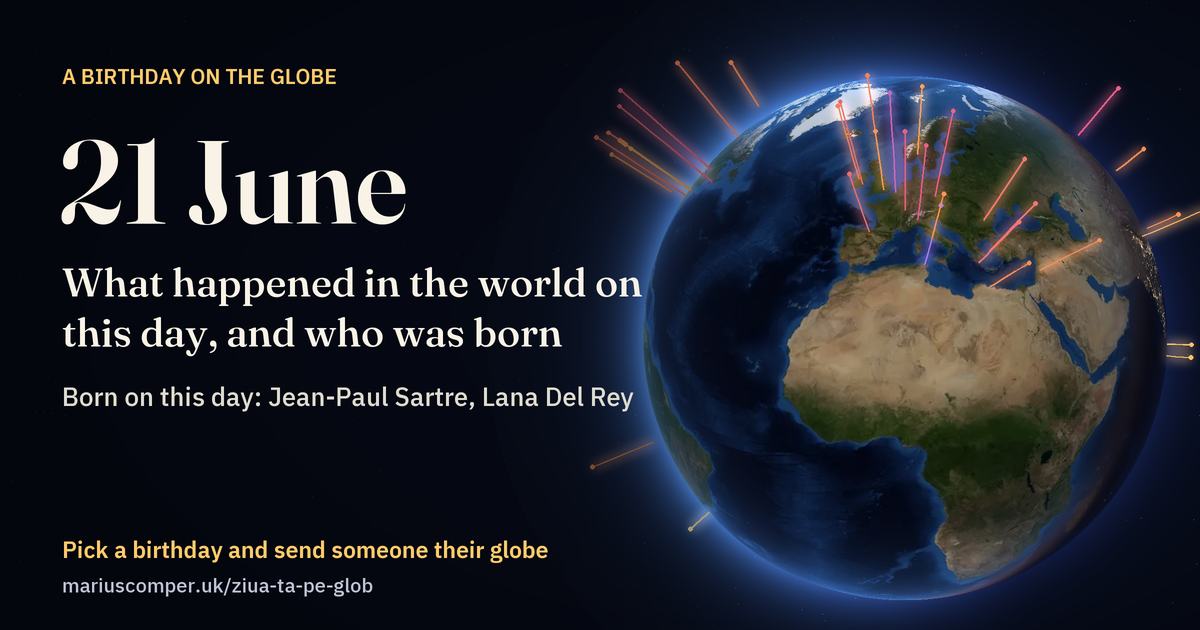
For 21 June, the English Wikipedia lists 59 events and 322 births. 37 of the events stand at their places as rays of light; three more are dashed circles, where the sentence links only to a country or a sea. The taller the ray, the longer ago it happened. The people born that day come further down, as blue points.
A birthday, yours or someone else’s:
Turn it into a greetingScroll: the globe turns to each place
The day you were born, on the globe.
Three things from your day
Scroll: your day first, then 21 June through the years
The Earth on 21 June
The picture on the globe was assembled by NASA from satellite photographs taken in June 2004: the snow, the ice and the green are those of the month.
On 21 June the Sun passes straight overhead at noon along the parallel of 23.5° north. In London, the day lasts about 16 hours 40 minutes.
Beyond 67° north the Sun no longer sets; beyond 67° south it no longer rises.
The line between day and night is tilted on the globe exactly as on this day of the year. On the dark side you can see the lights of towns.
Britain & Ireland · Prince Edward Theatre
1978
The original production of Tim Rice and Andrew Lloyd Webber's musical, Evita, based on the life of Eva Perón, opens at the Prince Edward Theatre, London.
On the map: Prince Edward Theatre.
Europe · Dealul Spirii
1848
In the Wallachian Revolution, Ion Heliade Rădulescu and Christian Tell issue the Proclamation of Islaz and create a new republican government.
On the map: Dealul Spirii.
Europe · 1963 conclave
1963
Cardinal Giovanni Battista Montini is elected as Pope Paul VI.
On the map: 1963 conclave.
Asia · Polytechnic University of the Philippines
1952
The Philippine School of Commerce, through a republic act, is converted to Philippine College of Commerce, later to be the Polytechnic University of the Philippines.
On the map: Polytechnic University of the Philippines.
Latin America · Arica
1973
The Primer Congreso del Hombre Andino is inaugurated in Arica, Chile.
On the map: Arica.
North America · Halifax, Nova Scotia
1749
Halifax, Nova Scotia, is founded.
On the map: Halifax, Nova Scotia.
North America · Supreme Court of the United States
1915
The U.S. Supreme Court hands down its decision in Guinn v. United States 238 US 347 1915, striking down Oklahoma grandfather clause legislation which had the effect of denying the right to vote to African-Americans.
On the map: Supreme Court of the United States.
North America · Supreme Court of the United States
1973
In its decision in Miller v. California, 413 U.S. 15, the Supreme Court of the United States establishes the Miller test for determining whether something is obscene and not protected speech under the U.S. constitution.
On the map: Supreme Court of the United States.
21 June
Born on 21 June#
The English Wikipedia lists 322 births for this day. The blue points are the birthplaces of 59 of these people: those written about in the most Wikipedia editions, where Wikidata gives a place of birth.
Born on 21 June
1905
Jean-Paul Sartre, French philosopher and author (died 1980)
Place of birth: Paris.
Born on 21 June
1985
Lana Del Rey, American singer-songwriter
Place of birth: New York City.
Born on 21 June
1983
Edward Snowden, American activist and academic
Place of birth: Elizabeth City.
Born on 21 June
1955
Michel Platini, French footballer and manager
Place of birth: Jœuf.
Born in Britain and Ireland
1948
Ian McEwan, British novelist and screenwriter
Place of birth: Aldershot.
Born in Britain and Ireland
1944
Tony Scott, English-American director and producer (died 2012)
Place of birth: North Shields.
21 June
Number one in the charts that week
At the cinema
An animal recorded that day
The record can be seen in GBIF, which brings together wildlife records from around the world.
All your birthdays
The weather that day
Data: Met Office Hadley Centre (HadCET); NOAA (GHCN-Daily, Mauna Loa).
Above the Earth
Sources: Jonathan McDowell, GCAT (launches); GFZ Potsdam (Kp index). Days are counted in Universal Time.
Football that day
International matches played that day:
Source: the “International football results” dataset kept by Mart Jürisoo (CC0).
Also that day
The earthquake’s page at the USGS
Source: the USGS catalogue. The day is counted in Universal Time (UTC).
In those days
Make a link for someone
Type the name, pick the day and the year of birth. The link opens straight on their day, with their name in the greeting.
The link carries the name, date and place typed here; anyone who gets it can see them.
Put another birthday beside it
Your mother’s, your child’s, a friend’s: the two days appear side by side.
Below: 21 June through the years.
The whole globe of the day
Drag the globe to turn it. Touch a ray or a point to read what happened there.
Everything Wikipedia lists for 21 June
The list is the English Wikipedia’s, in its own wording, as it stood in October 2026. 19 events have no place on the map: the sentence links to no place with coordinates, only to places too wide to mark, or to several countries.
- 217 BC
A Carthaginian force under Hannibal ambushes and defeats a Roman army commanded by Gaius Flaminius in the battle of lake Trasimene during the Second Punic War.
Africa · Ancient CarthageWikipedia: Battle of Lake Trasimene - 533
A Byzantine expeditionary fleet under Belisarios sails from Constantinople to attack the Vandals in Africa, via Greece and Sicily.
no place on the mapWikipedia: Vandalic War - 870
Caliph al-Muhtadi is killed by rebellious troops and is succeeded by his cousin Al-Mu'tamid.
no place on the mapWikipedia: Al-Muhtadi - 1128
William Clito defeated Thierry of Alsace in a battle over the succession to the title of Count of Flanders.
Europe · Battle of AxspoeleWikipedia: Battle of Axspoele - 1307
Külüg Khan is enthroned as Khagan of the Mongols and Wuzong of the Yuan.
Asia · Yuan dynastyWikipedia: Külüg Khan - 1529
French forces are driven out of northern Italy by Spain at the Battle of Landriano during the War of the League of Cognac.
Europe · Battle of LandrianoWikipedia: Battle of Landriano - 1575
French Wars of Religion: Catholic forces defeated an armed group of Huguenots attempting to capture Besançon, from which they had previously been expelled.
Europe · Battle of BesançonWikipedia: French Wars of Religion - 1582
Sengoku period: Oda Nobunaga, the most powerful of the Japanese daimyōs, is forced to commit suicide by his own general Akechi Mitsuhide.
Asia · Honnō-ji IncidentWikipedia: Honnō-ji Incident - 1621
Execution of 27 Czech noblemen on the Old Town Square in Prague as a consequence of the Battle of White Mountain.
Europe · Old Town Square executionWikipedia: Battle of White Mountain - 1734
In Montreal, New France, a slave known by the French name of Marie-Joseph Angélique is put to death, having been convicted of setting the fire that destroyed much of the city.
North America · MontrealWikipedia: Montreal - 1749
Halifax, Nova Scotia, is founded.
North America · Halifax, Nova ScotiaWikipedia: Halifax, Nova Scotia - 1768
James Otis Jr. offends the King and Parliament in a speech to the Massachusetts General Court.
no place on the mapWikipedia: James Otis Jr. - 1788
New Hampshire becomes the ninth state to ratify the Constitution of the United States.
North America · New HampshireWikipedia: New Hampshire - 1791
King Louis XVI and his immediate family begin the Flight to Varennes during the French Revolution.
no place on the mapWikipedia: Flight to Varennes - 1798
Irish Rebellion of 1798: The British Army defeats Irish rebels at the Battle of Vinegar Hill.
Britain & Ireland · Battle of Vinegar HillWikipedia: Battle of Vinegar Hill - 1813
Peninsular War: Wellington defeats Joseph Bonaparte at the Battle of Vitoria.
Europe · Battle of VitoriaWikipedia: Battle of Vitoria - 1824
Greek War of Independence: Egyptian forces capture Psara in the Aegean Sea.
Europe · PsaraWikipedia: Greek War of Independence - 1826
Maniots defeat Egyptians under Ibrahim Pasha in the Battle of Vergas.
Europe · Ottoman–Egyptian invasion of ManiWikipedia: Ottoman–Egyptian invasion of Mani - 1848
In the Wallachian Revolution, Ion Heliade Rădulescu and Christian Tell issue the Proclamation of Islaz and create a new republican government.
Europe · Dealul SpiriiWikipedia: Wallachian Revolution of 1848 - 1864
American Civil War: The Battle of Jerusalem Plank Road begins.
North America · Battle of Jerusalem Plank RoadWikipedia: American Civil War - 1864
New Zealand Wars: A British victory against the Māori King Movement brought the Tauranga campaign to an end.
no place on the mapWikipedia: New Zealand Wars - 1890
Rudyard Kipling's poem Mandalay was published.
no place on the mapWikipedia: Rudyard Kipling - 1898
The United States captures Guam from Spain. The few warning shots fired by the U.S. naval vessels are misinterpreted as salutes by the Spanish garrison, which was unaware that the two nations were at war.
Oceania · Capture of GuamWikipedia: Capture of Guam - 1900
Boxer Rebellion: China formally declares war on the United States, Britain, Germany, France and Japan, as an edict issued from the Empress Dowager Cixi.
no place on the mapWikipedia: Boxer Rebellion - 1915
The U.S. Supreme Court hands down its decision in Guinn v. United States 238 US 347 1915, striking down Oklahoma grandfather clause legislation which had the effect of denying the right to vote to African-Americans.
North America · Supreme Court of the United StatesWikipedia: Supreme Court of the United States - 1919
Admiral Ludwig von Reuter scuttles the German fleet at Scapa Flow, Orkney. The nine sailors killed are the last casualties of World War I.
Britain & Ireland · Scuttling of the German fleet at Scapa FlowWikipedia: Scuttling of the German fleet at Scapa Flow - 1919
The Royal Canadian Mounted Police fire a volley into a crowd of unemployed war veterans, killing two, during the Winnipeg general strike.
North America · Winnipeg general strikeWikipedia: Winnipeg general strike - 1921
The Irish village of Knockcroghery is burned by British forces.
Britain & Ireland · KnockcrogheryWikipedia: Knockcroghery - 1929
An agreement brokered by U.S. Ambassador Dwight Whitney Morrow ends the Cristero War in Mexico.
no place on the mapWikipedia: Cristero War - 1930
One-year conscription comes into force in France.
no place on the mapWikipedia: Conscription - 1940
World War II: Italy begins an unsuccessful invasion of France.
no place on the mapWikipedia: World War II - 1941
Having defeated forces of Vichy France, Allied forces capture Damascus.
Asia · Battle of DamascusWikipedia: Vichy France - 1942
World War II: A Japanese submarine surfaces near the Columbia River in Oregon, firing 17 shells at Fort Stevens in one of only a handful of attacks by Japan against the United States mainland.
North America · Bombardment of Fort StevensWikipedia: Bombardment of Fort Stevens - 1942
World War II: Tobruk falls to Italian and German forces; 33,000 Allied troops are taken prisoner.
Africa · TobrukWikipedia: Axis capture of Tobruk - 1945
World War II: The Battle of Okinawa ends when the organized resistance of Imperial Japanese Army forces collapses in the Mabuni area on the southern tip of the main island.
Asia · Battle of OkinawaWikipedia: Battle of Okinawa - 1948
The Manchester Baby, the world's first stored-program computer, ran its first program.
no place on the mapWikipedia: Manchester Baby - 1952
The Philippine School of Commerce, through a republic act, is converted to Philippine College of Commerce, later to be the Polytechnic University of the Philippines.
Asia · Polytechnic University of the PhilippinesWikipedia: Polytechnic University of the Philippines - 1957
Ellen Fairclough is sworn in as Canada's first female Cabinet Minister.
no place on the mapWikipedia: Ellen Fairclough - 1963
Cardinal Giovanni Battista Montini is elected as Pope Paul VI.
Europe · 1963 conclaveWikipedia: 1963 conclave - 1964
Three civil rights workers, Andrew Goodman, James Chaney and Michael Schwerner, are murdered in Neshoba County, Mississippi, United States, by members of the Ku Klux Klan.
North America · Neshoba CountyWikipedia: Murders of Chaney, Goodman, and Schwerner - 1970
Penn Central declares Section 77 bankruptcy in what was the largest U.S. corporate bankruptcy to date.
no place on the mapWikipedia: Bankruptcy of Penn Central - 1973
In its decision in Miller v. California, 413 U.S. 15, the Supreme Court of the United States establishes the Miller test for determining whether something is obscene and not protected speech under the U.S. constitution.
North America · Supreme Court of the United StatesWikipedia: Supreme Court of the United States - 1973
The Primer Congreso del Hombre Andino is inaugurated in Arica, Chile.
Latin America · AricaWikipedia: Primer Congreso del Hombre Andino - 1978
The original production of Tim Rice and Andrew Lloyd Webber's musical, Evita, based on the life of Eva Perón, opens at the Prince Edward Theatre, London.
Britain & Ireland · Prince Edward TheatreWikipedia: Evita - 1982
John Hinckley is found not guilty by reason of insanity for the attempted assassination of U.S. President Ronald Reagan.
North America · Attempted assassination of Ronald ReaganWikipedia: Attempted assassination of Ronald Reagan - 1985
Braathens SAFE Flight 139 is hijacked on approach to Oslo Airport, Fornebu. Special forces arrest the hijacker and there are no fatalities.
Europe · Oslo Airport, FornebuWikipedia: Braathens SAFE Flight 139 - 1989
The U.S. Supreme Court rules in Texas v. Johnson, 491 U.S. 397, that American flag-burning is a form of political protest protected by the First Amendment.
North America · Supreme Court of the United StatesWikipedia: Supreme Court of the United States - 1993
Space Shuttle Endeavour is launched on STS-57 to retrieve the European Retrievable Carrier (EURECA) satellite. It is also the first shuttle mission to carry the Spacehab module.
no place on the mapWikipedia: Space Shuttle Endeavour - 2000
President Bill Clinton awarded the Medal of Honor to 22 Asian Americans, mostly from the 442nd Regimental Combat Team, for actions during World War II.
no place on the mapWikipedia: Bill Clinton - 2000
Section 28 (of the Local Government Act 1988), outlawing the 'promotion' of homosexuality in the United Kingdom, is repealed in Scotland with a 99 to 17 vote.
no place on the mapWikipedia: Section 28 - 2001
A federal grand jury in Alexandria, Virginia, indicts 13 Saudis and a Lebanese in the 1996 bombing of the Khobar Towers in Saudi Arabia that killed 19 American servicemen.
North America · Alexandria, VirginiaWikipedia: Khobar Towers bombing - 2004
SpaceShipOne becomes the first privately funded spaceplane to achieve spaceflight.
no place on the mapWikipedia: SpaceShipOne - 2005
Edgar Ray Killen, who had previously been unsuccessfully tried for the murders of James Chaney, Andrew Goodman, and Mickey Schwerner, is convicted of manslaughter 41 years afterwards (the case had been reopened in 2004).
no place on the mapWikipedia: Edgar Ray Killen - 2006
A Yeti Airlines de Havilland Canada DHC-6 Twin Otter crashes at Jumla Airport in Nepal, killing nine people.
Asia · 2006 Yeti Airlines DHC-6 crashWikipedia: 2006 Yeti Airlines DHC-6 crash - 2006
Pluto's newly discovered moons are officially named Nix and Hydra.
no place on the mapWikipedia: Pluto - 2009
Greenland assumes self-rule.
North America · GreenlandWikipedia: Greenland - 2012
A boat carrying more than 200 migrants capsizes in the Indian Ocean between the Indonesian island of Java and Christmas Island, killing 17 people and leaving 70 others missing.
Asia · 2012 Indian Ocean migrant boat disasterWikipedia: 2012 Indian Ocean migrant boat disaster - 2012
An Indonesian Air Force Fokker F27 Friendship crashes near Halim Perdanakusuma International Airport, killing 11.
Asia · 2012 Indonesian Air Force Fokker F27 crashWikipedia: 2012 Indonesian Air Force Fokker F27 crash - 2025
A hot air balloon catches fire mid-flight and crashes in Praia Grande, Santa Catarina, Brazil, killing 8 of the 21 on board.
Latin America · 2025 Santa Catarina hot air balloon crashWikipedia: 2025 Santa Catarina hot air balloon crash
Who was born on 21 June
In order of how many Wikipedia editions have an article about each. The first 60 of 322 are shown.
- 1905
Jean-Paul Sartre, French philosopher and author (died 1980)
- 1985
Lana Del Rey, American singer-songwriter
New York CityWikipedia: Lana Del Rey - 1953
Benazir Bhutto, Pakistani politician, Prime Minister of Pakistan (died 2007)
KarachiWikipedia: Benazir Bhutto - 1979
Chris Pratt, American actor
VirginiaWikipedia: Chris Pratt - 1961
Joko Widodo, Indonesian businessman and politician, 7th President of Indonesia
SurakartaWikipedia: Joko Widodo - 1983
Edward Snowden, American activist and academic
Elizabeth CityWikipedia: Edward Snowden - 1947
Shirin Ebadi, Iranian lawyer, judge, and activist, Nobel Prize laureate
HamadanWikipedia: Shirin Ebadi - 1982
William, Prince of Wales, heir apparent to the British throne
St Mary's HospitalWikipedia: William, Prince of Wales - 1955
Michel Platini, French footballer and manager
- 1935
Françoise Sagan, French author and playwright (died 2004)
- 1962
Viktor Tsoi, Russian singer-songwriter and guitarist (died 1990)
Saint PetersburgWikipedia: Viktor Tsoi - 1967
Yingluck Shinawatra, Thai businesswoman and politician, 28th Prime Minister of Thailand
San KamphaengWikipedia: Yingluck Shinawatra - 1002
Pope Leo IX (died 1054)
EguisheimWikipedia: Pope Leo IX - 1781
Siméon Denis Poisson, French mathematician and physicist (died 1840)
PithiviersWikipedia: Siméon Denis Poisson - 1839
Joaquim Maria Machado de Assis, Brazilian author, poet, and playwright (died 1908)
Rio de JaneiroWikipedia: Machado de Assis - 1948
Andrzej Sapkowski, Polish author and translator
- 1948
Ian McEwan, British novelist and screenwriter
AldershotWikipedia: Ian McEwan - 1921
Jane Russell, American actress and singer (died 2011)
BemidjiWikipedia: Jane Russell - 1973
Juliette Lewis, American actress and singer-songwriter
Los AngelesWikipedia: Juliette Lewis - 1774
Daniel D. Tompkins, American lawyer and politician, 6th Vice President of the United States (died 1825)
ScarsdaleWikipedia: Daniel D. Tompkins - 1921
Judy Holliday, American actress and singer (died 1965)
New York CityWikipedia: Judy Holliday - 1863
Max Wolf, German astronomer and academic (died 1932)
HeidelbergWikipedia: Max Wolf - 1914
William Vickrey, Canadian-American economist and academic, Nobel Prize laureate (died 1996)
VictoriaWikipedia: William Vickrey - 1925
Maureen Stapleton, American actress (died 2006)
- 1944
Tony Scott, English-American director and producer (died 2012)
North ShieldsWikipedia: Tony Scott - 1957
Luis Antonio Tagle, Filipino cardinal
- 1965
Yang Liwei, Chinese general, pilot, and astronaut
Suizhong CountyWikipedia: Yang Liwei - 1882
Lluís Companys, Spanish lawyer and politician, 123rd President of Catalonia (died 1940)
El TarròsWikipedia: Lluís Companys - 1941
Joe Flaherty, American-Canadian actor, producer, and screenwriter (died 2024)
PittsburghWikipedia: Joe Flaherty - 1997
Rebecca Black, American singer-songwriter
IrvineWikipedia: Rebecca Black - 1881
(O.S.) Natalia Goncharova, Russian painter, costume designer, and illustrator (died 1962)
Nagaevo-KarbonierWikipedia: Natalia Goncharova - 1961
Manu Chao, French singer-songwriter, guitarist, and producer
ParisWikipedia: Manu Chao - 1892
Reinhold Niebuhr, American theologian and academic (died 1971)
Wright CityWikipedia: Reinhold Niebuhr - 1925
Giovanni Spadolini, Italian journalist and politician, 45th Prime Minister of Italy (died 1994)
FlorenceWikipedia: Giovanni Spadolini - 1979
Kostas Katsouranis, Greek footballer
ChalandritsaWikipedia: Kostas Katsouranis - 1870
Clara Immerwahr, Jewish-German chemist and academic (died 1915)
WojczyceWikipedia: Clara Immerwahr - 1945
Adam Zagajewski, Polish author and poet (died 2021)
- 1991
Gaël Kakuta, French footballer
- 1987
Sebastian Prödl, Austrian footballer
- 1884
Claude Auchinleck, English field marshal (died 1981)
AldershotWikipedia: Claude Auchinleck - 1528
Maria of Austria, Holy Roman Empress (died 1603)
- 1932
Lalo Schifrin, Argentinian pianist, composer, and conductor (died 2025)
Buenos AiresWikipedia: Lalo Schifrin - 1964
Doug Savant, American actor
BurbankWikipedia: Doug Savant - 1732
Johann Christoph Friedrich Bach, German pianist and composer (died 1791)
- 1910
Aleksandr Tvardovsky, Russian poet and author (died 1971)
- 1912
Mary McCarthy, American novelist and critic (died 1989)
SeattleWikipedia: Mary McCarthy - 1864
Heinrich Wölfflin, Swiss historian and critic (died 1945)
WinterthurWikipedia: Heinrich Wölfflin - 1981
Brandon Flowers, American singer-songwriter
HendersonWikipedia: Brandon Flowers - 1891
Pier Luigi Nervi, Italian architect and engineer, co-designed the Pirelli Tower and Cathedral of Saint Mary of the Assumption (died 1979)
SondrioWikipedia: Pier Luigi Nervi - 1958
Gennady Padalka, Russian colonel, pilot, and astronaut
KrasnodarWikipedia: Gennady Padalka - 1823
Jean Chacornac, French astronomer (died 1873)
- 1947
Fernando Savater, Spanish philosopher and author
San SebastiánWikipedia: Fernando Savater - 1950
Anne Carson, Canadian poet and academic
TorontoWikipedia: Anne Carson - 1990
Håvard Nordtveit, Norwegian footballer
- 1967
Pierre Omidyar, French-American businessman, founded eBay
- 1985
Kris Allen, American musician, singer and songwriter
JacksonvilleWikipedia: Kris Allen - 1792
Ferdinand Christian Baur, German theologian and scholar (died 1860)
- 1967
Carrie Preston, American actress, director, and producer
- 1987
Pablo Barrera, Mexican footballer
TlalnepantlaWikipedia: Pablo Barrera - 1730
Motoori Norinaga, Japanese poet and scholar (died 1801)
MatsusakaWikipedia: Motoori Norinaga
What is celebrated on 21 June
- Christian feast day: Alban of Mainz
- Christian feast day: Aloysius Gonzaga
- Christian feast day: Engelmund of Velsen
- Christian feast day: John Rigby
- Christian feast day: Martin of Tongres
- Christian feast day: Mewan
- Christian feast day: Onesimos Nesib (Lutheran)
- Christian feast day: June 21 (Eastern Orthodox liturgics)
- Day of the Martyrs (Togo)
- Father's Day (Egypt, Lebanon, Jordan, Syria, Uganda, Pakistan, United Arab Emirates)
- Go Skateboarding Day
- International Yoga Day (international)
- National Indigenous Peoples Day (Canada)
- Solstice-related observances (see also June 20): Day of Private Reflection (Northern Ireland)
A greeting link for someone
Type a name and, if you like, the year of birth. The link opens with a greeting, and beside each event it says how old the person turned that day, or how many years before their birth it happened.
The name and the year go only into the link you send.
All 366 days
How the globe is made
Where the events come from
Each edition of this page uses the day’s list from Wikipedia in its own language: Romanian, English, Spanish, Chinese. The lists are written by volunteers and differ from one edition to the next; the text of each event is Wikipedia’s, with a link to the article. A row that appears twice in a list is shown once. The lists have not been checked event by event: they are Wikipedia’s, mistakes included.
For events before 1582, and for countries that moved to the Gregorian calendar later (Britain in 1752, Russia in 1918), the same day may be counted Old Style in one list and New Style in another.
The chapter “What the other Wikipedias remember” adds up to five events a day from the lists of the other three editions, only for years in which the English list has nothing on that day. They were translated for this page, passed the same filters as the tour, and are not counted among the events of the English list.
How an event gets onto the map
The place comes from Wikidata. If the sentence links to the article about the event itself (a battle, an opening, an earthquake), dated to the same year, the ray stands on its coordinates or on those of its location. Otherwise it stands on the first place the sentence links to: a town, a building, a mountain, an island. This second step can be wrong: sometimes the sentence only mentions the place. That is why the page says, under each event, which place the ray stands on.
When the sentence links to a single state or province, or to a single sea, lake or desert larger than 5,000 km², the globe shows a dashed circle, not a ray. The circle has the area Wikidata gives, with its radius kept between 1.2° and 16°, or a radius of 4.5° when Wikidata gives no area; it says only that the sentence links to that place. Organisations, ships, spacecraft, museum objects, rivers, mountain ranges, languages and continents are never used as places. When a sentence names several states and no exact place, the event stays in the list only.
What the height means
The height of a ray shows how many years have passed, on a logarithmic scale: 10 years, 100 years and 1,000 years are equal steps apart; anything older than about 2,600 years has the tallest ray. The colour runs from pale yellow for recent years to violet for antiquity.
Where the tour stops
In each region the tour stops at up to three events (five in Britain and Ireland), chosen mainly by three things: whether Wikipedia’s editors put the event in the “On this day” box of their main page (the English, Spanish and Chinese editions), how many Wikipedia editions have an article about it, and how many of the four lists include it. Events whose sentence or article is about a war, an attack, a crime or a disaster are left out of the tour; they stay in the whole list, in Wikipedia’s wording. The filter is a list of words and a list of Wikidata types, so it can miss some.
The tour of births names the people with articles in the most editions and leaves aside those whom the list or Wikidata describes as rulers, politicians, commanders, leaders of movements or criminals; they stay in the list.
The Earth and the Sun
The daytime images are NASA’s Blue Marble Next Generation mosaics, one for each month of 2004; the night side is Black Marble 2016. The tilt of the line between day and night is computed for the day; the hour is chosen so that the place being read is in daylight. The latitude where the Sun stands overhead is the average of the four years of the leap cycle; in a given year it can differ by up to 0.4°.
The day you were born
The number ones come from the weekly lists on Wikipedia: Billboard for the United States (from 1940; the Hot 100 from August 1958), the UK Singles Chart (from November 1952), Los 40 Principales for Spain (from July 1966) and, for Romania, the Romanian Top 100 and Airplay 100 (2001–2021, with missing weeks). The page shows the chart of the week in which the day of birth falls, with its date; Billboard and the UK chart are dated at the end of their week. For Romania before 2001 and for China these sources have no weekly chart.
The films are those that reached cinemas in the United States up to ten days before or three days after that day (some of them in a few cinemas at first), from the English Wikipedia’s yearly lists (from 1968), in order of how many editions have an article about them. The events “in those days” are the ones on the neighbouring days’ lists that carry the year of birth, passed through the same filter as the tour.
The day of birth, year included
The Moon, the star sign and the constellation are worked out by the page itself, for noon Universal Time on the day. The lit part of the Moon is rounded and can differ by a few per cent from that at the hour of birth. The sign follows the usual zodiac of twelve equal parts starting at the March equinox; the constellation is the one the Sun actually stood in front of, by the borders set by the International Astronomical Union, and within a day of a border the page does not name it. When the Sun changes sign while it is that day anywhere on Earth, the page gives the moment of crossing, rounded to ten minutes and accurate to within about a quarter of an hour, and the clock time in a few cities, with the time zone and summer time of that year.
The year in the Chinese calendar is the one your device’s own calendar gives for the date, checked against the Hong Kong Observatory’s tables. “All your birthdays” uses the same sources as the rest of the chapter for the same day in every year since the birth: the temperature, well-known launches that took place on that very day, matches of the teams the edition follows, snow deeper than 10 cm and strong geomagnetic storms. The three things at the top and the four on the picture are chosen in a fixed order (the song, the animal, a full Moon, a well-known launch before an ordinary earthquake); on the picture you can change them.
When the link carries a year of birth, the page adds a few things about that exact day. The weather is the Met Office’s Central England temperature record and the readings from New York’s Central Park; the “usual high” is the average of the daily highs of 1961–1990 for that date, with two days either side. The carbon dioxide figure is the monthly mean at the Mauna Loa observatory, where measurements begin in March 1958.
The earthquake is the one with the largest magnitude in the USGS catalogue for that day, counted in Universal Time. Before the 1960s the catalogue has gaps even above magnitude 5.5, so in the older years many days have no earthquake. The page gives only the magnitude and the place: the country the epicentre falls in or, when the epicentre is at sea within 300 km of a coast, the nearest country; farther out, only the ocean.
The launches are those that reached orbit or left for the Moon and the planets, from Jonathan McDowell’s GCAT catalogue. If nothing left that day, the page shows the nearest launch within three days before or after, and says how many days away it was. The geomagnetic storm appears only when the Kp index reached at least 5 in one of the day’s eight three-hour intervals.
The animal comes from GBIF: an observation made by a person (the animal seen or heard, or its tracks), dated to that exact day, with coordinates and a CC0 or CC BY licence. Only a few hundred well-known species are searched (mammals, birds, turtles, butterflies); of those noted that day, mammals and species with articles in many Wikipedia editions come first; birds noted almost every day, and species used recently, wait their turn. Observations dated 1 January are left out, because records without a day are often filed there. An observation shows that the animal was recorded there, not how many animals there were.
The matches are those between national teams. Only matches of England, Scotland, Wales, Northern Ireland, the Republic of Ireland, the United States, Canada and Australia are shown, along with those at the big final tournaments. The picture to send is drawn in the page from the day’s globe and the facts above, and stays on your device until you send it.
Sources
- Events, births and holidays: the day’s page on Wikipedia, text under CC BY-SA 4.0.
- Coordinates, places of birth and the number of editions: Wikidata (CC0).
- The Earth by day: NASA Blue Marble Next Generation. The Earth by night: NASA Black Marble 2016.
- Borders and regions: Natural Earth.
- World population and births per year: UN World Population Prospects 2024.
- Charts and films: Wikipedia’s lists for Billboard, the UK Singles Chart, Los 40 Principales, Romanian Top 100, Airplay 100 and American films by year (CC BY-SA 4.0).
- Weather: Met Office Hadley Centre, HadCET (Open Government Licence) and NOAA GHCN-Daily, New York Central Park. Carbon dioxide: NOAA Global Monitoring Laboratory, Mauna Loa.
- Earthquakes: the USGS catalogue. Launches: Jonathan McDowell, GCAT (CC BY). Kp index: GFZ Potsdam (CC BY 4.0). Matches: International football results, Mart Jürisoo (CC0).
- Animal observations: GBIF, with a link to each record; species names come from Wikidata.