A birthday on the globe
16 June on the globe: what happened in the world on this day, and who was born
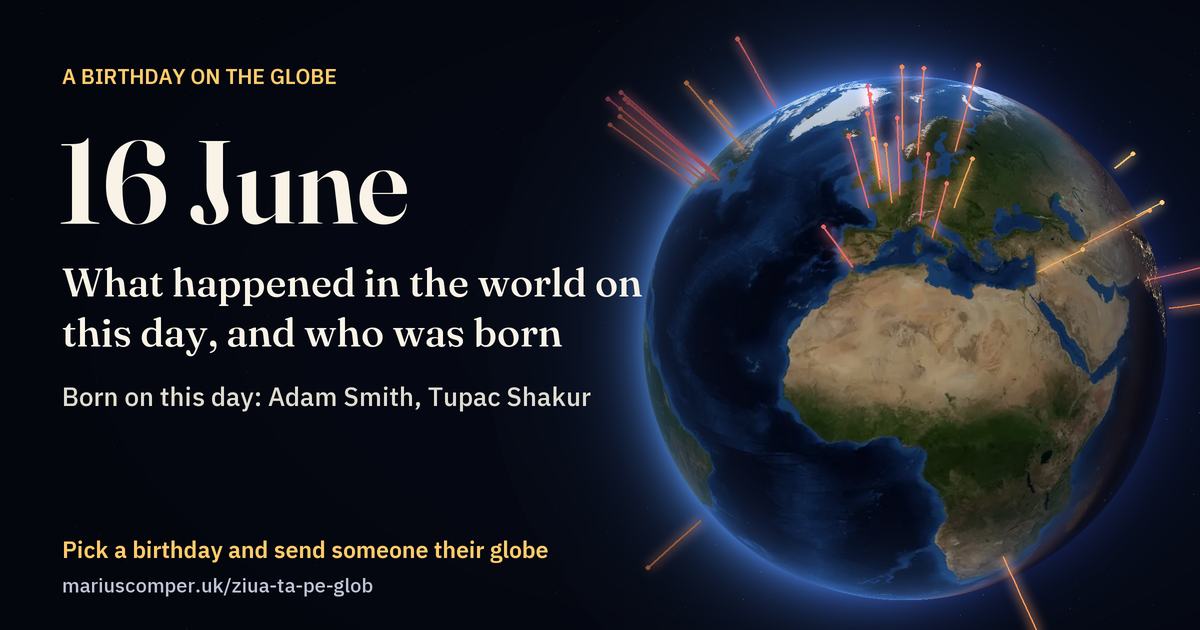
For 16 June, the English Wikipedia lists 59 events and 229 births. 32 of the events stand at their places as rays of light; nine more are dashed circles, where the sentence links only to a country or a sea. The taller the ray, the longer ago it happened. The people born that day come further down, as blue points.
A birthday, yours or someone else’s:
Turn it into a greetingScroll: the globe turns to each place
The day you were born, on the globe.
Three things from your day
Scroll: your day first, then 16 June through the years
The Earth on 16 June
The picture on the globe was assembled by NASA from satellite photographs taken in June 2004: the snow, the ice and the green are those of the month.
On 16 June the Sun passes straight overhead at noon along the parallel of 23.4° north. In London, the day lasts about 16 hours 35 minutes.
Beyond 67° north the Sun no longer sets; beyond 67° south it no longer rises.
The line between day and night is tilted on the globe exactly as on this day of the year. On the dark side you can see the lights of towns.
Britain & Ireland · University of Oxford
1871
The Universities Tests Act 1871 allows students to enter the universities of Oxford, Cambridge and Durham without religious tests (except for those intending to study theology).
On the map: University of Oxford.
Europe · 1846 conclave
1846
The Papal conclave of 1846 elects Pope Pius IX, beginning the longest reign in the history of the papacy.
On the map: the coordinates Wikidata gives for the article “1846 conclave”.
Europe · Oslo
1903
Roald Amundsen leaves Oslo, Norway, to commence the first east–west navigation of the Northwest Passage.
On the map: Oslo.
Europe · Paris
1961
While on tour with the Kirov Ballet in Paris, Rudolf Nureyev defects from the Soviet Union.
On the map: Paris.
Also on the day’s list of Wikipedia in Spanish.
Asia · Shebaa Farms
2000
The Secretary-General of the UN reports that Israel has complied with United Nations Security Council Resolution 425, 22 years after its issuance, and completely withdrawn from Lebanon. The Resolution does not encompass the Shebaa farms, which is claimed by Israel, Syria and Lebanon.
On the map: Shebaa Farms.
Asia · Shanghai Disneyland
2016
Shanghai Disneyland Park, the first Disney Park in mainland China, opens to the public.
On the map: Shanghai Disneyland.
Also on the day’s list of Wikipedia in Chinese.
North America · Fort Andross
1632
The Plymouth Company grants a land patent to Thomas Purchase, the first settler of Pejepscot, Maine, settling at the site of Fort Andross.
On the map: Fort Andross.
North America · Springfield
1858
Abraham Lincoln delivers his House Divided speech in Springfield, Illinois.
On the map: Springfield.
North America · Redwood Shores
1977
Oracle Corporation is incorporated in Redwood Shores, California, as Software Development Laboratories (SDL), by Larry Ellison, Bob Miner and Ed Oates.
On the map: Redwood Shores.
16 June
Born on 16 June#
The English Wikipedia lists 229 births for this day. The blue points are the birthplaces of 60 of these people: those written about in the most Wikipedia editions, where Wikidata gives a place of birth.
Born on 16 June
1723
Adam Smith, Scottish philosopher and economist (died 1790)
Place of birth: Kirkcaldy.
Born on 16 June
1971
Tupac Shakur, American rapper and producer (died 1996)
Place of birth: East Harlem.
Born on 16 June
1902
Barbara McClintock, American geneticist and academic, Nobel Prize laureate (died 1992)
Place of birth: Hartford.
Born on 16 June
1967
Jürgen Klopp, German footballer and manager
Place of birth: Stuttgart.
Born on 16 June
1890
Stan Laurel, English actor and comedian (died 1965)
Place of birth: Ulverston.
Born in Britain and Ireland
1990
John Newman, English musician, singer, songwriter and record producer
Place of birth: Settle.
16 June
Number one in the charts that week
At the cinema
An animal recorded that day
The record can be seen in GBIF, which brings together wildlife records from around the world.
All your birthdays
The weather that day
Data: Met Office Hadley Centre (HadCET); NOAA (GHCN-Daily, Mauna Loa).
Above the Earth
Sources: Jonathan McDowell, GCAT (launches); GFZ Potsdam (Kp index). Days are counted in Universal Time.
Football that day
International matches played that day:
Source: the “International football results” dataset kept by Mart Jürisoo (CC0).
Also that day
The earthquake’s page at the USGS
Source: the USGS catalogue. The day is counted in Universal Time (UTC).
In those days
Make a link for someone
Type the name, pick the day and the year of birth. The link opens straight on their day, with their name in the greeting.
The link carries the name, date and place typed here; anyone who gets it can see them.
Put another birthday beside it
Your mother’s, your child’s, a friend’s: the two days appear side by side.
Below: 16 June through the years.
The whole globe of the day
Drag the globe to turn it. Touch a ray or a point to read what happened there.
Everything Wikipedia lists for 16 June
The list is the English Wikipedia’s, in its own wording, as it stood in October 2026. 18 events have no place on the map: the sentence links to no place with coordinates, only to places too wide to mark, or to several countries.
- 632
Yazdegerd III ascends the throne as king (shah) of the Persian Empire. He becomes the last ruler of the Sasanian dynasty (modern Iran).
no place on the mapWikipedia: Yazdegerd III - 1407
Ming–Hồ War: Retired King Hồ Quý Ly and his son King Hồ Hán Thương of Hồ dynasty are captured by the Ming armies.
Asia · Ming dynastyWikipedia: Ming conquest of Đại Ngu - 1487
Battle of Stoke Field: King Henry VII of England defeats the leaders of a Yorkist rebellion in the final engagement of the Wars of the Roses.
Britain & Ireland · Battle of Stoke FieldWikipedia: Battle of Stoke Field - 1632
The Plymouth Company grants a land patent to Thomas Purchase, the first settler of Pejepscot, Maine, settling at the site of Fort Andross.
North America · Fort AndrossWikipedia: Plymouth Company - 1745
War of the Austrian Succession: New England colonial troops under the command of William Pepperrell capture the Fortress of Louisbourg in Louisbourg, New France (Old Style date).
North America · Fortress of LouisbourgWikipedia: War of the Austrian Succession - 1746
War of the Austrian Succession: Austria and Sardinia defeat a Franco-Spanish army at the Battle of Piacenza.
Europe · Battle of PiacenzaWikipedia: Battle of Piacenza - 1755
French and Indian War: The French surrender Fort Beauséjour to the British, leading to the expulsion of the Acadians.
North America · Fort BeauséjourWikipedia: Expulsion of the Acadians - 1760
French and Indian War: Robert Rogers and his Rangers surprise French held Fort Sainte Thérèse on the Richelieu River near Lake Champlain. The fort is raided and burned.
North America · Fort Sainte ThérèseWikipedia: Robert Rogers - 1779
American Revolutionary War: Spain declares war on the Kingdom of Great Britain, and the Great Siege of Gibraltar begins.
Europe · Great Siege of GibraltarWikipedia: American Revolutionary War - 1795
French Revolutionary Wars: In what became known as Cornwallis's Retreat, a British Royal Navy squadron led by Vice Admiral William Cornwallis strongly resists a much larger French Navy force and withdraws largely intact, setting up the French Navy defeat at the Battle of Groix six days later.
Europe · Battle of GroixWikipedia: Battle of Groix - 1811
Survivors of an attack the previous day by Tla-o-qui-aht on board the Pacific Fur Company's ship Tonquin intentionally detonate a powder magazine on the ship, destroying it and killing about 100 attackers.
North America · Clayoquot SoundWikipedia: Battle of Woody Point - 1815
Battle of Ligny and Battle of Quatre Bras, two days before the Battle of Waterloo.
Europe · Battle of LignyWikipedia: Battle of Ligny - 1819
A major earthquake strikes the Kutch district of western India, killing over 1,543 people and raising a 6-metre-high (20 ft), 6-kilometre-wide (3.7 mi), ridge, extending for at least 80 kilometres (50 mi), that was known as the Allah Bund ("Dam of God").
Asia · 1819 Rann of Kutch earthquakeWikipedia: 1819 Rann of Kutch earthquake - 1824
A meeting at Old Slaughter's coffee house in London leads to the formation of what is now the Royal Society for the Prevention of Cruelty to Animals (RSPCA).
no place on the mapWikipedia: RSPCA - 1836
The formation of the London Working Men's Association gives rise to the Chartist Movement.
no place on the mapWikipedia: London Working Men's Association - 1846
The Papal conclave of 1846 elects Pope Pius IX, beginning the longest reign in the history of the papacy.
Europe · 1846 conclaveWikipedia: 1846 conclave - 1858
Abraham Lincoln delivers his House Divided speech in Springfield, Illinois.
North America · SpringfieldWikipedia: Lincoln's House Divided Speech - 1871
The Universities Tests Act 1871 allows students to enter the universities of Oxford, Cambridge and Durham without religious tests (except for those intending to study theology).
Britain & Ireland · University of OxfordWikipedia: Universities Tests Act 1871 - 1883
The Victoria Hall theatre panic in Sunderland, England, kills 183 children.
Britain & Ireland · Victoria Hall disasterWikipedia: Victoria Hall disaster - 1884
The first purpose-built roller coaster, LaMarcus Adna Thompson's "Switchback Railway", opens in New York's Coney Island amusement park.
North America · Switchback RailwayWikipedia: LaMarcus Adna Thompson - 1897
A treaty annexing the Republic of Hawaii to the United States is signed; the Republic would not be dissolved until a year later.
North America · Republic of HawaiiWikipedia: Republic of Hawaii - 1903
Roald Amundsen leaves Oslo, Norway, to commence the first east–west navigation of the Northwest Passage.
Europe · OsloWikipedia: Roald Amundsen - 1903
The Ford Motor Company is incorporated.
no place on the mapWikipedia: Ford Motor Company - 1904
Eugen Schauman assassinates Nikolay Bobrikov, Governor-General of Finland.
Europe · Assassination of Nikolay BobrikovWikipedia: Assassination of Nikolay Bobrikov - 1904
Irish author James Joyce begins a relationship with Nora Barnacle and subsequently uses the date to set the actions for his novel Ulysses; this date is now traditionally called "Bloomsday".
no place on the mapWikipedia: James Joyce - 1911
IBM founded as the Computing-Tabulating-Recording Company in Endicott, New York.
North America · Endicott, New YorkWikipedia: IBM - 1922
General election in the Irish Free State: The pro-Treaty Sinn Féin party wins a large majority.
Britain & Ireland · Irish Free StateWikipedia: Irish Free State - 1925
Artek, the most famous Young Pioneer camp of the Soviet Union, is established.
Asia · Soviet UnionWikipedia: Artek - 1930
Sovnarkom establishes decree time in the USSR.
no place on the mapWikipedia: Council of People's Commissars - 1933
The National Industrial Recovery Act is passed in the United States, allowing businesses to avoid antitrust prosecution if they establish voluntary wage, price, and working condition regulations on an industry-wide basis.
no place on the mapWikipedia: National Industrial Recovery Act of 1933 - 1936
A Junkers Ju 52 aircraft of Norwegian Air Lines crashed into a mountainside near Hyllestad, Norway, killing all seven people on board.
Europe · Havørn AccidentWikipedia: Havørn Accident - 1940
The Soviet Union occupies Lithuania, which will eventually become the Lithuanian Soviet Socialist Republic (SSR).
no place on the mapWikipedia: Soviet Union - 1940
World War II: Marshal Henri Philippe Pétain becomes Chief of State of Vichy France (Chef de l'État Français).
Europe · Vichy FranceWikipedia: World War II - 1948
Members of the Malayan Communist Party kill three British plantation managers in Sungai Siput; in response, British Malaya declares a state of emergency.
Asia · Sungai SiputWikipedia: Malayan Emergency - 1955
In a futile effort to topple Argentine President Juan Perón, rogue aircraft pilots of the Argentine Navy drop several bombs upon an unarmed crowd demonstrating in favor of Perón in Buenos Aires, killing 364 and injuring at least 800. At the same time on the ground, some soldiers attempt to stage a coup but are suppressed by loyal forces.
Latin America · Bombing of Plaza de MayoWikipedia: Bombing of Plaza de Mayo - 1958
Imre Nagy, Pál Maléter and other leaders of the 1956 Hungarian Uprising are executed.
no place on the mapWikipedia: Hungarian Revolution of 1956 - 1960
Psycho, a psychological horror film directed by Alfred Hitchcock and based on a novel of the same name by Robert Bloch, premiered.
no place on the mapWikipedia: Psycho - 1961
While on tour with the Kirov Ballet in Paris, Rudolf Nureyev defects from the Soviet Union.
Europe · ParisWikipedia: Mariinsky Ballet - 1963
In an attempt to resolve the Buddhist crisis in South Vietnam, a Joint Communique is signed between President Ngo Dinh Diem and Buddhist leaders.
Asia · South VietnamWikipedia: Buddhist crisis - 1963
Soviet Space Program: Vostok 6 mission: Cosmonaut Valentina Tereshkova becomes the first woman in space.
no place on the mapWikipedia: Soviet space program - 1972
English musician David Bowie released his breakthrough album, The Rise and Fall of Ziggy Stardust and the Spiders from Mars.
no place on the mapWikipedia: David Bowie - 1972
The largest single-site hydroelectric power project in Canada is inaugurated at Churchill Falls Generating Station.
North America · Churchill Falls Generating StationWikipedia: Churchill Falls Generating Station - 1976
Soweto uprising: A non-violent march by 15,000 students in Soweto, South Africa, turns into days of rioting when police open fire on the crowd.
Africa · SowetoWikipedia: Soweto uprising - 1977
Oracle Corporation is incorporated in Redwood Shores, California, as Software Development Laboratories (SDL), by Larry Ellison, Bob Miner and Ed Oates.
North America · Redwood ShoresWikipedia: Oracle Corporation - 1981
US President Ronald Reagan awards the Congressional Gold Medal to Ken Taylor, Canada's former ambassador to Iran, for helping six Americans escape from Iran during the hostage crisis of 1979–81; he is the first foreign citizen bestowed the honor.
Asia · Iran hostage crisisWikipedia: Iran hostage crisis - 1989
Revolutions of 1989: Imre Nagy, the former Hungarian prime minister, is reburied in Budapest following the collapse of Communism in Hungary.
Europe · BudapestWikipedia: Revolutions of 1989 - 1995
The Astronomy Picture of the Day website is launched.
no place on the mapWikipedia: Astronomy Picture of the Day - 1997
Fifty people are killed in the Daïat Labguer (M'sila) massacre in Algeria.
Africa · AlgeriaWikipedia: Daïat Labguer (M'sila) massacre - 1997
The English rock band Radiohead released their landmark third album OK Computer in the United Kingdom.
no place on the mapWikipedia: Radiohead - 2000
The Secretary-General of the UN reports that Israel has complied with United Nations Security Council Resolution 425, 22 years after its issuance, and completely withdrawn from Lebanon. The Resolution does not encompass the Shebaa farms, which is claimed by Israel, Syria and Lebanon.
Asia · Shebaa FarmsWikipedia: United Nations Security Council Resolution 425 - 2002
Padre Pio is canonized by the Roman Catholic Church.
no place on the mapWikipedia: Padre Pio - 2010
Bhutan becomes the first country to institute a total ban on tobacco.
Asia · BhutanWikipedia: Bhutan - 2012
China successfully launches its Shenzhou 9 spacecraft, carrying three astronauts, including the first female Chinese astronaut Liu Yang, to the Tiangong-1 orbital module.
no place on the mapWikipedia: Shenzhou 9 - 2012
The United States Air Force's robotic Boeing X-37B spaceplane returns to Earth after a classified 469-day orbital mission.
no place on the mapWikipedia: United States Air Force - 2013
A multi-day cloudburst, centered on the North Indian state of Uttarakhand, causes devastating floods and landslides, becoming the country's worst natural disaster since the 2004 tsunami.
Asia · UttarakhandWikipedia: 2013 North India floods - 2015
American businessman Donald Trump announces his campaign to run for President of the United States in the upcoming election.
no place on the mapWikipedia: 2016 United States presidential election - 2016
Jo Cox, a British Member of Parliament, was murdered in her constituency.
Britain & Ireland · Murder of Jo CoxWikipedia: Murder of Jo Cox - 2016
Shanghai Disneyland Park, the first Disney Park in mainland China, opens to the public.
Asia · Shanghai DisneylandWikipedia: Shanghai Disneyland - 2019
Upwards of 2,000,000 people participate in the 2019–20 Hong Kong protests, the largest in Hong Kong's history.
Asia · 2019–2020 Hong Kong protestsWikipedia: 2019–2020 Hong Kong protests
Who was born on 16 June
In order of how many Wikipedia editions have an article about each. The first 60 of 229 are shown.
- 1723
Adam Smith, Scottish philosopher and economist (died 1790)
KirkcaldyWikipedia: Adam Smith - 1971
Tupac Shakur, American rapper and producer (died 1996)
East HarlemWikipedia: Tupac Shakur - 1902
Barbara McClintock, American geneticist and academic, Nobel Prize laureate (died 1992)
HartfordWikipedia: Barbara McClintock - 1967
Jürgen Klopp, German footballer and manager
StuttgartWikipedia: Jürgen Klopp - 1829
Geronimo, Apache military leader (died 1909)
Gila RiverWikipedia: Geronimo - 1858
Gustaf V, King of Sweden (died 1950)
Drottningholm PalaceWikipedia: Gustaf V - 1882
Mohammad Mosaddegh, Iranian educator and politician, 60th Prime Minister of Iran (died 1967)
- 1929
Sabah Al-Ahmad Al-Jaber Al-Sabah, Emir of Kuwait (died 2020)
Kuwait CityWikipedia: Sabah Al-Ahmad Al-Jaber Al-Sabah - 1952
George Papandreou, Greek sociologist and politician, 182nd Prime Minister of Greece
- 1890
Stan Laurel, English actor and comedian (died 1965)
UlverstonWikipedia: Stan Laurel - 1937
Simeon Saxe-Coburg-Gotha, Bulgarian politician, 48th Prime Minister of Bulgaria
SofiaWikipedia: Simeon II - 1938
Joyce Carol Oates, American novelist, short story writer, critic, and poet
LockportWikipedia: Joyce Carol Oates - 1888
Alexander Friedmann, Russian physicist and mathematician (died 1925)
Saint PetersburgWikipedia: Alexander Friedmann - 1978
Daniel Brühl, Spanish-German actor
BarcelonaWikipedia: Daniel Brühl - 1986
Fernando Muslera, Uruguayan footballer
Buenos AiresWikipedia: Fernando Muslera - 1897
Georg Wittig, German chemist and academic, Nobel Prize laureate (died 1987)
BerlinWikipedia: Georg Wittig - 1754
Salawat Yulayev, Russian poet (died 1800)
TekeyevoWikipedia: Salawat Yulayev - 1950
Mithun Chakraborty, Indian actor and politician
- 1962
Arnold Vosloo, South African-American actor
PretoriaWikipedia: Arnold Vosloo - 1966
Jan Železný, Czech javelin thrower and coach
Mladá BoleslavWikipedia: Jan Železný - 1920
José López Portillo, Mexican lawyer and politician, 31st President of Mexico (died 2004)
Mexico CityWikipedia: José López Portillo - 1980
Sibel Kekilli, German actress
HeilbronnWikipedia: Sibel Kekilli - 1583
Axel Oxenstierna, Swedish politician, Lord High Chancellor of Sweden (died 1654)
- 1955
Laurie Metcalf, American actress
CarbondaleWikipedia: Laurie Metcalf - 2000
Bianca Andreescu, Canadian tennis player
MississaugaWikipedia: Bianca Andreescu - 1917
Katharine Graham, American publisher (died 2001)
New York CityWikipedia: Katharine Graham - 1993
Park Bo-gum, South Korean actor
- 1874
Arthur Meighen, Canadian lawyer and politician, 9th Prime Minister of Canada (died 1960)
Perth SouthWikipedia: Arthur Meighen - 1907
Jack Albertson, American actor (died 1981)
- 1801
Julius Plücker, German mathematician and physicist (died 1868)
ElberfeldWikipedia: Julius Plücker - 1912
Enoch Powell, English soldier and politician, Secretary of State for Health (died 1998)
BirminghamWikipedia: Enoch Powell - 1926
Efraín Ríos Montt, Guatemalan general and politician, 26th President of Guatemala (died 2018)
HuehuetenangoWikipedia: Efraín Ríos Montt - 1972
John Cho, American actor
SeoulWikipedia: John Cho - 1986
Urby Emanuelson, Dutch footballer
AmsterdamWikipedia: Urby Emanuelson - 1644
Henrietta Anne Stuart, Princess of Scotland, England and Ireland (died 1670)
- 1925
Jean d'Ormesson, French journalist and author (died 2017)
7th arrondissement of ParisWikipedia: Jean d'Ormesson - 1910
Juan Velasco Alvarado, Peruvian general and politician, 1st President of Peru (died 1977)
Castilla DistrictWikipedia: Juan Velasco Alvarado - 1937
Erich Segal, American author and screenwriter (died 2010)
BrooklynWikipedia: Erich Segal - 1989
Odion Ighalo, Nigerian footballer
- 1902
George Gaylord Simpson, American paleontologist and author (died 1984)
- 1972
Andy Weir, American novelist
DavisWikipedia: Andy Weir - 1970
Cobi Jones, American soccer player and manager
DetroitWikipedia: Cobi Jones - 1990
John Newman, English musician, singer, songwriter and record producer
SettleWikipedia: John Newman - 1915
John Tukey, American mathematician and academic (died 2000)
New BedfordWikipedia: John Tukey - 1934
Bill Cobbs, American actor (died 2024)
ClevelandWikipedia: Bill Cobbs - 1959
The Ultimate Warrior, American wrestler (died 2014)
CrawfordsvilleWikipedia: Ultimate Warrior - 1968
James Patrick Stuart, American actor
- 1969
MC Ren, American rapper
ComptonWikipedia: MC Ren - 1995
Joseph Schooling, Singaporean swimmer
SingaporeWikipedia: Joseph Schooling - 1917
Irving Penn, American photographer (died 2009)
PlainfieldWikipedia: Irving Penn - 1930
Vilmos Zsigmond, Hungarian-American cinematographer and producer (died 2016)
- 1951
Roberto Durán, Panamanian boxer
Panama CityWikipedia: Roberto Durán - 1970
Phil Mickelson, American golfer
San DiegoWikipedia: Phil Mickelson - 1973
Eddie Cibrian, American actor
BurbankWikipedia: Eddie Cibrian - 1863
Francisco León de la Barra, Mexican politician and diplomat (died 1939)
Santiago de QuerétaroWikipedia: Francisco León de la Barra - 1139
Emperor Konoe of Japan (died 1155)
Heian-kyōWikipedia: Emperor Konoe - 1942
Giacomo Agostini, Italian motorcycle racer and manager
BresciaWikipedia: Giacomo Agostini - 1896
Murray Leinster, American author and screenwriter (died 1976)
NorfolkWikipedia: Murray Leinster - 1953
Valerie Mahaffey, American actress (died 2025)
SumatraWikipedia: Valerie Mahaffey - 1981
Benjamin Becker, German tennis player
What is celebrated on 16 June
- Birthday of Leonard P. Howell (Rastafari)
- Bloomsday (Dublin, Ireland)
- Christian feast days: Aurelianus of Arles
- Christian feast days: Aureus of Mainz (and his sister Justina)
- Christian feast days: Benno
- Christian feast days: Cettin of Oran
- Christian feast days: Curig of Llanbadarn
- Christian feast days: Cyricus and Julitta
- Christian feast days: Ferreolus and Ferrutio
- Christian feast days: George Berkeley and Joseph Butler (Episcopal Church)
- Christian feast days: John Francis Regis
- Christian feast days: Lutgardis
- Christian feast days: Blessed Maria Katherina Scherer
- Christian feast days: June 16 (Eastern Orthodox liturgics)
A greeting link for someone
Type a name and, if you like, the year of birth. The link opens with a greeting, and beside each event it says how old the person turned that day, or how many years before their birth it happened.
The name and the year go only into the link you send.
All 366 days
How the globe is made
Where the events come from
Each edition of this page uses the day’s list from Wikipedia in its own language: Romanian, English, Spanish, Chinese. The lists are written by volunteers and differ from one edition to the next; the text of each event is Wikipedia’s, with a link to the article. A row that appears twice in a list is shown once. The lists have not been checked event by event: they are Wikipedia’s, mistakes included.
For events before 1582, and for countries that moved to the Gregorian calendar later (Britain in 1752, Russia in 1918), the same day may be counted Old Style in one list and New Style in another.
The chapter “What the other Wikipedias remember” adds up to five events a day from the lists of the other three editions, only for years in which the English list has nothing on that day. They were translated for this page, passed the same filters as the tour, and are not counted among the events of the English list.
How an event gets onto the map
The place comes from Wikidata. If the sentence links to the article about the event itself (a battle, an opening, an earthquake), dated to the same year, the ray stands on its coordinates or on those of its location. Otherwise it stands on the first place the sentence links to: a town, a building, a mountain, an island. This second step can be wrong: sometimes the sentence only mentions the place. That is why the page says, under each event, which place the ray stands on.
When the sentence links to a single state or province, or to a single sea, lake or desert larger than 5,000 km², the globe shows a dashed circle, not a ray. The circle has the area Wikidata gives, with its radius kept between 1.2° and 16°, or a radius of 4.5° when Wikidata gives no area; it says only that the sentence links to that place. Organisations, ships, spacecraft, museum objects, rivers, mountain ranges, languages and continents are never used as places. When a sentence names several states and no exact place, the event stays in the list only.
What the height means
The height of a ray shows how many years have passed, on a logarithmic scale: 10 years, 100 years and 1,000 years are equal steps apart; anything older than about 2,600 years has the tallest ray. The colour runs from pale yellow for recent years to violet for antiquity.
Where the tour stops
In each region the tour stops at up to three events (five in Britain and Ireland), chosen mainly by three things: whether Wikipedia’s editors put the event in the “On this day” box of their main page (the English, Spanish and Chinese editions), how many Wikipedia editions have an article about it, and how many of the four lists include it. Events whose sentence or article is about a war, an attack, a crime or a disaster are left out of the tour; they stay in the whole list, in Wikipedia’s wording. The filter is a list of words and a list of Wikidata types, so it can miss some.
The tour of births names the people with articles in the most editions and leaves aside those whom the list or Wikidata describes as rulers, politicians, commanders, leaders of movements or criminals; they stay in the list.
The Earth and the Sun
The daytime images are NASA’s Blue Marble Next Generation mosaics, one for each month of 2004; the night side is Black Marble 2016. The tilt of the line between day and night is computed for the day; the hour is chosen so that the place being read is in daylight. The latitude where the Sun stands overhead is the average of the four years of the leap cycle; in a given year it can differ by up to 0.4°.
The day you were born
The number ones come from the weekly lists on Wikipedia: Billboard for the United States (from 1940; the Hot 100 from August 1958), the UK Singles Chart (from November 1952), Los 40 Principales for Spain (from July 1966) and, for Romania, the Romanian Top 100 and Airplay 100 (2001–2021, with missing weeks). The page shows the chart of the week in which the day of birth falls, with its date; Billboard and the UK chart are dated at the end of their week. For Romania before 2001 and for China these sources have no weekly chart.
The films are those that reached cinemas in the United States up to ten days before or three days after that day (some of them in a few cinemas at first), from the English Wikipedia’s yearly lists (from 1968), in order of how many editions have an article about them. The events “in those days” are the ones on the neighbouring days’ lists that carry the year of birth, passed through the same filter as the tour.
The day of birth, year included
The Moon, the star sign and the constellation are worked out by the page itself, for noon Universal Time on the day. The lit part of the Moon is rounded and can differ by a few per cent from that at the hour of birth. The sign follows the usual zodiac of twelve equal parts starting at the March equinox; the constellation is the one the Sun actually stood in front of, by the borders set by the International Astronomical Union, and within a day of a border the page does not name it. When the Sun changes sign while it is that day anywhere on Earth, the page gives the moment of crossing, rounded to ten minutes and accurate to within about a quarter of an hour, and the clock time in a few cities, with the time zone and summer time of that year.
The year in the Chinese calendar is the one your device’s own calendar gives for the date, checked against the Hong Kong Observatory’s tables. “All your birthdays” uses the same sources as the rest of the chapter for the same day in every year since the birth: the temperature, well-known launches that took place on that very day, matches of the teams the edition follows, snow deeper than 10 cm and strong geomagnetic storms. The three things at the top and the four on the picture are chosen in a fixed order (the song, the animal, a full Moon, a well-known launch before an ordinary earthquake); on the picture you can change them.
When the link carries a year of birth, the page adds a few things about that exact day. The weather is the Met Office’s Central England temperature record and the readings from New York’s Central Park; the “usual high” is the average of the daily highs of 1961–1990 for that date, with two days either side. The carbon dioxide figure is the monthly mean at the Mauna Loa observatory, where measurements begin in March 1958.
The earthquake is the one with the largest magnitude in the USGS catalogue for that day, counted in Universal Time. Before the 1960s the catalogue has gaps even above magnitude 5.5, so in the older years many days have no earthquake. The page gives only the magnitude and the place: the country the epicentre falls in or, when the epicentre is at sea within 300 km of a coast, the nearest country; farther out, only the ocean.
The launches are those that reached orbit or left for the Moon and the planets, from Jonathan McDowell’s GCAT catalogue. If nothing left that day, the page shows the nearest launch within three days before or after, and says how many days away it was. The geomagnetic storm appears only when the Kp index reached at least 5 in one of the day’s eight three-hour intervals.
The animal comes from GBIF: an observation made by a person (the animal seen or heard, or its tracks), dated to that exact day, with coordinates and a CC0 or CC BY licence. Only a few hundred well-known species are searched (mammals, birds, turtles, butterflies); of those noted that day, mammals and species with articles in many Wikipedia editions come first; birds noted almost every day, and species used recently, wait their turn. Observations dated 1 January are left out, because records without a day are often filed there. An observation shows that the animal was recorded there, not how many animals there were.
The matches are those between national teams. Only matches of England, Scotland, Wales, Northern Ireland, the Republic of Ireland, the United States, Canada and Australia are shown, along with those at the big final tournaments. The picture to send is drawn in the page from the day’s globe and the facts above, and stays on your device until you send it.
Sources
- Events, births and holidays: the day’s page on Wikipedia, text under CC BY-SA 4.0.
- Coordinates, places of birth and the number of editions: Wikidata (CC0).
- The Earth by day: NASA Blue Marble Next Generation. The Earth by night: NASA Black Marble 2016.
- Borders and regions: Natural Earth.
- World population and births per year: UN World Population Prospects 2024.
- Charts and films: Wikipedia’s lists for Billboard, the UK Singles Chart, Los 40 Principales, Romanian Top 100, Airplay 100 and American films by year (CC BY-SA 4.0).
- Weather: Met Office Hadley Centre, HadCET (Open Government Licence) and NOAA GHCN-Daily, New York Central Park. Carbon dioxide: NOAA Global Monitoring Laboratory, Mauna Loa.
- Earthquakes: the USGS catalogue. Launches: Jonathan McDowell, GCAT (CC BY). Kp index: GFZ Potsdam (CC BY 4.0). Matches: International football results, Mart Jürisoo (CC0).
- Animal observations: GBIF, with a link to each record; species names come from Wikidata.