A birthday on the globe
3 July on the globe: what happened in the world on this day, and who was born
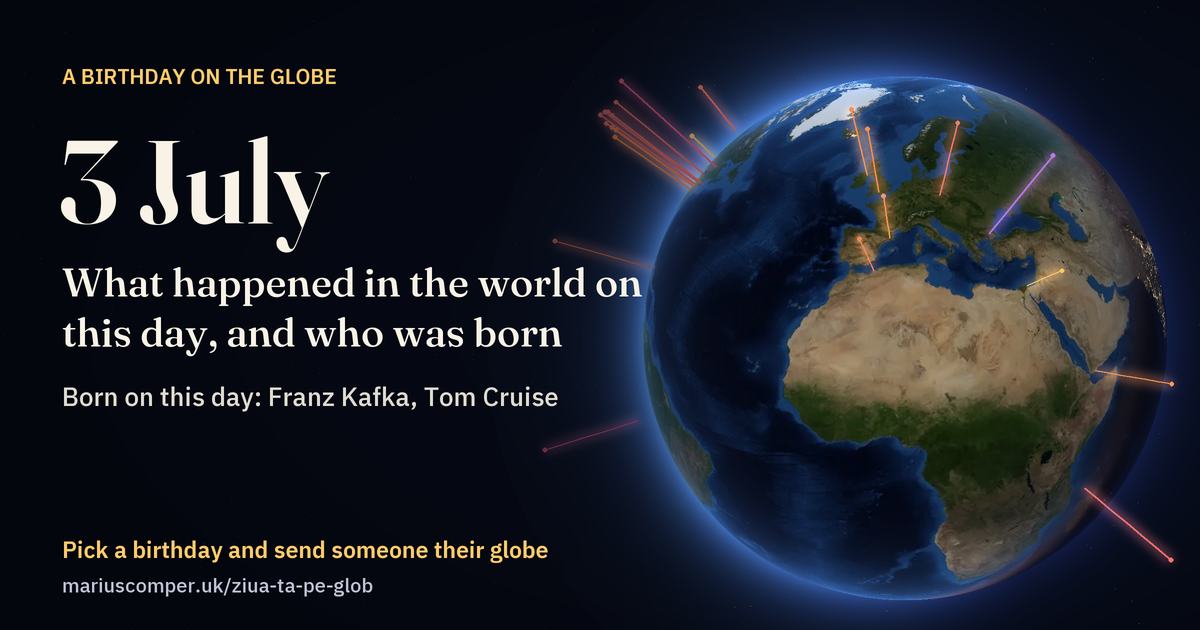
For 3 July, the English Wikipedia lists 45 events and 213 births. 24 of the events stand at their places as rays of light; six more are dashed circles, where the sentence links only to a country or a sea. The taller the ray, the longer ago it happened. The people born that day come further down, as blue points.
A birthday, yours or someone else’s:
Turn it into a greetingScroll: the globe turns to each place
The day you were born, on the globe.
Three things from your day
Scroll: your day first, then 3 July through the years
The Earth on 3 July
The picture on the globe was assembled by NASA from satellite photographs taken in July 2004: the snow, the ice and the green are those of the month.
On 3 July the Sun passes straight overhead at noon along the parallel of 23.0° north. In London, the day lasts about 16 hours 30 minutes.
Beyond 67° north the Sun no longer sets; beyond 67° south it no longer rises.
The line between day and night is tilted on the globe exactly as on this day of the year. On the dark side you can see the lights of towns.
Britain & Ireland · Southampton
1952
The SS United States sets sail on her maiden voyage to Southampton. During the voyage, the ship takes the Blue Riband away from the RMS Queen Mary.
On the map: Southampton.
North America · Quebec City
1608
Québec City is founded by Samuel de Champlain.
On the map: Quebec City.
Also on the day’s list of Wikipedia in Spanish and Chinese.
North America · San Francisco Mint
1852
Congress establishes the United States' 2nd mint in San Francisco.
On the map: San Francisco Mint.
North America · United States Congress
1952
The Constitution of Puerto Rico is approved by the United States Congress.
On the map: United States Congress.
Oceans · Pitcairn Island
1767
Pitcairn Island is discovered by Midshipman Robert Pitcairn on an expeditionary voyage commanded by Philip Carteret.
On the map: Pitcairn Island.
3 July
What the other Wikipedias remember#
For these years the English list has nothing on this day. The events below come from the same day’s lists on Wikipedia in Chinese and were translated for this page.
From Wikipedia in Chinese · Statue of Liberty
1986
The Statue of Liberty in New York marks 100 years of standing.
On the map: Statue of Liberty.
Translated from the list on Wikipedia in Chinese.
3 July
Born on 3 July#
The English Wikipedia lists 213 births for this day. The blue points are the birthplaces of 58 of these people: those written about in the most Wikipedia editions, where Wikidata gives a place of birth.
Born on 3 July
1883
Franz Kafka, Czech-Austrian author (died 1924)
Place of birth: Prague.
Born on 3 July
1962
Tom Cruise, American actor and producer
Place of birth: Syracuse.
Born on 3 July
1987
Sebastian Vettel, German race car driver
Place of birth: Heppenheim.
Born on 3 July
1937
Tom Stoppard, Czech-English playwright and screenwriter (died 2025)
Place of birth: Zlín.
Born on 3 July
1854
Leoš Janáček, Czech composer and theorist (died 1928)
Place of birth: Hukvaldy.
Born in Britain and Ireland
1728
Robert Adam, Scottish-English architect, designed Culzean Castle (died 1792)
Place of birth: Kirkcaldy.
Born in Britain and Ireland
1683
Edward Young, English poet, dramatist and literary critic (Night-Thoughts) (died 1765)
Place of birth: Upham.
Born in Britain and Ireland
1927
Ken Russell, English actor, director, and producer (died 2011)
Place of birth: Southampton.
3 July
Number one in the charts that week
At the cinema
An animal recorded that day
The record can be seen in GBIF, which brings together wildlife records from around the world.
All your birthdays
The weather that day
Data: Met Office Hadley Centre (HadCET); NOAA (GHCN-Daily, Mauna Loa).
Above the Earth
Sources: Jonathan McDowell, GCAT (launches); GFZ Potsdam (Kp index). Days are counted in Universal Time.
Football that day
International matches played that day:
Source: the “International football results” dataset kept by Mart Jürisoo (CC0).
Also that day
The earthquake’s page at the USGS
Source: the USGS catalogue. The day is counted in Universal Time (UTC).
In those days
Make a link for someone
Type the name, pick the day and the year of birth. The link opens straight on their day, with their name in the greeting.
The link carries the name, date and place typed here; anyone who gets it can see them.
Put another birthday beside it
Your mother’s, your child’s, a friend’s: the two days appear side by side.
Below: 3 July through the years.
The whole globe of the day
Drag the globe to turn it. Touch a ray or a point to read what happened there.
Everything Wikipedia lists for 3 July
The list is the English Wikipedia’s, in its own wording, as it stood in October 2026. 15 events have no place on the map: the sentence links to no place with coordinates, only to places too wide to mark, or to several countries.
- 324
Battle of Adrianople: Constantine I defeats Licinius, who flees to Byzantium.
Asia · Battle of AdrianopleWikipedia: Battle of Adrianople - 987
Hugh Capet is crowned King of France, the first of the Capetian dynasty that would rule France until the French Revolution in 1792.
no place on the mapWikipedia: French Revolution - 1035
William the Conqueror becomes the Duke of Normandy, reigning until 1087.
no place on the mapWikipedia: William the Conqueror - 1450
Jack Cade and his followers enter London unhindered by the government of king Henry VI.
no place on the mapWikipedia: Jack Cade's Rebellion - 1535
Diego de Almagro leaves the recently conquered Inca capital of Cuzco to lead an expedition to Chile.
Latin America · CuscoWikipedia: Diego de Almagro - 1608
Québec City is founded by Samuel de Champlain.
North America · Quebec CityWikipedia: Quebec City - 1754
French and Indian War: George Washington surrenders Fort Necessity to French forces.
North America · Battle of Fort NecessityWikipedia: Battle of Fort Necessity - 1767
Norway's oldest newspaper still in print, Adresseavisen, is founded and the first edition is published.
Europe · NorwayWikipedia: Norway - 1767
Pitcairn Island is discovered by Midshipman Robert Pitcairn on an expeditionary voyage commanded by Philip Carteret.
Oceans · Pitcairn IslandWikipedia: Pitcairn Island - 1775
American Revolutionary War: George Washington takes command of the Continental Army at Cambridge, Massachusetts.
North America · Cambridge, MassachusettsWikipedia: American Revolutionary War - 1778
American Revolutionary War: The Iroquois, allied with Britain, massacre 360 Patriot soldiers during the Battle of Wyoming.
North America · Battle of WyomingWikipedia: Battle of Wyoming - 1810
Mauritius campaign of 1809–1811: A French frigate squadron under Guy-Victor Duperré defeated a convoy of three British East Indiamen near the Comoro Islands.
Africa · Comoros IslandsWikipedia: Action of 3 July 1810 - 1814
War of 1812: American forces capture Fort Erie from British troops in Upper Canada.
North America · Capture of Fort ErieWikipedia: Capture of Fort Erie - 1819
The Bank for Savings in the City of New-York, the first savings bank in the United States, opens.
no place on the mapWikipedia: Bank for Savings in the City of New-York - 1839
The first state normal school in the United States, the forerunner to today's Framingham State University, opens in Lexington, Massachusetts with three students.
North America · Framingham State UniversityWikipedia: Normal school - 1848
Governor-General Peter von Scholten emancipates all remaining slaves in the Danish West Indies.
no place on the mapWikipedia: Peter von Scholten - 1849
France invades the Roman Republic and restores the Papal States.
Europe · Papal StatesWikipedia: Roman Republic - 1852
Congress establishes the United States' 2nd mint in San Francisco.
North America · San Francisco MintWikipedia: San Francisco Mint - 1863
American Civil War: The final day of the Battle of Gettysburg culminates with Pickett's Charge.
North America · Pickett's ChargeWikipedia: American Civil War - 1866
Austro-Prussian War is decided at the Battle of Königgrätz, enabling Prussia to exclude Austria from German affairs.
Europe · Battle of KöniggrätzWikipedia: Austro-Prussian War - 1884
Dow Jones & Company publishes its first stock average.
no place on the mapWikipedia: Dow Jones & Company - 1886
Karl Benz officially unveils the Benz Patent-Motorwagen, the first purpose-built automobile.
no place on the mapWikipedia: Benz Patent-Motorwagen - 1886
The New-York Tribune becomes the first newspaper to use a linotype machine, eliminating typesetting by hand.
no place on the mapWikipedia: New-York Tribune - 1890
Idaho is admitted as the 43rd U.S. state.
North America · IdahoWikipedia: Idaho - 1898
A Spanish squadron, led by Pascual Cervera y Topete, is defeated by an American squadron under William T. Sampson in the Battle of Santiago de Cuba.
Latin America · Battle of Santiago de CubaWikipedia: Battle of Santiago de Cuba - 1908
Start of the Young Turk Revolution in the Ottoman Empire, forcing Sultan Abdul Hamid II leads to restore the Constitution of 1876 and reconvene the parliament.
Asia · Ottoman EmpireWikipedia: Young Turk Revolution - 1913
Confederate veterans at the Great Reunion of 1913 reenact Pickett's Charge; upon reaching the high-water mark of the Confederacy they are met by the outstretched hands of friendship from Union survivors.
North America · Pickett's ChargeWikipedia: Pickett's Charge - 1938
United States President Franklin D. Roosevelt dedicates the Eternal Light Peace Memorial and lights the eternal flame at Gettysburg Battlefield.
North America · Eternal Light Peace MemorialWikipedia: Gettysburg Battlefield - 1938
World speed record for a steam locomotive is set in England, by the Mallard, which reaches a speed of 125.88 miles per hour (202.58 km/h).
no place on the mapWikipedia: LNER Class A4 4468 Mallard - 1940
World War II: The Royal Navy attacks the French naval squadron in Algeria, to ensure that it will not fall under German control. Of the four French battleships present, one is sunk, two are damaged, and one escapes back to France.
Africa · Attack on Mers-el-KébirWikipedia: Attack on Mers-el-Kébir - 1944
World War II: The Minsk Offensive clears German troops from the city.
Europe · Byelorussian Soviet Socialist RepublicWikipedia: Minsk offensive - 1952
The Constitution of Puerto Rico is approved by the United States Congress.
North America · United States CongressWikipedia: United States Congress - 1952
The SS United States sets sail on her maiden voyage to Southampton. During the voyage, the ship takes the Blue Riband away from the RMS Queen Mary.
Britain & Ireland · SouthamptonWikipedia: SS United States - 1967
The Aden Emergency: The Battle of the Crater in which the British Argyll and Sutherland Highlanders retake the Crater district following the Arab Police mutiny.
Asia · AdenWikipedia: Aden Emergency - 1970
Dan-Air Flight 1903 crashes into the Les Agudes mountain in the Montseny Massif near the village of Arbúcies in Catalonia, Spain, killing all 112 people aboard.
Europe · Dan-Air Flight 1903Wikipedia: Dan-Air Flight 1903 - 1970
The Troubles: The "Falls Curfew" begins in Belfast, Northern Ireland.
Britain & Ireland · Falls CurfewWikipedia: The Troubles - 1973
David Bowie retires his stage persona Ziggy Stardust with the surprise announcement that it is "the last show that we'll ever do" on the last day of the Ziggy Stardust Tour.
no place on the mapWikipedia: David Bowie - 1979
U.S. President Jimmy Carter signs the first directive for secret aid to the opponents of the pro-Soviet regime in Kabul.
no place on the mapWikipedia: Jimmy Carter - 1988
The Fatih Sultan Mehmet Bridge in Istanbul, Turkey is completed, providing the second connection between the continents of Europe and Asia over the Bosphorus.
no place on the mapWikipedia: Fatih Sultan Mehmet Bridge - 1988
United States Navy warship USS Vincennes shoots down Iran Air Flight 655 over the Persian Gulf, killing all 290 people aboard.
Asia · Persian GulfWikipedia: Iran Air Flight 655 - 1996
British Prime Minister John Major announced the Stone of Scone would be returned to Scotland.
no place on the mapWikipedia: Stone of Scone - 2005
Same-sex marriage became legal in Spain under a law passed by the Cortes Generales.
no place on the mapWikipedia: Same-sex marriage in Spain - 2006
The Valencia Metro derailment kills 41 people.
no place on the mapWikipedia: Valencia Metro derailment - 2013
President of Egypt Mohamed Morsi is removed from office by the military after four days of protests all over the country calling for his resignation, to which he did not respond. The president of the Supreme Constitutional Court of Egypt, Adly Mansour, is declared acting president until further elections are held.
Africa · 2013 Egyptian coup d'étatWikipedia: 2013 Egyptian coup d'état - 2017
In the U.S. state of Arizona, the Boundary Fire burned out after 32 days, burning 17,788 acres (7,199 ha) of the Coconino and Kaibab National Forests.
North America · Boundary FireWikipedia: Boundary Fire
What the other Wikipedias remember
For these years the English list has nothing on this day. The events below come from the same day’s lists on Wikipedia in Chinese and were translated for this page.
- 1986
The Statue of Liberty in New York marks 100 years of standing.
Who was born on 3 July
In order of how many Wikipedia editions have an article about each. The first 60 of 213 are shown.
- 1883
Franz Kafka, Czech-Austrian author (died 1924)
PragueWikipedia: Franz Kafka - 1971
Julian Assange, Australian journalist, publisher, and activist, founded WikiLeaks
TownsvilleWikipedia: Julian Assange - 1962
Tom Cruise, American actor and producer
SyracuseWikipedia: Tom Cruise - 1987
Sebastian Vettel, German race car driver
HeppenheimWikipedia: Sebastian Vettel - 1423
Louis XI, King of France (died 1483)
BourgesWikipedia: Louis XI - 321
Valentinian I, Roman emperor (died 375)
VinkovciWikipedia: Valentinian I - 1937
Tom Stoppard, Czech-English playwright and screenwriter (died 2025)
- 1854
Leoš Janáček, Czech composer and theorist (died 1928)
HukvaldyWikipedia: Leoš Janáček - 1860
Charlotte Perkins Gilman, American sociologist and author (died 1935)
- 1952
Laura Branigan, American singer-songwriter (died 2004)
Mount KiscoWikipedia: Laura Branigan - 1940
Jerzy Buzek, Polish engineer and politician, 9th Prime Minister of Poland
SmiloviceWikipedia: Jerzy Buzek - 1951
Jean-Claude Duvalier, Haitian politician, 41st President of Haiti (died 2014)
Port-au-PrinceWikipedia: Jean-Claude Duvalier - 1973
Patrick Wilson, American actor
NorfolkWikipedia: Patrick Wilson - 1906
George Sanders, Russian-born British actor (died 1972)
Saint PetersburgWikipedia: George Sanders - 1980
Olivia Munn, American actress and television host
Oklahoma CityWikipedia: Olivia Munn - 1924
S. R. Nathan, 6th President of Singapore (died 2016)
SingaporeWikipedia: S. R. Nathan - 1988
Winston Reid, New Zealand-Danish footballer
AucklandWikipedia: Winston Reid - 1991
Anastasia Pavlyuchenkova, Russian tennis player
- 1728
Robert Adam, Scottish-English architect, designed Culzean Castle (died 1792)
KirkcaldyWikipedia: Robert Adam - 1935
Harrison Schmitt, American geologist, astronaut, and politician. Twelfth man to walk on the moon.
Santa RitaWikipedia: Harrison Schmitt - 1965
Connie Nielsen, Danish-American actress
FrederikshavnWikipedia: Connie Nielsen - 2001
Folarin Balogun, American soccer player
New York CityWikipedia: Folarin Balogun - 1683
Edward Young, English poet, dramatist and literary critic (Night-Thoughts) (died 1765)
- 1964
Yeardley Smith, American actress, voice actress, comedian and writer
- 1927
Ken Russell, English actor, director, and producer (died 2011)
SouthamptonWikipedia: Ken Russell - 1968
Ramush Haradinaj, Kosovo-Albanian soldier and politician, 4th Prime Minister of Kosovo
Deçan MunicipalityWikipedia: Ramush Haradinaj - 1971
Benedict Wong, English actor
ManchesterWikipedia: Benedict Wong - 1870
R. B. Bennett, Canadian lawyer and politician, 11th Prime Minister of Canada (died 1947)
Hopewell HillWikipedia: R. B. Bennett - 1897
Jesse Douglas, American mathematician and academic (died 1965)
New York CityWikipedia: Jesse Douglas - 1949
Bo Xilai, Chinese politician, Chinese Minister of Commerce
BeijingWikipedia: Bo Xilai - 1738
John Singleton Copley, American painter (died 1815)
- 1879
Alfred Korzybski, Polish-American mathematician, linguist, and philosopher (died 1950)
- 1930
Carlos Kleiber, German-Austrian conductor (died 2004)
- 1963
Tracey Emin, British Artist
CroydonWikipedia: Tracey Emin - 1941
Liamine Zéroual, Algerian politician, 6th President of Algeria (died 2026)
- 1943
Kurtwood Smith, American actor
New LisbonWikipedia: Kurtwood Smith - 1962
Thomas Gibson, American actor and director
CharlestonWikipedia: Thomas Gibson - 1970
Teemu Selänne, Finnish ice hockey player
- 1888
Ramón Gómez de la Serna, Spanish author and playwright (died 1963)
- 1946
Leszek Miller, Polish political scientist and politician, 10th Prime Minister of Poland
ŻyrardówWikipedia: Leszek Miller - 1886
Raymond A. Spruance, American admiral and diplomat, United States Ambassador to the Philippines (died 1969)
BaltimoreWikipedia: Raymond A. Spruance - 1960
Vince Clarke, English singer-songwriter, keyboard player, and producer
South Woodford tube stationWikipedia: Vince Clarke - 1970
Audra McDonald, American actress and singer
- 1789
Johann Friedrich Overbeck, German-Italian painter and engraver (died 1869)
- 1940
Lamar Alexander, American lawyer and politician, 5th United States Secretary of Education
MaryvilleWikipedia: Lamar Alexander - 1959
David Shore, Canadian screenwriter and producer
LondonWikipedia: David Shore - 1988
James Troisi, Australian footballer
AdelaideWikipedia: James Troisi - 1900
Alessandro Blasetti, Italian director and screenwriter (died 1987)
- 1947
Dave Barry, American journalist and author
ArmonkWikipedia: Dave Barry - 1990
Alison Riske-Amritraj, American tennis player
PittsburghWikipedia: Alison Riske-Amritraj - 1518
Li Shizhen, Chinese physician and mineralogist (died 1593)
- 1921
Susan Peters, American actress (died 1952)
SpokaneWikipedia: Susan Peters - 1947
Betty Buckley, American actress and singer
Big SpringWikipedia: Betty Buckley - 1442
Emperor Go-Tsuchimikado of Japan (died 1500)
- 1778
Carl Ludvig Engel, German architect (died 1840)
- 1980
Harbhajan Singh, Indian cricketer
JalandharWikipedia: Harbhajan Singh - 1990
Lucas Mendes, Brazilian footballer
CuritibaWikipedia: Lucas Mendes - 1984
Churandy Martina, Dutch sprinter
WillemstadWikipedia: Churandy Martina - 1992
Crystal Dunn, American soccer player
New Hyde ParkWikipedia: Crystal Dunn - 2001
Promise David, Canadian soccer player
BramptonWikipedia: Promise David
What is celebrated on 3 July
- Christian feast day: Anatolius of Constantinople
- Christian feast day: Anatolius of Laodicea
- Christian feast day: Dathus
- Christian feast day: Germanus of Man
- Christian feast day: Gurthiern
- Christian feast day: Heliodorus of Altino
- Christian feast day: Mucian
- Christian feast day: Peregrina Mogas Fontcuberta
- Christian feast day: Pope Leo II
- Christian feast day: Thomas the Apostle
- Christian feast day: July 3 (Eastern Orthodox liturgics)
- Emancipation Day (United States Virgin Islands)
- Independence Day, celebrates the liberation of Minsk from Nazi occupation by Soviet troops in 1944 (Belarus)
- The start of the Dog Days according to the Old Farmer's Almanac but not according to established meaning in most European cultures
A greeting link for someone
Type a name and, if you like, the year of birth. The link opens with a greeting, and beside each event it says how old the person turned that day, or how many years before their birth it happened.
The name and the year go only into the link you send.
All 366 days
How the globe is made
Where the events come from
Each edition of this page uses the day’s list from Wikipedia in its own language: Romanian, English, Spanish, Chinese. The lists are written by volunteers and differ from one edition to the next; the text of each event is Wikipedia’s, with a link to the article. A row that appears twice in a list is shown once. The lists have not been checked event by event: they are Wikipedia’s, mistakes included.
For events before 1582, and for countries that moved to the Gregorian calendar later (Britain in 1752, Russia in 1918), the same day may be counted Old Style in one list and New Style in another.
The chapter “What the other Wikipedias remember” adds up to five events a day from the lists of the other three editions, only for years in which the English list has nothing on that day. They were translated for this page, passed the same filters as the tour, and are not counted among the events of the English list.
How an event gets onto the map
The place comes from Wikidata. If the sentence links to the article about the event itself (a battle, an opening, an earthquake), dated to the same year, the ray stands on its coordinates or on those of its location. Otherwise it stands on the first place the sentence links to: a town, a building, a mountain, an island. This second step can be wrong: sometimes the sentence only mentions the place. That is why the page says, under each event, which place the ray stands on.
When the sentence links to a single state or province, or to a single sea, lake or desert larger than 5,000 km², the globe shows a dashed circle, not a ray. The circle has the area Wikidata gives, with its radius kept between 1.2° and 16°, or a radius of 4.5° when Wikidata gives no area; it says only that the sentence links to that place. Organisations, ships, spacecraft, museum objects, rivers, mountain ranges, languages and continents are never used as places. When a sentence names several states and no exact place, the event stays in the list only.
What the height means
The height of a ray shows how many years have passed, on a logarithmic scale: 10 years, 100 years and 1,000 years are equal steps apart; anything older than about 2,600 years has the tallest ray. The colour runs from pale yellow for recent years to violet for antiquity.
Where the tour stops
In each region the tour stops at up to three events (five in Britain and Ireland), chosen mainly by three things: whether Wikipedia’s editors put the event in the “On this day” box of their main page (the English, Spanish and Chinese editions), how many Wikipedia editions have an article about it, and how many of the four lists include it. Events whose sentence or article is about a war, an attack, a crime or a disaster are left out of the tour; they stay in the whole list, in Wikipedia’s wording. The filter is a list of words and a list of Wikidata types, so it can miss some.
The tour of births names the people with articles in the most editions and leaves aside those whom the list or Wikidata describes as rulers, politicians, commanders, leaders of movements or criminals; they stay in the list.
The Earth and the Sun
The daytime images are NASA’s Blue Marble Next Generation mosaics, one for each month of 2004; the night side is Black Marble 2016. The tilt of the line between day and night is computed for the day; the hour is chosen so that the place being read is in daylight. The latitude where the Sun stands overhead is the average of the four years of the leap cycle; in a given year it can differ by up to 0.4°.
The day you were born
The number ones come from the weekly lists on Wikipedia: Billboard for the United States (from 1940; the Hot 100 from August 1958), the UK Singles Chart (from November 1952), Los 40 Principales for Spain (from July 1966) and, for Romania, the Romanian Top 100 and Airplay 100 (2001–2021, with missing weeks). The page shows the chart of the week in which the day of birth falls, with its date; Billboard and the UK chart are dated at the end of their week. For Romania before 2001 and for China these sources have no weekly chart.
The films are those that reached cinemas in the United States up to ten days before or three days after that day (some of them in a few cinemas at first), from the English Wikipedia’s yearly lists (from 1968), in order of how many editions have an article about them. The events “in those days” are the ones on the neighbouring days’ lists that carry the year of birth, passed through the same filter as the tour.
The day of birth, year included
The Moon, the star sign and the constellation are worked out by the page itself, for noon Universal Time on the day. The lit part of the Moon is rounded and can differ by a few per cent from that at the hour of birth. The sign follows the usual zodiac of twelve equal parts starting at the March equinox; the constellation is the one the Sun actually stood in front of, by the borders set by the International Astronomical Union, and within a day of a border the page does not name it. When the Sun changes sign while it is that day anywhere on Earth, the page gives the moment of crossing, rounded to ten minutes and accurate to within about a quarter of an hour, and the clock time in a few cities, with the time zone and summer time of that year.
The year in the Chinese calendar is the one your device’s own calendar gives for the date, checked against the Hong Kong Observatory’s tables. “All your birthdays” uses the same sources as the rest of the chapter for the same day in every year since the birth: the temperature, well-known launches that took place on that very day, matches of the teams the edition follows, snow deeper than 10 cm and strong geomagnetic storms. The three things at the top and the four on the picture are chosen in a fixed order (the song, the animal, a full Moon, a well-known launch before an ordinary earthquake); on the picture you can change them.
When the link carries a year of birth, the page adds a few things about that exact day. The weather is the Met Office’s Central England temperature record and the readings from New York’s Central Park; the “usual high” is the average of the daily highs of 1961–1990 for that date, with two days either side. The carbon dioxide figure is the monthly mean at the Mauna Loa observatory, where measurements begin in March 1958.
The earthquake is the one with the largest magnitude in the USGS catalogue for that day, counted in Universal Time. Before the 1960s the catalogue has gaps even above magnitude 5.5, so in the older years many days have no earthquake. The page gives only the magnitude and the place: the country the epicentre falls in or, when the epicentre is at sea within 300 km of a coast, the nearest country; farther out, only the ocean.
The launches are those that reached orbit or left for the Moon and the planets, from Jonathan McDowell’s GCAT catalogue. If nothing left that day, the page shows the nearest launch within three days before or after, and says how many days away it was. The geomagnetic storm appears only when the Kp index reached at least 5 in one of the day’s eight three-hour intervals.
The animal comes from GBIF: an observation made by a person (the animal seen or heard, or its tracks), dated to that exact day, with coordinates and a CC0 or CC BY licence. Only a few hundred well-known species are searched (mammals, birds, turtles, butterflies); of those noted that day, mammals and species with articles in many Wikipedia editions come first; birds noted almost every day, and species used recently, wait their turn. Observations dated 1 January are left out, because records without a day are often filed there. An observation shows that the animal was recorded there, not how many animals there were.
The matches are those between national teams. Only matches of England, Scotland, Wales, Northern Ireland, the Republic of Ireland, the United States, Canada and Australia are shown, along with those at the big final tournaments. The picture to send is drawn in the page from the day’s globe and the facts above, and stays on your device until you send it.
Sources
- Events, births and holidays: the day’s page on Wikipedia, text under CC BY-SA 4.0.
- Coordinates, places of birth and the number of editions: Wikidata (CC0).
- The Earth by day: NASA Blue Marble Next Generation. The Earth by night: NASA Black Marble 2016.
- Borders and regions: Natural Earth.
- World population and births per year: UN World Population Prospects 2024.
- Charts and films: Wikipedia’s lists for Billboard, the UK Singles Chart, Los 40 Principales, Romanian Top 100, Airplay 100 and American films by year (CC BY-SA 4.0).
- Weather: Met Office Hadley Centre, HadCET (Open Government Licence) and NOAA GHCN-Daily, New York Central Park. Carbon dioxide: NOAA Global Monitoring Laboratory, Mauna Loa.
- Earthquakes: the USGS catalogue. Launches: Jonathan McDowell, GCAT (CC BY). Kp index: GFZ Potsdam (CC BY 4.0). Matches: International football results, Mart Jürisoo (CC0).
- Animal observations: GBIF, with a link to each record; species names come from Wikidata.